THE STAGES OF
DEVELOPMENT AND
DEVELOPMENTAL
TASK
PRE-NATAL PERIOD
 The prenatal period can be considered that time
of development and growth of a baby prior to
birth. During this time, the baby is completely
dependent upon the mother for its nutritional
needs.
 During the prenatal period, important organs
such as the heart, brain, spinal cord and others
are forming. Without the proper levels of
vitamins, minerals, and trace minerals, these
organs will not develop correctly, and birth
defects can occur
 "How from so simple a beginning do endless
forms develop and grow and mature? What was
this organisms, what is it now, and what will it
become? Birth's fragile moment arrives, when
the new born is on a threshold between two
worlds." (Santrock 2002)
THE GERMINAL STAGE
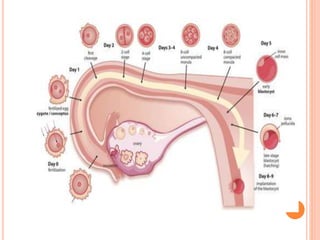
 The germinal stage begins at conception when the
sperm and egg cell unite in one of the two fallopian
tubes. The fertilized egg, known as a zygote, then
moves toward the uterus, a journey that can take up
to a week to complete. Cell division begins
approximately 24 to 36 hours after conception.
 First two weeks of pregnancy
THE EMBRYONIC STAGE
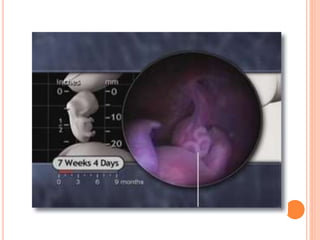
 The mass of cells is now known as and embryo. The
beginning of the third week after conception marks the
start of the embryonic period, a time when the mass of
cells becomes distinct as a human
 Around the fourth week, the head begins to form quickly
followed by the eyes, nose, ears, and mouth. The
cardiovascular system is where the earliest activity
begins as the blood vessel that will become the heart start
to pulse. During the fifth week, buds that will form the
arms and legs appear. By the time the eighth week of
development has been reached, the embryo has all of the
basic organs and parts except those of the sex organ
 Two weeks to eight weeks
THE FETAL STAGE
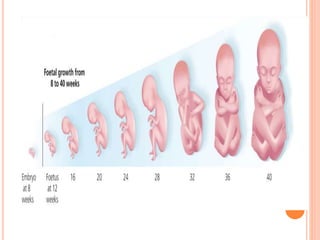
 Once cell differentiation is mostly complete, the
embryo enters the next stage and becomes
known as a fetus. This period of develop begins
during the ninth week and lasts until birth. Sex
organs begin to appear during the third month
of gestation.
 Eight weeks to birth
INFANCY
 From birth to 2 years
As newborns, we were not empty-headed organisms. We
cried, kicked, coughed, sucked, saw, heard and tasted.
We slept a lot and occasionally we smiled, although the
meaning of our smiles was not entirely clesr. We crawled
and then we walked, a journey of a thousand miles
beginning with a single step. …Sometimes we conformed
, sometimes others conformed to us. Our development
was a continuous creation of complex forms, and our
helpless kind demanded the meeting eyes of love. We
split the universe into two halves: “me and no me”. And
we juggled the need to curb our own will with becoming
what we could will freely. ( Santrock,2002)
 He is totally dependent on others for his needs.
During this stage, the infant learns whether the
world in which he lives can be trusted.
 If the infant fails to get needed support and care,
it develops mistrust which affects the personality
in later stages of life.
 It is a time for radical adjustment
 To temperature changes
 (To sucking and swallowing
 To breathing
 To elimination
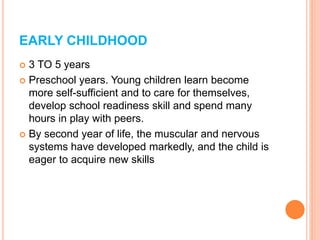
EARLY CHILDHOOD
 3 TO 5 years
 Preschool years. Young children learn become
more self-sufficient and to care for themselves,
develop school readiness skill and spend many
hours in play with peers.
 By second year of life, the muscular and nervous
systems have developed markedly, and the child is
eager to acquire new skills
 where they will be learning to read and write, to do
sums, to do things on their own.
 It learns to improve its movements through trial and
error.
MIDDLE AND LATE CHILDHOOD
 6-12 years
- It is in late childhood that the first signs of
puberty usually begin to appear
- A lot of growth is experienced by both boys
and girls during late childhood
 During this period the child develops greater
attention span, needs less sleep, and gains
rapidly in strength
 aims to develop a feeling of competence
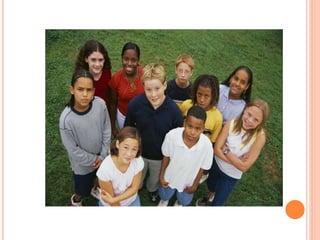
ADOLESCENCE
 13-18 YEARS OLD
 Adolescence refers to the period of human growth
that occurs between childhood and adulthood.
Adolescence begins at around age 13 and ends
around age18. Adolescence can be broken into
three stages: early adolescence, middle
adolescence, and late adolescence.
 The biological event of puberty unleashes a powerful
set of changes in the adolescent body that reflect
themselves in a teenager’s sexual, emotional,
cultural, and/or spiritual passion.
 (Erik Erikson) puts a great deal of emphasis on the
adolescent period, feeling it was a crucial stage for
developing a person’s identity, developing an
understanding of self
 The individual craves for encouragement and
support of caretakers and peer groups
 Children are becoming more independent, and begin
to look at the future in terms of career, relationships,
families, housing, etc. The individual wants to belong
to a society and fit in.
 http://www.psychologydiscussion.net
 http://www.simplypsychology.org/Erik-Erikson.html
 www.cde.ca.gov
Created by: Gerard F. Tolero

The stages-of-development-and-developmental-task

  • 1.
    THE STAGES OF DEVELOPMENTAND DEVELOPMENTAL TASK
  • 2.
    PRE-NATAL PERIOD  Theprenatal period can be considered that time of development and growth of a baby prior to birth. During this time, the baby is completely dependent upon the mother for its nutritional needs.  During the prenatal period, important organs such as the heart, brain, spinal cord and others are forming. Without the proper levels of vitamins, minerals, and trace minerals, these organs will not develop correctly, and birth defects can occur
  • 3.
     "How fromso simple a beginning do endless forms develop and grow and mature? What was this organisms, what is it now, and what will it become? Birth's fragile moment arrives, when the new born is on a threshold between two worlds." (Santrock 2002)
  • 4.
    THE GERMINAL STAGE The germinal stage begins at conception when the sperm and egg cell unite in one of the two fallopian tubes. The fertilized egg, known as a zygote, then moves toward the uterus, a journey that can take up to a week to complete. Cell division begins approximately 24 to 36 hours after conception.  First two weeks of pregnancy
  • 6.
    THE EMBRYONIC STAGE The mass of cells is now known as and embryo. The beginning of the third week after conception marks the start of the embryonic period, a time when the mass of cells becomes distinct as a human  Around the fourth week, the head begins to form quickly followed by the eyes, nose, ears, and mouth. The cardiovascular system is where the earliest activity begins as the blood vessel that will become the heart start to pulse. During the fifth week, buds that will form the arms and legs appear. By the time the eighth week of development has been reached, the embryo has all of the basic organs and parts except those of the sex organ  Two weeks to eight weeks
  • 8.
    THE FETAL STAGE Once cell differentiation is mostly complete, the embryo enters the next stage and becomes known as a fetus. This period of develop begins during the ninth week and lasts until birth. Sex organs begin to appear during the third month of gestation.  Eight weeks to birth
  • 10.
    INFANCY  From birthto 2 years As newborns, we were not empty-headed organisms. We cried, kicked, coughed, sucked, saw, heard and tasted. We slept a lot and occasionally we smiled, although the meaning of our smiles was not entirely clesr. We crawled and then we walked, a journey of a thousand miles beginning with a single step. …Sometimes we conformed , sometimes others conformed to us. Our development was a continuous creation of complex forms, and our helpless kind demanded the meeting eyes of love. We split the universe into two halves: “me and no me”. And we juggled the need to curb our own will with becoming what we could will freely. ( Santrock,2002)
  • 11.
     He istotally dependent on others for his needs. During this stage, the infant learns whether the world in which he lives can be trusted.  If the infant fails to get needed support and care, it develops mistrust which affects the personality in later stages of life.  It is a time for radical adjustment  To temperature changes  (To sucking and swallowing  To breathing  To elimination
  • 13.
    EARLY CHILDHOOD  3TO 5 years  Preschool years. Young children learn become more self-sufficient and to care for themselves, develop school readiness skill and spend many hours in play with peers.  By second year of life, the muscular and nervous systems have developed markedly, and the child is eager to acquire new skills
  • 14.
     where theywill be learning to read and write, to do sums, to do things on their own.  It learns to improve its movements through trial and error.
  • 16.
    MIDDLE AND LATECHILDHOOD  6-12 years - It is in late childhood that the first signs of puberty usually begin to appear - A lot of growth is experienced by both boys and girls during late childhood  During this period the child develops greater attention span, needs less sleep, and gains rapidly in strength  aims to develop a feeling of competence
  • 18.
    ADOLESCENCE  13-18 YEARSOLD  Adolescence refers to the period of human growth that occurs between childhood and adulthood. Adolescence begins at around age 13 and ends around age18. Adolescence can be broken into three stages: early adolescence, middle adolescence, and late adolescence.
  • 19.
     The biologicalevent of puberty unleashes a powerful set of changes in the adolescent body that reflect themselves in a teenager’s sexual, emotional, cultural, and/or spiritual passion.  (Erik Erikson) puts a great deal of emphasis on the adolescent period, feeling it was a crucial stage for developing a person’s identity, developing an understanding of self
  • 20.
     The individualcraves for encouragement and support of caretakers and peer groups  Children are becoming more independent, and begin to look at the future in terms of career, relationships, families, housing, etc. The individual wants to belong to a society and fit in.
  • 22.