Meaning, Concepts and
Approaches
At the end of the lesson, the learners
must have:
1. defined human development in your
own words;
2. drawn some principles of human
development; and
3. distinguished two approaches to
development.
Human Development
➢the pattern of movement or change
that begins at conception and
continues through the life span
➢includes growth and decline
➢can be positive or negative
Major Principles of
Human Development
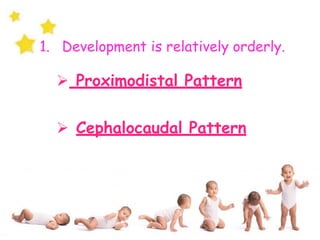
1. Development is relatively orderly.
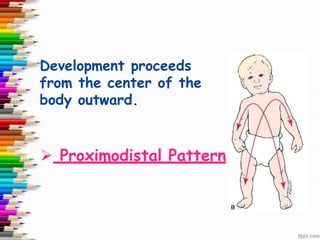
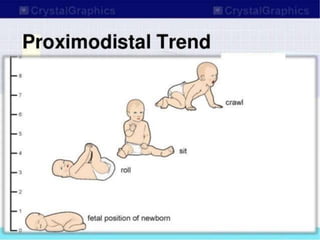
➢ Proximodistal Pattern
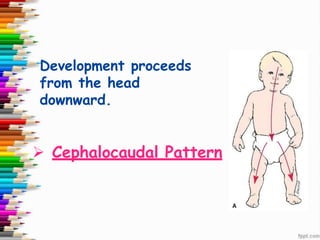
➢ Cephalocaudal Pattern
Development proceeds
from the center of the
body outward.
➢ Proximodistal Pattern
Development proceeds
from the head
downward.
➢ Cephalocaudal Pattern
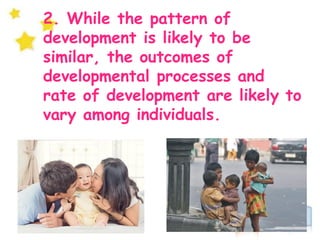
2. While the pattern of
development is likely to be
similar, the outcomes of
developmental processes and
rate of development are likely to
vary among individuals.
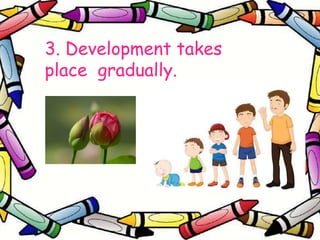
3. Development takes
place gradually.
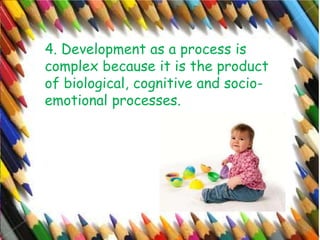
4. Development as a process is
complex because it is the product
of biological, cognitive and socio-
emotional processes.
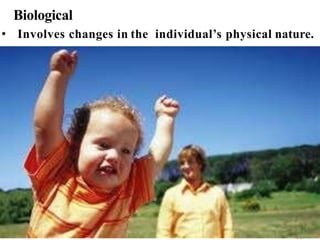
Biological
• Involves changes in the individual’s physical nature.
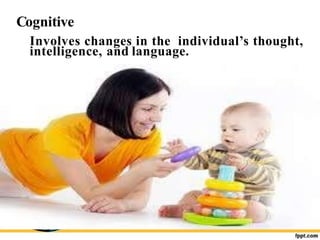
Cognitive
Involves changes in the individual’s thought,
intelligence, and language.
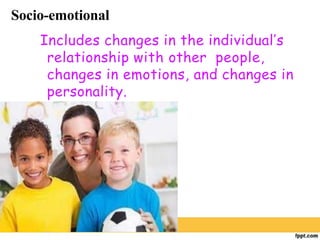
Socio-emotional
Includes changes in the individual’s
relationship with other people,
changes in emotions, and changes in
personality.
-all biological, cognitive and
socio economic are
intertwined and related to
each other.
-development of one may
affect the other
• Traditional Perspective
• Life-span Approach
Approaches to
Human Development
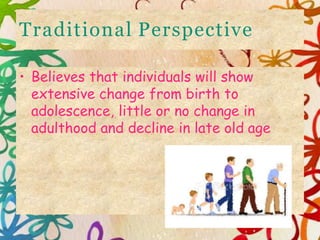
Traditional Perspective
• Believes that individuals will show
extensive change from birth to
adolescence, little or no change in
adulthood and decline in late old age
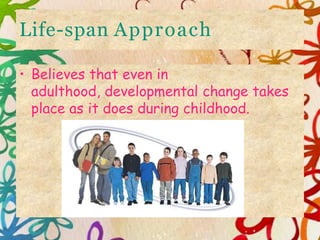
Life-span Approach
• Believes that even in
adulthood, developmental change takes
place as it does during childhood.
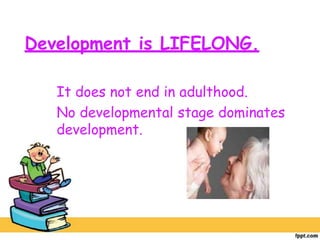
Development is LIFELONG.
It does not end in adulthood.
No developmental stage dominates
development.
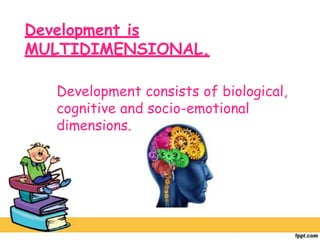
Development is
MULTIDIMENSIONAL.
Development consists of biological,
cognitive and socio-emotional
dimensions.
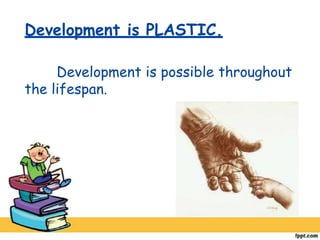
Development is PLASTIC.
Development is possible throughout
the lifespan.
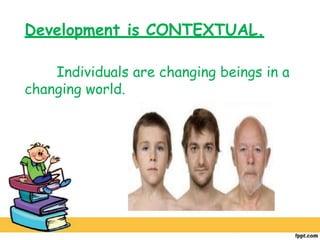
Development is CONTEXTUAL.
Individuals are changing beings in a
changing world.
Development involves
GROWTH, MAINTENANCE and
REGULATION.
Growth, maintenance and regulation
are 3 goals of human development. The
goals of individuals vary among
developmental stages.
Principles of Child
Development and Learning
that Inform Practice
➢All areas of development and
learning are important.
➢Learning and development follow
sequences.
➢Development and learning
proceed at varying rates.
➢Development and learning
result from an interaction
of maturation and
experience.
➢Early experiences have profound
effects on development and
learning.
➢Development proceeds toward
greater complexity, self-
regulation, and symbolic or
representational capacities.
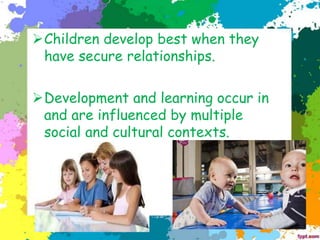
➢Children develop best when they
have secure relationships.
➢Development and learning occur in
and are influenced by multiple
social and cultural contexts.
➢Children learn in a variety of ways.
➢Play is an important vehicle for
developing self-regulation and
promoting language, cognition, and
social competence.
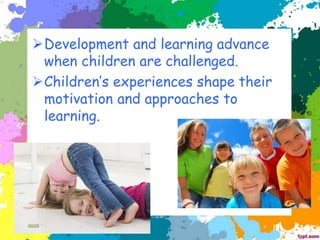
➢Development and learning advance
when children are challenged.
➢Children’s experiences shape their
motivation and approaches to
learning.
1_Human Development.pdf

1_Human Development.pdf