By Kyrie Petrakis
CHILD
CHILD AND ADOLESCENT
AND ADOLESCENT
DEVELOPMENT
DEVELOPMENT
PRE-TEST
Development is
a pattern of
change.
TRUE OR FALSE
Development is
sequential.
TRUE OR FALSE
From both
traditional and life-
span perspectives
development is
lifelong.
TRUE OR FALSE
In the development
process, there are
things that hold
true to all people.
TRUE OR FALSE
Individuals develop
uniformly.
TRUE OR FALSE
Development is
predictable
because it follows
an orderly process.
TRUE OR FALSE
Development is
unidimensional.
TRUE OR FALSE
Development takes
place in a vacuum.
TRUE OR FALSE
The effect of biological
process on development
is isolated from the
effect of cognitive and
socioemotional
processes.
TRUE OR FALSE
Children learn in variety
of ways.
TRUE OR FALSE
By Kyrie Petrakis
CHILD
CHILD AND ADOLESCENT
AND ADOLESCENT
DEVELOPMENT
DEVELOPMENT
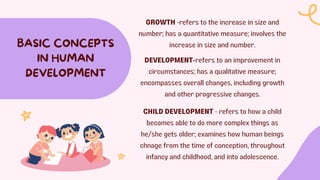
BASIC CONCEPTS IN
HUMAN DEVELOPMENT
GROWTH -refers to the increase in size and
number; has a quantitative measure; involves the
increase in size and number.
BASIC CONCEPTS
IN HUMAN
DEVELOPMENT
DEVELOPMENT-refers to an improvement in
circumstances; has a qualitative measure;
encompasses overall changes, including growth
and other progressive changes.
CHILD DEVELOPMENT - refers to how a child
becomes able to do more complex things as
he/she gets older; examines how human beings
chnage from the time of conception, throughout
infancy and childhood, and into adolescence.
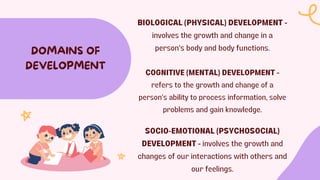
DOMAINS OF
DEVELOPMENT
BIOLOGICAL (PHYSICAL) DEVELOPMENT -
involves the growth and change in a
person's body and body functions.
DOMAINS OF
DEVELOPMENT
COGNITIVE (MENTAL) DEVELOPMENT -
refers to the growth and change of a
person's ability to process information, solve
problems and gain knowledge.
SOCIO-EMOTIONAL (PSYCHOSOCIAL)
DEVELOPMENT - involves the growth and
changes of our interactions with others and
our feelings.
DOMAINS OF
DEVELOPMENT
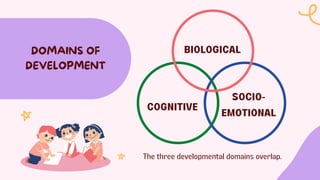
The three developmental domains overlap.
BIOLOGICAL
COGNITIVE
SOCIO-
EMOTIONAL
BASIC PRINCIPLES OF
DEVELOPMENT AND
LEARNING
CEPHALOCAUDAL
DEVELOPMENT
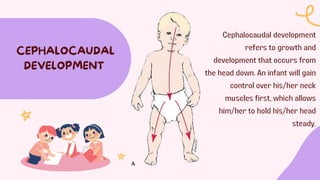
Cephalocaudal development
refers to growth and
development that occurs from
the head down. An infant will gain
control over his/her neck
muscles first, which allows
him/her to hold his/her head
steady.
CEPHALOCAUDAL
DEVELOPMENT
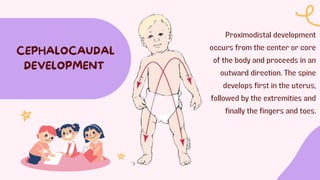
Proximodistal development
occurs from the center or core
of the body and proceeds in an
outward direction. The spine
develops first in the uterus,
followed by the extremities and
finally the fingers and toes.
Development is continuous.
1.
Development is gradual.
2.
Development is sequential.
3.
The rate of development varies person to person.
4.
Development proceeds from general to specific,
simple to complex.
5.
Early experiences have profound effects on
development.
6.
Growth and development are a product of both
heredity and environment.
7.
Development is predictable.
8.
There is a constant interaction among all
dimensions and factors of development.
9.
Children learn in a variety of ways.
10.
BASIC PRINCIPLES
OF DEVELOPMENT
AND LEARNING
FACTORS INFLUENCING
GROWTH & DEVELOPMENT
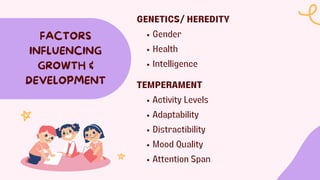
GENETICS/ HEREDITY
Gender
Health
Intelligence
FACTORS
INFLUENCING
GROWTH &
DEVELOPMENT TEMPERAMENT
Activity Levels
Adaptability
Distractibility
Mood Quality
Attention Span
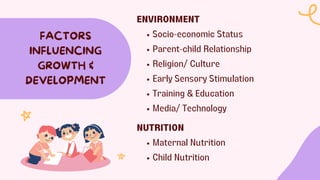
ENVIRONMENT
Socio-economic Status
Parent-child Relationship
Religion/ Culture
Early Sensory Stimulation
Training & Education
Media/ Technology
FACTORS
INFLUENCING
GROWTH &
DEVELOPMENT
NUTRITION
Maternal Nutrition
Child Nutrition
THE EIGHT (8) STAGES OF
HUMAN DEVELOPMENT
(LIFE SPAN)
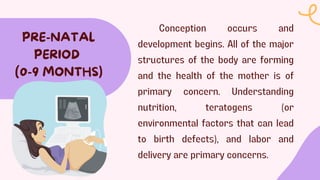
Conception occurs and
development begins. All of the major
structures of the body are forming
and the health of the mother is of
primary concern. Understanding
nutrition, teratogens (or
environmental factors that can lead
to birth defects), and labor and
delivery are primary concerns.
PRE-NATAL
PERIOD
(0-9 MONTHS)
GERMINAL PHASE - first 2 weeks,
conception, implantation, and formation of
placenta.
EMBRYONIC PHASE - 2 weeks-2 months,
formation of vital organs and systems.
FETAL STAGE - 2 months –birth, bodily
growth continues, movement capability
begins, brain cells multiply age of viability.
PRE-NATAL
PERIOD
(0-9 MONTHS)
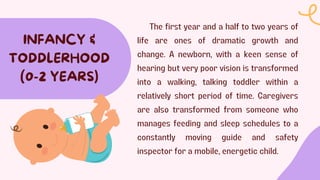
The first year and a half to two years of
life are ones of dramatic growth and
change. A newborn, with a keen sense of
hearing but very poor vision is transformed
into a walking, talking toddler within a
relatively short period of time. Caregivers
are also transformed from someone who
manages feeding and sleep schedules to a
constantly moving guide and safety
inspector for a mobile, energetic child.
INFANCY &
TODDLERHOOD
(0-2 YEARS)
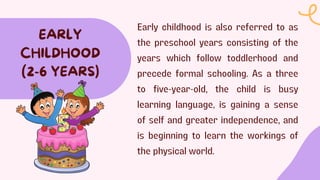
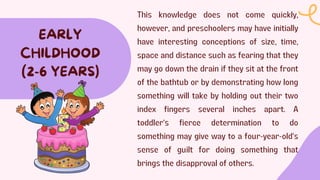
Early childhood is also referred to as
the preschool years consisting of the
years which follow toddlerhood and
precede formal schooling. As a three
to five-year-old, the child is busy
learning language, is gaining a sense
of self and greater independence, and
is beginning to learn the workings of
the physical world.
EARLY
CHILDHOOD
(2-6 YEARS)
This knowledge does not come quickly,
however, and preschoolers may have initially
have interesting conceptions of size, time,
space and distance such as fearing that they
may go down the drain if they sit at the front
of the bathtub or by demonstrating how long
something will take by holding out their two
index fingers several inches apart. A
toddler‘s fierce determination to do
something may give way to a four-year-old‘s
sense of guilt for doing something that
brings the disapproval of others.
EARLY
CHILDHOOD
(2-6 YEARS)
The ages of six through twelve
comprise middle childhood and much of
what children experience at this age is
connected to their involvement in the
early grades of school. Now the world
becomes one of learning and testing
new academic skills and by assessing
one‘s abilities and accomplishments by
making comparisons between self and
others.
MIDDLE
CHILDHOOD & LATE
CHILDHOOD
(6-12 YEARS)
Schools compare students and make
these comparisons public through
team sports, test scores, and other
forms of recognition. Growth rates
slow down and children are able to
refine their motor skills at this point in
life. And children begin to learn about
social relationships beyond the family
through interaction with friends and
fellow students.
MIDDLE
CHILDHOOD & LATE
CHILDHOOD
(6-12 YEARS)
Adolescence is a period of dramatic
physical change marked by an overall
physical growth spurt and sexual
maturation, known as puberty. It is also
a time of cognitive change as the
adolescent begins to think of new
possibilities and to consider abstract
concepts such as love, fear, and
freedom.
ADOLESCENCE
(13 - 18 YEARS)
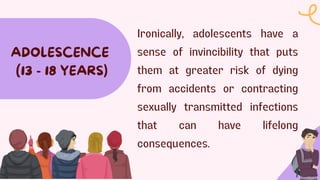
Ironically, adolescents have a
sense of invincibility that puts
them at greater risk of dying
from accidents or contracting
sexually transmitted infections
that can have lifelong
consequences.
ADOLESCENCE
(13 - 18 YEARS)
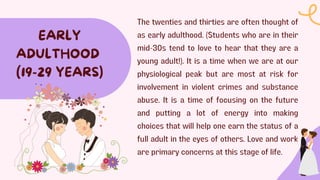
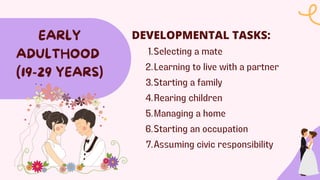
The twenties and thirties are often thought of
as early adulthood. (Students who are in their
mid-30s tend to love to hear that they are a
young adult!). It is a time when we are at our
physiological peak but are most at risk for
involvement in violent crimes and substance
abuse. It is a time of focusing on the future
and putting a lot of energy into making
choices that will help one earn the status of a
full adult in the eyes of others. Love and work
are primary concerns at this stage of life.
EARLY
ADULTHOOD
(19-29 YEARS)
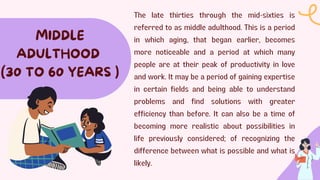
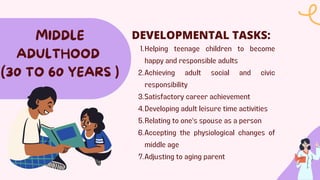
The late thirties through the mid-sixties is
referred to as middle adulthood. This is a period
in which aging, that began earlier, becomes
more noticeable and a period at which many
people are at their peak of productivity in love
and work. It may be a period of gaining expertise
in certain fields and being able to understand
problems and find solutions with greater
efficiency than before. It can also be a time of
becoming more realistic about possibilities in
life previously considered; of recognizing the
difference between what is possible and what is
likely.
MIDDLE
ADULTHOOD
(30 TO 60 YEARS )
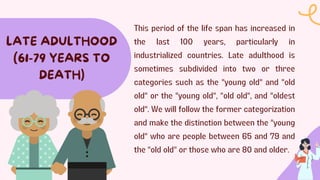
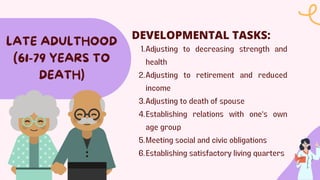
This period of the life span has increased in
the last 100 years, particularly in
industrialized countries. Late adulthood is
sometimes subdivided into two or three
categories such as the "young old" and "old
old" or the "young old", "old old", and "oldest
old". We will follow the former categorization
and make the distinction between the "young
old" who are people between 65 and 79 and
the "old old" or those who are 80 and older.
LATE ADULTHOOD
(61-79 YEARS TO
DEATH)
DEVELOPMENTAL TASKS
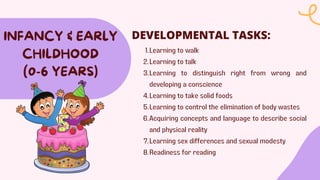
INFANCY & EARLY
CHILDHOOD
(0-6 YEARS)
Learning to walk
1.
Learning to talk
2.
Learning to distinguish right from wrong and
developing a conscience
3.
Learning to take solid foods
4.
Learning to control the elimination of body wastes
5.
Acquiring concepts and language to describe social
and physical reality
6.
Learning sex differences and sexual modesty
7.
Readiness for reading
8.
DEVELOPMENTAL TASKS:
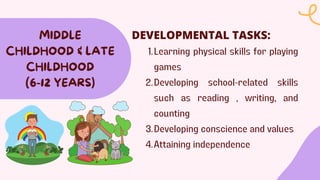
MIDDLE
CHILDHOOD & LATE
CHILDHOOD
(6-12 YEARS)
Learning physical skills for playing
games
1.
Developing school-related skills
such as reading , writing, and
counting
2.
Developing conscience and values
3.
Attaining independence
4.
DEVELOPMENTAL TASKS:
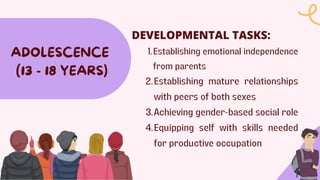
ADOLESCENCE
(13 - 18 YEARS)
Establishing emotional independence
from parents
1.
Establishing mature relationships
with peers of both sexes
2.
Achieving gender-based social role
3.
Equipping self with skills needed
for productive occupation
4.
DEVELOPMENTAL TASKS:
Selecting a mate
1.
Learning to live with a partner
2.
Starting a family
3.
Rearing children
4.
Managing a home
5.
Starting an occupation
6.
Assuming civic responsibility
7.
EARLY
ADULTHOOD
(19-29 YEARS)
DEVELOPMENTAL TASKS:
MIDDLE
ADULTHOOD
(30 TO 60 YEARS )
Helping teenage children to become
happy and responsible adults
1.
Achieving adult social and civic
responsibility
2.
Satisfactory career achievement
3.
Developing adult leisure time activities
4.
Relating to one's spouse as a person
5.
Accepting the physiological changes of
middle age
6.
Adjusting to aging parent
7.
DEVELOPMENTAL TASKS:
LATE ADULTHOOD
(61-79 YEARS TO
DEATH)
Adjusting to decreasing strength and
health
1.
Adjusting to retirement and reduced
income
2.
Adjusting to death of spouse
3.
Establishing relations with one's own
age group
4.
Meeting social and civic obligations
5.
Establishing satisfactory living quarters
6.
DEVELOPMENTAL TASKS:
DEVELOPMENTAL ISSUES
NATURE VS. NURTURE - the extent to
which development is influenced by
biological inheritance and/or environmental
experiences.
nature: the influences of biology and
genetics on behavior
nurture: environmental, social, and
cultural influences on behavior
DEVELOPMENTAL
ISSUES
STABILITY VS CHANGE - the degree to
which early traits and characteristics
persist or change through life.
stability: traits and characteristics
are seen as the result of heredity and
early life experiences.
change: traits and characteristics can
be altered by later experiences.
DEVELOPMENTAL
ISSUES
DEVELOPMENTAL
ISSUES
CONTINUITY VS DISCONTINUITY -
focuses on whether development is either...
continuous: the idea that development
is a progressive and cumulative
process, gradually improving on
existing skills.
discontinuous: the idea that
development takes place in unique
stages and occurs at specific times or
ages.
DEVELOPMENTAL
THEORIES
Psychoanalysis emphasizes
unconscious motivation - main
cause of behavior lies buried in
the unconscious mind. It is both
an approach to therapy and a
theory of personality.
PSYCHOANALYTIC
THEORIES
CONSCIOUS - thoughts, feelings and
perceptions that are directly and currently
available to us.
PSYCHODYNAMIC
THEORY PRECONSCIOUS - facts which are not
conscious but are available for possible use
in the future and are stored in a part of the
brain.
PRECONSCIOUS - contains all the feeling,
urges, or instincts that are beyond our
awareness but affect our expression,
feeling or actions.
THREE LEVELS OF THE MIND:
ID - part of the psyche that unconscious and
the source of primitive instincts, impulses
and drives.
PSYCHODYNAMIC
THEORY EGO - part of the psyche that contains
unconsciousness and memory; is involved
with control, planning and conforming.
SUPEREGO - part of the psyche that acts as
a conscience to the ego, developing moral
standards and rules through contact with
parents and society.
THREE COMPONENTS/ PARTS OF THE MIND:
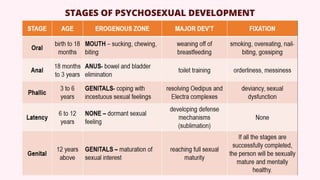
STAGES OF PSYCHOSEXUAL DEVELOPMENT
EROGENOUS ZONE
an area of the body sensitive to stimulation
pleasure centers
mouth, anus, genitals
FREUDIAN
TERMS
FIXATION
is getting "stuck" in a particular age
result of getting eith over or under gratification of erogenous
zone
2 Types of Oral Fixation
Oral Receptive- excessive smoking, drinking alcohol, overeating
Oral Aggressive- biting nails or pens, cursing, gossiping, overly
demanding
2 Types of Anal Fixation
Anal Retentive - overly neat, stingy, rigid
Anal Expulsive - very messy & disorganized
FREUDIAN
TERMS
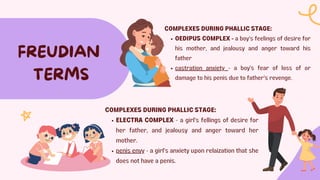
COMPLEXES DURING PHALLIC STAGE:
OEDIPUS COMPLEX - a boy's feelings of desire for
his mother, and jealousy and anger toward his
father
castration anxiety - a boy's fear of loss of or
damage to his penis due to father's revenge.
COMPLEXES DURING PHALLIC STAGE:
ELECTRA COMPLEX - a girl's fellings of desire for
her father, and jealousy and anger toward her
mother.
penis envy - a girl's anxiety upon relaization that she
does not have a penis.
PSYCHOSOCIAL
DEVELOPMENT THEORY
(ERIK ERIKSON)
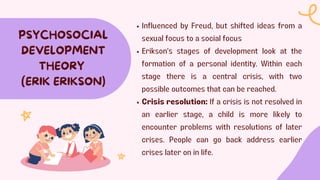
Influenced by Freud, but shifted ideas from a
sexual focus to a social focus
Erikson's stages of development look at the
formation of a personal identity. Within each
stage there is a central crisis, with two
possible outcomes that can be reached.
Crisis resolution: If a crisis is not resolved in
an earlier stage, a child is more likely to
encounter problems with resolutions of later
crises. People can go back address earlier
crises later on in life.
PSYCHOSOCIAL
DEVELOPMENT
THEORY
(ERIK ERIKSON)
STAGES OF
PSYCHOSOCIAL
DEVELOPMENT
STAGES OF
PSYCHOSOCIAL
DEVELOPMENT
Trust vs Mistrust (Birth to 1 year)
Adopted view depends on adult care.
Trust: If an infant develops a sense of trust (as a
result of being looked after, attended to and loved
by his/her parents), the infant will be happy and in
good health. Consistency and responsiveness
from caregivers will develop an infant's trust of
both others and self.
Mistrust: If an infant develops a sense of
mistrust (as a result of being neglected by its
parents), he/she will display a lack of interest in
his/her surroundings and have poor health.
STAGES OF
PSYCHOSOCIAL
DEVELOPMENT
Autonomy vs. Shame and Doubt (1 to 3 years)
Can I do things myself or must I always rely on
others?
Autonomy: A toddler with a sense of autonomy will
be interested in exploring his/her surroundings and
will constantly be looking for new things to mentally
stimulate him/herself with. Here, the toddler needs
permission to be independent and not be ridiculed.
Shame/Doubt: A toddler with a sense of shame and
doubt will be more withdrawn, appear to lack
confidence, and not venture too far into areas he/
she has not been before. If parents are controlling, a
toddler may doubt him/ herself and feel inadequate.
STAGES OF
PSYCHOSOCIAL
DEVELOPMENT
Initiative vs. Guilt (3 to 6 years)
Am I good or am I bad?
Initiative: A preschooler with a sense of initiative
will tend to complete tasks that s/he starts (e.g. if
s/he starts to draw a picture, s/he will keep
drawing until it's finished). Here, the child needs to
be supported in taking initiative and being
independent.
Guilt: A preschooler with a sense of guilt will tend
not to seek challenges and will tend to hold back
expressing who s/he is and what s/he would like to
do.
STAGES OF
PSYCHOSOCIAL
DEVELOPMENT
Industry vs. Inferiority (6 to 12 years)
Am I successful or worthless? The child will start to
make peer comparisons academically and socially.
Industry: Children with a sense of industry show
an interest in school work or tasks they are given
at home and display a responsible attitude.
Inferiority: Children with a sense of inferiority will
tend to display the opposite type of behavior, such
as being uninterested in school work or tasks they
are given because they feel they are not good
enough to complete those tasks successfully. Lack
of proficiency academically and socially leads to
inferiority.
STAGES OF
PSYCHOSOCIAL
DEVELOPMENT
Identity vs. Role confusion (12 to 19 years)
Who am I and where am I going? This is the peak of
peer influence.
Identity: An adolescent with a sense of identity will
feel as though s/he knows where s/he is going in
life or at least what s/he would like to be when s/he
is older.
Role Confusion: An adolescent with a sense of role
confusion will feel as though s/he has no direction
or purpose in life and feel unsure as to what the
future holds for him/her.
STAGES OF
PSYCHOSOCIAL
DEVELOPMENT
Intimacy vs. Isolation (20 to 40 years)
Shall I share my life with someone or live alone?
Intimacy: An adult who is capable of intimacy
will tend to form close bonds with people (such
as by forming friends and having romantic
relationships that eventually lead to marriage).
Isolation: An adult with a sense of isolation
finds it difficult to form relationships with people
and is unable to understand what other people
are thinking or feeling. As a result, s/he spends
most of the time by him/herself, with little or no
friends.
STAGES OF
PSYCHOSOCIAL
DEVELOPMENT
Generativity vs. Stagnation (40 to 65 years)
Will I produce something of real value?
Generativity: An adult with the trait of
generativity is capable of productive work,
which s/he usually undertakes for several
years. This trait is also linked to helping others
in some way (e.g. a mother who looks after her
children).
Stagnation: An adult with a trait of stagnation
is unable to find a way to contribute and feels
disconnected or uninvolved with his/her
community and with society as a whole.
STAGES OF
PSYCHOSOCIAL
DEVELOPMENT
Integrity vs. Despair (65 years onwards)
Have I lived a full life?
Integrity: A person with a trait of integrity can
face death with peace of mind, because s/he
knows his/her life has been lived to the fullest
and s/he has achieved the things s/he wanted to
do in life.
Despair: A person with a trait of despair feels a
sense of desperation as his/her life draws to a
close, because s/he feels s/he has wasted it and
was not able to do the things s/he hoped to do.
COGNITIVE DEVELOPMENT
THEORY (JEAN PIAGET)
Piaget used semi-structured clinical
interviews with children to determine
how they think and how their thinking
changes by analyzing their responses to
particular questions and scenarios.
Development is the active construction
of knowledge and learning as the passive
formation of associations. Piaget
believed that cognitive development has
to come before learning.
COGNITIVE
DEVELOPMENT
THEORY
(JEAN PIAGET)
STAGES OF
COGNITIVE DEVELOPMENT
STAGES OF
COGNITIVE
DEVELOPMENT
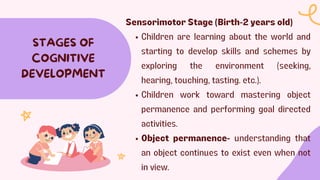
Sensorimotor Stage (Birth-2 years old)
Children are learning about the world and
starting to develop skills and schemes by
exploring the environment (seeking,
hearing, touching, tasting. etc.).
Children work toward mastering object
permanence and performing goal directed
activities.
Object permanence- understanding that
an object continues to exist even when not
in view.
STAGES OF
COGNITIVE
DEVELOPMENT
Preoperational Stage (2-7 years old)
At this stage, children haven't yet mastered mental
operations, without directly seeing the object they're
referring to.
From 2-4 years, children expand their vocabulary
enormously (approx. from 200 to 2000 words).
Intuitive thought: occurs when the child is able to believe in
something without knowing why she or he believes it.
Egocentrism: refers to the inability to see the world from
another's perspective. Here, the child thinks that everyone
sees the world in exactly the same way he/she sees it, feels
the same way, and understands the same way. This is very
prevalent in this stage.
Centration: is characterized by a child focusing or
attending to only one aspect of a stimulus or situation.
STAGES OF
COGNITIVE
DEVELOPMENT
Preoperational Stage (2-7 years old)
Collective monologues: are responses not related
to another child's words. Parallel play: happens when
two children appear to play side-by-side, but not with
each other.
Dramatic/symbolic play: makes use of objects that
take on imaginary qualities.
Animism: happens when the child believes that
inanimate objects have lifelike qualities and are
capable of action.
Magical thinking: cannot differentiate fantasy from
reality very easily. Here, the child tries to understand
the world and how it works.
STAGES OF
COGNITIVE
DEVELOPMENT
Concrete Operational Stage (7-11 years old)
Children in this stage need concrete experiences to
extend their thinking and understanding of the world
(can be described as more hands-on thinking).
Children think logically about things they experience,
but not yet hypothetically. They cannot really engage
in or understand abstract thought.
Classification (or class inclusion): The child starts
to classify objects according to physical
characteristics (e.g. farm & domestic animals).
Seriation: The child starts to put objects in logical
order, even without instructions (e.g., longest to
shortest sticks of varying length).
STAGES OF
COGNITIVE
DEVELOPMENT
Concrete Operational Stage (7-11 years old)
Transitivity: The child starts looking at
equal/less/greater than relationships and have more
complex types of understanding.
Decentering: This is where the child takes into
account multiple aspects of a problem to solve it.
Reversibility: This is where the child understands
that numbers or objects can be changed, then
returned to their original state.
Conservation: This happens when changing
something's shape does not change its quantity.
Younger children cannot understand this (e.g. same
volume of liquid even if cup shape changes).
STAGES OF
COGNITIVE
DEVELOPMENT
Formal Operational Stage (Adolescence-Adulthood)
Here, the child starts to develop abstract thinking.
Students can look at works of literature/art and start to
think abstractly about the meaning within those things.
The child can do hypothesis testing and scientific thinking
and can understand hypothetical situations/questions.
Combinational logic: This refers to the ability to think
about multiple aspects and combining them logically to
solve problems.
Reflective Thinking: ability to think deeply, thinking
about one's thinking
Adolescent Egocentrism: Here, an imaginary audience
is always watching what the child says and does.
SCHEMA THEORY
Schema (plural: schemata/schemes):
refers to our existing understanding of
how the world works; the basic building
blocks of thinking; organized systems of
actions or thoughts that allow us to
mentally represent or think about the
objects and events in the world.
Many schemes are challenged by
conflicting evidence, and the brain works
to resolve these inconsistences through a
process called adaptation.
SCHEMA THEORY
SCHEMA THEORY
Assimilation: is using an existing schema to deal with a
new object or situation
Equilibration: the process of restoring mental balance,
involves 2 types:
equilibrium - in a balanced state, no frustration,
successful assimilation
disequilibrium - in a disorderly state, there is
frustration, failed assimilation, misalignment between
one's schema and the real world (also known as
cognitive dissidence).
Accommodation: happens when the existing schema
(knowledge) does not work and needs to be changed to
deal with a new object or situation (equilibrium returns
after).
SOCIO-CULTURAL THEORY
OF DEVELOPMENT
(LEV VYGOTSKY)
Vygotsky's ideas about language,
culture, and cognitive development have
become major influences in psychology
and education today.
Socio-cultural theory emphasizes the
crucial influence that social interactions
and language, embedded within a
cultural context, have on cognitive
development.
SOCIO-CULTURAL
THEORY OF
DEVELOPMENT
Individual development cannot be understood
without looking into social and cultural
contexts within which development happens.
For Vygotsky, "talking-to-oneself" is an
indication of the thinking that goes on in the
mind of the child. This will lead to
private/inner speech - the use of words in
thinking that guides and monitors thinking
and problem-solving.
SOCIO-CULTURAL
THEORY OF
DEVELOPMENT
SOCIO-CULTURAL
THEORY OF
DEVELOPMENT
Zone of Actual Development
refers to the level where the
learner can do a task or
perform a skill alone.
Zone of Potential Development
refers to the level where the
learner cannot do a task or
perform a skill even with
assistance.
SOCIO-CULTURAL
THEORY OF
DEVELOPMENT
Zone of Proximal Development
refers to the difference between what the
child can accomplish alone and what he/ she
can accomplish with the guidance of another.
the area where there is something a child
can't quite grasp on his/her own, but with the
support of another will be able to learn and
understand
represents a learning opportunity where a
knowledgeable adult such as teacher or
parent or a more advanced peer can assist
the child's development.
SOCIO-CULTURAL
THEORY OF
DEVELOPMENT
Scaffolding
assistance provided by more competent peers or
adults to enable the task to be done successfully.
It should not be interpreted as doing the task for
the child while he/she watches or doing short cuts
for the child.
It should involve the judicious assistance given by
the adult or peer so that the child can move from
the zone of actual to the zone of proximal
development.
It can be in a form of clues, reminders,
encouragement, prompts, breaking the problem
down into steps, providing examples and feedbacks,
or anything else that can allow the student to grow
in independence as a learner.
MORAL DEVELOPMENT
THEORY
(LAWRENCE KOHLBERG)
MORAL
DEVELOPMENT
THEORY
Focused on a developmental sequence of
stages in which individuals restructure
their thinking about moral issues as they
mature.
Each level of moral reasoning is
composed of 2 distinct moral stages.
Assumed that each succeeding stage
evolves from and replaces its
predecessor.
Once an individual has attained a higher
stage of moral reasoning, she/he should
never regress to an earlier stage.
LEVELS OF MORAL
DEVELOPMENT
LEVELS OF MORAL
DEVELOPMENT
Level 1: Pre-Conventional (concerns
external consequences)
Punishment and obedience
orientation: Whatever leads to
punishment is wrong.
1.
Reward/mutual benefit orientation
(What's in it for me?): The right way to
behave is the way that is rewarded.
2.
LEVELS OF MORAL
DEVELOPMENT
Level 1: Pre-Conventional (concerns
external consequences)
Social approval orientation (The
good boy/good girl attitude):
Behaving in ways that conform to good
behavior.
1.
Social order orientation (Law and
order morality): Importance of
"doing one's duty"
2.
LEVELS OF MORAL
DEVELOPMENT
Level 3: Post-Conventional (shared
standards and values)
Social contract orientation:
Recognition that rules should sometimes
be broken, especially if found unjust.
1.
Universal ethical principles
(Principled conscience): This takes
account of likely views of everyone
affected by a moral decision.
2.
THANK YOU!

CHILD-AND-DEVELOPMENT-WITH-LEARNING-PRINCIPLES.pdf

  • 1.
    By Kyrie Petrakis CHILD CHILDAND ADOLESCENT AND ADOLESCENT DEVELOPMENT DEVELOPMENT
  • 2.
  • 3.
    Development is a patternof change. TRUE OR FALSE
  • 4.
  • 5.
    From both traditional andlife- span perspectives development is lifelong. TRUE OR FALSE
  • 6.
    In the development process,there are things that hold true to all people. TRUE OR FALSE
  • 7.
  • 8.
    Development is predictable because itfollows an orderly process. TRUE OR FALSE
  • 9.
  • 10.
    Development takes place ina vacuum. TRUE OR FALSE
  • 11.
    The effect ofbiological process on development is isolated from the effect of cognitive and socioemotional processes. TRUE OR FALSE
  • 12.
    Children learn invariety of ways. TRUE OR FALSE
  • 13.
    By Kyrie Petrakis CHILD CHILDAND ADOLESCENT AND ADOLESCENT DEVELOPMENT DEVELOPMENT
  • 14.
  • 15.
    GROWTH -refers tothe increase in size and number; has a quantitative measure; involves the increase in size and number. BASIC CONCEPTS IN HUMAN DEVELOPMENT DEVELOPMENT-refers to an improvement in circumstances; has a qualitative measure; encompasses overall changes, including growth and other progressive changes. CHILD DEVELOPMENT - refers to how a child becomes able to do more complex things as he/she gets older; examines how human beings chnage from the time of conception, throughout infancy and childhood, and into adolescence.
  • 16.
  • 17.
    BIOLOGICAL (PHYSICAL) DEVELOPMENT- involves the growth and change in a person's body and body functions. DOMAINS OF DEVELOPMENT COGNITIVE (MENTAL) DEVELOPMENT - refers to the growth and change of a person's ability to process information, solve problems and gain knowledge. SOCIO-EMOTIONAL (PSYCHOSOCIAL) DEVELOPMENT - involves the growth and changes of our interactions with others and our feelings.
  • 18.
    DOMAINS OF DEVELOPMENT The threedevelopmental domains overlap. BIOLOGICAL COGNITIVE SOCIO- EMOTIONAL
  • 19.
  • 20.
    CEPHALOCAUDAL DEVELOPMENT Cephalocaudal development refers togrowth and development that occurs from the head down. An infant will gain control over his/her neck muscles first, which allows him/her to hold his/her head steady.
  • 21.
    CEPHALOCAUDAL DEVELOPMENT Proximodistal development occurs fromthe center or core of the body and proceeds in an outward direction. The spine develops first in the uterus, followed by the extremities and finally the fingers and toes.
  • 22.
    Development is continuous. 1. Developmentis gradual. 2. Development is sequential. 3. The rate of development varies person to person. 4. Development proceeds from general to specific, simple to complex. 5. Early experiences have profound effects on development. 6. Growth and development are a product of both heredity and environment. 7. Development is predictable. 8. There is a constant interaction among all dimensions and factors of development. 9. Children learn in a variety of ways. 10. BASIC PRINCIPLES OF DEVELOPMENT AND LEARNING
  • 23.
  • 24.
    GENETICS/ HEREDITY Gender Health Intelligence FACTORS INFLUENCING GROWTH & DEVELOPMENTTEMPERAMENT Activity Levels Adaptability Distractibility Mood Quality Attention Span
  • 25.
    ENVIRONMENT Socio-economic Status Parent-child Relationship Religion/Culture Early Sensory Stimulation Training & Education Media/ Technology FACTORS INFLUENCING GROWTH & DEVELOPMENT NUTRITION Maternal Nutrition Child Nutrition
  • 26.
    THE EIGHT (8)STAGES OF HUMAN DEVELOPMENT (LIFE SPAN)
  • 27.
    Conception occurs and developmentbegins. All of the major structures of the body are forming and the health of the mother is of primary concern. Understanding nutrition, teratogens (or environmental factors that can lead to birth defects), and labor and delivery are primary concerns. PRE-NATAL PERIOD (0-9 MONTHS)
  • 28.
    GERMINAL PHASE -first 2 weeks, conception, implantation, and formation of placenta. EMBRYONIC PHASE - 2 weeks-2 months, formation of vital organs and systems. FETAL STAGE - 2 months –birth, bodily growth continues, movement capability begins, brain cells multiply age of viability. PRE-NATAL PERIOD (0-9 MONTHS)
  • 29.
    The first yearand a half to two years of life are ones of dramatic growth and change. A newborn, with a keen sense of hearing but very poor vision is transformed into a walking, talking toddler within a relatively short period of time. Caregivers are also transformed from someone who manages feeding and sleep schedules to a constantly moving guide and safety inspector for a mobile, energetic child. INFANCY & TODDLERHOOD (0-2 YEARS)
  • 30.
    Early childhood isalso referred to as the preschool years consisting of the years which follow toddlerhood and precede formal schooling. As a three to five-year-old, the child is busy learning language, is gaining a sense of self and greater independence, and is beginning to learn the workings of the physical world. EARLY CHILDHOOD (2-6 YEARS)
  • 31.
    This knowledge doesnot come quickly, however, and preschoolers may have initially have interesting conceptions of size, time, space and distance such as fearing that they may go down the drain if they sit at the front of the bathtub or by demonstrating how long something will take by holding out their two index fingers several inches apart. A toddler‘s fierce determination to do something may give way to a four-year-old‘s sense of guilt for doing something that brings the disapproval of others. EARLY CHILDHOOD (2-6 YEARS)
  • 32.
    The ages ofsix through twelve comprise middle childhood and much of what children experience at this age is connected to their involvement in the early grades of school. Now the world becomes one of learning and testing new academic skills and by assessing one‘s abilities and accomplishments by making comparisons between self and others. MIDDLE CHILDHOOD & LATE CHILDHOOD (6-12 YEARS)
  • 33.
    Schools compare studentsand make these comparisons public through team sports, test scores, and other forms of recognition. Growth rates slow down and children are able to refine their motor skills at this point in life. And children begin to learn about social relationships beyond the family through interaction with friends and fellow students. MIDDLE CHILDHOOD & LATE CHILDHOOD (6-12 YEARS)
  • 34.
    Adolescence is aperiod of dramatic physical change marked by an overall physical growth spurt and sexual maturation, known as puberty. It is also a time of cognitive change as the adolescent begins to think of new possibilities and to consider abstract concepts such as love, fear, and freedom. ADOLESCENCE (13 - 18 YEARS)
  • 35.
    Ironically, adolescents havea sense of invincibility that puts them at greater risk of dying from accidents or contracting sexually transmitted infections that can have lifelong consequences. ADOLESCENCE (13 - 18 YEARS)
  • 36.
    The twenties andthirties are often thought of as early adulthood. (Students who are in their mid-30s tend to love to hear that they are a young adult!). It is a time when we are at our physiological peak but are most at risk for involvement in violent crimes and substance abuse. It is a time of focusing on the future and putting a lot of energy into making choices that will help one earn the status of a full adult in the eyes of others. Love and work are primary concerns at this stage of life. EARLY ADULTHOOD (19-29 YEARS)
  • 37.
    The late thirtiesthrough the mid-sixties is referred to as middle adulthood. This is a period in which aging, that began earlier, becomes more noticeable and a period at which many people are at their peak of productivity in love and work. It may be a period of gaining expertise in certain fields and being able to understand problems and find solutions with greater efficiency than before. It can also be a time of becoming more realistic about possibilities in life previously considered; of recognizing the difference between what is possible and what is likely. MIDDLE ADULTHOOD (30 TO 60 YEARS )
  • 38.
    This period ofthe life span has increased in the last 100 years, particularly in industrialized countries. Late adulthood is sometimes subdivided into two or three categories such as the "young old" and "old old" or the "young old", "old old", and "oldest old". We will follow the former categorization and make the distinction between the "young old" who are people between 65 and 79 and the "old old" or those who are 80 and older. LATE ADULTHOOD (61-79 YEARS TO DEATH)
  • 39.
  • 40.
    INFANCY & EARLY CHILDHOOD (0-6YEARS) Learning to walk 1. Learning to talk 2. Learning to distinguish right from wrong and developing a conscience 3. Learning to take solid foods 4. Learning to control the elimination of body wastes 5. Acquiring concepts and language to describe social and physical reality 6. Learning sex differences and sexual modesty 7. Readiness for reading 8. DEVELOPMENTAL TASKS:
  • 41.
    MIDDLE CHILDHOOD & LATE CHILDHOOD (6-12YEARS) Learning physical skills for playing games 1. Developing school-related skills such as reading , writing, and counting 2. Developing conscience and values 3. Attaining independence 4. DEVELOPMENTAL TASKS:
  • 42.
    ADOLESCENCE (13 - 18YEARS) Establishing emotional independence from parents 1. Establishing mature relationships with peers of both sexes 2. Achieving gender-based social role 3. Equipping self with skills needed for productive occupation 4. DEVELOPMENTAL TASKS:
  • 43.
    Selecting a mate 1. Learningto live with a partner 2. Starting a family 3. Rearing children 4. Managing a home 5. Starting an occupation 6. Assuming civic responsibility 7. EARLY ADULTHOOD (19-29 YEARS) DEVELOPMENTAL TASKS:
  • 44.
    MIDDLE ADULTHOOD (30 TO 60YEARS ) Helping teenage children to become happy and responsible adults 1. Achieving adult social and civic responsibility 2. Satisfactory career achievement 3. Developing adult leisure time activities 4. Relating to one's spouse as a person 5. Accepting the physiological changes of middle age 6. Adjusting to aging parent 7. DEVELOPMENTAL TASKS:
  • 45.
    LATE ADULTHOOD (61-79 YEARSTO DEATH) Adjusting to decreasing strength and health 1. Adjusting to retirement and reduced income 2. Adjusting to death of spouse 3. Establishing relations with one's own age group 4. Meeting social and civic obligations 5. Establishing satisfactory living quarters 6. DEVELOPMENTAL TASKS:
  • 46.
  • 47.
    NATURE VS. NURTURE- the extent to which development is influenced by biological inheritance and/or environmental experiences. nature: the influences of biology and genetics on behavior nurture: environmental, social, and cultural influences on behavior DEVELOPMENTAL ISSUES
  • 48.
    STABILITY VS CHANGE- the degree to which early traits and characteristics persist or change through life. stability: traits and characteristics are seen as the result of heredity and early life experiences. change: traits and characteristics can be altered by later experiences. DEVELOPMENTAL ISSUES
  • 49.
    DEVELOPMENTAL ISSUES CONTINUITY VS DISCONTINUITY- focuses on whether development is either... continuous: the idea that development is a progressive and cumulative process, gradually improving on existing skills. discontinuous: the idea that development takes place in unique stages and occurs at specific times or ages.
  • 50.
  • 51.
    Psychoanalysis emphasizes unconscious motivation- main cause of behavior lies buried in the unconscious mind. It is both an approach to therapy and a theory of personality. PSYCHOANALYTIC THEORIES
  • 52.
    CONSCIOUS - thoughts,feelings and perceptions that are directly and currently available to us. PSYCHODYNAMIC THEORY PRECONSCIOUS - facts which are not conscious but are available for possible use in the future and are stored in a part of the brain. PRECONSCIOUS - contains all the feeling, urges, or instincts that are beyond our awareness but affect our expression, feeling or actions. THREE LEVELS OF THE MIND:
  • 53.
    ID - partof the psyche that unconscious and the source of primitive instincts, impulses and drives. PSYCHODYNAMIC THEORY EGO - part of the psyche that contains unconsciousness and memory; is involved with control, planning and conforming. SUPEREGO - part of the psyche that acts as a conscience to the ego, developing moral standards and rules through contact with parents and society. THREE COMPONENTS/ PARTS OF THE MIND:
  • 54.
  • 55.
    EROGENOUS ZONE an areaof the body sensitive to stimulation pleasure centers mouth, anus, genitals FREUDIAN TERMS FIXATION is getting "stuck" in a particular age result of getting eith over or under gratification of erogenous zone 2 Types of Oral Fixation Oral Receptive- excessive smoking, drinking alcohol, overeating Oral Aggressive- biting nails or pens, cursing, gossiping, overly demanding 2 Types of Anal Fixation Anal Retentive - overly neat, stingy, rigid Anal Expulsive - very messy & disorganized
  • 56.
    FREUDIAN TERMS COMPLEXES DURING PHALLICSTAGE: OEDIPUS COMPLEX - a boy's feelings of desire for his mother, and jealousy and anger toward his father castration anxiety - a boy's fear of loss of or damage to his penis due to father's revenge. COMPLEXES DURING PHALLIC STAGE: ELECTRA COMPLEX - a girl's fellings of desire for her father, and jealousy and anger toward her mother. penis envy - a girl's anxiety upon relaization that she does not have a penis.
  • 57.
  • 58.
    Influenced by Freud,but shifted ideas from a sexual focus to a social focus Erikson's stages of development look at the formation of a personal identity. Within each stage there is a central crisis, with two possible outcomes that can be reached. Crisis resolution: If a crisis is not resolved in an earlier stage, a child is more likely to encounter problems with resolutions of later crises. People can go back address earlier crises later on in life. PSYCHOSOCIAL DEVELOPMENT THEORY (ERIK ERIKSON)
  • 59.
  • 60.
    STAGES OF PSYCHOSOCIAL DEVELOPMENT Trust vsMistrust (Birth to 1 year) Adopted view depends on adult care. Trust: If an infant develops a sense of trust (as a result of being looked after, attended to and loved by his/her parents), the infant will be happy and in good health. Consistency and responsiveness from caregivers will develop an infant's trust of both others and self. Mistrust: If an infant develops a sense of mistrust (as a result of being neglected by its parents), he/she will display a lack of interest in his/her surroundings and have poor health.
  • 61.
    STAGES OF PSYCHOSOCIAL DEVELOPMENT Autonomy vs.Shame and Doubt (1 to 3 years) Can I do things myself or must I always rely on others? Autonomy: A toddler with a sense of autonomy will be interested in exploring his/her surroundings and will constantly be looking for new things to mentally stimulate him/herself with. Here, the toddler needs permission to be independent and not be ridiculed. Shame/Doubt: A toddler with a sense of shame and doubt will be more withdrawn, appear to lack confidence, and not venture too far into areas he/ she has not been before. If parents are controlling, a toddler may doubt him/ herself and feel inadequate.
  • 62.
    STAGES OF PSYCHOSOCIAL DEVELOPMENT Initiative vs.Guilt (3 to 6 years) Am I good or am I bad? Initiative: A preschooler with a sense of initiative will tend to complete tasks that s/he starts (e.g. if s/he starts to draw a picture, s/he will keep drawing until it's finished). Here, the child needs to be supported in taking initiative and being independent. Guilt: A preschooler with a sense of guilt will tend not to seek challenges and will tend to hold back expressing who s/he is and what s/he would like to do.
  • 63.
    STAGES OF PSYCHOSOCIAL DEVELOPMENT Industry vs.Inferiority (6 to 12 years) Am I successful or worthless? The child will start to make peer comparisons academically and socially. Industry: Children with a sense of industry show an interest in school work or tasks they are given at home and display a responsible attitude. Inferiority: Children with a sense of inferiority will tend to display the opposite type of behavior, such as being uninterested in school work or tasks they are given because they feel they are not good enough to complete those tasks successfully. Lack of proficiency academically and socially leads to inferiority.
  • 64.
    STAGES OF PSYCHOSOCIAL DEVELOPMENT Identity vs.Role confusion (12 to 19 years) Who am I and where am I going? This is the peak of peer influence. Identity: An adolescent with a sense of identity will feel as though s/he knows where s/he is going in life or at least what s/he would like to be when s/he is older. Role Confusion: An adolescent with a sense of role confusion will feel as though s/he has no direction or purpose in life and feel unsure as to what the future holds for him/her.
  • 65.
    STAGES OF PSYCHOSOCIAL DEVELOPMENT Intimacy vs.Isolation (20 to 40 years) Shall I share my life with someone or live alone? Intimacy: An adult who is capable of intimacy will tend to form close bonds with people (such as by forming friends and having romantic relationships that eventually lead to marriage). Isolation: An adult with a sense of isolation finds it difficult to form relationships with people and is unable to understand what other people are thinking or feeling. As a result, s/he spends most of the time by him/herself, with little or no friends.
  • 66.
    STAGES OF PSYCHOSOCIAL DEVELOPMENT Generativity vs.Stagnation (40 to 65 years) Will I produce something of real value? Generativity: An adult with the trait of generativity is capable of productive work, which s/he usually undertakes for several years. This trait is also linked to helping others in some way (e.g. a mother who looks after her children). Stagnation: An adult with a trait of stagnation is unable to find a way to contribute and feels disconnected or uninvolved with his/her community and with society as a whole.
  • 67.
    STAGES OF PSYCHOSOCIAL DEVELOPMENT Integrity vs.Despair (65 years onwards) Have I lived a full life? Integrity: A person with a trait of integrity can face death with peace of mind, because s/he knows his/her life has been lived to the fullest and s/he has achieved the things s/he wanted to do in life. Despair: A person with a trait of despair feels a sense of desperation as his/her life draws to a close, because s/he feels s/he has wasted it and was not able to do the things s/he hoped to do.
  • 68.
  • 69.
    Piaget used semi-structuredclinical interviews with children to determine how they think and how their thinking changes by analyzing their responses to particular questions and scenarios. Development is the active construction of knowledge and learning as the passive formation of associations. Piaget believed that cognitive development has to come before learning. COGNITIVE DEVELOPMENT THEORY (JEAN PIAGET)
  • 70.
  • 71.
    STAGES OF COGNITIVE DEVELOPMENT Sensorimotor Stage(Birth-2 years old) Children are learning about the world and starting to develop skills and schemes by exploring the environment (seeking, hearing, touching, tasting. etc.). Children work toward mastering object permanence and performing goal directed activities. Object permanence- understanding that an object continues to exist even when not in view.
  • 72.
    STAGES OF COGNITIVE DEVELOPMENT Preoperational Stage(2-7 years old) At this stage, children haven't yet mastered mental operations, without directly seeing the object they're referring to. From 2-4 years, children expand their vocabulary enormously (approx. from 200 to 2000 words). Intuitive thought: occurs when the child is able to believe in something without knowing why she or he believes it. Egocentrism: refers to the inability to see the world from another's perspective. Here, the child thinks that everyone sees the world in exactly the same way he/she sees it, feels the same way, and understands the same way. This is very prevalent in this stage. Centration: is characterized by a child focusing or attending to only one aspect of a stimulus or situation.
  • 73.
    STAGES OF COGNITIVE DEVELOPMENT Preoperational Stage(2-7 years old) Collective monologues: are responses not related to another child's words. Parallel play: happens when two children appear to play side-by-side, but not with each other. Dramatic/symbolic play: makes use of objects that take on imaginary qualities. Animism: happens when the child believes that inanimate objects have lifelike qualities and are capable of action. Magical thinking: cannot differentiate fantasy from reality very easily. Here, the child tries to understand the world and how it works.
  • 74.
    STAGES OF COGNITIVE DEVELOPMENT Concrete OperationalStage (7-11 years old) Children in this stage need concrete experiences to extend their thinking and understanding of the world (can be described as more hands-on thinking). Children think logically about things they experience, but not yet hypothetically. They cannot really engage in or understand abstract thought. Classification (or class inclusion): The child starts to classify objects according to physical characteristics (e.g. farm & domestic animals). Seriation: The child starts to put objects in logical order, even without instructions (e.g., longest to shortest sticks of varying length).
  • 75.
    STAGES OF COGNITIVE DEVELOPMENT Concrete OperationalStage (7-11 years old) Transitivity: The child starts looking at equal/less/greater than relationships and have more complex types of understanding. Decentering: This is where the child takes into account multiple aspects of a problem to solve it. Reversibility: This is where the child understands that numbers or objects can be changed, then returned to their original state. Conservation: This happens when changing something's shape does not change its quantity. Younger children cannot understand this (e.g. same volume of liquid even if cup shape changes).
  • 76.
    STAGES OF COGNITIVE DEVELOPMENT Formal OperationalStage (Adolescence-Adulthood) Here, the child starts to develop abstract thinking. Students can look at works of literature/art and start to think abstractly about the meaning within those things. The child can do hypothesis testing and scientific thinking and can understand hypothetical situations/questions. Combinational logic: This refers to the ability to think about multiple aspects and combining them logically to solve problems. Reflective Thinking: ability to think deeply, thinking about one's thinking Adolescent Egocentrism: Here, an imaginary audience is always watching what the child says and does.
  • 77.
  • 78.
    Schema (plural: schemata/schemes): refersto our existing understanding of how the world works; the basic building blocks of thinking; organized systems of actions or thoughts that allow us to mentally represent or think about the objects and events in the world. Many schemes are challenged by conflicting evidence, and the brain works to resolve these inconsistences through a process called adaptation. SCHEMA THEORY
  • 79.
    SCHEMA THEORY Assimilation: isusing an existing schema to deal with a new object or situation Equilibration: the process of restoring mental balance, involves 2 types: equilibrium - in a balanced state, no frustration, successful assimilation disequilibrium - in a disorderly state, there is frustration, failed assimilation, misalignment between one's schema and the real world (also known as cognitive dissidence). Accommodation: happens when the existing schema (knowledge) does not work and needs to be changed to deal with a new object or situation (equilibrium returns after).
  • 80.
  • 81.
    Vygotsky's ideas aboutlanguage, culture, and cognitive development have become major influences in psychology and education today. Socio-cultural theory emphasizes the crucial influence that social interactions and language, embedded within a cultural context, have on cognitive development. SOCIO-CULTURAL THEORY OF DEVELOPMENT
  • 82.
    Individual development cannotbe understood without looking into social and cultural contexts within which development happens. For Vygotsky, "talking-to-oneself" is an indication of the thinking that goes on in the mind of the child. This will lead to private/inner speech - the use of words in thinking that guides and monitors thinking and problem-solving. SOCIO-CULTURAL THEORY OF DEVELOPMENT
  • 83.
    SOCIO-CULTURAL THEORY OF DEVELOPMENT Zone ofActual Development refers to the level where the learner can do a task or perform a skill alone. Zone of Potential Development refers to the level where the learner cannot do a task or perform a skill even with assistance.
  • 84.
    SOCIO-CULTURAL THEORY OF DEVELOPMENT Zone ofProximal Development refers to the difference between what the child can accomplish alone and what he/ she can accomplish with the guidance of another. the area where there is something a child can't quite grasp on his/her own, but with the support of another will be able to learn and understand represents a learning opportunity where a knowledgeable adult such as teacher or parent or a more advanced peer can assist the child's development.
  • 85.
    SOCIO-CULTURAL THEORY OF DEVELOPMENT Scaffolding assistance providedby more competent peers or adults to enable the task to be done successfully. It should not be interpreted as doing the task for the child while he/she watches or doing short cuts for the child. It should involve the judicious assistance given by the adult or peer so that the child can move from the zone of actual to the zone of proximal development. It can be in a form of clues, reminders, encouragement, prompts, breaking the problem down into steps, providing examples and feedbacks, or anything else that can allow the student to grow in independence as a learner.
  • 86.
  • 87.
    MORAL DEVELOPMENT THEORY Focused on adevelopmental sequence of stages in which individuals restructure their thinking about moral issues as they mature. Each level of moral reasoning is composed of 2 distinct moral stages. Assumed that each succeeding stage evolves from and replaces its predecessor. Once an individual has attained a higher stage of moral reasoning, she/he should never regress to an earlier stage.
  • 88.
  • 89.
    LEVELS OF MORAL DEVELOPMENT Level1: Pre-Conventional (concerns external consequences) Punishment and obedience orientation: Whatever leads to punishment is wrong. 1. Reward/mutual benefit orientation (What's in it for me?): The right way to behave is the way that is rewarded. 2.
  • 90.
    LEVELS OF MORAL DEVELOPMENT Level1: Pre-Conventional (concerns external consequences) Social approval orientation (The good boy/good girl attitude): Behaving in ways that conform to good behavior. 1. Social order orientation (Law and order morality): Importance of "doing one's duty" 2.
  • 91.
    LEVELS OF MORAL DEVELOPMENT Level3: Post-Conventional (shared standards and values) Social contract orientation: Recognition that rules should sometimes be broken, especially if found unjust. 1. Universal ethical principles (Principled conscience): This takes account of likely views of everyone affected by a moral decision. 2.
  • 92.