MRS. LEIZEL C. DELA CRUZ, LPT
Child and
Adolescent
Learners and
Learning
Principles
CHILD and ADOLESCENT DEVELOPMENT
Being able to construct a definition of human
development and its implications.
Intended Learning Outcome
Nature and
Principles of
Development
01 CHAPTER 1
Growth
Refers to the physical changes that occur from conception to maturity
Aging
In a biological sense, is the deterioration of organisms (including human
beings) that leads inevitably to death
Development is the pattern of biological, cognitive, and socioemotional
changes that begins at conception and continues throughout the lifespan.
Maturation
The biological unfolding of an individual according to a plan contained in
the genes (the hereditary characteristics passed from parents to a child at
conception.)
Learning
The process through which experience brings about relatively permanent
changes in thoughts, feelings or behavior.
Development is the pattern of biological, cognitive, and socioemotional
changes that begins at conception and continues throughout the lifespan.
Environment
Refers to all the external physical and social conditions and events
that can affect us, from crowded living quarters to stimulating social
interactions.
Biological
• Involves changes in
the child’s body.
• Genetic inheritance
plays a large part
• Underlie the
development of the
brain, grains in
height, changes in
motor skills, and
puberty’s hormonal
changes
Cognitive
• Involve in the
child’s thinking,
intelligence, and
language.
Socioemotional
• Involve changes
in the child’s
relationships with
other people,
changes in
emotion, and
changes in
personality.
Processes and Periods in Development
MAJOR FOR COLLEGE CHILD DEVELOPMENT
Stage Age Period Major Features
1. Prenatal Conception to birth Physical development
2. Infancy Birth at full term to about 18
months
Locomotion established; rudimentary language;
social attachment
3. Early Childhood About 18 months to about 6 years Language well-established, sex typing; group
play; ends with readiness for schooling
4. Late Childhood About 6 to 13 years Many cognitive processes become adult except
in speed of operation; and team play
5. Adolescence About 13 to about 20 years Begins with puberty, ends at maturity, attainment
of highest level of cognition; independence from
parents, sexual relationships
6. Young Adulthood About 20 to about 45 years Career and family development
7. Midlife About 45 to about 65 years Career reaches highest level; self-assessment;
“empty nest” crisis; retirement
8. Late life About 65 years to death Enjoys family achievements; dependency;
widowhood; poor health
1. Development is a lifelong process.
2. Development is multidirectional.
3. Development always involves both gain and loss.
4. Development is characterized by lifelong plasticity.
5. Development is shaped by its historical/cultural
context.
6. Development is multiply influenced.
7. Understanding development requires multiple
disciplines.
The Lifespan Perspectives
(Baltes, Lindenburger, & Staudinger, 2006)
1. Assumptions about Human Nature
a. Original Sin (Thomas Hobbes, 1588-1679,
portrayed children as inherently selfish and bad)
b. Inherently Good (Jean-Jaques Rousseau, 1712-
1778 argued that children were innately good)
c. Tabula Rasa (John Locke, 1632-1704, maintained
that infants is a tabula rasa, or blank slate, waiting
to be written on by his or her own experiences)
Basic Issues in Human Development
2. Nature and Nurture
Nature refers to the behavior and characteristics
manifested because of the influence of biological forces
(heredity and biologically-based dispositions)
Nurture refers to the influences brought about by the
exposure to the environment (learning experiences, child-
rearing methods, societal changes and culture)
Basic Issues in Human Development
3. Activity and Passivity
Some theorists believe that children are curious,
active creatures who orchestrate their development by
exploring the world around them.
Other theorists view humans as passive beings who
are largely a product of forces beyond their control –
usually environmental influences
Basic Issues in Human Development
4. Continuity and Discontinuity
Discontinuity theorists picture the course of development
as more like a series of stair steps, each of which elevates the
individual to a new (and presumably more advance) level of
functioning. Continuity, views human development as a process
that occurs in small steps, without sudden changes (gradual
changes).
5. Universality and Context-Specificity
Developmental changes are common to everyone
(universal) or different from person to person (context specific)
Basic Issues in Human Development
A teacher’s life is influenced by his or her
background, this is specific to significant life
experiences; values formed; and support
groups.
Design your own life map by specifying ten
significant life events that lead to choosing
teaching as a profession. Make your life map
interesting and creative.
Activity 1: Designing My Life Map
The Filipino
Child and
Adolescence
02 CHAPTER 2
MAJOR FOR COLLEGE CHILD DEVELOPMENT
Being able to distinguish critical development
stages and tasks in the local context.
Intended Learning Outcome
CHILD DEVELOPMENT
The World Health Organization
(WHO)
19 years or younger unless national
law defines a person to be an adult at
an early age (WHO, 2013)
The United Nation’s Children Fund
(UNICEF) below the age of 18, unless
the laws of a particular country set the
legal age for adulthood younger.
CHILD
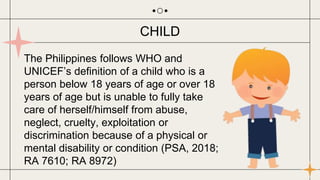
The Philippines follows WHO and
UNICEF’s definition of a child who is a
person below 18 years of age or over 18
years of age but is unable to fully take
care of herself/himself from abuse,
neglect, cruelty, exploitation or
discrimination because of a physical or
mental disability or condition (PSA, 2018;
RA 7610; RA 8972)
CHILD
In each stage of development a certain task or tasks
are expected of every individual.
• Developmental task, one that “arises at a certain
period in our life, the successful achievement of
which leads to happiness and success with later
tasks while failure leads to unhappiness, social
disapproval, and difficulty with later tasks.” (Havighurst,
1972)
DEVELOPMENTAL TASKS
1. Prenatal period (from conception to birth)
2. Infancy (birth to 18- 24 months)
3. Early childhood (end of infancy to 5 -6 years)
4. Middle and late childhood ( 6 – 11 years of age, the
elementary school years)
5. Adolescence ( 10 – 12 years of age ending up to 18 – 22
years of age)
6. Early adulthood (from late teens or early 20’s lasting
through the 30’s)
7. Middle adulthood (40 – 60 years of age)
8. Late adulthood (60’s and above)
DEVELOPMENTAL STAGES
(Santrock, 2002)
1. Infancy and Early childhood (0-5
years)
2. Middle childhood (6 – 12 years)
3. Adolescence (13 – 18 years)
4. Early adulthood (19-29 years)
5. Middle adulthood (30 – 60 years of
age)
6. Later maturity (61+)
DEVELOPMENTAL STAGES
(Havighurst, 1972)
1. Prenatal period (from conception to birth) – It involves tremendous growth
from a single cell to an organism complete with brain and behavioral
capabilities.
2. Infancy (birth to 18- 24 months) – A time of extreme dependence on adults.
Many psychological activities are just beginning – language, symbolic
thought, sensorimotor coordination and social learning.
3. Early childhood (end of infancy to 5 -6 years)
4. Middle and late childhood ( 6 – 11 years of age, the elementary school
years)
5. Adolescence ( 10 – 12 years of age ending up to 18 – 22 years of age)
6. Early adulthood (from late teens or early 20’s lasting through the 30’s)
7. Middle adulthood (40 – 60 years of age)
8. Late adulthood (60’s and above)
DEVELOPMENTAL TASKS
(Santrock, 2002)
1. Prenatal period (from conception to birth) – It involves
tremendous growth from a single cell to an organism
complete with brain and behavioral capabilities.
2. Infancy (birth to 18- 24 months) – A time of extreme
dependence on adults. Many psychological activities are
just beginning – language, symbolic thought, sensorimotor
coordination and social learning.
DEVELOPMENTAL TASKS
(Santrock, 2002)
3. Early childhood (end of infancy to 5 -6 years) – these are the
preschool years. Young children learn to become more self-
sufficient and to care for themselves, develop school readiness
skills and spend many hours in play with peers.
4. Middle and late childhood ( 6 – 11 years of age, the
elementary school years) – the fundamental skills of reading,
writing and arithmetic are mastered. The child is formally
exposed to the larger world and its culture. Achievement
becomes a more central theme of the child’s world and self-
control increases.
DEVELOPMENTAL TASKS
(Santrock, 2002)
5. Adolescence ( 10 – 12 years of age ending up to 18 – 22
years of age) – begins with rapid physical changes –
dramatic gains in height and weight, changes in body
contour, and the development of sexual characteristics
such as enlargement of the breasts, development of pubic
and facial hair, and deepening of voice. Pursuit of
independence and identity are prominent. Though is more
logical, abstract and idealistic. More time is spent outside
of the family
DEVELOPMENTAL TASKS
(Santrock, 2002)
6. Early adulthood (from late teens or early 20’s lasting
through the 30’s) – it is a time of establishing personal and
economic independence, career development, selecting a
mate, learning to live with someone in an intimate way,
starting a family and rearing children.
DEVELOPMENTAL TASKS
(Santrock, 2002)
7. Middle adulthood (40 – 60 years of age) - it is a time of
expanding personal and social involvement and
responsibility; of assisting the next generation in becoming
competent and mature individuals; and of reaching and
maintaining satisfaction in a career.
8. Late adulthood (60’s and above) – it is a time for
adjustment to decreasing strength and health, life review,
retirement, and adjustment to new social roles.
DEVELOPMENTAL TASKS
(Santrock, 2002)
Philippine Statistics Office (PSA), 2018
• 32,155,794 Filipinos among the 0-14 age group (31.8%
of the total population)
• 96.5% simple literacy rate (read and write)
• 90.3% functionally literate
Department of Education, S.Y. 2019-2020
• 27,770,263 enrollees (kindergarten to Grade 12)
• 805,957 (teaching positions: public)
• 300,170 (teaching positions: private)
THE CURRENT STATE OF THE FILIPINO
CHILDREN
QUESTION
What are the implications of these
developmental tasks to your role as a
future teacher or parent?
Reflect on your early childhood, middle and
late childhood day. Were you able to acquire
the developmental tasks expected of early,
middle, late childhood and adolescence?
What facilitated your acquisitions of the ability
to perform such tasks? Write your reflection.
Perspectives and
Approaches in the
Study of Human
Development
03
CHAPTER 3
MAJOR FOR COLLEGE CHILD DEVELOPMENT
Being able to associate human development
perspectives and approaches with specific
learning principle.
Intended Learning Outcome
CHILD DEVELOPMENT
1. Learning Paradigm
Learning theories work on the assumption that people
undergo the stages of development through the process of
interaction with one’s environment via observation,
conditioning, reward, and punishment system.
Revolves around the understanding of the relationship of
stimulus and response.
a. Classical Conditioning
b. Operant Conditioning
c. Social Cognitive Learning Theory
PERSPECTIVES IN HUMAN
DEVELOPMENT
a. Classical Conditioning
Developed by a Russian physiologist, Ivan Pavlov. Two
stimuli are linked together to produce a new learned response in a
person or animal.
Neutral Stimulus (NR) = No Response (NR)
Neutral Stimulus (NS) + Unconditioned Stimulus (US) =
Unconditioned Response (UR)
Neutral Stimulus (NS) = Conditioned Response (CR)
PERSPECTIVES IN HUMAN
DEVELOPMENT
b. Operant Conditioning
Developed by a American psychologist, Burrhus Frederic
Skinner (B.F. Skinner). Consequences of a response determine
the probability of it being repeated. Reinforced (rewarded)
behavior will likely be repeated, and behavior which is punished
will occur less frequently.
PERSPECTIVES IN HUMAN
DEVELOPMENT
b. Operant Conditioning
Positive Reinforcement
behavior is strengthened by the addition of praise or a direct reward
Negative Reinforcement
behavior is strengthened by the removal of something considered
unpleasant
Positive Punishment
an unfavorable event or outcome in order to weaken the response it
follows
Negative Punishment
a favorable event or outcome is removed after a behavior occurs
PERSPECTIVES IN HUMAN
DEVELOPMENT
c. Social Cognitive Learning Theory
The theory suggests that humans learn behaviors by observing
others and choosing which behaviors to imitate. Imitation and modeling
are central in learning new behaviors. Developed by Canadian-American
psychologist, Albert Bandura. (observational learning)
PERSPECTIVES IN HUMAN
DEVELOPMENT
Social Cognitive Learning Theory four processes:
Attention
a person has to be able to notice something in the environment
Retention
the observed event has to be remembered
Motor reproduction
action has to be produced to imitate what was observed
Motivation
the consequences from the environment have to be reinforcing to the
behavior
PERSPECTIVES IN HUMAN
DEVELOPMENT
For example, a student sees other students being praised
for academic accomplishments. He or she may engage in
scholarly behavior in an attempt to do well and receive
similar rewards. Finally, over time, the student internalizes
the reinforcement and does not need external rewards in
order to produce the behavior.
For instance, in time, the student in our example
internalizes the value of education, and doing well
academically eventually constitutes self-reinforcing
behavior.
PERSPECTIVES IN HUMAN
DEVELOPMENT
2. Socio Cultural Theories
This perspective highlights the influence of the collective
experiences of people found in the same cultural orientation. It
assumes the centrality of culture, such as language and
communication, as well as norms in the developmental process.
a. Socio-Cultural Theory of lev Vygotsky
b. The Cognitive Theory of Development of Jean Piaget
PERSPECTIVES IN HUMAN
DEVELOPMENT
a. Socio-Cultural Theory of lev Vygotsky
Lev Vygotsky, a Soviet psychologist; known as the father of
socio-cultural perspective. Emphasized the role of social interaction
particularly, in facilitating cognitive development of children.
Zone of proximal development (ZPD), identifies the gap
between assisted and non-assisted development of children’s
cognition.
Scaffolding, or supportive activities provided by the educator,
or more competent peer, to support the student as he or she is led
through the ZPD.
More Knowledgeable Other (MKO), refers to someone who
has a better understanding or a higher ability level than the learner,
with respect to a particular task, process, or concept.
PERSPECTIVES IN HUMAN
DEVELOPMENT
b. The Cognitive Theory of Development of Jean Piaget
Jean Piaget, a Swiss psychologist; Jean Piaget's theory of
cognitive development suggests that children move through four
different stages of learning. His theory focuses not only on
understanding how children acquire knowledge, but also on
understanding the nature of intelligence.
4 Stages of Cognitive Development:
• Sensorimotor stage
• Preoperational stage
• Concrete operational stage
• Formal operational stage
PERSPECTIVES IN HUMAN
DEVELOPMENT
3. Ethology – Evolutionary and Socio-biological
Ethology is a branch of knowledge dealing with human
character and with its formation and evolution. Genetics and
adaptation are two interacting factors that explains human
development.
PERSPECTIVES IN HUMAN
DEVELOPMENT
a. Konrad Lorenz, Austrian zoologist; founder of modern
ethology; discovered how animals are able to develop
behavioral patterns which have adaptive values for one’s
survival. (reflexive reactions)
b. Attachment Theories, children develop a sense of
emotional bond with the immediate caregiver, most
especially to mothers; the ability to initiate, sustain, and
end social relationships are based on quality of initial
relationship the mother has established.
PERSPECTIVES IN HUMAN
DEVELOPMENT
4. System Approach
Views that human person is a product of interaction of
nature and nurture.
a. The Contextualism Theory of Richard Lerner
b. The Ecological System Theory of Urie Bronfenbrenner
PERSPECTIVES IN HUMAN
DEVELOPMENT
a. The Contextualism Theory of Richard Lerner
Richard Lerner, an American researcher, conceptualized the
basic process of development as relational in character, that is, as
involving associations between the developing individual and his or
her complex and changing social and physical context, or ecology.
(plasticity)
PERSPECTIVES IN HUMAN
DEVELOPMENT
b. The Ecological System Theory of Urie Bronfenbrenner
Urie Bronfenbrenner, Russian-born American psychologist.
views child development as a complex system of relationships
affected by multiple levels of the surrounding environment, from
immediate settings of family and school to broad cultural values,
laws, and customs.
4 systems that work in the development of a child.
• Microsystem
• Mesosytem
• Exosystem
• Macrosystem
PERSPECTIVES IN HUMAN
DEVELOPMENT
4 systems that work in the development of a child:
Microsystem
Composed of the changes that take place within the individual
Mesosytem
Constitutes the immediate environment of a developing child who
has a direct influence to the child (parents, neighbors, friends,
teachers)
Exosystem
Composed of social institutions that may have indirect impact
onto the child (school policies, mass media, other agencies)
Macrosystem
Is sociological, political, cultural, and economi cin nature that
when modified, may have impact on the development of the child.
PERSPECTIVES IN HUMAN
DEVELOPMENT
Module-1-Nature-and-Principles-of-Develpment.pptx

Module-1-Nature-and-Principles-of-Develpment.pptx

  • 1.
    MRS. LEIZEL C.DELA CRUZ, LPT Child and Adolescent Learners and Learning Principles CHILD and ADOLESCENT DEVELOPMENT
  • 2.
    Being able toconstruct a definition of human development and its implications. Intended Learning Outcome
  • 3.
  • 4.
    Growth Refers to thephysical changes that occur from conception to maturity Aging In a biological sense, is the deterioration of organisms (including human beings) that leads inevitably to death Development is the pattern of biological, cognitive, and socioemotional changes that begins at conception and continues throughout the lifespan. Maturation The biological unfolding of an individual according to a plan contained in the genes (the hereditary characteristics passed from parents to a child at conception.)
  • 5.
    Learning The process throughwhich experience brings about relatively permanent changes in thoughts, feelings or behavior. Development is the pattern of biological, cognitive, and socioemotional changes that begins at conception and continues throughout the lifespan. Environment Refers to all the external physical and social conditions and events that can affect us, from crowded living quarters to stimulating social interactions.
  • 6.
    Biological • Involves changesin the child’s body. • Genetic inheritance plays a large part • Underlie the development of the brain, grains in height, changes in motor skills, and puberty’s hormonal changes Cognitive • Involve in the child’s thinking, intelligence, and language. Socioemotional • Involve changes in the child’s relationships with other people, changes in emotion, and changes in personality. Processes and Periods in Development MAJOR FOR COLLEGE CHILD DEVELOPMENT
  • 7.
    Stage Age PeriodMajor Features 1. Prenatal Conception to birth Physical development 2. Infancy Birth at full term to about 18 months Locomotion established; rudimentary language; social attachment 3. Early Childhood About 18 months to about 6 years Language well-established, sex typing; group play; ends with readiness for schooling 4. Late Childhood About 6 to 13 years Many cognitive processes become adult except in speed of operation; and team play 5. Adolescence About 13 to about 20 years Begins with puberty, ends at maturity, attainment of highest level of cognition; independence from parents, sexual relationships 6. Young Adulthood About 20 to about 45 years Career and family development 7. Midlife About 45 to about 65 years Career reaches highest level; self-assessment; “empty nest” crisis; retirement 8. Late life About 65 years to death Enjoys family achievements; dependency; widowhood; poor health
  • 8.
    1. Development isa lifelong process. 2. Development is multidirectional. 3. Development always involves both gain and loss. 4. Development is characterized by lifelong plasticity. 5. Development is shaped by its historical/cultural context. 6. Development is multiply influenced. 7. Understanding development requires multiple disciplines. The Lifespan Perspectives (Baltes, Lindenburger, & Staudinger, 2006)
  • 9.
    1. Assumptions aboutHuman Nature a. Original Sin (Thomas Hobbes, 1588-1679, portrayed children as inherently selfish and bad) b. Inherently Good (Jean-Jaques Rousseau, 1712- 1778 argued that children were innately good) c. Tabula Rasa (John Locke, 1632-1704, maintained that infants is a tabula rasa, or blank slate, waiting to be written on by his or her own experiences) Basic Issues in Human Development
  • 10.
    2. Nature andNurture Nature refers to the behavior and characteristics manifested because of the influence of biological forces (heredity and biologically-based dispositions) Nurture refers to the influences brought about by the exposure to the environment (learning experiences, child- rearing methods, societal changes and culture) Basic Issues in Human Development
  • 11.
    3. Activity andPassivity Some theorists believe that children are curious, active creatures who orchestrate their development by exploring the world around them. Other theorists view humans as passive beings who are largely a product of forces beyond their control – usually environmental influences Basic Issues in Human Development
  • 12.
    4. Continuity andDiscontinuity Discontinuity theorists picture the course of development as more like a series of stair steps, each of which elevates the individual to a new (and presumably more advance) level of functioning. Continuity, views human development as a process that occurs in small steps, without sudden changes (gradual changes). 5. Universality and Context-Specificity Developmental changes are common to everyone (universal) or different from person to person (context specific) Basic Issues in Human Development
  • 13.
    A teacher’s lifeis influenced by his or her background, this is specific to significant life experiences; values formed; and support groups. Design your own life map by specifying ten significant life events that lead to choosing teaching as a profession. Make your life map interesting and creative. Activity 1: Designing My Life Map
  • 17.
    The Filipino Child and Adolescence 02CHAPTER 2 MAJOR FOR COLLEGE CHILD DEVELOPMENT
  • 18.
    Being able todistinguish critical development stages and tasks in the local context. Intended Learning Outcome CHILD DEVELOPMENT
  • 19.
    The World HealthOrganization (WHO) 19 years or younger unless national law defines a person to be an adult at an early age (WHO, 2013) The United Nation’s Children Fund (UNICEF) below the age of 18, unless the laws of a particular country set the legal age for adulthood younger. CHILD
  • 20.
    The Philippines followsWHO and UNICEF’s definition of a child who is a person below 18 years of age or over 18 years of age but is unable to fully take care of herself/himself from abuse, neglect, cruelty, exploitation or discrimination because of a physical or mental disability or condition (PSA, 2018; RA 7610; RA 8972) CHILD
  • 21.
    In each stageof development a certain task or tasks are expected of every individual. • Developmental task, one that “arises at a certain period in our life, the successful achievement of which leads to happiness and success with later tasks while failure leads to unhappiness, social disapproval, and difficulty with later tasks.” (Havighurst, 1972) DEVELOPMENTAL TASKS
  • 22.
    1. Prenatal period(from conception to birth) 2. Infancy (birth to 18- 24 months) 3. Early childhood (end of infancy to 5 -6 years) 4. Middle and late childhood ( 6 – 11 years of age, the elementary school years) 5. Adolescence ( 10 – 12 years of age ending up to 18 – 22 years of age) 6. Early adulthood (from late teens or early 20’s lasting through the 30’s) 7. Middle adulthood (40 – 60 years of age) 8. Late adulthood (60’s and above) DEVELOPMENTAL STAGES (Santrock, 2002)
  • 23.
    1. Infancy andEarly childhood (0-5 years) 2. Middle childhood (6 – 12 years) 3. Adolescence (13 – 18 years) 4. Early adulthood (19-29 years) 5. Middle adulthood (30 – 60 years of age) 6. Later maturity (61+) DEVELOPMENTAL STAGES (Havighurst, 1972)
  • 26.
    1. Prenatal period(from conception to birth) – It involves tremendous growth from a single cell to an organism complete with brain and behavioral capabilities. 2. Infancy (birth to 18- 24 months) – A time of extreme dependence on adults. Many psychological activities are just beginning – language, symbolic thought, sensorimotor coordination and social learning. 3. Early childhood (end of infancy to 5 -6 years) 4. Middle and late childhood ( 6 – 11 years of age, the elementary school years) 5. Adolescence ( 10 – 12 years of age ending up to 18 – 22 years of age) 6. Early adulthood (from late teens or early 20’s lasting through the 30’s) 7. Middle adulthood (40 – 60 years of age) 8. Late adulthood (60’s and above) DEVELOPMENTAL TASKS (Santrock, 2002)
  • 27.
    1. Prenatal period(from conception to birth) – It involves tremendous growth from a single cell to an organism complete with brain and behavioral capabilities. 2. Infancy (birth to 18- 24 months) – A time of extreme dependence on adults. Many psychological activities are just beginning – language, symbolic thought, sensorimotor coordination and social learning. DEVELOPMENTAL TASKS (Santrock, 2002)
  • 28.
    3. Early childhood(end of infancy to 5 -6 years) – these are the preschool years. Young children learn to become more self- sufficient and to care for themselves, develop school readiness skills and spend many hours in play with peers. 4. Middle and late childhood ( 6 – 11 years of age, the elementary school years) – the fundamental skills of reading, writing and arithmetic are mastered. The child is formally exposed to the larger world and its culture. Achievement becomes a more central theme of the child’s world and self- control increases. DEVELOPMENTAL TASKS (Santrock, 2002)
  • 29.
    5. Adolescence (10 – 12 years of age ending up to 18 – 22 years of age) – begins with rapid physical changes – dramatic gains in height and weight, changes in body contour, and the development of sexual characteristics such as enlargement of the breasts, development of pubic and facial hair, and deepening of voice. Pursuit of independence and identity are prominent. Though is more logical, abstract and idealistic. More time is spent outside of the family DEVELOPMENTAL TASKS (Santrock, 2002)
  • 30.
    6. Early adulthood(from late teens or early 20’s lasting through the 30’s) – it is a time of establishing personal and economic independence, career development, selecting a mate, learning to live with someone in an intimate way, starting a family and rearing children. DEVELOPMENTAL TASKS (Santrock, 2002)
  • 31.
    7. Middle adulthood(40 – 60 years of age) - it is a time of expanding personal and social involvement and responsibility; of assisting the next generation in becoming competent and mature individuals; and of reaching and maintaining satisfaction in a career. 8. Late adulthood (60’s and above) – it is a time for adjustment to decreasing strength and health, life review, retirement, and adjustment to new social roles. DEVELOPMENTAL TASKS (Santrock, 2002)
  • 32.
    Philippine Statistics Office(PSA), 2018 • 32,155,794 Filipinos among the 0-14 age group (31.8% of the total population) • 96.5% simple literacy rate (read and write) • 90.3% functionally literate Department of Education, S.Y. 2019-2020 • 27,770,263 enrollees (kindergarten to Grade 12) • 805,957 (teaching positions: public) • 300,170 (teaching positions: private) THE CURRENT STATE OF THE FILIPINO CHILDREN
  • 33.
    QUESTION What are theimplications of these developmental tasks to your role as a future teacher or parent?
  • 34.
    Reflect on yourearly childhood, middle and late childhood day. Were you able to acquire the developmental tasks expected of early, middle, late childhood and adolescence? What facilitated your acquisitions of the ability to perform such tasks? Write your reflection.
  • 35.
    Perspectives and Approaches inthe Study of Human Development 03 CHAPTER 3 MAJOR FOR COLLEGE CHILD DEVELOPMENT
  • 36.
    Being able toassociate human development perspectives and approaches with specific learning principle. Intended Learning Outcome CHILD DEVELOPMENT
  • 37.
    1. Learning Paradigm Learningtheories work on the assumption that people undergo the stages of development through the process of interaction with one’s environment via observation, conditioning, reward, and punishment system. Revolves around the understanding of the relationship of stimulus and response. a. Classical Conditioning b. Operant Conditioning c. Social Cognitive Learning Theory PERSPECTIVES IN HUMAN DEVELOPMENT
  • 38.
    a. Classical Conditioning Developedby a Russian physiologist, Ivan Pavlov. Two stimuli are linked together to produce a new learned response in a person or animal. Neutral Stimulus (NR) = No Response (NR) Neutral Stimulus (NS) + Unconditioned Stimulus (US) = Unconditioned Response (UR) Neutral Stimulus (NS) = Conditioned Response (CR) PERSPECTIVES IN HUMAN DEVELOPMENT
  • 40.
    b. Operant Conditioning Developedby a American psychologist, Burrhus Frederic Skinner (B.F. Skinner). Consequences of a response determine the probability of it being repeated. Reinforced (rewarded) behavior will likely be repeated, and behavior which is punished will occur less frequently. PERSPECTIVES IN HUMAN DEVELOPMENT
  • 41.
    b. Operant Conditioning PositiveReinforcement behavior is strengthened by the addition of praise or a direct reward Negative Reinforcement behavior is strengthened by the removal of something considered unpleasant Positive Punishment an unfavorable event or outcome in order to weaken the response it follows Negative Punishment a favorable event or outcome is removed after a behavior occurs PERSPECTIVES IN HUMAN DEVELOPMENT
  • 43.
    c. Social CognitiveLearning Theory The theory suggests that humans learn behaviors by observing others and choosing which behaviors to imitate. Imitation and modeling are central in learning new behaviors. Developed by Canadian-American psychologist, Albert Bandura. (observational learning) PERSPECTIVES IN HUMAN DEVELOPMENT
  • 44.
    Social Cognitive LearningTheory four processes: Attention a person has to be able to notice something in the environment Retention the observed event has to be remembered Motor reproduction action has to be produced to imitate what was observed Motivation the consequences from the environment have to be reinforcing to the behavior PERSPECTIVES IN HUMAN DEVELOPMENT
  • 45.
    For example, astudent sees other students being praised for academic accomplishments. He or she may engage in scholarly behavior in an attempt to do well and receive similar rewards. Finally, over time, the student internalizes the reinforcement and does not need external rewards in order to produce the behavior. For instance, in time, the student in our example internalizes the value of education, and doing well academically eventually constitutes self-reinforcing behavior. PERSPECTIVES IN HUMAN DEVELOPMENT
  • 47.
    2. Socio CulturalTheories This perspective highlights the influence of the collective experiences of people found in the same cultural orientation. It assumes the centrality of culture, such as language and communication, as well as norms in the developmental process. a. Socio-Cultural Theory of lev Vygotsky b. The Cognitive Theory of Development of Jean Piaget PERSPECTIVES IN HUMAN DEVELOPMENT
  • 48.
    a. Socio-Cultural Theoryof lev Vygotsky Lev Vygotsky, a Soviet psychologist; known as the father of socio-cultural perspective. Emphasized the role of social interaction particularly, in facilitating cognitive development of children. Zone of proximal development (ZPD), identifies the gap between assisted and non-assisted development of children’s cognition. Scaffolding, or supportive activities provided by the educator, or more competent peer, to support the student as he or she is led through the ZPD. More Knowledgeable Other (MKO), refers to someone who has a better understanding or a higher ability level than the learner, with respect to a particular task, process, or concept. PERSPECTIVES IN HUMAN DEVELOPMENT
  • 49.
    b. The CognitiveTheory of Development of Jean Piaget Jean Piaget, a Swiss psychologist; Jean Piaget's theory of cognitive development suggests that children move through four different stages of learning. His theory focuses not only on understanding how children acquire knowledge, but also on understanding the nature of intelligence. 4 Stages of Cognitive Development: • Sensorimotor stage • Preoperational stage • Concrete operational stage • Formal operational stage PERSPECTIVES IN HUMAN DEVELOPMENT
  • 50.
    3. Ethology –Evolutionary and Socio-biological Ethology is a branch of knowledge dealing with human character and with its formation and evolution. Genetics and adaptation are two interacting factors that explains human development. PERSPECTIVES IN HUMAN DEVELOPMENT
  • 51.
    a. Konrad Lorenz,Austrian zoologist; founder of modern ethology; discovered how animals are able to develop behavioral patterns which have adaptive values for one’s survival. (reflexive reactions) b. Attachment Theories, children develop a sense of emotional bond with the immediate caregiver, most especially to mothers; the ability to initiate, sustain, and end social relationships are based on quality of initial relationship the mother has established. PERSPECTIVES IN HUMAN DEVELOPMENT
  • 52.
    4. System Approach Viewsthat human person is a product of interaction of nature and nurture. a. The Contextualism Theory of Richard Lerner b. The Ecological System Theory of Urie Bronfenbrenner PERSPECTIVES IN HUMAN DEVELOPMENT
  • 53.
    a. The ContextualismTheory of Richard Lerner Richard Lerner, an American researcher, conceptualized the basic process of development as relational in character, that is, as involving associations between the developing individual and his or her complex and changing social and physical context, or ecology. (plasticity) PERSPECTIVES IN HUMAN DEVELOPMENT
  • 54.
    b. The EcologicalSystem Theory of Urie Bronfenbrenner Urie Bronfenbrenner, Russian-born American psychologist. views child development as a complex system of relationships affected by multiple levels of the surrounding environment, from immediate settings of family and school to broad cultural values, laws, and customs. 4 systems that work in the development of a child. • Microsystem • Mesosytem • Exosystem • Macrosystem PERSPECTIVES IN HUMAN DEVELOPMENT
  • 55.
    4 systems thatwork in the development of a child: Microsystem Composed of the changes that take place within the individual Mesosytem Constitutes the immediate environment of a developing child who has a direct influence to the child (parents, neighbors, friends, teachers) Exosystem Composed of social institutions that may have indirect impact onto the child (school policies, mass media, other agencies) Macrosystem Is sociological, political, cultural, and economi cin nature that when modified, may have impact on the development of the child. PERSPECTIVES IN HUMAN DEVELOPMENT