Indices and Logarithms Mathematics-1 Lecture-1
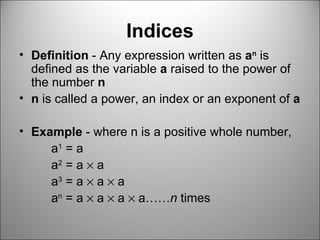
Indices Definition  - Any expression written as  a n  is defined as the variable  a  raised to the power of the number  n n  is called a power, an index or an exponent of  a Example  - where n is a positive whole number,  a 1  = a a 2  = a    a  a 3  = a    a    a  a n  = a    a    a    a…… n  times
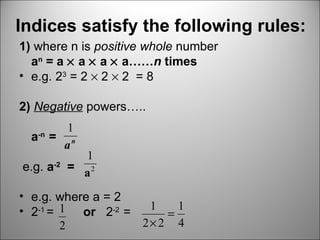
Indices satisfy the following rules:   1)  where n is  positive whole  number a n  = a    a    a    a…… n  times e.g. 2 3  = 2    2    2  = 8 2)  Negative  powers….. a -n  = e.g.  a -2   =  e.g. where a = 2 2 -1  =  or  2 -2  =
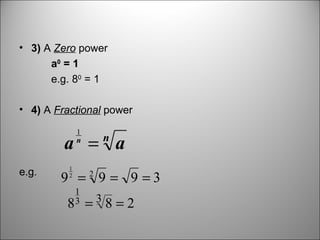
3)  A  Zero  power a 0  = 1  e.g. 8 0  = 1 4)  A  Fractional  power e.g.
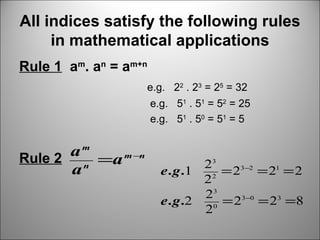
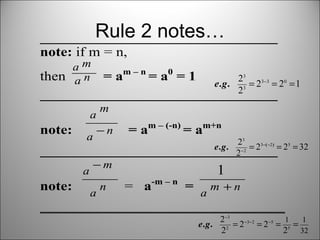
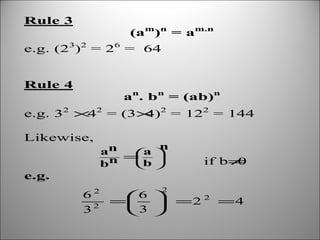
All indices satisfy the following rules in mathematical applications Rule 1   a m . a n  = a m+n e.g.  2 2  . 2 3  = 2 5  = 32   e.g.  5 1  . 5 1  = 5 2  = 25   e.g.  5 1  . 5 0  = 5 1  = 5 Rule 2
Rule 2 notes…
 
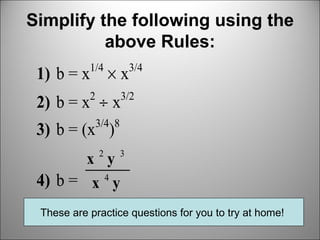
Simplify the following using the above Rules: These are practice questions for you to try at home!
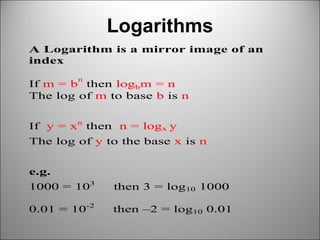
Logarithms
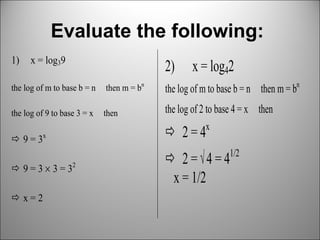
Evaluate the following:
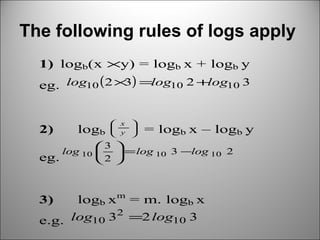
The following rules of logs apply
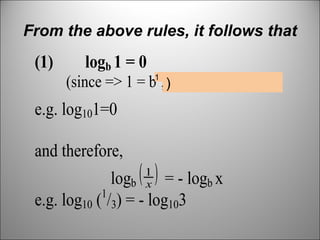
From the above rules, it follows that 1 1 )
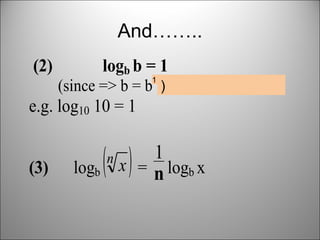
And…….. 1 )
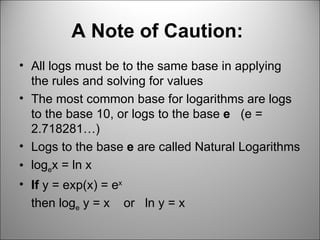
A Note of Caution:   All logs must be to the same base in applying the rules and solving for values The most common base for logarithms are logs to the base 10, or logs to the base  e  (e = 2.718281…) Logs to the base  e  are called Natural Logarithms log e x = ln x If  y = exp(x) = e x  then log e  y = x  or  ln y = x
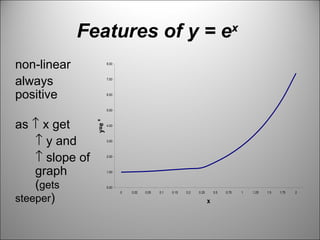
Features of y = e x   non-linear always positive as    x get    y and     slope of  graph  ( gets  steeper )
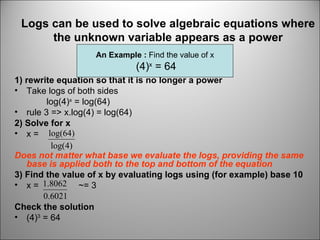
Logs can be used to solve algebraic equations where the unknown variable appears as a power 1) rewrite equation so that it is no longer a power Take logs of both sides log(4) x  = log(64) rule 3 => x.log(4) = log(64) 2) Solve for x x =  Does not matter what base we evaluate the logs, providing the same base is applied both to the top and bottom of the equation 3) Find the value of x by evaluating logs using (for example) base 10  x =  ~= 3 Check the solution (4) 3  = 64 An Example :  Find the value of x (4) x  = 64
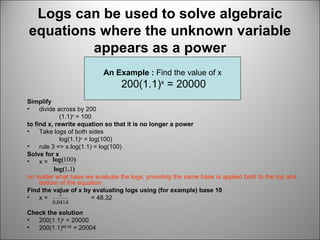
Logs can be used to solve algebraic equations where the unknown variable appears as a power Simplify divide across by 200 (1.1) x  = 100 to find x, rewrite equation so that it is no longer a power Take logs of both sides log(1.1) x  = log(100) rule 3 => x.log(1.1) = log(100) Solve for x x =  no matter what base we evaluate the logs, providing the same base is applied both to the top and bottom of the equation Find the value of x by evaluating logs using (for example) base 10  x =  = 48.32 Check the solution 200(1.1) x  = 20000 200(1.1) 48.32  = 20004   An Example :  Find the value of x 200(1.1) x  = 20000
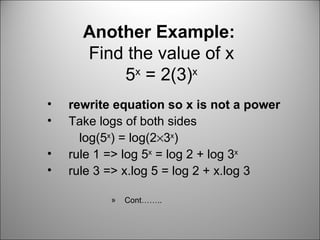
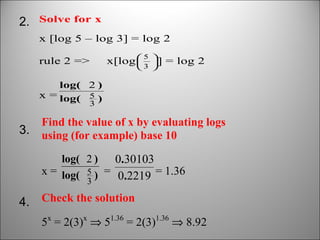
Another Example:  Find the value of x 5 x  = 2(3) x rewrite equation so x is not a power Take logs of both sides log(5 x ) = log(2  3 x ) rule 1 => log 5 x  = log 2 + log 3 x rule 3 => x.log 5 = log 2 + x.log 3 Cont……..
2. 3.  4.
Good Learning Strategy! Up to students to revise and practice the rules of indices and logs using examples from textbooks.  These rules are very important for remaining topics in the course .

Indices and logarithms

  • 1.
    Indices and LogarithmsMathematics-1 Lecture-1
  • 2.
    Indices Definition - Any expression written as a n is defined as the variable a raised to the power of the number n n is called a power, an index or an exponent of a Example - where n is a positive whole number, a 1 = a a 2 = a  a a 3 = a  a  a a n = a  a  a  a…… n times
  • 3.
    Indices satisfy thefollowing rules: 1) where n is positive whole number a n = a  a  a  a…… n times e.g. 2 3 = 2  2  2 = 8 2) Negative powers….. a -n = e.g. a -2 = e.g. where a = 2 2 -1 = or 2 -2 =
  • 4.
    3) A Zero power a 0 = 1 e.g. 8 0 = 1 4) A Fractional power e.g.
  • 5.
    All indices satisfythe following rules in mathematical applications Rule 1 a m . a n = a m+n e.g. 2 2 . 2 3 = 2 5 = 32 e.g. 5 1 . 5 1 = 5 2 = 25 e.g. 5 1 . 5 0 = 5 1 = 5 Rule 2
  • 6.
  • 7.
  • 8.
    Simplify the followingusing the above Rules: These are practice questions for you to try at home!
  • 9.
  • 10.
  • 11.
    The following rulesof logs apply
  • 12.
    From the aboverules, it follows that 1 1 )
  • 13.
  • 14.
    A Note ofCaution: All logs must be to the same base in applying the rules and solving for values The most common base for logarithms are logs to the base 10, or logs to the base e (e = 2.718281…) Logs to the base e are called Natural Logarithms log e x = ln x If y = exp(x) = e x then log e y = x or ln y = x
  • 15.
    Features of y= e x non-linear always positive as  x get  y and  slope of graph ( gets steeper )
  • 16.
    Logs can beused to solve algebraic equations where the unknown variable appears as a power 1) rewrite equation so that it is no longer a power Take logs of both sides log(4) x = log(64) rule 3 => x.log(4) = log(64) 2) Solve for x x = Does not matter what base we evaluate the logs, providing the same base is applied both to the top and bottom of the equation 3) Find the value of x by evaluating logs using (for example) base 10 x = ~= 3 Check the solution (4) 3 = 64 An Example : Find the value of x (4) x = 64
  • 17.
    Logs can beused to solve algebraic equations where the unknown variable appears as a power Simplify divide across by 200 (1.1) x = 100 to find x, rewrite equation so that it is no longer a power Take logs of both sides log(1.1) x = log(100) rule 3 => x.log(1.1) = log(100) Solve for x x = no matter what base we evaluate the logs, providing the same base is applied both to the top and bottom of the equation Find the value of x by evaluating logs using (for example) base 10 x = = 48.32 Check the solution 200(1.1) x = 20000 200(1.1) 48.32 = 20004 An Example : Find the value of x 200(1.1) x = 20000
  • 18.
    Another Example: Find the value of x 5 x = 2(3) x rewrite equation so x is not a power Take logs of both sides log(5 x ) = log(2  3 x ) rule 1 => log 5 x = log 2 + log 3 x rule 3 => x.log 5 = log 2 + x.log 3 Cont……..
  • 19.
  • 20.
    Good Learning Strategy!Up to students to revise and practice the rules of indices and logs using examples from textbooks. These rules are very important for remaining topics in the course .