Downloaded 66 times

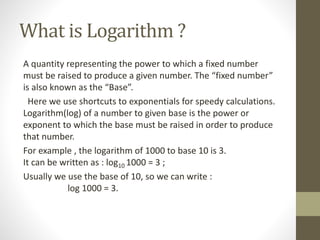
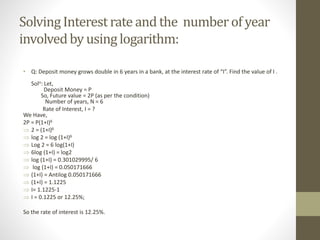
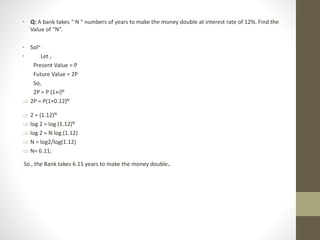


Logarithms are useful for business calculations involving exponential functions. A logarithm represents the power to which a fixed number, called the base, must be raised to produce a given number. For example, the logarithm of 1000 to base 10 is 3, written as log10 1000 = 3 or log 1000 = 3. Logarithms allow solving problems like calculating interest rates or number of years to double an investment through exponentiation, done more easily with logarithms than through long arithmetic. Examples show calculating a 12.25% interest rate and that it takes 6.11 years for money to double at 12% interest. Logarithms are widely used in financial institutions for simplifying complicated calculations.


