LOGARITHMS
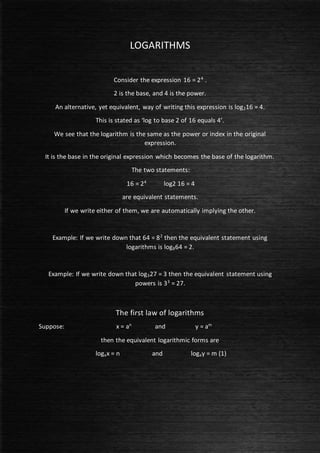
Consider the expression 16 = 24
.
2 is the base, and 4 is the power.
An alternative, yet equivalent, way of writing this expression is log216 = 4.
This is stated as ‘log to base 2 of 16 equals 4’.
We see that the logarithm is the same as the power or index in the original
expression.
It is the base in the original expression which becomes the base of the logarithm.
The two statements:
16 = 24
log2 16 = 4
are equivalent statements.
If we write either of them, we are automatically implying the other.
Example: If we write down that 64 = 82
then the equivalent statement using
logarithms is log864 = 2.
Example: If we write down that log327 = 3 then the equivalent statement using
powers is 33
= 27.
The first law of logarithms
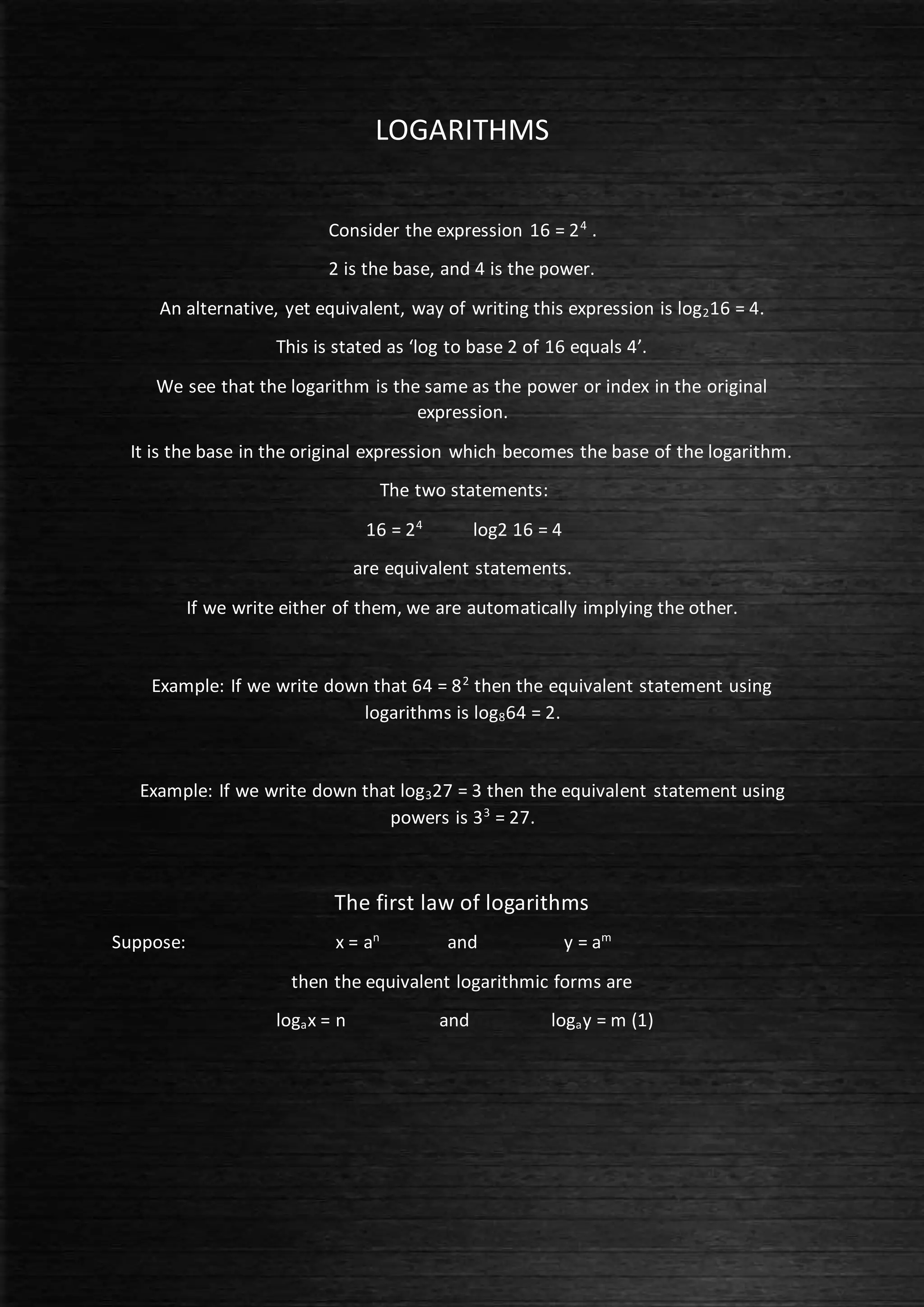
Suppose: x = an
and y = am
then the equivalent logarithmic forms are
logax = n and logay = m (1)
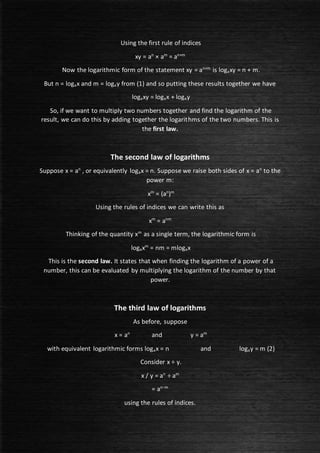
Using the first rule of indices
xy = an
× am
= an+m
Now the logarithmic form of the statement xy = an+m
is logaxy = n + m.
But n = logax and m = logay from (1) and so putting these results together we have
logaxy = logax + logay
So, if we want to multiply two numbers together and find the logarithm of the
result, we can do this by adding together the logarithms of the two numbers. This is
the first law.
The second law of logarithms
Suppose x = an
, or equivalently logax = n. Suppose we raise both sides of x = an
to the
power m:
xm
= (an
)m
Using the rules of indices we can write this as
xm
= anm
Thinking of the quantity xm
as a single term, the logarithmic form is
logaxm
= nm = mlogax
This is the second law. It states that when finding the logarithm of a power of a
number, this can be evaluated by multiplying the logarithm of the number by that
power.
The third law of logarithms
As before, suppose
x = an
and y = am
with equivalent logarithmic forms logax = n and logay = m (2)
Consider x ÷ y.
x / y = an
÷ am
= an−m
using the rules of indices.
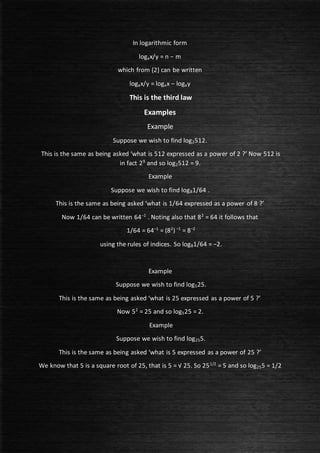
In logarithmic form
logax/y = n − m
which from (2) can be written
logax/y = logax − logay
This is the third law
Examples
Example
Suppose we wish to find log2512.
This is the same as being asked ‘what is 512 expressed as a power of 2 ?’ Now 512 is
in fact 29
and so log2512 = 9.
Example
Suppose we wish to find log81/64 .
This is the same as being asked ‘what is 1/64 expressed as a power of 8 ?’
Now 1/64 can be written 64−1
. Noting also that 82
= 64 it follows that
1/64 = 64−1
= (82
) −1
= 8−2
using the rules of indices. So log81/64 = −2.
Example
Suppose we wish to find log525.
This is the same as being asked ‘what is 25 expressed as a power of 5 ?’
Now 52
= 25 and so log525 = 2.
Example
Suppose we wish to find log255.
This is the same as being asked ‘what is 5 expressed as a power of 25 ?’
We know that 5 is a square root of 25, that is 5 = √ 25. So 251/2
= 5 and so log255 = 1/2
Example
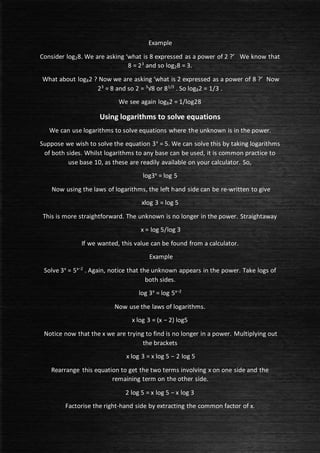
Consider log28. We are asking ‘what is 8 expressed as a power of 2 ?’ We know that
8 = 23
and so log28 = 3.
What about log82 ? Now we are asking ‘what is 2 expressed as a power of 8 ?’ Now
23
= 8 and so 2 = 3
√8 or 81/3
. So log82 = 1/3 .
We see again log82 = 1/log28
Using logarithms to solve equations
We can use logarithms to solve equations where the unknown is in the power.
Suppose we wish to solve the equation 3x
= 5. We can solve this by taking logarithms
of both sides. Whilst logarithms to any base can be used, it is common practice to
use base 10, as these are readily available on your calculator. So,
log3x
= log 5
Now using the laws of logarithms, the left hand side can be re-written to give
xlog 3 = log 5
This is more straightforward. The unknown is no longer in the power. Straightaway
x = log 5/log 3
If we wanted, this value can be found from a calculator.
Example
Solve 3x
= 5x−2
. Again, notice that the unknown appears in the power. Take logs of
both sides.
log 3x
= log 5x−2
Now use the laws of logarithms.
x log 3 = (x − 2) log5
Notice now that the x we are trying to find is no longer in a power. Multiplying out
the brackets
x log 3 = x log 5 − 2 log 5
Rearrange this equation to get the two terms involving x on one side and the
remaining term on the other side.
2 log 5 = x log 5 − x log 3
Factorise the right-hand side by extracting the common factor of x.
2 log 5 = x(log 5 − log 3)
= x log (5/3)
using the laws of logarithms.
And finally
x = 2 log 5/log(5/3)
If we wanted, this value can be found from a calculator

Logarithms

  • 1.
    LOGARITHMS Consider the expression16 = 24 . 2 is the base, and 4 is the power. An alternative, yet equivalent, way of writing this expression is log216 = 4. This is stated as ‘log to base 2 of 16 equals 4’. We see that the logarithm is the same as the power or index in the original expression. It is the base in the original expression which becomes the base of the logarithm. The two statements: 16 = 24 log2 16 = 4 are equivalent statements. If we write either of them, we are automatically implying the other. Example: If we write down that 64 = 82 then the equivalent statement using logarithms is log864 = 2. Example: If we write down that log327 = 3 then the equivalent statement using powers is 33 = 27. The first law of logarithms Suppose: x = an and y = am then the equivalent logarithmic forms are logax = n and logay = m (1)
  • 2.
    Using the firstrule of indices xy = an × am = an+m Now the logarithmic form of the statement xy = an+m is logaxy = n + m. But n = logax and m = logay from (1) and so putting these results together we have logaxy = logax + logay So, if we want to multiply two numbers together and find the logarithm of the result, we can do this by adding together the logarithms of the two numbers. This is the first law. The second law of logarithms Suppose x = an , or equivalently logax = n. Suppose we raise both sides of x = an to the power m: xm = (an )m Using the rules of indices we can write this as xm = anm Thinking of the quantity xm as a single term, the logarithmic form is logaxm = nm = mlogax This is the second law. It states that when finding the logarithm of a power of a number, this can be evaluated by multiplying the logarithm of the number by that power. The third law of logarithms As before, suppose x = an and y = am with equivalent logarithmic forms logax = n and logay = m (2) Consider x ÷ y. x / y = an ÷ am = an−m using the rules of indices.
  • 3.
    In logarithmic form logax/y= n − m which from (2) can be written logax/y = logax − logay This is the third law Examples Example Suppose we wish to find log2512. This is the same as being asked ‘what is 512 expressed as a power of 2 ?’ Now 512 is in fact 29 and so log2512 = 9. Example Suppose we wish to find log81/64 . This is the same as being asked ‘what is 1/64 expressed as a power of 8 ?’ Now 1/64 can be written 64−1 . Noting also that 82 = 64 it follows that 1/64 = 64−1 = (82 ) −1 = 8−2 using the rules of indices. So log81/64 = −2. Example Suppose we wish to find log525. This is the same as being asked ‘what is 25 expressed as a power of 5 ?’ Now 52 = 25 and so log525 = 2. Example Suppose we wish to find log255. This is the same as being asked ‘what is 5 expressed as a power of 25 ?’ We know that 5 is a square root of 25, that is 5 = √ 25. So 251/2 = 5 and so log255 = 1/2
  • 4.
    Example Consider log28. Weare asking ‘what is 8 expressed as a power of 2 ?’ We know that 8 = 23 and so log28 = 3. What about log82 ? Now we are asking ‘what is 2 expressed as a power of 8 ?’ Now 23 = 8 and so 2 = 3 √8 or 81/3 . So log82 = 1/3 . We see again log82 = 1/log28 Using logarithms to solve equations We can use logarithms to solve equations where the unknown is in the power. Suppose we wish to solve the equation 3x = 5. We can solve this by taking logarithms of both sides. Whilst logarithms to any base can be used, it is common practice to use base 10, as these are readily available on your calculator. So, log3x = log 5 Now using the laws of logarithms, the left hand side can be re-written to give xlog 3 = log 5 This is more straightforward. The unknown is no longer in the power. Straightaway x = log 5/log 3 If we wanted, this value can be found from a calculator. Example Solve 3x = 5x−2 . Again, notice that the unknown appears in the power. Take logs of both sides. log 3x = log 5x−2 Now use the laws of logarithms. x log 3 = (x − 2) log5 Notice now that the x we are trying to find is no longer in a power. Multiplying out the brackets x log 3 = x log 5 − 2 log 5 Rearrange this equation to get the two terms involving x on one side and the remaining term on the other side. 2 log 5 = x log 5 − x log 3 Factorise the right-hand side by extracting the common factor of x.
  • 5.
    2 log 5= x(log 5 − log 3) = x log (5/3) using the laws of logarithms. And finally x = 2 log 5/log(5/3) If we wanted, this value can be found from a calculator