Prepared by Dr. Sadaf Konain Ansari
for 2nd
year BDS
AntimicrobialAntimicrobial
Susceptibility TestingSusceptibility Testing
(AST)(AST)
Reasons and Indications for
Antimicrobial Susceptibility Testing
(AST)
 Goal
 Offer guidance to physician in selecting effective
antibacterial therapy for a pathogen in a specific body
site
 Performed on bacteria isolated from clinical
specimens if the bacteria’s susceptibility to
particular antimicrobial agents is uncertain
 Susceptibilities NOT performed on bacteria that are
predictably susceptible to antimicrobials
 Ex. Group A Strep
Dr.Sadaf Konain Ansari
Factors to Consider When
Determining Whether Testing is
Warranted
 Body site of infection
 Susceptibility not performed on bacteria isolated from body
site where they are normal flora
 Ex. Susceptibility for E. coli is NOT performed when isolated
from stool, but IS performed when isolated from blood
Dr.Sadaf Konain Ansari
Factors to Consider When
Determining Whether Testing is
Warranted (cont’d)
 Presence of other bacteria and quality of specimen
Ex. Two or more organisms grown in a urine
specimen
 Host status
Immunocompromised patients
Allergies to usual antimicrobials
Dr.Sadaf Konain Ansari
Selecting Antimicrobial Agents for
Testing and Reporting
Clinical & Laboratory Standards
Institute (CLSI)
 Develop standards, methods, QC parameters,
and interpretive criteria for sensitivity
testing
 If necessary, can alter the breakpoints of
the SIR ( susceptible, intermediate,
resistant) based on emerging resistance
Dr.Sadaf Konain Ansari
Selecting Antimicrobial Agents
for Testing and Reporting (cont’d)
There are approximately 50 antibacterial agents
Follow CLSI recommendations
Each laboratory should have a battery of
antibiotics ordinarily used for testing
Drug formulary decided by medical staff,
pharmacists, and medical technologists
Dr.Sadaf Konain Ansari
Selection of Test Batteries
Generally, labs choose 10-15 antibiotics
to test susceptibility for GP organisms
and another 10-15 for GN organisms
Too many choices can confuse
physicians and be too expensive
Primary objective
 Use the least toxic, most cost-effective, and most clinically
appropriate agents
 Refrain from more costly, broader-spectrum agents
Dr.Sadaf Konain Ansari
Example of Drug Formulary
Drug Enterococcus Staphylococcus spp.
Ampicillin X
Cefazolin X
Clindamycin
Erythromycin X
Linezolid X X
Oxacillin X
Penicillin G X X
Rifampin X
Streptomycin-2000 X
Tetracycline X X
Trimeth/ Sulfa X
Vancomycin X X
Dr.Sadaf Konain Ansari
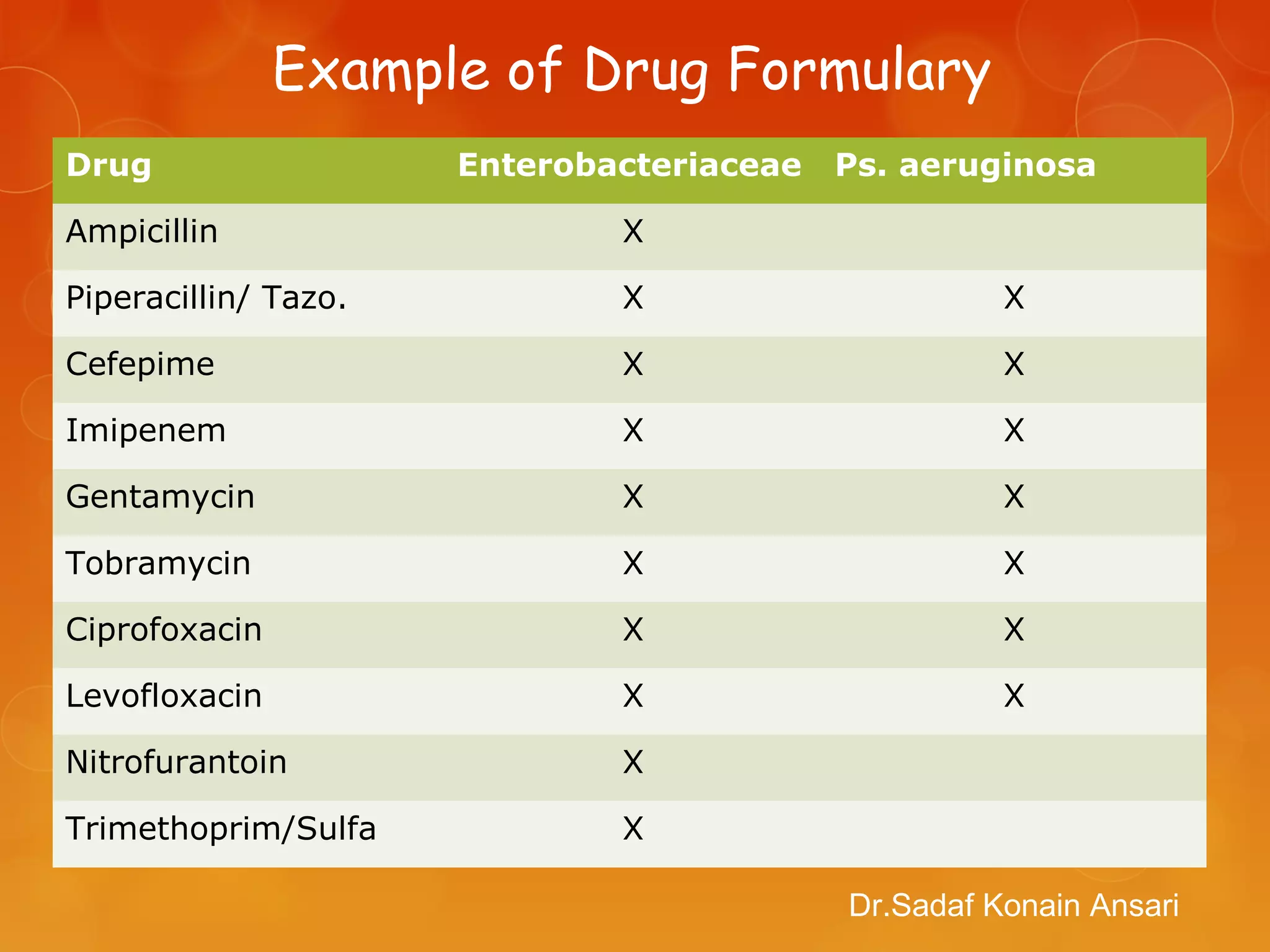
Example of Drug Formulary
Drug Enterobacteriaceae Ps. aeruginosa
Ampicillin X
Piperacillin/ Tazo. X X
Cefepime X X
Imipenem X X
Gentamycin X X
Tobramycin X X
Ciprofoxacin X X
Levofloxacin X X
Nitrofurantoin X
Trimethoprim/Sulfa X
Dr.Sadaf Konain Ansari
Definitions (important to remember)
 Minimum inhibitory concentration(MIC)
 Lowest concentration of an antimicrobial agent that
visibly inhibits the growth of the organism.
 Minimum bactericidal concentration (MBC)
 Lowest concentration of the antimicrobial agent
that results in the death of the organism.
Dr.Sadaf Konain Ansari
Definitions (cont’d)
 Susceptible ”S”
 Interpretive category that indicates an organism is
inhibited by the recommended dose, at the
infection site, of an antimicrobial agent
 Intermediate “I”
 Interpretive category that represents an organism
that may require a higher dose of antibiotic for a
longer period of time to be inhibited
 Resistant “R”
 Interpretive category that indicates an organism is
not inhibited by the recommended dose, at the
infection site, of an antimicrobial agent.
Dr.Sadaf Konain Ansari
Continue
Methods of Performing AST
 Agar dilution method
 Broth macrodilution / Tube dilution
 Broth microdilution
 Disk diffusion method
Gradient diffusion method (E-Test)
Dr.Sadaf Konain Ansari
Standardization of Antimicrobial
Susceptibility Testing
 Inoculum Preparation
Use 4-5 colonies
NOT just 1 colony
 Inoculum Standardization
using 0.5
McFarland
standard
Dr.Sadaf Konain Ansari
Methods of Performing AST
Agar Dilution
Dilutions of antimicrobial agent added
to agar
Growth on agar indicates MIC
Broth macrodilution/Tube Dilution Tests
Two-fold serial dilution series, each
with 1-2 mL of antimicrobial
Too expensive and time consuming
Microdilution Tests
plastic trays with dilutions of
antimicrobials
Dr.Sadaf Konain Ansari
Disk Diffusion/ Kirby- Bauer
 Procedure
 Use a well-isolated, 18-24 hour old
organism
 Transfer organism to a broth
Either tryptic soy/sterile saline
 Ensure a turbidity of 0.5 McFarland
 Inoculate MH agar by swabbing in
three different directions “Lawn of
growth”
 Place filter paper disks impregnated
with anitmicrobial agents on the agar
 Invert and incubate for 16-18 hours
at35 o
C in non-CO2
Dr.Sadaf Konain Ansari
Disk Diffusion/ Kirby-Bauer (cont’d)
During incubation, drug
diffuses into agar
Depending on the organism and
drug, areas of no growth form
a zone of inhibition
Zones are measured to
determine whether the
organism is susceptible,
intermediate, or resistant to
the drug
Dr.Sadaf Konain Ansari
E- test/ Gradient Diffusion Method
 “MIC on a stick”
 Plastic strips
impregnated with
antimicrobial on one side
 MIC scale on the other
side
 Read MIC where zone
of inhibition intersects E
strip scale
Dr.Sadaf Konain Ansari
Automated
Antimicrobial Susceptibility Test
Methods
Detect growth in micro volumes of broth with
various dilutions of antimicrobials
Detection via photometric, turbi-dimetric, or
fluoro-metric methods
Types
BD Phoenix
Microscan Walkaway
TREK Sensititre
Vitek 1 and 2
Dr.Sadaf Konain Ansari
Automated
Antimicrobial Susceptibility Test Methods
Advantages
Increased reproducibility
Decreased labor costs
Rapid results
Software
Detects multi-drug resistances
ESBLs
Correlates bacterial ID with sensitivity
Disadvantages
Cost
Dr.Sadaf Konain Ansari
Quality Control in Susceptibility
Testing
 Reflects types of patient isolates & range of
susceptibility
 Frequency of quality control depends on
method, CLSI, or manufacturer
 Reference strains of QC material
American Type Culture Collection(ATCC)
E. coli ATCC* 25922
S. aureus ATCC* 25923
Dr.Sadaf Konain Ansari
The Superbugs (important to remember)
 Organisms resistant to previously effective drugs
 MRSA
 methicillin-resistant Staphylococcus aureus
mecA gene codes for a PBP that does not bind
beta-lactam antibiotics
Resistant to oxacillin
 Vancomycin
VRE –Enterococcus species
VISA/VRSA- Staphylococcus aureus
Dr.Sadaf Konain Ansari
The Superbugs: The Beta-Lactamases
 Gram negative rods that have genes on chromosomes that code for
enzymes against certain antimicrobials
 ESBLs-extended spectrum beta lactamase
 Resistant to extended spectrum cephalosporins, penicillins,
aztreonam
 Examples: E. coli, Klebsiella
 Carbapenemases (CRE)
 Klebsiella pneumoniae- KPC- Class A
 Class B (NDM, VIM, IMP)- metallo beta lactamases
 Resistant to penicillins, cephalosporins, carbapenems, and aztreonam
 Cephalosporinases
 AmpC enzyme
 inducible
 “SPACE” organisms Dr.Sadaf Konain Ansari
Controlling the Superbugs
 Lab’s Role
 Recognize and report isolates recovered from
clinical specimens
 Methods for identification include automated
systems and screening agars
Dr.Sadaf Konain Ansari
Controlling the Superbugs
 Role of Health Care Workers/Facilities
 Hand hygiene with the use of alcohol-based hand
rubs or soap and water after patient care
 Contact precautions for patients identified as
colonized or infected with a superbug
 Healthcare personnel education about the
methods of transmission, contact precautions,
and proper use of hand hygiene
 Minimization of invasive devices (catheters, etc.)
 Proper administration of antimicrobial agents
where therapy is selected for susceptible
organisms for the proper duration
Dr.Sadaf Konain Ansari
Continue
References
 http://www.biomerieux-diagnostics.com/servlet/srt/bio/clinical-d
 http://www.cdc.gov/std/gonorrhea/lab/diskdiff.htm
 http://www.who.int/drugresistance/Antimicrobial_Detection/en/
 Kiser, K. M., Payne, W. C., & Taff, T. A. (2011). Clinical
Laboratory Microbiology: A Practical Approach . Upper
Saddle River, NJ: Pearson Education.
 Mahon, C. R., Lehman, D. C., & Manuselis, G. (2011).
Textbook of Diagnostic Microbiology (4th ed.).
Maryland Heights, MO: Saunders.
 Murray, P. R. (2013, May). Carbapenem-resistant
Enterobacteriaceae: what has happened, and what is
being done. MLO, 45(5), 26-30.
Dr.Sadaf Konain Ansari
Exercise Questions
ESKAPEPathogens of Highest Concern The most serious, life-
threatening infections are caused by a group of drug-
resistant bacteria that the Infectious Diseases Society of
America (IDSA) has labeled the "ESKAPE" pathogens, because
they effectively escape the effects of antibacterial drugs 
What are ESKAPE
Dr.Sadaf Konain Ansari
 Minimum inhibitory concentration(MIC)
Lowest concentration of an antimicrobial agent that
visibly inhibits the growth of the organism.
 Minimum bactericidal concentration (MBC)
Lowest concentration of the antimicrobial agent that
results in the death of the organism.
What stand for MIS, and MBC?
Dr.Sadaf Konain Ansari
Common Questions:
 Susceptible ”S”
 Interpretive category that indicates an organism is inhibited by the
recommended dose, at the infection site, of an antimicrobial agent
 Intermediate “I”
 Interpretive category that represents an organism that may require
a higher dose of antibiotic for a longer period of time to be inhibited
 Resistant “R”
 Interpretive category that indicates an organism is not inhibited by
the recommended dose, at the infection site, of an antimicrobial
agent.
What stands for S, I and R?
Dr.Sadaf Konain Ansari
Common Questions:
THANK YOU
Email:
Sdf_ansari@yahoo.com

ACT antimicrobial susceptibility testing, inoculation and drug sensitivity

  • 1.
    Prepared by Dr.Sadaf Konain Ansari for 2nd year BDS AntimicrobialAntimicrobial Susceptibility TestingSusceptibility Testing (AST)(AST)
  • 2.
    Reasons and Indicationsfor Antimicrobial Susceptibility Testing (AST)  Goal  Offer guidance to physician in selecting effective antibacterial therapy for a pathogen in a specific body site  Performed on bacteria isolated from clinical specimens if the bacteria’s susceptibility to particular antimicrobial agents is uncertain  Susceptibilities NOT performed on bacteria that are predictably susceptible to antimicrobials  Ex. Group A Strep Dr.Sadaf Konain Ansari
  • 3.
    Factors to ConsiderWhen Determining Whether Testing is Warranted  Body site of infection  Susceptibility not performed on bacteria isolated from body site where they are normal flora  Ex. Susceptibility for E. coli is NOT performed when isolated from stool, but IS performed when isolated from blood Dr.Sadaf Konain Ansari
  • 4.
    Factors to ConsiderWhen Determining Whether Testing is Warranted (cont’d)  Presence of other bacteria and quality of specimen Ex. Two or more organisms grown in a urine specimen  Host status Immunocompromised patients Allergies to usual antimicrobials Dr.Sadaf Konain Ansari
  • 5.
    Selecting Antimicrobial Agentsfor Testing and Reporting Clinical & Laboratory Standards Institute (CLSI)  Develop standards, methods, QC parameters, and interpretive criteria for sensitivity testing  If necessary, can alter the breakpoints of the SIR ( susceptible, intermediate, resistant) based on emerging resistance Dr.Sadaf Konain Ansari
  • 6.
    Selecting Antimicrobial Agents forTesting and Reporting (cont’d) There are approximately 50 antibacterial agents Follow CLSI recommendations Each laboratory should have a battery of antibiotics ordinarily used for testing Drug formulary decided by medical staff, pharmacists, and medical technologists Dr.Sadaf Konain Ansari
  • 7.
    Selection of TestBatteries Generally, labs choose 10-15 antibiotics to test susceptibility for GP organisms and another 10-15 for GN organisms Too many choices can confuse physicians and be too expensive Primary objective  Use the least toxic, most cost-effective, and most clinically appropriate agents  Refrain from more costly, broader-spectrum agents Dr.Sadaf Konain Ansari
  • 8.
    Example of DrugFormulary Drug Enterococcus Staphylococcus spp. Ampicillin X Cefazolin X Clindamycin Erythromycin X Linezolid X X Oxacillin X Penicillin G X X Rifampin X Streptomycin-2000 X Tetracycline X X Trimeth/ Sulfa X Vancomycin X X Dr.Sadaf Konain Ansari
  • 9.
    Example of DrugFormulary Drug Enterobacteriaceae Ps. aeruginosa Ampicillin X Piperacillin/ Tazo. X X Cefepime X X Imipenem X X Gentamycin X X Tobramycin X X Ciprofoxacin X X Levofloxacin X X Nitrofurantoin X Trimethoprim/Sulfa X Dr.Sadaf Konain Ansari
  • 10.
    Definitions (important toremember)  Minimum inhibitory concentration(MIC)  Lowest concentration of an antimicrobial agent that visibly inhibits the growth of the organism.  Minimum bactericidal concentration (MBC)  Lowest concentration of the antimicrobial agent that results in the death of the organism. Dr.Sadaf Konain Ansari
  • 11.
    Definitions (cont’d)  Susceptible”S”  Interpretive category that indicates an organism is inhibited by the recommended dose, at the infection site, of an antimicrobial agent  Intermediate “I”  Interpretive category that represents an organism that may require a higher dose of antibiotic for a longer period of time to be inhibited  Resistant “R”  Interpretive category that indicates an organism is not inhibited by the recommended dose, at the infection site, of an antimicrobial agent. Dr.Sadaf Konain Ansari
  • 12.
  • 13.
    Methods of PerformingAST  Agar dilution method  Broth macrodilution / Tube dilution  Broth microdilution  Disk diffusion method Gradient diffusion method (E-Test) Dr.Sadaf Konain Ansari
  • 14.
    Standardization of Antimicrobial SusceptibilityTesting  Inoculum Preparation Use 4-5 colonies NOT just 1 colony  Inoculum Standardization using 0.5 McFarland standard Dr.Sadaf Konain Ansari
  • 15.
    Methods of PerformingAST Agar Dilution Dilutions of antimicrobial agent added to agar Growth on agar indicates MIC Broth macrodilution/Tube Dilution Tests Two-fold serial dilution series, each with 1-2 mL of antimicrobial Too expensive and time consuming Microdilution Tests plastic trays with dilutions of antimicrobials Dr.Sadaf Konain Ansari
  • 16.
    Disk Diffusion/ Kirby-Bauer  Procedure  Use a well-isolated, 18-24 hour old organism  Transfer organism to a broth Either tryptic soy/sterile saline  Ensure a turbidity of 0.5 McFarland  Inoculate MH agar by swabbing in three different directions “Lawn of growth”  Place filter paper disks impregnated with anitmicrobial agents on the agar  Invert and incubate for 16-18 hours at35 o C in non-CO2 Dr.Sadaf Konain Ansari
  • 17.
    Disk Diffusion/ Kirby-Bauer(cont’d) During incubation, drug diffuses into agar Depending on the organism and drug, areas of no growth form a zone of inhibition Zones are measured to determine whether the organism is susceptible, intermediate, or resistant to the drug Dr.Sadaf Konain Ansari
  • 18.
    E- test/ GradientDiffusion Method  “MIC on a stick”  Plastic strips impregnated with antimicrobial on one side  MIC scale on the other side  Read MIC where zone of inhibition intersects E strip scale Dr.Sadaf Konain Ansari
  • 19.
    Automated Antimicrobial Susceptibility Test Methods Detectgrowth in micro volumes of broth with various dilutions of antimicrobials Detection via photometric, turbi-dimetric, or fluoro-metric methods Types BD Phoenix Microscan Walkaway TREK Sensititre Vitek 1 and 2 Dr.Sadaf Konain Ansari
  • 20.
    Automated Antimicrobial Susceptibility TestMethods Advantages Increased reproducibility Decreased labor costs Rapid results Software Detects multi-drug resistances ESBLs Correlates bacterial ID with sensitivity Disadvantages Cost Dr.Sadaf Konain Ansari
  • 21.
    Quality Control inSusceptibility Testing  Reflects types of patient isolates & range of susceptibility  Frequency of quality control depends on method, CLSI, or manufacturer  Reference strains of QC material American Type Culture Collection(ATCC) E. coli ATCC* 25922 S. aureus ATCC* 25923 Dr.Sadaf Konain Ansari
  • 22.
    The Superbugs (importantto remember)  Organisms resistant to previously effective drugs  MRSA  methicillin-resistant Staphylococcus aureus mecA gene codes for a PBP that does not bind beta-lactam antibiotics Resistant to oxacillin  Vancomycin VRE –Enterococcus species VISA/VRSA- Staphylococcus aureus Dr.Sadaf Konain Ansari
  • 23.
    The Superbugs: TheBeta-Lactamases  Gram negative rods that have genes on chromosomes that code for enzymes against certain antimicrobials  ESBLs-extended spectrum beta lactamase  Resistant to extended spectrum cephalosporins, penicillins, aztreonam  Examples: E. coli, Klebsiella  Carbapenemases (CRE)  Klebsiella pneumoniae- KPC- Class A  Class B (NDM, VIM, IMP)- metallo beta lactamases  Resistant to penicillins, cephalosporins, carbapenems, and aztreonam  Cephalosporinases  AmpC enzyme  inducible  “SPACE” organisms Dr.Sadaf Konain Ansari
  • 24.
    Controlling the Superbugs Lab’s Role  Recognize and report isolates recovered from clinical specimens  Methods for identification include automated systems and screening agars Dr.Sadaf Konain Ansari
  • 25.
    Controlling the Superbugs Role of Health Care Workers/Facilities  Hand hygiene with the use of alcohol-based hand rubs or soap and water after patient care  Contact precautions for patients identified as colonized or infected with a superbug  Healthcare personnel education about the methods of transmission, contact precautions, and proper use of hand hygiene  Minimization of invasive devices (catheters, etc.)  Proper administration of antimicrobial agents where therapy is selected for susceptible organisms for the proper duration Dr.Sadaf Konain Ansari
  • 26.
  • 27.
    References  http://www.biomerieux-diagnostics.com/servlet/srt/bio/clinical-d  http://www.cdc.gov/std/gonorrhea/lab/diskdiff.htm http://www.who.int/drugresistance/Antimicrobial_Detection/en/  Kiser, K. M., Payne, W. C., & Taff, T. A. (2011). Clinical Laboratory Microbiology: A Practical Approach . Upper Saddle River, NJ: Pearson Education.  Mahon, C. R., Lehman, D. C., & Manuselis, G. (2011). Textbook of Diagnostic Microbiology (4th ed.). Maryland Heights, MO: Saunders.  Murray, P. R. (2013, May). Carbapenem-resistant Enterobacteriaceae: what has happened, and what is being done. MLO, 45(5), 26-30. Dr.Sadaf Konain Ansari
  • 28.
  • 29.
    ESKAPEPathogens of HighestConcern The most serious, life- threatening infections are caused by a group of drug- resistant bacteria that the Infectious Diseases Society of America (IDSA) has labeled the "ESKAPE" pathogens, because they effectively escape the effects of antibacterial drugs  What are ESKAPE Dr.Sadaf Konain Ansari
  • 30.
     Minimum inhibitoryconcentration(MIC) Lowest concentration of an antimicrobial agent that visibly inhibits the growth of the organism.  Minimum bactericidal concentration (MBC) Lowest concentration of the antimicrobial agent that results in the death of the organism. What stand for MIS, and MBC? Dr.Sadaf Konain Ansari Common Questions:
  • 31.
     Susceptible ”S” Interpretive category that indicates an organism is inhibited by the recommended dose, at the infection site, of an antimicrobial agent  Intermediate “I”  Interpretive category that represents an organism that may require a higher dose of antibiotic for a longer period of time to be inhibited  Resistant “R”  Interpretive category that indicates an organism is not inhibited by the recommended dose, at the infection site, of an antimicrobial agent. What stands for S, I and R? Dr.Sadaf Konain Ansari Common Questions:
  • 32.