ANTIBIOTIC
SENSIIVITY TEST
PRESENTED BY
S A N A F AT I M A
TOPICS
Introduction
Interpretations of
results
Conclusion
Advancement
Clinical significance
Limitations
Methods of testing
Importance
3
7
6
8
5
4
2
1
INTRODUCTION
Antibiotic Susceptibility Testing (AST) is a laboratory procedure
used to determine the sensitivity of bacteria to specific
antibiotics.
It helps in identifying the most effective antibiotic for treating a
bacterial infection, ensuring that the chosen drug can inhibit or
kill the pathogen.
IMPORTANCE
• Ensures the appropriate antibiotic is prescribed, reducing the
risk of treatment failure.
• Helps in the management of antibiotic resistance by
identifying resistant strains.
• Guides personalized treatment plans, improving patient
outcomes and reducing healthcare costs.
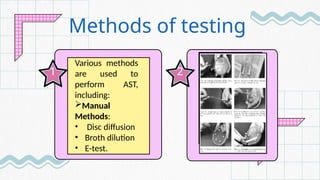
Methods of testing
1 2
Various methods
are used to
perform AST,
including:
Manual
Methods:
• Disc diffusion
• Broth dilution
• E-test.
Methods of testing
Automated Methods:
Systems like VITEK, and BD Phoenix.
• Each method varies in complexity,
time, and precision, with manual
methods often used in smaller
labs and automated systems in
larger clinical settings.
disc diffusion method
• The culture method used for
antibiotic sensitivity testing is Muller
Hinton agar.
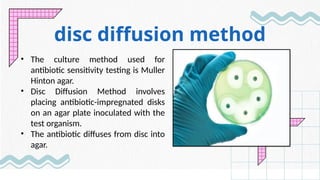
• Disc Diffusion Method involves
placing antibiotic-impregnated disks
on an agar plate inoculated with the
test organism.
• The antibiotic diffuses from disc into
agar.
Cont..
Interpretation.
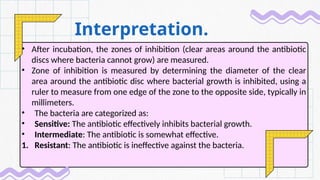
• After incubation, the zones of inhibition (clear areas around the antibiotic
discs where bacteria cannot grow) are measured.
• Zone of inhibition is measured by determining the diameter of the clear
area around the antibiotic disc where bacterial growth is inhibited, using a
ruler to measure from one edge of the zone to the opposite side, typically in
millimeters.
• The bacteria are categorized as:
• Sensitive: The antibiotic effectively inhibits bacterial growth.
• Intermediate: The antibiotic is somewhat effective.
1. Resistant: The antibiotic is ineffective against the bacteria.
Advantages:
Simple and cost-effective.
Provides clear, visual results that are easy to interpret.
Can be done for a wide range of bacteria and antibiotics.
Disadvantages:
It is semi-quantitative (compared to the MIC, it doesn’t give a precise
concentration of antibiotics that can inhibit bacterial growth).
• Results can be influenced by factors like agar thickness, incubation time,
or temperature.
Broth dilution method
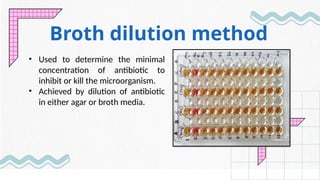
• Used to determine the minimal
concentration of antibiotic to
inhibit or kill the microorganism.
• Achieved by dilution of antibiotic
in either agar or broth media.
MIC
The lowest concentration of drug that inhibits the growth of bacteria.
The MIC is determined by inoculating the organism isolated from patient
into series of tubes containing dilutions of drug.
Incubate at 37°C
Interpretation:
After incubation the lowest concentration of drug that prevent visible
growth of organism is the MIC.
• The MIC can be calculated from the diameter of the zone of inhibition in a
Kirby-Bauer (disc diffusion method) test using a standard-curve graph.
The zone of inhibition is measured in millimeters.
MIC
Advantages:
Provides a precise measurement of the lowest concentration of antibiotic
that will prevent bacterial growth.
• Useful for determining the most appropriate antibiotic and dosage for
treatment.
• Disadvantages:
• More labor-intensive and time-consuming compared to the disk
diffusion test.
• Typically requires more specialized equipment and reagents.
E test method
• The E-test is a gradient method that
combines elements of both disk
diffusion and dilution.
• A plastic strip with a gradient of
antibiotic concentration is placed on an
inoculated agar plate.
• The MIC is read at the point where the
bacterial growth intersects the strip.
Interpretation:
• The MIC is read directly from the strip at the point where the
bacterial growth is inhibited.
• For example, if the bacterial growth is inhibited at a point labeled
0.5 µg/mL, the MIC for that antibiotic is 0.5 µg/mL.
• Advantages:
• Offers precise MIC determination like the MIC test but is simpler and
faster.
• Ideal for cases where traditional disk diffusion is not sufficient or
appropriate.
• Disadvantages:
• More expensive than disk diffusion.
• Limited to certain bacterial species and antibiotics.
IInterpretations of
results
 AST results are interpreted using
clinical breakpoints, which classify
bacteria as:
Susceptible (S): The antibiotic is
likely effective at standard doses.
Intermediate (I): Higher antibiotic
doses may be needed, or
effectiveness is uncertain.
Resistant (R): The antibiotic is
unlikely to be effective, even at high
doses
Factors affecting test
results
1. Inoculum Size: Incorrect bacterial concentration can
skew results.
2. Medium Composition: The type and composition of the
growth medium can influence bacterial growth.
3. Incubation Conditions: Temperature, atmosphere, and
incubation time must be strictly controlled to ensure
valid results.
Clinical significance
AST results guide clinicians in:
 Selecting the most appropriate antibiotic therapy,
reducing the risk of ineffective treatment.
 Monitoring the emergence of antibiotic resistance in
hospital and community settings.
Limitations of antibiotic
susceptibility
1. Slow-growing bacteria: Some pathogens grow slowly or
not at all in standard testing conditions, leading to
inconclusive results.
2. Biofilms: Bacteria in biofilms may show different
susceptibility than planktonic cells.
3. Resistance mechanisms: Some resistance mechanisms
may not be detected by standard AST methods,
requiring molecular testing.
Advantages in testing
technologies
1.Rapid AST Methods: New technologies provide results
within hours instead of days.
2.Genotypic Testing: Detects specific genetic markers of
resistance, offering a faster and more precise alternative
to phenotypic methods.
conclusion
 AST is essential in modern medicine for guiding antibiotic
therapy, managing resistance, and ensuring effective
treatment.
 Future advancements, such as rapid and genotypic
testing, will enhance the ability to combat antibiotic-
resistant bacteria and improve patient outcomes.
Thank you

AST( antibiotic susceptibility testing).pptx

  • 1.
  • 2.
  • 3.
    INTRODUCTION Antibiotic Susceptibility Testing(AST) is a laboratory procedure used to determine the sensitivity of bacteria to specific antibiotics. It helps in identifying the most effective antibiotic for treating a bacterial infection, ensuring that the chosen drug can inhibit or kill the pathogen.
  • 4.
    IMPORTANCE • Ensures theappropriate antibiotic is prescribed, reducing the risk of treatment failure. • Helps in the management of antibiotic resistance by identifying resistant strains. • Guides personalized treatment plans, improving patient outcomes and reducing healthcare costs.
  • 5.
    Methods of testing 12 Various methods are used to perform AST, including: Manual Methods: • Disc diffusion • Broth dilution • E-test.
  • 6.
    Methods of testing AutomatedMethods: Systems like VITEK, and BD Phoenix. • Each method varies in complexity, time, and precision, with manual methods often used in smaller labs and automated systems in larger clinical settings.
  • 7.
    disc diffusion method •The culture method used for antibiotic sensitivity testing is Muller Hinton agar. • Disc Diffusion Method involves placing antibiotic-impregnated disks on an agar plate inoculated with the test organism. • The antibiotic diffuses from disc into agar.
  • 8.
  • 9.
    Interpretation. • After incubation,the zones of inhibition (clear areas around the antibiotic discs where bacteria cannot grow) are measured. • Zone of inhibition is measured by determining the diameter of the clear area around the antibiotic disc where bacterial growth is inhibited, using a ruler to measure from one edge of the zone to the opposite side, typically in millimeters. • The bacteria are categorized as: • Sensitive: The antibiotic effectively inhibits bacterial growth. • Intermediate: The antibiotic is somewhat effective. 1. Resistant: The antibiotic is ineffective against the bacteria.
  • 10.
    Advantages: Simple and cost-effective. Providesclear, visual results that are easy to interpret. Can be done for a wide range of bacteria and antibiotics. Disadvantages: It is semi-quantitative (compared to the MIC, it doesn’t give a precise concentration of antibiotics that can inhibit bacterial growth). • Results can be influenced by factors like agar thickness, incubation time, or temperature.
  • 11.
    Broth dilution method •Used to determine the minimal concentration of antibiotic to inhibit or kill the microorganism. • Achieved by dilution of antibiotic in either agar or broth media.
  • 12.
    MIC The lowest concentrationof drug that inhibits the growth of bacteria. The MIC is determined by inoculating the organism isolated from patient into series of tubes containing dilutions of drug. Incubate at 37°C Interpretation: After incubation the lowest concentration of drug that prevent visible growth of organism is the MIC. • The MIC can be calculated from the diameter of the zone of inhibition in a Kirby-Bauer (disc diffusion method) test using a standard-curve graph. The zone of inhibition is measured in millimeters.
  • 13.
    MIC Advantages: Provides a precisemeasurement of the lowest concentration of antibiotic that will prevent bacterial growth. • Useful for determining the most appropriate antibiotic and dosage for treatment. • Disadvantages: • More labor-intensive and time-consuming compared to the disk diffusion test. • Typically requires more specialized equipment and reagents.
  • 14.
    E test method •The E-test is a gradient method that combines elements of both disk diffusion and dilution. • A plastic strip with a gradient of antibiotic concentration is placed on an inoculated agar plate. • The MIC is read at the point where the bacterial growth intersects the strip.
  • 15.
    Interpretation: • The MICis read directly from the strip at the point where the bacterial growth is inhibited. • For example, if the bacterial growth is inhibited at a point labeled 0.5 µg/mL, the MIC for that antibiotic is 0.5 µg/mL. • Advantages: • Offers precise MIC determination like the MIC test but is simpler and faster. • Ideal for cases where traditional disk diffusion is not sufficient or appropriate. • Disadvantages: • More expensive than disk diffusion. • Limited to certain bacterial species and antibiotics.
  • 16.
    IInterpretations of results  ASTresults are interpreted using clinical breakpoints, which classify bacteria as: Susceptible (S): The antibiotic is likely effective at standard doses. Intermediate (I): Higher antibiotic doses may be needed, or effectiveness is uncertain. Resistant (R): The antibiotic is unlikely to be effective, even at high doses
  • 17.
    Factors affecting test results 1.Inoculum Size: Incorrect bacterial concentration can skew results. 2. Medium Composition: The type and composition of the growth medium can influence bacterial growth. 3. Incubation Conditions: Temperature, atmosphere, and incubation time must be strictly controlled to ensure valid results.
  • 18.
    Clinical significance AST resultsguide clinicians in:  Selecting the most appropriate antibiotic therapy, reducing the risk of ineffective treatment.  Monitoring the emergence of antibiotic resistance in hospital and community settings.
  • 19.
    Limitations of antibiotic susceptibility 1.Slow-growing bacteria: Some pathogens grow slowly or not at all in standard testing conditions, leading to inconclusive results. 2. Biofilms: Bacteria in biofilms may show different susceptibility than planktonic cells. 3. Resistance mechanisms: Some resistance mechanisms may not be detected by standard AST methods, requiring molecular testing.
  • 20.
    Advantages in testing technologies 1.RapidAST Methods: New technologies provide results within hours instead of days. 2.Genotypic Testing: Detects specific genetic markers of resistance, offering a faster and more precise alternative to phenotypic methods.
  • 21.
    conclusion  AST isessential in modern medicine for guiding antibiotic therapy, managing resistance, and ensuring effective treatment.  Future advancements, such as rapid and genotypic testing, will enhance the ability to combat antibiotic- resistant bacteria and improve patient outcomes.
  • 22.