CHROMOSOMAL
ABNORMALITIES
What are chromosomal abnormalities?
• These alterations can be detected by studying
the affected person´s karyotype.
• There are many types of chromosomal
abnormalities. However, they can be organized
into two basic groups:
▫ Numerical abnormalities:
▫ Structural abnormalities
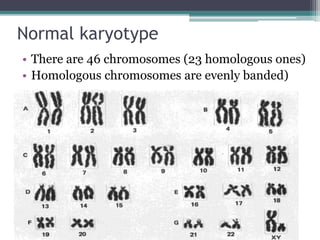
Normal karyotype
• There are 46 chromosomes (23 homologous ones)
• Homologous chromosomes are evenly banded)
Changes in the number of chromosomes of a karyotype.
Numerical abnormalities
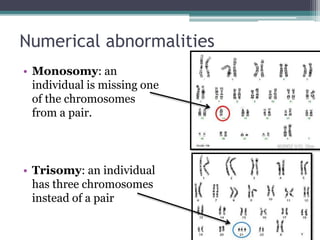
• Monosomy: an
individual is missing one
of the chromosomes
from a pair.
• Trisomy: an individual
has three chromosomes
instead of a pair
Numerical abnormalities. MONOSOMY
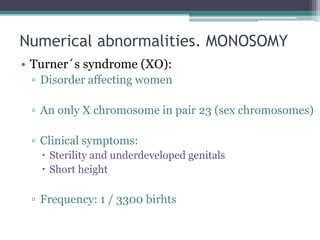
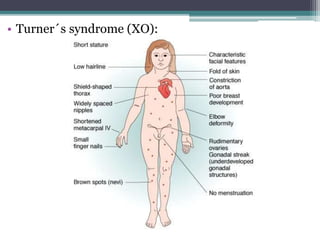
• Turner´s syndrome (XO):
▫ Disorder affecting women
▫ An only X chromosome in pair 23 (sex chromosomes)
▫ Clinical symptoms:
 Sterility and underdeveloped genitals
 Short height
▫ Frequency: 1 / 3300 birhts
• Turner´s syndrome (XO):
Numerical abnormalities. TRISOMY
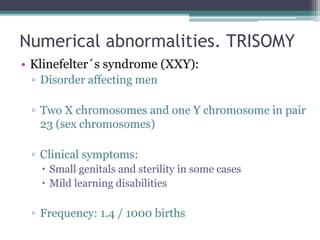
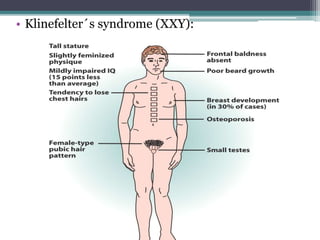
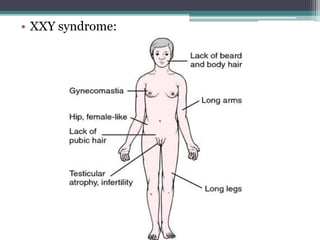
• Klinefelter´s syndrome (XXY):
▫ Disorder affecting men
▫ Two X chromosomes and one Y chromosome in pair
23 (sex chromosomes)
▫ Clinical symptoms:
 Small genitals and sterility in some cases
 Mild learning disabilities
▫ Frequency: 1.4 / 1000 births
• Klinefelter´s syndrome (XXY):
Numerical abnormalities. TRISOMY
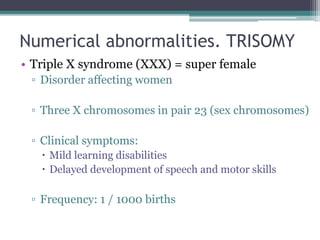
• Triple X syndrome (XXX) = super female
▫ Disorder affecting women
▫ Three X chromosomes in pair 23 (sex chromosomes)
▫ Clinical symptoms:
 Mild learning disabilities
 Delayed development of speech and motor skills
▫ Frequency: 1 / 1000 births
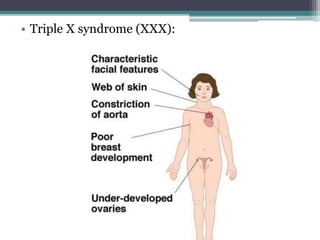
• Triple X syndrome (XXX):
Numerical abnormalities. TRISOMY
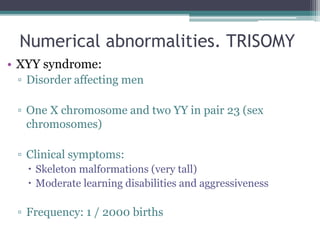
• XYY syndrome:
▫ Disorder affecting men
▫ One X chromosome and two YY in pair 23 (sex
chromosomes)
▫ Clinical symptoms:
 Skeleton malformations (very tall)
 Moderate learning disabilities and aggressiveness
▫ Frequency: 1 / 2000 births
• XYY syndrome:
Numerical abnormalities. TRISOMY
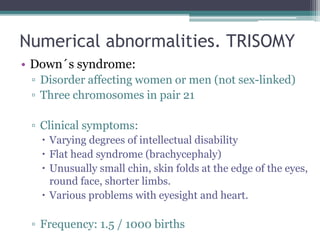
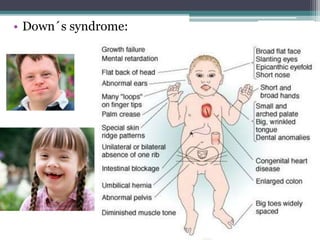
• Down´s syndrome:
▫ Disorder affecting women or men (not sex-linked)
▫ Three chromosomes in pair 21
▫ Clinical symptoms:
 Varying degrees of intellectual disability
 Flat head syndrome (brachycephaly)
 Unusually small chin, skin folds at the edge of the eyes,
round face, shorter limbs.
 Various problems with eyesight and heart.
▫ Frequency: 1.5 / 1000 births
• Down´s syndrome:
Numerical abnormalities. TRISOMY
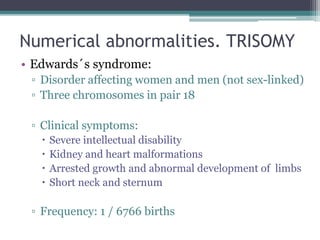
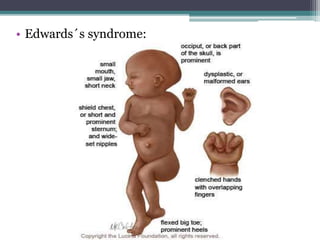
• Edwards´s syndrome:
▫ Disorder affecting women and men (not sex-linked)
▫ Three chromosomes in pair 18
▫ Clinical symptoms:
 Severe intellectual disability
 Kidney and heart malformations
 Arrested growth and abnormal development of limbs
 Short neck and sternum
▫ Frequency: 1 / 6766 births
• Edwards´s syndrome:
Numerical abnormalities. TRISOMY
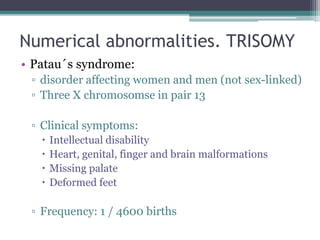
• Patau´s syndrome:
▫ disorder affecting women and men (not sex-linked)
▫ Three X chromosomse in pair 13
▫ Clinical symptoms:
 Intellectual disability
 Heart, genital, finger and brain malformations
 Missing palate
 Deformed feet
▫ Frequency: 1 / 4600 births
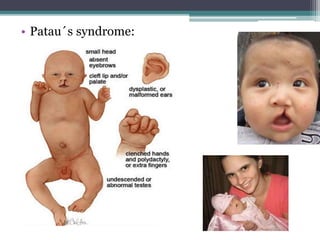
• Patau´s syndrome:
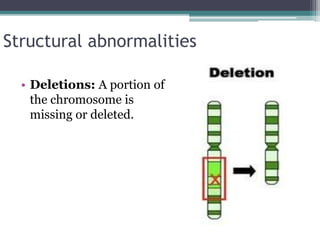
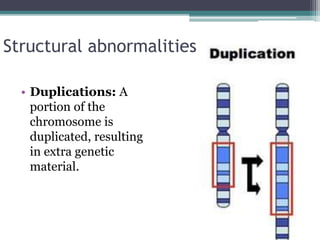
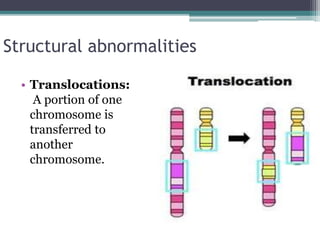
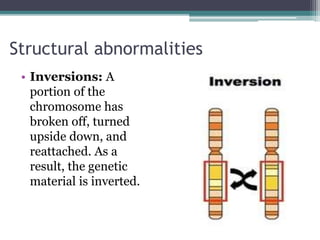
Changes located in the structure of every single chromosome
Structural abnormalities
• Deletions: A portion of
the chromosome is
missing or deleted.
Structural abnormalities
• Duplications: A
portion of the
chromosome is
duplicated, resulting
in extra genetic
material.
Structural abnormalities
• Translocations:
A portion of one
chromosome is
transferred to
another
chromosome.
Structural abnormalities
• Inversions: A
portion of the
chromosome has
broken off, turned
upside down, and
reattached. As a
result, the genetic
material is inverted.
References
• http://www.genome.gov/11508982#al-5
• http://www.dnaftb.org/#classical
• http://learn.genetics.utah.edu/content/disorders/c
hromosomal/
• Cabrera. A. et al. 2012. 4 ESO. Biology and Geology.
Oxford Education

Chromosomal abnormalities