ANTHONY GABRIAL.S
Indira Gandhi Medical College & Research Institute
Pondicherry
CONGENITAL
VAGINAL
HYDROCELE
A case report
INTRODUCTION
 Definition: Is a collection of fluid within
the tunica vaginalis of the testis.
 Common in newborns.
 Most hydroceles disappear without
treatment within the 18 months of life.
 Usually unilateral, but can also occur
bilatarally
 Hydrocele normally is seen
in infant boys - as enlarged scrotum.
in infant girls - as enlarged labia.
 Hydrocele boys > girls.
 There is a greater chance of infertility if
the hydrocele does not show itself until
the child has reached adulthood.
MATERIALS & METHODS
 A 4 years old boy was referred to the
pediatric OPD with swelling of right
scrotum since birth.
 The mother complained of swelling of
right scrotum, which increased in size
gradually.
 No h/o pain.
 There was no h/o decresing in size of
swelling on lying position.
 No h/o increase in size with swelling on
coughing.
HYDROCELE
ON EXAMINATION
 Skin and subcutaneous tissue: Tense,
normal rugosity of the skin lost.
 Impulse on coughing: Negative
 Fluctuation: Positive
 Transillumination test: Positive
 Reducibility: Positive.
 Testis- can be palpated posteriorly
 Lymph nodes- Not palpable
 Left scrotum was normal.
 USG : Done for right scrotum
ULTRASONOGRAPHY
USG reveals the right testicle with
hydrocele
 On examination, It was identified as
COMMUNICATING HYDROCELE.
 It was diagnosed as CONGENITAL RIGHT
SIDED VAGINAL HYDROCELE & surgical
correction of the hydrocele was done.
DISCUSSION
CONGENITAL VAGINAL HYDROCELE
Fluid-filled sac surrounding a testicle
swelling of the scrotum
Presented as loose bag of skin underneath
the penis.
 As the testes
descends it carries along
with it a double layered
Peritoneal sac –
PROCESSUS
VAGINALIS.
 Later on the distal
portion of processus
vaginalis alone persists
as TUNICA VAGINALIS.
 Proximal portion
obliterates.
DEVELOPMENT
Descend of Testis
TYPES
VAGINAL
HYDROCELE
COMMUNICATING
HYROCELE
INFANTILE
HYDROCELE
HYDROCELE
OF CORD
 Congenital vaginal hydrocele results
when the processus vaginalis remains
patent, allowing fluid from the
peritoneum to accumulate in the
scrotum.
INCIDENCE
 30% in the infant boys
◦ (8% - 33%)
 10% in the infant girls
◦ (6% - 15%)
 40% in aldults
◦ (19% - 41%)
 58% - 93% right sided
 <10% left sided
 Few are bilateral
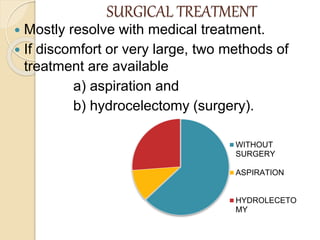
SURGICAL TREATMENT
 Mostly resolve with medical treatment.
 If discomfort or very large, two methods of
treatment are available
a) aspiration and
b) hydrocelectomy (surgery).
WITHOUT
SURGERY
ASPIRATION
HYDROLECETO
MY
ASPIRATION
 Needle is used to drain the fluid.
 Not common treatment for hydroceles,
but performed when surgery is too
risky.
 Complication: FIBROSIS
Hydrocelectomy
 Minor surgical procedure where fluid is
drained.
 Under anesthesia, through a small incision,
fluid is drained and while stitching,
the tunica vaginalis is everted and stitched.
 Here the proximal part is also cut and
stitched.
 Complications: blood clot,
infection & injury to scrotum
COMPLICATIONS
 Infertility
 Testicular atrophy.
 Haematoma.
Excessive scar formation.
 Recurrence of the hydrocele after inguinal
approaches.
CONCLUSION
 Hydrocele is a differential diagnosis in
males commonly presenting with an
enlarged scrotum.
 Hydroceletomy is done & tunica
vaginalis is everted &stitched.
 Proximal part extending into inguinal
region is also stitched in its proximal
portion.
 Most commonly seen in boys than girls.
 Congenital communicating hydrocele is
accompanied with hernia and so a
search on hernia with hydrocele should
BIBLIOGRAPHY
 Scrotal swelling : NICE, CKS, Feb 2010.
 Aspiration versus hydrocelectomy for the
treatment of hydroceles.
 Rudkin SE et al, Hydrocele in emergency
medicine
 Clinical hydrocele : A Manual Method Of
Surgeey, S.DAS
 Hydrocele swelling : net source Wikipedia
 Hydrocele overview : Mayo Clinic
 Kogan BA. Communicating hydrocele/hernia
repair in children. BJU Int 2007;100:703-13
Congenital vaginal hydrocele/Dr.Anthony

Congenital vaginal hydrocele/Dr.Anthony

  • 1.
    ANTHONY GABRIAL.S Indira GandhiMedical College & Research Institute Pondicherry CONGENITAL VAGINAL HYDROCELE A case report
  • 2.
    INTRODUCTION  Definition: Isa collection of fluid within the tunica vaginalis of the testis.  Common in newborns.  Most hydroceles disappear without treatment within the 18 months of life.
  • 3.
     Usually unilateral,but can also occur bilatarally  Hydrocele normally is seen in infant boys - as enlarged scrotum. in infant girls - as enlarged labia.  Hydrocele boys > girls.  There is a greater chance of infertility if the hydrocele does not show itself until the child has reached adulthood.
  • 4.
    MATERIALS & METHODS A 4 years old boy was referred to the pediatric OPD with swelling of right scrotum since birth.  The mother complained of swelling of right scrotum, which increased in size gradually.  No h/o pain.  There was no h/o decresing in size of swelling on lying position.  No h/o increase in size with swelling on coughing.
  • 5.
  • 6.
    ON EXAMINATION  Skinand subcutaneous tissue: Tense, normal rugosity of the skin lost.  Impulse on coughing: Negative  Fluctuation: Positive  Transillumination test: Positive  Reducibility: Positive.  Testis- can be palpated posteriorly  Lymph nodes- Not palpable  Left scrotum was normal.  USG : Done for right scrotum
  • 7.
    ULTRASONOGRAPHY USG reveals theright testicle with hydrocele
  • 8.
     On examination,It was identified as COMMUNICATING HYDROCELE.  It was diagnosed as CONGENITAL RIGHT SIDED VAGINAL HYDROCELE & surgical correction of the hydrocele was done.
  • 9.
    DISCUSSION CONGENITAL VAGINAL HYDROCELE Fluid-filledsac surrounding a testicle swelling of the scrotum Presented as loose bag of skin underneath the penis.
  • 10.
     As thetestes descends it carries along with it a double layered Peritoneal sac – PROCESSUS VAGINALIS.  Later on the distal portion of processus vaginalis alone persists as TUNICA VAGINALIS.  Proximal portion obliterates. DEVELOPMENT
  • 11.
  • 12.
  • 13.
     Congenital vaginalhydrocele results when the processus vaginalis remains patent, allowing fluid from the peritoneum to accumulate in the scrotum.
  • 14.
    INCIDENCE  30% inthe infant boys ◦ (8% - 33%)  10% in the infant girls ◦ (6% - 15%)  40% in aldults ◦ (19% - 41%)  58% - 93% right sided  <10% left sided  Few are bilateral
  • 15.
    SURGICAL TREATMENT  Mostlyresolve with medical treatment.  If discomfort or very large, two methods of treatment are available a) aspiration and b) hydrocelectomy (surgery). WITHOUT SURGERY ASPIRATION HYDROLECETO MY
  • 16.
    ASPIRATION  Needle isused to drain the fluid.  Not common treatment for hydroceles, but performed when surgery is too risky.  Complication: FIBROSIS
  • 17.
    Hydrocelectomy  Minor surgicalprocedure where fluid is drained.  Under anesthesia, through a small incision, fluid is drained and while stitching, the tunica vaginalis is everted and stitched.  Here the proximal part is also cut and stitched.  Complications: blood clot, infection & injury to scrotum
  • 18.
    COMPLICATIONS  Infertility  Testicularatrophy.  Haematoma. Excessive scar formation.  Recurrence of the hydrocele after inguinal approaches.
  • 19.
    CONCLUSION  Hydrocele isa differential diagnosis in males commonly presenting with an enlarged scrotum.  Hydroceletomy is done & tunica vaginalis is everted &stitched.  Proximal part extending into inguinal region is also stitched in its proximal portion.  Most commonly seen in boys than girls.  Congenital communicating hydrocele is accompanied with hernia and so a search on hernia with hydrocele should
  • 20.
    BIBLIOGRAPHY  Scrotal swelling: NICE, CKS, Feb 2010.  Aspiration versus hydrocelectomy for the treatment of hydroceles.  Rudkin SE et al, Hydrocele in emergency medicine  Clinical hydrocele : A Manual Method Of Surgeey, S.DAS  Hydrocele swelling : net source Wikipedia  Hydrocele overview : Mayo Clinic  Kogan BA. Communicating hydrocele/hernia repair in children. BJU Int 2007;100:703-13