ARRHYTHMIA.
Presented by :
Mr.Amogh .R. Lotankar
M.PHARM (Pharmacollogy)
1 22-Nov-15
WHAT IS ARRHYTHMIA??
An arrhythmia is an abnormal heart rhythm. It
may be so brief that it does not change your
over all heart rate. (American heart
association,2012)
OR
It can cause heart rate to be too slow or too
fast. Some arrhythmias don’t cause any
symptoms. Others can fell u lightheaded and
dizzy
2 22-Nov-15
3
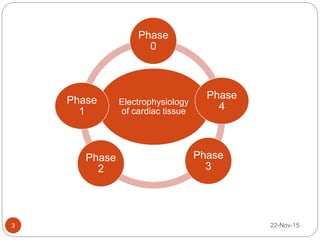
Electrophysiology
of cardiac tissue
Phase
0
Phase
4
Phase
3
Phase
2
Phase
1
22-Nov-15
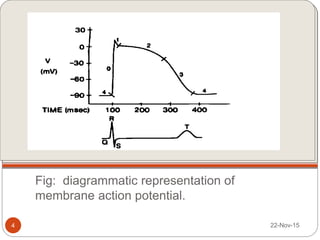
Fig: diagrammatic representation of
membrane action potential.
4 22-Nov-15
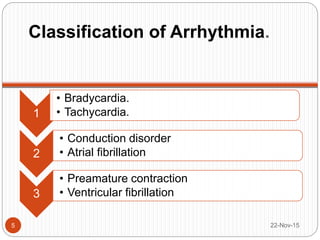
Classification of Arrhythmia.
22-Nov-155
1
• Bradycardia.
• Tachycardia.
2
• Conduction disorder
• Atrial fibrillation
3
• Preamature contraction
• Ventricular fibrillation
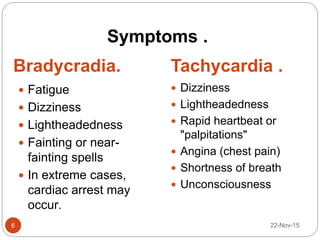
Symptoms .
Bradycradia. Tachycardia .
22-Nov-156
 Fatigue
 Dizziness
 Lightheadedness
 Fainting or near-
fainting spells
 In extreme cases,
cardiac arrest may
occur.
 Dizziness
 Lightheadedness
 Rapid heartbeat or
"palpitations"
 Angina (chest pain)
 Shortness of breath
 Unconsciousness
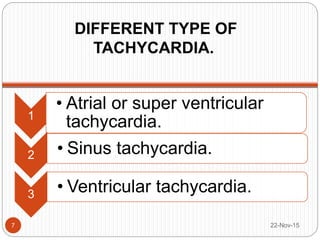
DIFFERENT TYPE OF
TACHYCARDIA.
22-Nov-157
1
• Atrial or super ventricular
tachycardia.
2 • Sinus tachycardia.
3 • Ventricular tachycardia.
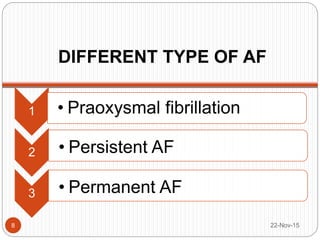
DIFFERENT TYPE OF AF
22-Nov-158
1 • Praoxysmal fibrillation
2 • Persistent AF
3 • Permanent AF
DIFFERENT TYPE OF
premature contraction.
22-Nov-159
1
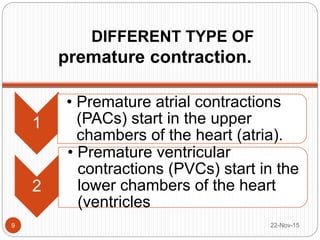
• Premature atrial contractions
(PACs) start in the upper
chambers of the heart (atria).
2
• Premature ventricular
contractions (PVCs) start in the
lower chambers of the heart
(ventricles
Monitoring of arrhythmia.
22-Nov-1510
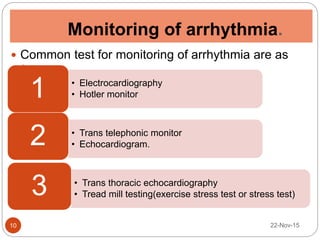
 Common test for monitoring of arrhythmia are as
follows:
• Electrocardiography
• Hotler monitor1
• Trans telephonic monitor
• Echocardiogram.2
• Trans thoracic echocardiography
• Tread mill testing(exercise stress test or stress test)3
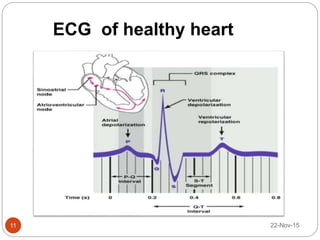
ECG of healthy heart
22-Nov-1511
22-Nov-1512
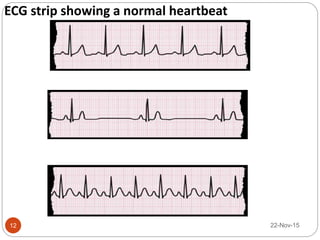
ECG strip showing a normal heartbeat
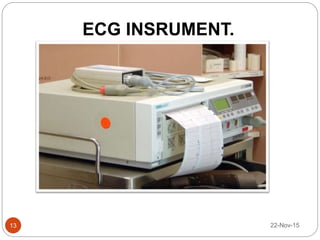
ECG INSRUMENT.
22-Nov-1513
Echocardiogram machine
22-Nov-1514
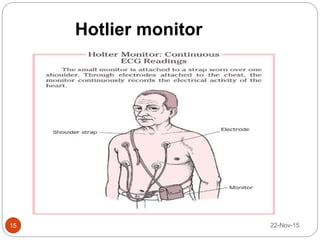
Hotlier monitor
22-Nov-1515
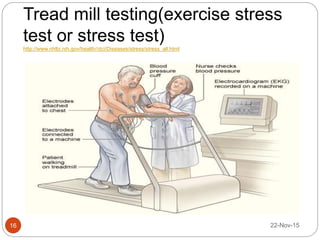
Tread mill testing(exercise stress
test or stress test)
http://www.nhlbi.nih.gov/health//dci/Diseases/stress/stress_all.html
22-Nov-1516
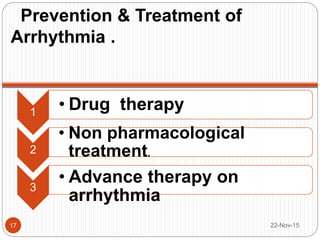
Prevention & Treatment of
Arrhythmia .
22-Nov-1517
1
• Drug therapy
2
• Non pharmacological
treatment.
3
• Advance therapy on
arrhythmia
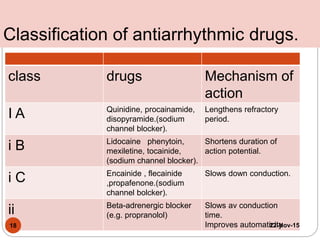
Classification of antiarrhythmic drugs.
class drugs Mechanism of
action
I A Quinidine, procainamide,
disopyramide.(sodium
channel blocker).
Lengthens refractory
period.
i B Lidocaine phenytoin,
mexiletine, tocainide,
(sodium channel blocker).
Shortens duration of
action potential.
i C Encainide , flecainide
,propafenone.(sodium
channel bolcker).
Slows down conduction.
ii Beta-adrenergic blocker
(e.g. propranolol)
Slows av conduction
time.
Improves automaticity18 22-Nov-15
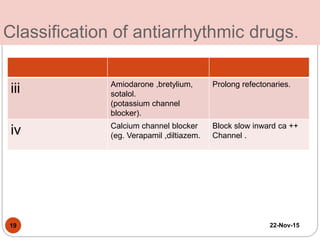
Classification of antiarrhythmic drugs.
iii Amiodarone ,bretylium,
sotalol.
(potassium channel
blocker).
Prolong refectonaries.
iv Calcium channel blocker
(eg. Verapamil ,diltiazem.
Block slow inward ca ++
Channel .
19 22-Nov-15
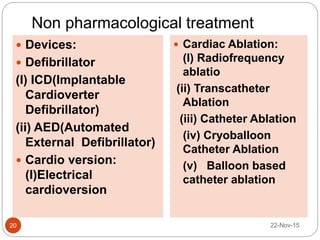
Non pharmacological treatment
22-Nov-1520
 Devices:
 Defibrillator
(I) ICD(Implantable
Cardioverter
Defibrillator)
(ii) AED(Automated
External Defibrillator)
 Cardio version:
(I)Electrical
cardioversion
 Cardiac Ablation:
(I) Radiofrequency
ablatio
(ii) Transcatheter
Ablation
(iii) Catheter Ablation
(iv) Cryoballoon
Catheter Ablation
(v) Balloon based
catheter ablation
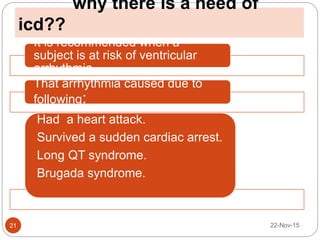
why there is a need of
icd??
22-Nov-1521
It is recommended when a
subject is at risk of ventricular
arrhythmia.
That arrhythmia caused due to
following:
Had a heart attack.
Survived a sudden cardiac arrest.
Long QT syndrome.
Brugada syndrome.
What is an ICD??
22-Nov-1522
An icd is a battery powered
device place under the skin that
keeps track of you heart rate.
ICD`S is useful in ventricular
tachycardia or fibrillation.
If an abnormal heart rhythm , will
deliver an electric shock.
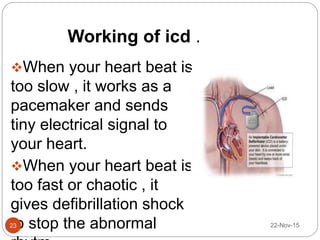
Working of icd .
When your heart beat is
too slow , it works as a
pacemaker and sends
tiny electrical signal to
your heart.
When your heart beat is
too fast or chaotic , it
gives defibrillation shock
to stop the abnormal 22-Nov-1523
What is an aed ??
22-Nov-1524
An aed is a lightweight, portable
device that delivers an electric
shock through the chest to the
heart.
The shock can stop an irregular
rhythm and allow a noramal
rhythm to resume in a heart in
sudden cardiac arrest.
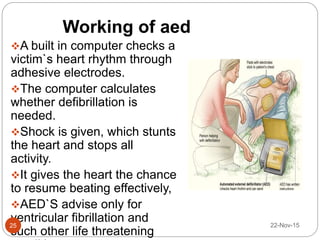
Working of aed
A built in computer checks a
victim`s heart rhythm through
adhesive electrodes.
The computer calculates
whether defibrillation is
needed.
Shock is given, which stunts
the heart and stops all
activity.
It gives the heart the chance
to resume beating effectively,
AED`S advise only for
ventricular fibrillation and
such other life threatening
22-Nov-1525
Ablation.
22-Nov-1526
Ablation is simple terms means
destroying or damaging the
tissue responsible for unwanted
results.
To treat various type of arrythmia
, sevearl ablation techniues have
been used.
Types of Ablation
1
• Radio Frequency Ablation
2
• catheter Ablation
3
• Cryoballoon Ablation
27 22-Nov-15
Radiofrequency ablation.
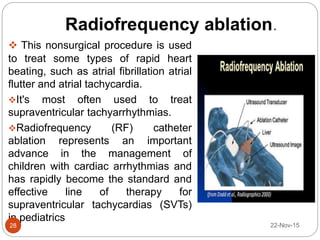
 This nonsurgical procedure is used
to treat some types of rapid heart
beating, such as atrial fibrillation atrial
flutter and atrial tachycardia.
It's most often used to treat
supraventricular tachyarrhythmias.
Radiofrequency (RF) catheter
ablation represents an important
advance in the management of
children with cardiac arrhythmias and
has rapidly become the standard and
effective line of therapy for
supraventricular tachycardias (SVTs)
in pediatrics
22-Nov-1528
Catheter ablation.
Priciple of
catheter ablation
is same as that
of
radiofrequency
ablation.
Catheter
ablation is used
to treat abnormal
heart rhythm
when medecine
are not effective
or convenient.
22-Nov-1529
 Due to sevearl drawbacks of
radiofrequency and cathater ablation
there is use of other device or technique
called as cryoballoon catheter ablation.
 It is mainly used to treat various types of
atrial fibrillation.
 There is also ballon based ablation
catheter, only one ballon design used
clinically which is available as
medtronic.inc
 Due to its technical difficulties and
requires experince operator alog with
long procedure time. So not used widely
and hence ideally cryoballon is used.
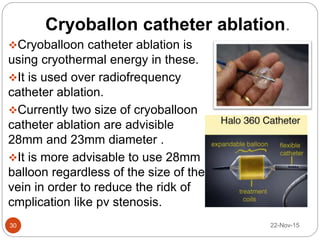
Cryoballon catheter ablation.
Cryoballoon catheter ablation is
using cryothermal energy in these.
It is used over radiofrequency
catheter ablation.
Currently two size of cryoballoon
catheter ablation are advisible
28mm and 23mm diameter .
It is more advisable to use 28mm
balloon regardless of the size of the
vein in order to reduce the ridk of
cmplication like pv stenosis.
22-Nov-1530
cardioversion.
22-Nov-1531
 There is two type of cardioversion:
Pharmacologic
cardioversion.
Electrical
cardioversion.
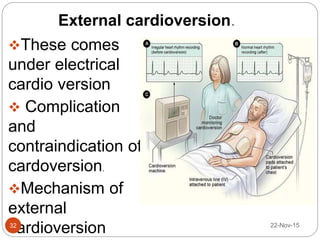
External cardioversion.
These comes
under electrical
cardio version
 Complication
and
contraindication of
cardoversion.
Mechanism of
external
cardioversion 22-Nov-1532
Advance therapy on arrhythmia.
22-Nov-1533
1
•Gene therapy.
2
•Stem cell
therapy.
Gene therapy.
22-Nov-1534
• Gene therapy is defined as
the transfer of nucleic
acids to somatic cells as
therapeutically useful
molecules. Genetic defects
can be corrected or gene
products be expressed by
gene therapy
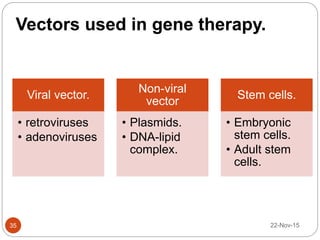
Vectors used in gene therapy.
22-Nov-1535
Viral vector.
• retroviruses
• adenoviruses
Non-viral
vector
• Plasmids.
• DNA-lipid
complex.
Stem cells.
• Embryonic
stem cells.
• Adult stem
cells.
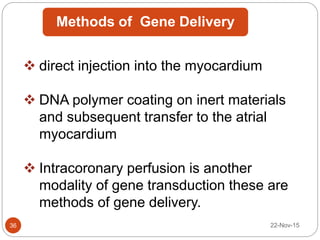
 direct injection into the myocardium
 DNA polymer coating on inert materials
and subsequent transfer to the atrial
myocardium
 Intracoronary perfusion is another
modality of gene transduction these are
methods of gene delivery.
Methods of Gene Delivery
22-Nov-1536
Gene therapy procedure.
22-Nov-1537
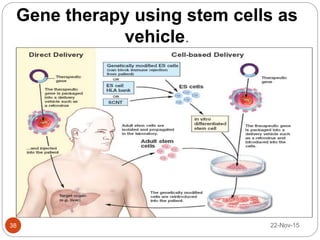
Gene therapy using stem cells as
vehicle.
22-Nov-1538
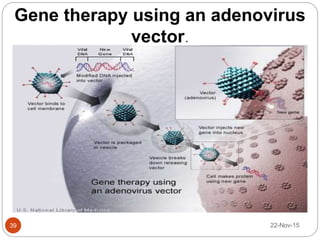
Gene therapy using an adenovirus
vector.
22-Nov-1539
Ongoing research into gene
therapy for cardiac arrhythmia.
Arrhythmias of cardiac failure
Ventricular arrhythmia
22-Nov-1540
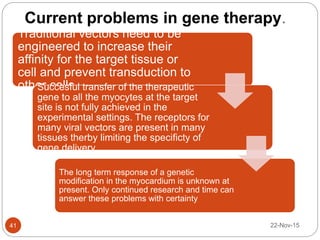
Current problems in gene therapy.
22-Nov-1541
Traditional vectors need to be
engineered to increase their
affinity for the target tissue or
cell and prevent transduction to
other cellsSuccesful transfer of the therapeutic
gene to all the myocytes at the target
site is not fully achieved in the
experimental settings. The receptors for
many viral vectors are present in many
tissues therby limiting the specificty of
gene delivery
The long term response of a genetic
modification in the myocardium is unknown at
present. Only continued research and time can
answer these problems with certainty
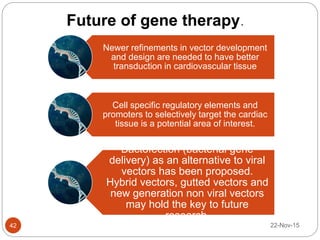
Future of gene therapy.
22-Nov-1542
Newer refinements in vector development
and design are needed to have better
transduction in cardiovascular tissue
Cell specific regulatory elements and
promoters to selectively target the cardiac
tissue is a potential area of interest.
Bactofection (bacterial gene
delivery) as an alternative to viral
vectors has been proposed.
Hybrid vectors, gutted vectors and
new generation non viral vectors
may hold the key to future
research.
conclusion.
22-Nov-1543
Given a wide plethora of potential targets
for gene therapeutic strategies, the
possible applications are unlimited. We
have still a long way to go from animal
models to the level of safe and efficacious
application at the bedside. This awaits
more refinements in gene delivery
methods and vector designs. Not to be
forgotten are the increasing concerns
about safety. A regulated and sustained
target tissue expression of the transduced
gene with a wide index of safety should
be the ultimate goal of any genetic
Stem cell therapy for cardiac
arrhythmia.
22-Nov-1544
What are stem cells??
They are undifferentaited cells
that can differentiate into
specialized cell types.
Classification of stem cells based
on their sources.
22-Nov-1545
Stem cells comes from two
main sources:
Embryonic
stem cells.
Adult stem
cells.
22-Nov-1546
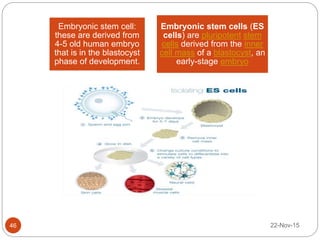
Embryonic stem cell:
these are derived from
4-5 old human embryo
that is in the blastocyst
phase of development.
Embryonic stem cells (ES
cells) are pluripotent stem
cells derived from the inner
cell mass of a blastocyst, an
early-stage embryo
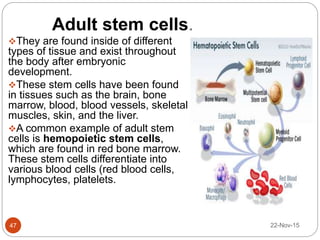
Adult stem cells.
They are found inside of different
types of tissue and exist throughout
the body after embryonic
development.
These stem cells have been found
in tissues such as the brain, bone
marrow, blood, blood vessels, skeletal
muscles, skin, and the liver.
A common example of adult stem
cells is hemopoietic stem cells,
which are found in red bone marrow.
These stem cells differentiate into
various blood cells (red blood cells,
lymphocytes, platelets.
22-Nov-1547
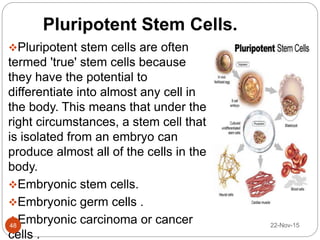
Pluripotent Stem Cells.
Pluripotent stem cells are often
termed 'true' stem cells because
they have the potential to
differentiate into almost any cell in
the body. This means that under the
right circumstances, a stem cell that
is isolated from an embryo can
produce almost all of the cells in the
body.
Embryonic stem cells.
Embryonic germ cells .
Embryonic carcinoma or cancer
cells .
22-Nov-1548
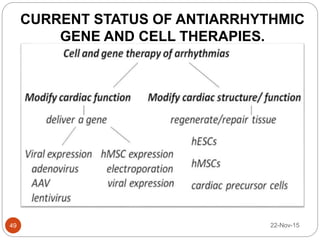
CURRENT STATUS OF ANTIARRHYTHMIC
GENE AND CELL THERAPIES.
22-Nov-1549
Conclusion.
22-Nov-1550
 The past decade has seen remarkable changes in our approach to
patients with cardiac arrhythmias. Clearly, the incomplete efficacy
and proarrhythmic potential of traditional antiarrhythmics have
generated interest in not only novel pharmacologic approaches to
arrhythmias but also non-pharmacologic treatments such as
catheter ablation. Studies of familial syndromes have identified
molecules whose dysfunction leads to arrhythmias and provided a
better understanding of fundamental mechanisms underlying
arrhythmias. Thus, a mechanism-based approach for the
treatment of patients with these syndromes is now possible.
However, the bigger challenge now is to apply the same approach
to common types of arrhythmias such as AF and SCD. In large
populations the identification of common variants that predispose
individuals to arrhythmias hold promise for early detection and
intervention in asymptomatic patients at high risk.
 We have still a long way to go from animal models to the level of
safe and efficacious application at the bedside. This awaits more
refinements in gene delivery methods and vector designs. Not to
be forgotten are the increasing concerns about safety. A regulated
and sustained target tissue expression of the transduced gene
with a wide index of safety should be the ultimate goal of any
Refrences:
22-Nov-1551
 Dan M. Roden ,principle of electrophysiology of
cardiac system, Goodman and gilman`s The
pharmacological basisi of therapeutics, ninth
edition, pg no:839-841.
 Wilson and gisvold`s , textbook of organic medical
and pharmaceutical chemistry, pg no :634
 K .D .Tripathi , essential of medical pharmacology,
pg no: 511.
 Peter Cram, Sandeep Vijan, David Katz, A. Mark
Fendrick, Cost-effectiveness of In-home Automated
External Defibrillators for Individual at Increased
Risk of Sudden Cardiac Death, J GEN INTERN MED,
2005, pg no:251-257.
Thank you
52 22-Nov-15

Arrhythmia

  • 1.
    ARRHYTHMIA. Presented by : Mr.Amogh.R. Lotankar M.PHARM (Pharmacollogy) 1 22-Nov-15
  • 2.
    WHAT IS ARRHYTHMIA?? Anarrhythmia is an abnormal heart rhythm. It may be so brief that it does not change your over all heart rate. (American heart association,2012) OR It can cause heart rate to be too slow or too fast. Some arrhythmias don’t cause any symptoms. Others can fell u lightheaded and dizzy 2 22-Nov-15
  • 3.
  • 4.
    Fig: diagrammatic representationof membrane action potential. 4 22-Nov-15
  • 5.
    Classification of Arrhythmia. 22-Nov-155 1 •Bradycardia. • Tachycardia. 2 • Conduction disorder • Atrial fibrillation 3 • Preamature contraction • Ventricular fibrillation
  • 6.
    Symptoms . Bradycradia. Tachycardia. 22-Nov-156  Fatigue  Dizziness  Lightheadedness  Fainting or near- fainting spells  In extreme cases, cardiac arrest may occur.  Dizziness  Lightheadedness  Rapid heartbeat or "palpitations"  Angina (chest pain)  Shortness of breath  Unconsciousness
  • 7.
    DIFFERENT TYPE OF TACHYCARDIA. 22-Nov-157 1 •Atrial or super ventricular tachycardia. 2 • Sinus tachycardia. 3 • Ventricular tachycardia.
  • 8.
    DIFFERENT TYPE OFAF 22-Nov-158 1 • Praoxysmal fibrillation 2 • Persistent AF 3 • Permanent AF
  • 9.
    DIFFERENT TYPE OF prematurecontraction. 22-Nov-159 1 • Premature atrial contractions (PACs) start in the upper chambers of the heart (atria). 2 • Premature ventricular contractions (PVCs) start in the lower chambers of the heart (ventricles
  • 10.
    Monitoring of arrhythmia. 22-Nov-1510 Common test for monitoring of arrhythmia are as follows: • Electrocardiography • Hotler monitor1 • Trans telephonic monitor • Echocardiogram.2 • Trans thoracic echocardiography • Tread mill testing(exercise stress test or stress test)3
  • 11.
    ECG of healthyheart 22-Nov-1511
  • 12.
  • 13.
  • 14.
  • 15.
  • 16.
    Tread mill testing(exercisestress test or stress test) http://www.nhlbi.nih.gov/health//dci/Diseases/stress/stress_all.html 22-Nov-1516
  • 17.
    Prevention & Treatmentof Arrhythmia . 22-Nov-1517 1 • Drug therapy 2 • Non pharmacological treatment. 3 • Advance therapy on arrhythmia
  • 18.
    Classification of antiarrhythmicdrugs. class drugs Mechanism of action I A Quinidine, procainamide, disopyramide.(sodium channel blocker). Lengthens refractory period. i B Lidocaine phenytoin, mexiletine, tocainide, (sodium channel blocker). Shortens duration of action potential. i C Encainide , flecainide ,propafenone.(sodium channel bolcker). Slows down conduction. ii Beta-adrenergic blocker (e.g. propranolol) Slows av conduction time. Improves automaticity18 22-Nov-15
  • 19.
    Classification of antiarrhythmicdrugs. iii Amiodarone ,bretylium, sotalol. (potassium channel blocker). Prolong refectonaries. iv Calcium channel blocker (eg. Verapamil ,diltiazem. Block slow inward ca ++ Channel . 19 22-Nov-15
  • 20.
    Non pharmacological treatment 22-Nov-1520 Devices:  Defibrillator (I) ICD(Implantable Cardioverter Defibrillator) (ii) AED(Automated External Defibrillator)  Cardio version: (I)Electrical cardioversion  Cardiac Ablation: (I) Radiofrequency ablatio (ii) Transcatheter Ablation (iii) Catheter Ablation (iv) Cryoballoon Catheter Ablation (v) Balloon based catheter ablation
  • 21.
    why there isa need of icd?? 22-Nov-1521 It is recommended when a subject is at risk of ventricular arrhythmia. That arrhythmia caused due to following: Had a heart attack. Survived a sudden cardiac arrest. Long QT syndrome. Brugada syndrome.
  • 22.
    What is anICD?? 22-Nov-1522 An icd is a battery powered device place under the skin that keeps track of you heart rate. ICD`S is useful in ventricular tachycardia or fibrillation. If an abnormal heart rhythm , will deliver an electric shock.
  • 23.
    Working of icd. When your heart beat is too slow , it works as a pacemaker and sends tiny electrical signal to your heart. When your heart beat is too fast or chaotic , it gives defibrillation shock to stop the abnormal 22-Nov-1523
  • 24.
    What is anaed ?? 22-Nov-1524 An aed is a lightweight, portable device that delivers an electric shock through the chest to the heart. The shock can stop an irregular rhythm and allow a noramal rhythm to resume in a heart in sudden cardiac arrest.
  • 25.
    Working of aed Abuilt in computer checks a victim`s heart rhythm through adhesive electrodes. The computer calculates whether defibrillation is needed. Shock is given, which stunts the heart and stops all activity. It gives the heart the chance to resume beating effectively, AED`S advise only for ventricular fibrillation and such other life threatening 22-Nov-1525
  • 26.
    Ablation. 22-Nov-1526 Ablation is simpleterms means destroying or damaging the tissue responsible for unwanted results. To treat various type of arrythmia , sevearl ablation techniues have been used.
  • 27.
    Types of Ablation 1 •Radio Frequency Ablation 2 • catheter Ablation 3 • Cryoballoon Ablation 27 22-Nov-15
  • 28.
    Radiofrequency ablation.  Thisnonsurgical procedure is used to treat some types of rapid heart beating, such as atrial fibrillation atrial flutter and atrial tachycardia. It's most often used to treat supraventricular tachyarrhythmias. Radiofrequency (RF) catheter ablation represents an important advance in the management of children with cardiac arrhythmias and has rapidly become the standard and effective line of therapy for supraventricular tachycardias (SVTs) in pediatrics 22-Nov-1528
  • 29.
    Catheter ablation. Priciple of catheterablation is same as that of radiofrequency ablation. Catheter ablation is used to treat abnormal heart rhythm when medecine are not effective or convenient. 22-Nov-1529  Due to sevearl drawbacks of radiofrequency and cathater ablation there is use of other device or technique called as cryoballoon catheter ablation.  It is mainly used to treat various types of atrial fibrillation.  There is also ballon based ablation catheter, only one ballon design used clinically which is available as medtronic.inc  Due to its technical difficulties and requires experince operator alog with long procedure time. So not used widely and hence ideally cryoballon is used.
  • 30.
    Cryoballon catheter ablation. Cryoballooncatheter ablation is using cryothermal energy in these. It is used over radiofrequency catheter ablation. Currently two size of cryoballoon catheter ablation are advisible 28mm and 23mm diameter . It is more advisable to use 28mm balloon regardless of the size of the vein in order to reduce the ridk of cmplication like pv stenosis. 22-Nov-1530
  • 31.
    cardioversion. 22-Nov-1531  There istwo type of cardioversion: Pharmacologic cardioversion. Electrical cardioversion.
  • 32.
    External cardioversion. These comes underelectrical cardio version  Complication and contraindication of cardoversion. Mechanism of external cardioversion 22-Nov-1532
  • 33.
    Advance therapy onarrhythmia. 22-Nov-1533 1 •Gene therapy. 2 •Stem cell therapy.
  • 34.
    Gene therapy. 22-Nov-1534 • Genetherapy is defined as the transfer of nucleic acids to somatic cells as therapeutically useful molecules. Genetic defects can be corrected or gene products be expressed by gene therapy
  • 35.
    Vectors used ingene therapy. 22-Nov-1535 Viral vector. • retroviruses • adenoviruses Non-viral vector • Plasmids. • DNA-lipid complex. Stem cells. • Embryonic stem cells. • Adult stem cells.
  • 36.
     direct injectioninto the myocardium  DNA polymer coating on inert materials and subsequent transfer to the atrial myocardium  Intracoronary perfusion is another modality of gene transduction these are methods of gene delivery. Methods of Gene Delivery 22-Nov-1536
  • 37.
  • 38.
    Gene therapy usingstem cells as vehicle. 22-Nov-1538
  • 39.
    Gene therapy usingan adenovirus vector. 22-Nov-1539
  • 40.
    Ongoing research intogene therapy for cardiac arrhythmia. Arrhythmias of cardiac failure Ventricular arrhythmia 22-Nov-1540
  • 41.
    Current problems ingene therapy. 22-Nov-1541 Traditional vectors need to be engineered to increase their affinity for the target tissue or cell and prevent transduction to other cellsSuccesful transfer of the therapeutic gene to all the myocytes at the target site is not fully achieved in the experimental settings. The receptors for many viral vectors are present in many tissues therby limiting the specificty of gene delivery The long term response of a genetic modification in the myocardium is unknown at present. Only continued research and time can answer these problems with certainty
  • 42.
    Future of genetherapy. 22-Nov-1542 Newer refinements in vector development and design are needed to have better transduction in cardiovascular tissue Cell specific regulatory elements and promoters to selectively target the cardiac tissue is a potential area of interest. Bactofection (bacterial gene delivery) as an alternative to viral vectors has been proposed. Hybrid vectors, gutted vectors and new generation non viral vectors may hold the key to future research.
  • 43.
    conclusion. 22-Nov-1543 Given a wideplethora of potential targets for gene therapeutic strategies, the possible applications are unlimited. We have still a long way to go from animal models to the level of safe and efficacious application at the bedside. This awaits more refinements in gene delivery methods and vector designs. Not to be forgotten are the increasing concerns about safety. A regulated and sustained target tissue expression of the transduced gene with a wide index of safety should be the ultimate goal of any genetic
  • 44.
    Stem cell therapyfor cardiac arrhythmia. 22-Nov-1544 What are stem cells?? They are undifferentaited cells that can differentiate into specialized cell types.
  • 45.
    Classification of stemcells based on their sources. 22-Nov-1545 Stem cells comes from two main sources: Embryonic stem cells. Adult stem cells.
  • 46.
    22-Nov-1546 Embryonic stem cell: theseare derived from 4-5 old human embryo that is in the blastocyst phase of development. Embryonic stem cells (ES cells) are pluripotent stem cells derived from the inner cell mass of a blastocyst, an early-stage embryo
  • 47.
    Adult stem cells. Theyare found inside of different types of tissue and exist throughout the body after embryonic development. These stem cells have been found in tissues such as the brain, bone marrow, blood, blood vessels, skeletal muscles, skin, and the liver. A common example of adult stem cells is hemopoietic stem cells, which are found in red bone marrow. These stem cells differentiate into various blood cells (red blood cells, lymphocytes, platelets. 22-Nov-1547
  • 48.
    Pluripotent Stem Cells. Pluripotentstem cells are often termed 'true' stem cells because they have the potential to differentiate into almost any cell in the body. This means that under the right circumstances, a stem cell that is isolated from an embryo can produce almost all of the cells in the body. Embryonic stem cells. Embryonic germ cells . Embryonic carcinoma or cancer cells . 22-Nov-1548
  • 49.
    CURRENT STATUS OFANTIARRHYTHMIC GENE AND CELL THERAPIES. 22-Nov-1549
  • 50.
    Conclusion. 22-Nov-1550  The pastdecade has seen remarkable changes in our approach to patients with cardiac arrhythmias. Clearly, the incomplete efficacy and proarrhythmic potential of traditional antiarrhythmics have generated interest in not only novel pharmacologic approaches to arrhythmias but also non-pharmacologic treatments such as catheter ablation. Studies of familial syndromes have identified molecules whose dysfunction leads to arrhythmias and provided a better understanding of fundamental mechanisms underlying arrhythmias. Thus, a mechanism-based approach for the treatment of patients with these syndromes is now possible. However, the bigger challenge now is to apply the same approach to common types of arrhythmias such as AF and SCD. In large populations the identification of common variants that predispose individuals to arrhythmias hold promise for early detection and intervention in asymptomatic patients at high risk.  We have still a long way to go from animal models to the level of safe and efficacious application at the bedside. This awaits more refinements in gene delivery methods and vector designs. Not to be forgotten are the increasing concerns about safety. A regulated and sustained target tissue expression of the transduced gene with a wide index of safety should be the ultimate goal of any
  • 51.
    Refrences: 22-Nov-1551  Dan M.Roden ,principle of electrophysiology of cardiac system, Goodman and gilman`s The pharmacological basisi of therapeutics, ninth edition, pg no:839-841.  Wilson and gisvold`s , textbook of organic medical and pharmaceutical chemistry, pg no :634  K .D .Tripathi , essential of medical pharmacology, pg no: 511.  Peter Cram, Sandeep Vijan, David Katz, A. Mark Fendrick, Cost-effectiveness of In-home Automated External Defibrillators for Individual at Increased Risk of Sudden Cardiac Death, J GEN INTERN MED, 2005, pg no:251-257.
  • 52.