The Elements &
Principles of Design

By: ADMEC Multimedia Institute
www.admecindia.co.in
Introduction
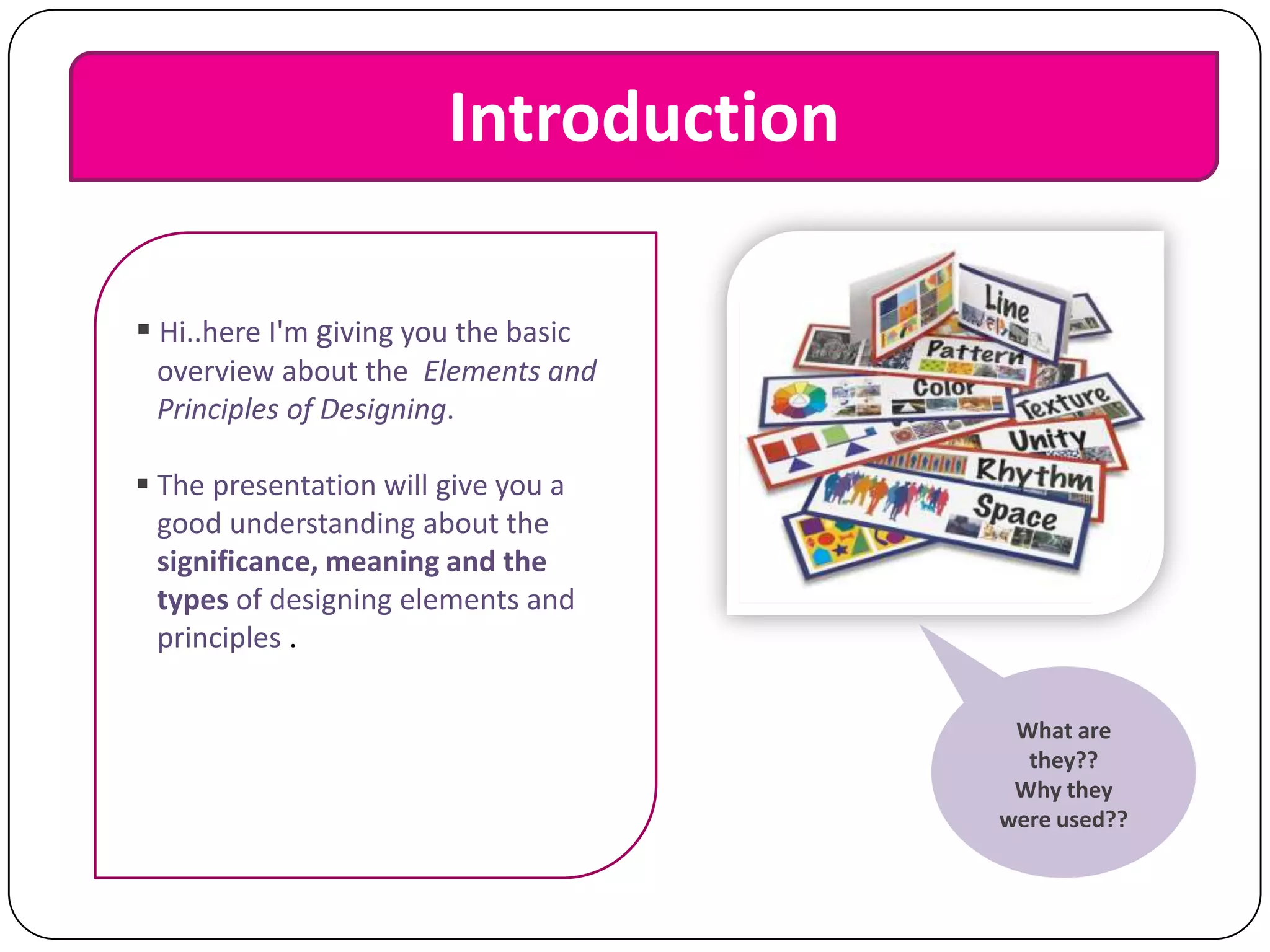
 Hi..here I'm giving you the basic
overview about the Elements and
Principles of Designing.
 The presentation will give you a
good understanding about the
significance, meaning and the
types of designing elements and
principles .
What are
they??
Why they
were used??
Significance of the Topic
Sometimes we have to give our
opinion about likes or dislikes on a
piece of art or a design, and it’s easy to
say just “ I like this, or I don’t like
that…”. But if we are asked to give the
reasons for it , then it proves to be a
very difficult to find out the reason.
This generally happens because we
judge the designs on its appeal rather
than on its articulate sub-factors.

Therefore it’s imperative to know the
meaning and the types of the designing
elements and principles.

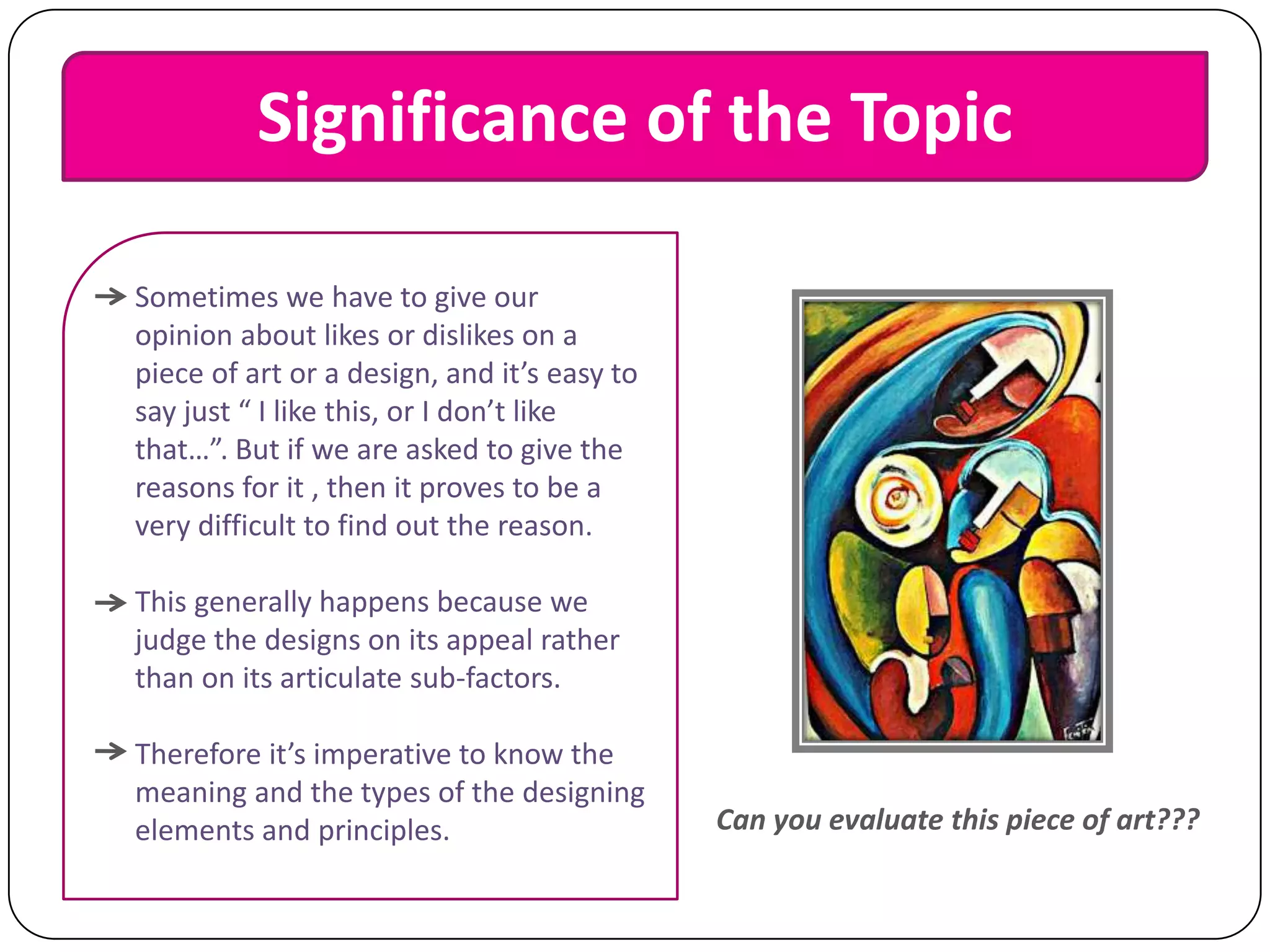
Can you evaluate this piece of art???
Designer who knows the
design Elements & Principles
can evaluate
the design/page in terms of
line, color, balance, texture,
etc.

Designing Elements and
Principles proves to be an
analyzing frame for
the designers.

A designer can express his thought &
intentions with the elements of
design and does it effectively along
with the design principles, i.e. they
serves as an expressing tool for
designers.

Now, let us discus these
Elements & Principles!!!
Elements
Of
Design
Meaning

“Elements of Design are the components or part which
can be isolated & defined in any visual design or work of
art. They structure and carry the work.”
Basic Elements of Design
 Following are the seven basic elements of design which are common

throughout the field of designing.
1. Point / Mark
2. Line
3. Shape
4. Forms
5. Space
6. Color
7. Texture

Can someone tell
us about the
Elements of
Design???
Point (Mark)

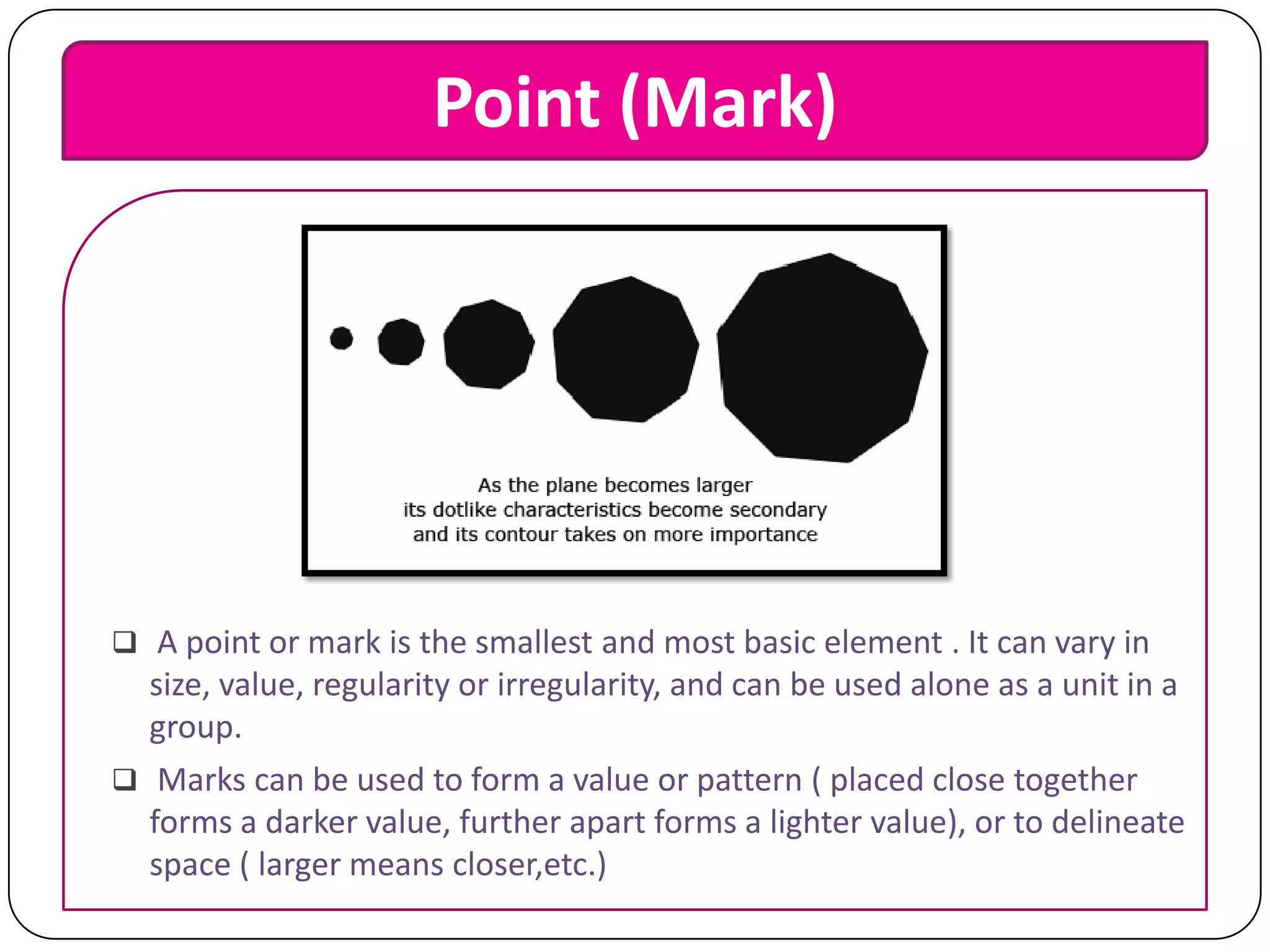
 A point or mark is the smallest and most basic element . It can vary in

size, value, regularity or irregularity, and can be used alone as a unit in a
group.
 Marks can be used to form a value or pattern ( placed close together
forms a darker value, further apart forms a lighter value), or to delineate
space ( larger means closer,etc.)
Line
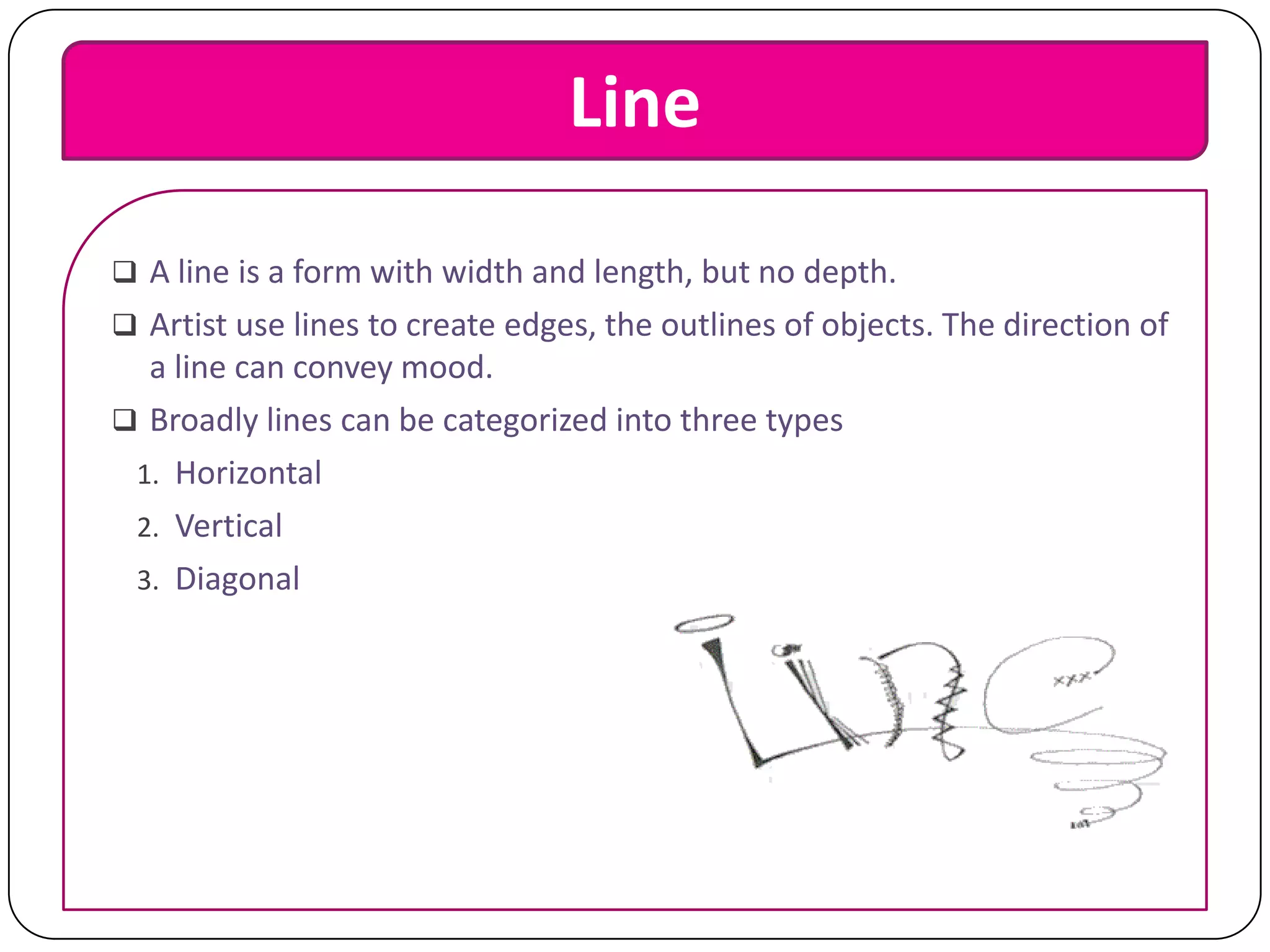
 A line is a form with width and length, but no depth.

 Artist use lines to create edges, the outlines of objects. The direction of

a line can convey mood.
 Broadly lines can be categorized into three types
1. Horizontal
2. Vertical
3. Diagonal
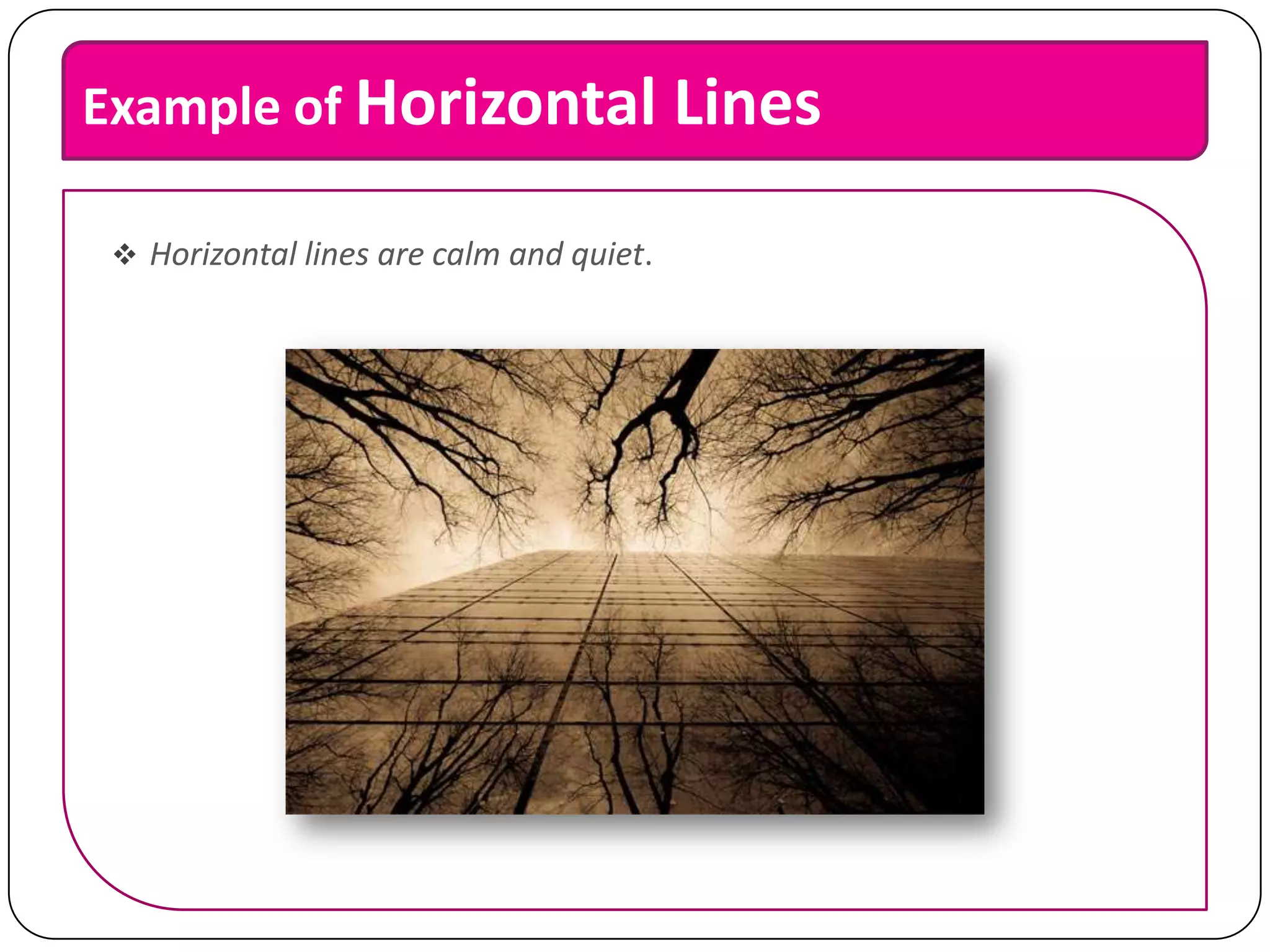
Example of Horizontal Lines
 Horizontal lines are calm and quiet.
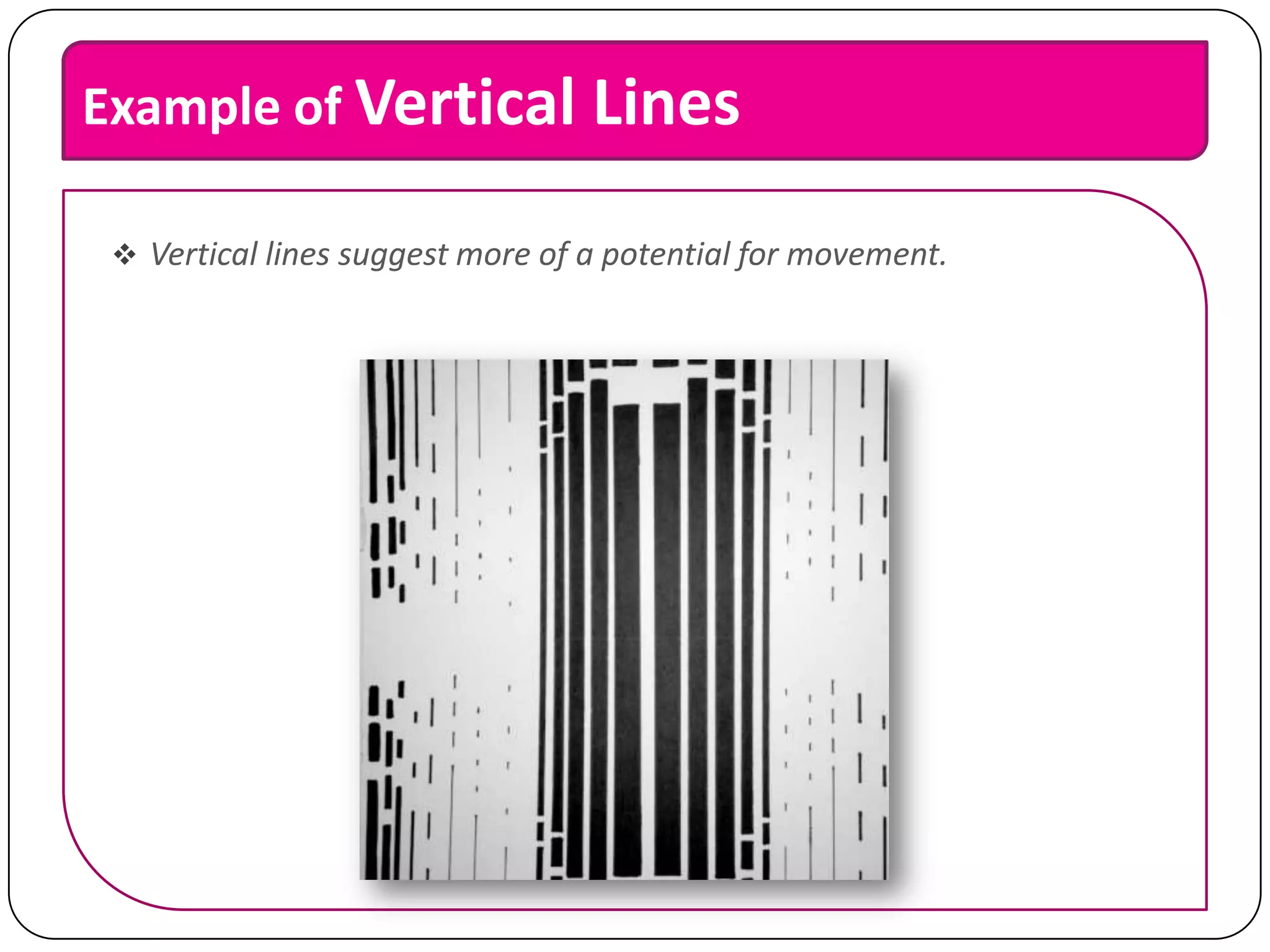
Example of Vertical Lines
 Vertical lines suggest more of a potential for movement.
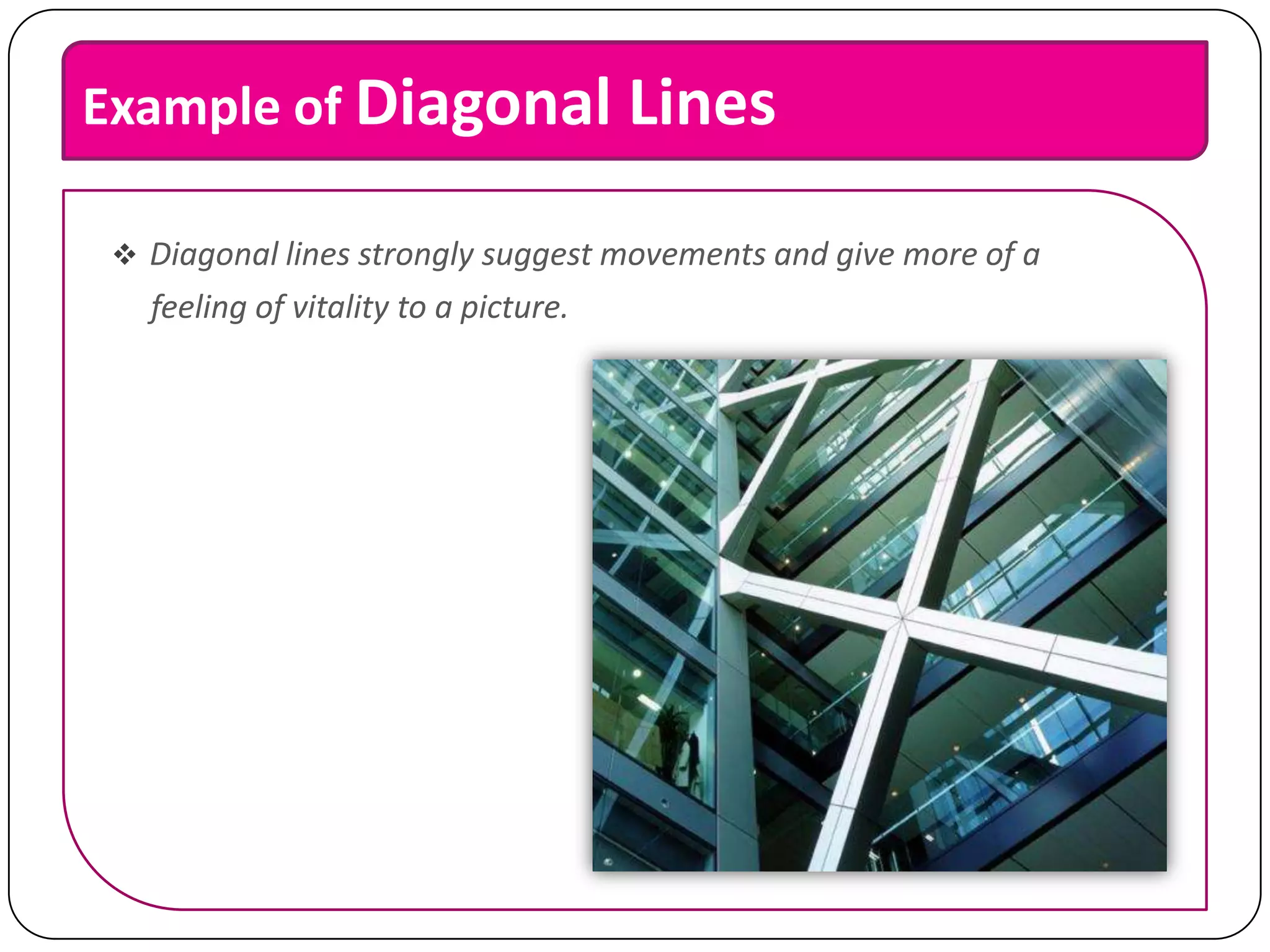
Example of Diagonal Lines
 Diagonal lines strongly suggest movements and give more of a

feeling of vitality to a picture.
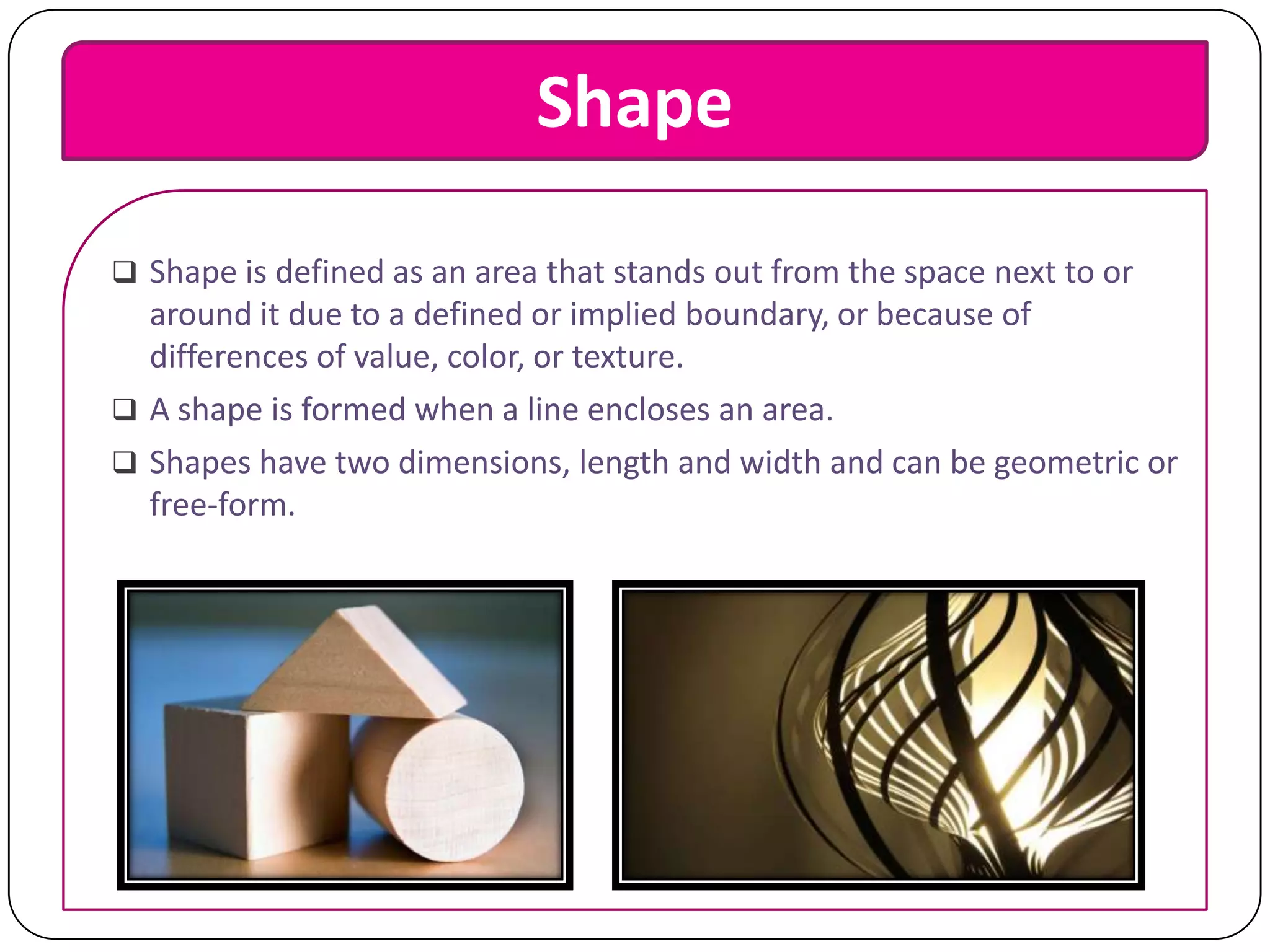
Shape
 Shape is defined as an area that stands out from the space next to or

around it due to a defined or implied boundary, or because of
differences of value, color, or texture.
 A shape is formed when a line encloses an area.
 Shapes have two dimensions, length and width and can be geometric or
free-form.
Forms
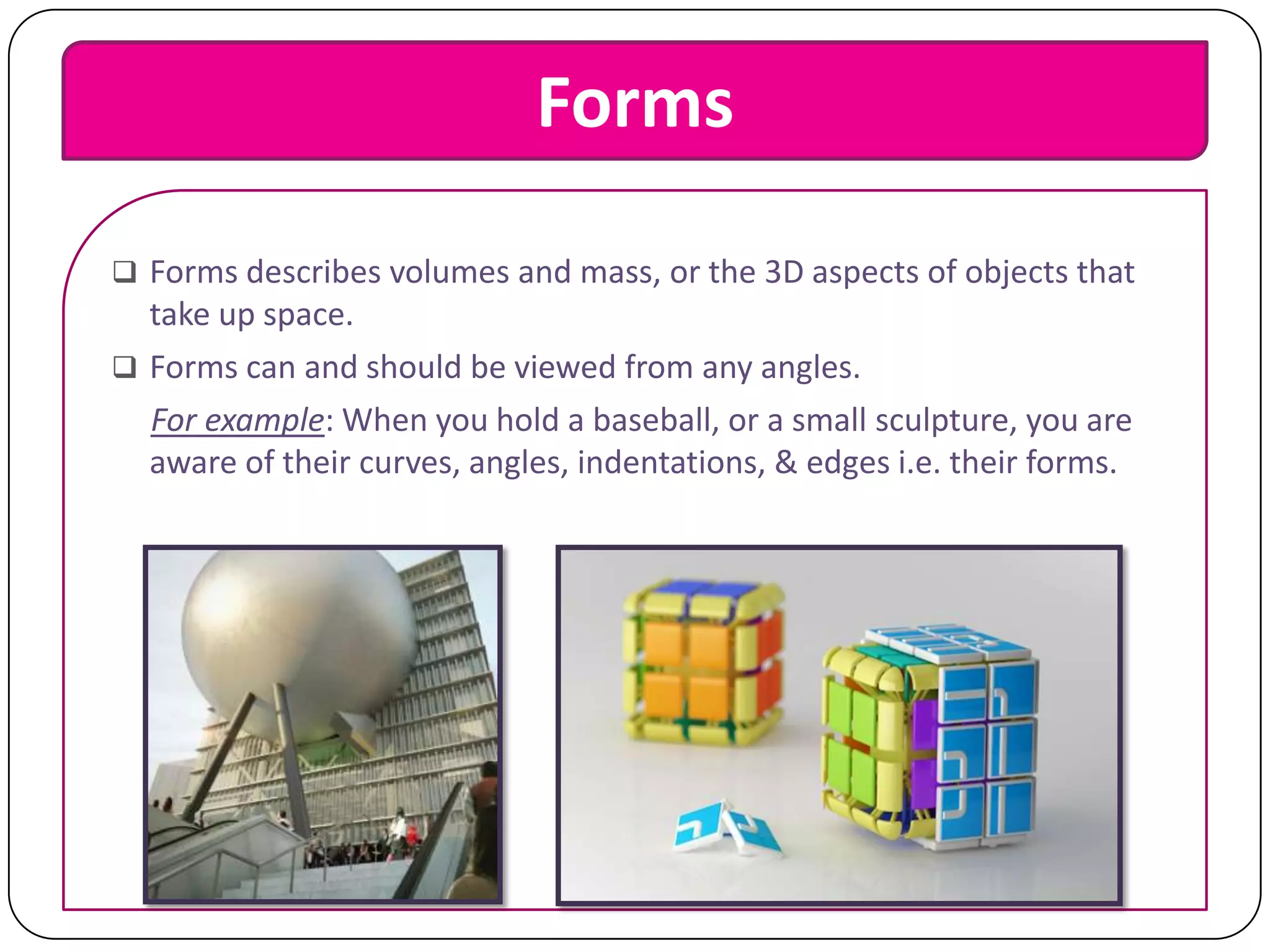
 Forms describes volumes and mass, or the 3D aspects of objects that

take up space.
 Forms can and should be viewed from any angles.
For example: When you hold a baseball, or a small sculpture, you are
aware of their curves, angles, indentations, & edges i.e. their forms.
Space
 Space is a 3D volume that can be empty or filled with objects. It has

width, height, and depth.
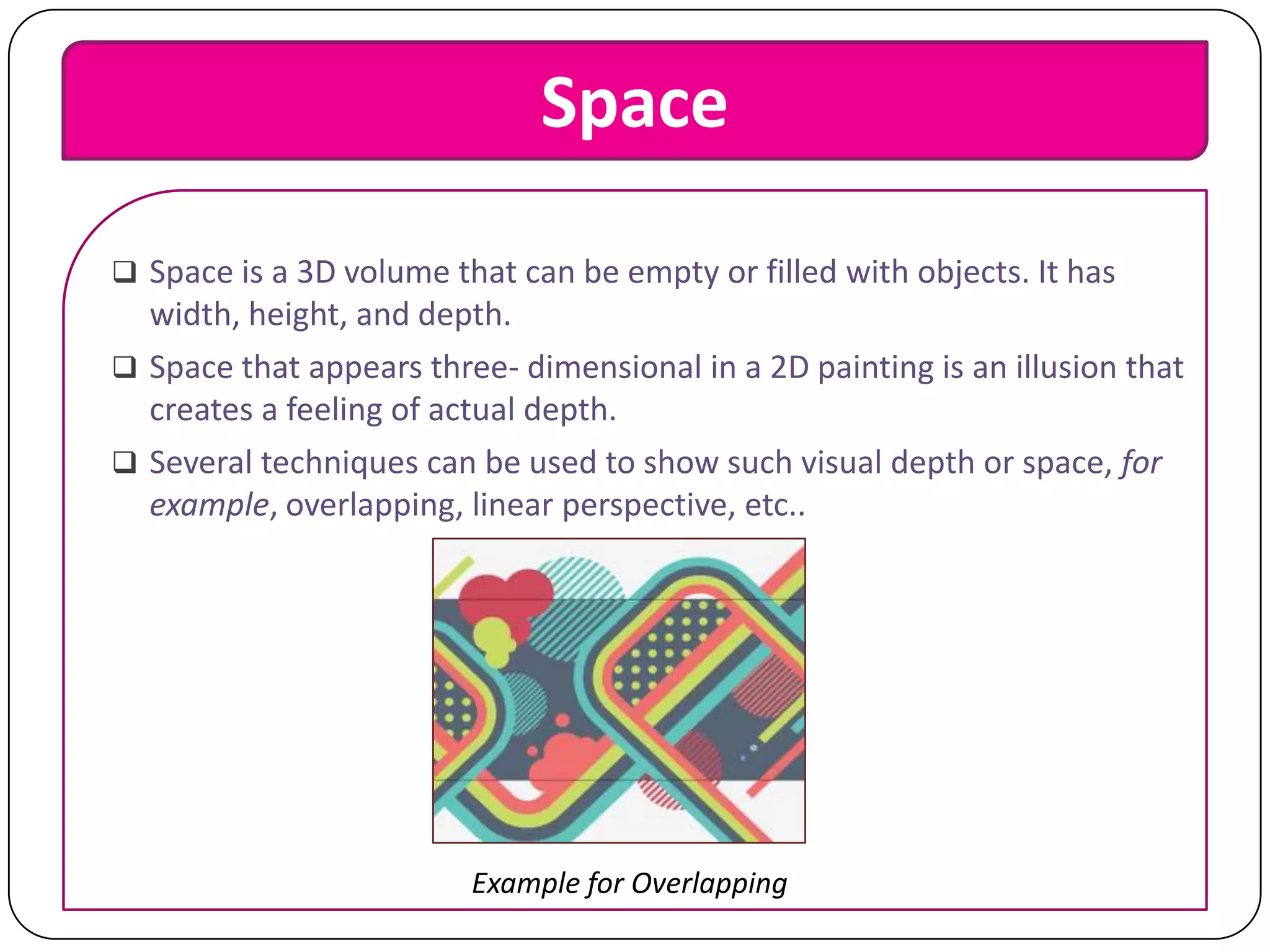
 Space that appears three- dimensional in a 2D painting is an illusion that
creates a feeling of actual depth.
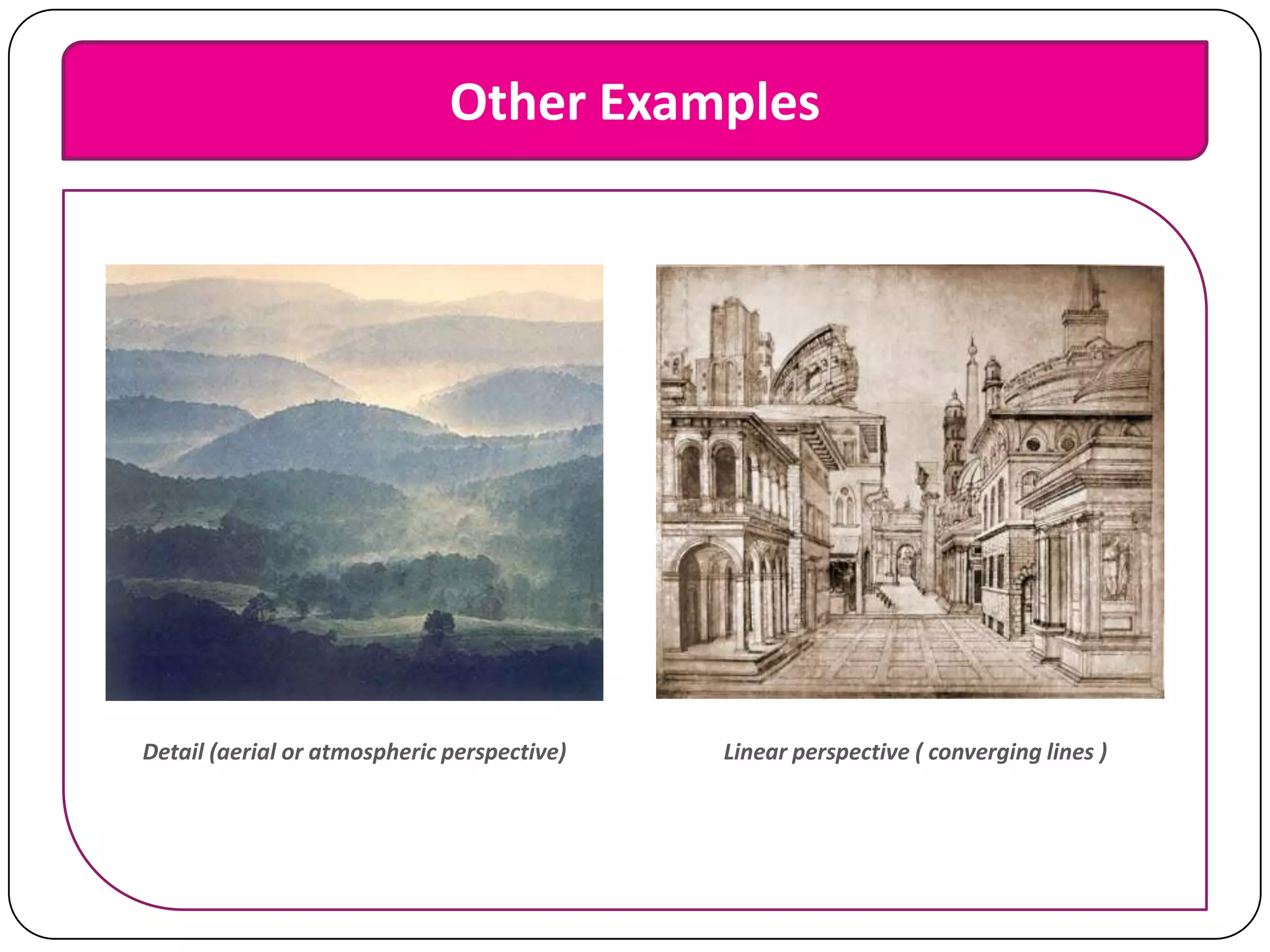
 Several techniques can be used to show such visual depth or space, for
example, overlapping, linear perspective, etc..

Example for Overlapping
Other Examples

Detail (aerial or atmospheric perspective)

Linear perspective ( converging lines )
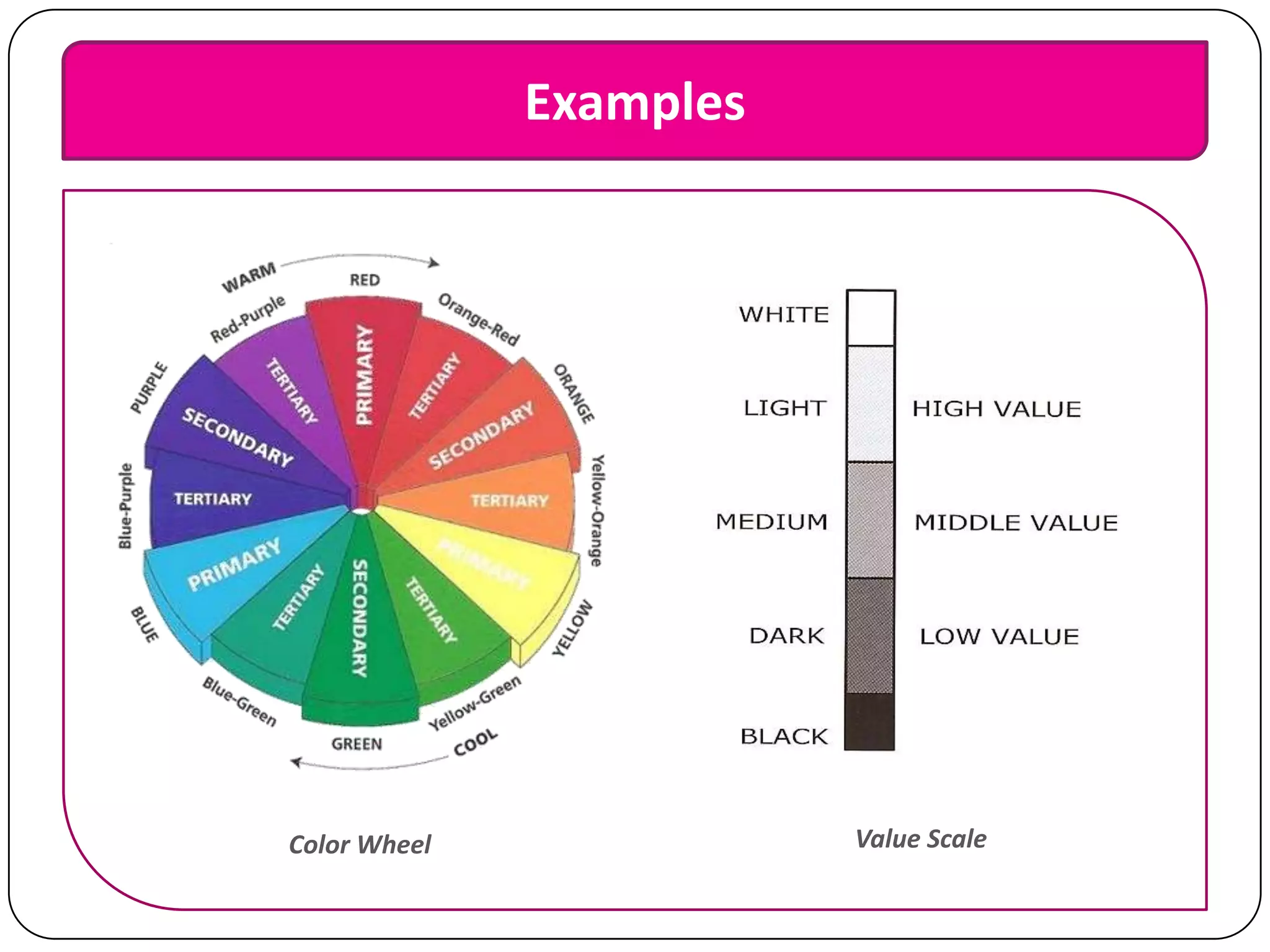
Color
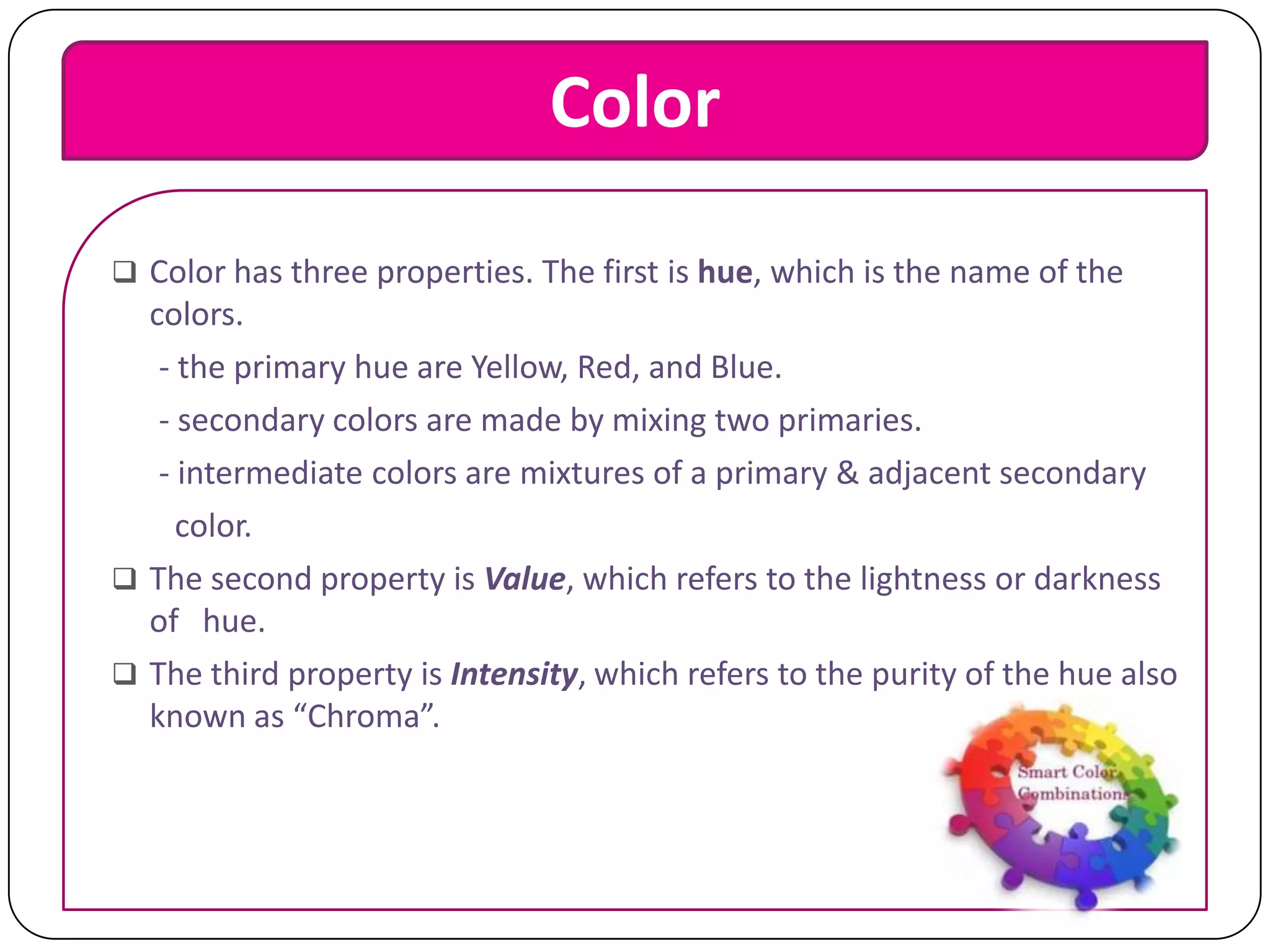
 Color has three properties. The first is hue, which is the name of the

colors.
- the primary hue are Yellow, Red, and Blue.
- secondary colors are made by mixing two primaries.
- intermediate colors are mixtures of a primary & adjacent secondary
color.
 The second property is Value, which refers to the lightness or darkness
of hue.
 The third property is Intensity, which refers to the purity of the hue also
known as “Chroma”.
Examples

Color Wheel

Value Scale
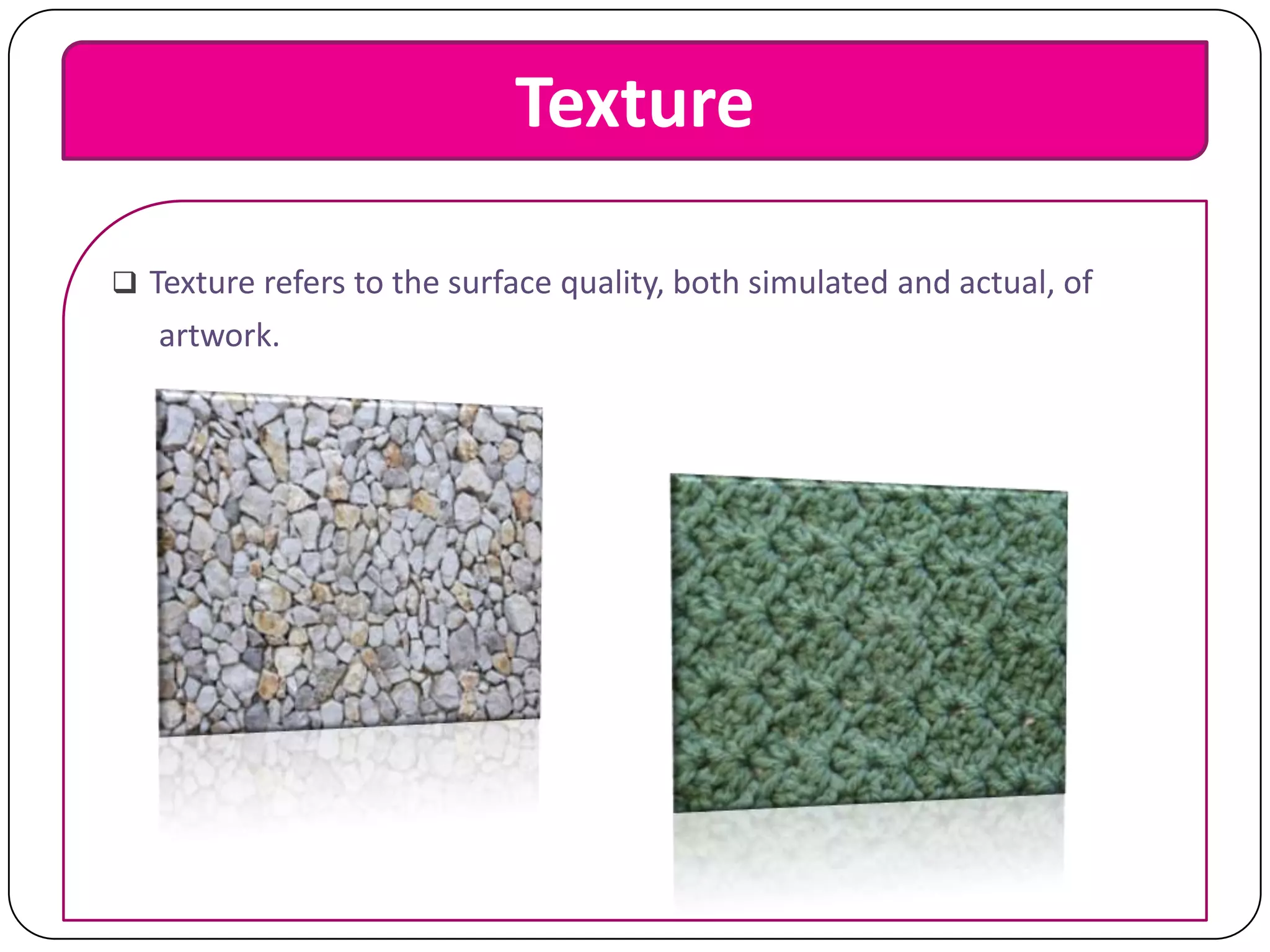
Texture
 Texture refers to the surface quality, both simulated and actual, of

artwork.
Meaning
“The Principles of Design are the artistic
guidelines used to organize or arrange the
structural elements of design.”
Basic Principles of Designing
 Following are the six basic principles of effective design which are

common throughout the field of designing (i.e. from print design to
lithography, typography, & industrial design).
1. Balance
2. Contrast
3. Emphasis
4. Pattern
5. Rhythm/Movement
6. Unity

Principles
???
Balance
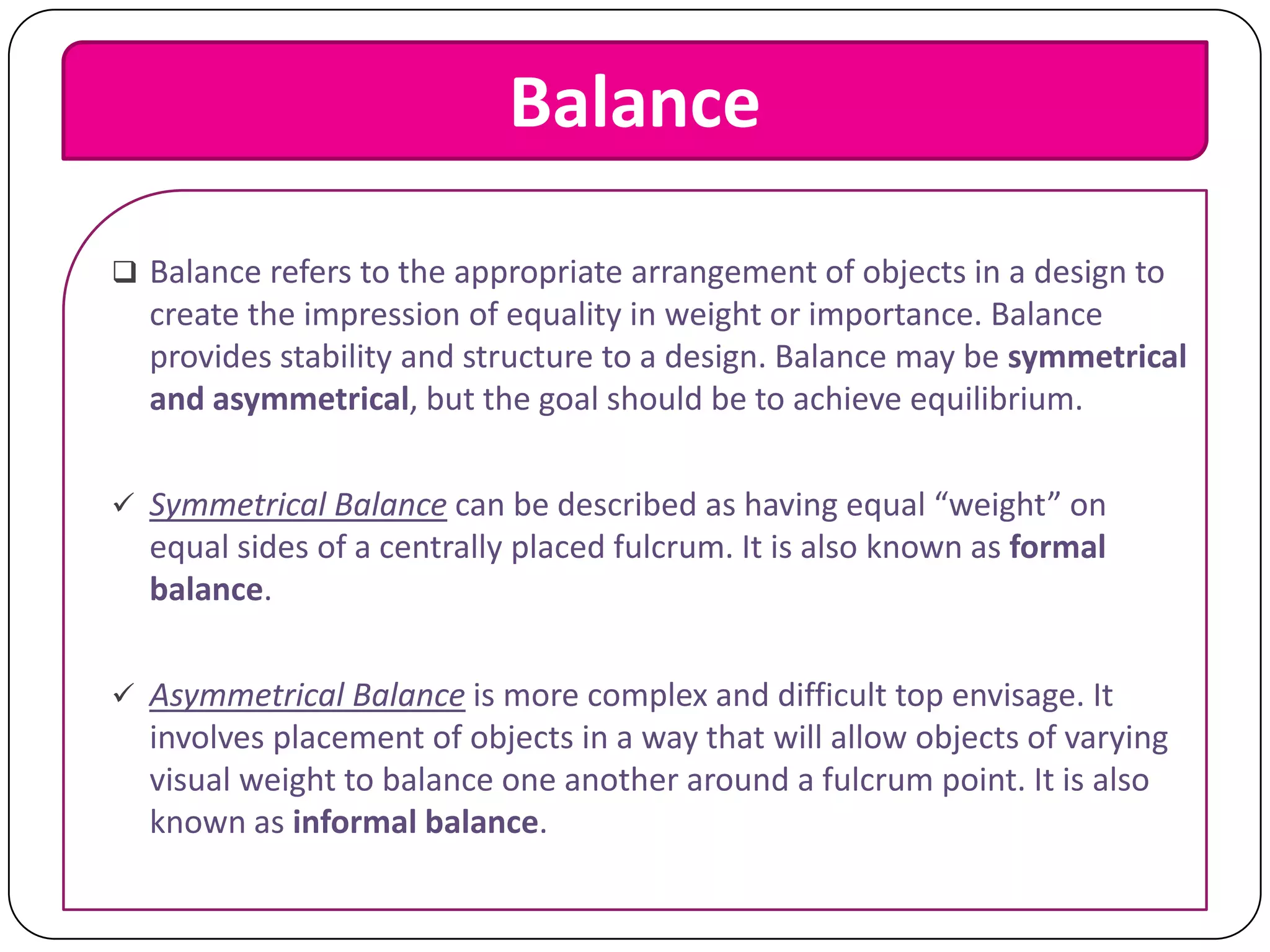
 Balance refers to the appropriate arrangement of objects in a design to

create the impression of equality in weight or importance. Balance
provides stability and structure to a design. Balance may be symmetrical
and asymmetrical, but the goal should be to achieve equilibrium.
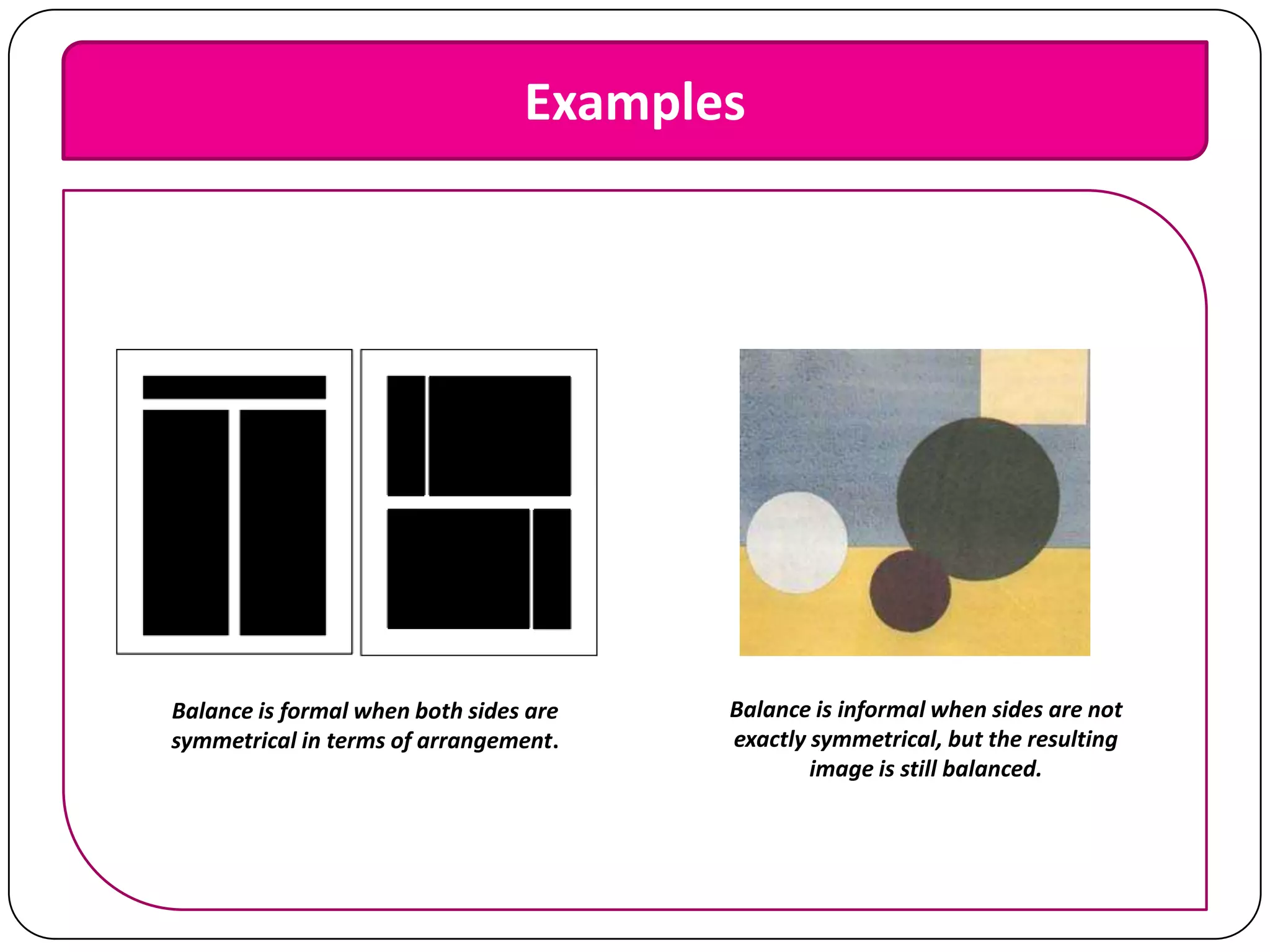
 Symmetrical Balance can be described as having equal “weight” on

equal sides of a centrally placed fulcrum. It is also known as formal
balance.
 Asymmetrical Balance is more complex and difficult top envisage. It

involves placement of objects in a way that will allow objects of varying
visual weight to balance one another around a fulcrum point. It is also
known as informal balance.
Examples

Balance is formal when both sides are
symmetrical in terms of arrangement.

Balance is informal when sides are not
exactly symmetrical, but the resulting
image is still balanced.
Rhythm

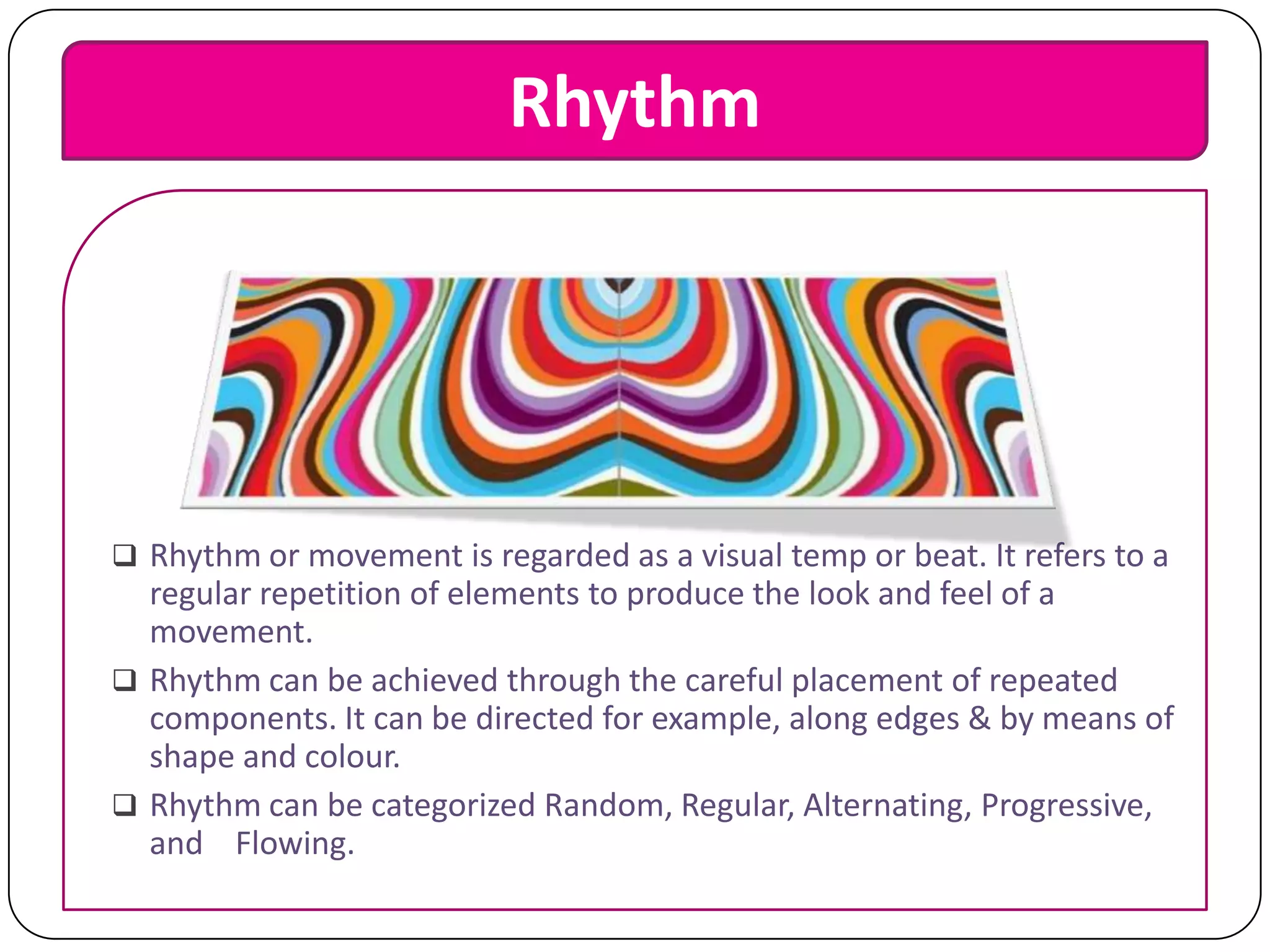
 Rhythm or movement is regarded as a visual temp or beat. It refers to a

regular repetition of elements to produce the look and feel of a
movement.
 Rhythm can be achieved through the careful placement of repeated
components. It can be directed for example, along edges & by means of
shape and colour.
 Rhythm can be categorized Random, Regular, Alternating, Progressive,
and Flowing.
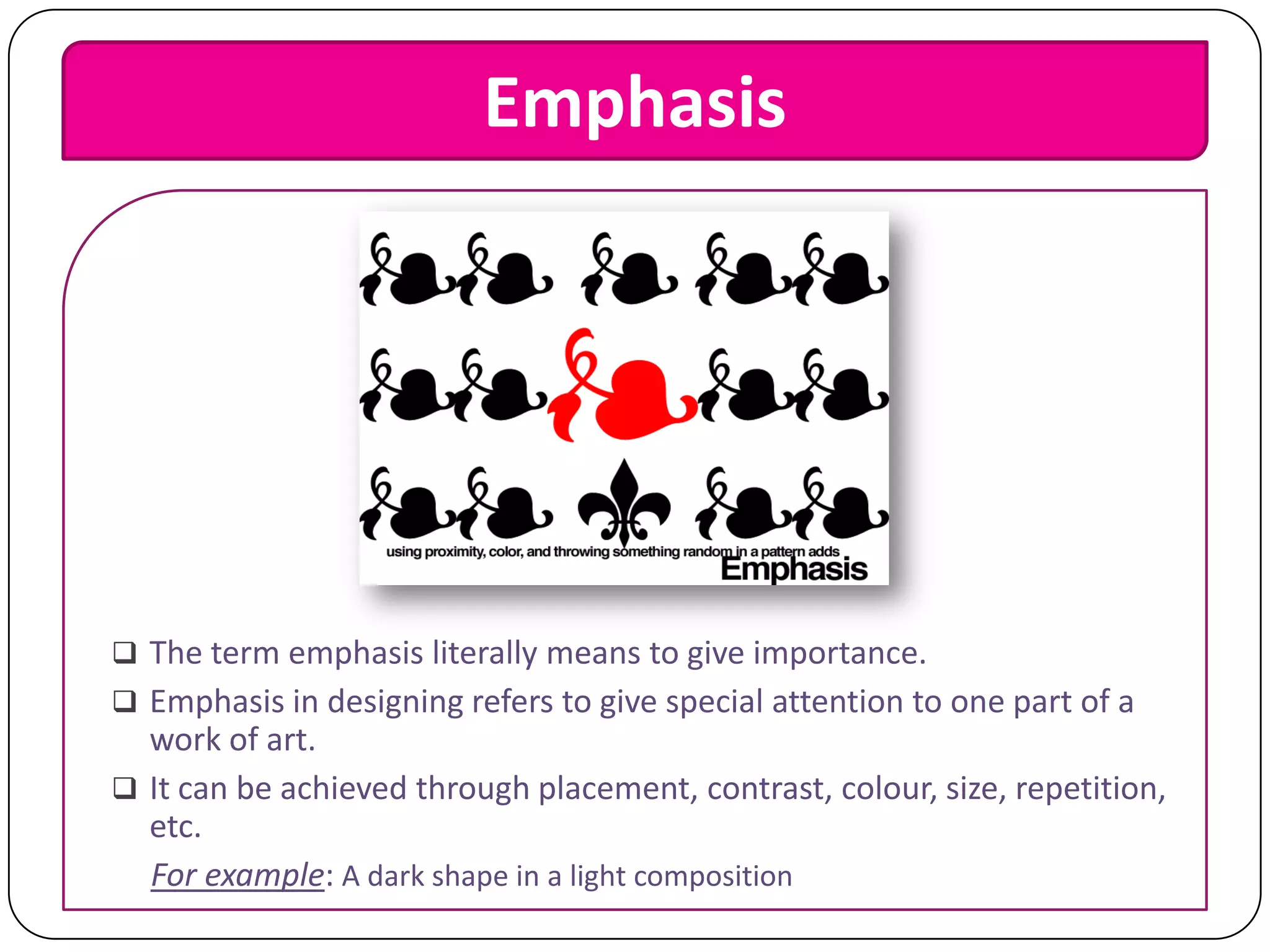
Emphasis

 The term emphasis literally means to give importance.
 Emphasis in designing refers to give special attention to one part of a

work of art.
 It can be achieved through placement, contrast, colour, size, repetition,
etc.
For example: A dark shape in a light composition
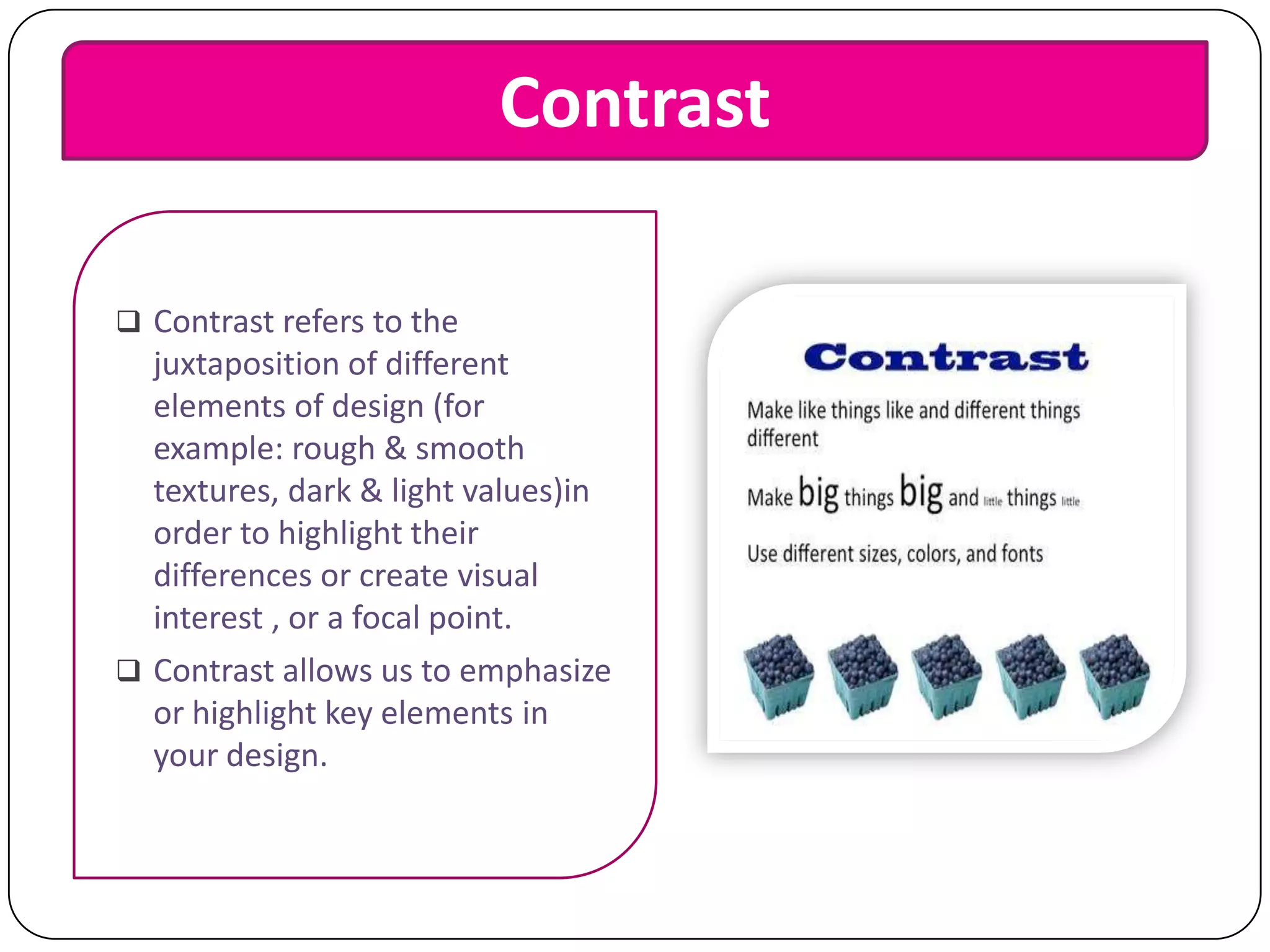
Contrast
 Contrast refers to the

juxtaposition of different
elements of design (for
example: rough & smooth
textures, dark & light values)in
order to highlight their
differences or create visual
interest , or a focal point.
 Contrast allows us to emphasize
or highlight key elements in
your design.
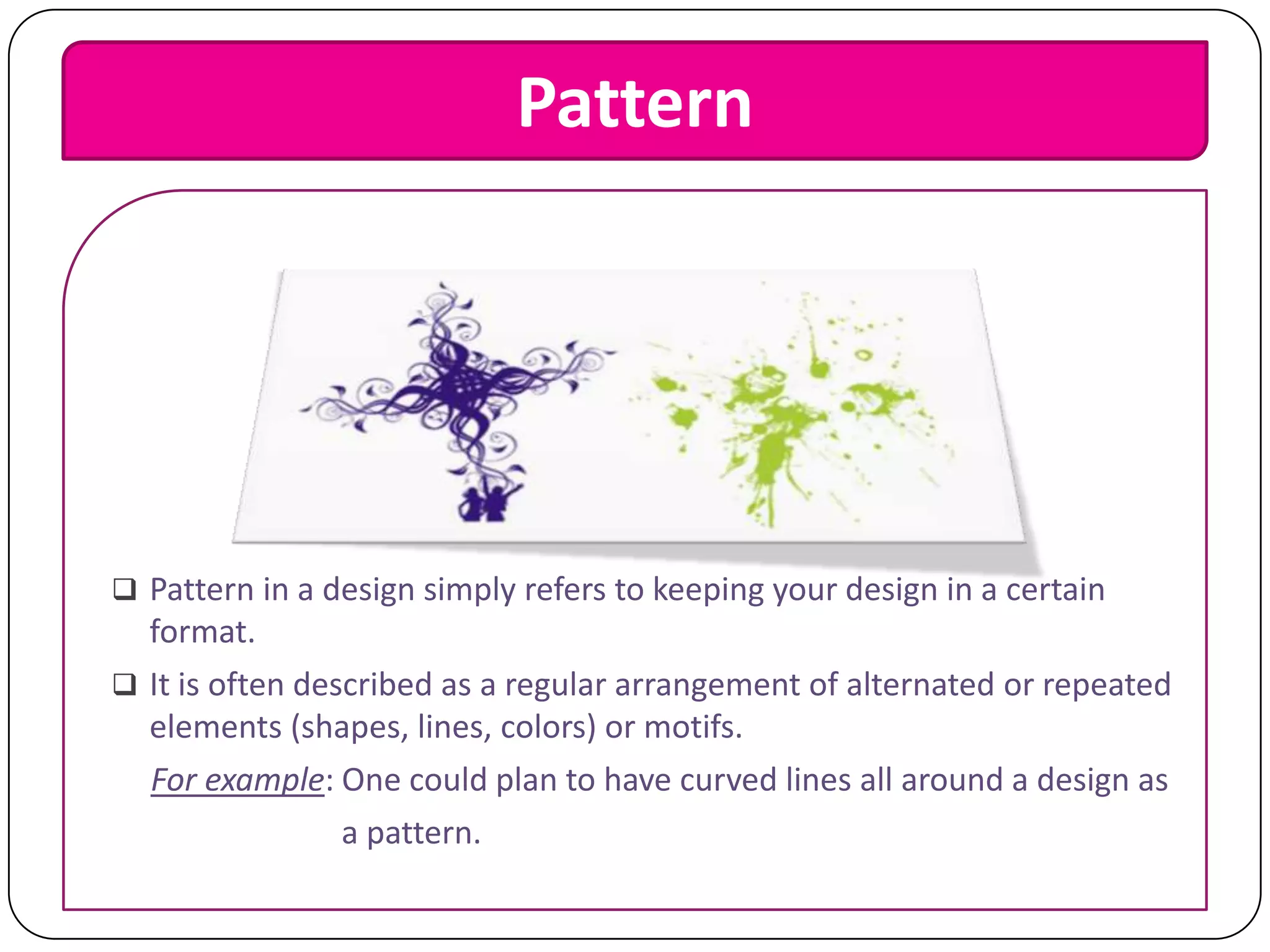
Pattern

 Pattern in a design simply refers to keeping your design in a certain

format.
 It is often described as a regular arrangement of alternated or repeated
elements (shapes, lines, colors) or motifs.
For example: One could plan to have curved lines all around a design as
a pattern.
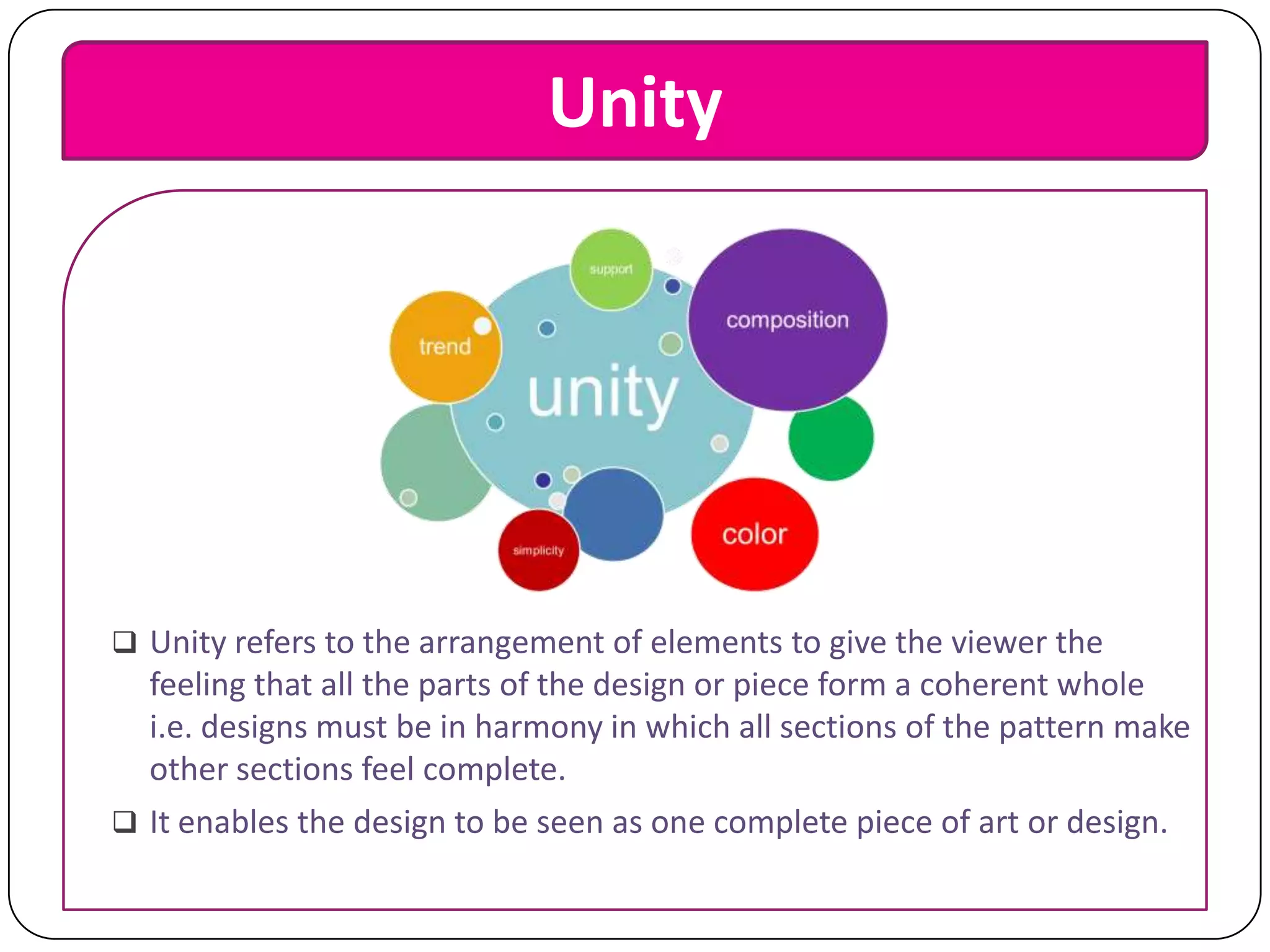
Unity

 Unity refers to the arrangement of elements to give the viewer the

feeling that all the parts of the design or piece form a coherent whole
i.e. designs must be in harmony in which all sections of the pattern make
other sections feel complete.
 It enables the design to be seen as one complete piece of art or design.
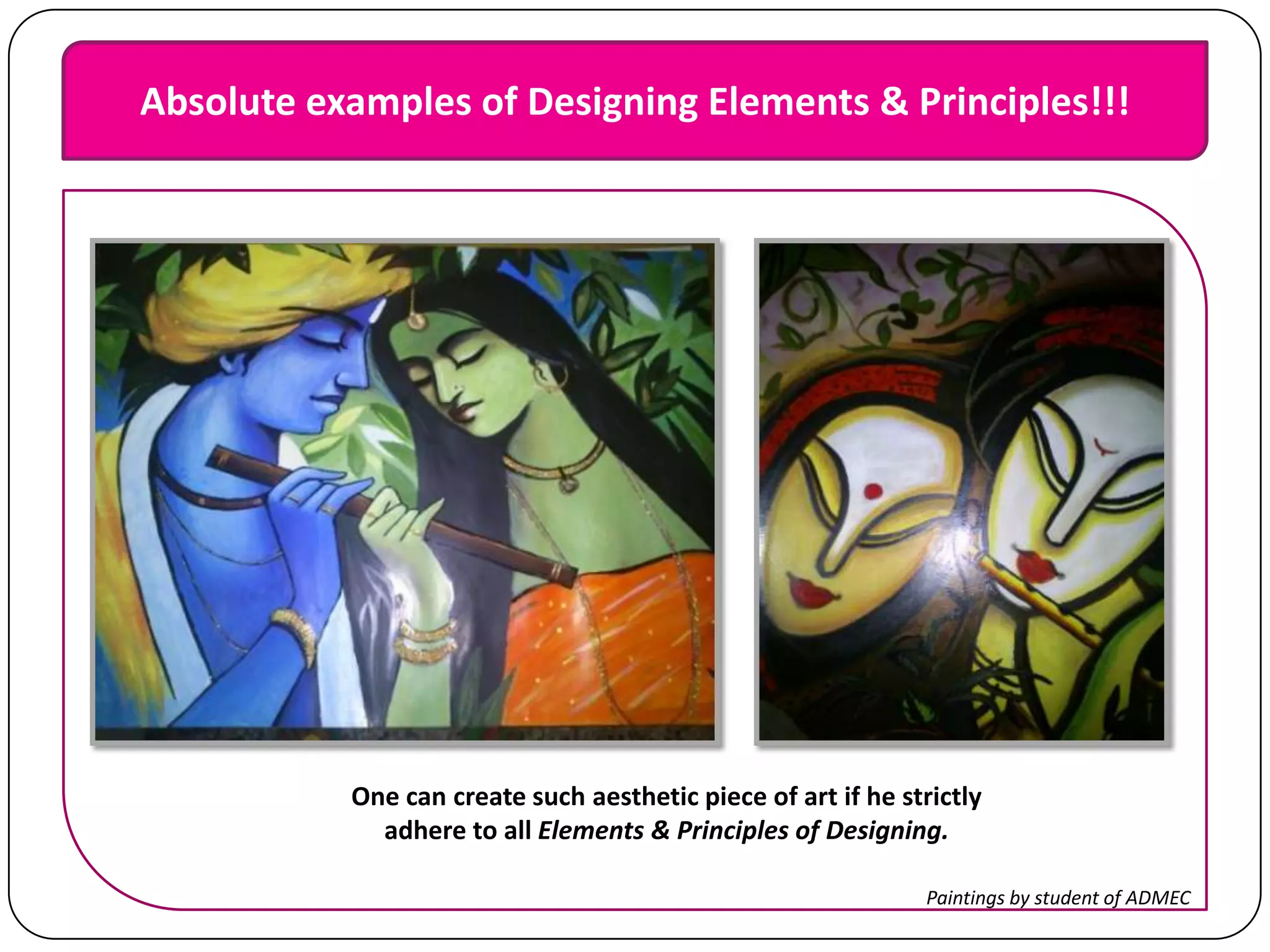
Absolute examples of Designing Elements & Principles!!!

One can create such aesthetic piece of art if he strictly
adhere to all Elements & Principles of Designing.
Paintings by student of ADMEC
Compiled By
Pooja Jindal
ADMEC Multimedia Institute
For more info you can visit
www.admecindia.co.in

For course related enquiry, ring us at:
9811-81-81-22, 011-3130-5055, 011-3203-5055

Can send feedback at: @admecinstitute

Elements and Principles of Design

  • 1.
    The Elements & Principlesof Design By: ADMEC Multimedia Institute www.admecindia.co.in
  • 2.
    Introduction  Hi..here I'mgiving you the basic overview about the Elements and Principles of Designing.  The presentation will give you a good understanding about the significance, meaning and the types of designing elements and principles . What are they?? Why they were used??
  • 3.
    Significance of theTopic Sometimes we have to give our opinion about likes or dislikes on a piece of art or a design, and it’s easy to say just “ I like this, or I don’t like that…”. But if we are asked to give the reasons for it , then it proves to be a very difficult to find out the reason. This generally happens because we judge the designs on its appeal rather than on its articulate sub-factors. Therefore it’s imperative to know the meaning and the types of the designing elements and principles. Can you evaluate this piece of art???
  • 4.
    Designer who knowsthe design Elements & Principles can evaluate the design/page in terms of line, color, balance, texture, etc. Designing Elements and Principles proves to be an analyzing frame for the designers. A designer can express his thought & intentions with the elements of design and does it effectively along with the design principles, i.e. they serves as an expressing tool for designers. Now, let us discus these Elements & Principles!!!
  • 5.
  • 6.
    Meaning “Elements of Designare the components or part which can be isolated & defined in any visual design or work of art. They structure and carry the work.”
  • 7.
    Basic Elements ofDesign  Following are the seven basic elements of design which are common throughout the field of designing. 1. Point / Mark 2. Line 3. Shape 4. Forms 5. Space 6. Color 7. Texture Can someone tell us about the Elements of Design???
  • 8.
    Point (Mark)  Apoint or mark is the smallest and most basic element . It can vary in size, value, regularity or irregularity, and can be used alone as a unit in a group.  Marks can be used to form a value or pattern ( placed close together forms a darker value, further apart forms a lighter value), or to delineate space ( larger means closer,etc.)
  • 9.
    Line  A lineis a form with width and length, but no depth.  Artist use lines to create edges, the outlines of objects. The direction of a line can convey mood.  Broadly lines can be categorized into three types 1. Horizontal 2. Vertical 3. Diagonal
  • 10.
    Example of HorizontalLines  Horizontal lines are calm and quiet.
  • 11.
    Example of VerticalLines  Vertical lines suggest more of a potential for movement.
  • 12.
    Example of DiagonalLines  Diagonal lines strongly suggest movements and give more of a feeling of vitality to a picture.
  • 13.
    Shape  Shape isdefined as an area that stands out from the space next to or around it due to a defined or implied boundary, or because of differences of value, color, or texture.  A shape is formed when a line encloses an area.  Shapes have two dimensions, length and width and can be geometric or free-form.
  • 14.
    Forms  Forms describesvolumes and mass, or the 3D aspects of objects that take up space.  Forms can and should be viewed from any angles. For example: When you hold a baseball, or a small sculpture, you are aware of their curves, angles, indentations, & edges i.e. their forms.
  • 15.
    Space  Space isa 3D volume that can be empty or filled with objects. It has width, height, and depth.  Space that appears three- dimensional in a 2D painting is an illusion that creates a feeling of actual depth.  Several techniques can be used to show such visual depth or space, for example, overlapping, linear perspective, etc.. Example for Overlapping
  • 16.
    Other Examples Detail (aerialor atmospheric perspective) Linear perspective ( converging lines )
  • 17.
    Color  Color hasthree properties. The first is hue, which is the name of the colors. - the primary hue are Yellow, Red, and Blue. - secondary colors are made by mixing two primaries. - intermediate colors are mixtures of a primary & adjacent secondary color.  The second property is Value, which refers to the lightness or darkness of hue.  The third property is Intensity, which refers to the purity of the hue also known as “Chroma”.
  • 18.
  • 19.
    Texture  Texture refersto the surface quality, both simulated and actual, of artwork.
  • 21.
    Meaning “The Principles ofDesign are the artistic guidelines used to organize or arrange the structural elements of design.”
  • 22.
    Basic Principles ofDesigning  Following are the six basic principles of effective design which are common throughout the field of designing (i.e. from print design to lithography, typography, & industrial design). 1. Balance 2. Contrast 3. Emphasis 4. Pattern 5. Rhythm/Movement 6. Unity Principles ???
  • 23.
    Balance  Balance refersto the appropriate arrangement of objects in a design to create the impression of equality in weight or importance. Balance provides stability and structure to a design. Balance may be symmetrical and asymmetrical, but the goal should be to achieve equilibrium.  Symmetrical Balance can be described as having equal “weight” on equal sides of a centrally placed fulcrum. It is also known as formal balance.  Asymmetrical Balance is more complex and difficult top envisage. It involves placement of objects in a way that will allow objects of varying visual weight to balance one another around a fulcrum point. It is also known as informal balance.
  • 24.
    Examples Balance is formalwhen both sides are symmetrical in terms of arrangement. Balance is informal when sides are not exactly symmetrical, but the resulting image is still balanced.
  • 25.
    Rhythm  Rhythm ormovement is regarded as a visual temp or beat. It refers to a regular repetition of elements to produce the look and feel of a movement.  Rhythm can be achieved through the careful placement of repeated components. It can be directed for example, along edges & by means of shape and colour.  Rhythm can be categorized Random, Regular, Alternating, Progressive, and Flowing.
  • 26.
    Emphasis  The termemphasis literally means to give importance.  Emphasis in designing refers to give special attention to one part of a work of art.  It can be achieved through placement, contrast, colour, size, repetition, etc. For example: A dark shape in a light composition
  • 27.
    Contrast  Contrast refersto the juxtaposition of different elements of design (for example: rough & smooth textures, dark & light values)in order to highlight their differences or create visual interest , or a focal point.  Contrast allows us to emphasize or highlight key elements in your design.
  • 28.
    Pattern  Pattern ina design simply refers to keeping your design in a certain format.  It is often described as a regular arrangement of alternated or repeated elements (shapes, lines, colors) or motifs. For example: One could plan to have curved lines all around a design as a pattern.
  • 29.
    Unity  Unity refersto the arrangement of elements to give the viewer the feeling that all the parts of the design or piece form a coherent whole i.e. designs must be in harmony in which all sections of the pattern make other sections feel complete.  It enables the design to be seen as one complete piece of art or design.
  • 30.
    Absolute examples ofDesigning Elements & Principles!!! One can create such aesthetic piece of art if he strictly adhere to all Elements & Principles of Designing. Paintings by student of ADMEC
  • 31.
    Compiled By Pooja Jindal ADMECMultimedia Institute For more info you can visit www.admecindia.co.in For course related enquiry, ring us at: 9811-81-81-22, 011-3130-5055, 011-3203-5055 Can send feedback at: @admecinstitute