SOLAR CELLS VERSUS
PHOTODIODE
Presented by: Abdulaziz Almabrouk Altagawy
Course: EC610 Advanced Electronic Devices2 February 2018
1
Information
 Introduction
 Biasing
 Working Mode
 Differences between
Solar Cell and
Photodiode
 Book(s)
 Semiconductor Physics
And Devices 4th Ed-
Neamen
 [Sheng_S._Li]
Semiconductor physical
electronics
 Materials
 Web site and Google
searching
2 February 2018
2
Introduction
 A solar cell (photovoltaic
devices) is a pn junction
device with no voltage
directly applied across the
junction (used with zero
bias).
 The solar cell converts
photon power into
electrical power and
delivers this power to a
load.
 A photodiode is a pn
junction diode operated
with an applied reverse-
biased voltage.
 We will initially consider
a long diode in which
excess carriers are
generated uniformly
throughout the
semiconductor device.
2 February 2018
3
Solar Cells Photodiode
Biasing
2 February 2018
4
Solar Cells Photodiode
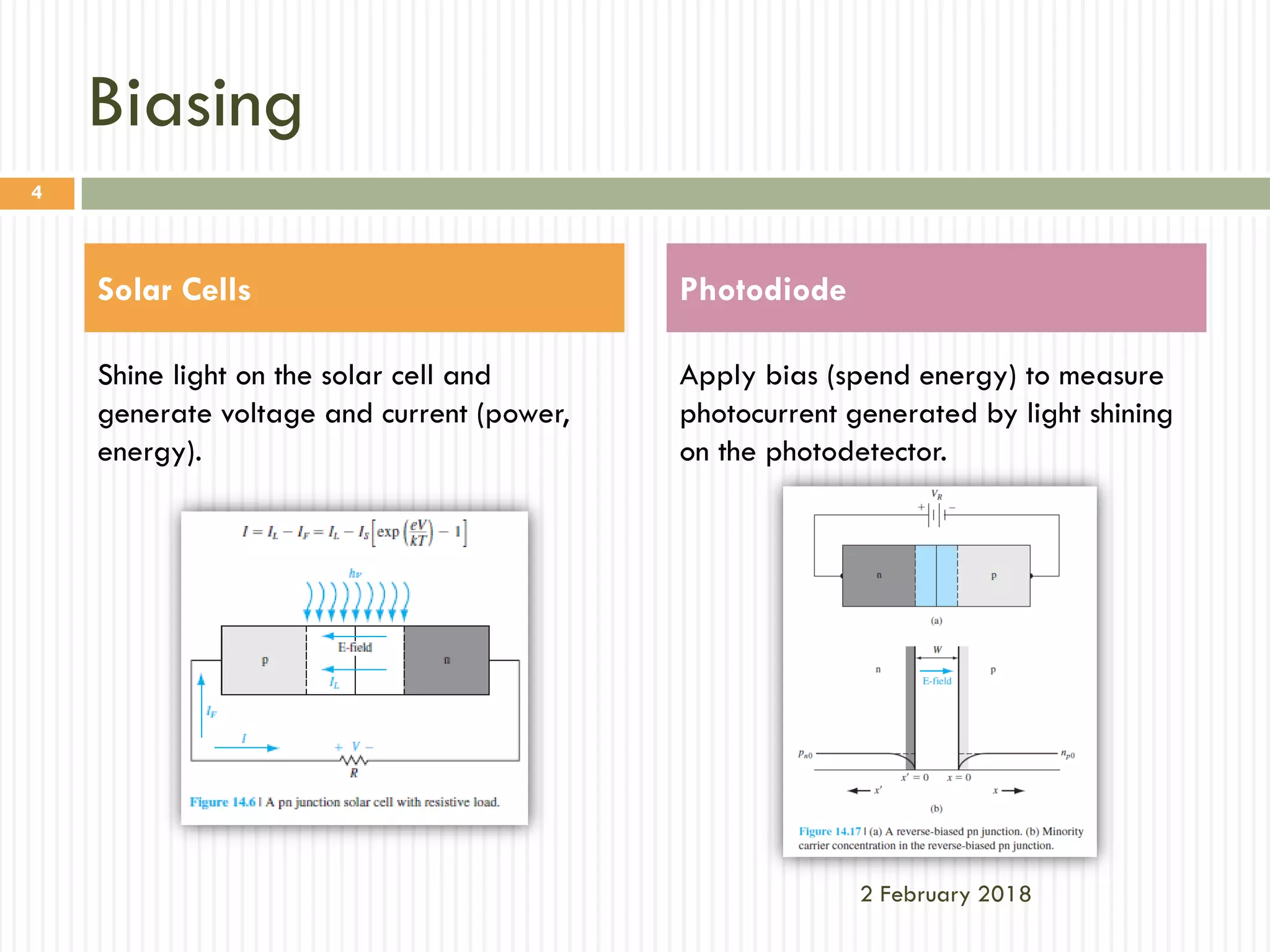
Apply bias (spend energy) to measure
photocurrent generated by light shining
on the photodetector.
Shine light on the solar cell and
generate voltage and current (power,
energy).
Working Mode
2 February 2018
5
Solar Cells Photodiode
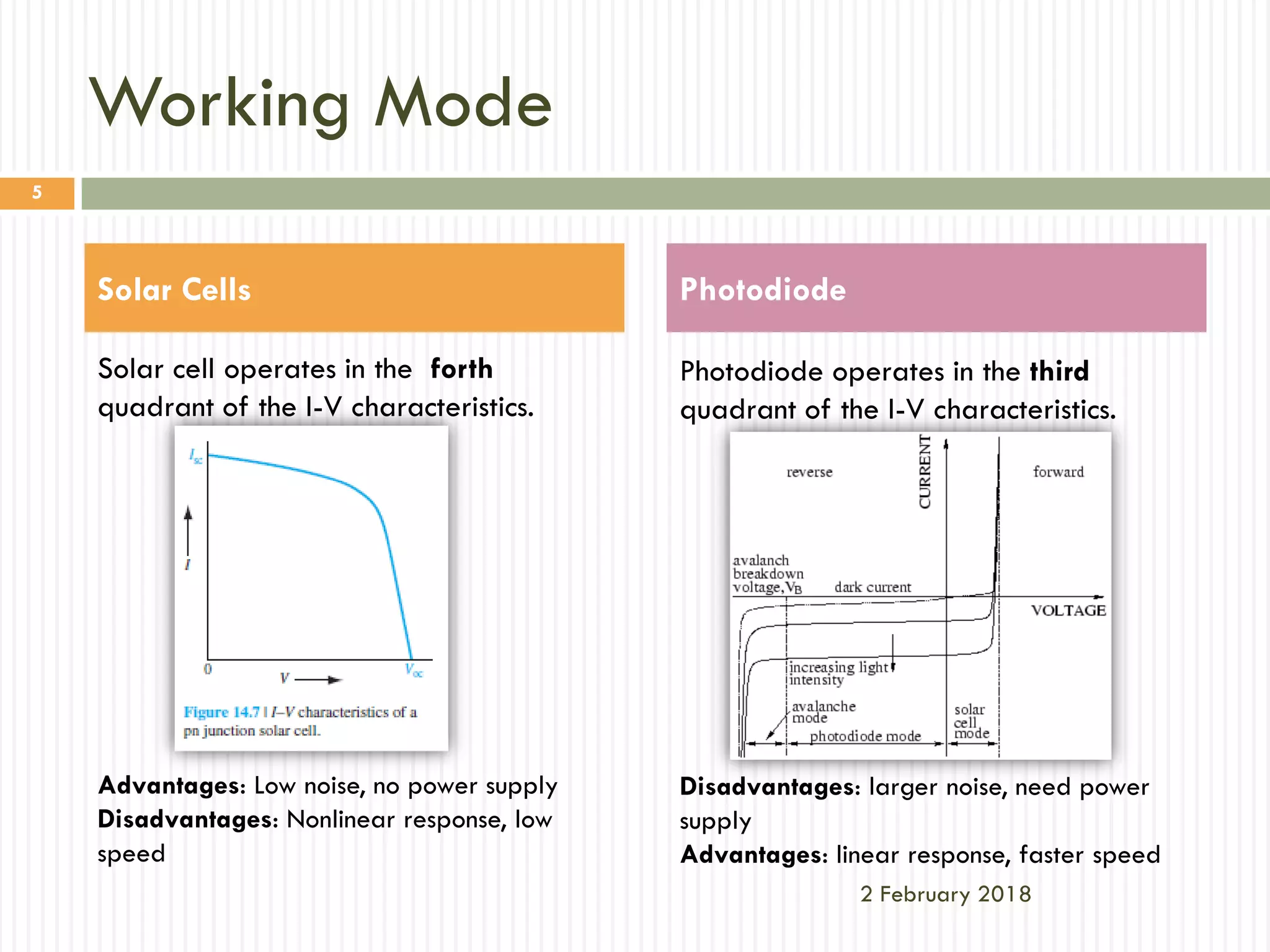
Photodiode operates in the third
quadrant of the I-V characteristics.
Solar cell operates in the forth
quadrant of the I-V characteristics.
Disadvantages: larger noise, need power
supply
Advantages: linear response, faster speed
Advantages: Low noise, no power supply
Disadvantages: Nonlinear response, low
speed
Differences between Solar Cell and Photodiode.
In terms of working principles, there is no difference;
But?
 Area: A solar cell has as substantial area that means
high capacitance is there. It is kind of sensitive and can
produce a greater amount of power from light.
 Size: A solar cell or photovoltaic cell mostly is in
greater size and larger area as compare to
photodiodes.
 Biasing: Solar cell or photovoltaic cell can be utilized
only in forward bias as they never utilized in the
reverse bias.
 Response time: Solar cells take more response time as
compare to photodiodes but for solar cells, we give it a
second thought more about amount of photons ingested
(assimilation effectiveness) instead of response time.
 Usage: Solar cells are prepared to gather power from
light. The solar cell or photovoltaic (PV) cell can be
utilized as a light identifying transducer.
 Applications: Solar cells are used in hand-held
calculators, communication satellites and battery
chargers.
 Area: A photodiode must be quick, which implies low
capacitance, which implies little area of silicon.
Consequently, it is not extremely sensitive, and can’t
produce a great deal of power from light.
 Size: A photodiode is of small size as it has small area.
 Biasing: The photodiodes can be utilized in forward
bias as well as reverse bias, this produces only the
reverse current because of minority transporters yet this
extraordinarily enhances the response time which is
essential in numerous applications.
 Response time: Photodiodes are physically composed
in an approach to yield the current as quick as could be
expected under the circumstances that means this is
done in lesser response time.
 Usage: A photodiode is prepared to identify light
rapidly. Photodiode is utilized as a sensor to identify
light; it is utilized as transducer to change over light into
corresponding current.
 Applications: Photodiodes are used in Intruder alarms,
smoke detector, remote control and home door sensor.
2 February 2018
6
Solar Cells Photodiode
Conclusion
 The difference appears in the specialized design and operation of the
concrete practical devices.
 The actual devices called “photodiodes” are usually intended to work as
sensors or receivers, i.e. to convert light into signal (without regard to
whether they make any of the light’s energy content available to the circuit
they’re in). They are therefore optimized for sensitivity and/or speed: often
small, often having a so-called p–i–n junction or other response-time-
enhancing tweaks, often used with negative bias. Furthermore, they may use
particular materials in order to be particularly or only sensitive to certain
wavelengths.
 The devices called “solar cells” or “photovoltaic devices” are meant as
power sources, i.e. to convert light into power (without any regard to
speed). They are therefore designed for maximum power yield: with a
large area, avoiding unnecessary exclusion of any wavelength where
sunlight carries a meaningful amount of energy, and used with zero bias.
2 February 2018
7
THANKS
2 February 2018
8

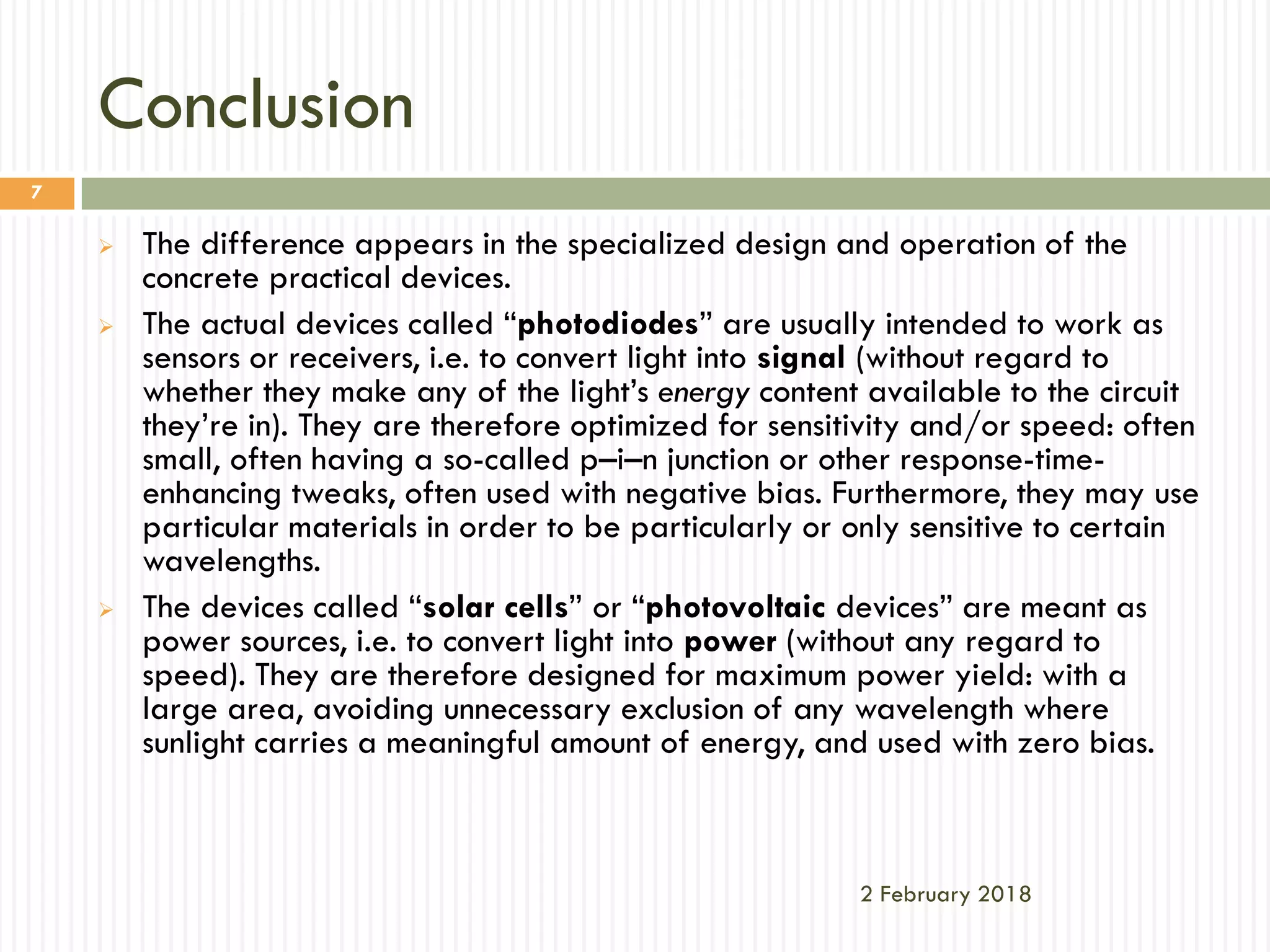
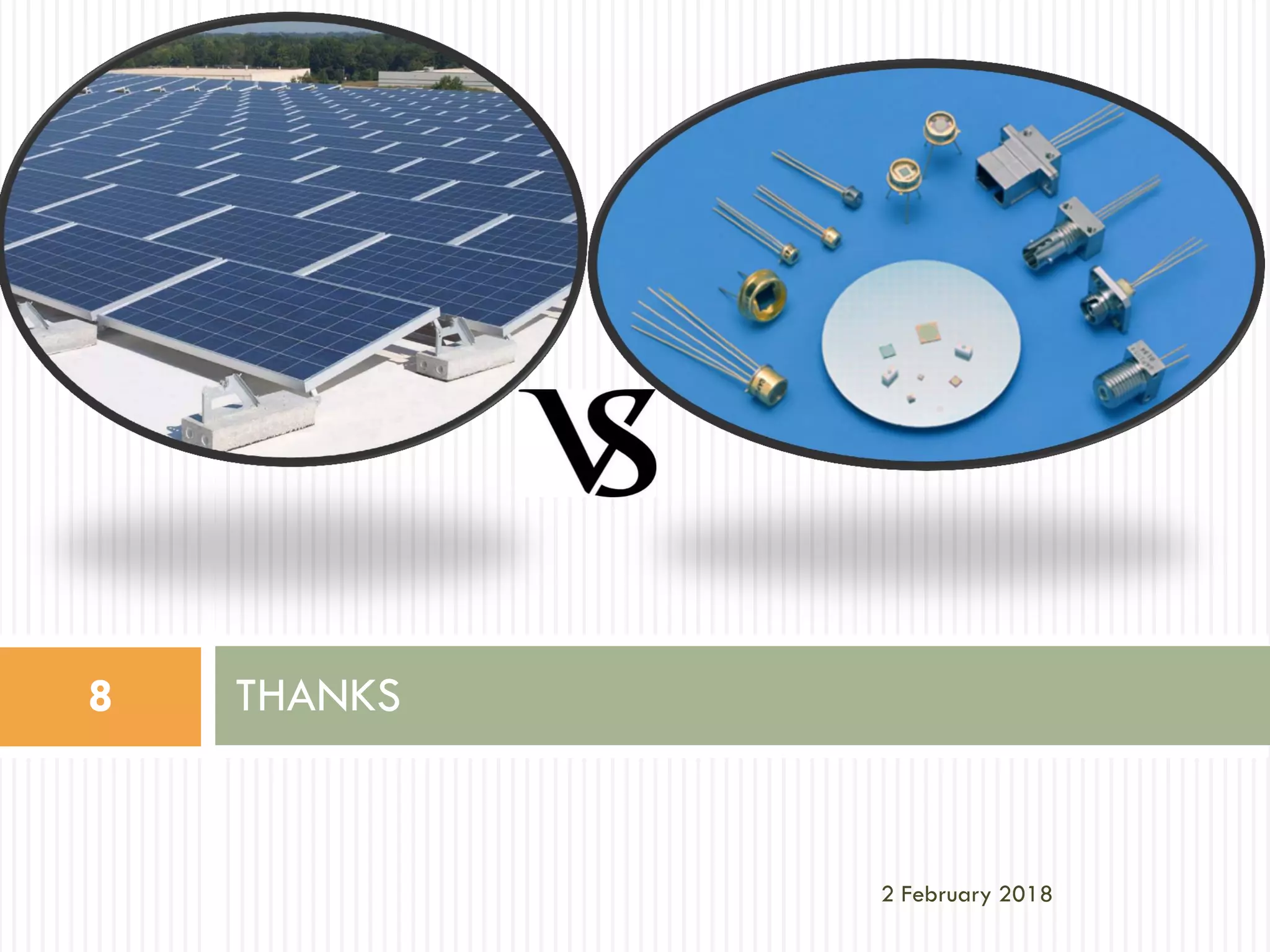
Solar Cells versus Photodiode

  • 1.
    SOLAR CELLS VERSUS PHOTODIODE Presentedby: Abdulaziz Almabrouk Altagawy Course: EC610 Advanced Electronic Devices2 February 2018 1
  • 2.
    Information  Introduction  Biasing Working Mode  Differences between Solar Cell and Photodiode  Book(s)  Semiconductor Physics And Devices 4th Ed- Neamen  [Sheng_S._Li] Semiconductor physical electronics  Materials  Web site and Google searching 2 February 2018 2
  • 3.
    Introduction  A solarcell (photovoltaic devices) is a pn junction device with no voltage directly applied across the junction (used with zero bias).  The solar cell converts photon power into electrical power and delivers this power to a load.  A photodiode is a pn junction diode operated with an applied reverse- biased voltage.  We will initially consider a long diode in which excess carriers are generated uniformly throughout the semiconductor device. 2 February 2018 3 Solar Cells Photodiode
  • 4.
    Biasing 2 February 2018 4 SolarCells Photodiode Apply bias (spend energy) to measure photocurrent generated by light shining on the photodetector. Shine light on the solar cell and generate voltage and current (power, energy).
  • 5.
    Working Mode 2 February2018 5 Solar Cells Photodiode Photodiode operates in the third quadrant of the I-V characteristics. Solar cell operates in the forth quadrant of the I-V characteristics. Disadvantages: larger noise, need power supply Advantages: linear response, faster speed Advantages: Low noise, no power supply Disadvantages: Nonlinear response, low speed
  • 6.
    Differences between SolarCell and Photodiode. In terms of working principles, there is no difference; But?  Area: A solar cell has as substantial area that means high capacitance is there. It is kind of sensitive and can produce a greater amount of power from light.  Size: A solar cell or photovoltaic cell mostly is in greater size and larger area as compare to photodiodes.  Biasing: Solar cell or photovoltaic cell can be utilized only in forward bias as they never utilized in the reverse bias.  Response time: Solar cells take more response time as compare to photodiodes but for solar cells, we give it a second thought more about amount of photons ingested (assimilation effectiveness) instead of response time.  Usage: Solar cells are prepared to gather power from light. The solar cell or photovoltaic (PV) cell can be utilized as a light identifying transducer.  Applications: Solar cells are used in hand-held calculators, communication satellites and battery chargers.  Area: A photodiode must be quick, which implies low capacitance, which implies little area of silicon. Consequently, it is not extremely sensitive, and can’t produce a great deal of power from light.  Size: A photodiode is of small size as it has small area.  Biasing: The photodiodes can be utilized in forward bias as well as reverse bias, this produces only the reverse current because of minority transporters yet this extraordinarily enhances the response time which is essential in numerous applications.  Response time: Photodiodes are physically composed in an approach to yield the current as quick as could be expected under the circumstances that means this is done in lesser response time.  Usage: A photodiode is prepared to identify light rapidly. Photodiode is utilized as a sensor to identify light; it is utilized as transducer to change over light into corresponding current.  Applications: Photodiodes are used in Intruder alarms, smoke detector, remote control and home door sensor. 2 February 2018 6 Solar Cells Photodiode
  • 7.
    Conclusion  The differenceappears in the specialized design and operation of the concrete practical devices.  The actual devices called “photodiodes” are usually intended to work as sensors or receivers, i.e. to convert light into signal (without regard to whether they make any of the light’s energy content available to the circuit they’re in). They are therefore optimized for sensitivity and/or speed: often small, often having a so-called p–i–n junction or other response-time- enhancing tweaks, often used with negative bias. Furthermore, they may use particular materials in order to be particularly or only sensitive to certain wavelengths.  The devices called “solar cells” or “photovoltaic devices” are meant as power sources, i.e. to convert light into power (without any regard to speed). They are therefore designed for maximum power yield: with a large area, avoiding unnecessary exclusion of any wavelength where sunlight carries a meaningful amount of energy, and used with zero bias. 2 February 2018 7
  • 8.