Computer Network Course
Lecture 1
Introduction
5/2/2014 2
Computer Network
Why network
Communications Model
Network types
Network Software
Layering
Protocol
Stack models
A network is a set of devices (often referred to as nodes) connected
by communication links. A node can be a computer, printer, or any
other device capable of sending and/or receiving data generated by
other nodes on the network. A link can be a cable, air, optical fiber,
or any medium which can transport a signal carrying information.
5/2/2014 3
Why Network
Resource Sharing
Reliability and Availability
Communication Medium
Access Information
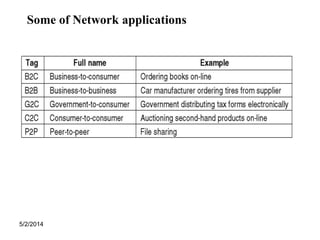
E- Commerce
Person to Person Communication
Others
Some of Network applications
5/2/2014
5/2/2014 5
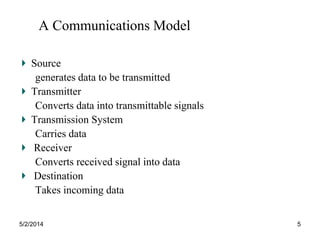
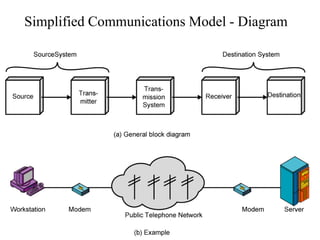
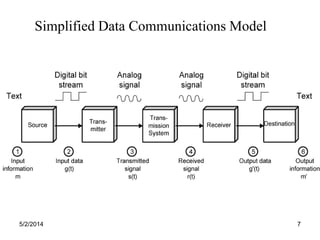
A Communications Model
Source
generates data to be transmitted
Transmitter
Converts data into transmittable signals
Transmission System
Carries data
Receiver
Converts received signal into data
Destination
Takes incoming data
5/2/2014 6
Simplified Communications Model - Diagram
5/2/2014 7
Simplified Data Communications Model
5/2/2014 8
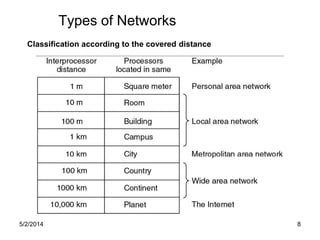
Types of Networks
Classification according to the covered distance
5/2/2014 9
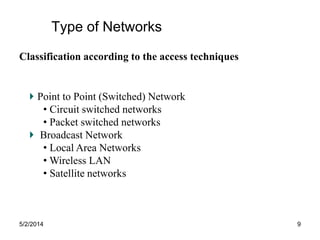
Type of Networks
Classification according to the access techniques
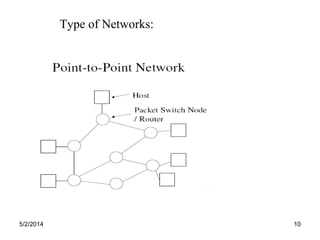
Point to Point (Switched) Network
• Circuit switched networks
• Packet switched networks
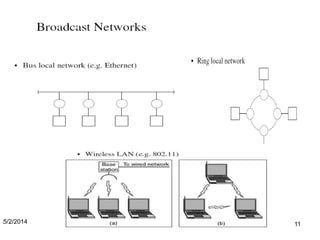
Broadcast Network
• Local Area Networks
• Wireless LAN
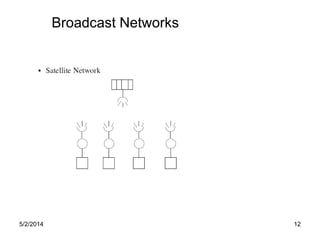
• Satellite networks
5/2/2014 10
Type of Networks:
5/2/2014 11
5/2/2014 12
Broadcast Networks
Network Software
Protocol Hierarchies
Design Issues for the Layers
Connection-Oriented and Connectionless Services
Service Primitives
The Relationship of Services to Protocols
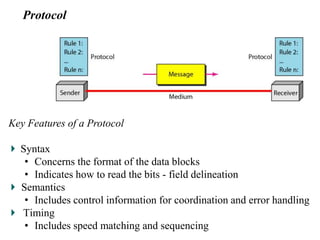
Protocol
Key Features of a Protocol
Syntax
• Concerns the format of the data blocks
• Indicates how to read the bits - field delineation
Semantics
• Includes control information for coordination and error handling
Timing
• Includes speed matching and sequencing
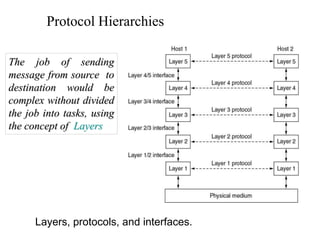
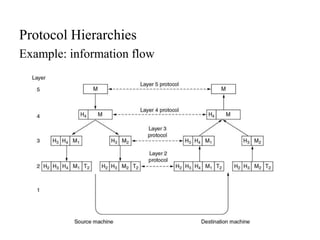
Protocol Hierarchies
Layers, protocols, and interfaces.
The job of sending
message from source to
destination would be
complex without divided
the job into tasks, using
the concept of Layers
Protocol Hierarchies
Example: information flow
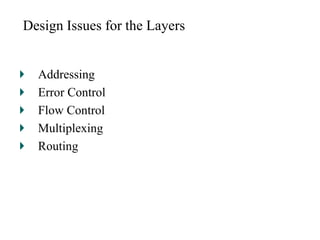
Design Issues for the Layers
Addressing
Error Control
Flow Control
Multiplexing
Routing
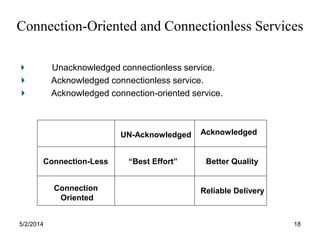
Connection-Oriented and Connectionless Services
5/2/2014 18
Unacknowledged connectionless service.
Acknowledged connectionless service.
Acknowledged connection-oriented service.
Connection-Less
Connection
Oriented
AcknowledgedUN-Acknowledged
“Best Effort” Better Quality
Reliable Delivery
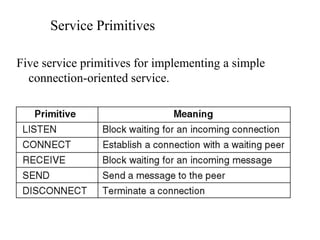
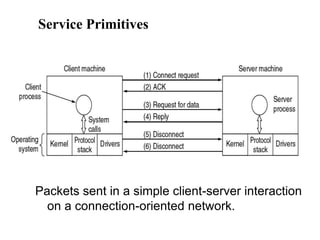
Service Primitives
Five service primitives for implementing a simple
connection-oriented service.
Service Primitives
Packets sent in a simple client-server interaction
on a connection-oriented network.
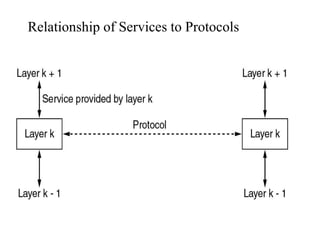
Relationship of Services to Protocols
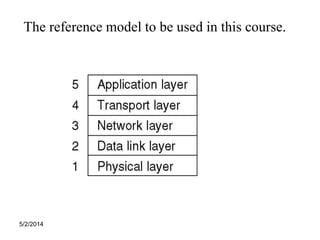
Reference Models
The OSI Reference Model
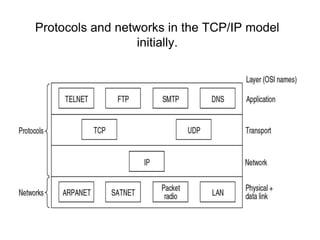
The TCP/IP Reference Model
A Comparison of OSI and TCP/IP
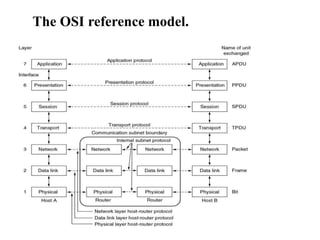
The OSI reference model.
5/2/2014 24
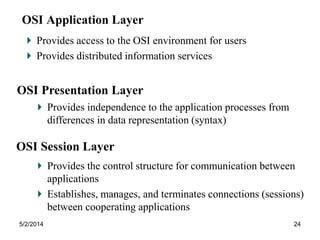
OSI Application Layer
Provides access to the OSI environment for users
Provides distributed information services
OSI Presentation Layer
Provides independence to the application processes from
differences in data representation (syntax)
OSI Session Layer
Provides the control structure for communication between
applications
Establishes, manages, and terminates connections (sessions)
between cooperating applications
25
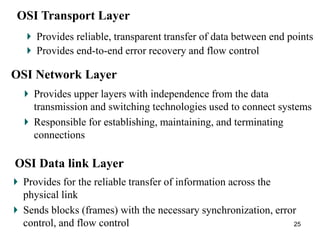
OSI Transport Layer
Provides reliable, transparent transfer of data between end points
Provides end-to-end error recovery and flow control
OSI Network Layer
Provides upper layers with independence from the data
transmission and switching technologies used to connect systems
Responsible for establishing, maintaining, and terminating
connections
OSI Data link Layer
Provides for the reliable transfer of information across the
physical link
Sends blocks (frames) with the necessary synchronization, error
control, and flow control
5/2/2014 26
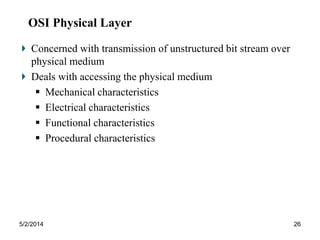
OSI Physical Layer
Concerned with transmission of unstructured bit stream over
physical medium
Deals with accessing the physical medium
 Mechanical characteristics
 Electrical characteristics
 Functional characteristics
 Procedural characteristics
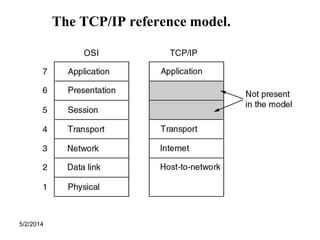
The TCP/IP reference model.
5/2/2014
Protocols and networks in the TCP/IP model
initially.
The reference model to be used in this course.
5/2/2014

Comp net 1

  • 1.
  • 2.
    5/2/2014 2 Computer Network Whynetwork Communications Model Network types Network Software Layering Protocol Stack models A network is a set of devices (often referred to as nodes) connected by communication links. A node can be a computer, printer, or any other device capable of sending and/or receiving data generated by other nodes on the network. A link can be a cable, air, optical fiber, or any medium which can transport a signal carrying information.
  • 3.
    5/2/2014 3 Why Network ResourceSharing Reliability and Availability Communication Medium Access Information E- Commerce Person to Person Communication Others
  • 4.
    Some of Networkapplications 5/2/2014
  • 5.
    5/2/2014 5 A CommunicationsModel Source generates data to be transmitted Transmitter Converts data into transmittable signals Transmission System Carries data Receiver Converts received signal into data Destination Takes incoming data
  • 6.
  • 7.
    5/2/2014 7 Simplified DataCommunications Model
  • 8.
    5/2/2014 8 Types ofNetworks Classification according to the covered distance
  • 9.
    5/2/2014 9 Type ofNetworks Classification according to the access techniques Point to Point (Switched) Network • Circuit switched networks • Packet switched networks Broadcast Network • Local Area Networks • Wireless LAN • Satellite networks
  • 10.
  • 11.
  • 12.
  • 13.
    Network Software Protocol Hierarchies DesignIssues for the Layers Connection-Oriented and Connectionless Services Service Primitives The Relationship of Services to Protocols
  • 14.
    Protocol Key Features ofa Protocol Syntax • Concerns the format of the data blocks • Indicates how to read the bits - field delineation Semantics • Includes control information for coordination and error handling Timing • Includes speed matching and sequencing
  • 15.
    Protocol Hierarchies Layers, protocols,and interfaces. The job of sending message from source to destination would be complex without divided the job into tasks, using the concept of Layers
  • 16.
  • 17.
    Design Issues forthe Layers Addressing Error Control Flow Control Multiplexing Routing
  • 18.
    Connection-Oriented and ConnectionlessServices 5/2/2014 18 Unacknowledged connectionless service. Acknowledged connectionless service. Acknowledged connection-oriented service. Connection-Less Connection Oriented AcknowledgedUN-Acknowledged “Best Effort” Better Quality Reliable Delivery
  • 19.
    Service Primitives Five serviceprimitives for implementing a simple connection-oriented service.
  • 20.
    Service Primitives Packets sentin a simple client-server interaction on a connection-oriented network.
  • 21.
  • 22.
    Reference Models The OSIReference Model The TCP/IP Reference Model A Comparison of OSI and TCP/IP
  • 23.
  • 24.
    5/2/2014 24 OSI ApplicationLayer Provides access to the OSI environment for users Provides distributed information services OSI Presentation Layer Provides independence to the application processes from differences in data representation (syntax) OSI Session Layer Provides the control structure for communication between applications Establishes, manages, and terminates connections (sessions) between cooperating applications
  • 25.
    25 OSI Transport Layer Providesreliable, transparent transfer of data between end points Provides end-to-end error recovery and flow control OSI Network Layer Provides upper layers with independence from the data transmission and switching technologies used to connect systems Responsible for establishing, maintaining, and terminating connections OSI Data link Layer Provides for the reliable transfer of information across the physical link Sends blocks (frames) with the necessary synchronization, error control, and flow control
  • 26.
    5/2/2014 26 OSI PhysicalLayer Concerned with transmission of unstructured bit stream over physical medium Deals with accessing the physical medium  Mechanical characteristics  Electrical characteristics  Functional characteristics  Procedural characteristics
  • 27.
    The TCP/IP referencemodel. 5/2/2014
  • 28.
    Protocols and networksin the TCP/IP model initially.
  • 29.
    The reference modelto be used in this course. 5/2/2014