Bobath & Brunnstrom
Approaches
Dr. Maheshwari Harishchandre
Assistant Professor
M.P.Th (Neurosciences)
DVVPF College of Physiotherapy,
Ahmednagar
Learning Objectives…
At the end of the lecture, the students
should be able to:
• Discuss the theoretical basis of the
neurodevelopmental approaches
• Discuss the concepts and principles
underlying the Bobath approach
• Discuss the concepts and principles
underlying the Brunnstrom approach
Sensorimotor Approaches
• Bobath approach
• Brunnstrom’s movement therapy
• Rood approach
• Proprioceptive neuromuscular
facilitation
Theoretical basis…
• Neurodevelopmental model
• Reflex theory
• Hierarchical theory
• Systems approach
Neurodevelopmental Model
• motor control and its production
refers to two systems of output: the
open loop (voluntary control ) and
the closed loop (postural control)
mechanisms
Open-loop system…
• commands sequences of movement
that are centrally stored in the
nervous system and that serve the
functions of mobility in the
production of isolated joint and limb
motions
Closed-loop system…
• Dependent upon afferent feedback
for the elicitation of its automatic
movements that serve as the
principle motility or stability of the
organism
• prerequisite for the development of
normal movement behaviors
• arise from patterns of coordination
Reflex Theory
• The basic unit of motor control are reflexes
– Reflexes  purposeful movement
– Damage to the CNS results to re-emergence of
and inability to control the reflexes
Hierarchical Theory
• Motor control is hierarchically arranged
– CNS structures involved with movement
can be grouped into HIGHER, MIDDLE,
and LOWER levels
– Higher centers regulate and control the
middle and lower centers
– Damage to the CNS results to disruption of
the normal coordinated function of these
levels
Systems approach
• suggests that the CNS does not operate
in a strictly descending manner
• no higher levels with which to control
the operation of the lower levels
• there is a mutable relationship between
the various levels so that each level will
alternate between command and
subordinate roles in relation to the other
levels.
Bobath Approach
Concepts and Principles
History…
• Developed by Dr. Karel Bobath, a
neuropsychiatrist, and Mrs. Berta
Bobath, a physical therapist
• 1943 – while working with children with
cerebral palsy
Original theoretical
framework…
• Based on the works of Jackson,
Sherrington, and Magnus
 who described nervous system as
HIERARCHICAL in nature
• Model
 Higher brain centers exerted control
over lower-level centers
 Eg. The cerebral cortex control
supercedes that of the brainstem
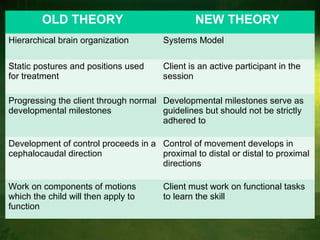
OLD THEORY NEW THEORY
Hierarchical brain organization Systems Model
Static postures and positions used
for treatment
Client is an active participant in the
session
Progressing the client through normal
developmental milestones
Developmental milestones serve as
guidelines but should not be strictly
adhered to
Development of control proceeds in a
cephalocaudal direction
Control of movement develops in
proximal to distal or distal to proximal
directions
Work on components of motions
which the child will then apply to
function
Client must work on functional tasks
to learn the skill
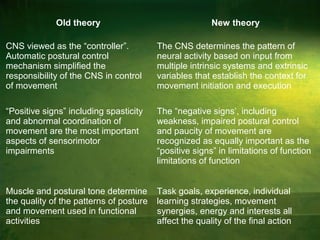
Old theory New theory
CNS viewed as the “controller”.
Automatic postural control
mechanism simplified the
responsibility of the CNS in control
of movement
The CNS determines the pattern of
neural activity based on input from
multiple intrinsic systems and extrinsic
variables that establish the context for
movement initiation and execution
“Positive signs” including spasticity
and abnormal coordination of
movement are the most important
aspects of sensorimotor
impairments
The “negative signs’, including
weakness, impaired postural control
and paucity of movement are
recognized as equally important as the
“positive signs” in limitations of function
limitations of function
Muscle and postural tone determine
the quality of the patterns of posture
and movement used in functional
activities
Task goals, experience, individual
learning strategies, movement
synergies, energy and interests all
affect the quality of the final action
Basic idea of Bobath Approach
• The abnormal patterns must be stopped not
by modifying the sensory input, but by
giving back to the patient the lost or
undeveloped control over his out put in
developmental sequence.
• The basic patterns of posture & movement ,
the righting reaction & equilibrium responses
are elicited by providing the appropriate
stimuli while the abnormal patterns are
inhibited.
• In this way patient the patient is given the
opportunity to experience normal movement.
Basic idea of Bobath approach
• The sensory information of correct
movement is absolutely necessary for
the development of improved motor
control.
• Treatment therefore, concentrate on
handling the patient in such a way as
to inhibit abnormal distribution of
tone & abnormal postures while
stimulating or encouraging the next
level of motor control.
Adult hemiplegia..
• Treatment approach was later on expanded to
include the rehabilitation of adults with motor
problems, particularly CVA
• Main problem: the abnormal coordination of
movement patterns combined with abnormal
postural tonus (Bernstein, 1967)
• Secondary problem: muscle strength and
muscle activity
Bobath concept…
• Is a living concept
 It has undergone changes in its
theoretical base to accommodate
developments in the fields of
neurophysiology, biomechanics, and
typical development
• Holistic approach
 It involves the whole patient, his sensory,
perceptual and adaptive behaviour, and
motor problems
Traditional View
• Principles of treatment
– Normalize muscle tone
– Inhibit primitive reflexes
– Facilitate normal postural reactions
– Treatment should be developmental
• Techniques
– Handling
– Weight bearing over the affected limb
– Utilize positions that allow use of the
affected limbs
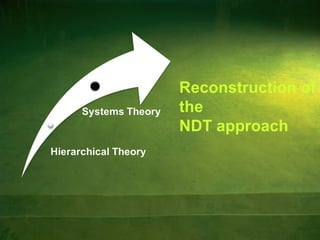
Reconstruction of
the
NDT approach
Problems in the adult patient
with stroke
• Abnormal tone
• Loss of postural control
• Abnormal coordination
• Abnormal functional performance
Goals…
• Decrease the influence of spasticity and
abnormal coordination
• Improve control of the involved trunk,
arm and leg
• Retain normal, functional patterns of
movement in the adult stroke patient
Principles of treatment:
• Treatment should avoid movements and
activities that increase muscle tone or
produce abnormal reflex patterns in the
involved side
• Treatment should be directed toward the
development of normal patterns of posture
and movement.
Principles of treatment
• The hemiplegic side should be
incorporated into all treatment activities
to reestablish symmetry and increased
functional use
• Treatment should produce a change in
the quality of movement and functional
performance of the involved side
Principles of treatment:
• Increase active use of the involved side
• Provide practice to improve motor
performance that lead to motor learning
Stages of hemiplegia and the
Bobath Approach
• Initial Flaccid Stage
 Tx focus on positioning and movement in
bed to avoid the typical postural patterns of
hemiplegia
• Stage of Spasticity
 tx is a continuation of the previous stage
with the goal of breaking down the total
patterns by developing control of the
intermediate joints
Stages of hemiplegia and the
Bobath Approach
• Stage of Relative Recovery
 tx aims at improving the quality of
gait and the use of the affected hand
Principles of treatment:
children with cerebral palsy
• Treat the child as a whole
• Basis for intervention is normal
movement and their interrelationships
• Treatment incorporates facilitation and
inhibition using key points of control
 abnormal tone is always inhibited
 normal responses, once elicited, are
always repeated
What are key points of
control (KPC)?
• Parts of the body where the therapist
can most effectively control and change
patterns of posture and movement in
other body parts
– Proximal: shoulder/scapula, pelvis/hip
– Distal: jaw, wrist, ankle,
– Head may be a proximal or distal KPC
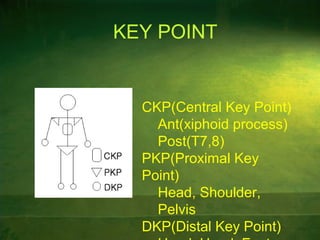
KEY POINT
CKP(Central Key Point)
Ant(xiphoid process)
Post(T7,8)
PKP(Proximal Key
Point)
Head, Shoulder,
Pelvis
DKP(Distal Key Point)
Facilitation-Inhibition
• Facilitation
 is a mean by which movement is made
easy, made possible, and made necessary
• Inhibition
 involves decreasing the use of pathological
movements and the effects of tonal
dysfunctions on movement
• Facilitation and inhibition may be used
simultaneouly and may be applied throughout
the session
What is handling?
Manner of controlling the patient
through tone influencing patterns
• Normal patterns of activity used to modify
abnormal patterns of posture and movement
o Total TIPs: whole body is controlled in a
reversal of the abnormal pattern
o Partial TIPs: some body parts remain free
to move
• TIPs are utilized via KPCs
Positioning
Techniques of treatment
Initial flaccid stage: last for few day to 7 week
or may be longer.
•Problems: confused & disoriented.
•Divided into two half
•No balnace or arm support on affected side
•Fear of fall
•Abnormal attitude on affected side
•No midline orientation
Treatment: self orientation on affected side.
•Carry wt on affected side
•Bilateral functioning- interplay.
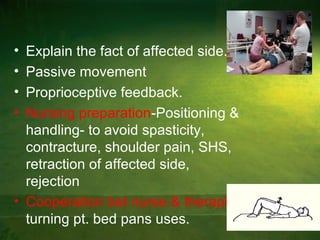
• Explain the fact of affected side.
• Passive movement
• Proprioceptive feedback.
• Nursing preparation-Positioning &
handling- to avoid spasticity,
contracture, shoulder pain, SHS,
retraction of affected side,
rejection
• Cooperation bet nurse & therapist:
turning pt. bed pans uses.
• Weight bearing exe.
• Trunk balance in sitting
• Mobilization of shoulder girdle
Reference
Bandong, A. (2008). Approaches to
therapeutic exercise: Concepts,
principles, and strategies. Power point
lecture presentation in PT 154.
Bobath B (1990). Adult hemiplegia:
Evaluation and treatment (3rd
ed).
Oxford, Heinemann Medical Books.
Levitt S (2004). Treatment of cerebral
palsy and motor delay (4th
ed).
Singapore, McGraw-Hill Inc.
THANK YOU..

Bobath approaches

  • 1.
    Bobath & Brunnstrom Approaches Dr.Maheshwari Harishchandre Assistant Professor M.P.Th (Neurosciences) DVVPF College of Physiotherapy, Ahmednagar
  • 2.
    Learning Objectives… At theend of the lecture, the students should be able to: • Discuss the theoretical basis of the neurodevelopmental approaches • Discuss the concepts and principles underlying the Bobath approach • Discuss the concepts and principles underlying the Brunnstrom approach
  • 3.
    Sensorimotor Approaches • Bobathapproach • Brunnstrom’s movement therapy • Rood approach • Proprioceptive neuromuscular facilitation
  • 4.
    Theoretical basis… • Neurodevelopmentalmodel • Reflex theory • Hierarchical theory • Systems approach
  • 5.
    Neurodevelopmental Model • motorcontrol and its production refers to two systems of output: the open loop (voluntary control ) and the closed loop (postural control) mechanisms
  • 6.
    Open-loop system… • commandssequences of movement that are centrally stored in the nervous system and that serve the functions of mobility in the production of isolated joint and limb motions
  • 7.
    Closed-loop system… • Dependentupon afferent feedback for the elicitation of its automatic movements that serve as the principle motility or stability of the organism • prerequisite for the development of normal movement behaviors • arise from patterns of coordination
  • 8.
    Reflex Theory • Thebasic unit of motor control are reflexes – Reflexes  purposeful movement – Damage to the CNS results to re-emergence of and inability to control the reflexes
  • 9.
    Hierarchical Theory • Motorcontrol is hierarchically arranged – CNS structures involved with movement can be grouped into HIGHER, MIDDLE, and LOWER levels – Higher centers regulate and control the middle and lower centers – Damage to the CNS results to disruption of the normal coordinated function of these levels
  • 10.
    Systems approach • suggeststhat the CNS does not operate in a strictly descending manner • no higher levels with which to control the operation of the lower levels • there is a mutable relationship between the various levels so that each level will alternate between command and subordinate roles in relation to the other levels.
  • 11.
  • 12.
    History… • Developed byDr. Karel Bobath, a neuropsychiatrist, and Mrs. Berta Bobath, a physical therapist • 1943 – while working with children with cerebral palsy
  • 13.
    Original theoretical framework… • Basedon the works of Jackson, Sherrington, and Magnus  who described nervous system as HIERARCHICAL in nature • Model  Higher brain centers exerted control over lower-level centers  Eg. The cerebral cortex control supercedes that of the brainstem
  • 14.
    OLD THEORY NEWTHEORY Hierarchical brain organization Systems Model Static postures and positions used for treatment Client is an active participant in the session Progressing the client through normal developmental milestones Developmental milestones serve as guidelines but should not be strictly adhered to Development of control proceeds in a cephalocaudal direction Control of movement develops in proximal to distal or distal to proximal directions Work on components of motions which the child will then apply to function Client must work on functional tasks to learn the skill
  • 15.
    Old theory Newtheory CNS viewed as the “controller”. Automatic postural control mechanism simplified the responsibility of the CNS in control of movement The CNS determines the pattern of neural activity based on input from multiple intrinsic systems and extrinsic variables that establish the context for movement initiation and execution “Positive signs” including spasticity and abnormal coordination of movement are the most important aspects of sensorimotor impairments The “negative signs’, including weakness, impaired postural control and paucity of movement are recognized as equally important as the “positive signs” in limitations of function limitations of function Muscle and postural tone determine the quality of the patterns of posture and movement used in functional activities Task goals, experience, individual learning strategies, movement synergies, energy and interests all affect the quality of the final action
  • 16.
    Basic idea ofBobath Approach • The abnormal patterns must be stopped not by modifying the sensory input, but by giving back to the patient the lost or undeveloped control over his out put in developmental sequence. • The basic patterns of posture & movement , the righting reaction & equilibrium responses are elicited by providing the appropriate stimuli while the abnormal patterns are inhibited. • In this way patient the patient is given the opportunity to experience normal movement.
  • 17.
    Basic idea ofBobath approach • The sensory information of correct movement is absolutely necessary for the development of improved motor control. • Treatment therefore, concentrate on handling the patient in such a way as to inhibit abnormal distribution of tone & abnormal postures while stimulating or encouraging the next level of motor control.
  • 18.
    Adult hemiplegia.. • Treatmentapproach was later on expanded to include the rehabilitation of adults with motor problems, particularly CVA • Main problem: the abnormal coordination of movement patterns combined with abnormal postural tonus (Bernstein, 1967) • Secondary problem: muscle strength and muscle activity
  • 19.
    Bobath concept… • Isa living concept  It has undergone changes in its theoretical base to accommodate developments in the fields of neurophysiology, biomechanics, and typical development • Holistic approach  It involves the whole patient, his sensory, perceptual and adaptive behaviour, and motor problems
  • 20.
    Traditional View • Principlesof treatment – Normalize muscle tone – Inhibit primitive reflexes – Facilitate normal postural reactions – Treatment should be developmental • Techniques – Handling – Weight bearing over the affected limb – Utilize positions that allow use of the affected limbs
  • 21.
  • 22.
    Problems in theadult patient with stroke • Abnormal tone • Loss of postural control • Abnormal coordination • Abnormal functional performance
  • 23.
    Goals… • Decrease theinfluence of spasticity and abnormal coordination • Improve control of the involved trunk, arm and leg • Retain normal, functional patterns of movement in the adult stroke patient
  • 24.
    Principles of treatment: •Treatment should avoid movements and activities that increase muscle tone or produce abnormal reflex patterns in the involved side • Treatment should be directed toward the development of normal patterns of posture and movement.
  • 25.
    Principles of treatment •The hemiplegic side should be incorporated into all treatment activities to reestablish symmetry and increased functional use • Treatment should produce a change in the quality of movement and functional performance of the involved side
  • 26.
    Principles of treatment: •Increase active use of the involved side • Provide practice to improve motor performance that lead to motor learning
  • 28.
    Stages of hemiplegiaand the Bobath Approach • Initial Flaccid Stage  Tx focus on positioning and movement in bed to avoid the typical postural patterns of hemiplegia • Stage of Spasticity  tx is a continuation of the previous stage with the goal of breaking down the total patterns by developing control of the intermediate joints
  • 29.
    Stages of hemiplegiaand the Bobath Approach • Stage of Relative Recovery  tx aims at improving the quality of gait and the use of the affected hand
  • 30.
    Principles of treatment: childrenwith cerebral palsy • Treat the child as a whole • Basis for intervention is normal movement and their interrelationships • Treatment incorporates facilitation and inhibition using key points of control  abnormal tone is always inhibited  normal responses, once elicited, are always repeated
  • 31.
    What are keypoints of control (KPC)? • Parts of the body where the therapist can most effectively control and change patterns of posture and movement in other body parts – Proximal: shoulder/scapula, pelvis/hip – Distal: jaw, wrist, ankle, – Head may be a proximal or distal KPC
  • 32.
    KEY POINT CKP(Central KeyPoint) Ant(xiphoid process) Post(T7,8) PKP(Proximal Key Point) Head, Shoulder, Pelvis DKP(Distal Key Point)
  • 33.
    Facilitation-Inhibition • Facilitation  isa mean by which movement is made easy, made possible, and made necessary • Inhibition  involves decreasing the use of pathological movements and the effects of tonal dysfunctions on movement • Facilitation and inhibition may be used simultaneouly and may be applied throughout the session
  • 34.
    What is handling? Mannerof controlling the patient through tone influencing patterns • Normal patterns of activity used to modify abnormal patterns of posture and movement o Total TIPs: whole body is controlled in a reversal of the abnormal pattern o Partial TIPs: some body parts remain free to move • TIPs are utilized via KPCs
  • 35.
  • 36.
    Techniques of treatment Initialflaccid stage: last for few day to 7 week or may be longer. •Problems: confused & disoriented. •Divided into two half •No balnace or arm support on affected side •Fear of fall •Abnormal attitude on affected side •No midline orientation Treatment: self orientation on affected side. •Carry wt on affected side •Bilateral functioning- interplay.
  • 37.
    • Explain thefact of affected side. • Passive movement • Proprioceptive feedback. • Nursing preparation-Positioning & handling- to avoid spasticity, contracture, shoulder pain, SHS, retraction of affected side, rejection • Cooperation bet nurse & therapist: turning pt. bed pans uses.
  • 38.
    • Weight bearingexe. • Trunk balance in sitting • Mobilization of shoulder girdle
  • 39.
    Reference Bandong, A. (2008).Approaches to therapeutic exercise: Concepts, principles, and strategies. Power point lecture presentation in PT 154. Bobath B (1990). Adult hemiplegia: Evaluation and treatment (3rd ed). Oxford, Heinemann Medical Books. Levitt S (2004). Treatment of cerebral palsy and motor delay (4th ed). Singapore, McGraw-Hill Inc.
  • 40.