Introduction
Neurodevelopmental Therapy (NDT),also known as the Bobath
Concept, is a problem-solving approach used in neurorehabilitation.
Developed by Berta and Karel Bobath, it focuses on the treatment of
individuals with neurological impairments such as stroke, cerebral
palsy (CP), traumatic brain injury (TBI), and other CNS lesions.
Goal: To improve functional movement, posture, and participation
through facilitation of normal movement patterns and inhibition of
abnormal tone/reflexes.
5.
Bobath approach isbased on the premise that the presence
of normal postural reflex mechanisms is fundamental to a
motor skill's performance. Bobath interventions are multi-
dimensional, individualised, and reflective[5]
. The Bobath
approach focuses on recovery potential and motor
performance[4]
. The Bobath concept primarily consists of
facilitation, which includes therapeutic handling,
environmental modification, and use of appropriate verbal
cues
6.
The normal posturalreflex mechanisms consist of:
Righting and Equilibrium reactions.
Reciprocal innervation.
Coordination patterns.
7.
The release ofabnormal tone and tonic reflexes seen in CP
interfered with the development of righting and equilibrium
reactions[3]
.
It is an interactive problem-solving approach that focuses on
continuing reassessment with attention to individual goals,
developing working hypotheses, treatment plans, and
relevant objective measures to evaluate interventions.
8.
Regardless of severity,individuals of any age with damage to their CNS can be handled
with this approach. This makes the approach different from other forms of treatment,
like motor relearning or constraint-induced movement therapy, which can only work on
high functioning individuals[1]
.
It is congruent with the International Classification of Functioning, Disability, and Health.
It lays emphasis on two interdependent aspects important for optimizing motor recovery
following stroke:
◦ Integration of postural control and task performance.
◦ Selective movement control for the production of coordinated sequences of
movements.
◦ In addition, the contribution of sensory inputs to motor control and motor learning
has always been a vital focus of the Bobath concept.
9.
Clinical Application ofBobath Concept
Motor Control
Bobath Concept concerns sensory, perception and adaptive behaviour along with the motor problem
that involves the whole patient. It is a goal-orientated and task-specific approach, aiming to organise
the internal (proprioceptive) and external (exteroceptive) environment of the nervous system for
efficient functioning of the individual. It is an interactive process between patients and therapists[6]
.
Therapy focuses on the following:
Neuro-muscular system, spinal cord and higher centres to change motor performance.
Neuroplasticity, an interactive nervous system, and individual expression of movement.
Overcoming weakness of neural drive after a UMN lesion through selective activation of cutaneous
and muscle receptors[
10.
Therapists should havethe knowledge of the principles of motor learning: active
participation, opportunities for practice, and meaningful goals. Bobath concept
demands training in different real-life situations rather than just practicing in the
therapy department. Task-specific muscle activation patterns and sensory input
enables successful completion of the task in different contexts and
environments, taking in to account the perceptual and cognitive demands[1]
.
Therapy addresses abnormal, stereotypical movement patterns that interfere
with function. It is aimed at preventing development of spasticity and improving
residual function. Therapists can influence hypertonia at a non-neural level by
influencing muscle length and range.
11.
Therapists work ontone to improve movement, not to normalise
tone. Tone can be reduced by[6]
:
Mobilisation of muscles and stiff joints.
Muscle stretch.
Practice of more normal movement patterns.
Through a more efficient, less effortful performance of functional
tasks.
Weight-bearing.
12.
Sensory Systems
The contributionof sensory inputs to motor learning and shaping motor output
is a key concept in the Bobath approach. Patients with partial or complete
sensory loss make movements that lack precision and coordination. Even in the
presence of visual information, movements in deafferented patients with
complete large fibre sensory loss and no cutaneous sensation or proprioception
are imprecise and characterised by dysmetria. When proprioceptive information
is missing or altered as a result of injury or disease, the nervous system is unable
to specify the origin point, or referent position, of the spatial frame of reference
for motoneurons to recruit, resulting in abnormal movement.
13.
Bobath therapists commonlyshape movement with sensory inputs in the form of:
Tactile information from the hands.
Removing manual guidance once patients are capable of self-generated movement.
For example, it is believed that by properly positioning the therapist's hands, a therapist can
nonverbally guide a patient to move the limb in the desired direction. It is well known that
cutaneous and other sensory signals can influence motor output.
Lower limb H-reflexes can be modulated by cutaneous afferent input elicited by electrical
stimulation.The cutaneous information provided by the therapist's hands may also modify
muscle activation in the same way that exteroceptive mechanical vibration or electrical
stimulation may modify spatial motoneuronal thresholds.
14.
Musculoskeletal system
The Bobathapproach addresses the problems that occur as a result of impairment
of the developing central nervous system that affect the individual's sensory -
motor, cognitive, perceptual, social and emotional development
It is an approach/concept, not a method.
It recognises that all clients with neurodisability have the potential for enhanced
function.
It recognises the need for thorough analysis of each patient's functional skills.
15.
It is basedon available knowledge evidence.
It is an important approach to the rehabilitation of patients with neurological injuries.
In the United States the Bobath concept is usually referred to as 'neuro-developmental
treatment' (NDT).
It is based on the brain's ability to remodel and reorganise (neuroplasticity).
It is a multidisciplinary approach, involving physiotherapists, occupational therapists and speech
and language therapists.
Individuals with CNS pathophysiology have dysfunction in posture and movement and
subsequent functional activity limitations.
16.
Living Concept
The NDT/Bobathapproach continues to be enriched with the emergence of new theories, new models
and new information in the movement sciences. There have been changes in the concept of NDT
but some aspects remain the same.
Aspects that remain the same:
It is a problem solving and assessments approach.
Tone plays an important role in movements pattern and postural control and directly affects the
performance of functional tasks.
Handling is the main method for better functional and postural performance of tasks.
Individuals are encourage for active participation during treatment sessions.
Functional training is important of milestone developments.
17.
Aspects that havebeen changed:
Neural and non-neural components can be affected by tone.
Spasticity is rarely a major source of patient's movements
disorders[6]
. In addition, as the characteristics of the
population with CNS pathophysiology change, the approach
continues to evolve.
18.
Evidence
There is evidencethat despite NDT being the most widely used
approach for neurorehabilitation, it is not superior to other
treatment approaches[9]
, other than there being limited
evidence for symmetry of weight distribution over both sides
and overall balance (ie, Berg Balance Scale)[10]
. There is
currently inconclusive evidence for the efficacy of Bobath over
other treatment approaches in improving function, gait or
spasticity after stroke
19.
Bobath concept
Neuro- basedon neuro anatomy and neurophysiology
Developmental- the normal development of ageing child guides us through the rehabilitation
process
Treatment-A structured and methodic approach of the rehabilitation issues of stroke patients
Inhibition of abnormal tone and posture of released postural reflex while facilitating specific
automatic motor response(by special technique of handling) resulting in performance of skilled
voluntary movements.
20.
Bobath approach totreatment
The bobath treatment aims to improve posture and movement to enable more realistic
functioning in daily life
Through specialized ways of handling, stiffness can be reduced,muscle control against gravity
increased,and fluctuating muscle activity stabilized
Depending on the severity of the condition, the child may be better able to learn how to sit
up,use his or her hands,to stand up ,to stand and to walk
Ideally the treatment will be an integral part of the daily routine for that child
21.
For eg:The waythe child is picked up,carried,put down,or positioned when sitting,will enable
parents/carers to enhance the child’s ability and function
Treatment is tailored to client’s individual needs,and is based upon an assessment of their
abilities and analysis of their movement disorder.
This is achieved through the use of specialized handling techniques that help to facilitate more
normal movement
22.
Aim of Treatment
Toimprove the quality of movement on affected side,so that ultimately the two sides work
together harmoniously as possible within the scope of the cerebral injury.
23.
In general theresults of a treatment depends on
Measure of spasticity
Sensibility disorders
Perceptive disorders
Incontinence
Duration and deepness of coma
24.
NOT
Overload of notaffected body half to compensate loss of functionality in affected body half.
25.
Two major principles
Plasticityof the CNS
The brain is able to learn and the brain is also able to relearn
Initiation of a normal development
The normal development shows the same major developments but we can also notice little
individual differences in development
26.
Principles of NDT
Client-centeredand task-oriented approach.
Emphasis on functional activities and participation.
Facilitation of normal postural tone and movement patterns.
Inhibition of abnormal tone, synergies, and reflexes.
Use of key points of control (proximal/distal): therapist’s hands guide and influence tone and
movement.
Importance of sensory inputs (tactile, proprioceptive, vestibular).
Motor learning and neuroplasticity: practice and repetition encourage cortical reorganization.
Holistic: considers environment, family, and context in therapy.
27.
Structural Bobath thinking
1.Analysis of normal movements
2. Analysis of pathological movements
3. Analysis of rehabilitation techniques and methods
28.
Analysis of normalmovements
After 3 yrs there are recognizable specific patterns with little individual differences
Intentional movements
Specific
Intended
Controlled
Automatic reactions
unconsciously
Theoretical Basis
Based ondynamic systems theory and neuroplasticity.
CNS lesions cause abnormal tone and movement synergies
→ limit functional performance.
By facilitating normal alignment, weight shift, and
movement transitions, NDT helps the CNS learn more
efficient patterns.
Conditions for anormal development of
motor skills
Sensory motor conditions
Muscle tone
Adaptation to postural changes
Mobility,feeling,senses,endurance
Cognition
psychological and social conditions
33.
Control of movement
Fromproximal to distal
From global to selective
From reflex to reaction
From spontaneous to functional
34.
Key Techniques inNDT
A. Inhibition Techniques
Reduce spasticity, abnormal reflexes, and primitive patterns.
Examples:
◦ Slow rhythmic rotation of limbs
◦ Sustained stretching
◦ Weight bearing for tone regulation
◦ Reflex inhibiting postures
35.
Facilitation Techniques
Encourage activeparticipation in functional movement.
Examples:
◦ Tapping muscles to activate contraction
◦ Quick stretch
◦ Guidance at pelvis/trunk for weight shift
◦ Use of key points of control during gait training
36.
NDT in PediatricNeuro (Cerebral Palsy Example)
Promotes head and trunk control, sitting balance, crawling, standing,
walking.
Reduces spasticity and abnormal postures (e.g., scissoring, toe
walking).
Encourages functional skills: reaching, grasp, ADLs.
Parent training and home programs are integral.
37.
NDT in AdultNeuro (Stroke Example)
Improves hemiplegic posture and gait.
Facilitates weight bearing and weight shifting on affected
side.
Inhibits abnormal synergies (flexor/extensor patterns).
Promotes bilateral activities, ADLs, and task-specific
training.
Limitations
Requires high therapistskill and experience.
Time-consuming.
Some research shows limited superiority over other motor
learning-based approaches.
Needs to be integrated with task-specific training, strength
training, robotics, and evidence-based interventions.
40.
Clinical Applications
Cerebral Palsy(spastic, athetoid, ataxic)
Stroke (CVA)
Traumatic Brain Injury
Multiple Sclerosis
Spinal Cord Injury (in early rehab)
41.
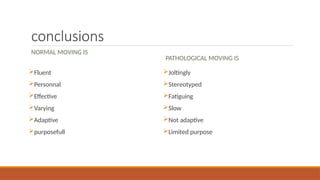
conclusions
Normal moving includes
1.Mechanisms of postural reflexes
2. Mechanisms of postural reactions
3. Normal muscle tonus
4. Reciprocal innervation/inhibition
5. Automatic movement patterns
Basis of Practice
Itis based on the assumption that,
Increased tone and reflex activity emerges as the result of lack of inhibition from damaged
postural reflex mechanism and movement will be abnormal if it emerges from abnormal tone.
Performing abnormal movements will reinforce more abnormal movements
Tone could be influenced by altering the position or movement of proximal joints of body



![Bobath approach is based on the premise that the presence
of normal postural reflex mechanisms is fundamental to a
motor skill's performance. Bobath interventions are multi-
dimensional, individualised, and reflective[5]
. The Bobath
approach focuses on recovery potential and motor
performance[4]
. The Bobath concept primarily consists of
facilitation, which includes therapeutic handling,
environmental modification, and use of appropriate verbal
cues](https://image.slidesharecdn.com/ndt-251113112254-e3c572b0/85/NEURODEVELOPMENT-THERAPY-OR-NDT-OR-BOBATH-APPROACH-5-320.jpg)
![The release of abnormal tone and tonic reflexes seen in CP
interfered with the development of righting and equilibrium
reactions[3]
.
It is an interactive problem-solving approach that focuses on
continuing reassessment with attention to individual goals,
developing working hypotheses, treatment plans, and
relevant objective measures to evaluate interventions.](https://image.slidesharecdn.com/ndt-251113112254-e3c572b0/85/NEURODEVELOPMENT-THERAPY-OR-NDT-OR-BOBATH-APPROACH-7-320.jpg)
![Regardless of severity, individuals of any age with damage to their CNS can be handled
with this approach. This makes the approach different from other forms of treatment,
like motor relearning or constraint-induced movement therapy, which can only work on
high functioning individuals[1]
.
It is congruent with the International Classification of Functioning, Disability, and Health.
It lays emphasis on two interdependent aspects important for optimizing motor recovery
following stroke:
◦ Integration of postural control and task performance.
◦ Selective movement control for the production of coordinated sequences of
movements.
◦ In addition, the contribution of sensory inputs to motor control and motor learning
has always been a vital focus of the Bobath concept.](https://image.slidesharecdn.com/ndt-251113112254-e3c572b0/85/NEURODEVELOPMENT-THERAPY-OR-NDT-OR-BOBATH-APPROACH-8-320.jpg)
![Clinical Application of Bobath Concept
Motor Control
Bobath Concept concerns sensory, perception and adaptive behaviour along with the motor problem
that involves the whole patient. It is a goal-orientated and task-specific approach, aiming to organise
the internal (proprioceptive) and external (exteroceptive) environment of the nervous system for
efficient functioning of the individual. It is an interactive process between patients and therapists[6]
.
Therapy focuses on the following:
Neuro-muscular system, spinal cord and higher centres to change motor performance.
Neuroplasticity, an interactive nervous system, and individual expression of movement.
Overcoming weakness of neural drive after a UMN lesion through selective activation of cutaneous
and muscle receptors[](https://image.slidesharecdn.com/ndt-251113112254-e3c572b0/85/NEURODEVELOPMENT-THERAPY-OR-NDT-OR-BOBATH-APPROACH-9-320.jpg)
![Therapists should have the knowledge of the principles of motor learning: active
participation, opportunities for practice, and meaningful goals. Bobath concept
demands training in different real-life situations rather than just practicing in the
therapy department. Task-specific muscle activation patterns and sensory input
enables successful completion of the task in different contexts and
environments, taking in to account the perceptual and cognitive demands[1]
.
Therapy addresses abnormal, stereotypical movement patterns that interfere
with function. It is aimed at preventing development of spasticity and improving
residual function. Therapists can influence hypertonia at a non-neural level by
influencing muscle length and range.](https://image.slidesharecdn.com/ndt-251113112254-e3c572b0/85/NEURODEVELOPMENT-THERAPY-OR-NDT-OR-BOBATH-APPROACH-10-320.jpg)
![Therapists work on tone to improve movement, not to normalise
tone. Tone can be reduced by[6]
:
Mobilisation of muscles and stiff joints.
Muscle stretch.
Practice of more normal movement patterns.
Through a more efficient, less effortful performance of functional
tasks.
Weight-bearing.](https://image.slidesharecdn.com/ndt-251113112254-e3c572b0/85/NEURODEVELOPMENT-THERAPY-OR-NDT-OR-BOBATH-APPROACH-11-320.jpg)
![Aspects that have been changed:
Neural and non-neural components can be affected by tone.
Spasticity is rarely a major source of patient's movements
disorders[6]
. In addition, as the characteristics of the
population with CNS pathophysiology change, the approach
continues to evolve.](https://image.slidesharecdn.com/ndt-251113112254-e3c572b0/85/NEURODEVELOPMENT-THERAPY-OR-NDT-OR-BOBATH-APPROACH-17-320.jpg)
![Evidence
There is evidence that despite NDT being the most widely used
approach for neurorehabilitation, it is not superior to other
treatment approaches[9]
, other than there being limited
evidence for symmetry of weight distribution over both sides
and overall balance (ie, Berg Balance Scale)[10]
. There is
currently inconclusive evidence for the efficacy of Bobath over
other treatment approaches in improving function, gait or
spasticity after stroke](https://image.slidesharecdn.com/ndt-251113112254-e3c572b0/85/NEURODEVELOPMENT-THERAPY-OR-NDT-OR-BOBATH-APPROACH-18-320.jpg)