1ENT201-Electronic Devices Instructor- V. R. GuptaLecture No. 10
ENT201-Electronic Devices
LectureNo.10
Unit-1
*
Quantitative Theory of the PN-Diode Currents
- Diode Current Equation
V. R. Gupta
Assistant Professor
Department of Electronics Engineering
Shri Ramdeobaba College of Engineering and Management, Nagpur.
2ENT201-Electronic Devices Instructor- V. R. GuptaLecture No. 10
PROPRIETARY MATERIAL. © 2010 The McGraw-Hill Companies, Inc. All rights reserved. No part of this PowerPoint slide may be displayed, reproduced or distributed
in any form or by any means, without the prior written permission of the publisher, or used beyond the limited distribution to teachers and educators permitted by McGraw-Hill
for their individual course preparation. If you are a student using this PowerPoint slide, you are using it without permission.
Disclaimer
Most of the images used in this presentation are taken form the following books.
3ENT201-Electronic Devices Instructor- V. R. GuptaLecture No. 10
Quantitative Theory of the pn-Diode Currents
• To derive the expression for the total current as a function of
the applied voltage (the volt –ampere characteristics), let us
assume that the depletion width is zero.
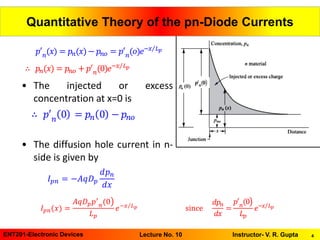
• When the forward bias is applied to a diode, holes are
injected from the p-side into the n-side.
• Thus the concentration pn of holes in the n-side is increased
above its thermal equilibrium value pno
• Where, Lp is the diffusion length for holes in n-type
semiconductor
𝑝′
𝑛(𝑥) = 𝑝 𝑛(𝑥) − 𝑝 𝑛𝑜 = 𝑝′
𝑛(𝑜)𝑒− Τ𝑥 𝐿 𝑝
∴ 𝑝 𝑛(𝑥) = 𝑝 𝑛𝑜 + 𝑝′
𝑛(0)𝑒− Τ𝑥 𝐿 𝑝
4ENT201-Electronic Devices Instructor- V. R. GuptaLecture No. 10
Quantitative Theory of the pn-Diode Currents
• The injected or excess
concentration at x=0 is
• The diffusion hole current in n-
side is given by
𝑝′
𝑛(𝑥) = 𝑝𝑛(𝑥)− 𝑝𝑛𝑜 = 𝑝′
𝑛(𝑜)𝑒− Τ𝑥 𝐿 𝑝
∴ 𝑝𝑛(𝑥) = 𝑝𝑛𝑜 + 𝑝′
𝑛(0)𝑒− Τ𝑥 𝐿 𝑝
∴ 𝑝′
𝑛 0 = 𝑝𝑛 0 − 𝑝𝑛𝑜
൯𝒑′
𝒏
(𝟎
𝐼 𝑝𝑛 = −𝐴𝑞𝐷 𝑝
𝑑𝑝 𝑛
𝑑𝑥
since
𝑑𝑝𝑛
𝑑𝑥
=
൯𝑝′
𝑛
(0
𝐿𝑝
𝑒− Τ𝑥 𝐿 𝑝𝐼 𝑝𝑛(𝑥) =
൯𝐴𝑞𝐷 𝑝 𝑝′
𝑛
(0
𝐿 𝑝
𝑒− Τ𝑥 𝐿 𝑝
5ENT201-Electronic Devices Instructor- V. R. GuptaLecture No. 10
Quantitative Theory of the pn-Diode Currents
𝐼 𝑝𝑛(𝑥) =
൯𝐴𝑞𝐷 𝑝 𝑝′
𝑛
(0
𝐿 𝑝
𝑒− Τ𝑥 𝐿 𝑝
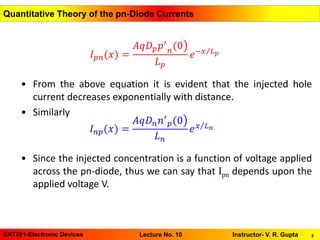
• From the above equation it is evident that the injected hole
current decreases exponentially with distance.
• Similarly
• Since the injected concentration is a function of voltage applied
across the pn-diode, thus we can say that Ipn depends upon the
applied voltage V.
𝐼 𝑛𝑝(𝑥) =
൯𝐴𝑞𝐷 𝑛 𝑛′
𝑝(0
𝐿 𝑛
𝑒 Τ𝑥 𝐿 𝑛
6ENT201-Electronic Devices Instructor- V. R. GuptaLecture No. 10
Quantitative Theory of the pn-Diode Currents
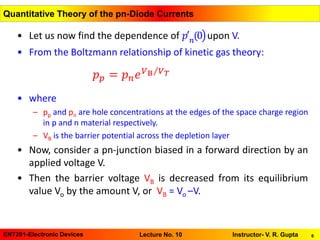
• Let us now find the dependence of ൯𝑝′
𝑛(0 upon V.
• From the Boltzmann relationship of kinetic gas theory:
• where
– pp and pn are hole concentrations at the edges of the space charge region
in p and n material respectively.
– VB is the barrier potential across the depletion layer
• Now, consider a pn-junction biased in a forward direction by an
applied voltage V.
• Then the barrier voltage VB is decreased from its equilibrium
value Vo by the amount V, or VB = Vo –V.
𝑝 𝑝 = 𝑝 𝑛 𝑒 Τ𝑉B 𝑉 𝑇
7ENT201-Electronic Devices Instructor- V. R. GuptaLecture No. 10
Quantitative Theory of the pn-Diode Currents
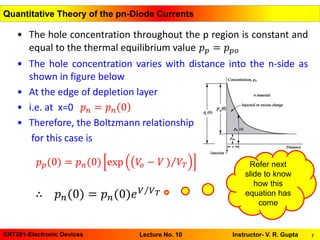
• The hole concentration throughout the p region is constant and
equal to the thermal equilibrium value 𝑝 𝑝 = 𝑝 𝑝𝑜
• The hole concentration varies with distance into the n-side as
shown in figure below
• At the edge of depletion layer
• i.e. at x=0
• Therefore, the Boltzmann relationship
for this case is
൯𝒑′
𝒏(𝟎)𝑝 𝑛 = 𝑝 𝑛(0
𝑝 𝑝(0) = 𝑝 𝑛(0) exp ൫𝑉𝑜 − 𝑉 Τ) 𝑉𝑇
∴ 𝑝 𝑛(0) = 𝑝 𝑛(0)𝑒 Τ𝑉 𝑉 𝑇
Refer next
slide to know
how this
equation has
come
8ENT201-Electronic Devices Instructor- V. R. GuptaLecture No. 10
Quantitative Theory of the pn-Diode Currents
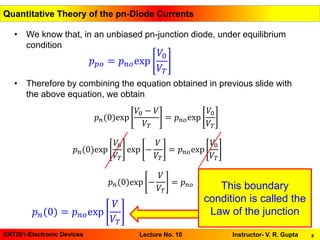
• We know that, in an unbiased pn-junction diode, under equilibrium
condition
• Therefore by combining the equation obtained in previous slide with
the above equation, we obtain
𝑝 𝑝𝑜 = 𝑝 𝑛𝑜exp
𝑉0
𝑉𝑇
𝑝 𝑛(0)exp
𝑉0 − 𝑉
𝑉𝑇
= 𝑝 𝑛𝑜exp
𝑉0
𝑉𝑇
𝑝 𝑛(0)exp
𝑉0
𝑉𝑇
exp −
𝑉
𝑉𝑇
= 𝑝 𝑛𝑜exp
𝑉0
𝑉𝑇
𝑝 𝑛(0)exp −
𝑉
𝑉𝑇
= 𝑝 𝑛𝑜
𝑝 𝑛(0) = 𝑝 𝑛𝑜exp
𝑉
𝑉𝑇
This boundary
condition is called the
Law of the junction
9ENT201-Electronic Devices Instructor- V. R. GuptaLecture No. 10
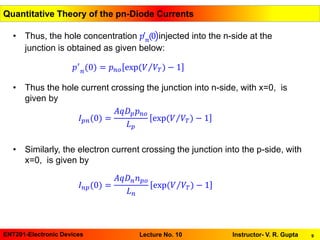
• Thus, the hole concentration ൯𝑝′
𝑛(0 injected into the n-side at the
junction is obtained as given below:
• Thus the hole current crossing the junction into n-side, with x=0, is
given by
• Similarly, the electron current crossing the junction into the p-side, with
x=0, is given by
Quantitative Theory of the pn-Diode Currents
𝑝′
𝑛(0) = 𝑝 𝑛𝑜 exp( Τ𝑉 𝑉𝑇) − 1
𝐼 𝑝𝑛(0) =
𝐴𝑞𝐷 𝑝 𝑝 𝑛𝑜
𝐿 𝑝
exp( Τ𝑉 𝑉𝑇) − 1
𝐼 𝑛𝑝(0) =
𝐴𝑞𝐷 𝑛 𝑛 𝑝𝑜
𝐿 𝑛
exp( Τ𝑉 𝑉𝑇) − 1
10ENT201-Electronic Devices Instructor- V. R. GuptaLecture No. 10
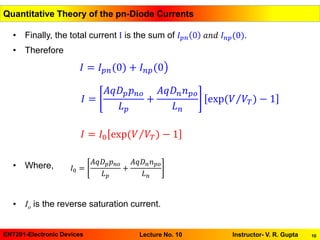
• Finally, the total current I is the sum of 𝐼 𝑝𝑛 0 𝑎𝑛𝑑 𝐼 𝑛𝑝(0).
• Therefore
• Where,
• Io is the reverse saturation current.
Quantitative Theory of the pn-Diode Currents
൯𝐼 = 𝐼 𝑝𝑛(0) + 𝐼 𝑛𝑝(0
𝐼 =
𝐴𝑞𝐷 𝑝 𝑝 𝑛𝑜
𝐿 𝑝
+
𝐴𝑞𝐷 𝑛 𝑛 𝑝𝑜
𝐿 𝑛
exp( Τ𝑉 𝑉𝑇) − 1
𝐼 = 𝐼0 exp( Τ𝑉 𝑉𝑇) − 1
𝐼0 =
𝐴𝑞𝐷 𝑝 𝑝 𝑛𝑜
𝐿 𝑝
+
𝐴𝑞𝐷 𝑛 𝑛 𝑝𝑜
𝐿 𝑛
11ENT201-Electronic Devices Instructor- V. R. GuptaLecture No. 10
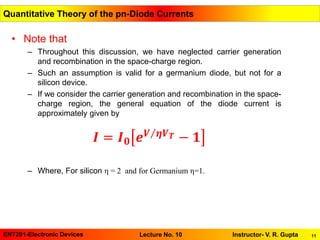
• Note that
– Throughout this discussion, we have neglected carrier generation
and recombination in the space-charge region.
– Such an assumption is valid for a germanium diode, but not for a
silicon device.
– If we consider the carrier generation and recombination in the space-
charge region, the general equation of the diode current is
approximately given by
– Where, For silicon η = 2 and for Germanium η=1.
Quantitative Theory of the pn-Diode Currents
𝑰 = 𝑰 𝟎 𝒆 Τ𝑽 𝜼𝑽 𝑻 − 𝟏
12ENT201-Electronic Devices Instructor- V. R. GuptaLecture No. 10
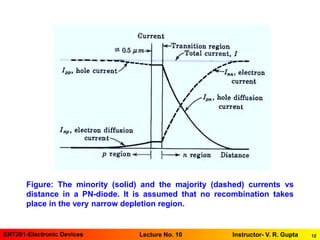
Figure: The minority (solid) and the majority (dashed) currents vs
distance in a PN-diode. It is assumed that no recombination takes
place in the very narrow depletion region.
13ENT201-Electronic Devices Instructor- V. R. GuptaLecture No. 10
Reading Assignment
• Chapter-3 of Milliman's Integrated Electronics
(2nd edition) Book.
• section 3.3.
• AND
• Chapter-5 of Milliman's Electronic Devices and Circuits
(3rd or 4th edition) Book.
• section 5.4 and 5.5.

Diode Current Equation

  • 1.
    1ENT201-Electronic Devices Instructor-V. R. GuptaLecture No. 10 ENT201-Electronic Devices LectureNo.10 Unit-1 * Quantitative Theory of the PN-Diode Currents - Diode Current Equation V. R. Gupta Assistant Professor Department of Electronics Engineering Shri Ramdeobaba College of Engineering and Management, Nagpur.
  • 2.
    2ENT201-Electronic Devices Instructor-V. R. GuptaLecture No. 10 PROPRIETARY MATERIAL. © 2010 The McGraw-Hill Companies, Inc. All rights reserved. No part of this PowerPoint slide may be displayed, reproduced or distributed in any form or by any means, without the prior written permission of the publisher, or used beyond the limited distribution to teachers and educators permitted by McGraw-Hill for their individual course preparation. If you are a student using this PowerPoint slide, you are using it without permission. Disclaimer Most of the images used in this presentation are taken form the following books.
  • 3.
    3ENT201-Electronic Devices Instructor-V. R. GuptaLecture No. 10 Quantitative Theory of the pn-Diode Currents • To derive the expression for the total current as a function of the applied voltage (the volt –ampere characteristics), let us assume that the depletion width is zero. • When the forward bias is applied to a diode, holes are injected from the p-side into the n-side. • Thus the concentration pn of holes in the n-side is increased above its thermal equilibrium value pno • Where, Lp is the diffusion length for holes in n-type semiconductor 𝑝′ 𝑛(𝑥) = 𝑝 𝑛(𝑥) − 𝑝 𝑛𝑜 = 𝑝′ 𝑛(𝑜)𝑒− Τ𝑥 𝐿 𝑝 ∴ 𝑝 𝑛(𝑥) = 𝑝 𝑛𝑜 + 𝑝′ 𝑛(0)𝑒− Τ𝑥 𝐿 𝑝
  • 4.
    4ENT201-Electronic Devices Instructor-V. R. GuptaLecture No. 10 Quantitative Theory of the pn-Diode Currents • The injected or excess concentration at x=0 is • The diffusion hole current in n- side is given by 𝑝′ 𝑛(𝑥) = 𝑝𝑛(𝑥)− 𝑝𝑛𝑜 = 𝑝′ 𝑛(𝑜)𝑒− Τ𝑥 𝐿 𝑝 ∴ 𝑝𝑛(𝑥) = 𝑝𝑛𝑜 + 𝑝′ 𝑛(0)𝑒− Τ𝑥 𝐿 𝑝 ∴ 𝑝′ 𝑛 0 = 𝑝𝑛 0 − 𝑝𝑛𝑜 ൯𝒑′ 𝒏 (𝟎 𝐼 𝑝𝑛 = −𝐴𝑞𝐷 𝑝 𝑑𝑝 𝑛 𝑑𝑥 since 𝑑𝑝𝑛 𝑑𝑥 = ൯𝑝′ 𝑛 (0 𝐿𝑝 𝑒− Τ𝑥 𝐿 𝑝𝐼 𝑝𝑛(𝑥) = ൯𝐴𝑞𝐷 𝑝 𝑝′ 𝑛 (0 𝐿 𝑝 𝑒− Τ𝑥 𝐿 𝑝
  • 5.
    5ENT201-Electronic Devices Instructor-V. R. GuptaLecture No. 10 Quantitative Theory of the pn-Diode Currents 𝐼 𝑝𝑛(𝑥) = ൯𝐴𝑞𝐷 𝑝 𝑝′ 𝑛 (0 𝐿 𝑝 𝑒− Τ𝑥 𝐿 𝑝 • From the above equation it is evident that the injected hole current decreases exponentially with distance. • Similarly • Since the injected concentration is a function of voltage applied across the pn-diode, thus we can say that Ipn depends upon the applied voltage V. 𝐼 𝑛𝑝(𝑥) = ൯𝐴𝑞𝐷 𝑛 𝑛′ 𝑝(0 𝐿 𝑛 𝑒 Τ𝑥 𝐿 𝑛
  • 6.
    6ENT201-Electronic Devices Instructor-V. R. GuptaLecture No. 10 Quantitative Theory of the pn-Diode Currents • Let us now find the dependence of ൯𝑝′ 𝑛(0 upon V. • From the Boltzmann relationship of kinetic gas theory: • where – pp and pn are hole concentrations at the edges of the space charge region in p and n material respectively. – VB is the barrier potential across the depletion layer • Now, consider a pn-junction biased in a forward direction by an applied voltage V. • Then the barrier voltage VB is decreased from its equilibrium value Vo by the amount V, or VB = Vo –V. 𝑝 𝑝 = 𝑝 𝑛 𝑒 Τ𝑉B 𝑉 𝑇
  • 7.
    7ENT201-Electronic Devices Instructor-V. R. GuptaLecture No. 10 Quantitative Theory of the pn-Diode Currents • The hole concentration throughout the p region is constant and equal to the thermal equilibrium value 𝑝 𝑝 = 𝑝 𝑝𝑜 • The hole concentration varies with distance into the n-side as shown in figure below • At the edge of depletion layer • i.e. at x=0 • Therefore, the Boltzmann relationship for this case is ൯𝒑′ 𝒏(𝟎)𝑝 𝑛 = 𝑝 𝑛(0 𝑝 𝑝(0) = 𝑝 𝑛(0) exp ൫𝑉𝑜 − 𝑉 Τ) 𝑉𝑇 ∴ 𝑝 𝑛(0) = 𝑝 𝑛(0)𝑒 Τ𝑉 𝑉 𝑇 Refer next slide to know how this equation has come
  • 8.
    8ENT201-Electronic Devices Instructor-V. R. GuptaLecture No. 10 Quantitative Theory of the pn-Diode Currents • We know that, in an unbiased pn-junction diode, under equilibrium condition • Therefore by combining the equation obtained in previous slide with the above equation, we obtain 𝑝 𝑝𝑜 = 𝑝 𝑛𝑜exp 𝑉0 𝑉𝑇 𝑝 𝑛(0)exp 𝑉0 − 𝑉 𝑉𝑇 = 𝑝 𝑛𝑜exp 𝑉0 𝑉𝑇 𝑝 𝑛(0)exp 𝑉0 𝑉𝑇 exp − 𝑉 𝑉𝑇 = 𝑝 𝑛𝑜exp 𝑉0 𝑉𝑇 𝑝 𝑛(0)exp − 𝑉 𝑉𝑇 = 𝑝 𝑛𝑜 𝑝 𝑛(0) = 𝑝 𝑛𝑜exp 𝑉 𝑉𝑇 This boundary condition is called the Law of the junction
  • 9.
    9ENT201-Electronic Devices Instructor-V. R. GuptaLecture No. 10 • Thus, the hole concentration ൯𝑝′ 𝑛(0 injected into the n-side at the junction is obtained as given below: • Thus the hole current crossing the junction into n-side, with x=0, is given by • Similarly, the electron current crossing the junction into the p-side, with x=0, is given by Quantitative Theory of the pn-Diode Currents 𝑝′ 𝑛(0) = 𝑝 𝑛𝑜 exp( Τ𝑉 𝑉𝑇) − 1 𝐼 𝑝𝑛(0) = 𝐴𝑞𝐷 𝑝 𝑝 𝑛𝑜 𝐿 𝑝 exp( Τ𝑉 𝑉𝑇) − 1 𝐼 𝑛𝑝(0) = 𝐴𝑞𝐷 𝑛 𝑛 𝑝𝑜 𝐿 𝑛 exp( Τ𝑉 𝑉𝑇) − 1
  • 10.
    10ENT201-Electronic Devices Instructor-V. R. GuptaLecture No. 10 • Finally, the total current I is the sum of 𝐼 𝑝𝑛 0 𝑎𝑛𝑑 𝐼 𝑛𝑝(0). • Therefore • Where, • Io is the reverse saturation current. Quantitative Theory of the pn-Diode Currents ൯𝐼 = 𝐼 𝑝𝑛(0) + 𝐼 𝑛𝑝(0 𝐼 = 𝐴𝑞𝐷 𝑝 𝑝 𝑛𝑜 𝐿 𝑝 + 𝐴𝑞𝐷 𝑛 𝑛 𝑝𝑜 𝐿 𝑛 exp( Τ𝑉 𝑉𝑇) − 1 𝐼 = 𝐼0 exp( Τ𝑉 𝑉𝑇) − 1 𝐼0 = 𝐴𝑞𝐷 𝑝 𝑝 𝑛𝑜 𝐿 𝑝 + 𝐴𝑞𝐷 𝑛 𝑛 𝑝𝑜 𝐿 𝑛
  • 11.
    11ENT201-Electronic Devices Instructor-V. R. GuptaLecture No. 10 • Note that – Throughout this discussion, we have neglected carrier generation and recombination in the space-charge region. – Such an assumption is valid for a germanium diode, but not for a silicon device. – If we consider the carrier generation and recombination in the space- charge region, the general equation of the diode current is approximately given by – Where, For silicon η = 2 and for Germanium η=1. Quantitative Theory of the pn-Diode Currents 𝑰 = 𝑰 𝟎 𝒆 Τ𝑽 𝜼𝑽 𝑻 − 𝟏
  • 12.
    12ENT201-Electronic Devices Instructor-V. R. GuptaLecture No. 10 Figure: The minority (solid) and the majority (dashed) currents vs distance in a PN-diode. It is assumed that no recombination takes place in the very narrow depletion region.
  • 13.
    13ENT201-Electronic Devices Instructor-V. R. GuptaLecture No. 10 Reading Assignment • Chapter-3 of Milliman's Integrated Electronics (2nd edition) Book. • section 3.3. • AND • Chapter-5 of Milliman's Electronic Devices and Circuits (3rd or 4th edition) Book. • section 5.4 and 5.5.