Heterocyclic Compounds
Pyrrole
Synthesis,Reactions&MedicinalUses
Prof.Dr.P.Venkatesh
Jagan’s Institute of Pharmaceutical Sciences - Nellore
Chem Eazy
N
H
Synthesis of Pyrrole
By passing a mixture of acetylene and ammonia through a red-hot tube.
By heating succinimide with zinc dust.
By warming succinic dialdehyde with ammonia.
+
CH
CH
+ NH3

HC
HC N
H
Acetylene Ammonia Pyrrole
N
H
O
O N
H
OH
HO
Zn

N
H
Pyrrole
Succinimide
O
O
Succinic dialdehyde
OH
HO
NH3
N
H
Pyrrole
Chem Eazy
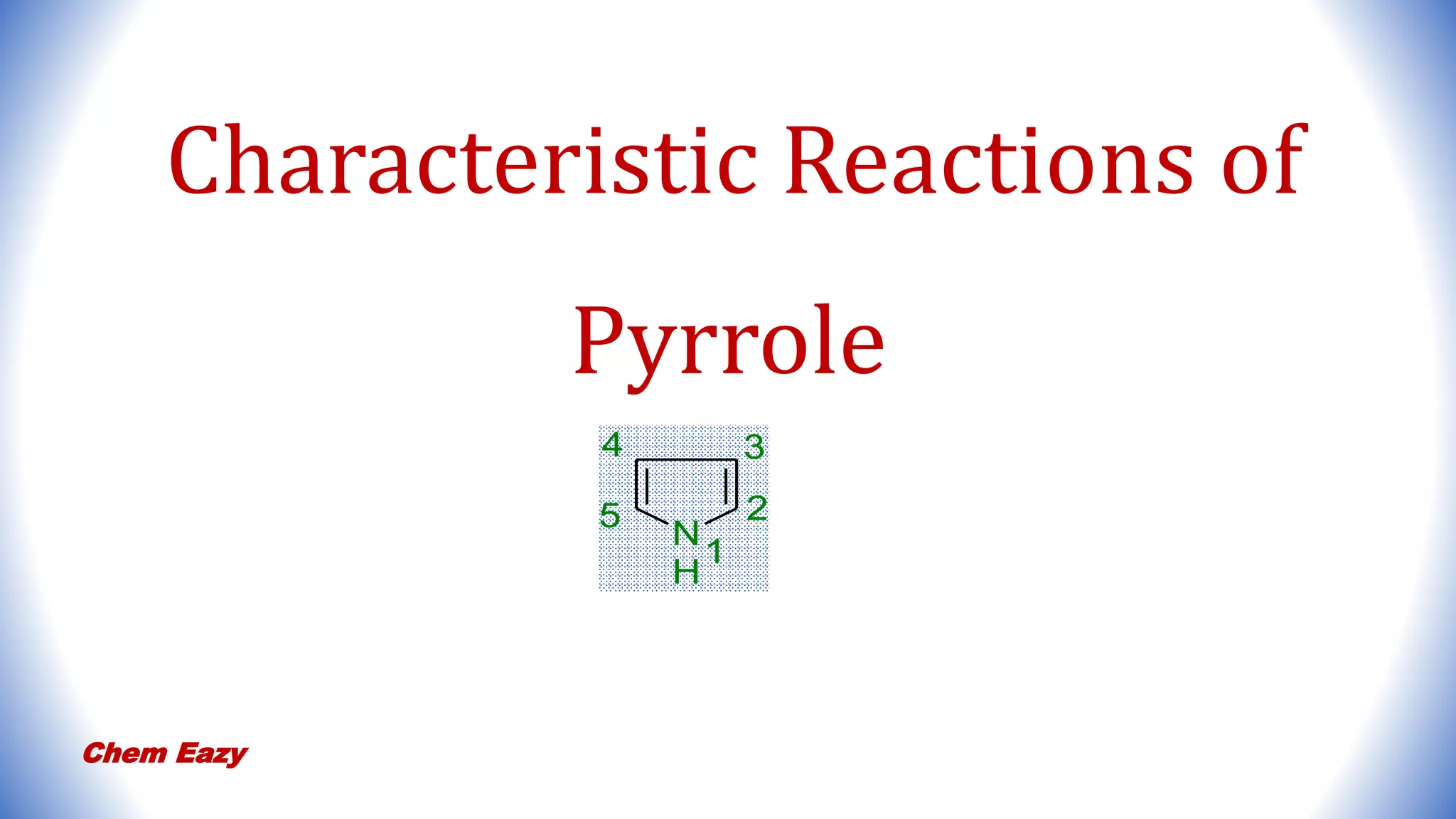
Characteristic Reactions of
Pyrrole
N
H
1
2
3
4
5
Chem Eazy
1.ElectrophilicSubstitution
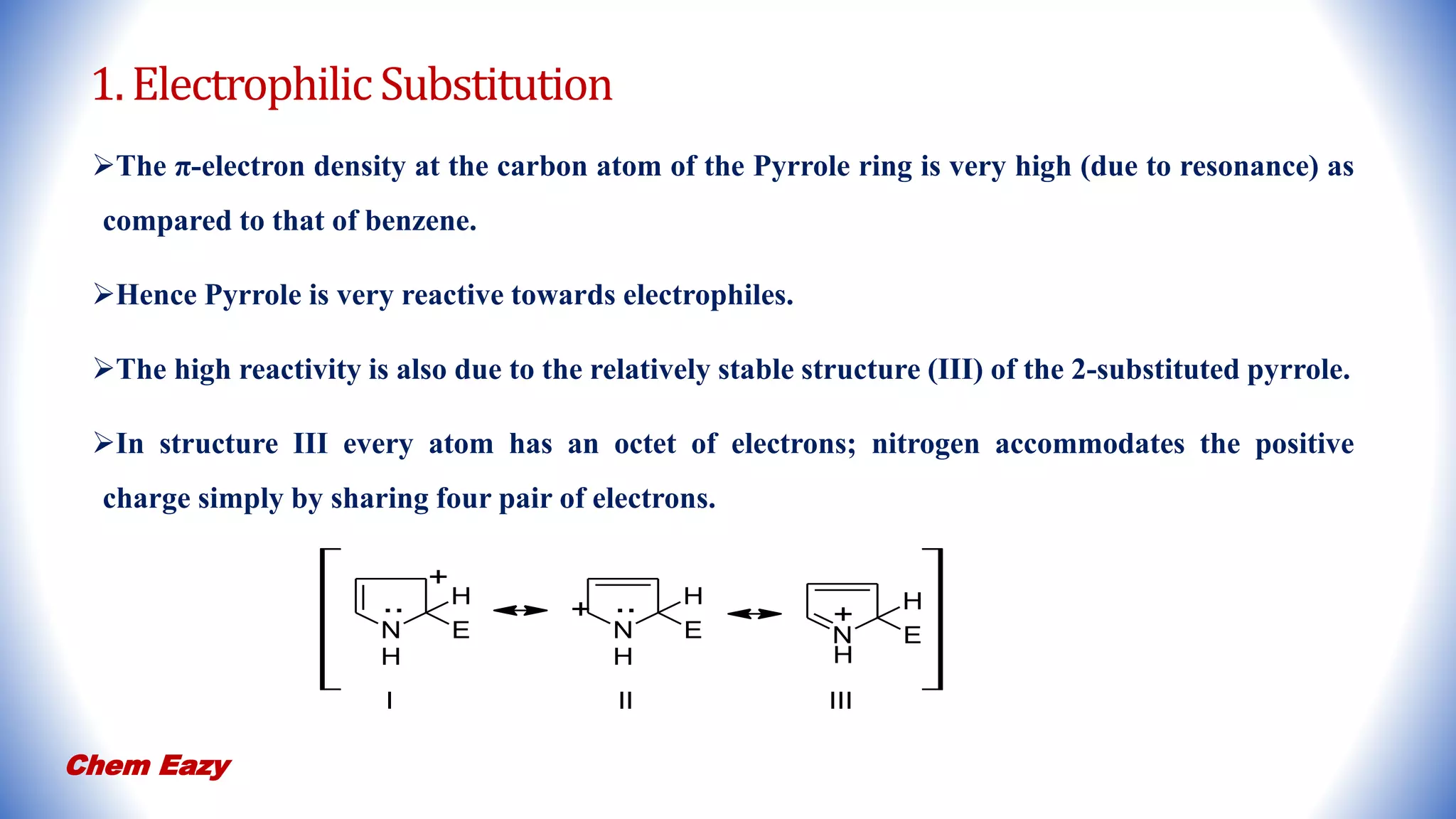
The π-electron density at the carbon atom of the Pyrrole ring is very high (due to resonance) as
compared to that of benzene.
Hence Pyrrole is very reactive towards electrophiles.
The high reactivity is also due to the relatively stable structure (III) of the 2-substituted pyrrole.
In structure III every atom has an octet of electrons; nitrogen accommodates the positive
charge simply by sharing four pair of electrons.
N
H
E
H
..
+
N
H
E
H
..
+
N E
H
+
I II III
H
Chem Eazy
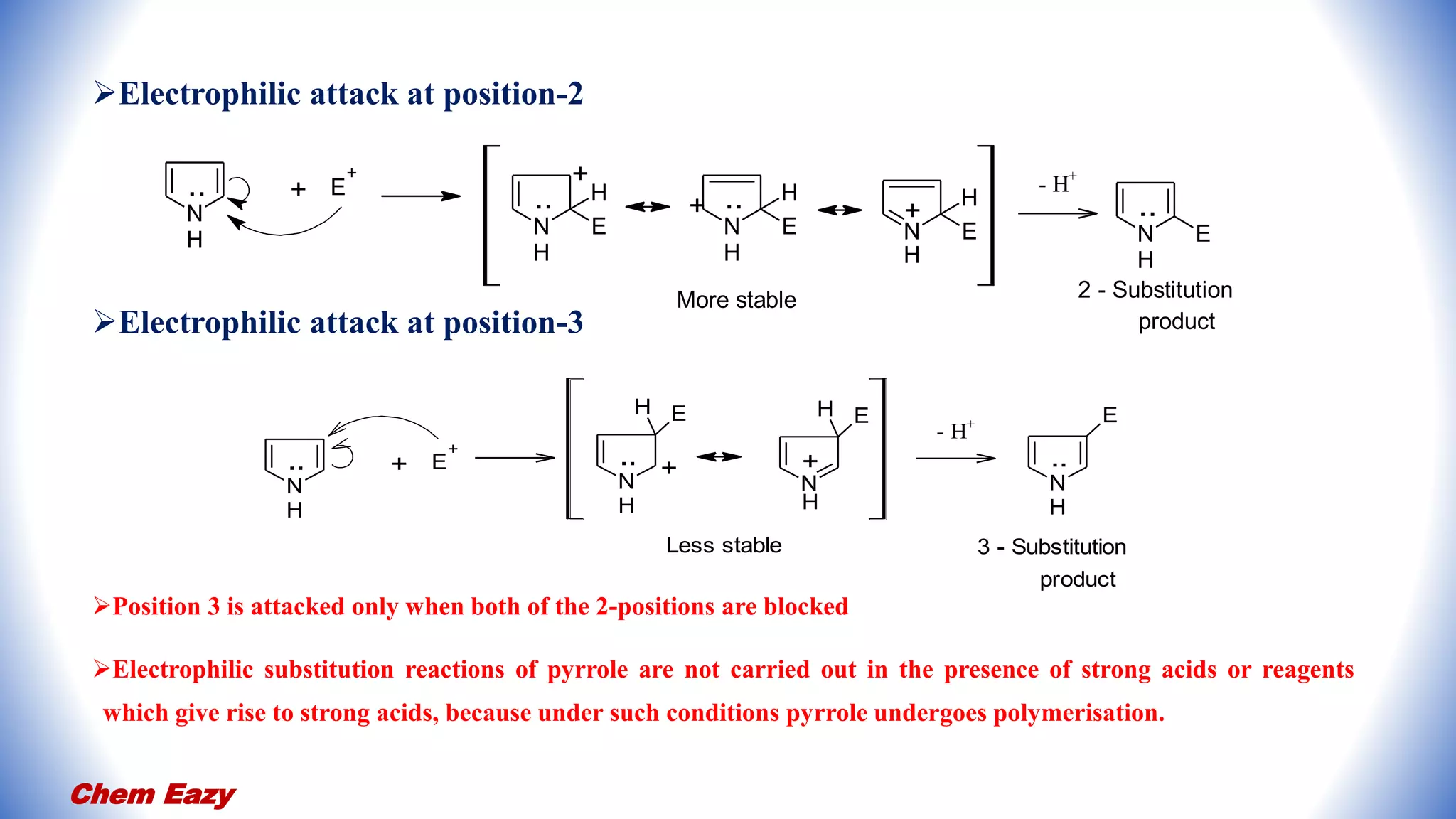
Pyrrole undergoes electrophilic substitution preferentially at either of the 2-positions
followed by 3.
The predominance of 2-substituted product over 3 is because of the positive charge in the
transition state in 2-substituted product is delocalised over three atoms as compared to two
in 3-substituted product.
Thus, the intermediate from position-2 attack has less energy (more stable) than the
intermediate from position-3 attack.
Chem Eazy
Electrophilic attack at position-2
Electrophilic attack at position-3
Position 3 is attacked only when both of the 2-positions are blocked
Electrophilic substitution reactions of pyrrole are not carried out in the presence of strong acids or reagents
which give rise to strong acids, because under such conditions pyrrole undergoes polymerisation.
N
H
.. + E
+
N
H
E
H
..
+
N
H
E
H
..
+
N E
H
+
N
H
E
..
- H+
More stable 2 - Substitution
product
H
N
H
.. + E
+
N
H
E
H
.. +
N
E
H
+
Less stable
- H+
N
H
E
..
3 - Substitution
product
H
Chem Eazy
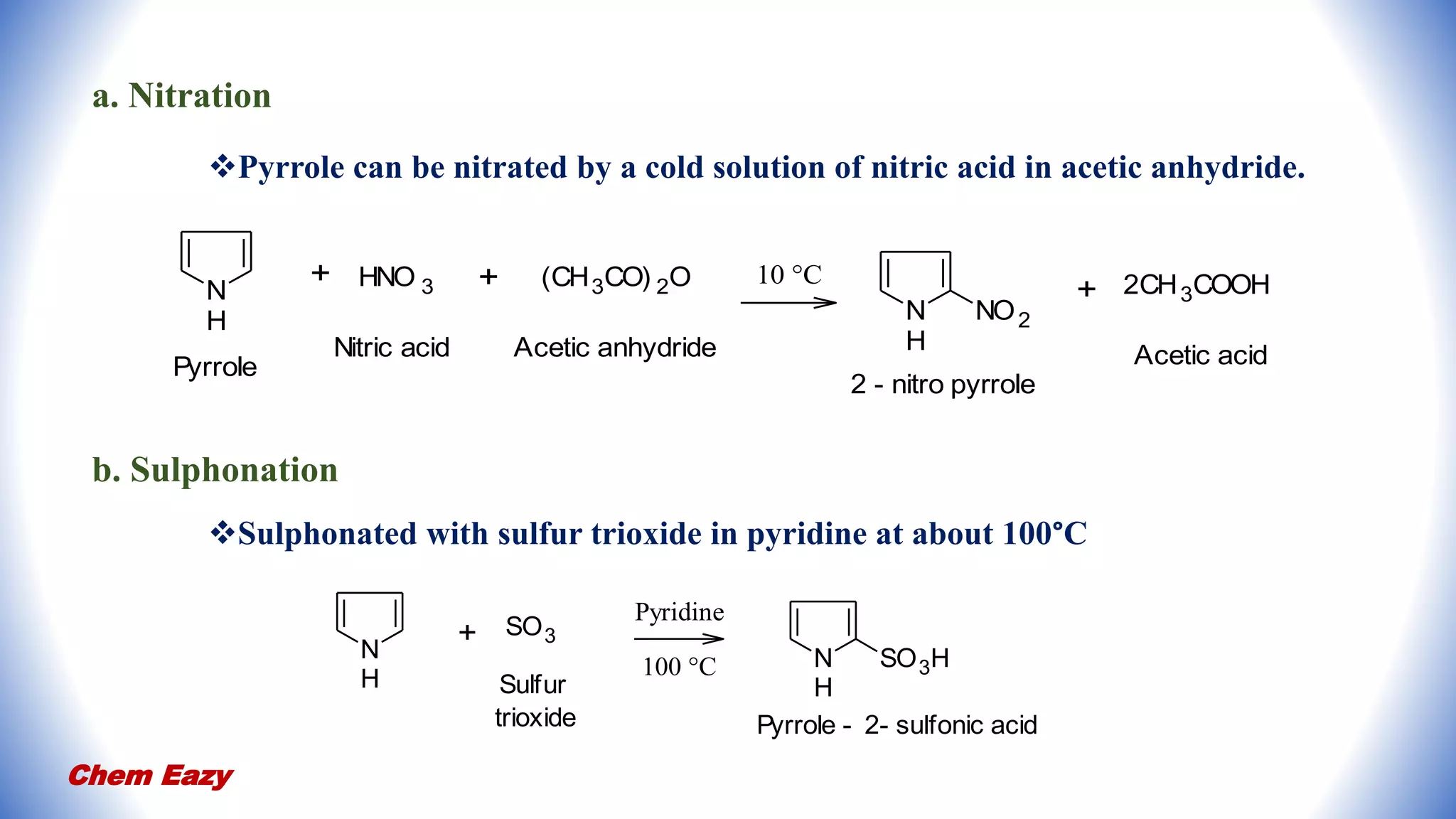
a. Nitration
Pyrrole can be nitrated by a cold solution of nitric acid in acetic anhydride.
b. Sulphonation
Sulphonated with sulfur trioxide in pyridine at about 100°C
N
H
Pyrrole
+ HNO 3 + (CH3CO) 2O
Nitric acid Acetic anhydride
10 °C
N
H
NO2
+ 2CH3COOH
2 - nitro pyrrole
Acetic acid
N
H
+ SO3
Sulfur
trioxide
Pyridine
100 °C N
H
SO3H
Pyrrole - 2- sulfonic acid
Chem Eazy
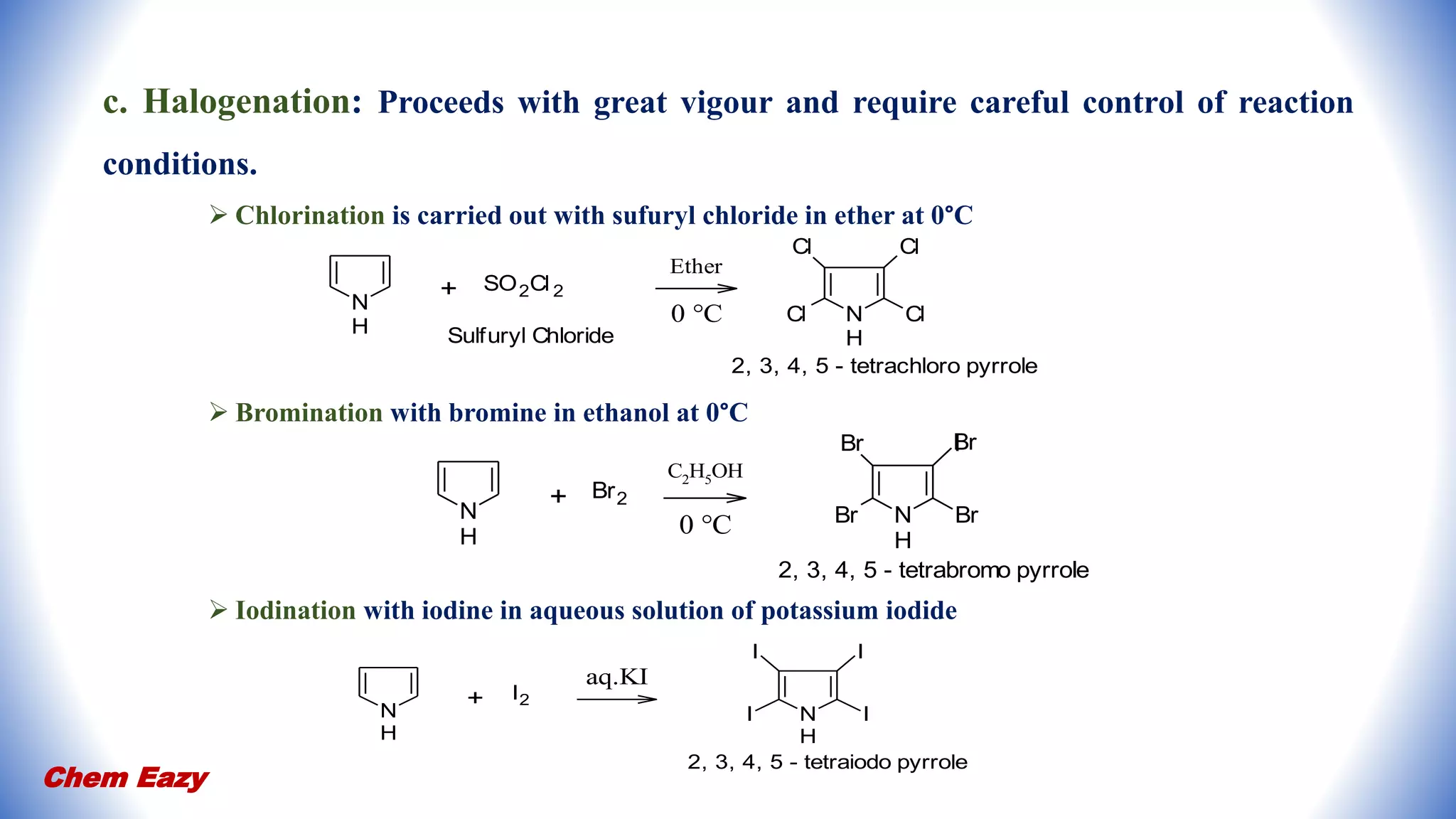
c. Halogenation: Proceeds with great vigour and require careful control of reaction
conditions.
 Chlorination is carried out with sufuryl chloride in ether at 0°C
 Bromination with bromine in ethanol at 0°C
 Iodination with iodine in aqueous solution of potassium iodide
N
H
+ SO2Cl2
Sulfuryl Chloride
Ether
0 °C N
H
Cl
Cl
Cl
Cl
2, 3, 4, 5 - tetrachloro pyrrole
N
H
+ Br2
N
H
I
Br
Br
Br
2, 3, 4, 5 - tetrabromo pyrrole
Br
C2H5OH
0 °C
N
H
+ I2
aq.KI
N
H
I
I
I
I
2, 3, 4, 5 - tetraiodo pyrrole
Chem Eazy
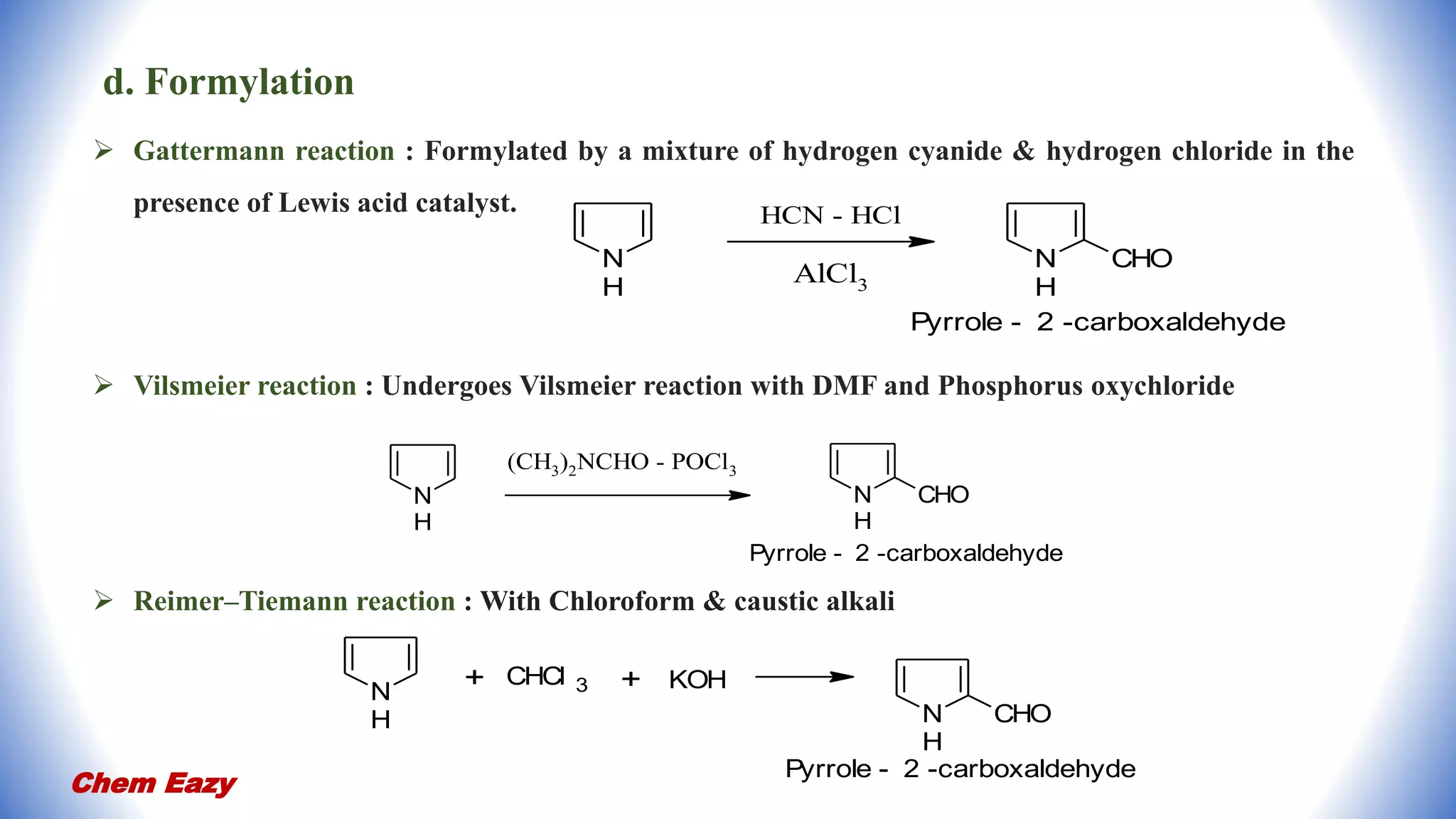
d. Formylation
 Gattermann reaction : Formylated by a mixture of hydrogen cyanide & hydrogen chloride in the
presence of Lewis acid catalyst.
 Vilsmeier reaction : Undergoes Vilsmeier reaction with DMF and Phosphorus oxychloride
 Reimer–Tiemann reaction : With Chloroform & caustic alkali
HCN - HCl
AlCl3
N
H
N
H
CHO
Pyrrole - 2 -carboxaldehyde
N
H
(CH3)2NCHO - POCl3
N
H
CHO
Pyrrole - 2 -carboxaldehyde
N
H
+ CHCl 3 + KOH
N
H
CHO
Pyrrole - 2 -carboxaldehyde
Chem Eazy
e. Acetylation [Friedel-Crafts reaction] : Acetylated with acetic anhydride at 250°C
f. Alkylation: N-alkylation of pyrrole was readily achieved with primary alkyl halides
g. Coupling reaction: Undergoes coupling reaction with benzenediazonium chloride
N
H
+ CH3 - CO - O - CO - CH 3
N
H
CO - CH 3
+ CH3COOH
2 - acetyl pyrrole
Acetic anhydride

250 °C
CH3I
60 °C
N
H
N
CH3
high temp
N
H
CH3
+
N
H
CH3
N-methyl pyrrole 2 - methyl pyrrole 3 - methyl pyrrole
N
H
C6H5N2Cl
CH3COONa N
H
N = N - C 6H5
2- phenylazopyrrole
Chem Eazy
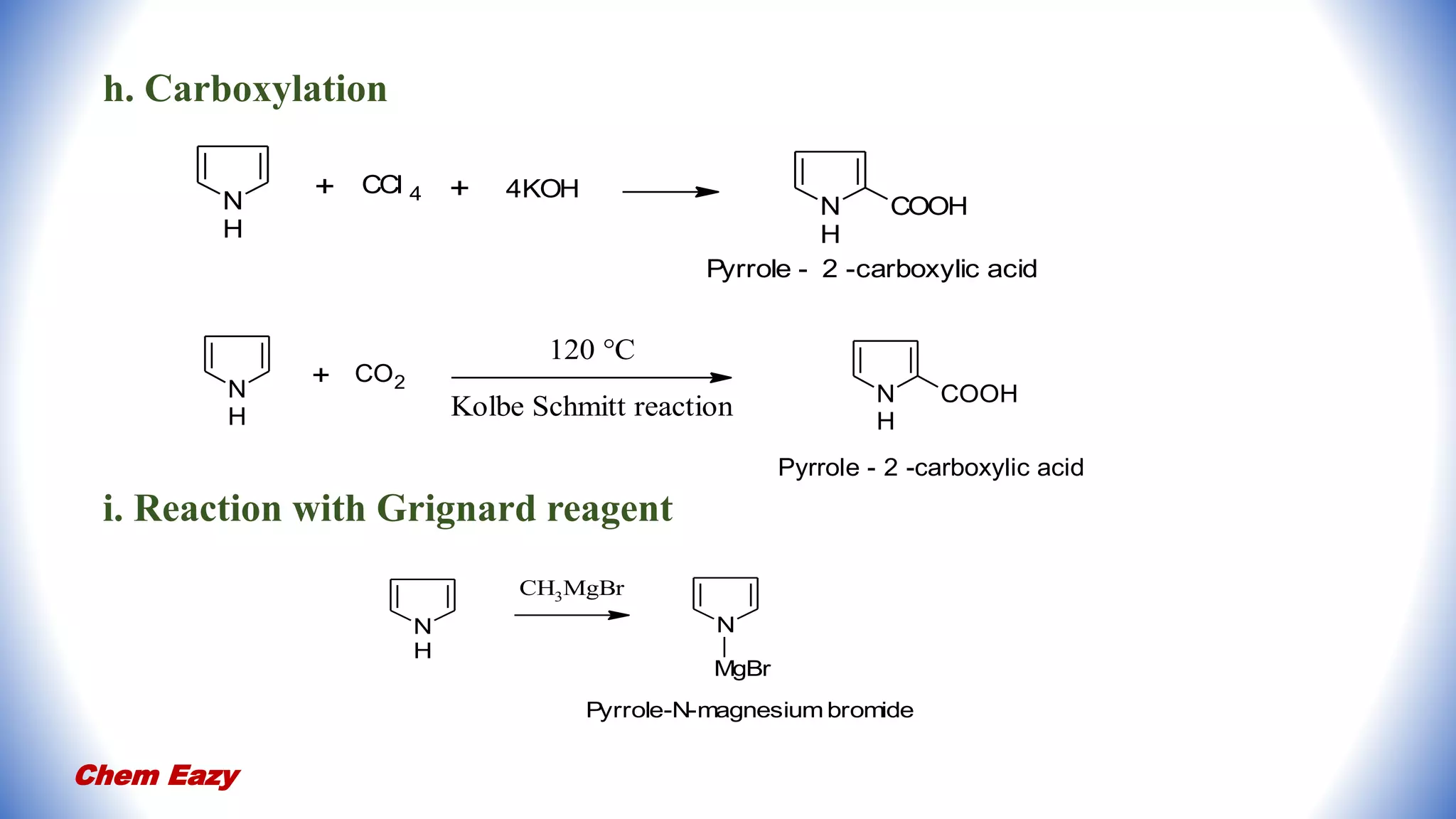
h. Carboxylation
i. Reaction with Grignard reagent
N
H
+ CCl 4 + 4KOH
N
H
COOH
Pyrrole - 2 -carboxylic acid
N
H
+ CO2
N
H
COOH
Pyrrole - 2 -carboxylic acid
120 °C
Kolbe Schmitt reaction
N
H
CH3MgBr
N
MgBr
Pyrrole-N-magnesium bromide
Chem Eazy
2. Oxidation : Pyrrole oxidised by chromium trioxide in acetic acid
3 . Reduction: Zinc and acetic acid reduces Pyrrole to Pyrroline which may be further
reduced to Pyrrolidine by means of red phosphorus & hydriodic acid.
 Catalytic reduction reduces Pyrrole directly to pyrrolidine
N
H
+ 3 [O]
Cr2O3
CH3COOH N
H
O
O
Maleic imide
N
H
Zn
CH3COOH N
H
2, 5 - dihydropyrrole
(Pyrroline)
Red P
HI N
H
Pyrrolidine
N
H
H2 - Ni
200 °C N
H
Pyrrolidine
Chem Eazy
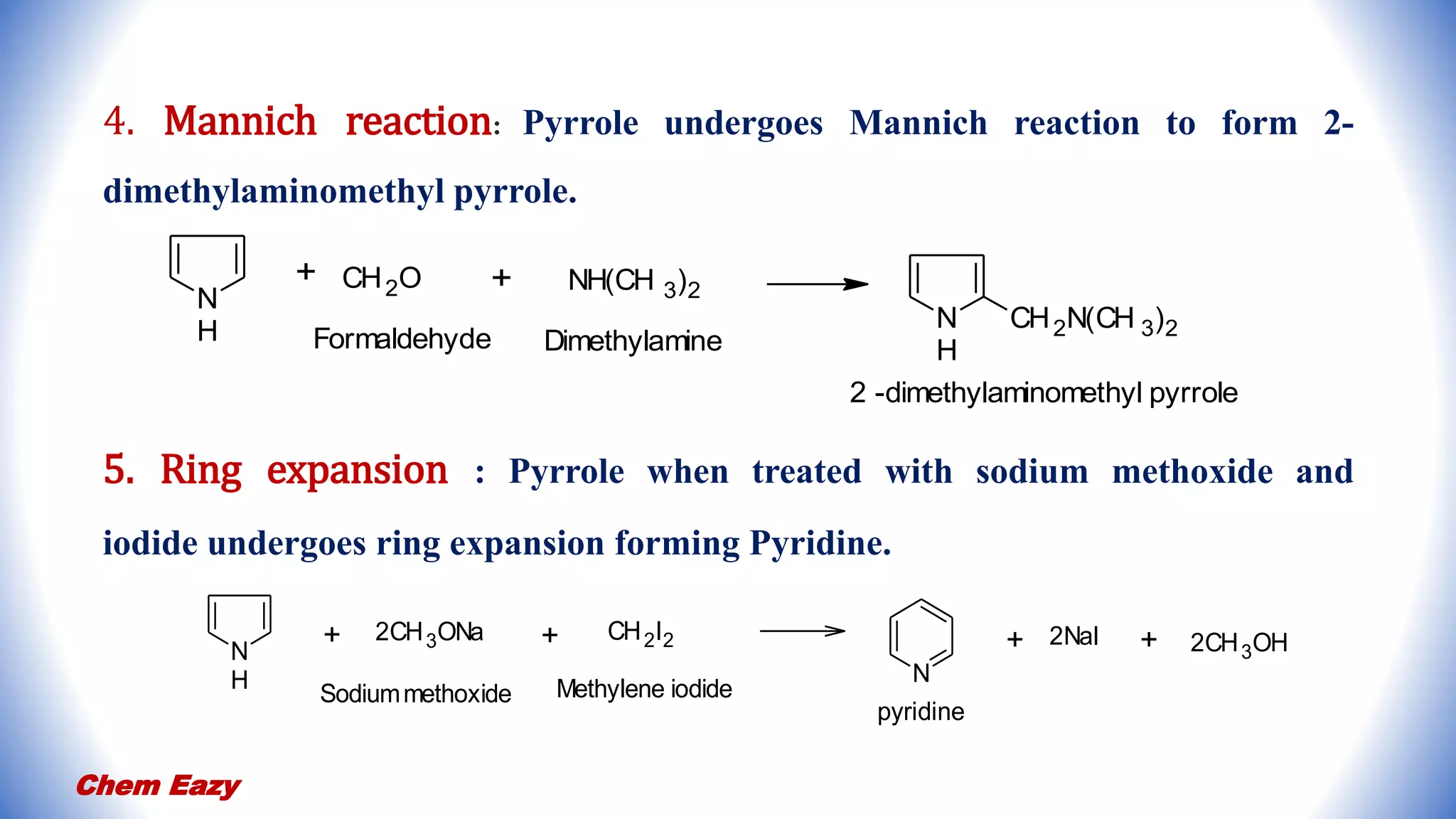
4. Mannich reaction: Pyrrole undergoes Mannich reaction to form 2-
dimethylaminomethyl pyrrole.
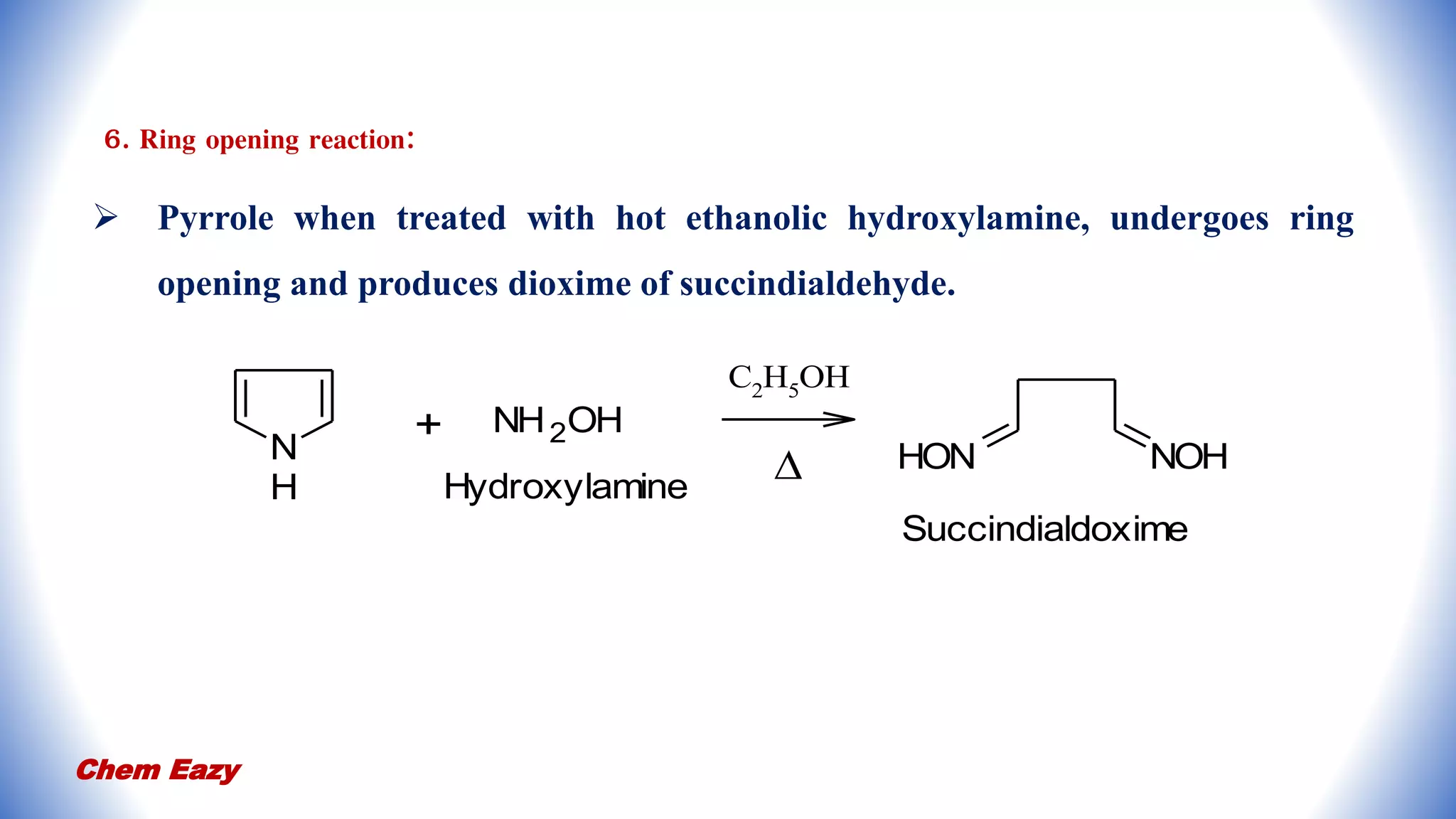
5. Ring expansion : Pyrrole when treated with sodium methoxide and
iodide undergoes ring expansion forming Pyridine.
N
H
+ CH2O +
Formaldehyde
NH(CH 3)2
Dimethylamine
N
H
CH2N(CH 3)2
2 -dimethylaminomethyl pyrrole
N
H
+ 2CH3ONa + CH2I2
Sodiummethoxide Methylene iodide
N
+ 2NaI + 2CH3OH
pyridine
Chem Eazy
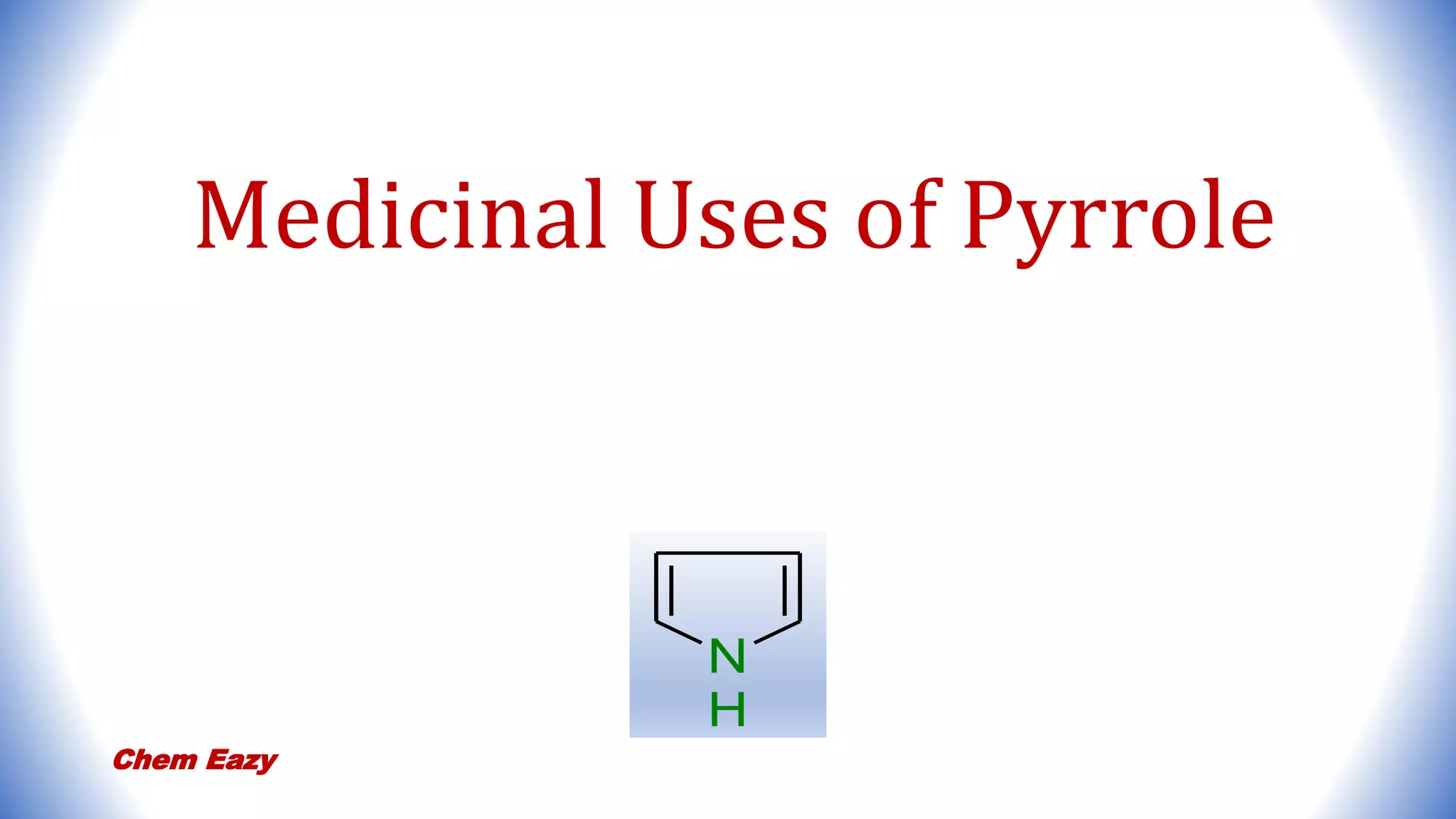
6. Ring opening reaction:
 Pyrrole when treated with hot ethanolic hydroxylamine, undergoes ring
opening and produces dioxime of succindialdehyde.
N
H
+ NH2OH
C2H5OH

Hydroxylamine
NOH
HON
Succindialdoxime
Chem Eazy
Medicinal Uses of Pyrrole
N
H
Chem Eazy
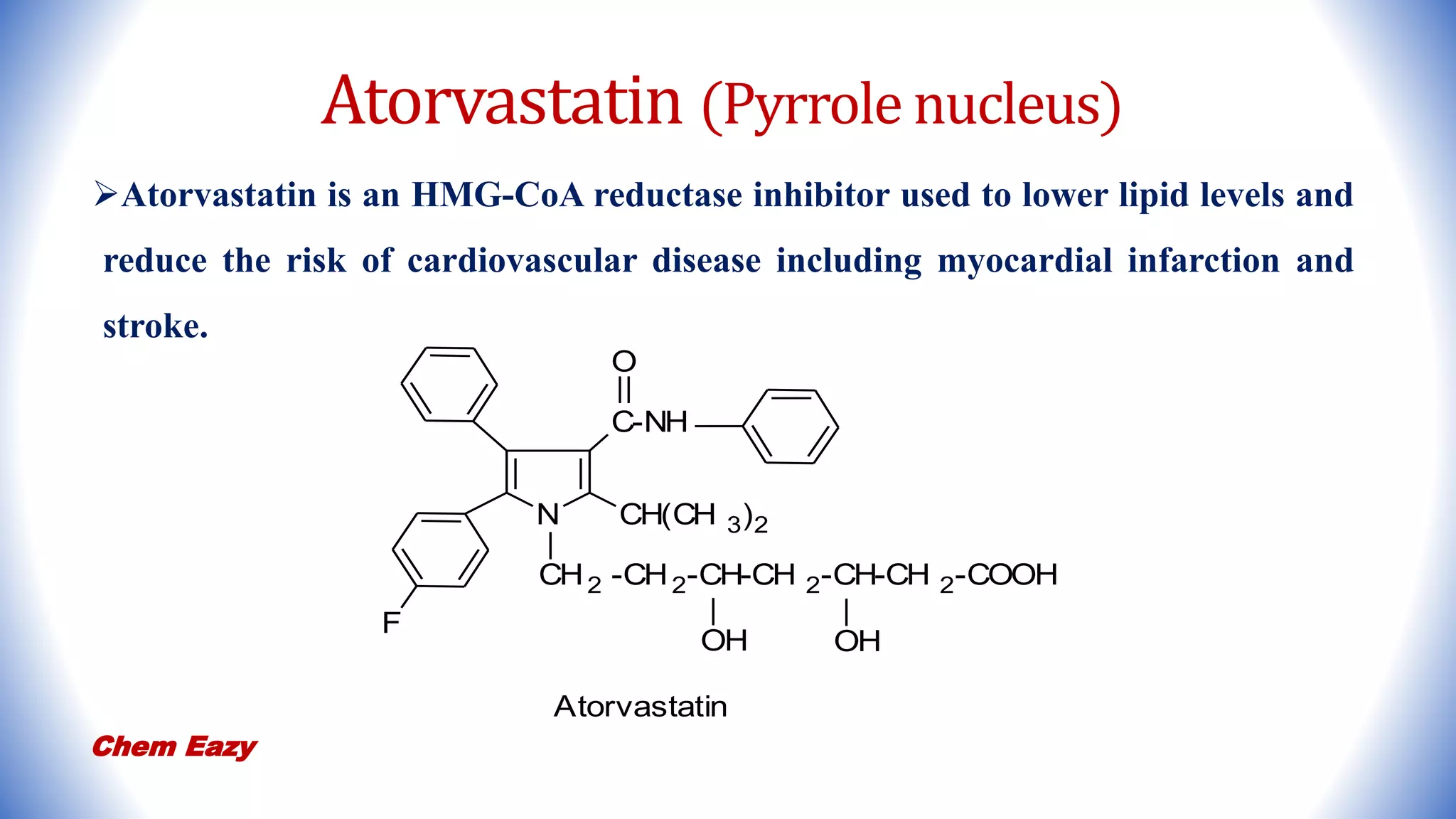
Atorvastatin (Pyrrole nucleus)
Atorvastatin is an HMG-CoA reductase inhibitor used to lower lipid levels and
reduce the risk of cardiovascular disease including myocardial infarction and
stroke.
N CH(CH 3)2
C-NH
F
CH2 -CH2-CH-CH 2-CH-CH 2-COOH
OH OH
O
Atorvastatin
Chem Eazy
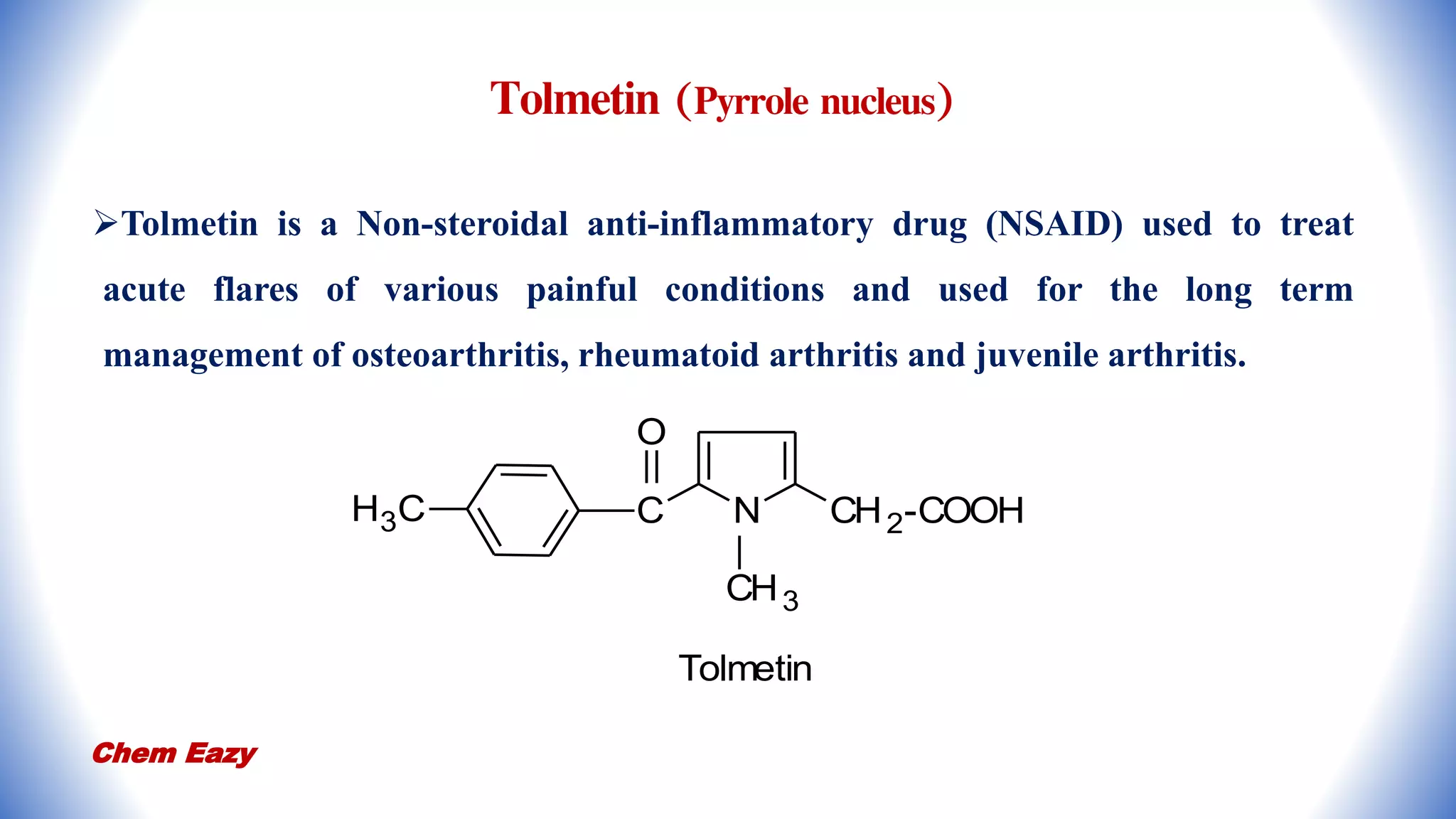
Tolmetin (Pyrrole nucleus)
Tolmetin is a Non-steroidal anti-inflammatory drug (NSAID) used to treat
acute flares of various painful conditions and used for the long term
management of osteoarthritis, rheumatoid arthritis and juvenile arthritis.
O
H3C N CH2-COOH
C
CH3
Tolmetin
Chem Eazy
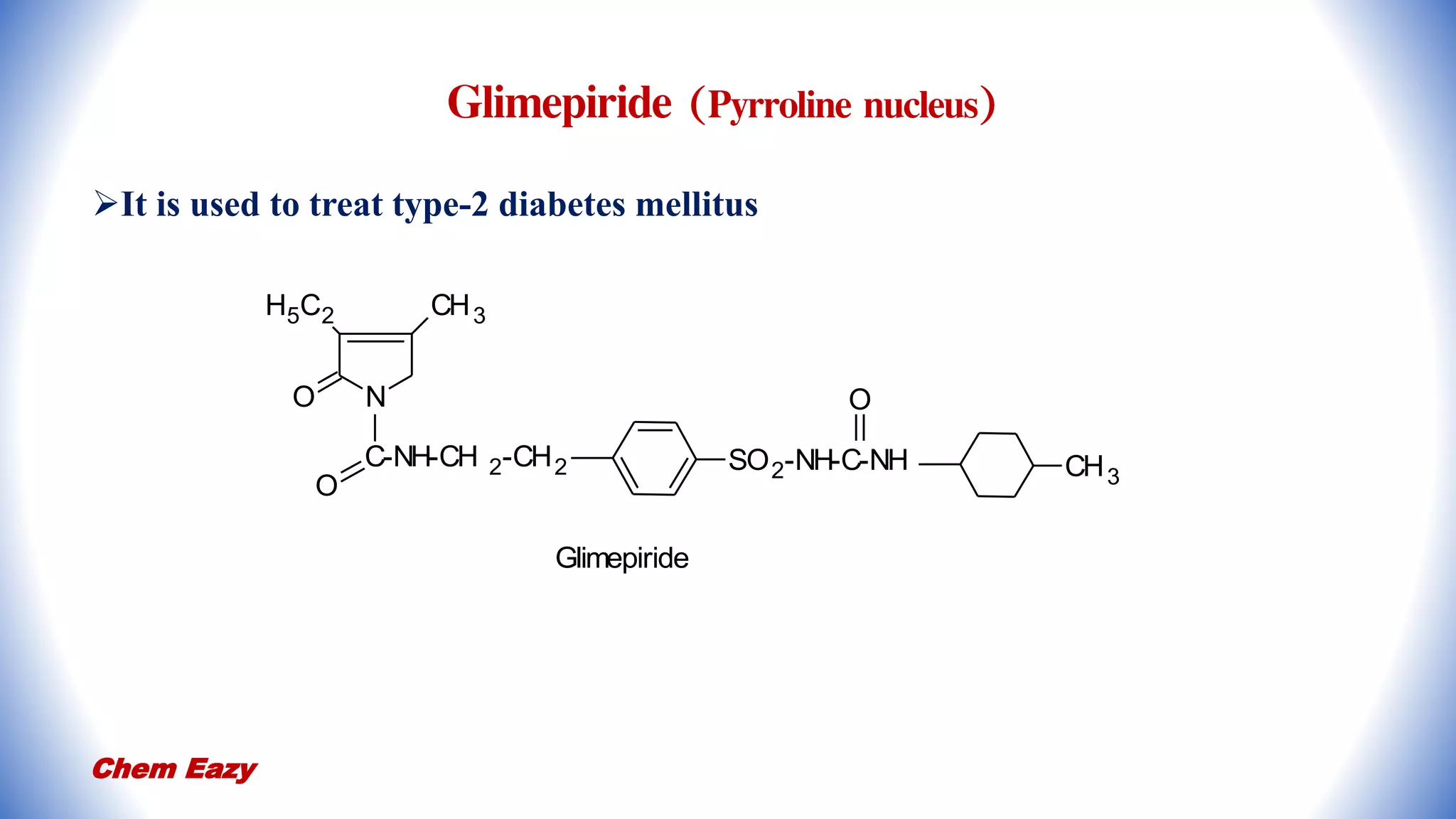
Glimepiride (Pyrroline nucleus)
It is used to treat type-2 diabetes mellitus
N
CH3
H5C2
O
C-NH-CH 2-CH2
O
SO2-NH-C-NH CH3
O
Glimepiride
Chem Eazy
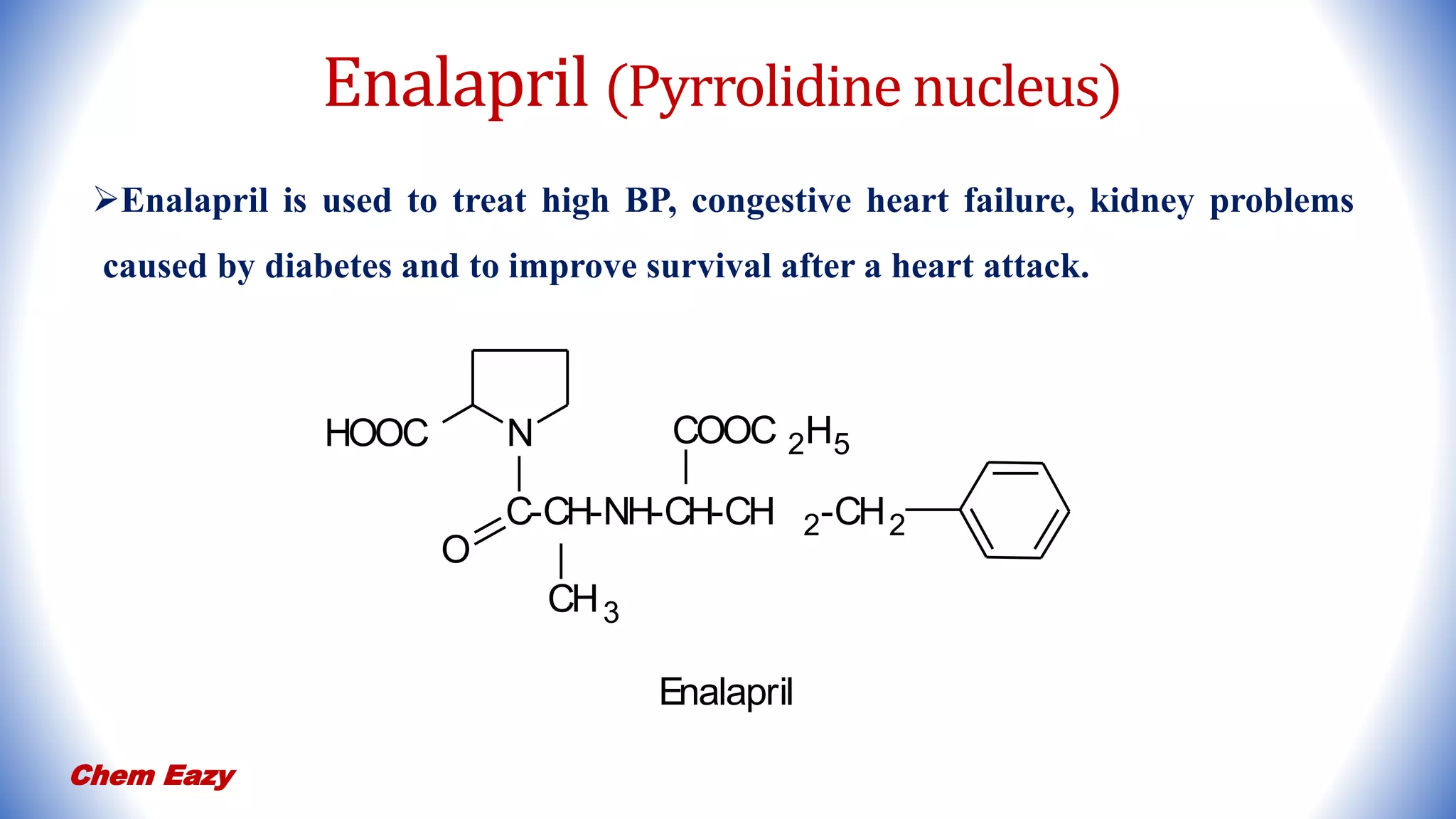
Enalapril (Pyrrolidine nucleus)
Enalapril is used to treat high BP, congestive heart failure, kidney problems
caused by diabetes and to improve survival after a heart attack.
N
HOOC
C-CH-NH-CH-CH 2-CH2
CH3
COOC 2H5
O
Enalapril
Chem Eazy
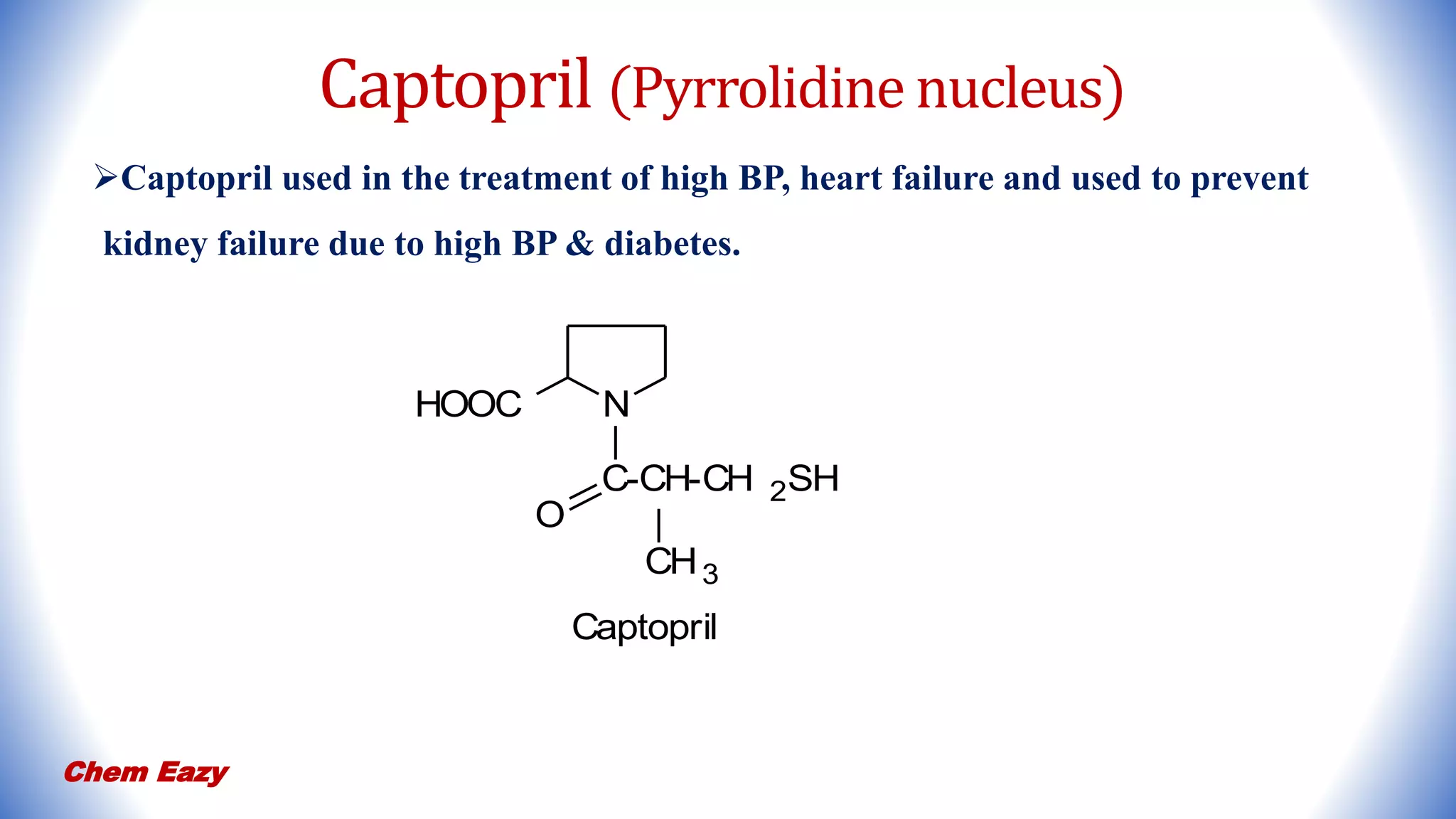
Captopril (Pyrrolidine nucleus)
Captopril used in the treatment of high BP, heart failure and used to prevent
kidney failure due to high BP & diabetes.
N
HOOC
C-CH-CH 2SH
CH3
O
Captopril
Chem Eazy

Heterocyclic compounds - pyrrole - synthesis of pyrrole - characteristic reactions of pyrrole - medicinal uses of pyrrole

  • 1.
  • 2.
    Synthesis of Pyrrole Bypassing a mixture of acetylene and ammonia through a red-hot tube. By heating succinimide with zinc dust. By warming succinic dialdehyde with ammonia. + CH CH + NH3  HC HC N H Acetylene Ammonia Pyrrole N H O O N H OH HO Zn  N H Pyrrole Succinimide O O Succinic dialdehyde OH HO NH3 N H Pyrrole Chem Eazy
  • 3.
  • 4.
    1.ElectrophilicSubstitution The π-electron densityat the carbon atom of the Pyrrole ring is very high (due to resonance) as compared to that of benzene. Hence Pyrrole is very reactive towards electrophiles. The high reactivity is also due to the relatively stable structure (III) of the 2-substituted pyrrole. In structure III every atom has an octet of electrons; nitrogen accommodates the positive charge simply by sharing four pair of electrons. N H E H .. + N H E H .. + N E H + I II III H Chem Eazy
  • 5.
    Pyrrole undergoes electrophilicsubstitution preferentially at either of the 2-positions followed by 3. The predominance of 2-substituted product over 3 is because of the positive charge in the transition state in 2-substituted product is delocalised over three atoms as compared to two in 3-substituted product. Thus, the intermediate from position-2 attack has less energy (more stable) than the intermediate from position-3 attack. Chem Eazy
  • 6.
    Electrophilic attack atposition-2 Electrophilic attack at position-3 Position 3 is attacked only when both of the 2-positions are blocked Electrophilic substitution reactions of pyrrole are not carried out in the presence of strong acids or reagents which give rise to strong acids, because under such conditions pyrrole undergoes polymerisation. N H .. + E + N H E H .. + N H E H .. + N E H + N H E .. - H+ More stable 2 - Substitution product H N H .. + E + N H E H .. + N E H + Less stable - H+ N H E .. 3 - Substitution product H Chem Eazy
  • 7.
    a. Nitration Pyrrole canbe nitrated by a cold solution of nitric acid in acetic anhydride. b. Sulphonation Sulphonated with sulfur trioxide in pyridine at about 100°C N H Pyrrole + HNO 3 + (CH3CO) 2O Nitric acid Acetic anhydride 10 °C N H NO2 + 2CH3COOH 2 - nitro pyrrole Acetic acid N H + SO3 Sulfur trioxide Pyridine 100 °C N H SO3H Pyrrole - 2- sulfonic acid Chem Eazy
  • 8.
    c. Halogenation: Proceedswith great vigour and require careful control of reaction conditions.  Chlorination is carried out with sufuryl chloride in ether at 0°C  Bromination with bromine in ethanol at 0°C  Iodination with iodine in aqueous solution of potassium iodide N H + SO2Cl2 Sulfuryl Chloride Ether 0 °C N H Cl Cl Cl Cl 2, 3, 4, 5 - tetrachloro pyrrole N H + Br2 N H I Br Br Br 2, 3, 4, 5 - tetrabromo pyrrole Br C2H5OH 0 °C N H + I2 aq.KI N H I I I I 2, 3, 4, 5 - tetraiodo pyrrole Chem Eazy
  • 9.
    d. Formylation  Gattermannreaction : Formylated by a mixture of hydrogen cyanide & hydrogen chloride in the presence of Lewis acid catalyst.  Vilsmeier reaction : Undergoes Vilsmeier reaction with DMF and Phosphorus oxychloride  Reimer–Tiemann reaction : With Chloroform & caustic alkali HCN - HCl AlCl3 N H N H CHO Pyrrole - 2 -carboxaldehyde N H (CH3)2NCHO - POCl3 N H CHO Pyrrole - 2 -carboxaldehyde N H + CHCl 3 + KOH N H CHO Pyrrole - 2 -carboxaldehyde Chem Eazy
  • 10.
    e. Acetylation [Friedel-Craftsreaction] : Acetylated with acetic anhydride at 250°C f. Alkylation: N-alkylation of pyrrole was readily achieved with primary alkyl halides g. Coupling reaction: Undergoes coupling reaction with benzenediazonium chloride N H + CH3 - CO - O - CO - CH 3 N H CO - CH 3 + CH3COOH 2 - acetyl pyrrole Acetic anhydride  250 °C CH3I 60 °C N H N CH3 high temp N H CH3 + N H CH3 N-methyl pyrrole 2 - methyl pyrrole 3 - methyl pyrrole N H C6H5N2Cl CH3COONa N H N = N - C 6H5 2- phenylazopyrrole Chem Eazy
  • 11.
    h. Carboxylation i. Reactionwith Grignard reagent N H + CCl 4 + 4KOH N H COOH Pyrrole - 2 -carboxylic acid N H + CO2 N H COOH Pyrrole - 2 -carboxylic acid 120 °C Kolbe Schmitt reaction N H CH3MgBr N MgBr Pyrrole-N-magnesium bromide Chem Eazy
  • 12.
    2. Oxidation :Pyrrole oxidised by chromium trioxide in acetic acid 3 . Reduction: Zinc and acetic acid reduces Pyrrole to Pyrroline which may be further reduced to Pyrrolidine by means of red phosphorus & hydriodic acid.  Catalytic reduction reduces Pyrrole directly to pyrrolidine N H + 3 [O] Cr2O3 CH3COOH N H O O Maleic imide N H Zn CH3COOH N H 2, 5 - dihydropyrrole (Pyrroline) Red P HI N H Pyrrolidine N H H2 - Ni 200 °C N H Pyrrolidine Chem Eazy
  • 13.
    4. Mannich reaction:Pyrrole undergoes Mannich reaction to form 2- dimethylaminomethyl pyrrole. 5. Ring expansion : Pyrrole when treated with sodium methoxide and iodide undergoes ring expansion forming Pyridine. N H + CH2O + Formaldehyde NH(CH 3)2 Dimethylamine N H CH2N(CH 3)2 2 -dimethylaminomethyl pyrrole N H + 2CH3ONa + CH2I2 Sodiummethoxide Methylene iodide N + 2NaI + 2CH3OH pyridine Chem Eazy
  • 14.
    6. Ring openingreaction:  Pyrrole when treated with hot ethanolic hydroxylamine, undergoes ring opening and produces dioxime of succindialdehyde. N H + NH2OH C2H5OH  Hydroxylamine NOH HON Succindialdoxime Chem Eazy
  • 15.
    Medicinal Uses ofPyrrole N H Chem Eazy
  • 16.
    Atorvastatin (Pyrrole nucleus) Atorvastatinis an HMG-CoA reductase inhibitor used to lower lipid levels and reduce the risk of cardiovascular disease including myocardial infarction and stroke. N CH(CH 3)2 C-NH F CH2 -CH2-CH-CH 2-CH-CH 2-COOH OH OH O Atorvastatin Chem Eazy
  • 17.
    Tolmetin (Pyrrole nucleus) Tolmetinis a Non-steroidal anti-inflammatory drug (NSAID) used to treat acute flares of various painful conditions and used for the long term management of osteoarthritis, rheumatoid arthritis and juvenile arthritis. O H3C N CH2-COOH C CH3 Tolmetin Chem Eazy
  • 18.
    Glimepiride (Pyrroline nucleus) Itis used to treat type-2 diabetes mellitus N CH3 H5C2 O C-NH-CH 2-CH2 O SO2-NH-C-NH CH3 O Glimepiride Chem Eazy
  • 19.
    Enalapril (Pyrrolidine nucleus) Enalaprilis used to treat high BP, congestive heart failure, kidney problems caused by diabetes and to improve survival after a heart attack. N HOOC C-CH-NH-CH-CH 2-CH2 CH3 COOC 2H5 O Enalapril Chem Eazy
  • 20.
    Captopril (Pyrrolidine nucleus) Captoprilused in the treatment of high BP, heart failure and used to prevent kidney failure due to high BP & diabetes. N HOOC C-CH-CH 2SH CH3 O Captopril Chem Eazy