The Veil-Framework
@HarmJ0y
@ChrisTruncer
@VeilFramework
Who Are We?
 Will Schroeder (@harmj0y)
 Former national research lab keyboard monkey
 Chris Truncer (@ChrisTruncer)
 Florida State Graduate – Go Noles!
 Veris group pentesters by day, offensive security
researchers by night
 And we’re hiring!
Overview
 The Initial Problem
 Public Reaction and Ethical Considerations
 The Veil-Framework
 Evading AV: Veil-Evasion
 Payload Delivery: Veil-Catapult
 Situation Awareness: Veil-
PowerView
 Demos Throughout
The Initial Problem
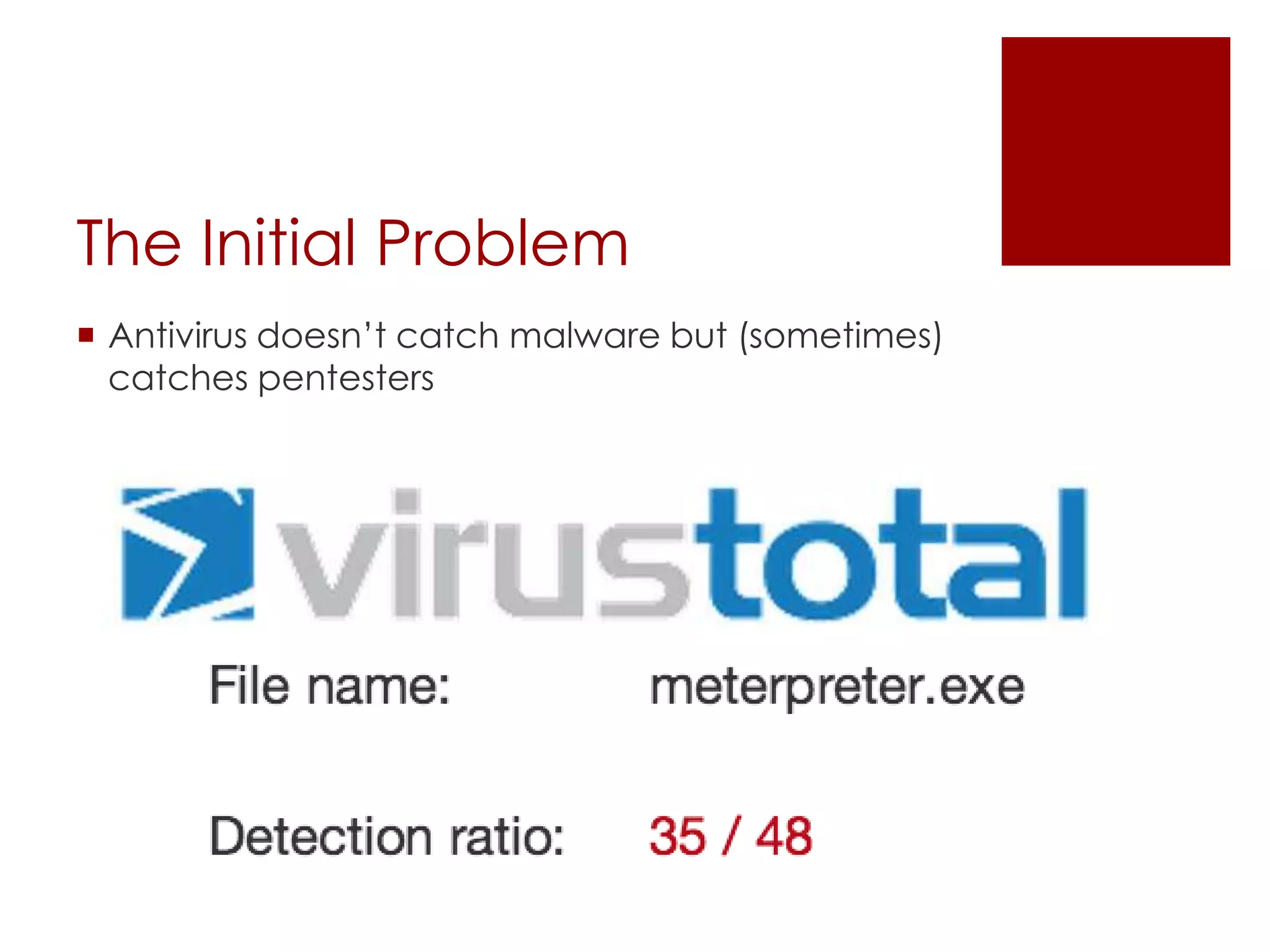
 Antivirus doesn’t catch malware but (sometimes)
catches pentesters
Our Initial Solution
 A way to get around antivirus as easily as
professional malware
 Don’t want to roll our own backdoor each time
 Find a way to execute existing shellcode in an
AV-evading way
The Veil-Framework
 A toolset aiming to bridge the gap between
pentesting and red teaming capabilities
 We started with Veil-Evasion, and began to
branch out to payload delivery and Powershell
exploitation
 Nothing revolutionary here, but want to bring
together existing techniques and incremental
research try to push things forward
Ethical Considerations
 The disclosure debate is not new…
 Pentesters are 5+ years behind the professional
malware community
 This is already a problem the bad guys have
solved
HD Moore’s Take
 “The strongest case for information disclosure is
when the benefit of releasing the information
outweighs the possible risks. In this case, like
many others, the bad guys already won.”
 https://community.rapid7.com/community/meta
sploit/blog/2009/02/23/the-best-defense-is-
information
Public Reaction
 “surely this will just result in 21 new signatures for all major
AVs and then we're back to square one?”
 “Isn't our entire field meant to be working towards
increasing security, rather than handing out fully
functioning weapons?”
 “The other point here is that anything that helps to expose
how in-effective AV really is at stopping even a minimally
sophisticated attacker is a good thing.”
 http://www.reddit.com/r/netsec/comments/1fc2xp/veil_a
_metasploit_payload_generator_for_bypassing/
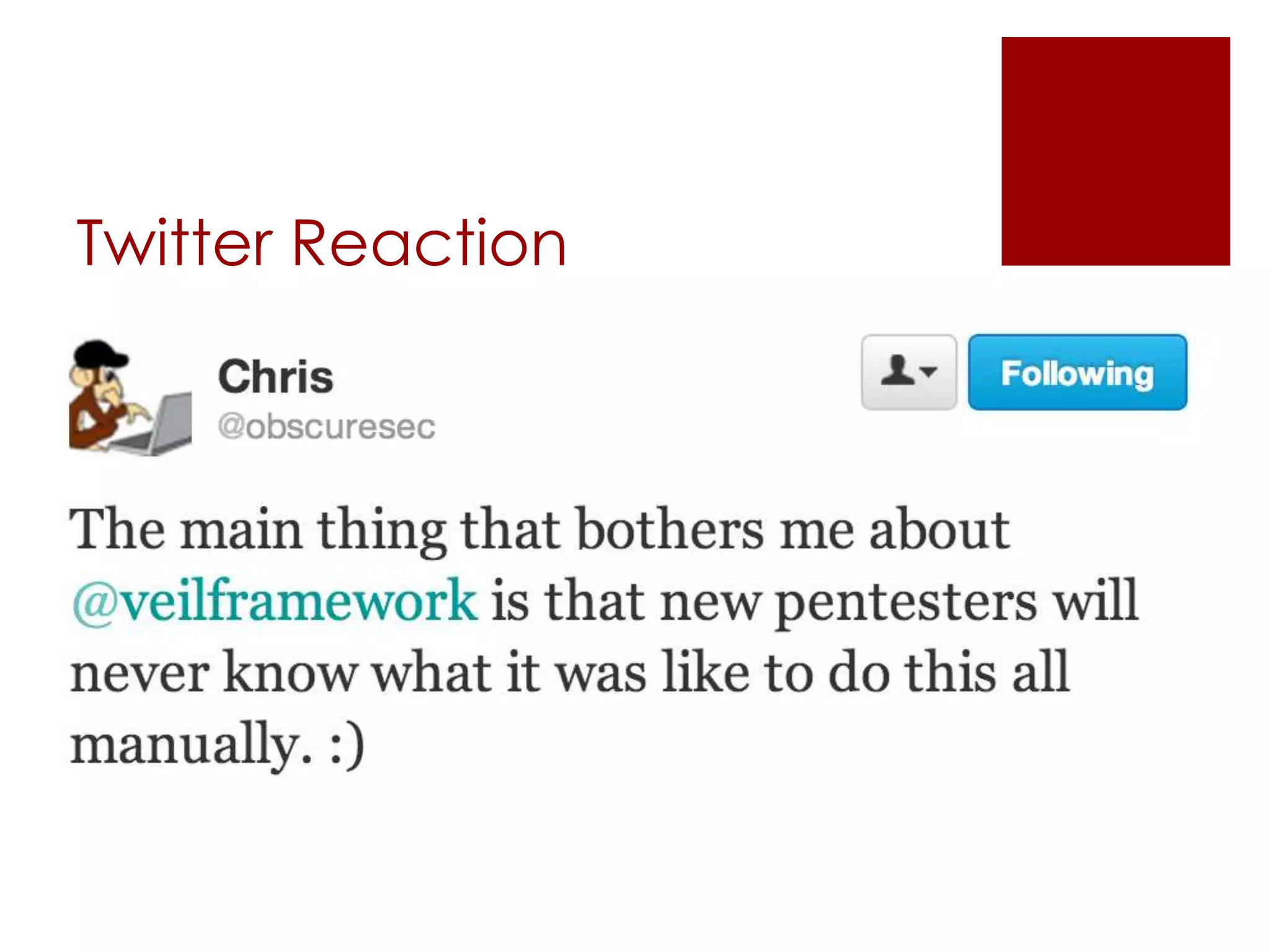
Twitter Reaction
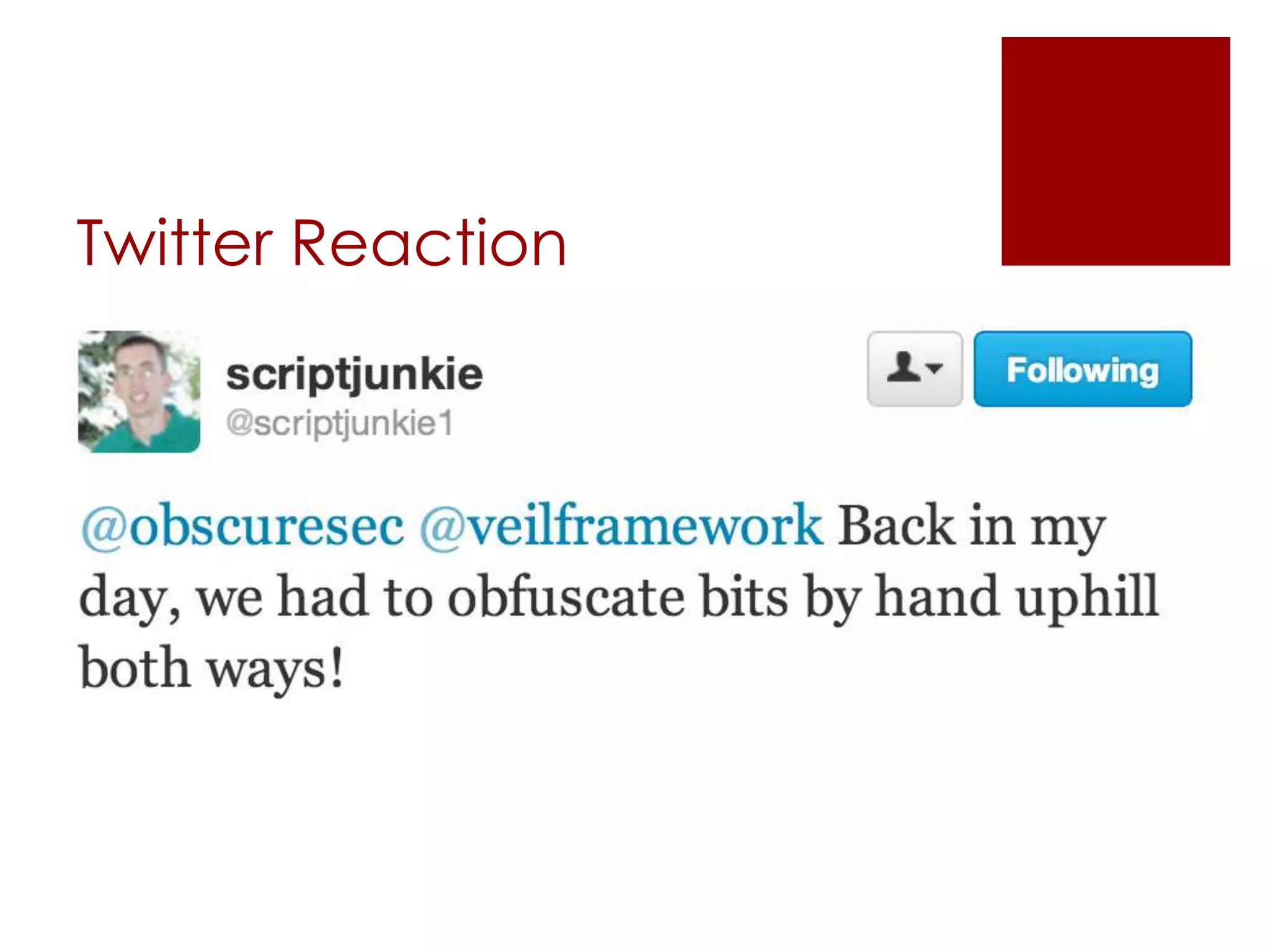
Twitter Reaction
Evading AV
Veil-Evasion
Veil-Evasion’s Approach
 Aggregation of various shellcode injection
techniques across multiple languages
 These have been known and documented in other
tools
 Focused on automation, usability, and
developing a true framework
 Some shellcodeless Meterpreter stagers and
“auxiliary” modules as well
Veil-Evasion Features
 Can use Metasploit-generated or custom
shellcode
 MSF payloads/options dynamically loaded
 In the process of porting msfvenom
 Third party tools can be easily integrated
 Hyperion, PEScrambler, BackDoor Factory, etc.
 Command line switches to allow scriptability
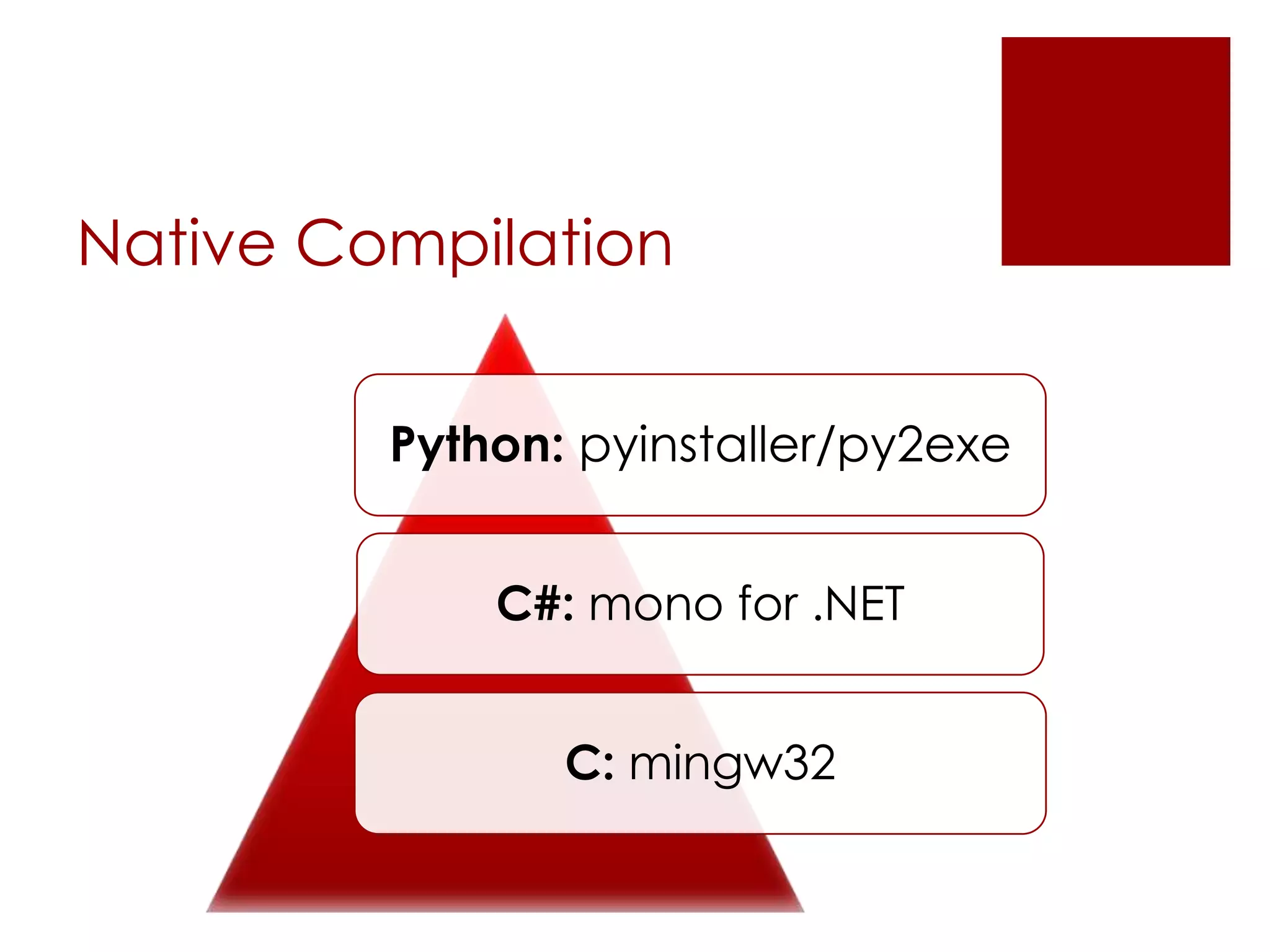
Native Compilation
Python: pyinstaller/py2exe
C#: mono for .NET
C: mingw32
Module Development
 Implement your own obfuscation methods!
 Lots of reusable functionality
 Shellcode generation is abstracted and can be
invoked as needed
 https://www.veil-framework.com/tutorial-veil-
payload-development/
Shellcode Injection
 Void pointer casting
 no guarantee the memory region is executable
 VirtualAlloc
 allocate memory as RWX, copy code in and create
a thread
 HeapAlloc
 create a heap object and manually allocate
memory
Pyinstaller and DEP
 Pyinstaller produced .exe’s are DEP enabled by
default
 this ruins some shellcode injection methods
 Luckily Pyinstaller is open source
 we can recompile to turn off DEP opt-in
 https://www.veil-evasion.com/dep-pyinstaller/
Pwnstaller
 A generator for obfuscated Pyinstaller loaders
 BSides Boston „14 – Pwnstaller 1.0
 Dynamically generates and compiles a new
Pyinstaller loader on the fly
 http://www.harmj0y.net/blog/python/pwnstaller-
1-0/
Payload Releases
#VDay
VDay
 Since 9/15/2013, we’ve release at least one new
payload on the 15th of every month
 32 currently published payloads
 20+ additional payloads have been developed
so far
 we’re going to be releasing for a while :)
Native Stagers
 Stage 1 Meterpreter loaders don’t have to be
implemented in shellcode
 Meterpreter stagers can be written in higher-level
languages
 https://github.com/rsmudge/metasploit-loader
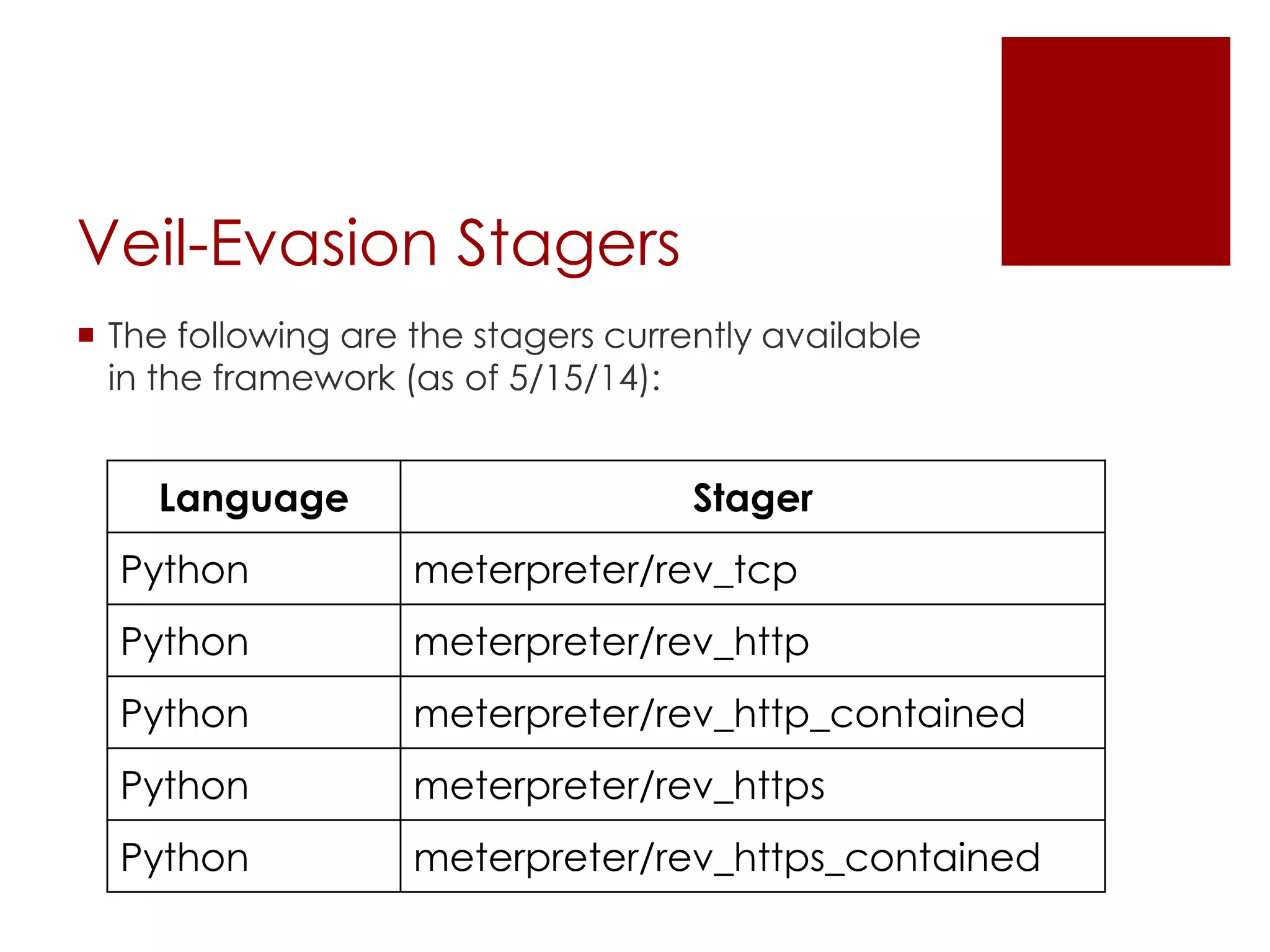
Veil-Evasion Stagers
 The following are the stagers currently available
in the framework (as of 5/15/14):
Language Stager
Python meterpreter/rev_tcp
Python meterpreter/rev_http
Python meterpreter/rev_http_contained
Python meterpreter/rev_https
Python meterpreter/rev_https_contained
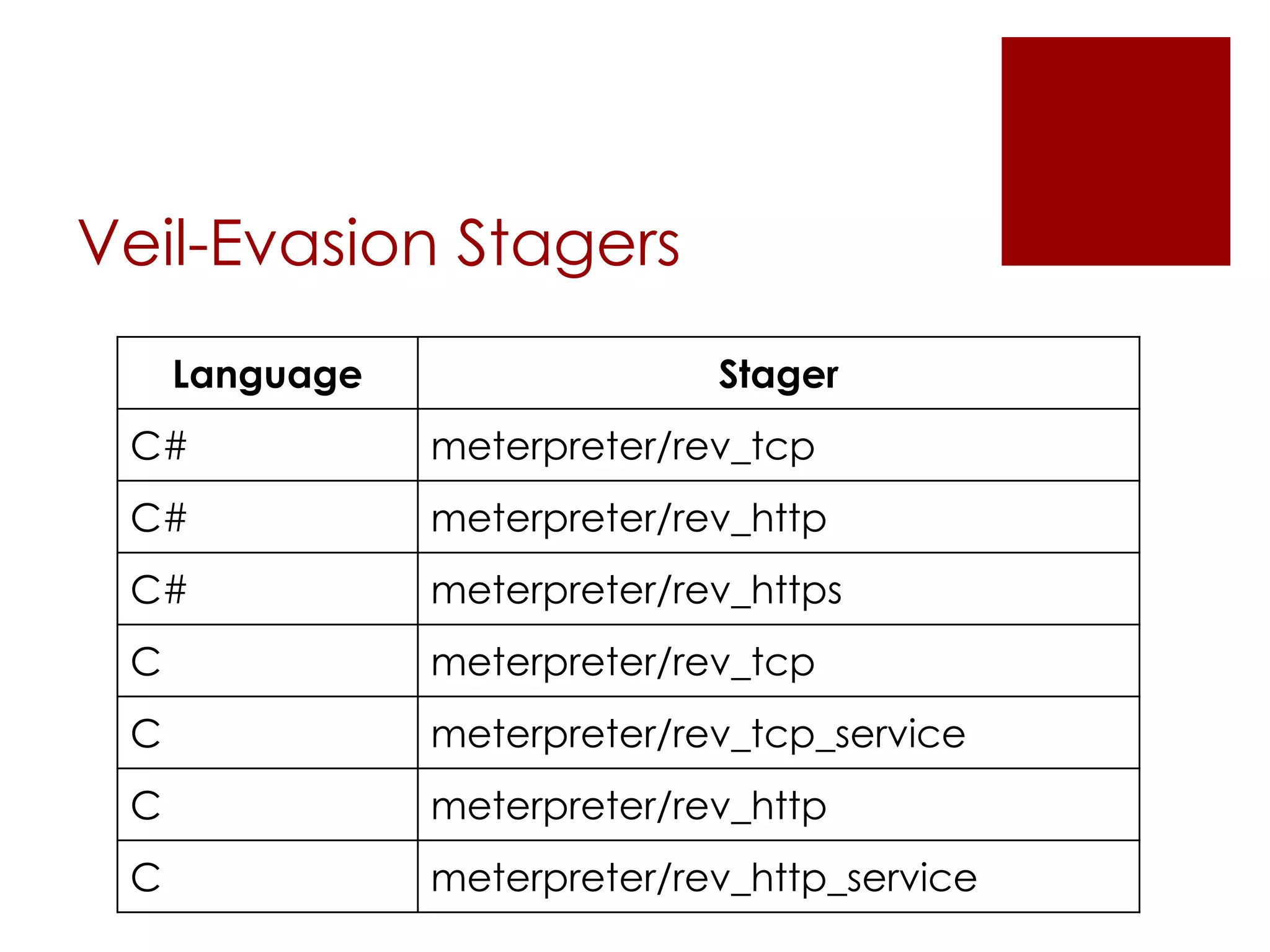
Veil-Evasion Stagers
Language Stager
C# meterpreter/rev_tcp
C# meterpreter/rev_http
C# meterpreter/rev_https
C meterpreter/rev_tcp
C meterpreter/rev_tcp_service
C meterpreter/rev_http
C meterpreter/rev_http_service
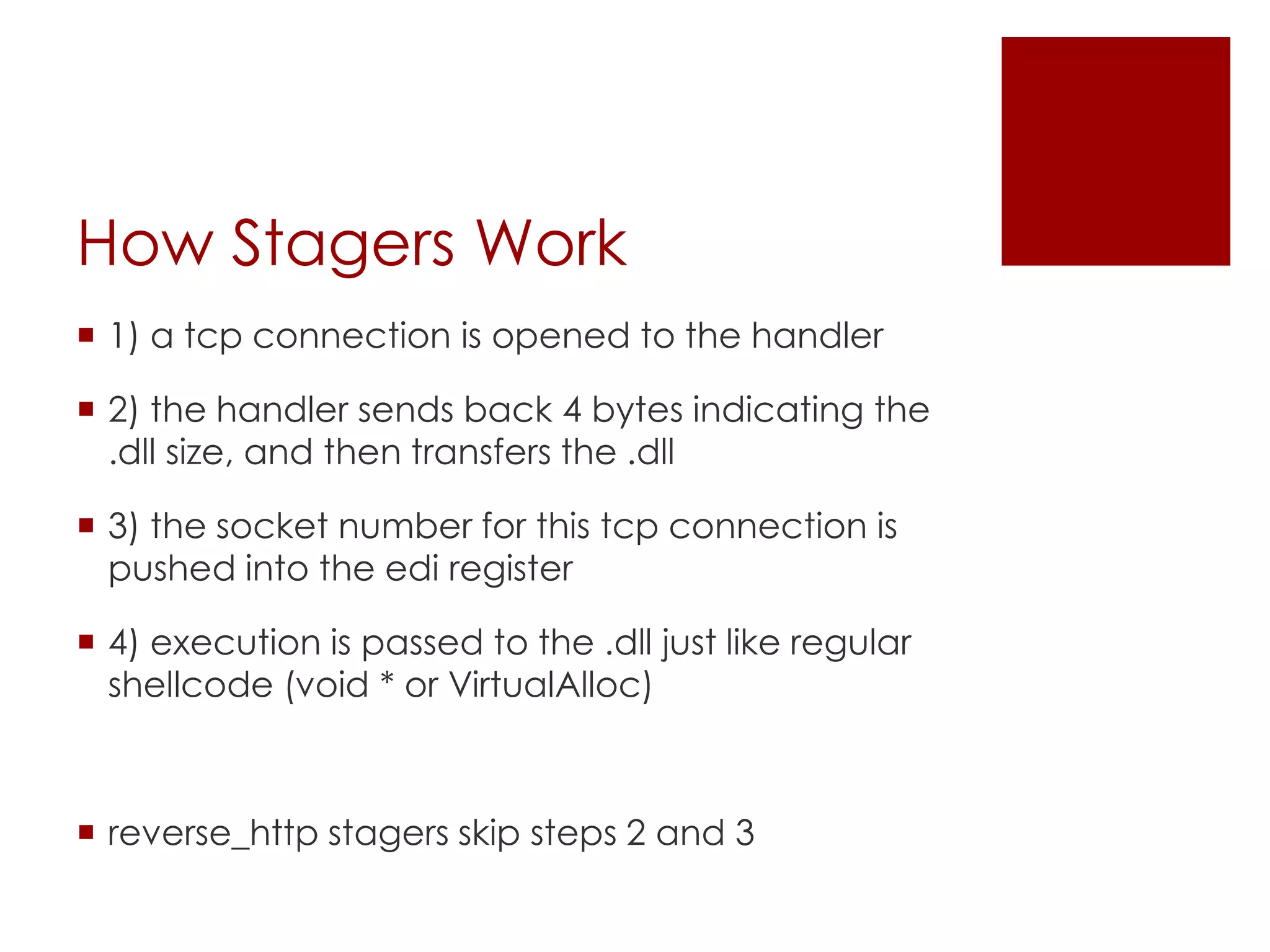
How Stagers Work
 1) a tcp connection is opened to the handler
 2) the handler sends back 4 bytes indicating the
.dll size, and then transfers the .dll
 3) the socket number for this tcp connection is
pushed into the edi register
 4) execution is passed to the .dll just like regular
shellcode (void * or VirtualAlloc)
 reverse_http stagers skip steps 2 and 3
Veil-Evasion Demo
Payload Delivery
Veil-Catapult
Veil-Catapult
Veil-Catapult
 After payload generation, our focus shifted to
delivery
 Features nice integration with Veil-Evasion for on-
the-fly payload generation
 Cleanup scripts generated for payload killing
and deletion
 Command line flags for every option
 https://www.veil-framework.com/catapult/
.EXE Delivery
 Users can invoke Veil-Evasion to generate a
payload, or specify an existing .exe
 Payloads are delivered in one of two ways:
 upload/execute using Impacket and pth-toolkit
 host/execute UNC path to the attacker’s box
 UNC invocation gets otherwise detectable .EXEs
right by some AVs (lol @MSE)
Standalone Payloads
 Powershell: shellcode injector, bye bye disk writes
 http://www.exploit-
monday.com/2011/10/exploiting-powershells-
features-not.html
 Barebones python: uploads a minimal python
installation to invoke shellcode (see: next slide)
 Sethc backdoor: issues a registry command to set
up the sticky-keys RDP backdoor
Barebones Python
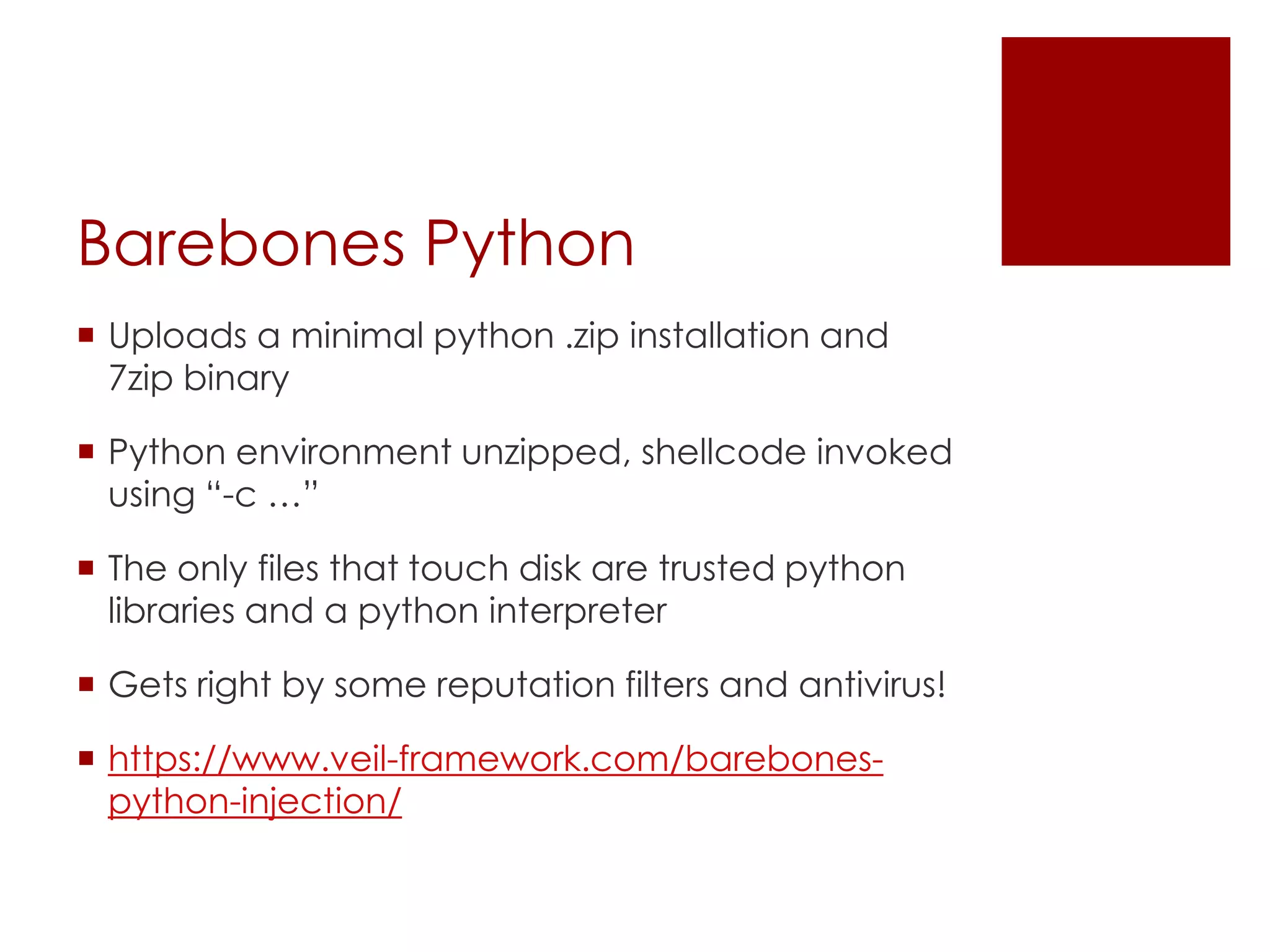
 Uploads a minimal python .zip installation and
7zip binary
 Python environment unzipped, shellcode invoked
using “-c …”
 The only files that touch disk are trusted python
libraries and a python interpreter
 Gets right by some reputation filters and antivirus!
 https://www.veil-framework.com/barebones-
python-injection/
Veil-Catapult Demo
Situational Awareness
Veil-PowerView
Situational Awareness; redux
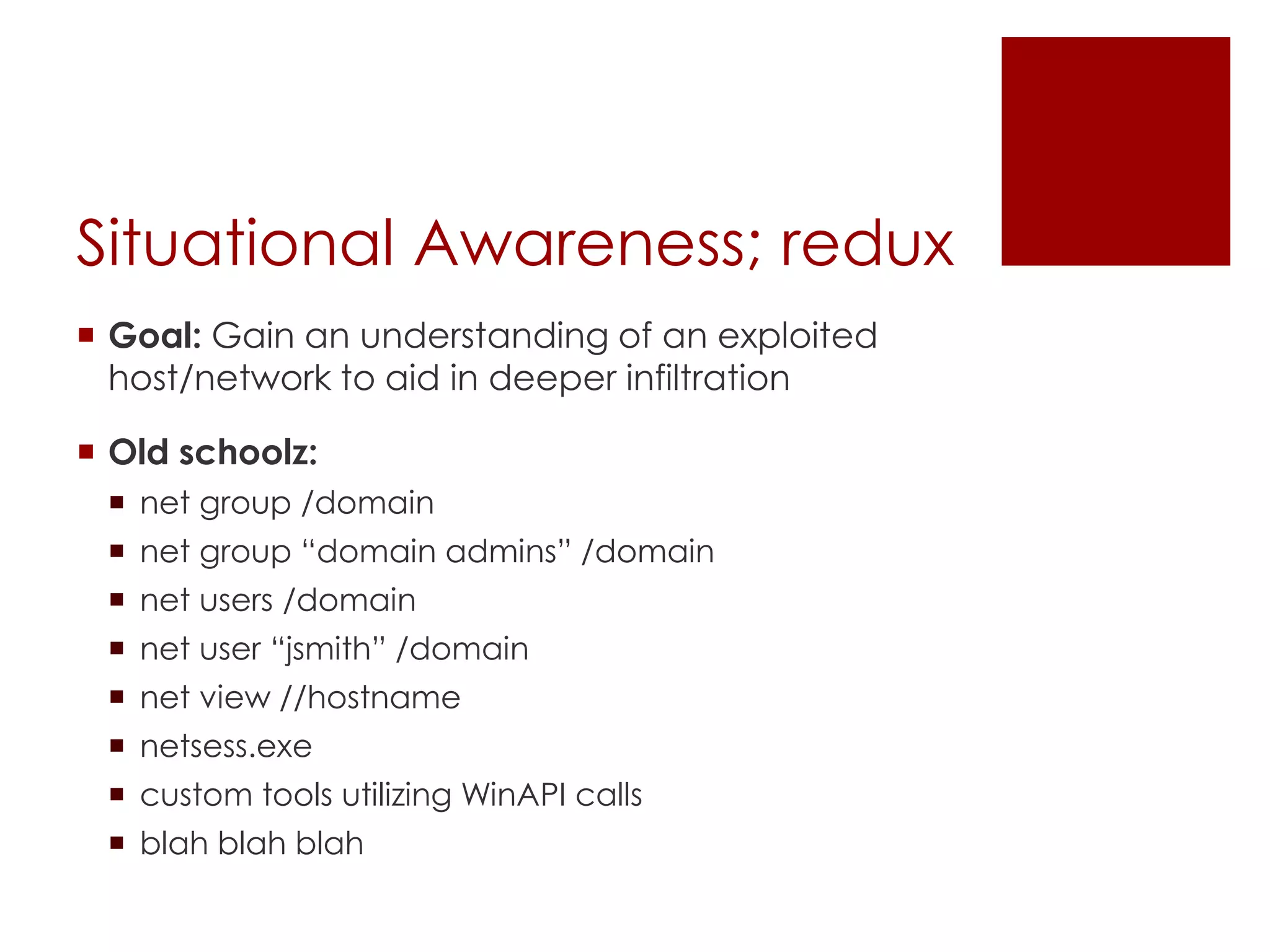
 Goal: Gain an understanding of an exploited
host/network to aid in deeper infiltration
 Old schoolz:
 net group /domain
 net group “domain admins” /domain
 net users /domain
 net user “jsmith” /domain
 net view //hostname
 netsess.exe
 custom tools utilizing WinAPI calls
 blah blah blah
Veil-PowerView
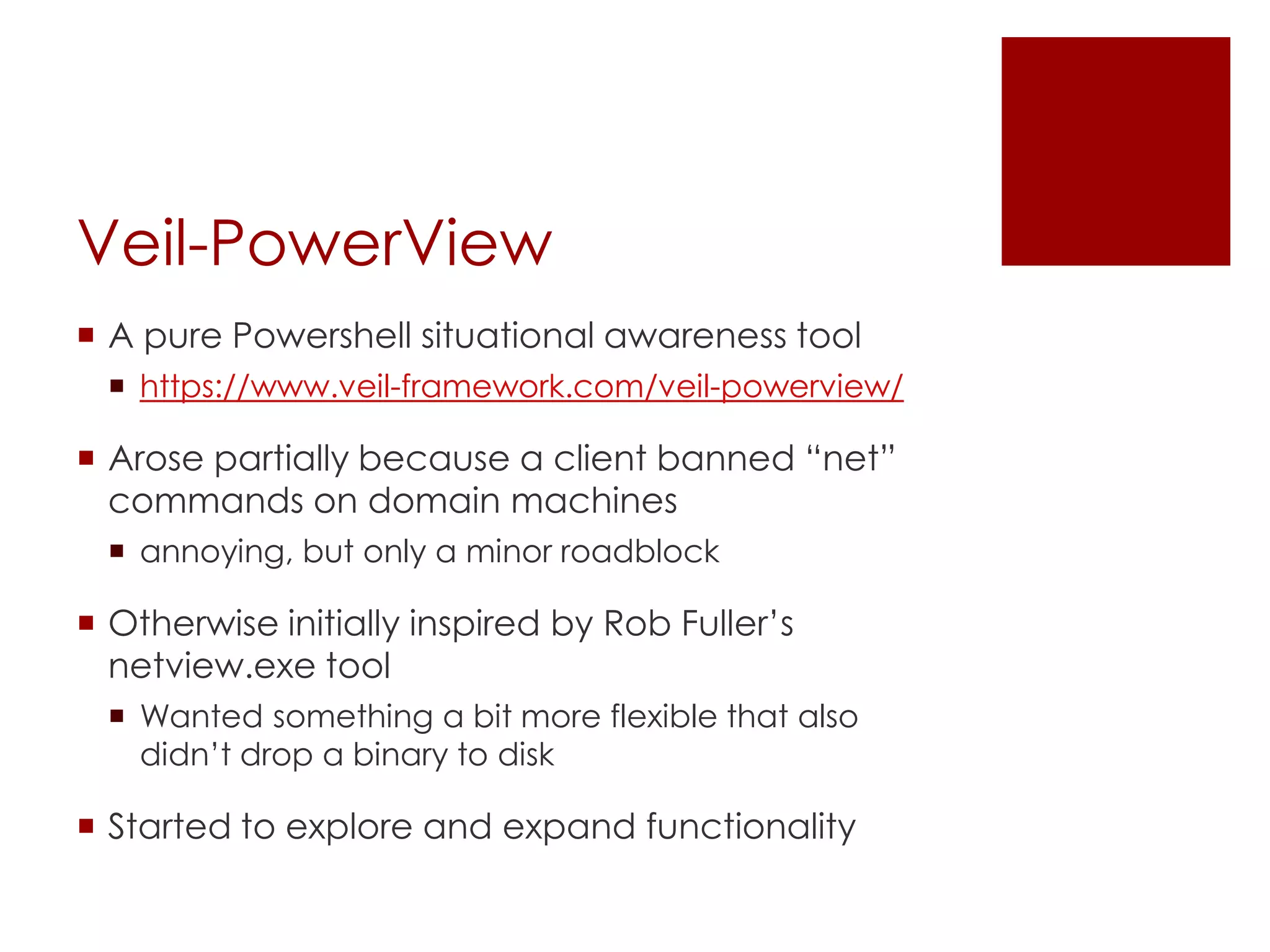
 A pure Powershell situational awareness tool
 https://www.veil-framework.com/veil-powerview/
 Arose partially because a client banned “net”
commands on domain machines
 annoying, but only a minor roadblock
 Otherwise initially inspired by Rob Fuller’s
netview.exe tool
 Wanted something a bit more flexible that also
didn’t drop a binary to disk
 Started to explore and expand functionality
Get-Net*
 Full-featured replacements for almost all “net *”
commands, utilizing Powershell AD hooks and
various API calls
 Get-NetUsers, Get-NetGroup, Get-NetServers,
Get-NetSessions, Get-NetLoggedon, etc.
 See README.md for complete list, and function
descriptions for usage options
Meta-Functions
 Invoke-Netview: full-featured netview.exe
replacement, plus more:
 hostlists, jitter/delay, check share access, etc.
 Invoke-ShareFinder: finds open shares on the
network and checks if you have read access
 Invoke-FindLocalAdminAccess: port of
local_admin_search_enum.rb Metaspoit module
 finds machines the current user has admin access to
 Invoke-FindVulnSystems: queries AD for
machines likely vulnerable to MS08-067
User Hunting
 Goal: find which domain machines specific users
are logged into
 Invoke-UserHunter: finds where target users or
group members are logged into on the
network, optionally checking if you have admin
access on targets with found users!
 Utilizes Get-NetSessions and Get-NetLoggedon
 Invoke-StealthUserHunter: extracts
user.HomeDirectories from AD, and runs
Get-NetSessions on file servers to hunt for targets
 Significantly less traffic than Invoke-UserHunter
Veil-PowerView Demo
Get the Veil-Framework
 Github: https://github.com/Veil-Framework/
 Read more: https://www.veil-framework.com
 Now in Kali: apt-get install veil
Questions?
 harmj0y@veil-framework.com
 @harmj0y
 chris@veil-framework.com
 @ChrisTruncer
 #veil on freenode
 forums at https://veil-framework.com/forums/

The Veil-Framework

  • 1.
  • 2.
    Who Are We? Will Schroeder (@harmj0y)  Former national research lab keyboard monkey  Chris Truncer (@ChrisTruncer)  Florida State Graduate – Go Noles!  Veris group pentesters by day, offensive security researchers by night  And we’re hiring!
  • 3.
    Overview  The InitialProblem  Public Reaction and Ethical Considerations  The Veil-Framework  Evading AV: Veil-Evasion  Payload Delivery: Veil-Catapult  Situation Awareness: Veil- PowerView  Demos Throughout
  • 4.
    The Initial Problem Antivirus doesn’t catch malware but (sometimes) catches pentesters
  • 5.
    Our Initial Solution A way to get around antivirus as easily as professional malware  Don’t want to roll our own backdoor each time  Find a way to execute existing shellcode in an AV-evading way
  • 6.
    The Veil-Framework  Atoolset aiming to bridge the gap between pentesting and red teaming capabilities  We started with Veil-Evasion, and began to branch out to payload delivery and Powershell exploitation  Nothing revolutionary here, but want to bring together existing techniques and incremental research try to push things forward
  • 7.
    Ethical Considerations  Thedisclosure debate is not new…  Pentesters are 5+ years behind the professional malware community  This is already a problem the bad guys have solved
  • 8.
    HD Moore’s Take “The strongest case for information disclosure is when the benefit of releasing the information outweighs the possible risks. In this case, like many others, the bad guys already won.”  https://community.rapid7.com/community/meta sploit/blog/2009/02/23/the-best-defense-is- information
  • 9.
    Public Reaction  “surelythis will just result in 21 new signatures for all major AVs and then we're back to square one?”  “Isn't our entire field meant to be working towards increasing security, rather than handing out fully functioning weapons?”  “The other point here is that anything that helps to expose how in-effective AV really is at stopping even a minimally sophisticated attacker is a good thing.”  http://www.reddit.com/r/netsec/comments/1fc2xp/veil_a _metasploit_payload_generator_for_bypassing/
  • 10.
  • 11.
  • 12.
  • 13.
    Veil-Evasion’s Approach  Aggregationof various shellcode injection techniques across multiple languages  These have been known and documented in other tools  Focused on automation, usability, and developing a true framework  Some shellcodeless Meterpreter stagers and “auxiliary” modules as well
  • 14.
    Veil-Evasion Features  Canuse Metasploit-generated or custom shellcode  MSF payloads/options dynamically loaded  In the process of porting msfvenom  Third party tools can be easily integrated  Hyperion, PEScrambler, BackDoor Factory, etc.  Command line switches to allow scriptability
  • 15.
  • 16.
    Module Development  Implementyour own obfuscation methods!  Lots of reusable functionality  Shellcode generation is abstracted and can be invoked as needed  https://www.veil-framework.com/tutorial-veil- payload-development/
  • 17.
    Shellcode Injection  Voidpointer casting  no guarantee the memory region is executable  VirtualAlloc  allocate memory as RWX, copy code in and create a thread  HeapAlloc  create a heap object and manually allocate memory
  • 18.
    Pyinstaller and DEP Pyinstaller produced .exe’s are DEP enabled by default  this ruins some shellcode injection methods  Luckily Pyinstaller is open source  we can recompile to turn off DEP opt-in  https://www.veil-evasion.com/dep-pyinstaller/
  • 19.
    Pwnstaller  A generatorfor obfuscated Pyinstaller loaders  BSides Boston „14 – Pwnstaller 1.0  Dynamically generates and compiles a new Pyinstaller loader on the fly  http://www.harmj0y.net/blog/python/pwnstaller- 1-0/
  • 20.
  • 21.
    VDay  Since 9/15/2013,we’ve release at least one new payload on the 15th of every month  32 currently published payloads  20+ additional payloads have been developed so far  we’re going to be releasing for a while :)
  • 22.
    Native Stagers  Stage1 Meterpreter loaders don’t have to be implemented in shellcode  Meterpreter stagers can be written in higher-level languages  https://github.com/rsmudge/metasploit-loader
  • 23.
    Veil-Evasion Stagers  Thefollowing are the stagers currently available in the framework (as of 5/15/14): Language Stager Python meterpreter/rev_tcp Python meterpreter/rev_http Python meterpreter/rev_http_contained Python meterpreter/rev_https Python meterpreter/rev_https_contained
  • 24.
    Veil-Evasion Stagers Language Stager C#meterpreter/rev_tcp C# meterpreter/rev_http C# meterpreter/rev_https C meterpreter/rev_tcp C meterpreter/rev_tcp_service C meterpreter/rev_http C meterpreter/rev_http_service
  • 25.
    How Stagers Work 1) a tcp connection is opened to the handler  2) the handler sends back 4 bytes indicating the .dll size, and then transfers the .dll  3) the socket number for this tcp connection is pushed into the edi register  4) execution is passed to the .dll just like regular shellcode (void * or VirtualAlloc)  reverse_http stagers skip steps 2 and 3
  • 26.
  • 27.
  • 28.
  • 29.
    Veil-Catapult  After payloadgeneration, our focus shifted to delivery  Features nice integration with Veil-Evasion for on- the-fly payload generation  Cleanup scripts generated for payload killing and deletion  Command line flags for every option  https://www.veil-framework.com/catapult/
  • 30.
    .EXE Delivery  Userscan invoke Veil-Evasion to generate a payload, or specify an existing .exe  Payloads are delivered in one of two ways:  upload/execute using Impacket and pth-toolkit  host/execute UNC path to the attacker’s box  UNC invocation gets otherwise detectable .EXEs right by some AVs (lol @MSE)
  • 31.
    Standalone Payloads  Powershell:shellcode injector, bye bye disk writes  http://www.exploit- monday.com/2011/10/exploiting-powershells- features-not.html  Barebones python: uploads a minimal python installation to invoke shellcode (see: next slide)  Sethc backdoor: issues a registry command to set up the sticky-keys RDP backdoor
  • 32.
    Barebones Python  Uploadsa minimal python .zip installation and 7zip binary  Python environment unzipped, shellcode invoked using “-c …”  The only files that touch disk are trusted python libraries and a python interpreter  Gets right by some reputation filters and antivirus!  https://www.veil-framework.com/barebones- python-injection/
  • 33.
  • 34.
  • 35.
    Situational Awareness; redux Goal: Gain an understanding of an exploited host/network to aid in deeper infiltration  Old schoolz:  net group /domain  net group “domain admins” /domain  net users /domain  net user “jsmith” /domain  net view //hostname  netsess.exe  custom tools utilizing WinAPI calls  blah blah blah
  • 36.
    Veil-PowerView  A purePowershell situational awareness tool  https://www.veil-framework.com/veil-powerview/  Arose partially because a client banned “net” commands on domain machines  annoying, but only a minor roadblock  Otherwise initially inspired by Rob Fuller’s netview.exe tool  Wanted something a bit more flexible that also didn’t drop a binary to disk  Started to explore and expand functionality
  • 37.
    Get-Net*  Full-featured replacementsfor almost all “net *” commands, utilizing Powershell AD hooks and various API calls  Get-NetUsers, Get-NetGroup, Get-NetServers, Get-NetSessions, Get-NetLoggedon, etc.  See README.md for complete list, and function descriptions for usage options
  • 38.
    Meta-Functions  Invoke-Netview: full-featurednetview.exe replacement, plus more:  hostlists, jitter/delay, check share access, etc.  Invoke-ShareFinder: finds open shares on the network and checks if you have read access  Invoke-FindLocalAdminAccess: port of local_admin_search_enum.rb Metaspoit module  finds machines the current user has admin access to  Invoke-FindVulnSystems: queries AD for machines likely vulnerable to MS08-067
  • 39.
    User Hunting  Goal:find which domain machines specific users are logged into  Invoke-UserHunter: finds where target users or group members are logged into on the network, optionally checking if you have admin access on targets with found users!  Utilizes Get-NetSessions and Get-NetLoggedon  Invoke-StealthUserHunter: extracts user.HomeDirectories from AD, and runs Get-NetSessions on file servers to hunt for targets  Significantly less traffic than Invoke-UserHunter
  • 40.
  • 41.
    Get the Veil-Framework Github: https://github.com/Veil-Framework/  Read more: https://www.veil-framework.com  Now in Kali: apt-get install veil
  • 42.
    Questions?  harmj0y@veil-framework.com  @harmj0y chris@veil-framework.com  @ChrisTruncer  #veil on freenode  forums at https://veil-framework.com/forums/