Staged Patching Approach
     Session 12125

          Vasu Balla

      The Pythian Group
About Me
Oracle Apps DBA with 10+ Years of
Experience
Oracle Apps ATG Customer Advisory Board
Member
Oracle EBS Cluster Technical Lead at Pythian

                 @vasuballa
About Pythian
•     Recognized Leader:
    Global industry-leader in remote database administration services and consulting
      for Oracle, Oracle Applications, MySQL and Microsoft SQL Server
    Work with over 250 multinational companies such as Forbes.com, Fox Sports,
     Nordion and Western Union to help manage their complex IT deployments
•     Expertise:
    Pythian’s data experts are the elite in their field. We have the highest concentration
      of Oracle ACEs on staff - 10 including 3 ACE Directors—and 2 Microsoft MVPs.
    Pythian holds 7 Specializations under Oracle Platinum Partner program, including
      Oracle Exadata, Oracle GoldenGate & Oracle RAC
•    Global Reach & Scalability:
    Around the clock global remote support for DBA and consulting, systems
      administration, special projects or emergency response
Agenda

• What is Staged Patching For?
• How Staged Patching works?
• Best Practices
• Future of Staged Patching in R12.2
What is Staged Patching for?
Reasons
• Cut downtime for patching
• Exhausted all other options like
  distributed AD, merging patches etc

• Best fit for large patches like
  Maintenance Packs
Adpatch stages
• Copy Portion
 - Copies files from patch to appltop
 - Relinks Executables
 - Compiles JSPs
 - Generates jar files
Adpatch stages
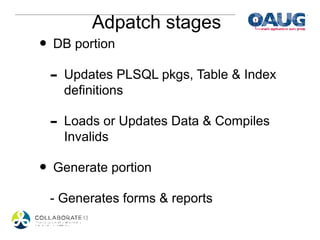
• DB portion
 - Updates PLSQL pkgs, Table & Index
   definitions

 - Loads or Updates Data & Compiles
   Invalids

• Generate portion
 - Generates forms & reports
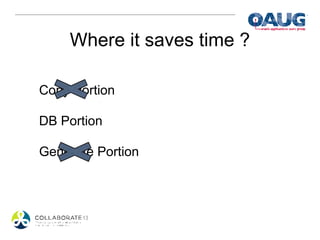
Where it saves time ?

Copy Portion

DB Portion

Generate Portion
How Staged Patching works?
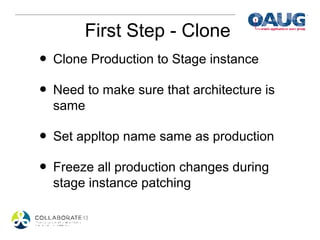
First Step - Clone
• Clone Production to Stage instance
• Need to make sure that architecture is
  same

• Set appltop name same as production
• Freeze all production changes during
  stage instance patching
Apply Patches to Stage
• A typical EBS patch updates both
  middle tier files and DB objects

• Apply All the required patches on Stage
• Make sure to document all fixes for any
  failed patch jobs
Prepare for production

• Merge all AD/FND patches into one
  bundle and rest of the patches into
  another bundle

• Document any required manual post
  patching steps
Production Cutover
• Shutdown PROD Apps Services
• Point STAGE instance appltop
  tnsnames to PROD

• Apply patch bundle with nocopyportion
  and nogenerateportion options from
  STAGE instance
Production Cutover Contd…
• When adpatch is running, Start copy of
  STAGE apps_st and tech_st to PROD

• You should not copy INST_TOP which
  contains the report logs and other
  configuration files

• Use utilities like rsync for the copy
Finish Cutover
• After patch completes from STAGE env,
  remove the PROD tnsentry

• Complete any documented manual
  steps

• Start Production Services and release
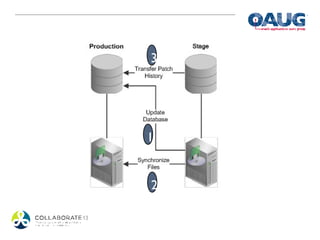
Migrate Patch History
• Export patch history from stage env


• Copy generated adpsv*txt and
  javaupdates*txt to $APPL_TOP/ admin/
  $TWO_TASK on PROD

• Run adpatch in PROD and abort when it
  prompts for driver file, to upload history
3


1


2
Best practices
It’s Better
• Keep SID of STAGE env different from
  PROD

• Keep apps Passwords different
• Run Maintain current view snapshot in
  PROD before STAGE clone

• Leverage SAN/NAS features for Copy
R12 upgrades
• Not supported to use 12.1.3 staged
  appltop for upgrade from 11i

• Need to first upgrade to 12.1.1 using
  staged appltop and then upgrade to
  12.1.3 using another staged appltop

• Staged appltop is best suited for point
  release upgrades 11.5.9 to 11.5.10.2
  and 12.0.6 to 12.1.3
Future of Staged Patching

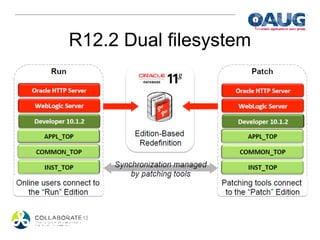
• In R12.2 Staged patching is already
  built in

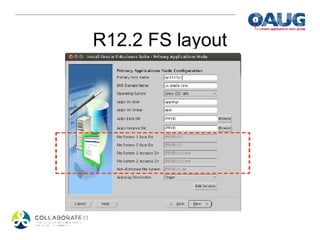
• We have 2 apps file systems
• Two copies of DB objects using Edition
  Based Redefinition

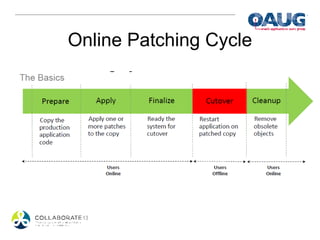
• Its called Online Patching
R12.2 Dual filesystem
R12.2 FS layout
Online Patching Cycle
Questions?
Comments?
THANK YOU

        Vasu Balla

     balla@pythian.com

@vasuballa #C13TCH #C13DEN

   www.pythian.com/blog

Staged Patching Approach in Oracle E-Business Suite

  • 1.
    Staged Patching Approach Session 12125 Vasu Balla The Pythian Group
  • 2.
    About Me Oracle AppsDBA with 10+ Years of Experience Oracle Apps ATG Customer Advisory Board Member Oracle EBS Cluster Technical Lead at Pythian @vasuballa
  • 3.
    About Pythian • Recognized Leader: Global industry-leader in remote database administration services and consulting for Oracle, Oracle Applications, MySQL and Microsoft SQL Server Work with over 250 multinational companies such as Forbes.com, Fox Sports, Nordion and Western Union to help manage their complex IT deployments • Expertise: Pythian’s data experts are the elite in their field. We have the highest concentration of Oracle ACEs on staff - 10 including 3 ACE Directors—and 2 Microsoft MVPs. Pythian holds 7 Specializations under Oracle Platinum Partner program, including Oracle Exadata, Oracle GoldenGate & Oracle RAC • Global Reach & Scalability: Around the clock global remote support for DBA and consulting, systems administration, special projects or emergency response
  • 4.
    Agenda • What isStaged Patching For? • How Staged Patching works? • Best Practices • Future of Staged Patching in R12.2
  • 5.
    What is StagedPatching for?
  • 6.
    Reasons • Cut downtimefor patching • Exhausted all other options like distributed AD, merging patches etc • Best fit for large patches like Maintenance Packs
  • 7.
    Adpatch stages • CopyPortion - Copies files from patch to appltop - Relinks Executables - Compiles JSPs - Generates jar files
  • 8.
    Adpatch stages • DBportion - Updates PLSQL pkgs, Table & Index definitions - Loads or Updates Data & Compiles Invalids • Generate portion - Generates forms & reports
  • 9.
    Where it savestime ? Copy Portion DB Portion Generate Portion
  • 10.
  • 11.
    First Step -Clone • Clone Production to Stage instance • Need to make sure that architecture is same • Set appltop name same as production • Freeze all production changes during stage instance patching
  • 12.
    Apply Patches toStage • A typical EBS patch updates both middle tier files and DB objects • Apply All the required patches on Stage • Make sure to document all fixes for any failed patch jobs
  • 13.
    Prepare for production •Merge all AD/FND patches into one bundle and rest of the patches into another bundle • Document any required manual post patching steps
  • 14.
    Production Cutover • ShutdownPROD Apps Services • Point STAGE instance appltop tnsnames to PROD • Apply patch bundle with nocopyportion and nogenerateportion options from STAGE instance
  • 15.
    Production Cutover Contd… •When adpatch is running, Start copy of STAGE apps_st and tech_st to PROD • You should not copy INST_TOP which contains the report logs and other configuration files • Use utilities like rsync for the copy
  • 16.
    Finish Cutover • Afterpatch completes from STAGE env, remove the PROD tnsentry • Complete any documented manual steps • Start Production Services and release
  • 17.
    Migrate Patch History •Export patch history from stage env • Copy generated adpsv*txt and javaupdates*txt to $APPL_TOP/ admin/ $TWO_TASK on PROD • Run adpatch in PROD and abort when it prompts for driver file, to upload history
  • 18.
  • 19.
  • 20.
    It’s Better • KeepSID of STAGE env different from PROD • Keep apps Passwords different • Run Maintain current view snapshot in PROD before STAGE clone • Leverage SAN/NAS features for Copy
  • 21.
    R12 upgrades • Notsupported to use 12.1.3 staged appltop for upgrade from 11i • Need to first upgrade to 12.1.1 using staged appltop and then upgrade to 12.1.3 using another staged appltop • Staged appltop is best suited for point release upgrades 11.5.9 to 11.5.10.2 and 12.0.6 to 12.1.3
  • 22.
  • 23.
    Future of StagedPatching • In R12.2 Staged patching is already built in • We have 2 apps file systems • Two copies of DB objects using Edition Based Redefinition • Its called Online Patching
  • 24.
  • 25.
  • 26.
  • 27.
  • 28.
    THANK YOU Vasu Balla balla@pythian.com @vasuballa #C13TCH #C13DEN www.pythian.com/blog