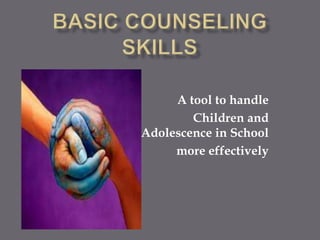


A tool to handle
        Children and
Adolescence in School
     more effectively
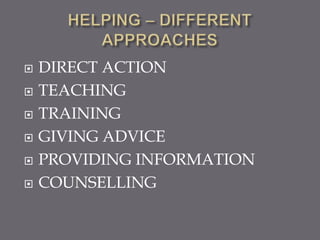
   DIRECT ACTION
   TEACHING
   TRAINING
   GIVING ADVICE
   PROVIDING INFORMATION
   COUNSELLING
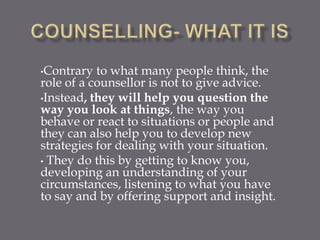
•Contrary  to what many people think, the
role of a counsellor is not to give advice.
•Instead, they will help you question the
way you look at things, the way you
behave or react to situations or people and
they can also help you to develop new
strategies for dealing with your situation.
• They do this by getting to know you,
developing an understanding of your
circumstances, listening to what you have
to say and by offering support and insight.
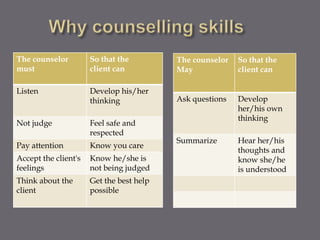
The counselor         So that the         The counselor   So that the
must                  client can          May             client can

Listen                Develop his/her
                      thinking            Ask questions   Develop
                                                          her/his own
                                                          thinking
Not judge             Feel safe and
                      respected
                                          Summarize       Hear her/his
Pay attention         Know you care
                                                          thoughts and
Accept the client's   Know he/she is                      know she/he
feelings              not being judged                    is understood
Think about the       Get the best help
client                possible
   It can be really helpful to talk to someone you
    know and trust
   you may feel more comfortable confiding in
    someone who’s removed from your personal
    situation and is therefore more objective.
   Having a set time and space to talk may help
    you to work through the issues concerning
    you.
•Provides  emotional
 security and comfort
•Promotes insight

•Generates self awareness

•Facilitates confidence
When
 being withdrawn
 lack of appetite
 Taking too much food
 Sleeping very little or more than 9 hours per night,
 loss of interest in things they once enjoyed,
 neglecting personal hygiene
 crying for no reason
 Over sensitive with otherwise negligible issues
 seeming sad for longer than two weeks
 Academic deterioration
 Disobeying significant adults
 Extreme stubbornness and difficult to manage by any means
   Violent behavior
    harming or threatening to harm themselves or
    others, including animals
   Using slangs
   Aggressive attitude
   Suddenly gaining or losing a lot of
    weight, which could indicate a life-threatening
    eating disorder
   Tendencies to violate institutional disciplines
   Extreme, rapid changes in moods or personality, or
    drastic changes that last more than six weeks
   Running away from home
   Illegal activities
   Behavior problems at school
   Using tobacco, drugs, or alcohol
   A sudden change in friends
   Risky sexual behavior or sexual promiscuity
   Other risky or dangerous behavior
   Noticeable changes in school performance or
    attendance
Counselling is definitely worth considering
  when:
 you are feeling overwhelmed or depressed
 you need someone to listen to you and
  help you work out what’s most important
 an issue or situation is seriously affecting
  your day-to-day life
 you can’t make important decisions and
  are not sure what to do next.
   Building rapport
   Ensuring trust issues and confidentiality
   Attending
   Listening
   Responding
   Showing genuineness
   Providing Empathy
   Being transparent to self (to be aware of own
    emotional issues)
   Self aware
   Respect
   Trustworthiness
   Competence
   Suspend critical judgment
   Genuineness
   Being concern/being there
   Empathy
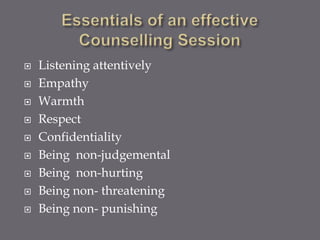
   Listening attentively
   Empathy
   Warmth
   Respect
   Confidentiality
   Being non-judgemental
   Being non-hurting
   Being non- threatening
   Being non- punishing
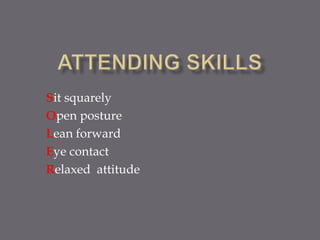
Sit squarely
Open posture
Lean forward
Eye contact
Relaxed attitude
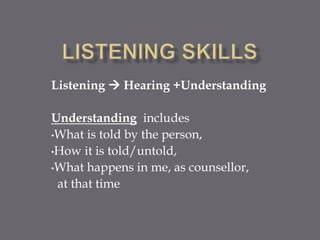
Listening  Hearing +Understanding

Understanding includes
•What is told by the person,

•How it is told/untold,

•What happens in me, as counsellor,

 at that time
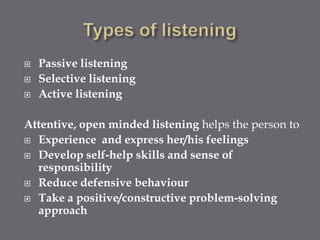
   Passive listening
   Selective listening
   Active listening

Attentive, open minded listening helps the person to
 Experience and express her/his feelings

 Develop self-help skills and sense of
  responsibility
 Reduce defensive behaviour

 Take a positive/constructive problem-solving
  approach
•Evaluative

•Interpretative

•Supportive

•Probing

•Understanding
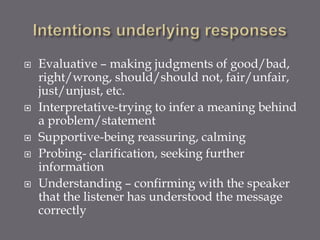
   Evaluative – making judgments of good/bad,
    right/wrong, should/should not, fair/unfair,
    just/unjust, etc.
   Interpretative-trying to infer a meaning behind
    a problem/statement
   Supportive-being reassuring, calming
   Probing- clarification, seeking further
    information
   Understanding – confirming with the speaker
    that the listener has understood the message
    correctly
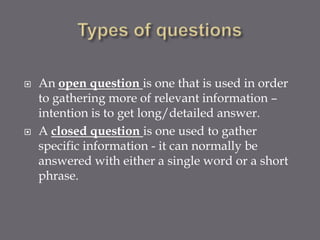
   An open question is one that is used in order
    to gathering more of relevant information –
    intention is to get long/detailed answer.
   A closed question is one used to gather
    specific information - it can normally be
    answered with either a single word or a short
    phrase.
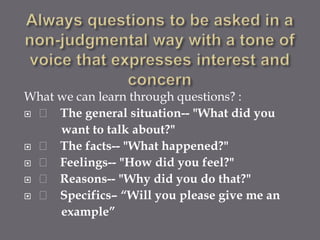
What we can learn through questions? :
 􀂙 The general situation-- "What did you
     want to talk about?"
 􀂙 The facts-- "What happened?"
 􀂙 Feelings-- "How did you feel?"
 􀂙 Reasons-- "Why did you do that?"
 􀂙 Specifics– “Will you please give me an
     example”
•REPHRASING     (restating what is told, without
adding or subtracting its meaning. Sometimes
Paraphrasing is used to clarify / Summarizing is
focusing on the main points of the conversation )

•REFLECTING    ( To convey that the feelings or
emotions are understood)

•REFRAMING     ( to facilitate the person to think
from other perspectives, develops insight)
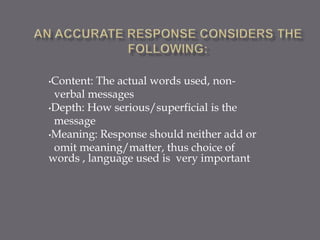
•Content: The actual words used, non-
 verbal messages
•Depth: How serious/superficial is the
 message
•Meaning: Response should neither add or
 omit meaning/matter, thus choice of
words , language used is very important
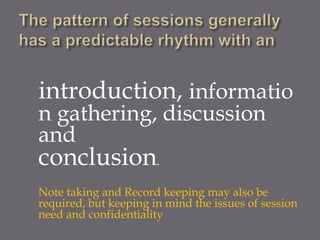
introduction, informatio
n gathering, discussion
and
conclusion.
Note taking and Record keeping may also be
required, but keeping in mind the issues of session
need and confidentiality
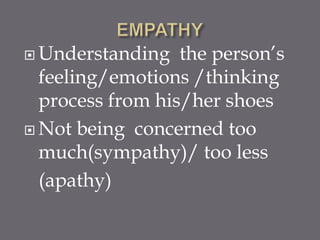
 Understanding   the person’s
  feeling/emotions /thinking
  process from his/her shoes
 Not being concerned too
  much(sympathy)/ too less
  (apathy)
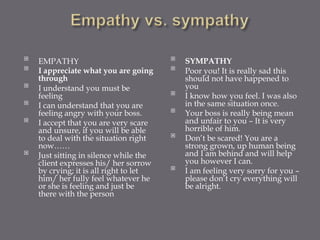
                                       
    EMPATHY                                 SYMPATHY
                                       
    I appreciate what you are going         Poor you! It is really sad this
    through                                 should not have happened to

    I understand you must be                you
                                        
    feeling                                 I know how you feel. I was also

    I can understand that you are           in the same situation once.
                                        
    feeling angry with your boss.           Your boss is really being mean

    I accept that you are very scare        and unfair to you – It is very
    and unsure, if you will be able         horrible of him.
                                        
    to deal with the situation right        Don’t be scared! You are a
    now……                                   strong grown, up human being

    Just sitting in silence while the       and I am behind and will help
    client expresses his/ her sorrow        you however I can.
                                        
    by crying; it is all right to let       I am feeling very sorry for you –
    him/ her fully feel whatever he         please don’t cry everything will
    or she is feeling and just be           be alright.
    there with the person
Be aware of Body languages:
facial expressions, angle of our
body, proximity of ourselves to
another, placement of arms and
legs, raising and lowering of
eyebrows, tone of voice , etc .
   Counselors can take comfort in knowing that
    they have cared for a person during a very
    significant time in her / his life,
    and can remind themselves of this quotation
    by Thomas Carruthers:


    A teacher is one who makes himself /
    herself progressively unnecessary.
   Which facilitates an individual to explore
    his/her own world , and
   To find a best suitable way out for his/her
    difficulties , thus
   To become better balanced individual in terms
    of his/her overall wellbeing
Counseling is an important part of handling
  problems . Individual or group sessions, in
  school, can help the children and adolescence to:
 Understand why their behaviors are negative, and
  how to cope better
 Recognize and change negative thoughts that may
  cause or trigger their behaviors
 Find better ways to solve problems
 Learn better social skills


School counselor/ provision of appropriate
  counseling services in school play a very
  significant role in this context.
 Understand why their behaviors are
  negative, and how to cope better
 Recognize and change negative thoughts that
  may cause or trigger their behaviors
 Find better ways to solve problems

 Learn better social skills

School counselor/ provision of appropriate
  counseling services in school play a very
  significant role in this context.
   To observe and identify problem areas
    (emotional, behavioural, social, study related
    difficulties, academic deterioration, etc.)
    properly
   To provide initial support to them, initially, in
    school
   To refer for further intervention, in time, if
    required
Basic counselling skills

Basic counselling skills

  • 1.
    A tool tohandle Children and Adolescence in School more effectively
  • 2.
    DIRECT ACTION  TEACHING  TRAINING  GIVING ADVICE  PROVIDING INFORMATION  COUNSELLING
  • 3.
    •Contrary towhat many people think, the role of a counsellor is not to give advice. •Instead, they will help you question the way you look at things, the way you behave or react to situations or people and they can also help you to develop new strategies for dealing with your situation. • They do this by getting to know you, developing an understanding of your circumstances, listening to what you have to say and by offering support and insight.
  • 4.
    The counselor So that the The counselor So that the must client can May client can Listen Develop his/her thinking Ask questions Develop her/his own thinking Not judge Feel safe and respected Summarize Hear her/his Pay attention Know you care thoughts and Accept the client's Know he/she is know she/he feelings not being judged is understood Think about the Get the best help client possible
  • 5.
    It can be really helpful to talk to someone you know and trust  you may feel more comfortable confiding in someone who’s removed from your personal situation and is therefore more objective.  Having a set time and space to talk may help you to work through the issues concerning you.
  • 6.
    •Provides emotional security and comfort •Promotes insight •Generates self awareness •Facilitates confidence
  • 7.
    When  being withdrawn lack of appetite  Taking too much food  Sleeping very little or more than 9 hours per night,  loss of interest in things they once enjoyed,  neglecting personal hygiene  crying for no reason  Over sensitive with otherwise negligible issues  seeming sad for longer than two weeks  Academic deterioration  Disobeying significant adults  Extreme stubbornness and difficult to manage by any means
  • 8.
    Violent behavior  harming or threatening to harm themselves or others, including animals  Using slangs  Aggressive attitude  Suddenly gaining or losing a lot of weight, which could indicate a life-threatening eating disorder  Tendencies to violate institutional disciplines
  • 9.
    Extreme, rapid changes in moods or personality, or drastic changes that last more than six weeks  Running away from home  Illegal activities  Behavior problems at school  Using tobacco, drugs, or alcohol  A sudden change in friends  Risky sexual behavior or sexual promiscuity  Other risky or dangerous behavior  Noticeable changes in school performance or attendance
  • 10.
    Counselling is definitelyworth considering when:  you are feeling overwhelmed or depressed  you need someone to listen to you and help you work out what’s most important  an issue or situation is seriously affecting your day-to-day life  you can’t make important decisions and are not sure what to do next.
  • 11.
    Building rapport  Ensuring trust issues and confidentiality  Attending  Listening  Responding  Showing genuineness  Providing Empathy  Being transparent to self (to be aware of own emotional issues)
  • 12.
    Self aware  Respect  Trustworthiness  Competence  Suspend critical judgment  Genuineness  Being concern/being there  Empathy
  • 13.
    Listening attentively  Empathy  Warmth  Respect  Confidentiality  Being non-judgemental  Being non-hurting  Being non- threatening  Being non- punishing
  • 14.
    Sit squarely Open posture Leanforward Eye contact Relaxed attitude
  • 15.
    Listening  Hearing+Understanding Understanding includes •What is told by the person, •How it is told/untold, •What happens in me, as counsellor, at that time
  • 16.
    Passive listening  Selective listening  Active listening Attentive, open minded listening helps the person to  Experience and express her/his feelings  Develop self-help skills and sense of responsibility  Reduce defensive behaviour  Take a positive/constructive problem-solving approach
  • 17.
  • 18.
    Evaluative – making judgments of good/bad, right/wrong, should/should not, fair/unfair, just/unjust, etc.  Interpretative-trying to infer a meaning behind a problem/statement  Supportive-being reassuring, calming  Probing- clarification, seeking further information  Understanding – confirming with the speaker that the listener has understood the message correctly
  • 19.
    An open question is one that is used in order to gathering more of relevant information – intention is to get long/detailed answer.  A closed question is one used to gather specific information - it can normally be answered with either a single word or a short phrase.
  • 20.
    What we canlearn through questions? :  􀂙 The general situation-- "What did you want to talk about?"  􀂙 The facts-- "What happened?"  􀂙 Feelings-- "How did you feel?"  􀂙 Reasons-- "Why did you do that?"  􀂙 Specifics– “Will you please give me an example”
  • 21.
    •REPHRASING (restating what is told, without adding or subtracting its meaning. Sometimes Paraphrasing is used to clarify / Summarizing is focusing on the main points of the conversation ) •REFLECTING ( To convey that the feelings or emotions are understood) •REFRAMING ( to facilitate the person to think from other perspectives, develops insight)
  • 22.
    •Content: The actualwords used, non- verbal messages •Depth: How serious/superficial is the message •Meaning: Response should neither add or omit meaning/matter, thus choice of words , language used is very important
  • 23.
    introduction, informatio n gathering,discussion and conclusion. Note taking and Record keeping may also be required, but keeping in mind the issues of session need and confidentiality
  • 24.
     Understanding the person’s feeling/emotions /thinking process from his/her shoes  Not being concerned too much(sympathy)/ too less (apathy)
  • 25.
     EMPATHY SYMPATHY   I appreciate what you are going Poor you! It is really sad this through should not have happened to  I understand you must be you  feeling I know how you feel. I was also  I can understand that you are in the same situation once.  feeling angry with your boss. Your boss is really being mean  I accept that you are very scare and unfair to you – It is very and unsure, if you will be able horrible of him.  to deal with the situation right Don’t be scared! You are a now…… strong grown, up human being  Just sitting in silence while the and I am behind and will help client expresses his/ her sorrow you however I can.  by crying; it is all right to let I am feeling very sorry for you – him/ her fully feel whatever he please don’t cry everything will or she is feeling and just be be alright. there with the person
  • 26.
    Be aware ofBody languages: facial expressions, angle of our body, proximity of ourselves to another, placement of arms and legs, raising and lowering of eyebrows, tone of voice , etc .
  • 27.
    Counselors can take comfort in knowing that they have cared for a person during a very significant time in her / his life,  and can remind themselves of this quotation by Thomas Carruthers: A teacher is one who makes himself / herself progressively unnecessary.
  • 30.
    Which facilitates an individual to explore his/her own world , and  To find a best suitable way out for his/her difficulties , thus  To become better balanced individual in terms of his/her overall wellbeing
  • 31.
    Counseling is animportant part of handling problems . Individual or group sessions, in school, can help the children and adolescence to:  Understand why their behaviors are negative, and how to cope better  Recognize and change negative thoughts that may cause or trigger their behaviors  Find better ways to solve problems  Learn better social skills School counselor/ provision of appropriate counseling services in school play a very significant role in this context.
  • 32.
     Understand whytheir behaviors are negative, and how to cope better  Recognize and change negative thoughts that may cause or trigger their behaviors  Find better ways to solve problems  Learn better social skills School counselor/ provision of appropriate counseling services in school play a very significant role in this context.
  • 33.
    To observe and identify problem areas (emotional, behavioural, social, study related difficulties, academic deterioration, etc.) properly  To provide initial support to them, initially, in school  To refer for further intervention, in time, if required