Teaching Students inTeaching Students in
DistressDistress
Faculty as a Helping ResourceFaculty as a Helping Resource
Kurt Lundberg, MEd, RCCKurt Lundberg, MEd, RCC
Joelle Turner, MA, RCCJoelle Turner, MA, RCC
Mental Health DefinedMental Health Defined
- Capacity to feel, think and act in ways
that enhance our ability to enjoy life
and deal with challenges
- Can range from a state of positive
well-being to a state of disabling
thoughts, feelings and behaviours
Mental Health DefinedMental Health Defined
Source: http://www.safety.uwa.edu.au/health-
wellbeing/health/psychological/common-mental-health-issues
Mental & Behavioural HealthMental & Behavioural Health
Problems are Learning ProblemsProblems are Learning Problems
- Can impair the quality and quantity ofCan impair the quality and quantity of
learninglearning
- Decrease students’ intellectual andDecrease students’ intellectual and
emotional flexibilityemotional flexibility
- Weaken creativityWeaken creativity
- Undermine interest in new knowledge,Undermine interest in new knowledge,
ideas and experiencesideas and experiences
A Strategic Primer on College Student Mental HealthA Strategic Primer on College Student Mental Health
Recognizing students in DistressRecognizing students in Distress
 Stress is a natural part of life and no stranger toStress is a natural part of life and no stranger to
university students. Many students successfullyuniversity students. Many students successfully
cope with the realities of college life, but forcope with the realities of college life, but for
some the stressors are overwhelming andsome the stressors are overwhelming and
unmanageable. Their emotional and behavioralunmanageable. Their emotional and behavioral
consequences are often played out on campus inconsequences are often played out on campus in
classrooms, residence halls, or offices.classrooms, residence halls, or offices.
College of the Overwhelmed: The Campus Mental Health Crisis and What To Do About It.College of the Overwhelmed: The Campus Mental Health Crisis and What To Do About It.
Richard Kadison and Theresa Foy DiGeronimo. San Francisco, CA: Jossey-Richard Kadison and Theresa Foy DiGeronimo. San Francisco, CA: Jossey-
Bass, 2004.Bass, 2004.
• Prevent mental health
challenges from getting worse
• Decrease the risk of more
serious problems
• Reduce recovery time
• Reduce the burden of illness
Early intervention for mental health
and substance use challenges can:
Recognizing Students in Distress:Recognizing Students in Distress:
What to Look ForWhat to Look For
 Marked Changes in Academic Performance orMarked Changes in Academic Performance or
behaviorbehavior
 Unusual Behavior or AppearanceUnusual Behavior or Appearance
 References to Suicide, Homicide or DeathReferences to Suicide, Homicide or Death
Marked Changes in AcademicMarked Changes in Academic
Performance or BehaviorPerformance or Behavior
 Poor performance and preparationPoor performance and preparation
 Excessive absences or tardinessExcessive absences or tardiness
 Repeated requests for special consideration especially when thisRepeated requests for special consideration especially when this
represents a change from previous functioningrepresents a change from previous functioning
 Unusual or changed pattern of interactionUnusual or changed pattern of interaction
 Avoiding participationAvoiding participation
 Dominating discussionsDominating discussions
 Excessively anxious when called uponExcessively anxious when called upon
 Disruptive behaviorDisruptive behavior
 Problems with roommates or familyProblems with roommates or family
 Exaggerated emotional response obviously inappropriate to theExaggerated emotional response obviously inappropriate to the
situationsituation
Unusual Behavior or AppearanceUnusual Behavior or Appearance
 Depressed or lethargic moodDepressed or lethargic mood
 Hyperactivity or very rapid speechHyperactivity or very rapid speech
 Unexplained cryingUnexplained crying
 Irritability or angry outburstsIrritability or angry outbursts
 Swollen or red eyesSwollen or red eyes
 Change in personal hygiene or dressChange in personal hygiene or dress
 Dramatic weight loss or gainDramatic weight loss or gain
 Strange or bizarre behavior indicating loss of contactStrange or bizarre behavior indicating loss of contact
with realitywith reality
References to Suicide, Homicide orReferences to Suicide, Homicide or
DeathDeath
 Expressed thoughts of helplessness orExpressed thoughts of helplessness or
hopelessnesshopelessness
 Overt references to suicideOvert references to suicide
 Isolation from friends or familyIsolation from friends or family
 Homicidal threats, any of which may occur inHomicidal threats, any of which may occur in
students’ verbal or written statementsstudents’ verbal or written statements
What Can You Do?What Can You Do?
 TALK…TALK…
 LISTEN…LISTEN…
 COMMUNICATE…COMMUNICATE…
 GIVE HOPE…GIVE HOPE…
 MAINTAIN…MAINTAIN…
 REFER…REFER…
TALK…TALK…
 Talk to the student in private when both of youTalk to the student in private when both of you
have the time and are not rushed or preoccupiedhave the time and are not rushed or preoccupied
 Give the student your undivided attention.Give the student your undivided attention.
 It is possible that just a few minutes of effectiveIt is possible that just a few minutes of effective
listening on your part may be enough to help thelistening on your part may be enough to help the
student feel cared about as an individual andstudent feel cared about as an individual and
more confident about what to do.more confident about what to do.
LISTEN…LISTEN…
 Listen to thoughts and feelings in a sensitive,Listen to thoughts and feelings in a sensitive,
non threatening way.non threatening way.
 If you have initiated the contact, express yourIf you have initiated the contact, express your
concern in behavioral, non judgmental terms.concern in behavioral, non judgmental terms.
For example: “I’ve noticed you’ve been absentFor example: “I’ve noticed you’ve been absent
from class lately and I’m concerned,” rather thanfrom class lately and I’m concerned,” rather than
“Where have you been lately? You should be“Where have you been lately? You should be
more concerned about your grades.”more concerned about your grades.”
COMMUNICATE…COMMUNICATE…
 Communicate understanding by repeating backCommunicate understanding by repeating back
the essence of what the student has told you.the essence of what the student has told you.
 Try to include both content and feelings “ItTry to include both content and feelings “It
sounds like you’re not accustomed to thesounds like you’re not accustomed to the
campus culture and you really don’t feel a sensecampus culture and you really don’t feel a sense
of belonging.”of belonging.”
 Let the student talk.Let the student talk.
GIVE HOPE…GIVE HOPE…
 Assure the student that it is possible for thingsAssure the student that it is possible for things
to get better.to get better.
 It is important to help them realize there areIt is important to help them realize there are
options, and that things will not always seemoptions, and that things will not always seem
hopeless.hopeless.
 Suggest resources: friends, family, pastor orSuggest resources: friends, family, pastor or
professionals on campus.professionals on campus.
MAINTAIN…MAINTAIN…
 Maintain clear and consistent boundaries andMaintain clear and consistent boundaries and
expectations.expectations.
 It is important to maintain the professionalIt is important to maintain the professional
nature of the faculty/student relationship andnature of the faculty/student relationship and
the consistency of academic expectations, examthe consistency of academic expectations, exam
schedules, etc.schedules, etc.
REFER…REFER…
to other resources, such as the Wellness Centre when:to other resources, such as the Wellness Centre when:
 The problem is more serious than you feel comfortable handling.The problem is more serious than you feel comfortable handling.
 You are extremely busy, stressed, and cannot find the time toYou are extremely busy, stressed, and cannot find the time to
deal with the problem.deal with the problem.
 You have helped as much as you can and further assistance isYou have helped as much as you can and further assistance is
needed.needed.
 You think your personal feelings about the student will interfereYou think your personal feelings about the student will interfere
with your objectivity.with your objectivity.
 The student admits that there is a problem, but doesn’t want toThe student admits that there is a problem, but doesn’t want to
talk to you about it.talk to you about it.
 The student asks for information or assistance that you areThe student asks for information or assistance that you are
unable to provide.unable to provide.
Making a Referral For CounsellingMaking a Referral For Counselling
Seeking professional help is:Seeking professional help is:
A sign of strength and courage rather than a signA sign of strength and courage rather than a sign
of weakness or failureof weakness or failure
Considered good judgment and an appropriateConsidered good judgment and an appropriate
use of resources. You might say, “If you had ause of resources. You might say, “If you had a
broken arm you would go to the doctor ratherbroken arm you would go to the doctor rather
than try to set it yourself.”than try to set it yourself.”
Tell the student what you know about the referralTell the student what you know about the referral
person or service you are recommending.person or service you are recommending.
Take all suicidal expressionsTake all suicidal expressions
seriously.seriously.
Please CONSULT when in doubt about thePlease CONSULT when in doubt about the
appropriateness of an intervention.appropriateness of an intervention.
Please feel free to call:Please feel free to call:
TWU Counselling Services (604) 513-2100TWU Counselling Services (604) 513-2100
TWU Health Services (604) 513-2024TWU Health Services (604) 513-2024
Campus Security (604) 513-2099Campus Security (604) 513-2099
Comm. Life (Emergency Pager) (604)-307-4857Comm. Life (Emergency Pager) (604)-307-4857
Mon-Fri 4:30pm – 8:30am / Sat – Sun 24 HoursMon-Fri 4:30pm – 8:30am / Sat – Sun 24 Hours
Community ResourcesCommunity Resources
 Keltymentalhealth.ca - (604) 875-2084Keltymentalhealth.ca - (604) 875-2084
BC’s information source for children, youth andBC’s information source for children, youth and
familiesfamilies
 FRASER HEALTH CRISIS LINE (24 – HourFRASER HEALTH CRISIS LINE (24 – Hour
supportive telephone counselling) (604)951-8855supportive telephone counselling) (604)951-8855
If you are in a crisis and need immediateIf you are in a crisis and need immediate
assistance, call 911.assistance, call 911.
If a Student is Reluctant to SeekIf a Student is Reluctant to Seek
Professional HelpProfessional Help
1.1. Normalize the process of seeking help. ThisNormalize the process of seeking help. This
may be especially helpful for internationalmay be especially helpful for international
students whose countries may not have similarstudents whose countries may not have similar
views of psychological counselling.views of psychological counselling.
2.2. Reassure students that counsellors in theReassure students that counsellors in the
Wellness Centre work with a wide range ofWellness Centre work with a wide range of
concerns.concerns.
If a Student is Reluctant to SeekIf a Student is Reluctant to Seek
Professional Help (cont.)Professional Help (cont.)
3.3. Remind students that successful students seekRemind students that successful students seek
support.support.
4.4. Problems need not reach crisis proportions forProblems need not reach crisis proportions for
students to benefit from professional help.students to benefit from professional help.
Suggest to students that it is often much easierSuggest to students that it is often much easier
to work on problems if they are addressedto work on problems if they are addressed
before they reach crisis level.before they reach crisis level.
If a Student is Reluctant to SeekIf a Student is Reluctant to Seek
Professional Help (cont.)Professional Help (cont.)
5.5. Reluctant students might also be relieved to knowReluctant students might also be relieved to know
that they can speak with a therapist on a one-timethat they can speak with a therapist on a one-time
basis without making a commitment to ongoingbasis without making a commitment to ongoing
therapy.therapy.
6.6. Students may be relieved to hear that any contact andStudents may be relieved to hear that any contact and
information shared by the student is kept strictlyinformation shared by the student is kept strictly
confidential and will not be disclosed to parents,confidential and will not be disclosed to parents,
faculty, other university departments, or even you,faculty, other university departments, or even you,
except with the student’s written permission.except with the student’s written permission.
How to Make a CounsellingHow to Make a Counselling
AppointmentAppointment
 Students should make their own appointments ifStudents should make their own appointments if
possible.possible.
 Students can make an appointment to speak with aStudents can make an appointment to speak with a
counsellor by visiting the Wellness Centre andcounsellor by visiting the Wellness Centre and
completing an intake questionnaire or they maycompleting an intake questionnaire or they may
complete the questionnaire on line atcomplete the questionnaire on line at
www.twu.ca/life/wellnesswww.twu.ca/life/wellness..
 The receptionist will arrange for the student to meetThe receptionist will arrange for the student to meet
with a staff member as soon as possible, usuallywith a staff member as soon as possible, usually
within a week of the request.within a week of the request.
Cost for Counselling at TWUCost for Counselling at TWU
 Students can meet with a counsellor for aStudents can meet with a counsellor for a
nominal fee. The first 6 appointments are $25nominal fee. The first 6 appointments are $25
for each session. All appointments after the 6for each session. All appointments after the 6thth
session are $35.session are $35.
 If a student can not afford to pay for counsellingIf a student can not afford to pay for counselling
they are encouraged to speak with theirthey are encouraged to speak with their
counsellor at their initial appointment to discusscounsellor at their initial appointment to discuss
an alternative payment plan. (We do not turnan alternative payment plan. (We do not turn
away students who can not pay for counselling)away students who can not pay for counselling)
How to Contact Mental HealthHow to Contact Mental Health
ServicesServices
The University Mental Health Services is a unitThe University Mental Health Services is a unit
of the Wellness Centre and is located on the 2of the Wellness Centre and is located on the 2ndnd
floor of Douglass Centre.floor of Douglass Centre.
Hours: 8:30 A.M.-4:30 P.M., Monday –Friday.Hours: 8:30 A.M.-4:30 P.M., Monday –Friday.
Phone: (604) 513-2100Phone: (604) 513-2100
StudentCare Alert ProgramStudentCare Alert Program
 What is a StudentCare Alert?What is a StudentCare Alert?
 How do I submit a StudentCare Alert?How do I submit a StudentCare Alert?
 What happens after I submit a StudentCareWhat happens after I submit a StudentCare
Alert?Alert?
What is the StudentCare AlertWhat is the StudentCare Alert
Program?Program?
 Our commitment to providing a personalOur commitment to providing a personal
and caring educationand caring education
 Addresses concerns of facultyAddresses concerns of faculty
 Offers supportOffers support
 Provides referrals to on-campus resourcesProvides referrals to on-campus resources
When should I submit a StudentCareWhen should I submit a StudentCare
Alert?Alert?
When a student:
Has multiple absences
Missed a quiz, test, short papers, or term papers without
prior communication or if the communication is
concerning
Has difficulty staying engaged in class presentations or
discussions
Exhibits any substantial change in behavior, mood, or
appearance
When should I submit a SCA? (cont)When should I submit a SCA? (cont)
 Expresses significant personal or family problems in
conversation, emails, or assignment
 Has experienced a death/significant illness of a family
member or friend
 Has been hospitalized, injured, or experiencing a
significant illness
 Informed a teacher, staff member, or student that he or
she will be missing a significant number of classes
 Has indicated severe resource insecurity affecting access
to housing, food, academic books/supplies, or any
other basic needs
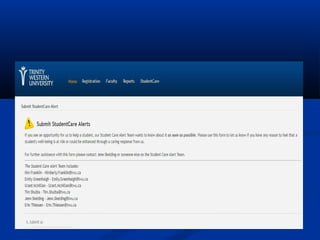
How to submit a SCAHow to submit a SCA
Type of Concern:Type of Concern:
 Academic Engagement
 Academic Performance
 Financial
 Other
 Student Life Engagement
 Wellness
Student Intervention ProtocolStudent Intervention Protocol
 When a student is identified as in distress/crisis the
Resident Director is notified and becomes a primary
caregiver to the student throughout the crisis.
 If the crisis will affect academics in any way, an email is
sent to all the student’s professors notifying them.
 Throughout any crisis/distress the student is still always
responsible to communicate with their professors for
missed assignments/exams.
QuestionsQuestions

Faculty as Helping Resources

  • 1.
    Teaching Students inTeachingStudents in DistressDistress Faculty as a Helping ResourceFaculty as a Helping Resource Kurt Lundberg, MEd, RCCKurt Lundberg, MEd, RCC Joelle Turner, MA, RCCJoelle Turner, MA, RCC
  • 2.
    Mental Health DefinedMentalHealth Defined - Capacity to feel, think and act in ways that enhance our ability to enjoy life and deal with challenges - Can range from a state of positive well-being to a state of disabling thoughts, feelings and behaviours
  • 3.
    Mental Health DefinedMentalHealth Defined Source: http://www.safety.uwa.edu.au/health- wellbeing/health/psychological/common-mental-health-issues
  • 4.
    Mental & BehaviouralHealthMental & Behavioural Health Problems are Learning ProblemsProblems are Learning Problems - Can impair the quality and quantity ofCan impair the quality and quantity of learninglearning - Decrease students’ intellectual andDecrease students’ intellectual and emotional flexibilityemotional flexibility - Weaken creativityWeaken creativity - Undermine interest in new knowledge,Undermine interest in new knowledge, ideas and experiencesideas and experiences A Strategic Primer on College Student Mental HealthA Strategic Primer on College Student Mental Health
  • 5.
    Recognizing students inDistressRecognizing students in Distress  Stress is a natural part of life and no stranger toStress is a natural part of life and no stranger to university students. Many students successfullyuniversity students. Many students successfully cope with the realities of college life, but forcope with the realities of college life, but for some the stressors are overwhelming andsome the stressors are overwhelming and unmanageable. Their emotional and behavioralunmanageable. Their emotional and behavioral consequences are often played out on campus inconsequences are often played out on campus in classrooms, residence halls, or offices.classrooms, residence halls, or offices. College of the Overwhelmed: The Campus Mental Health Crisis and What To Do About It.College of the Overwhelmed: The Campus Mental Health Crisis and What To Do About It. Richard Kadison and Theresa Foy DiGeronimo. San Francisco, CA: Jossey-Richard Kadison and Theresa Foy DiGeronimo. San Francisco, CA: Jossey- Bass, 2004.Bass, 2004.
  • 6.
    • Prevent mentalhealth challenges from getting worse • Decrease the risk of more serious problems • Reduce recovery time • Reduce the burden of illness Early intervention for mental health and substance use challenges can:
  • 8.
    Recognizing Students inDistress:Recognizing Students in Distress: What to Look ForWhat to Look For  Marked Changes in Academic Performance orMarked Changes in Academic Performance or behaviorbehavior  Unusual Behavior or AppearanceUnusual Behavior or Appearance  References to Suicide, Homicide or DeathReferences to Suicide, Homicide or Death
  • 9.
    Marked Changes inAcademicMarked Changes in Academic Performance or BehaviorPerformance or Behavior  Poor performance and preparationPoor performance and preparation  Excessive absences or tardinessExcessive absences or tardiness  Repeated requests for special consideration especially when thisRepeated requests for special consideration especially when this represents a change from previous functioningrepresents a change from previous functioning  Unusual or changed pattern of interactionUnusual or changed pattern of interaction  Avoiding participationAvoiding participation  Dominating discussionsDominating discussions  Excessively anxious when called uponExcessively anxious when called upon  Disruptive behaviorDisruptive behavior  Problems with roommates or familyProblems with roommates or family  Exaggerated emotional response obviously inappropriate to theExaggerated emotional response obviously inappropriate to the situationsituation
  • 10.
    Unusual Behavior orAppearanceUnusual Behavior or Appearance  Depressed or lethargic moodDepressed or lethargic mood  Hyperactivity or very rapid speechHyperactivity or very rapid speech  Unexplained cryingUnexplained crying  Irritability or angry outburstsIrritability or angry outbursts  Swollen or red eyesSwollen or red eyes  Change in personal hygiene or dressChange in personal hygiene or dress  Dramatic weight loss or gainDramatic weight loss or gain  Strange or bizarre behavior indicating loss of contactStrange or bizarre behavior indicating loss of contact with realitywith reality
  • 11.
    References to Suicide,Homicide orReferences to Suicide, Homicide or DeathDeath  Expressed thoughts of helplessness orExpressed thoughts of helplessness or hopelessnesshopelessness  Overt references to suicideOvert references to suicide  Isolation from friends or familyIsolation from friends or family  Homicidal threats, any of which may occur inHomicidal threats, any of which may occur in students’ verbal or written statementsstudents’ verbal or written statements
  • 12.
    What Can YouDo?What Can You Do?  TALK…TALK…  LISTEN…LISTEN…  COMMUNICATE…COMMUNICATE…  GIVE HOPE…GIVE HOPE…  MAINTAIN…MAINTAIN…  REFER…REFER…
  • 13.
    TALK…TALK…  Talk tothe student in private when both of youTalk to the student in private when both of you have the time and are not rushed or preoccupiedhave the time and are not rushed or preoccupied  Give the student your undivided attention.Give the student your undivided attention.  It is possible that just a few minutes of effectiveIt is possible that just a few minutes of effective listening on your part may be enough to help thelistening on your part may be enough to help the student feel cared about as an individual andstudent feel cared about as an individual and more confident about what to do.more confident about what to do.
  • 14.
    LISTEN…LISTEN…  Listen tothoughts and feelings in a sensitive,Listen to thoughts and feelings in a sensitive, non threatening way.non threatening way.  If you have initiated the contact, express yourIf you have initiated the contact, express your concern in behavioral, non judgmental terms.concern in behavioral, non judgmental terms. For example: “I’ve noticed you’ve been absentFor example: “I’ve noticed you’ve been absent from class lately and I’m concerned,” rather thanfrom class lately and I’m concerned,” rather than “Where have you been lately? You should be“Where have you been lately? You should be more concerned about your grades.”more concerned about your grades.”
  • 15.
    COMMUNICATE…COMMUNICATE…  Communicate understandingby repeating backCommunicate understanding by repeating back the essence of what the student has told you.the essence of what the student has told you.  Try to include both content and feelings “ItTry to include both content and feelings “It sounds like you’re not accustomed to thesounds like you’re not accustomed to the campus culture and you really don’t feel a sensecampus culture and you really don’t feel a sense of belonging.”of belonging.”  Let the student talk.Let the student talk.
  • 16.
    GIVE HOPE…GIVE HOPE… Assure the student that it is possible for thingsAssure the student that it is possible for things to get better.to get better.  It is important to help them realize there areIt is important to help them realize there are options, and that things will not always seemoptions, and that things will not always seem hopeless.hopeless.  Suggest resources: friends, family, pastor orSuggest resources: friends, family, pastor or professionals on campus.professionals on campus.
  • 17.
    MAINTAIN…MAINTAIN…  Maintain clearand consistent boundaries andMaintain clear and consistent boundaries and expectations.expectations.  It is important to maintain the professionalIt is important to maintain the professional nature of the faculty/student relationship andnature of the faculty/student relationship and the consistency of academic expectations, examthe consistency of academic expectations, exam schedules, etc.schedules, etc.
  • 18.
    REFER…REFER… to other resources,such as the Wellness Centre when:to other resources, such as the Wellness Centre when:  The problem is more serious than you feel comfortable handling.The problem is more serious than you feel comfortable handling.  You are extremely busy, stressed, and cannot find the time toYou are extremely busy, stressed, and cannot find the time to deal with the problem.deal with the problem.  You have helped as much as you can and further assistance isYou have helped as much as you can and further assistance is needed.needed.  You think your personal feelings about the student will interfereYou think your personal feelings about the student will interfere with your objectivity.with your objectivity.  The student admits that there is a problem, but doesn’t want toThe student admits that there is a problem, but doesn’t want to talk to you about it.talk to you about it.  The student asks for information or assistance that you areThe student asks for information or assistance that you are unable to provide.unable to provide.

  • 19.
    Making a ReferralFor CounsellingMaking a Referral For Counselling Seeking professional help is:Seeking professional help is: A sign of strength and courage rather than a signA sign of strength and courage rather than a sign of weakness or failureof weakness or failure Considered good judgment and an appropriateConsidered good judgment and an appropriate use of resources. You might say, “If you had ause of resources. You might say, “If you had a broken arm you would go to the doctor ratherbroken arm you would go to the doctor rather than try to set it yourself.”than try to set it yourself.” Tell the student what you know about the referralTell the student what you know about the referral person or service you are recommending.person or service you are recommending.
  • 20.
    Take all suicidalexpressionsTake all suicidal expressions seriously.seriously. Please CONSULT when in doubt about thePlease CONSULT when in doubt about the appropriateness of an intervention.appropriateness of an intervention. Please feel free to call:Please feel free to call: TWU Counselling Services (604) 513-2100TWU Counselling Services (604) 513-2100 TWU Health Services (604) 513-2024TWU Health Services (604) 513-2024 Campus Security (604) 513-2099Campus Security (604) 513-2099 Comm. Life (Emergency Pager) (604)-307-4857Comm. Life (Emergency Pager) (604)-307-4857 Mon-Fri 4:30pm – 8:30am / Sat – Sun 24 HoursMon-Fri 4:30pm – 8:30am / Sat – Sun 24 Hours
  • 21.
    Community ResourcesCommunity Resources Keltymentalhealth.ca - (604) 875-2084Keltymentalhealth.ca - (604) 875-2084 BC’s information source for children, youth andBC’s information source for children, youth and familiesfamilies  FRASER HEALTH CRISIS LINE (24 – HourFRASER HEALTH CRISIS LINE (24 – Hour supportive telephone counselling) (604)951-8855supportive telephone counselling) (604)951-8855 If you are in a crisis and need immediateIf you are in a crisis and need immediate assistance, call 911.assistance, call 911.
  • 22.
    If a Studentis Reluctant to SeekIf a Student is Reluctant to Seek Professional HelpProfessional Help 1.1. Normalize the process of seeking help. ThisNormalize the process of seeking help. This may be especially helpful for internationalmay be especially helpful for international students whose countries may not have similarstudents whose countries may not have similar views of psychological counselling.views of psychological counselling. 2.2. Reassure students that counsellors in theReassure students that counsellors in the Wellness Centre work with a wide range ofWellness Centre work with a wide range of concerns.concerns.
  • 23.
    If a Studentis Reluctant to SeekIf a Student is Reluctant to Seek Professional Help (cont.)Professional Help (cont.) 3.3. Remind students that successful students seekRemind students that successful students seek support.support. 4.4. Problems need not reach crisis proportions forProblems need not reach crisis proportions for students to benefit from professional help.students to benefit from professional help. Suggest to students that it is often much easierSuggest to students that it is often much easier to work on problems if they are addressedto work on problems if they are addressed before they reach crisis level.before they reach crisis level.
  • 24.
    If a Studentis Reluctant to SeekIf a Student is Reluctant to Seek Professional Help (cont.)Professional Help (cont.) 5.5. Reluctant students might also be relieved to knowReluctant students might also be relieved to know that they can speak with a therapist on a one-timethat they can speak with a therapist on a one-time basis without making a commitment to ongoingbasis without making a commitment to ongoing therapy.therapy. 6.6. Students may be relieved to hear that any contact andStudents may be relieved to hear that any contact and information shared by the student is kept strictlyinformation shared by the student is kept strictly confidential and will not be disclosed to parents,confidential and will not be disclosed to parents, faculty, other university departments, or even you,faculty, other university departments, or even you, except with the student’s written permission.except with the student’s written permission.
  • 25.
    How to Makea CounsellingHow to Make a Counselling AppointmentAppointment  Students should make their own appointments ifStudents should make their own appointments if possible.possible.  Students can make an appointment to speak with aStudents can make an appointment to speak with a counsellor by visiting the Wellness Centre andcounsellor by visiting the Wellness Centre and completing an intake questionnaire or they maycompleting an intake questionnaire or they may complete the questionnaire on line atcomplete the questionnaire on line at www.twu.ca/life/wellnesswww.twu.ca/life/wellness..  The receptionist will arrange for the student to meetThe receptionist will arrange for the student to meet with a staff member as soon as possible, usuallywith a staff member as soon as possible, usually within a week of the request.within a week of the request.
  • 26.
    Cost for Counsellingat TWUCost for Counselling at TWU  Students can meet with a counsellor for aStudents can meet with a counsellor for a nominal fee. The first 6 appointments are $25nominal fee. The first 6 appointments are $25 for each session. All appointments after the 6for each session. All appointments after the 6thth session are $35.session are $35.  If a student can not afford to pay for counsellingIf a student can not afford to pay for counselling they are encouraged to speak with theirthey are encouraged to speak with their counsellor at their initial appointment to discusscounsellor at their initial appointment to discuss an alternative payment plan. (We do not turnan alternative payment plan. (We do not turn away students who can not pay for counselling)away students who can not pay for counselling)
  • 27.
    How to ContactMental HealthHow to Contact Mental Health ServicesServices The University Mental Health Services is a unitThe University Mental Health Services is a unit of the Wellness Centre and is located on the 2of the Wellness Centre and is located on the 2ndnd floor of Douglass Centre.floor of Douglass Centre. Hours: 8:30 A.M.-4:30 P.M., Monday –Friday.Hours: 8:30 A.M.-4:30 P.M., Monday –Friday. Phone: (604) 513-2100Phone: (604) 513-2100
  • 28.
    StudentCare Alert ProgramStudentCareAlert Program  What is a StudentCare Alert?What is a StudentCare Alert?  How do I submit a StudentCare Alert?How do I submit a StudentCare Alert?  What happens after I submit a StudentCareWhat happens after I submit a StudentCare Alert?Alert?
  • 29.
    What is theStudentCare AlertWhat is the StudentCare Alert Program?Program?  Our commitment to providing a personalOur commitment to providing a personal and caring educationand caring education  Addresses concerns of facultyAddresses concerns of faculty  Offers supportOffers support  Provides referrals to on-campus resourcesProvides referrals to on-campus resources
  • 30.
    When should Isubmit a StudentCareWhen should I submit a StudentCare Alert?Alert? When a student: Has multiple absences Missed a quiz, test, short papers, or term papers without prior communication or if the communication is concerning Has difficulty staying engaged in class presentations or discussions Exhibits any substantial change in behavior, mood, or appearance
  • 31.
    When should Isubmit a SCA? (cont)When should I submit a SCA? (cont)  Expresses significant personal or family problems in conversation, emails, or assignment  Has experienced a death/significant illness of a family member or friend  Has been hospitalized, injured, or experiencing a significant illness  Informed a teacher, staff member, or student that he or she will be missing a significant number of classes  Has indicated severe resource insecurity affecting access to housing, food, academic books/supplies, or any other basic needs
  • 32.
    How to submita SCAHow to submit a SCA
  • 35.
    Type of Concern:Typeof Concern:  Academic Engagement  Academic Performance  Financial  Other  Student Life Engagement  Wellness
  • 36.
    Student Intervention ProtocolStudentIntervention Protocol  When a student is identified as in distress/crisis the Resident Director is notified and becomes a primary caregiver to the student throughout the crisis.  If the crisis will affect academics in any way, an email is sent to all the student’s professors notifying them.  Throughout any crisis/distress the student is still always responsible to communicate with their professors for missed assignments/exams.
  • 37.

Editor's Notes

  • #3 Mental health is defined in many ways but usually refers to our capacity to feel, think and act in ways that enhance our ability to enjoy life and deal with the challenges we face. Mental health is an important part of our overall health and can range from a state of positive mental well-being to a state of disabling thoughts, feelings and behaviours. At any moment in time, our mental health is somewhere on this continuum.
  • #5 Mental health problems (notably stress, anxiety, and depression) and harmful health behaviors such as substance abuse can impair the quality and quantity of learning. They decrease students’ intellectual and emotional flexibility, weaken their creativity, and undermine their interest in new knowledge, ideas, and experiences. Mental and behavioral health problems are also learning problems. – (A Strategic Primer on College Student Mental Health)
  • #9 Faculty and staff may not be able to spot every distressed student, nor will every student you approach be willing to accept your assistance. Just by being available and ready to listen, you may play an important role in helping that student regain the emotional balance needed to cope with stress and get back on track.
  • #13 If you choose to approach a student you’re concerned about or if a student reaches out to you for help with personal problems, here are some suggestions which might assist you to respond
  • #20 It is usually best to speak directly to the student in a caring and supportive manner. Here are some things you might share when making a referral:
  • #23 While it is important to care about the emotional well being of our students, we cannot make their decisions for them, and students are often reluctant to seek counselling. Here are some ideas for encouraging the reluctant student
  • #30 A safety net designed to catch students who are experiencing a concern that is or has the potential to interfere with the academic success of the student.
  • #33 The StudentCare Alert link is found on the Jenzabar Faculty Home Page.
  • #34 Once you have clicked on the Student Care Alert Messages link found in the Quick Links column on the right hand side of the page the page looks like:
  • #35 This is the place to fill in the required information about a student concern.
  • #36 There are 6 options to select for #4: Type of Concern:
  • #37 When a staff or faculty member selects the Wellness option, the alert is automatically issued to Student Life and the RD is notified. The RD then determines if the student requires further support. If so an SIP is issued. Michele Regehr is notified if and SIP is issued.