Pathways
 counseling
dePartment
PoPular myths
about counseling
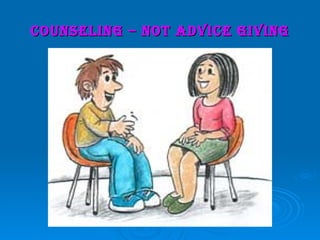
counseling – not advice giving
counseling-not a crutch
grilling for information…….
only for major Problems
‘ fixing’ children ‘ in trouble’
for crazy PeoPle
myths about counseling
   it is the same as advice giving
   grilling for information…
   you go to the counselor when you are ‘in
    trouble’
   helP for PeoPle with really major Problems
   a crutch for PeoPle who are just too weak to
    handle life.
   something for crazy PeoPle
what is counseling?

 is a helPing Process which takes Place
  in an
 atmosPhere of accePtance, resPect
  and trust.
 is confidential and non judgmental.
 PurPose of counseling is to helP
  students recognize their strengths and
  to make them indePendent in Problem
  solving.
counseling involves
what does counseling involve?
   the counselor listens to the students
    exPerience and feelings with emPathy

   the counselor equalizes the relationshiP
    and both counselor and student try to
    find shared meaning and PersPective

   both Parties arrive at
    a focus for change
    and work towards it.
confidentiality

   done or communicated in confidence.
   counselors are firmly committed to the code of
    confidentiality.
   limits of confidentiality.
   communicated to the students in the beginning.
school counselor
 Professional member of an
  educational team.
 assists students in acquiring and
  using life-long skills through the
  develoPment of academic, self-
  awareness and interPersonal
  communication skills.
 Proactive and Preventive in focus.
 goal is to Provide all students with
  life success skills.
counseling can helP with……
   managing anxiety                relaxation training
   coPing with and reducing        resolution of Personal
    stress                           issues
   adjusting to loss (death,       eating concerns
    relationshiPs, job)             drug/alcohol issues
   increasing self-                self-esteem
    understanding                   academic concerns (text
   making difficult decisions       anxiety, study skills)
    and clarifying choices          imProving communication
   social skills                    (with Parents, faculty,
   conflict resolution              friends, roommates)
   anger management                coPing with incidents or
   assertive training               trauma
when to refer a student?

consider
 referring a
 student, if a
 student:

exPresses concerns
 over a Personal
 issue (i.e.
 relationshiPs,
 addiction, family
 difficulties)
consider referring a
   student if a student:

seems excessively,
anxious,dePressed,
irritable,withdrawn,
angry or sad.
consider referring a
   student if a student:

you notice significant
changes in a student’s
aPPearance or habits
(i.e. deterioration in
grooming, hygiene,
weight loss, change in
activity or sPeech
Patterns, or changes in
academic Performance)
counselors see the students thru’ the following
  channels :-


  reference from teachers, form
  tutors, head of Pastoral care,
  PrinciPals or resident Parents

  direct observation of student in
  a community or during the Pulse          relevant feedback
  classes.                                 is given
                                           to the concerned
  student “walking-in” to the
                                           Persons
  counseling room, for counseling
  or just a chat.

  crisis intervention: e.g., threatening
  suicide, self-mutilation, severe
  anger outburst, violence.
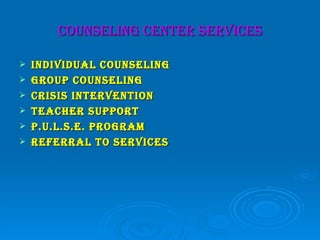
counseling center services

   individual counseling
   grouP counseling
   crisis intervention
   teacher suPPort
   P.u.l.s.e. Program
   referral to services
Counseling

Counseling

  • 1.
  • 2.
  • 3.
    counseling – notadvice giving
  • 4.
  • 5.
  • 6.
  • 7.
    ‘ fixing’ children‘ in trouble’
  • 8.
  • 9.
    myths about counseling  it is the same as advice giving  grilling for information…  you go to the counselor when you are ‘in trouble’  helP for PeoPle with really major Problems  a crutch for PeoPle who are just too weak to handle life.  something for crazy PeoPle
  • 10.
    what is counseling? is a helPing Process which takes Place in an atmosPhere of accePtance, resPect and trust.  is confidential and non judgmental.  PurPose of counseling is to helP students recognize their strengths and to make them indePendent in Problem solving.
  • 11.
  • 12.
    what does counselinginvolve?  the counselor listens to the students exPerience and feelings with emPathy  the counselor equalizes the relationshiP and both counselor and student try to find shared meaning and PersPective  both Parties arrive at a focus for change and work towards it.
  • 13.
    confidentiality  done or communicated in confidence.  counselors are firmly committed to the code of confidentiality.  limits of confidentiality.  communicated to the students in the beginning.
  • 14.
    school counselor  Professionalmember of an educational team.  assists students in acquiring and using life-long skills through the develoPment of academic, self- awareness and interPersonal communication skills.  Proactive and Preventive in focus.  goal is to Provide all students with life success skills.
  • 16.
    counseling can helPwith……  managing anxiety  relaxation training  coPing with and reducing  resolution of Personal stress issues  adjusting to loss (death,  eating concerns relationshiPs, job)  drug/alcohol issues  increasing self-  self-esteem understanding  academic concerns (text  making difficult decisions anxiety, study skills) and clarifying choices  imProving communication  social skills (with Parents, faculty,  conflict resolution friends, roommates)  anger management  coPing with incidents or  assertive training trauma
  • 17.
    when to refera student? consider referring a student, if a student: exPresses concerns over a Personal issue (i.e. relationshiPs, addiction, family difficulties)
  • 18.
    consider referring a student if a student: seems excessively, anxious,dePressed, irritable,withdrawn, angry or sad.
  • 19.
    consider referring a student if a student: you notice significant changes in a student’s aPPearance or habits (i.e. deterioration in grooming, hygiene, weight loss, change in activity or sPeech Patterns, or changes in academic Performance)
  • 20.
    counselors see thestudents thru’ the following channels :- reference from teachers, form tutors, head of Pastoral care, PrinciPals or resident Parents direct observation of student in a community or during the Pulse relevant feedback classes. is given to the concerned student “walking-in” to the Persons counseling room, for counseling or just a chat. crisis intervention: e.g., threatening suicide, self-mutilation, severe anger outburst, violence.
  • 21.
    counseling center services  individual counseling  grouP counseling  crisis intervention  teacher suPPort  P.u.l.s.e. Program  referral to services