RESEARCH
DESIGN
By:
Shivangi Singh
Kriti Agarwal
Jyoti Verma
Lavisha Bassi
Monica Swami
Pallawi
Shivani Gautam
RESEARCH DESIGN
• A detailed outline of how an investigation will take place.
• A research design will typically include how data is to be
collected, what instruments will be employed, how the
instruments will be used and the intended means for analyzing
data collected.
• A research design depends on the purpose and nature of the
research problem.
• Thus, one single design cannot be used to solve all types of
research problem, i.e. , a particular design is suitable for a
particular problem.
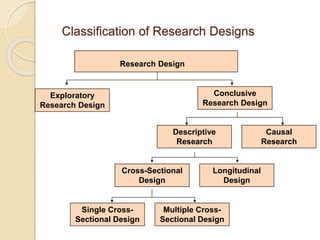
Classification of Research Designs
Single Cross-
Sectional Design
Multiple Cross-
Sectional Design
Research Design
Conclusive
Research Design
Exploratory
Research Design
Descriptive
Research
Causal
Research
Cross-Sectional
Design
Longitudinal
Design
EXPLORATORY DESIGN
 Explores the research questions and does not intend to offer
final result
 Conducted in order to determine the nature of the problem
 Exploratory research is flexible and can address research
questions of all types(what, why, how)
 Leads to generation of new ideas and assumption, development
of tentative theories of hypothesis
 Exploratory studies help establish research priorities
 Provides an opportunity to define new terms and clarify existing
concepts
 The research process underpinning exploratory studies is
flexible but often unstructured, leading to only tentative results
that have limited value in decision-making
CONCLUSIVE DESIGN
It provides information that helps the executive make a
rational decision
It is the research designed to assist the decision maker
in determining, evaluating & selecting the best course
of action to take in a given situation
Information needed is clearly defined
Research process is formal & structured
Findings are used as input to decision making
CONCLUSIVE RESEARCH
 Conclusive research uses statistical
tests, advanced analytical techniques ,
and larger sample sizes, compared with
exploratory studies
 Conclusive research is more likely to use
quantitative, rather than qualitative
techniques
 Types of Conclusive Research
 Descriptive
 Causal/ experimental
CAUSAL RESEARCH
 The investigation into an issue or topic that looks at the effect
of one thing or variable on another. For example, causal
research might be used in a business environment to quantify
the effect that a change to its present operations will have
future production levels to assist in the business
planning process.
 For example, if a clothing company currently sells blue denim
jeans, causal research can measure the impact of the company
changing the product design to the color white.
 Following the research, company bosses will be able to decide
whether changing the color of the jeans to white would be
profitable.
CAUSAL RESEARCH
 Causal research has two objectives :
 Understanding which variables are the
cause, and which variables are the effect.
 Determining the nature of the relationship
between the causal variables and the effect
predicted.
CAUSAL RESEARCH
 Conditions of causality
 Concomitant variation
 Time order of occurrence
 Absence of other causal factors
 Kinds of variables
 Type 1: Independent variables
 Type 2: Dependent variables
 Type 3: Extraneous variables
DESCRIPTIVE RESEARCH
 Why Do we use Descriptive Research?
◦ To describe characteristics
◦ To estimate percentage of units
◦ To determine perception of product characteristics
◦ To determine degree to which variables are
associated
METHODS OF DESCRIPTIVE
RESEARCH
 Methods of descriptive research:
◦ Analysing secondary data
◦ Surveys
◦ Panels
◦ Observational data
LONGITUDINAL RESEARCH
 A longitudinal research is an
observational. In this, the researches
do not interfere with their subjects.
 In longitudinal study, researches
conduct several observations of same
subjects over a period of time.
 A fixed example of population
elements is measured repeatedly on
the same variable.
ADVANTAGES
• Incident events are recorded.
• Prospective ascertainment of exposure.
• Measurement of industrial change in the
outcomes.
• Accuracy.
• Large amount of data collection.
DISADVANTAGES
• Representative Sampling.
• Response Bias.
CROSS-SECTIONAL RESEARCH
 Cross-sectional research is used to examine one variable in
different groups that are similar in all other characteristics,
such as socioeconomic status, educational background, and
ethnicity.
 Cross-sectional research studies are based on observations
that take place in different groups at one time.
 There is no experimental procedure, so no variables are
manipulated by the researcher. Instead of performing an
experiment, you would simply record the information that you
observe in the groups you are examining.
 The benefits of cross-sectional study design are that it allows
researchers to compare many different variables at the same
time.
TYPES OF CROSS-SECTIONAL
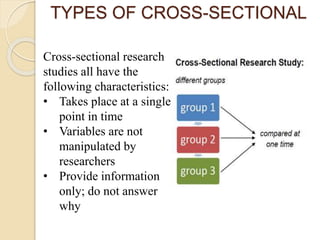
Cross-sectional research
studies all have the
following characteristics:
• Takes place at a single
point in time
• Variables are not
manipulated by
researchers
• Provide information
only; do not answer
why
TYPES OF CROSS-SECTIONAL
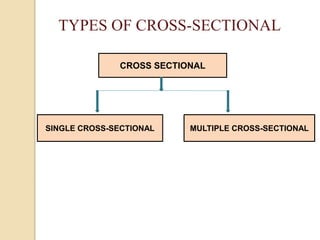
CROSS SECTIONAL
SINGLE CROSS-SECTIONAL MULTIPLE CROSS-SECTIONAL
Research Design

Research Design

  • 1.
    RESEARCH DESIGN By: Shivangi Singh Kriti Agarwal JyotiVerma Lavisha Bassi Monica Swami Pallawi Shivani Gautam
  • 2.
    RESEARCH DESIGN • Adetailed outline of how an investigation will take place. • A research design will typically include how data is to be collected, what instruments will be employed, how the instruments will be used and the intended means for analyzing data collected. • A research design depends on the purpose and nature of the research problem. • Thus, one single design cannot be used to solve all types of research problem, i.e. , a particular design is suitable for a particular problem.
  • 3.
    Classification of ResearchDesigns Single Cross- Sectional Design Multiple Cross- Sectional Design Research Design Conclusive Research Design Exploratory Research Design Descriptive Research Causal Research Cross-Sectional Design Longitudinal Design
  • 4.
    EXPLORATORY DESIGN  Exploresthe research questions and does not intend to offer final result  Conducted in order to determine the nature of the problem  Exploratory research is flexible and can address research questions of all types(what, why, how)  Leads to generation of new ideas and assumption, development of tentative theories of hypothesis  Exploratory studies help establish research priorities  Provides an opportunity to define new terms and clarify existing concepts  The research process underpinning exploratory studies is flexible but often unstructured, leading to only tentative results that have limited value in decision-making
  • 5.
    CONCLUSIVE DESIGN It providesinformation that helps the executive make a rational decision It is the research designed to assist the decision maker in determining, evaluating & selecting the best course of action to take in a given situation Information needed is clearly defined Research process is formal & structured Findings are used as input to decision making
  • 6.
    CONCLUSIVE RESEARCH  Conclusiveresearch uses statistical tests, advanced analytical techniques , and larger sample sizes, compared with exploratory studies  Conclusive research is more likely to use quantitative, rather than qualitative techniques  Types of Conclusive Research  Descriptive  Causal/ experimental
  • 7.
    CAUSAL RESEARCH  Theinvestigation into an issue or topic that looks at the effect of one thing or variable on another. For example, causal research might be used in a business environment to quantify the effect that a change to its present operations will have future production levels to assist in the business planning process.  For example, if a clothing company currently sells blue denim jeans, causal research can measure the impact of the company changing the product design to the color white.  Following the research, company bosses will be able to decide whether changing the color of the jeans to white would be profitable.
  • 8.
    CAUSAL RESEARCH  Causalresearch has two objectives :  Understanding which variables are the cause, and which variables are the effect.  Determining the nature of the relationship between the causal variables and the effect predicted.
  • 9.
    CAUSAL RESEARCH  Conditionsof causality  Concomitant variation  Time order of occurrence  Absence of other causal factors  Kinds of variables  Type 1: Independent variables  Type 2: Dependent variables  Type 3: Extraneous variables
  • 10.
    DESCRIPTIVE RESEARCH  WhyDo we use Descriptive Research? ◦ To describe characteristics ◦ To estimate percentage of units ◦ To determine perception of product characteristics ◦ To determine degree to which variables are associated
  • 11.
    METHODS OF DESCRIPTIVE RESEARCH Methods of descriptive research: ◦ Analysing secondary data ◦ Surveys ◦ Panels ◦ Observational data
  • 12.
    LONGITUDINAL RESEARCH  Alongitudinal research is an observational. In this, the researches do not interfere with their subjects.  In longitudinal study, researches conduct several observations of same subjects over a period of time.  A fixed example of population elements is measured repeatedly on the same variable.
  • 13.
    ADVANTAGES • Incident eventsare recorded. • Prospective ascertainment of exposure. • Measurement of industrial change in the outcomes. • Accuracy. • Large amount of data collection. DISADVANTAGES • Representative Sampling. • Response Bias.
  • 14.
    CROSS-SECTIONAL RESEARCH  Cross-sectionalresearch is used to examine one variable in different groups that are similar in all other characteristics, such as socioeconomic status, educational background, and ethnicity.  Cross-sectional research studies are based on observations that take place in different groups at one time.  There is no experimental procedure, so no variables are manipulated by the researcher. Instead of performing an experiment, you would simply record the information that you observe in the groups you are examining.  The benefits of cross-sectional study design are that it allows researchers to compare many different variables at the same time.
  • 15.
    TYPES OF CROSS-SECTIONAL Cross-sectionalresearch studies all have the following characteristics: • Takes place at a single point in time • Variables are not manipulated by researchers • Provide information only; do not answer why
  • 16.
    TYPES OF CROSS-SECTIONAL CROSSSECTIONAL SINGLE CROSS-SECTIONAL MULTIPLE CROSS-SECTIONAL