Types of research
Prof.Alok Gaddi
• Research: a systematic approach to finding
answers to questions.
• Research Design: a plan for gathering data for
answering specific research questions.
• Statistics: the methods used on the data
collected to answer the research questions at
hand.
Research Design: Definition
• A research design is a framework or blueprint
for conducting the marketing research project.
It details the procedures necessary for
obtaining the information needed to structure
or solve marketing research problems.
A Classification of Marketing Research Designs
Single Cross-
Sectional Design
Multiple Cross-
Sectional Design
Research Design
Conclusive
Research Design
Exploratory
Research Design
Descriptive
Research
Causal
Research
Cross-Sectional
Design
Longitudinal
Design
Types of research
• Exploratory research : helps investigate gain some initial
insights and may pave the way further research
• Conclusive research : helps investigators verify insights
and select the appropriate course of action.
• Descriptive
Deals with everything that can be counted and studied. But
there are always restrictions to that. Your research must have an
impact to the lives of the people around you. For example, finding
the most frequent disease that affects the children of a town
• Experimental
• Causal Research (If-then)
– Designed to provide information on potential
cause-and-effect relationships.
– Most practical in marketing to talk about
associations or impact of one variable on another.
Differences Between Exploratory and
Conclusive Research
• Research Project Components: Research
Purpose
– Exploratory Research
• General: To generate insights about a situation
– Conclusive Research
• Specific: To verify insights and aid in selecting a course
of action
Differences Between Exploratory and
Conclusive Research (Cont’d)
• Research Project Components: Data needs
– Exploratory Research
• Vague
– Conclusive Research
• Clear
Differences Between Exploratory and
Conclusive Research (Cont’d)
• Research Project Components: Data sources
– Exploratory Research
• Ill-defined
– Conclusive Research
• Well-defined
Differences Between Exploratory and
Conclusive Research (Cont’d)
• Research Project Components: Data collection
form
– Exploratory Research
• Open-ended, rough
– Conclusive Research
• Usually structured
Differences Between Exploratory and
Conclusive Research (Cont’d)
• Research Project Components: Data collection
– Exploratory Research
• Flexible; no set procedure
– Conclusive Research
• Rigid; well-laid-out procedure
Differences Between Exploratory and
Conclusive Research (Cont’d)
• Research Project Components: Data analysis
– Exploratory Research
• Informal; typically non-quantitative
– Conclusive Research
• Formal; typically quantitative
Types of Data for Exploratory Research
• Key informant, Expert opinion, lead-user
• Focus groups
• Secondary data
• Observation studies method :Involves human or mechanical
observation of what people actually do or what events take place
during a buying or consumption situation
• Case studies : In This method in-depth examination of a unit of
interest . The unit came be customer , store ,firm , market area
– Intensive study of related cases or past activities
– May be internal or external
– Can help provide clues as to how other units or companies
have dealt with similar issues
Types and Characteristics of Exploratory Studies
• Experience Surveys (depth interviews)
– Knowledgeable people with varying points of view
– Unstructured and informal interviews
– Respondent free to choose issues to be discussed
• Focus Groups
– 8 to 10 people at one time
– Relatively homogeneous groups
– Multiple, heterogeneous groups
– Group dynamics
– Moderator is key
– Relies on general topical guide with plenty of time for
interaction
Duties of a Moderator
• Guide discussion
• Ensure key aspects of the topic are discussed
• Observe
• Record
On-line Focus Groups
• Advantages
– No geographic barriers
– Lower costs
– Do not have to see a moderator face-to-face
– Two way interaction between moderator and the client
is possible
On-line Focus Groups
• Disadvantages
– Client involvement with participants is practically non-
existent
– Security - who is the person on-line?
– Attention to the topic - is the participant paying
attention?
– Role and skill of moderator are more difficult
Depth Interviews
• One-on-one interviews that probe and elicit detailed
answers to questions, often using nondirective
techniques to uncover hidden motivations.
• Advantages
– No group pressure
– Respondent is focus of attention and feels important
– Respondent is highly aware and active
– Long time period encourages revealing new information
– Can probe to reveal feelings and motivations
Depth Interviews
• Disadvantages
– Much more expensive than focus groups
– Do not get the same degree of client
involvement; clients do not want to observe
single interviews
– Are physically exhausting for the
moderator…reduces the number of people that
can be interviewed in a given time period.
Types of Conclusive Research
• Descriptive
– Generates data on the composition and
characteristics of a specific group such as
customers, sales people, and market areas
• Experimental
– Generates data to determine causal relationships
Types and Characteristics of Descriptive Studies
• Cross-Sectional Study
– Easily the most common type of research project.
– Typically involves conducting a survey of a sample of population
elements at one point in time.
– Useful because it provides a quick snapshot of what’s going on with the
variables of interest for our research problem.
• Longitudinal Study
– An investigation that involves taking repeated measures over time.
– Useful for conducting trend analysis, tracking changes in behavior over
time (e.g., brand switching, levels of awareness, turnover) and
monitoring long-term effects of marketing activities (e.g., market share,
pricing effects)
– True panel vs. omnibus panel
Longitudinal Studies (Cont’d)
• Types of Panels
– OMNIBUS PANEL: different subjects are pulled
from the panel for each time period
• Drawbacks: data is not as reliable
– TRUE PANEL: the same subjects are used for the
panel every time data is collected
• Drawbacks: members sometimes evolve out of the
desired study group
Experimental (Cont’d)
Multi-group Design
Control
Group
All variables stay the same
Experimental
Group
Change one variable
Measure the differences.
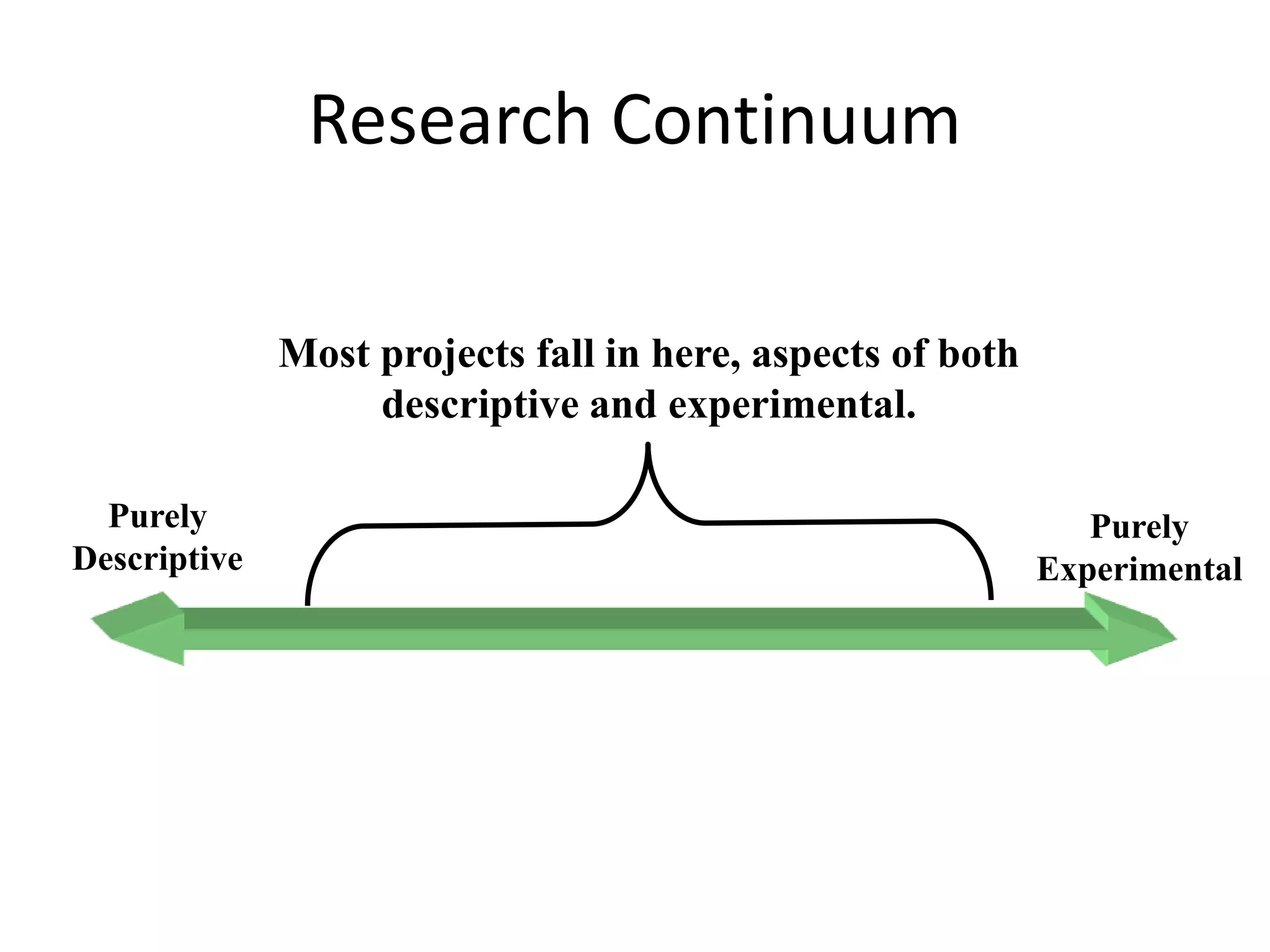
Research Continuum
Most projects fall in here, aspects of both
descriptive and experimental.
Purely
Descriptive
Purely
Experimental
Types of longitudinal surveys
 trend survey
 cohort survey
 panel survey
 follow-up survey
Trend survey
• A study where a sample is taken from the
general population in order to collect data
over time
• Involves different groups and different
samples over time
Cohort survey
• A study where a specific population is
examined by sampling different groups
within the population over time
• Involves the same group but different
samples from that group over time
Panel survey
A study where the same group and the
same sample are examined over time
Follow-up survey
A study undertaken after a panel survey
and seeks to examine subsequent
development or change
Causal Research Designs
– Time order of occurrence
• If X is supposed to cause Y, then changes in X must
precede changes in Y.
– Elimination of other possible causes
• If X causes Y, no other factor could have reasonably
caused the change in Y at that moment.
• Must hold all other variables constant.
Causal Research Designs
• Examples of experimentation in marketing
– Market test (test marketing)
– Advertising response (recall, affect, attitude
toward ad elements)
– Promotional design (consumer response to
promotional deals, incentives, tie-ins
– Store layout and design
– Product positioning
– Color tracking and package design
Selecting the Appropriate
Research Type
Is the research purpose
specific and are data
requirements clear?
Analyze data/interpret findings
Is there a need for further research
Analyze data/interpret findings
Make recommendations
Conduct a suitable
descriptive-research study
Conduct exploratory research with
these procedures:
-Key informant technique
-Focus group interviews
-Secondary-data analysis
-Case study method
Design conclusive research
Does the research purpose call for
testing cause-and-effect
relationships between variables?
Conduct an appropriate
experimental-research study
Yes
No
No
Yes
No
Yes
Objective:
Characteristics:
Methods:
A Comparison of Basic Research Designs
Discovery of ideas
and insights
Flexible, versatile
Often the front
end of total
research design
Expert surveys
Pilot surveys
Secondary data
Qualitative
research
Describe market
characteristics or
functions
Marked by the prior
formulation of
specific hypotheses
Preplanned and
structured design
Secondary data
Surveys
Panels
Observation and
other data
Determine cause
and effect
relationships
Manipulation of
one or more
independent
variables
Control of other
mediating
variables
Experiments
Exploratory Descriptive Causal

Types of research mba mr

  • 1.
  • 2.
    • Research: asystematic approach to finding answers to questions. • Research Design: a plan for gathering data for answering specific research questions. • Statistics: the methods used on the data collected to answer the research questions at hand.
  • 3.
    Research Design: Definition •A research design is a framework or blueprint for conducting the marketing research project. It details the procedures necessary for obtaining the information needed to structure or solve marketing research problems.
  • 4.
    A Classification ofMarketing Research Designs Single Cross- Sectional Design Multiple Cross- Sectional Design Research Design Conclusive Research Design Exploratory Research Design Descriptive Research Causal Research Cross-Sectional Design Longitudinal Design
  • 5.
    Types of research •Exploratory research : helps investigate gain some initial insights and may pave the way further research • Conclusive research : helps investigators verify insights and select the appropriate course of action. • Descriptive Deals with everything that can be counted and studied. But there are always restrictions to that. Your research must have an impact to the lives of the people around you. For example, finding the most frequent disease that affects the children of a town • Experimental
  • 6.
    • Causal Research(If-then) – Designed to provide information on potential cause-and-effect relationships. – Most practical in marketing to talk about associations or impact of one variable on another.
  • 7.
    Differences Between Exploratoryand Conclusive Research • Research Project Components: Research Purpose – Exploratory Research • General: To generate insights about a situation – Conclusive Research • Specific: To verify insights and aid in selecting a course of action
  • 8.
    Differences Between Exploratoryand Conclusive Research (Cont’d) • Research Project Components: Data needs – Exploratory Research • Vague – Conclusive Research • Clear
  • 9.
    Differences Between Exploratoryand Conclusive Research (Cont’d) • Research Project Components: Data sources – Exploratory Research • Ill-defined – Conclusive Research • Well-defined
  • 10.
    Differences Between Exploratoryand Conclusive Research (Cont’d) • Research Project Components: Data collection form – Exploratory Research • Open-ended, rough – Conclusive Research • Usually structured
  • 11.
    Differences Between Exploratoryand Conclusive Research (Cont’d) • Research Project Components: Data collection – Exploratory Research • Flexible; no set procedure – Conclusive Research • Rigid; well-laid-out procedure
  • 12.
    Differences Between Exploratoryand Conclusive Research (Cont’d) • Research Project Components: Data analysis – Exploratory Research • Informal; typically non-quantitative – Conclusive Research • Formal; typically quantitative
  • 13.
    Types of Datafor Exploratory Research • Key informant, Expert opinion, lead-user • Focus groups • Secondary data • Observation studies method :Involves human or mechanical observation of what people actually do or what events take place during a buying or consumption situation • Case studies : In This method in-depth examination of a unit of interest . The unit came be customer , store ,firm , market area – Intensive study of related cases or past activities – May be internal or external – Can help provide clues as to how other units or companies have dealt with similar issues
  • 14.
    Types and Characteristicsof Exploratory Studies • Experience Surveys (depth interviews) – Knowledgeable people with varying points of view – Unstructured and informal interviews – Respondent free to choose issues to be discussed • Focus Groups – 8 to 10 people at one time – Relatively homogeneous groups – Multiple, heterogeneous groups – Group dynamics – Moderator is key – Relies on general topical guide with plenty of time for interaction
  • 15.
    Duties of aModerator • Guide discussion • Ensure key aspects of the topic are discussed • Observe • Record
  • 16.
    On-line Focus Groups •Advantages – No geographic barriers – Lower costs – Do not have to see a moderator face-to-face – Two way interaction between moderator and the client is possible
  • 17.
    On-line Focus Groups •Disadvantages – Client involvement with participants is practically non- existent – Security - who is the person on-line? – Attention to the topic - is the participant paying attention? – Role and skill of moderator are more difficult
  • 18.
    Depth Interviews • One-on-oneinterviews that probe and elicit detailed answers to questions, often using nondirective techniques to uncover hidden motivations. • Advantages – No group pressure – Respondent is focus of attention and feels important – Respondent is highly aware and active – Long time period encourages revealing new information – Can probe to reveal feelings and motivations
  • 19.
    Depth Interviews • Disadvantages –Much more expensive than focus groups – Do not get the same degree of client involvement; clients do not want to observe single interviews – Are physically exhausting for the moderator…reduces the number of people that can be interviewed in a given time period.
  • 20.
    Types of ConclusiveResearch • Descriptive – Generates data on the composition and characteristics of a specific group such as customers, sales people, and market areas • Experimental – Generates data to determine causal relationships
  • 21.
    Types and Characteristicsof Descriptive Studies • Cross-Sectional Study – Easily the most common type of research project. – Typically involves conducting a survey of a sample of population elements at one point in time. – Useful because it provides a quick snapshot of what’s going on with the variables of interest for our research problem. • Longitudinal Study – An investigation that involves taking repeated measures over time. – Useful for conducting trend analysis, tracking changes in behavior over time (e.g., brand switching, levels of awareness, turnover) and monitoring long-term effects of marketing activities (e.g., market share, pricing effects) – True panel vs. omnibus panel
  • 22.
    Longitudinal Studies (Cont’d) •Types of Panels – OMNIBUS PANEL: different subjects are pulled from the panel for each time period • Drawbacks: data is not as reliable – TRUE PANEL: the same subjects are used for the panel every time data is collected • Drawbacks: members sometimes evolve out of the desired study group
  • 23.
    Experimental (Cont’d) Multi-group Design Control Group Allvariables stay the same Experimental Group Change one variable Measure the differences.
  • 24.
    Research Continuum Most projectsfall in here, aspects of both descriptive and experimental. Purely Descriptive Purely Experimental
  • 25.
    Types of longitudinalsurveys  trend survey  cohort survey  panel survey  follow-up survey
  • 26.
    Trend survey • Astudy where a sample is taken from the general population in order to collect data over time • Involves different groups and different samples over time
  • 27.
    Cohort survey • Astudy where a specific population is examined by sampling different groups within the population over time • Involves the same group but different samples from that group over time
  • 28.
    Panel survey A studywhere the same group and the same sample are examined over time
  • 29.
    Follow-up survey A studyundertaken after a panel survey and seeks to examine subsequent development or change
  • 30.
    Causal Research Designs –Time order of occurrence • If X is supposed to cause Y, then changes in X must precede changes in Y. – Elimination of other possible causes • If X causes Y, no other factor could have reasonably caused the change in Y at that moment. • Must hold all other variables constant.
  • 31.
    Causal Research Designs •Examples of experimentation in marketing – Market test (test marketing) – Advertising response (recall, affect, attitude toward ad elements) – Promotional design (consumer response to promotional deals, incentives, tie-ins – Store layout and design – Product positioning – Color tracking and package design
  • 32.
    Selecting the Appropriate ResearchType Is the research purpose specific and are data requirements clear? Analyze data/interpret findings Is there a need for further research Analyze data/interpret findings Make recommendations Conduct a suitable descriptive-research study Conduct exploratory research with these procedures: -Key informant technique -Focus group interviews -Secondary-data analysis -Case study method Design conclusive research Does the research purpose call for testing cause-and-effect relationships between variables? Conduct an appropriate experimental-research study Yes No No Yes No Yes
  • 33.
    Objective: Characteristics: Methods: A Comparison ofBasic Research Designs Discovery of ideas and insights Flexible, versatile Often the front end of total research design Expert surveys Pilot surveys Secondary data Qualitative research Describe market characteristics or functions Marked by the prior formulation of specific hypotheses Preplanned and structured design Secondary data Surveys Panels Observation and other data Determine cause and effect relationships Manipulation of one or more independent variables Control of other mediating variables Experiments Exploratory Descriptive Causal

Editor's Notes