Name:-mdshahbaz
hassan


Defectsinbricks
Building constructions-5
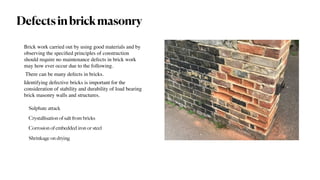
Defectsinbrickmasonry
Brick work carried out by using good materials and by
observing the speci
fi
ed principles of construction
should require no maintenance defects in brick work
may how ever occur due to the following
.

There can be many defects in bricks.
 

Identifying defective bricks is important for the
consideration of stability and durability of load bearing
brick masonry walls and structures
.

• Sulphate attack


• Crystallisation of salt from bricks


• Corrosion of embedded iron or steel


• Shrinkage on drying
Factoreffectingbrickmasonry
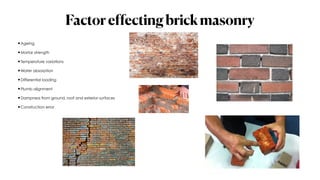
•Ageing


•Mortar strength


•Temperature variations


•Water absorption


•Differential loading


•Plumb alignment


•Dampness from ground, roof and exterior surfaces


•Construction error


Defectinrawmaterial
Extrusion Laminations
• The defect occurs where the turning effect of the equipment pushes the clay out of the machine: the center of the brick is
turning faster than the outside clay.


• These defects are weak spots because they can be harmed by frost damage or spalling.
 

Multiple surface cracks in random directions
• Differential drying can cause shrinkage, and lumps of drier material will shrink differently than the rest of the brick
.

Under
fi
ring
• The clay will be a lighter color, and when knocked together, the bricks will not have the expected metallic sound, but rather a
dull clunk. Straight cracks at right angles from one of the long surfaces


• These cracks form if the drying process is too fast, and the brick may break even if
fi
red correctly.
 

Lamination crack
• This defect may occur in the sand-molded process if a piece of clay covered with sand is mixed into another piece. • The
fi
lm
of sand may separate the two pieces of clay if stresses occur during drying or
fi
ring.
Defectsinbricks
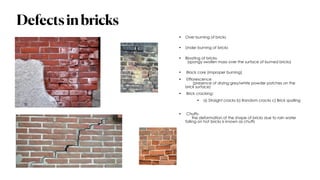
• Over burning of bricks


• Under burning of bricks


• Bloating of bricks-


(spongy swollen mass over the surface of burned bricks)


• Black core (improper burning)
• Efflorescence


(presence of drying grey/white powder patches on the
brick surface)
• Brick cracking:


• a) Straight cracks b) Random cracks c) Brick spalling
• Chuffs-


the deformation of the shape of bricks due to rain water
falling on hot bricks is known as chuffs
Typesofcracks
In brick
•Vertical cracks in side walls at corners


•Vertical cracks around balconies


•Vertical cracks at top most stories at corners of structures


•Vertical cracks at junctions


•Vertical cracks below opening


Causesofcrack
In brick
•Differential brick expansion


•Differential foundation settlement


•Steel lintel expansion


•Reflective cracking


•Climate and seasonal changes


✦ STRENGTH OF BRICK WORK


• Strength between the brick and mortar


• The age of specimen


• Curing conditions


• The flow of mortar


• The composition of mortar


• Ageing


✦ AGEING


• It is usually assumed that the flexural bond strength of brick work increases with time as the


hydration of the cement becomes more complete.


• Some previous tests indicated that greatest strength occurred as early as three to seven days


after building.


✦ EFFECTS OF AGEING
• Due to exposure to rain


• Temperature


• Moisture absorption


• Chemical alteration


• Continuous exposure to chemicals


Thank you

Defects in brick

  • 1.
  • 2.
    Defectsinbrickmasonry Brick work carriedout by using good materials and by observing the speci fi ed principles of construction should require no maintenance defects in brick work may how ever occur due to the following . There can be many defects in bricks. Identifying defective bricks is important for the consideration of stability and durability of load bearing brick masonry walls and structures . • Sulphate attack 
 • Crystallisation of salt from bricks 
 • Corrosion of embedded iron or steel 
 • Shrinkage on drying
  • 3.
    Factoreffectingbrickmasonry •Ageing 
 •Mortar strength 
 •Temperature variations 
 •Waterabsorption 
 •Differential loading 
 •Plumb alignment 
 •Dampness from ground, roof and exterior surfaces 
 •Construction error 

  • 4.
    Defectinrawmaterial Extrusion Laminations • Thedefect occurs where the turning effect of the equipment pushes the clay out of the machine: the center of the brick is turning faster than the outside clay. 
 • These defects are weak spots because they can be harmed by frost damage or spalling. Multiple surface cracks in random directions • Differential drying can cause shrinkage, and lumps of drier material will shrink differently than the rest of the brick . Under fi ring • The clay will be a lighter color, and when knocked together, the bricks will not have the expected metallic sound, but rather a dull clunk. Straight cracks at right angles from one of the long surfaces 
 • These cracks form if the drying process is too fast, and the brick may break even if fi red correctly. Lamination crack • This defect may occur in the sand-molded process if a piece of clay covered with sand is mixed into another piece. • The fi lm of sand may separate the two pieces of clay if stresses occur during drying or fi ring.
  • 5.
    Defectsinbricks • Over burningof bricks 
 • Under burning of bricks 
 • Bloating of bricks- 
 (spongy swollen mass over the surface of burned bricks) 
 • Black core (improper burning) • Efflorescence 
 (presence of drying grey/white powder patches on the brick surface) • Brick cracking: • a) Straight cracks b) Random cracks c) Brick spalling • Chuffs- 
 the deformation of the shape of bricks due to rain water falling on hot bricks is known as chuffs
  • 6.
    Typesofcracks In brick •Vertical cracksin side walls at corners 
 •Vertical cracks around balconies 
 •Vertical cracks at top most stories at corners of structures 
 •Vertical cracks at junctions 
 •Vertical cracks below opening 

  • 7.
    Causesofcrack In brick •Differential brickexpansion 
 •Differential foundation settlement 
 •Steel lintel expansion 
 •Reflective cracking 
 •Climate and seasonal changes 

  • 8.
    ✦ STRENGTH OFBRICK WORK • Strength between the brick and mortar 
 • The age of specimen 
 • Curing conditions 
 • The flow of mortar 
 • The composition of mortar 
 • Ageing 
 ✦ AGEING • It is usually assumed that the flexural bond strength of brick work increases with time as the 
 hydration of the cement becomes more complete. 
 • Some previous tests indicated that greatest strength occurred as early as three to seven days 
 after building. 
 ✦ EFFECTS OF AGEING • Due to exposure to rain 
 • Temperature 
 • Moisture absorption 
 • Chemical alteration 
 • Continuous exposure to chemicals 

  • 9.