CRACKS IN BUILDINGS:CRACKS IN BUILDINGS:
Some Remedial MeasuresSome Remedial Measures
RamasharyRamashary
CivilCivil engineersengineers
IS THAT CRACK SERIOUS?IS THAT CRACK SERIOUS?
• Simplest questions to ask.Simplest questions to ask.
• One of the most difficult to answer.One of the most difficult to answer.
• Prof. Mealcom Hollis-”Surveying buildings is anProf. Mealcom Hollis-”Surveying buildings is an
art, verifying the cause of failure is a science”art, verifying the cause of failure is a science”
Classification of CracksClassification of Cracks
Structural crackStructural crack Non structural crackNon structural crack
Incorrect designIncorrect design
Faulty constructionFaulty construction
OverloadingOverloading
Internal induced stress inInternal induced stress in
building materialbuilding material
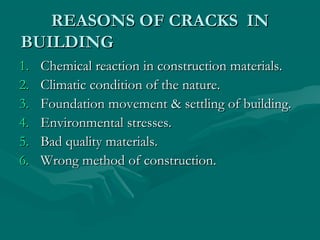
REASONS OF CRACKS INREASONS OF CRACKS IN
BUILDINGBUILDING
1.1. Chemical reaction in construction materials.Chemical reaction in construction materials.
2.2. Climatic condition of the nature.Climatic condition of the nature.
3.3. Foundation movement & settling of building.Foundation movement & settling of building.
4.4. Environmental stresses.Environmental stresses.
5.5. Bad quality materials.Bad quality materials.
6.6. Wrong method of construction.Wrong method of construction.
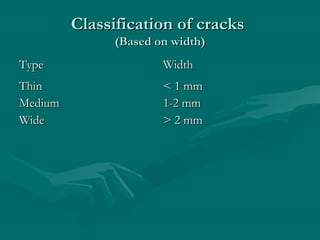
Classification of cracksClassification of cracks
(Based on width)(Based on width)
TypeType WidthWidth
ThinThin
MediumMedium
WideWide
< 1 mm< 1 mm
1-2 mm1-2 mm
> 2 mm> 2 mm
REPAIR CRACKSREPAIR CRACKS
1. Repair cracks on plaster surface.
2. Repair cracks on RCC surface.
3. Repair cracks on masonry walls.
4. Repair cracks in floor.
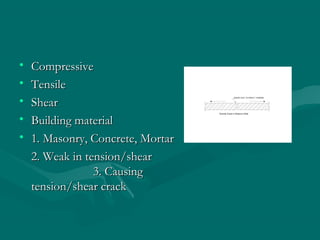
• CompressiveCompressive
• TensileTensile
• ShearShear
• Building materialBuilding material
• 1. Masonry, Concrete, Mortar1. Masonry, Concrete, Mortar
2. Weak in tension/shear2. Weak in tension/shear
3. Causing3. Causing
tension/shear cracktension/shear crack
HOW TO PREVENT CRACKSHOW TO PREVENT CRACKS
IN BUILDINGIN BUILDING
1.1. Drainage arrangement should be made aroundDrainage arrangement should be made around
the building to minimize water entry in thethe building to minimize water entry in the
foundation.foundation.
2.2. Avoid construction of wall on filled up soil.Avoid construction of wall on filled up soil.
3.3. Avoid trees grow too close to building &Avoid trees grow too close to building &
compound wallscompound walls
Moisture MovementMoisture Movement
• Reversible MovementReversible Movement
- Material expands on absorbing moistureMaterial expands on absorbing moisture
contentcontent
- Shrinks on dryingShrinks on drying
• Irreversible movementIrreversible movement
-- Material undergo some irreversible movementMaterial undergo some irreversible movement
due to initial moisture changedue to initial moisture change
Types and causes of cracks inTypes and causes of cracks in
ConcreteConcrete
• Before hardeningBefore hardening
DryingDrying
- Plastic shrinkagePlastic shrinkage
- Settlement shrinkageSettlement shrinkage
- BleedingBleeding
- Delayed curingDelayed curing
Continue…Continue…
ConstructionalConstructional
- Formwork movementFormwork movement
- Excess vibrationExcess vibration
- Subgrade settlementSubgrade settlement
- FinishingFinishing
Early frost damageEarly frost damage
Continue…Continue…
• After hardeningAfter hardening
 Unsound materialUnsound material
 Long term drying shrinkageLong term drying shrinkage
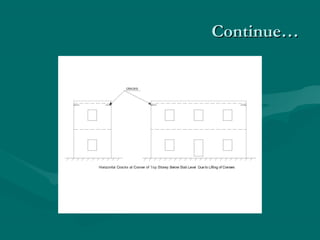
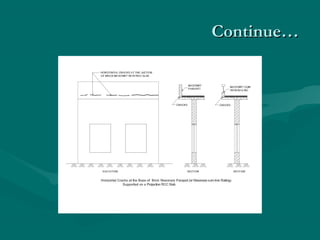
 ThermalThermal
 Moisture movementMoisture movement
 BiologicalBiological
 Structural design deficienciesStructural design deficiencies
 ChemicalChemical
 Corrosion of reinforcementCorrosion of reinforcement
Plastic shrinkage cracksPlastic shrinkage cracks
• Concrete surface loses water faster than theConcrete surface loses water faster than the
bleeding action brings it to topbleeding action brings it to top
• Quick drying of concrete at the surface results inQuick drying of concrete at the surface results in
shrinkageshrinkage
• Concrete at the plastic state can not resistConcrete at the plastic state can not resist
tensiontension
• Crack Depth 5 to 10 cm, width 3 mmCrack Depth 5 to 10 cm, width 3 mm
• Once developed difficult to rectifyOnce developed difficult to rectify
Measure to reduce plastic crackMeasure to reduce plastic crack
• Moisture the sub grade and form workMoisture the sub grade and form work
• Erect the temporary wind breakerErect the temporary wind breaker
• Erect the temporary roof to protect greenErect the temporary roof to protect green
concrete from hot sunconcrete from hot sun
• Reduce the time between placing & finishingReduce the time between placing & finishing
• In case of delay in finishing cover the concreteIn case of delay in finishing cover the concrete
with polythenewith polythene
Settlement shrinkageSettlement shrinkage
• If concrete is free to settle uniformly, no crackIf concrete is free to settle uniformly, no crack
occursoccurs
• Obstruction to uniform settlement createsObstruction to uniform settlement creates
voids/cracks (Reinforcement/Aggregate)voids/cracks (Reinforcement/Aggregate)
• Settlement crack (common in deep beam)Settlement crack (common in deep beam)
MeasureMeasure
• Pouring of concrete in layers with properPouring of concrete in layers with proper
compactioncompaction
• Revibration, if possibleRevibration, if possible
BleedingBleeding
• Upward movement of water when concrete settleUpward movement of water when concrete settle
downsdowns
• Internal bleedingInternal bleeding
- Bleeding water trapped below reinforcement &Bleeding water trapped below reinforcement &
aggregateaggregate
- Affects bonds between reinforcement and concreteAffects bonds between reinforcement and concrete
- Interface, prone to micro crackingInterface, prone to micro cracking
- Weak link in concreteWeak link in concrete
- Further loading propagate crackingFurther loading propagate cracking
Continue…Continue…
• External BleedingExternal Bleeding
- Upward movement of water emerged at topUpward movement of water emerged at top
surfacesurface
- After evaporation : surface – Porous andAfter evaporation : surface – Porous and
abrasion resistance very little.abrasion resistance very little.
General ObservationsGeneral Observations
• Mason floats concrete when bleeding water stillMason floats concrete when bleeding water still
standing.standing.
• ResultsResults
-- Downward movement of coarse aggregateDownward movement of coarse aggregate
- Upward movement of fine particles (cement and water)Upward movement of fine particles (cement and water)
• Top surfaceTop surface
- Presence of fine materials develops crack and crazinessPresence of fine materials develops crack and craziness
(Craziness: occurrence of closely spaced crack at surface)(Craziness: occurrence of closely spaced crack at surface)
Delayed CuringDelayed Curing
• Common practiceCommon practice
- Delayed curingDelayed curing
- Interruption in continuous curingInterruption in continuous curing
- Curing not done for required periodCuring not done for required period
• Major cause for shrinkageMajor cause for shrinkage
• Minimum 7 to 10 days curing requiredMinimum 7 to 10 days curing required
Unsound MaterialUnsound Material
• Use of crushed sand very common nowUse of crushed sand very common now
• Amount of dust (<75 micron): Very highAmount of dust (<75 micron): Very high
• Presence of excess dust :Presence of excess dust :
- Causes crack formation- Causes crack formation
- Interfere with setting time, Shrinkage and- Interfere with setting time, Shrinkage and
BondBond
• Maximum %age of fine = 3% (CoarseMaximum %age of fine = 3% (Coarse
aggregate)aggregate)
Continue…Continue…
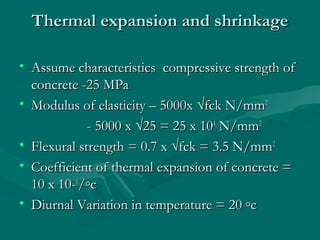
Thermal expansion and shrinkageThermal expansion and shrinkage
• Assume characteristics compressive strength ofAssume characteristics compressive strength of
concrete -25 MPaconcrete -25 MPa
• Modulus of elasticity – 5000x √fck N/mmModulus of elasticity – 5000x √fck N/mm22
- 5000 x √25 = 25 x 10- 5000 x √25 = 25 x 1044
N/mmN/mm22
• Flexural strength = 0.7 x √fck = 3.5 N/mmFlexural strength = 0.7 x √fck = 3.5 N/mm22
• Coefficient of thermal expansion of concrete =Coefficient of thermal expansion of concrete =
10 x 10-10 x 10-66
/◦c/◦c
• Diurnal Variation in temperature = 20 ◦cDiurnal Variation in temperature = 20 ◦c
Continue…Continue…
Thanks…Thanks…

cracks in building

  • 1.
    CRACKS IN BUILDINGS:CRACKSIN BUILDINGS: Some Remedial MeasuresSome Remedial Measures RamasharyRamashary CivilCivil engineersengineers
  • 2.
    IS THAT CRACKSERIOUS?IS THAT CRACK SERIOUS? • Simplest questions to ask.Simplest questions to ask. • One of the most difficult to answer.One of the most difficult to answer. • Prof. Mealcom Hollis-”Surveying buildings is anProf. Mealcom Hollis-”Surveying buildings is an art, verifying the cause of failure is a science”art, verifying the cause of failure is a science”
  • 3.
    Classification of CracksClassificationof Cracks Structural crackStructural crack Non structural crackNon structural crack Incorrect designIncorrect design Faulty constructionFaulty construction OverloadingOverloading Internal induced stress inInternal induced stress in building materialbuilding material
  • 4.
    REASONS OF CRACKSINREASONS OF CRACKS IN BUILDINGBUILDING 1.1. Chemical reaction in construction materials.Chemical reaction in construction materials. 2.2. Climatic condition of the nature.Climatic condition of the nature. 3.3. Foundation movement & settling of building.Foundation movement & settling of building. 4.4. Environmental stresses.Environmental stresses. 5.5. Bad quality materials.Bad quality materials. 6.6. Wrong method of construction.Wrong method of construction.
  • 5.
    Classification of cracksClassificationof cracks (Based on width)(Based on width) TypeType WidthWidth ThinThin MediumMedium WideWide < 1 mm< 1 mm 1-2 mm1-2 mm > 2 mm> 2 mm
  • 6.
    REPAIR CRACKSREPAIR CRACKS 1.Repair cracks on plaster surface. 2. Repair cracks on RCC surface. 3. Repair cracks on masonry walls. 4. Repair cracks in floor.
  • 7.
    • CompressiveCompressive • TensileTensile •ShearShear • Building materialBuilding material • 1. Masonry, Concrete, Mortar1. Masonry, Concrete, Mortar 2. Weak in tension/shear2. Weak in tension/shear 3. Causing3. Causing tension/shear cracktension/shear crack
  • 8.
    HOW TO PREVENTCRACKSHOW TO PREVENT CRACKS IN BUILDINGIN BUILDING 1.1. Drainage arrangement should be made aroundDrainage arrangement should be made around the building to minimize water entry in thethe building to minimize water entry in the foundation.foundation. 2.2. Avoid construction of wall on filled up soil.Avoid construction of wall on filled up soil. 3.3. Avoid trees grow too close to building &Avoid trees grow too close to building & compound wallscompound walls
  • 9.
    Moisture MovementMoisture Movement •Reversible MovementReversible Movement - Material expands on absorbing moistureMaterial expands on absorbing moisture contentcontent - Shrinks on dryingShrinks on drying • Irreversible movementIrreversible movement -- Material undergo some irreversible movementMaterial undergo some irreversible movement due to initial moisture changedue to initial moisture change
  • 10.
    Types and causesof cracks inTypes and causes of cracks in ConcreteConcrete • Before hardeningBefore hardening DryingDrying - Plastic shrinkagePlastic shrinkage - Settlement shrinkageSettlement shrinkage - BleedingBleeding - Delayed curingDelayed curing
  • 11.
    Continue…Continue… ConstructionalConstructional - Formwork movementFormworkmovement - Excess vibrationExcess vibration - Subgrade settlementSubgrade settlement - FinishingFinishing Early frost damageEarly frost damage
  • 12.
    Continue…Continue… • After hardeningAfterhardening  Unsound materialUnsound material  Long term drying shrinkageLong term drying shrinkage  ThermalThermal  Moisture movementMoisture movement  BiologicalBiological  Structural design deficienciesStructural design deficiencies  ChemicalChemical  Corrosion of reinforcementCorrosion of reinforcement
  • 13.
    Plastic shrinkage cracksPlasticshrinkage cracks • Concrete surface loses water faster than theConcrete surface loses water faster than the bleeding action brings it to topbleeding action brings it to top • Quick drying of concrete at the surface results inQuick drying of concrete at the surface results in shrinkageshrinkage • Concrete at the plastic state can not resistConcrete at the plastic state can not resist tensiontension • Crack Depth 5 to 10 cm, width 3 mmCrack Depth 5 to 10 cm, width 3 mm • Once developed difficult to rectifyOnce developed difficult to rectify
  • 14.
    Measure to reduceplastic crackMeasure to reduce plastic crack • Moisture the sub grade and form workMoisture the sub grade and form work • Erect the temporary wind breakerErect the temporary wind breaker • Erect the temporary roof to protect greenErect the temporary roof to protect green concrete from hot sunconcrete from hot sun • Reduce the time between placing & finishingReduce the time between placing & finishing • In case of delay in finishing cover the concreteIn case of delay in finishing cover the concrete with polythenewith polythene
  • 15.
    Settlement shrinkageSettlement shrinkage •If concrete is free to settle uniformly, no crackIf concrete is free to settle uniformly, no crack occursoccurs • Obstruction to uniform settlement createsObstruction to uniform settlement creates voids/cracks (Reinforcement/Aggregate)voids/cracks (Reinforcement/Aggregate) • Settlement crack (common in deep beam)Settlement crack (common in deep beam)
  • 16.
    MeasureMeasure • Pouring ofconcrete in layers with properPouring of concrete in layers with proper compactioncompaction • Revibration, if possibleRevibration, if possible
  • 17.
    BleedingBleeding • Upward movementof water when concrete settleUpward movement of water when concrete settle downsdowns • Internal bleedingInternal bleeding - Bleeding water trapped below reinforcement &Bleeding water trapped below reinforcement & aggregateaggregate - Affects bonds between reinforcement and concreteAffects bonds between reinforcement and concrete - Interface, prone to micro crackingInterface, prone to micro cracking - Weak link in concreteWeak link in concrete - Further loading propagate crackingFurther loading propagate cracking
  • 18.
    Continue…Continue… • External BleedingExternalBleeding - Upward movement of water emerged at topUpward movement of water emerged at top surfacesurface - After evaporation : surface – Porous andAfter evaporation : surface – Porous and abrasion resistance very little.abrasion resistance very little.
  • 19.
    General ObservationsGeneral Observations •Mason floats concrete when bleeding water stillMason floats concrete when bleeding water still standing.standing. • ResultsResults -- Downward movement of coarse aggregateDownward movement of coarse aggregate - Upward movement of fine particles (cement and water)Upward movement of fine particles (cement and water) • Top surfaceTop surface - Presence of fine materials develops crack and crazinessPresence of fine materials develops crack and craziness (Craziness: occurrence of closely spaced crack at surface)(Craziness: occurrence of closely spaced crack at surface)
  • 20.
    Delayed CuringDelayed Curing •Common practiceCommon practice - Delayed curingDelayed curing - Interruption in continuous curingInterruption in continuous curing - Curing not done for required periodCuring not done for required period • Major cause for shrinkageMajor cause for shrinkage • Minimum 7 to 10 days curing requiredMinimum 7 to 10 days curing required
  • 21.
    Unsound MaterialUnsound Material •Use of crushed sand very common nowUse of crushed sand very common now • Amount of dust (<75 micron): Very highAmount of dust (<75 micron): Very high • Presence of excess dust :Presence of excess dust : - Causes crack formation- Causes crack formation - Interfere with setting time, Shrinkage and- Interfere with setting time, Shrinkage and BondBond • Maximum %age of fine = 3% (CoarseMaximum %age of fine = 3% (Coarse aggregate)aggregate)
  • 22.
  • 23.
    Thermal expansion andshrinkageThermal expansion and shrinkage • Assume characteristics compressive strength ofAssume characteristics compressive strength of concrete -25 MPaconcrete -25 MPa • Modulus of elasticity – 5000x √fck N/mmModulus of elasticity – 5000x √fck N/mm22 - 5000 x √25 = 25 x 10- 5000 x √25 = 25 x 1044 N/mmN/mm22 • Flexural strength = 0.7 x √fck = 3.5 N/mmFlexural strength = 0.7 x √fck = 3.5 N/mm22 • Coefficient of thermal expansion of concrete =Coefficient of thermal expansion of concrete = 10 x 10-10 x 10-66 /◦c/◦c • Diurnal Variation in temperature = 20 ◦cDiurnal Variation in temperature = 20 ◦c
  • 24.
  • 25.