CAD/ CAM/CAE
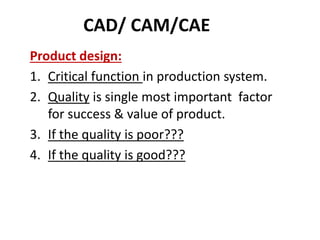
Product design:
1. Critical function in production system.
2. Quality is single most important factor
for success & value of product.
3. If the quality is poor???
4. If the quality is good???
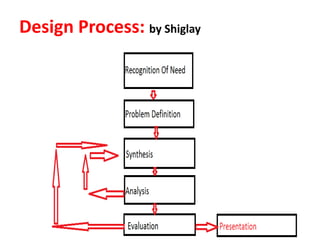
Design Process: by Shiglay
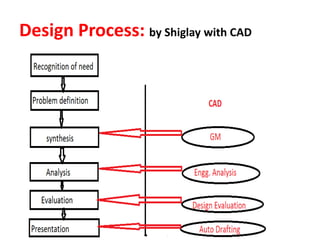
Design Process: by Shiglay with CAD
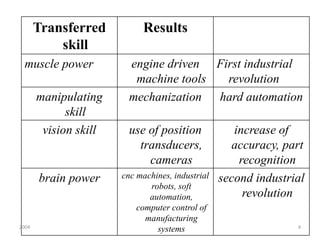
Transferred
skill
Results
muscle power engine driven
machine tools
First industrial
revolution
manipulating
skill
mechanization hard automation
vision skill use of position
transducers,
cameras
increase of
accuracy, part
recognition
brain power cnc machines, industrial
robots, soft
automation,
computer control of
manufacturing
systems
second industrial
revolution
2004 4
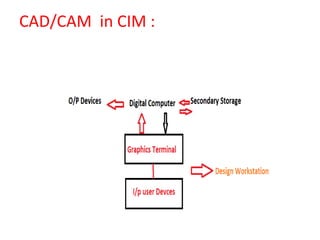
CAD/CAM in CIM :
CAD in CIM
• The hardware:
1) One or more Design workstations.
2) Digital Computers.
3) Plotters, printers.
4) Other Output devices.
5) Storage devices.
………..
1) Design Workstations:
Functions:
• Communicate with CPU (LAN)
• Continuously generate a graphic image.
• Provide digital description of the image .
• Translate user commands into operating
functions.
• Facilitate interaction between the user and
the system.
The user input devices:
1) It permits the operator to communicate with system.
2) It operates CAD system :
Enter alphanumerical data, Enter commands, Control
cursor position on display screen
2. Digital Computers:
• CAD Application requires a digital comp. with
specifications.
(CPU, Math-co processor, large internal
memory)
Math Co processor is used for to perform
COMPUTATION-Intensive operations
High Speed execution of Image by usin32
bit,64bit processors
3. Storage Devices:
• These are known as STORAGE PERIPHERALS
• Used in CAD system to store programs & data
files.
• Medium: Magnetic Disk & Magnetic Tape.
Files can be easily retrieved from Disk .
More time is required to access a given file for
magnetic tape due to Sequential File storage
on the tape. But less expensive.
4) Output Devices:
• CRT displays often used as a o/p device @
CAD workstations.
• Pen Plotters-X,Y plotters
• Electrostatic Plotters
• Inkjet Printers.
CAM:
• Computer integrated manufacturing is
effective use of computer technology in
manufacturing planning & manufacturing
control.
• It is related with process planning & NC.
CAM divided into
1) Mfg. Planning 2) Mfg. Control
Manufacturing Planning
Here computers are used directly or indirectly to
support the production function.
Application:
1) CAPP: process plan & Route sheets.
2) Computer NC part Programming: It
represents a much more efficient method of
generating the control instruction for m/c
tool than manual part programming.
>>>>
3) Computerized Mach-inability Data System:
Here different values are determined related to
machining such as feed rate, speed that should be
used to m/c a given w/p.
4) Cost Estimating:
Several Key steps are required to prepare the estimate.
5) Production& Inventory Planning:
Maintenance of inventory records, automatic
recording of stock items, production
scheduling, MRP,CP.
CAD/CAM in CIM Integration
• It is concerned with engg. function in both
design & Mfg.
Product design.
Engg. & documentation activities.
Process planning, NC programming & some
other activities.
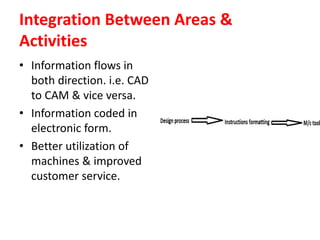
Integration Between Areas &
Activities
• Information flows in
both direction. i.e. CAD
to CAM & vice versa.
• Information coded in
electronic form.
• Better utilization of
machines & improved
customer service.
b.) Integration within Areas &
Activities
• Design:
Traditional engg. Dept
replaced by CAD facility.
Here designers work with
computer & result is
integrated CAD work
stations.
• Manufacturing
Moving conventional m/c to
NC, CNC/DNC, FMS &
now AI(Artificial
Intelligence)
Integrated cell, CNC cell etc.
• Coordination
Integrated Stock control,
MRP-I & II, integrated with
CAPM results in CIPMS
Benefits of
CAD/CAM in CIM
• Reduce the time for
synthesize, analyse &
documentation
• Allows to select diff
shapes, blended angles
which are difficult in
manual drafting.
• Using analysis
techniques select proper
design
• specifications of
product, dimensions,
material Specification,
BOM.
• Increased Design
Productivity
• Increased available
geometric forms in
design
• Improved quality in
design
• Improved design
documentation &
creating mfg.
database.
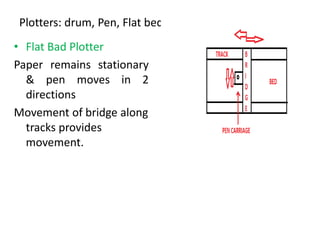
Plotters: drum, Pen, Flat bed
• Flat Bad Plotter
Paper remains stationary
& pen moves in 2
directions
Movement of bridge along
tracks provides
movement.
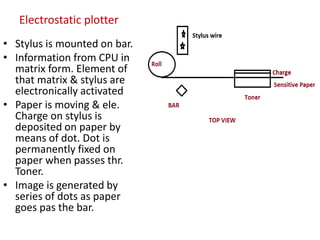
Electrostatic plotter
• Stylus is mounted on bar.
• Information from CPU in
matrix form. Element of
that matrix & stylus are
electronically activated
• Paper is moving & ele.
Charge on stylus is
deposited on paper by
means of dot. Dot is
permanently fixed on
paper when passes thr.
Toner.
• Image is generated by
series of dots as paper
goes pas the bar.

Cad cam-cae

  • 1.
    CAD/ CAM/CAE Product design: 1.Critical function in production system. 2. Quality is single most important factor for success & value of product. 3. If the quality is poor??? 4. If the quality is good???
  • 2.
  • 3.
    Design Process: byShiglay with CAD
  • 4.
    Transferred skill Results muscle power enginedriven machine tools First industrial revolution manipulating skill mechanization hard automation vision skill use of position transducers, cameras increase of accuracy, part recognition brain power cnc machines, industrial robots, soft automation, computer control of manufacturing systems second industrial revolution 2004 4
  • 5.
  • 6.
    CAD in CIM •The hardware: 1) One or more Design workstations. 2) Digital Computers. 3) Plotters, printers. 4) Other Output devices. 5) Storage devices.
  • 7.
    ……….. 1) Design Workstations: Functions: •Communicate with CPU (LAN) • Continuously generate a graphic image. • Provide digital description of the image . • Translate user commands into operating functions. • Facilitate interaction between the user and the system.
  • 8.
    The user inputdevices: 1) It permits the operator to communicate with system. 2) It operates CAD system : Enter alphanumerical data, Enter commands, Control cursor position on display screen
  • 9.
    2. Digital Computers: •CAD Application requires a digital comp. with specifications. (CPU, Math-co processor, large internal memory) Math Co processor is used for to perform COMPUTATION-Intensive operations High Speed execution of Image by usin32 bit,64bit processors
  • 10.
    3. Storage Devices: •These are known as STORAGE PERIPHERALS • Used in CAD system to store programs & data files. • Medium: Magnetic Disk & Magnetic Tape. Files can be easily retrieved from Disk . More time is required to access a given file for magnetic tape due to Sequential File storage on the tape. But less expensive.
  • 11.
    4) Output Devices: •CRT displays often used as a o/p device @ CAD workstations. • Pen Plotters-X,Y plotters • Electrostatic Plotters • Inkjet Printers.
  • 12.
    CAM: • Computer integratedmanufacturing is effective use of computer technology in manufacturing planning & manufacturing control. • It is related with process planning & NC. CAM divided into 1) Mfg. Planning 2) Mfg. Control
  • 13.
    Manufacturing Planning Here computersare used directly or indirectly to support the production function. Application: 1) CAPP: process plan & Route sheets. 2) Computer NC part Programming: It represents a much more efficient method of generating the control instruction for m/c tool than manual part programming.
  • 14.
    >>>> 3) Computerized Mach-inabilityData System: Here different values are determined related to machining such as feed rate, speed that should be used to m/c a given w/p. 4) Cost Estimating: Several Key steps are required to prepare the estimate. 5) Production& Inventory Planning: Maintenance of inventory records, automatic recording of stock items, production scheduling, MRP,CP.
  • 15.
    CAD/CAM in CIMIntegration • It is concerned with engg. function in both design & Mfg. Product design. Engg. & documentation activities. Process planning, NC programming & some other activities.
  • 16.
    Integration Between Areas& Activities • Information flows in both direction. i.e. CAD to CAM & vice versa. • Information coded in electronic form. • Better utilization of machines & improved customer service.
  • 17.
    b.) Integration withinAreas & Activities • Design: Traditional engg. Dept replaced by CAD facility. Here designers work with computer & result is integrated CAD work stations. • Manufacturing Moving conventional m/c to NC, CNC/DNC, FMS & now AI(Artificial Intelligence) Integrated cell, CNC cell etc. • Coordination Integrated Stock control, MRP-I & II, integrated with CAPM results in CIPMS
  • 18.
    Benefits of CAD/CAM inCIM • Reduce the time for synthesize, analyse & documentation • Allows to select diff shapes, blended angles which are difficult in manual drafting. • Using analysis techniques select proper design • specifications of product, dimensions, material Specification, BOM. • Increased Design Productivity • Increased available geometric forms in design • Improved quality in design • Improved design documentation & creating mfg. database.
  • 19.
    Plotters: drum, Pen,Flat bed • Flat Bad Plotter Paper remains stationary & pen moves in 2 directions Movement of bridge along tracks provides movement.
  • 20.
    Electrostatic plotter • Stylusis mounted on bar. • Information from CPU in matrix form. Element of that matrix & stylus are electronically activated • Paper is moving & ele. Charge on stylus is deposited on paper by means of dot. Dot is permanently fixed on paper when passes thr. Toner. • Image is generated by series of dots as paper goes pas the bar.