Major Assignment
Topic: CAD-CAM
Submitted To: Submitted By:
Mr. Amardeep Neha Nagar (K12236)
1st Year/ 2nd Sem.
CAD and CAM generally stands for Computer aided
Design and Computer aided manufacturing
Respectively. Designing usually starts with CAD
software where actual drawing of the part to be
machined is made which is followed by generating
tool paths on CAM software. CAD Technology =
Design Techniques + Computers The CAD Process
is the subset of the Design process. The CAM
Process is a subset of Manufacturing Process
Integration of CAD and CAM leads to automation.
 CAD and Cam (Computer Aided Manufacturing) together create
a link between product design and manufacturing.
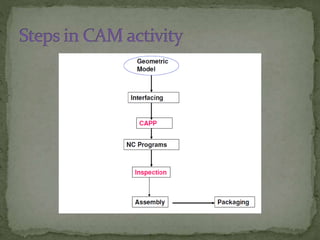
 The CAD system is used to develop a geometric model of the part
which is then used by the CAM system to generate part programs
for CNC machine tools.
 Both CAD and CAM functions may be performed either by the
same system or separate systems in different rooms or even
countries.
 A computer aided design, or CAD, system uses computers to
graphically create product designs and models. These designs can
be reviewed, revised, and refined for optimum end use and
application. Once finalized, the CAD design is then exported to a
computer aided manufacturing, or CAM, system.
 CAM systems assist in all phases of manufacturing a product,
including process planning, production planning, machining,
scheduling, management and quality control.
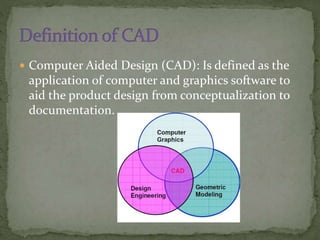
 Computer Aided Design (CAD): Is defined as the
application of computer and graphics software to
aid the product design from conceptualization to
documentation.
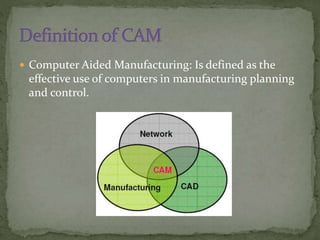
 Computer Aided Manufacturing: Is defined as the
effective use of computers in manufacturing planning
and control.
 Two types of activities: synthesis and analysis.
 Synthesis is largely qualitative and hard to capture on
computer.
 Analysis can be greatly enhanced with computers.
 Once analysis is complete, design evaluation- rapid
prototyping.
 Software packages for design optimization.
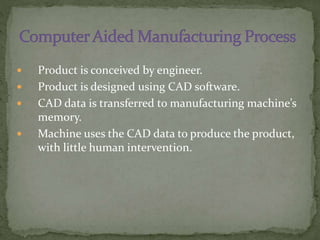
 Product is conceived by engineer.
 Product is designed using CAD software.
 CAD data is transferred to manufacturing machine’s
memory.
 Machine uses the CAD data to produce the product,
with little human intervention.
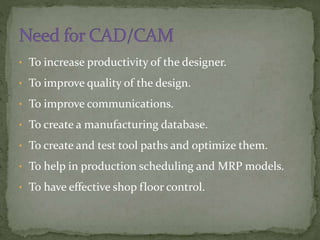
• To increase productivity of the designer.
• To improve quality of the design.
• To improve communications.
• To create a manufacturing database.
• To create and test tool paths and optimize them.
• To help in production scheduling and MRP models.
• To have effective shop floor control.
 CAE (Computer Aided Engineering).
 CAA(Computer Aided Analysis).
 CNC(Computer Numerical Control).
 CAP(Computer Aided Planning).
 CIM(Computer Integrated Manufacturing).
 Automotive Industry.
 Aerospace and aircraft industry.
 Textile industry.
 Medical industry.
 Video gaming industry.
 Tool and Die Manufacturing industry.
 Welding and Cutting industry.
 CAD/CAM systems allow for rapid development and
modifying of designs and documentation.
 It Lowers the overhead costs.
 The coupling of CAD and CAM considerably shortens the
time needed to bring a new product to market.
 Increased productivity is generally the justification for
using CAD/CAM system.
 It gives us Error free drafting.
 Expensive Software.
 Special skills required.
 Expensive machines required.
 High Maintenance.
 Nature of material of the object.
 Alternative to older mainframe and workstation based
system.
 Faster and more complex software could be run on
Unix.
 Standardization of software.
 Hologram technology in CAD-CAM.
Cad cam

Cad cam

  • 1.
    Major Assignment Topic: CAD-CAM SubmittedTo: Submitted By: Mr. Amardeep Neha Nagar (K12236) 1st Year/ 2nd Sem.
  • 2.
    CAD and CAMgenerally stands for Computer aided Design and Computer aided manufacturing Respectively. Designing usually starts with CAD software where actual drawing of the part to be machined is made which is followed by generating tool paths on CAM software. CAD Technology = Design Techniques + Computers The CAD Process is the subset of the Design process. The CAM Process is a subset of Manufacturing Process Integration of CAD and CAM leads to automation.
  • 3.
     CAD andCam (Computer Aided Manufacturing) together create a link between product design and manufacturing.  The CAD system is used to develop a geometric model of the part which is then used by the CAM system to generate part programs for CNC machine tools.  Both CAD and CAM functions may be performed either by the same system or separate systems in different rooms or even countries.  A computer aided design, or CAD, system uses computers to graphically create product designs and models. These designs can be reviewed, revised, and refined for optimum end use and application. Once finalized, the CAD design is then exported to a computer aided manufacturing, or CAM, system.  CAM systems assist in all phases of manufacturing a product, including process planning, production planning, machining, scheduling, management and quality control.
  • 4.
     Computer AidedDesign (CAD): Is defined as the application of computer and graphics software to aid the product design from conceptualization to documentation.
  • 5.
     Computer AidedManufacturing: Is defined as the effective use of computers in manufacturing planning and control.
  • 6.
     Two typesof activities: synthesis and analysis.  Synthesis is largely qualitative and hard to capture on computer.  Analysis can be greatly enhanced with computers.  Once analysis is complete, design evaluation- rapid prototyping.  Software packages for design optimization.
  • 7.
     Product isconceived by engineer.  Product is designed using CAD software.  CAD data is transferred to manufacturing machine’s memory.  Machine uses the CAD data to produce the product, with little human intervention.
  • 9.
    • To increaseproductivity of the designer. • To improve quality of the design. • To improve communications. • To create a manufacturing database. • To create and test tool paths and optimize them. • To help in production scheduling and MRP models. • To have effective shop floor control.
  • 10.
     CAE (ComputerAided Engineering).  CAA(Computer Aided Analysis).  CNC(Computer Numerical Control).  CAP(Computer Aided Planning).  CIM(Computer Integrated Manufacturing).
  • 11.
     Automotive Industry. Aerospace and aircraft industry.  Textile industry.  Medical industry.  Video gaming industry.  Tool and Die Manufacturing industry.  Welding and Cutting industry.
  • 12.
     CAD/CAM systemsallow for rapid development and modifying of designs and documentation.  It Lowers the overhead costs.  The coupling of CAD and CAM considerably shortens the time needed to bring a new product to market.  Increased productivity is generally the justification for using CAD/CAM system.  It gives us Error free drafting.
  • 13.
     Expensive Software. Special skills required.  Expensive machines required.  High Maintenance.  Nature of material of the object.
  • 14.
     Alternative toolder mainframe and workstation based system.  Faster and more complex software could be run on Unix.  Standardization of software.  Hologram technology in CAD-CAM.