Sanjivani Rural Education Society’s
Sanjivani College of Engineering, Kopargaon-423 603
(An Autonomous Institute, Affiliated to Savitribai Phule Pune University, Pune)
NAAC ‘A’ Grade Accredited, ISO 9001:2015 Certified
Department of Mechanical Engineering
Dr.S.R.Thorat
Assistant Professor
E-mail : thoratsandipmech@sanjivani.org.in
Subject :- Advanced Materials and Technology (ME405D)
B. Tech
Unit 3- Surface Modification Technology
Contents
• Importance of surface modification,
• classification of different methods & factors affecting :
• Electroplating , PVD , CVD ,IVD, powder coating, shot blasting, ion implantation,
plasma nitriding , anodizing,
• Surface preparation before coating & coating defects.
Dr. S.R.Thorat/Mech Engg Dept/Sanjivani COE Kopargaon
Introduction
Thorat S.R. Department Of Mechanical Engineering, Sanjivani COE, Kopargaon
What is surface?
Surface can be defined as geometrical boundary between solid and
environment and near surface of material to some depth.
Importance of Surface Preparation
Dr. S.R.Thorat/Mech Engg Dept/Sanjivani COE Kopargaon
Enhancing anticorrosive properties
Improving electrical conductivity and optical property
increasing bioactivities
Improving adhesion properties
Improve component lifetime and resistance to aggressive environment
Produce biocompatibility
Thorat S.R. Department Of Mechanical Engineering, Sanjivani COE, Kopargaon
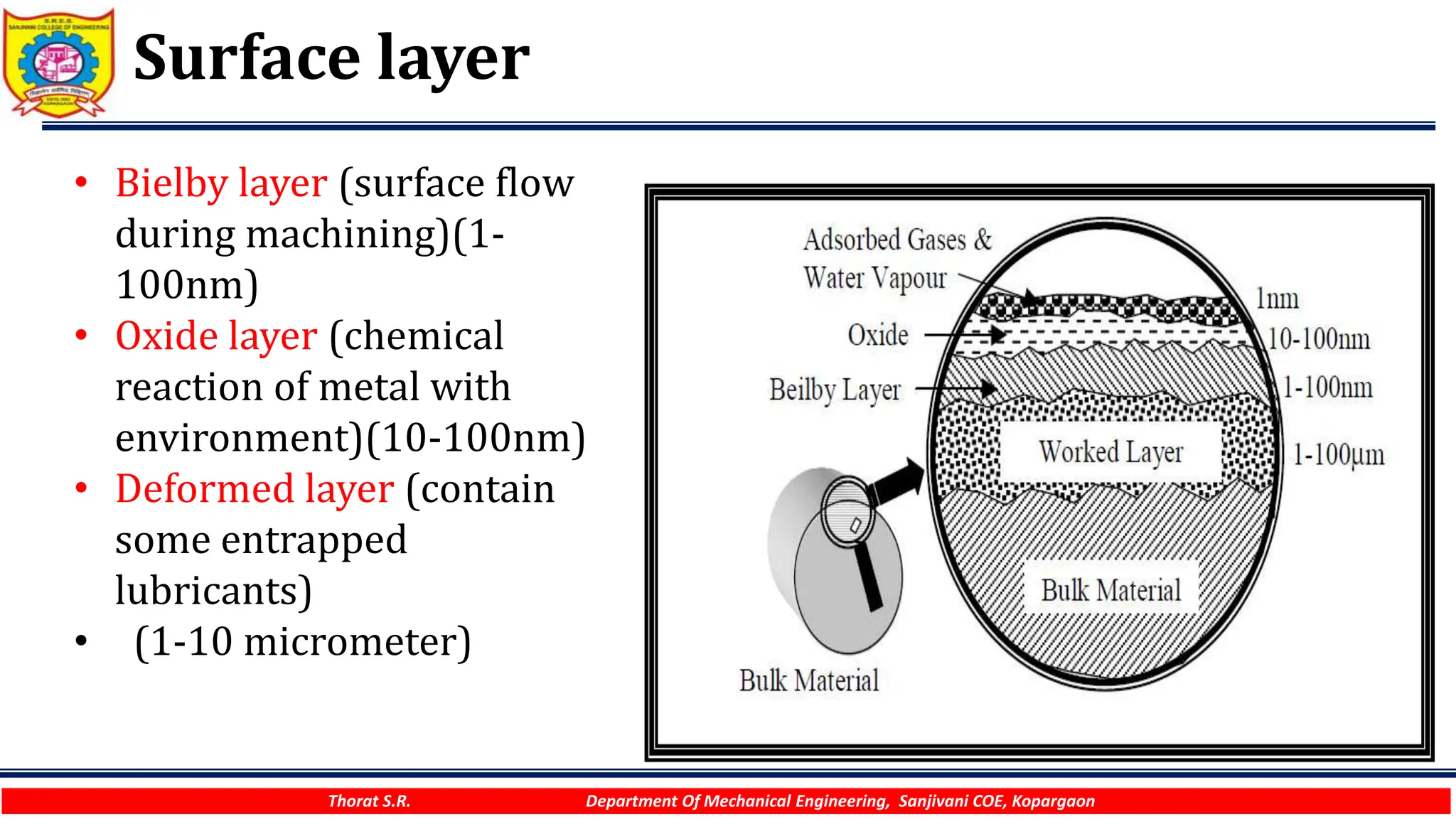
• Bielby layer (surface flow
during machining)(1-
100nm)
• Oxide layer (chemical
reaction of metal with
environment)(10-100nm)
• Deformed layer (contain
some entrapped
lubricants)
• (1-10 micrometer)
Surface layer
Prof. S.R.Thorat/Mech Engg Dept/Sanjivani COE Kopargaon
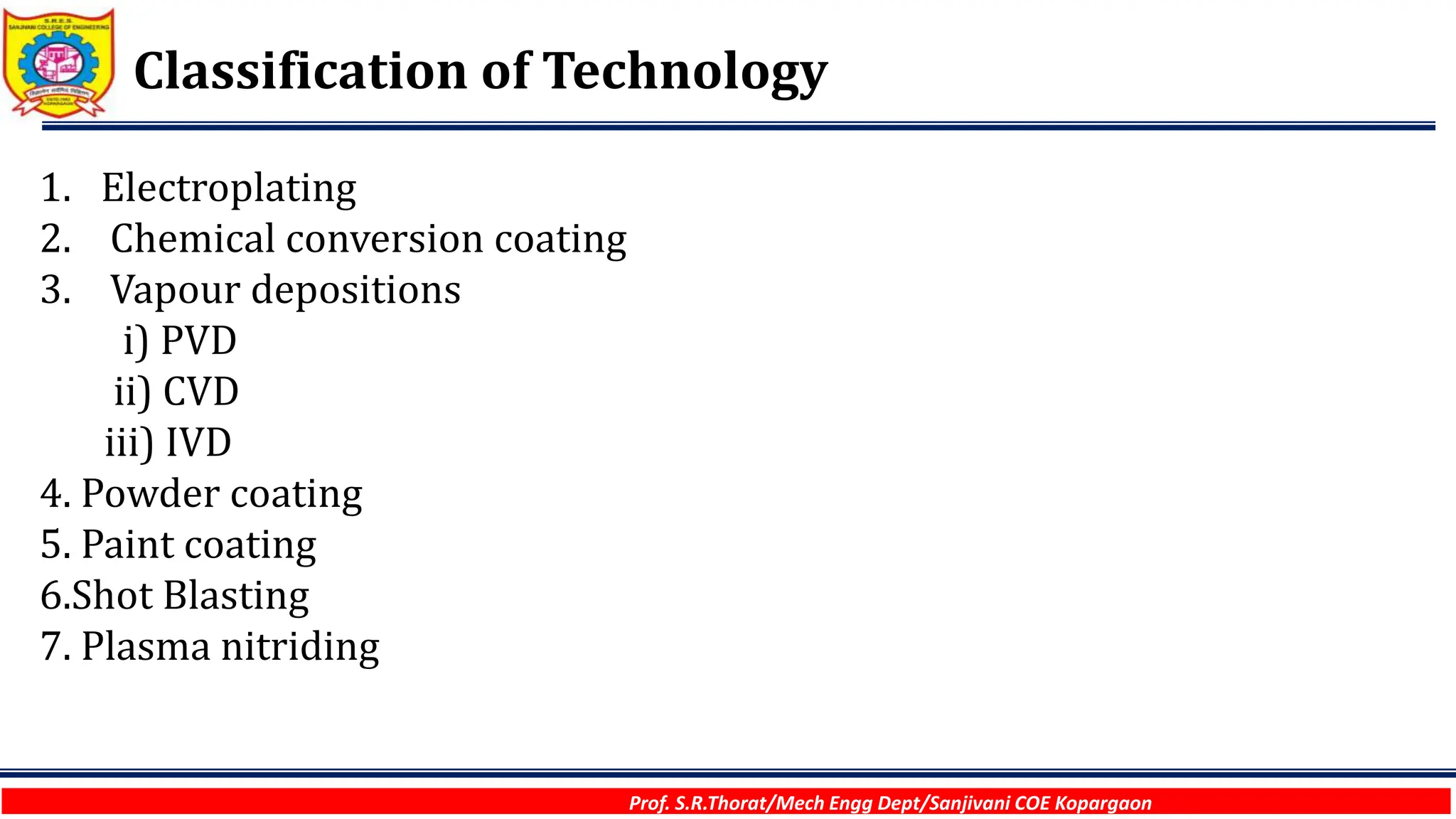
Classification of Technology
1. Electroplating
2. Chemical conversion coating
3. Vapour depositions
i) PVD
ii) CVD
iii) IVD
4. Powder coating
5. Paint coating
6.Shot Blasting
7. Plasma nitriding
Prof. S.R.Thorat/Mech Engg Dept/Sanjivani COE Kopargaon
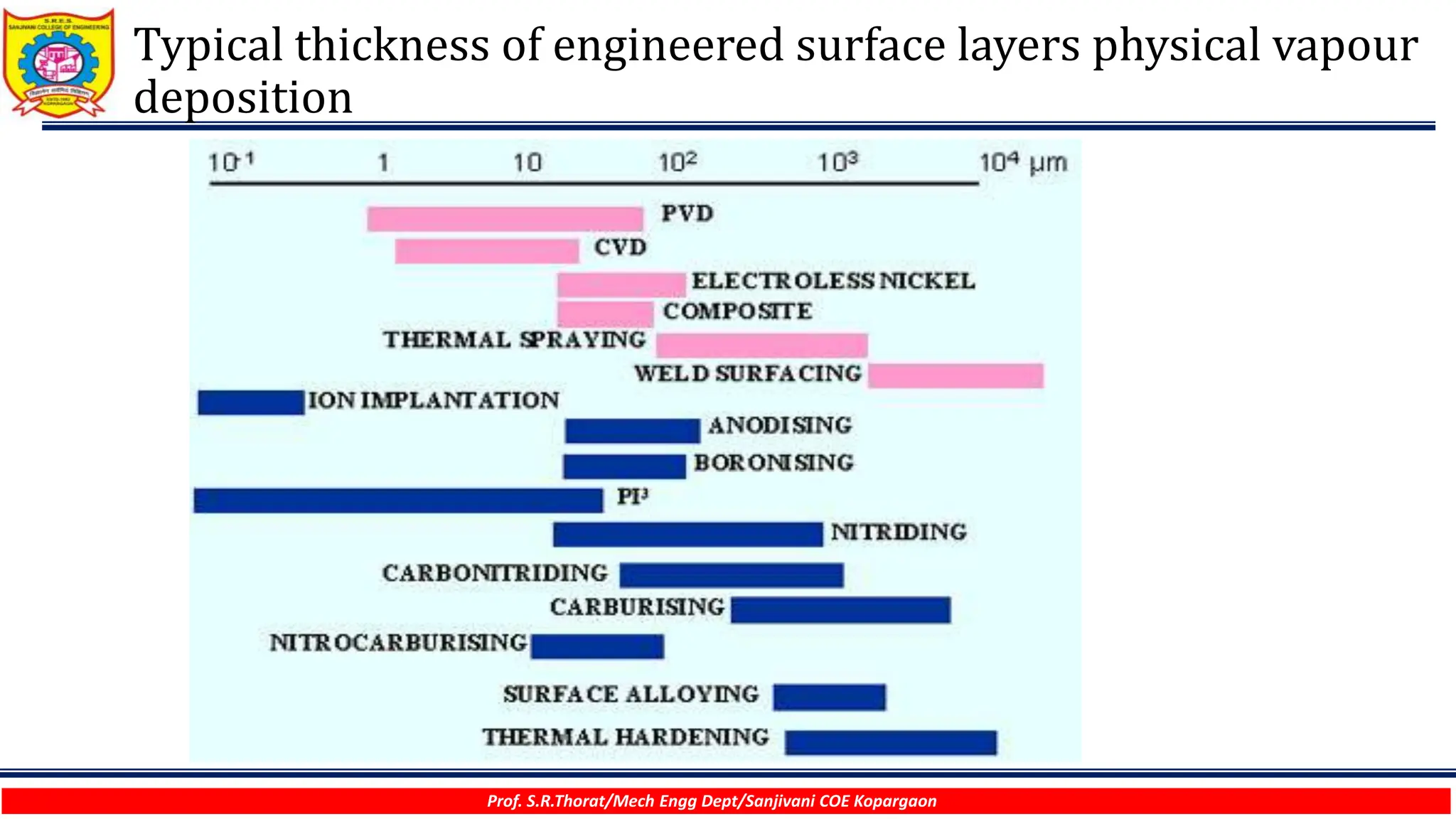
Typical thickness of engineered surface layers physical vapour
deposition
1.Electroplating
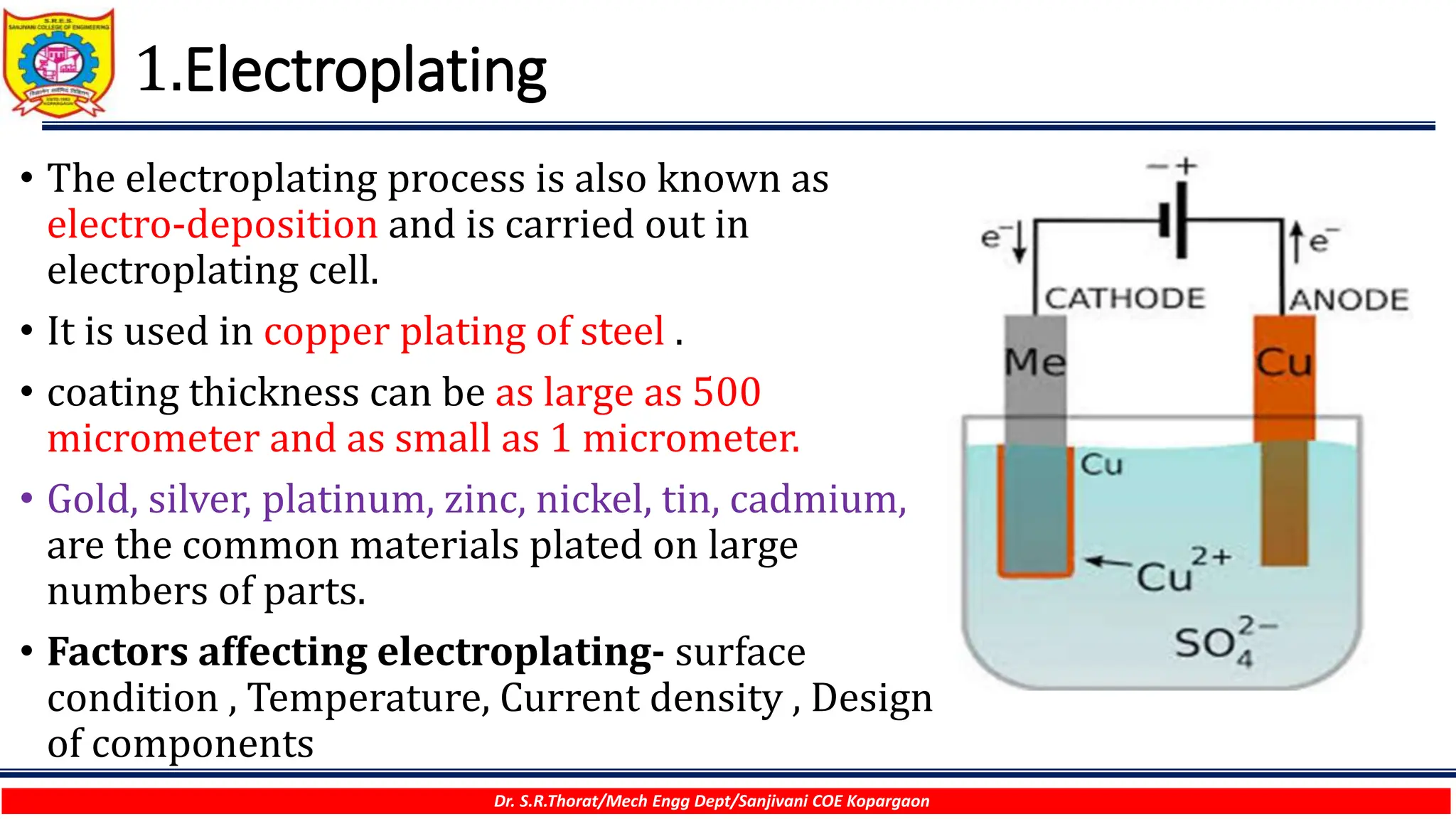
• The electroplating process is also known as
electro-deposition and is carried out in
electroplating cell.
• It is used in copper plating of steel .
• coating thickness can be as large as 500
micrometer and as small as 1 micrometer.
• Gold, silver, platinum, zinc, nickel, tin, cadmium,
are the common materials plated on large
numbers of parts.
• Factors affecting electroplating- surface
condition , Temperature, Current density , Design
of components
Dr. S.R.Thorat/Mech Engg Dept/Sanjivani COE Kopargaon
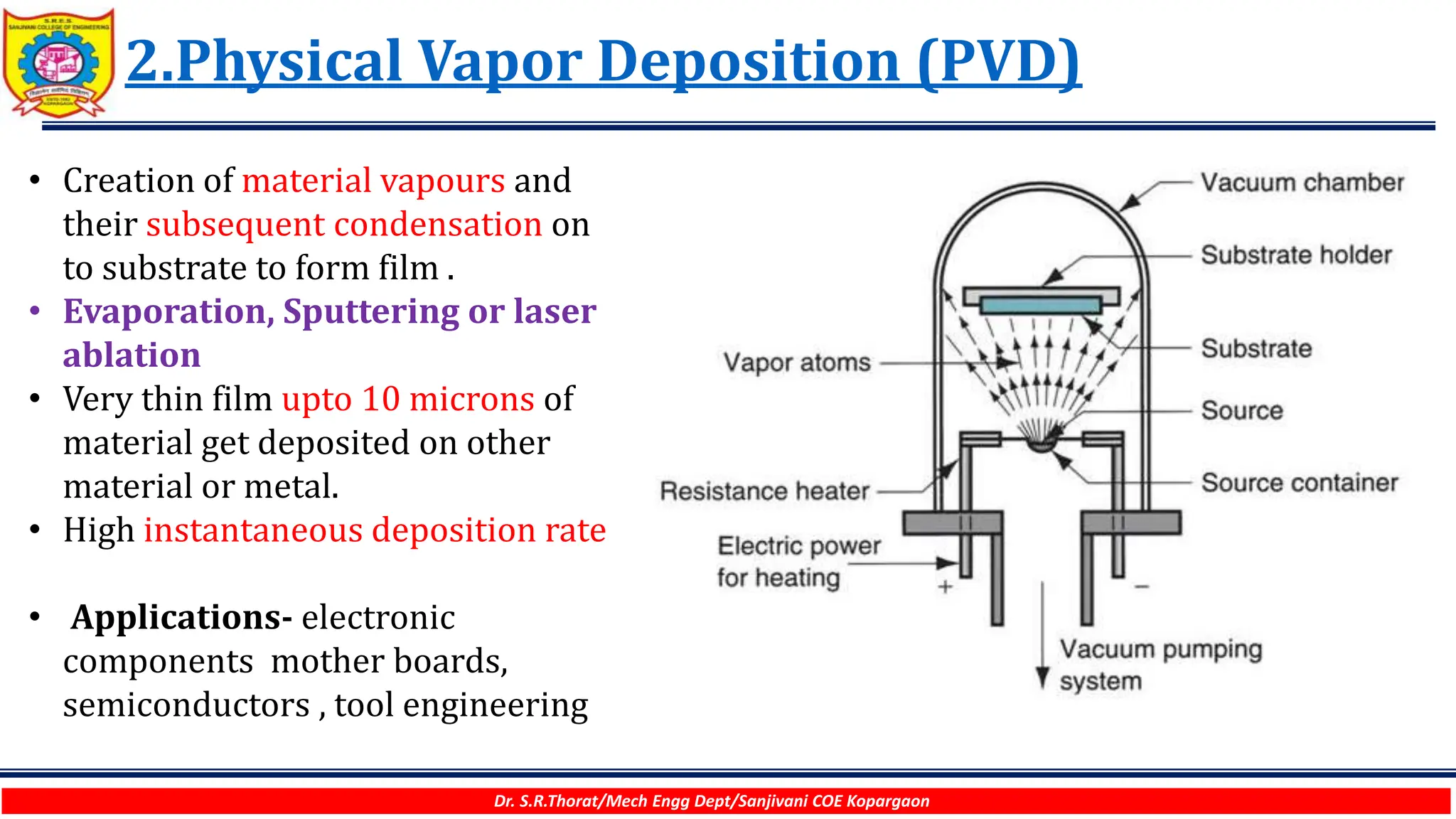
2.Physical Vapor Deposition (PVD)
• Creation of material vapours and
their subsequent condensation on
to substrate to form film .
• Evaporation, Sputtering or laser
ablation
• Very thin film upto 10 microns of
material get deposited on other
material or metal.
• High instantaneous deposition rate
• Applications- electronic
components mother boards,
semiconductors , tool engineering
Dr. S.R.Thorat/Mech Engg Dept/Sanjivani COE Kopargaon
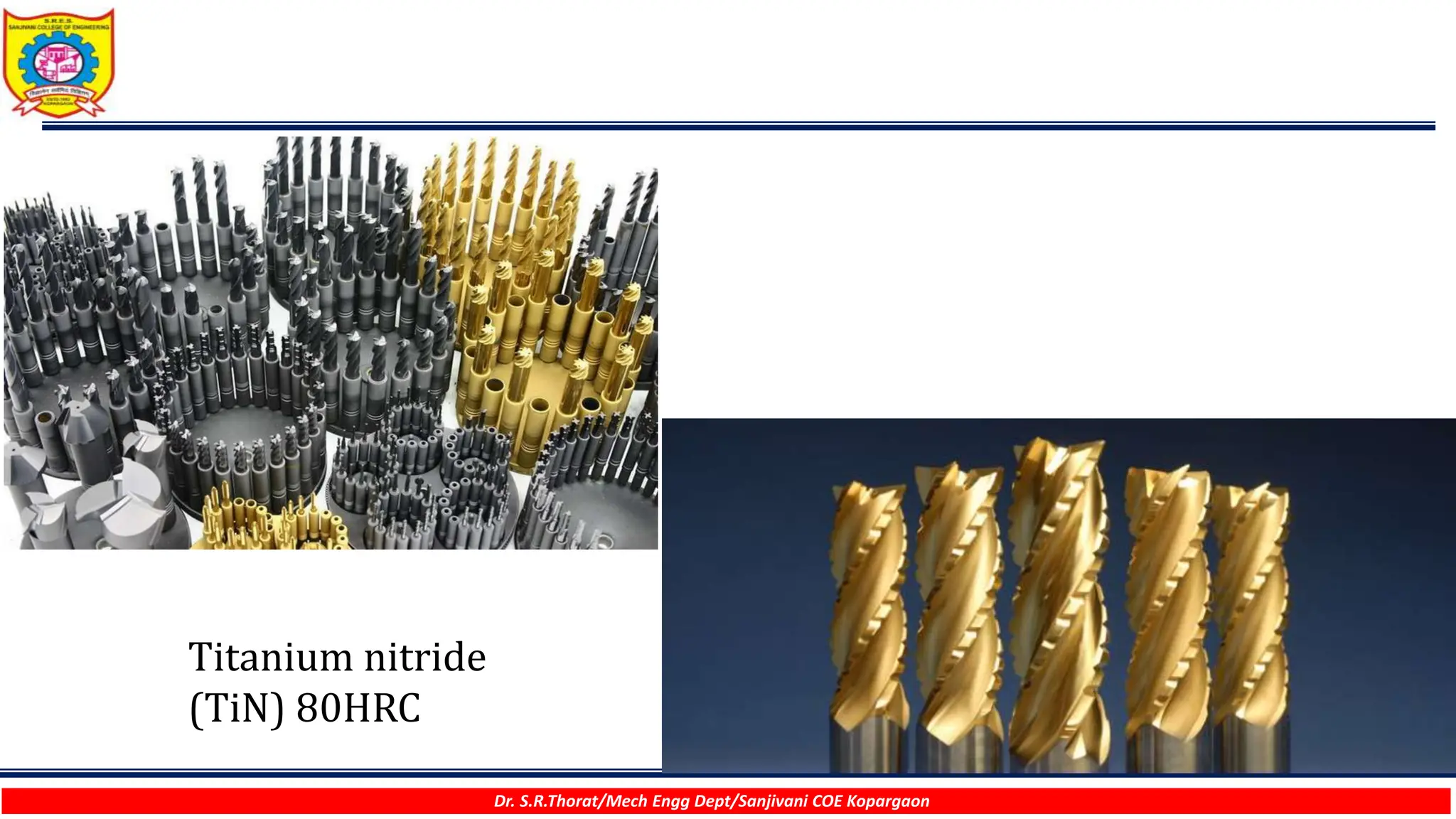
Titanium nitride
(TiN) 80HRC
Dr. S.R.Thorat/Mech Engg Dept/Sanjivani COE Kopargaon
• Advantages
• PVD is Harder &more corrosion resistant
• Most durable & excellent Abrasion resistance
Disadvantages
• PVD operates at very high temp.
• Required cooling water to dissipate large heat.
• Special attention is required
Dr. S.R.Thorat/Mech Engg Dept/Sanjivani COE Kopargaon
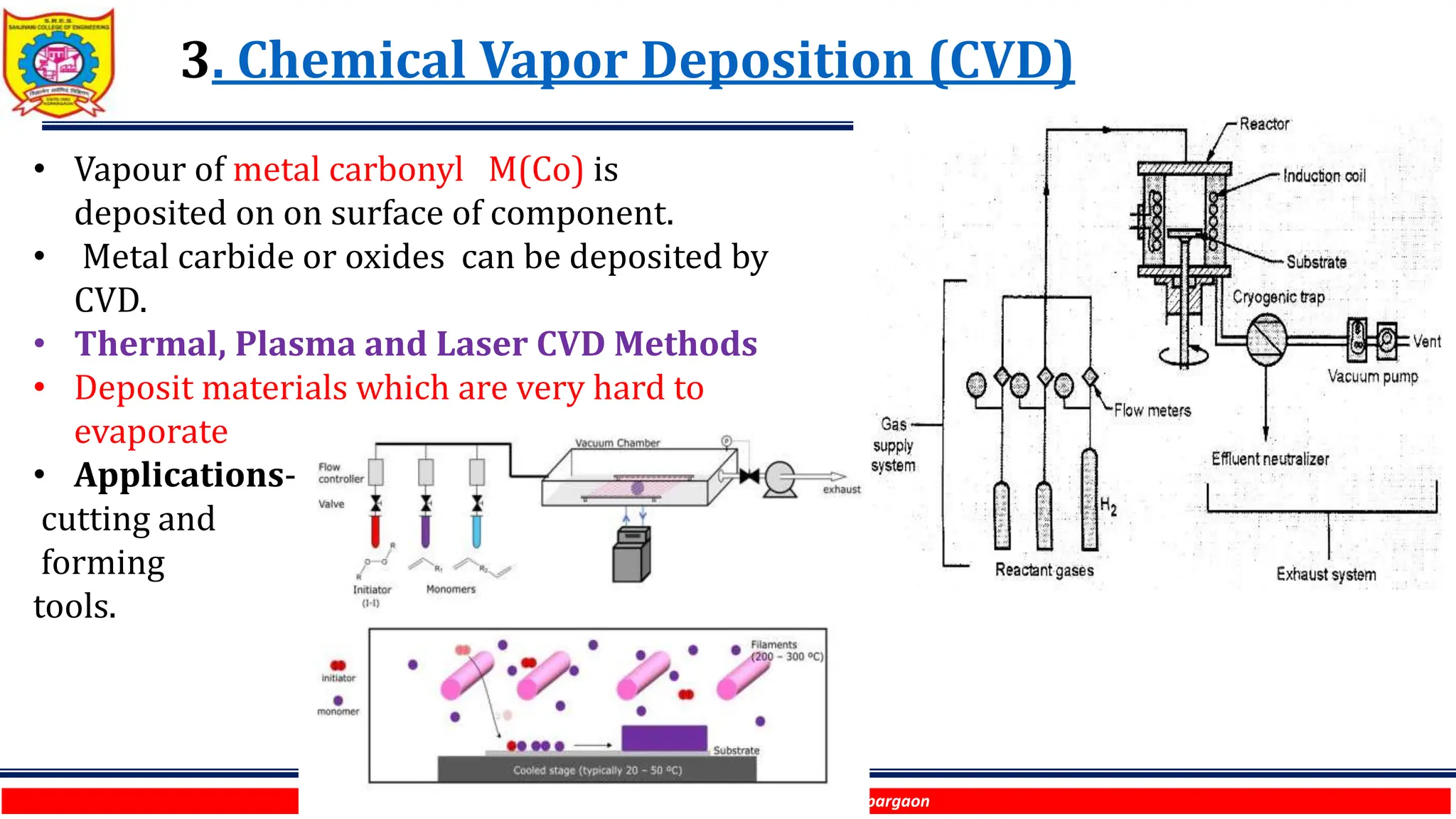
3. Chemical Vapor Deposition (CVD)
• Vapour of metal carbonyl M(Co) is
deposited on on surface of component.
• Metal carbide or oxides can be deposited by
CVD.
• Thermal, Plasma and Laser CVD Methods
• Deposit materials which are very hard to
evaporate
• Applications-
cutting and
forming
tools.
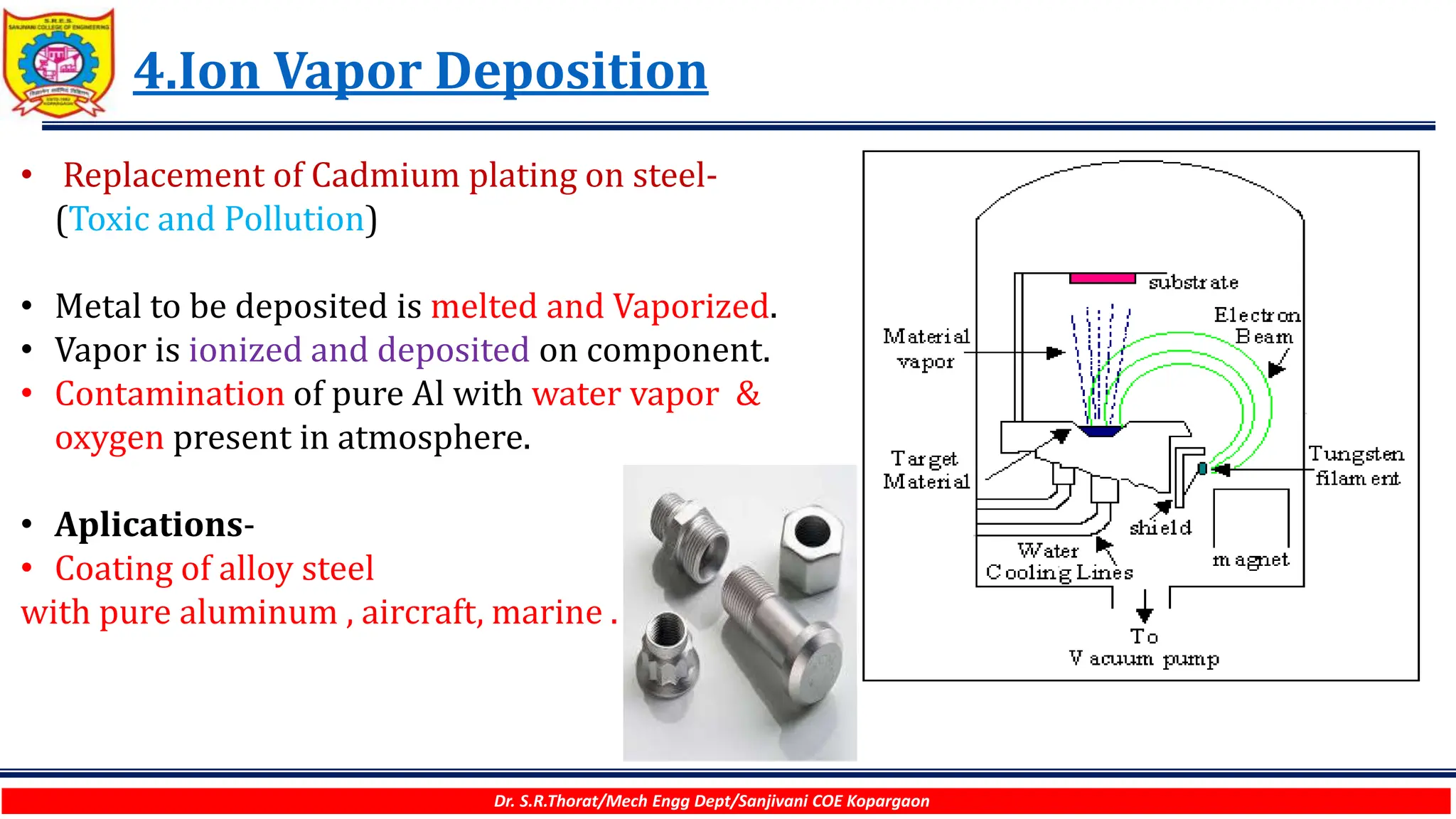
4.Ion Vapor Deposition
Dr. S.R.Thorat/Mech Engg Dept/Sanjivani COE Kopargaon
• Replacement of Cadmium plating on steel-
(Toxic and Pollution)
• Metal to be deposited is melted and Vaporized.
• Vapor is ionized and deposited on component.
• Contamination of pure Al with water vapor &
oxygen present in atmosphere.
• Aplications-
• Coating of alloy steel
with pure aluminum , aircraft, marine .
Dr. S.R.Thorat/Mech Engg Dept/Sanjivani COE Kopargaon
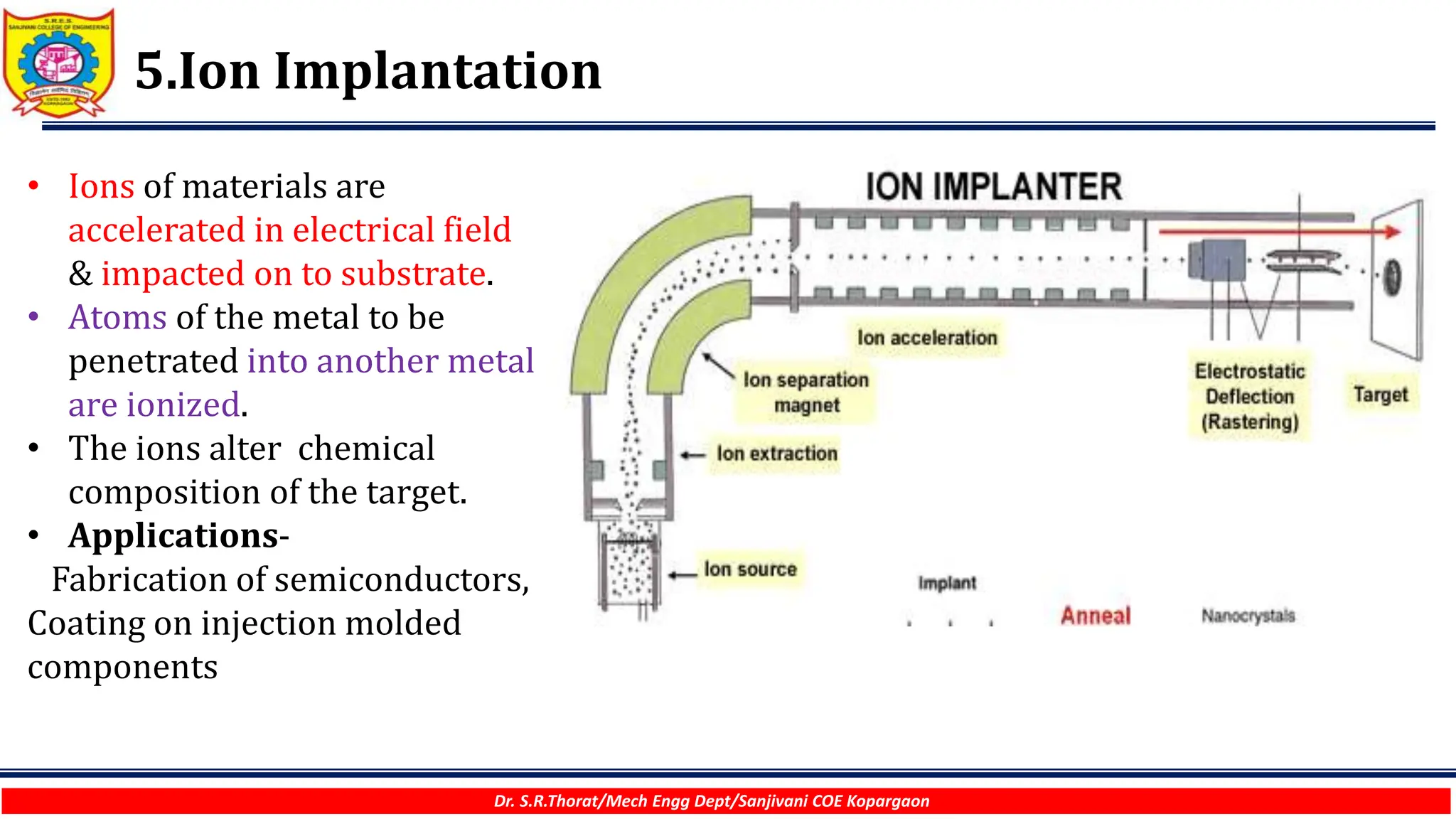
5.Ion Implantation
Dr. S.R.Thorat/Mech Engg Dept/Sanjivani COE Kopargaon
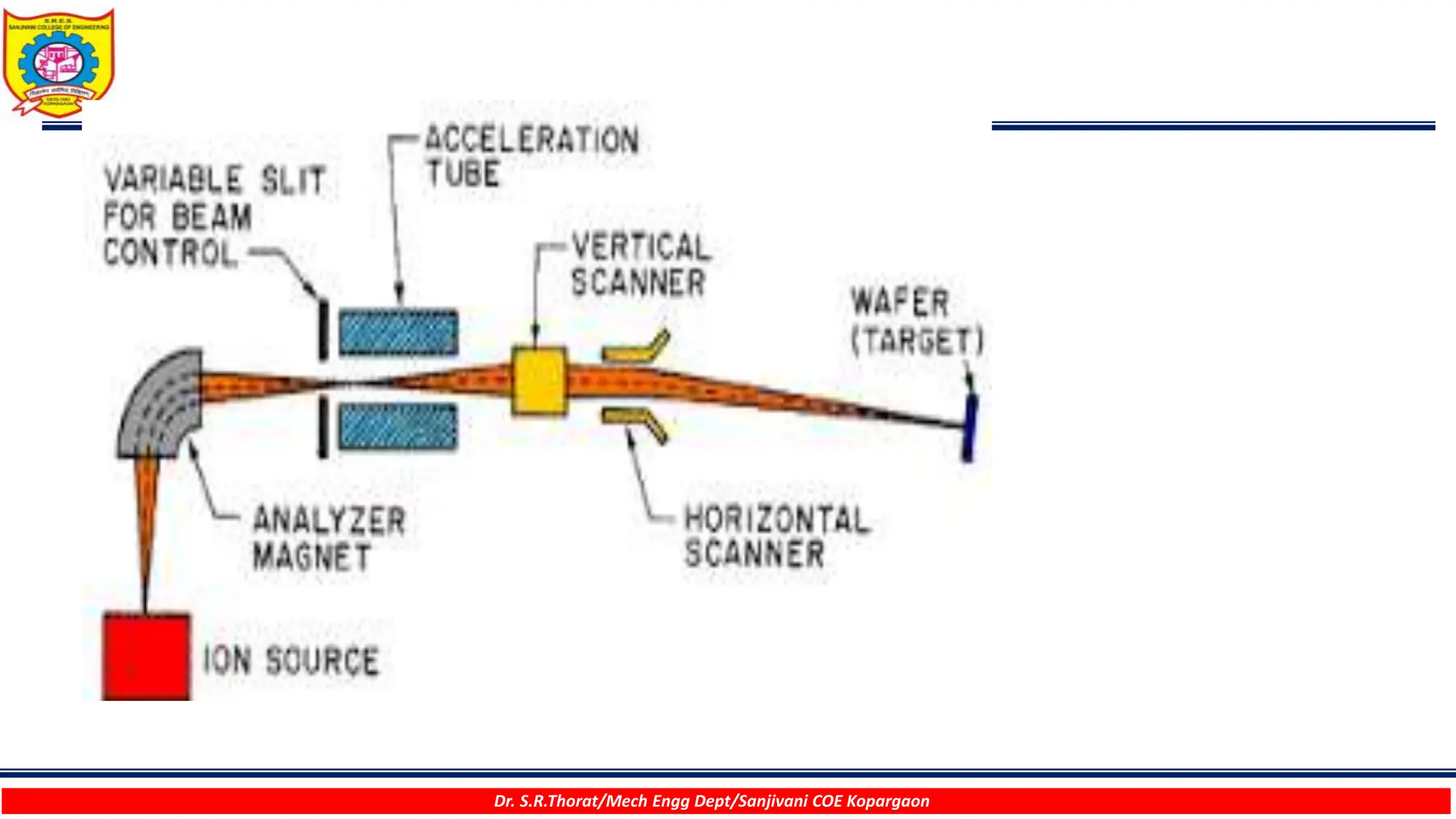
• Ions of materials are
accelerated in electrical field
& impacted on to substrate.
• Atoms of the metal to be
penetrated into another metal
are ionized.
• The ions alter chemical
composition of the target.
• Applications-
Fabrication of semiconductors,
Coating on injection molded
components
Dr. S.R.Thorat/Mech Engg Dept/Sanjivani COE Kopargaon
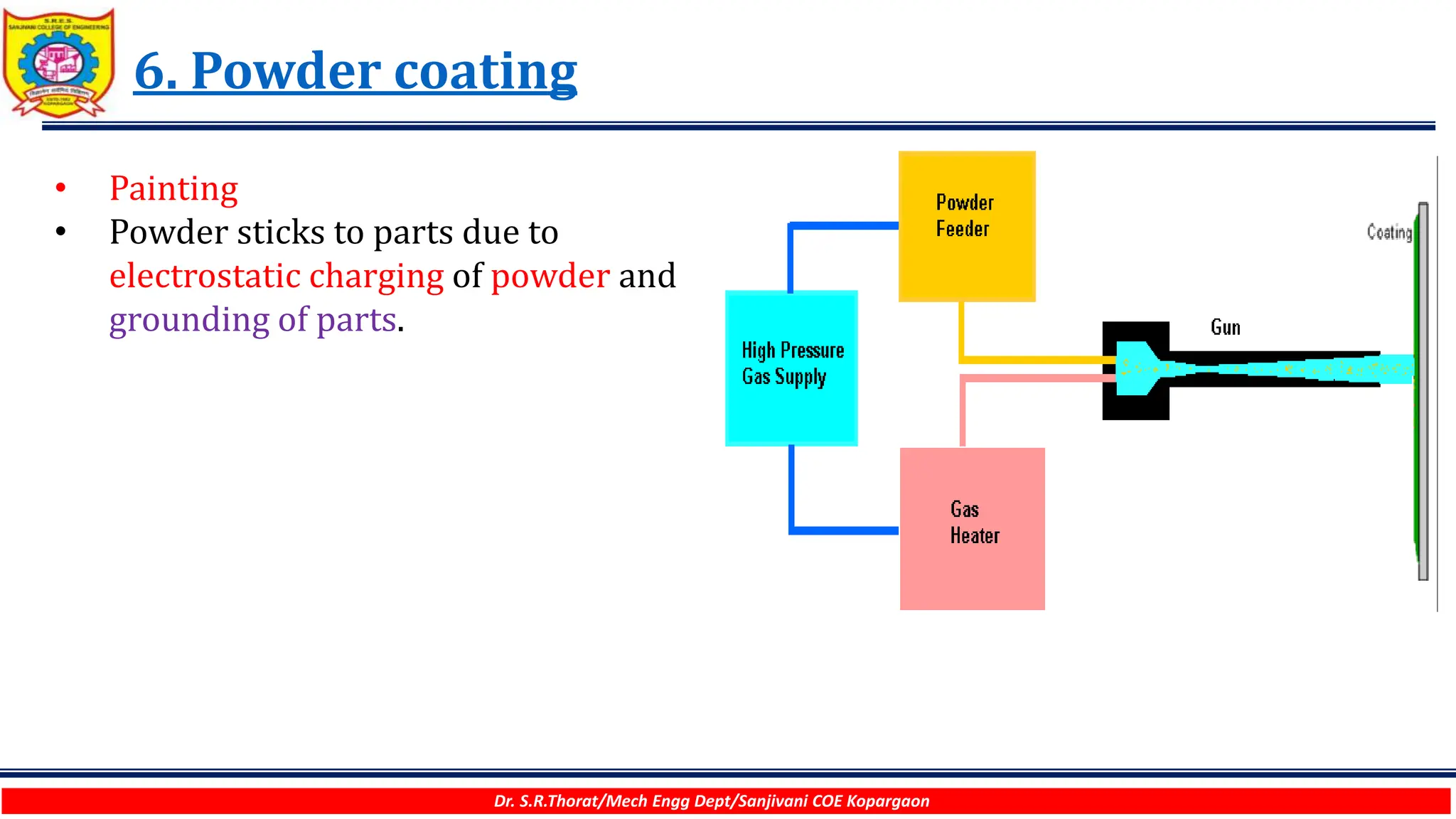
6. Powder coating
Dr. S.R.Thorat/Mech Engg Dept/Sanjivani COE Kopargaon
• Painting
• Powder sticks to parts due to
electrostatic charging of powder and
grounding of parts.
Dr. S.R.Thorat/Mech Engg Dept/Sanjivani COE Kopargaon
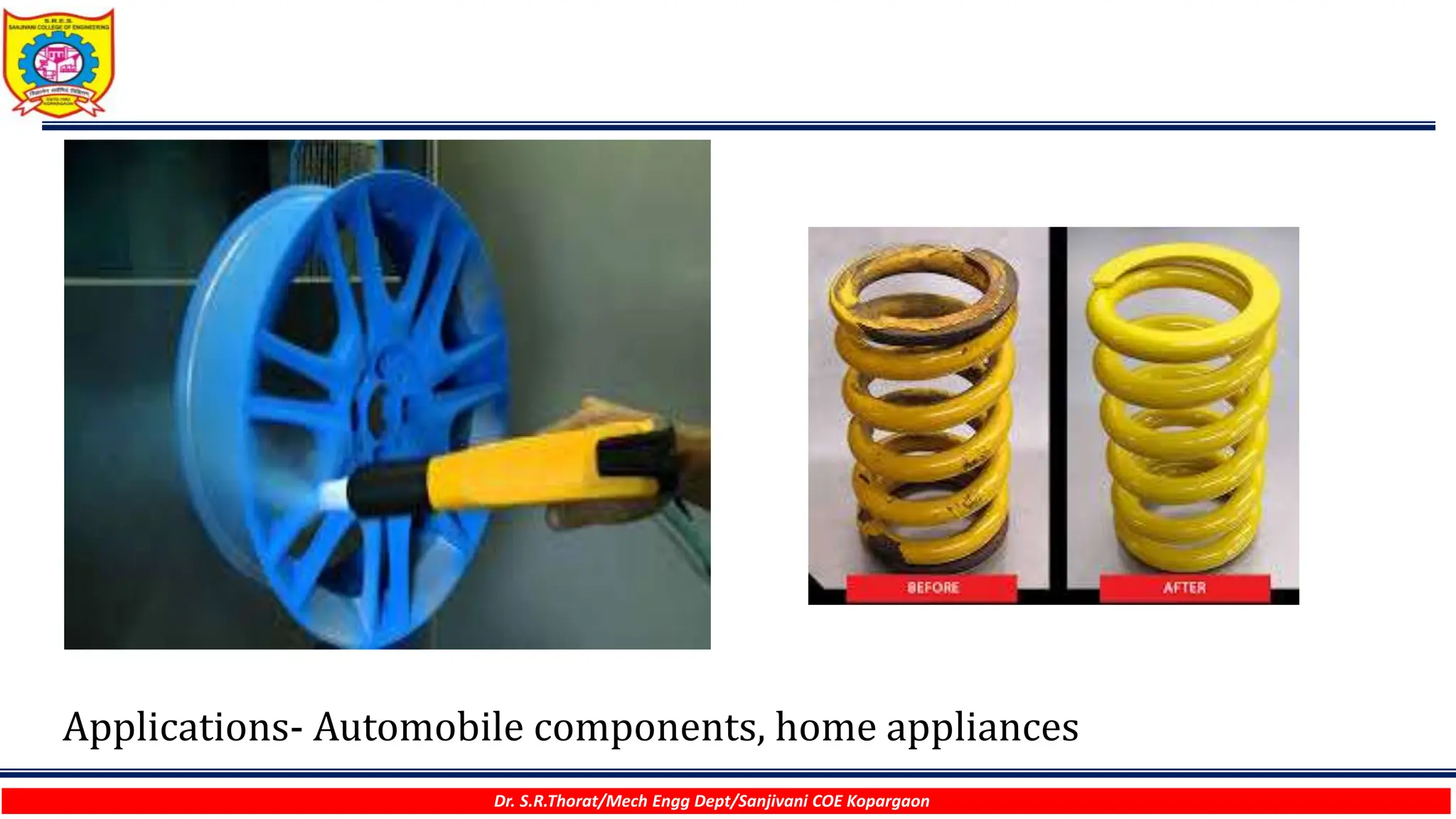
Applications- Automobile components, home appliances
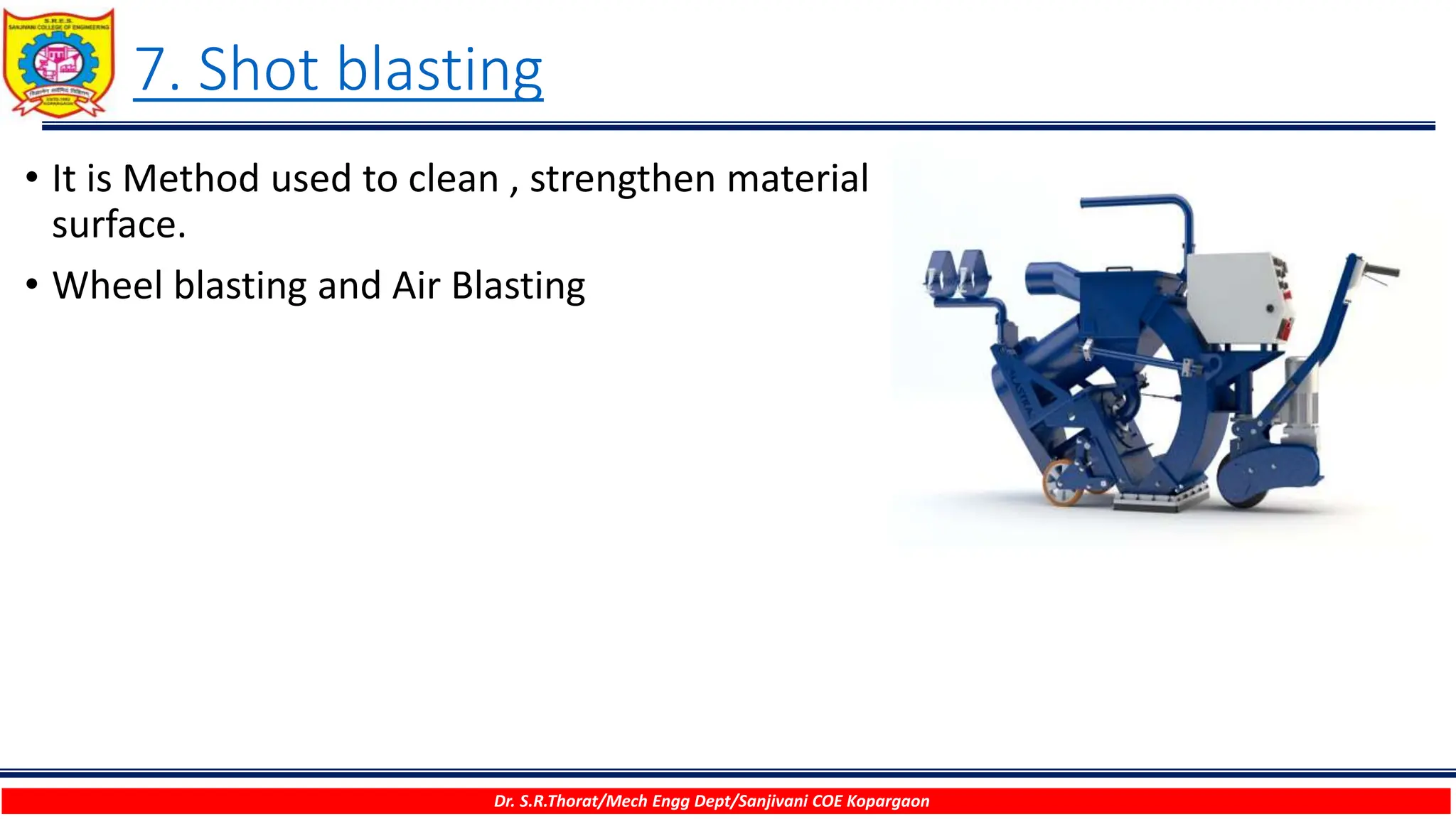
7. Shot blasting
Dr. S.R.Thorat/Mech Engg Dept/Sanjivani COE Kopargaon
• It is Method used to clean , strengthen material
surface.
• Wheel blasting and Air Blasting
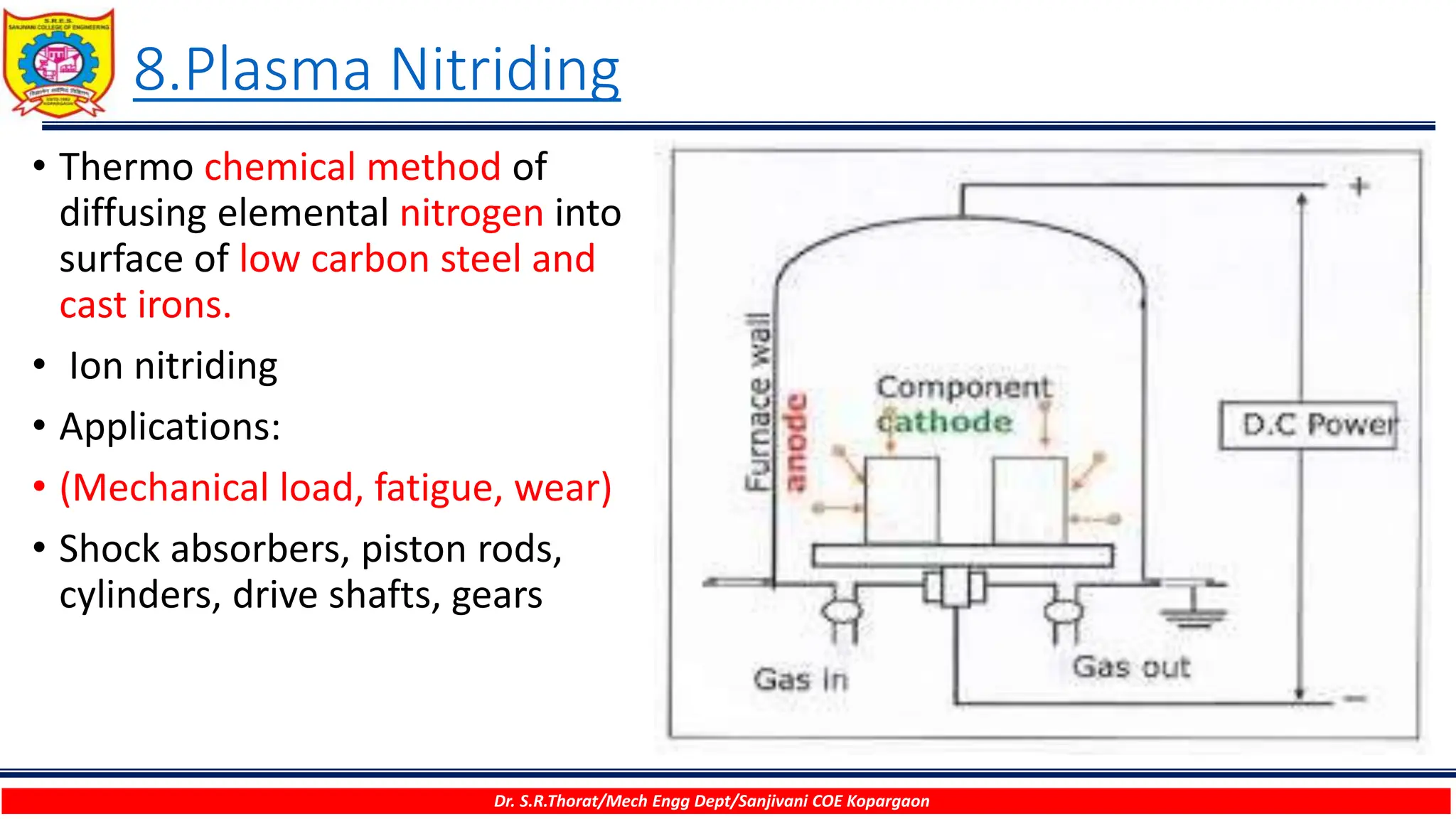
8.Plasma Nitriding
• Thermo chemical method of
diffusing elemental nitrogen into
surface of low carbon steel and
cast irons.
• Ion nitriding
• Applications:
• (Mechanical load, fatigue, wear)
• Shock absorbers, piston rods,
cylinders, drive shafts, gears
Dr. S.R.Thorat/Mech Engg Dept/Sanjivani COE Kopargaon
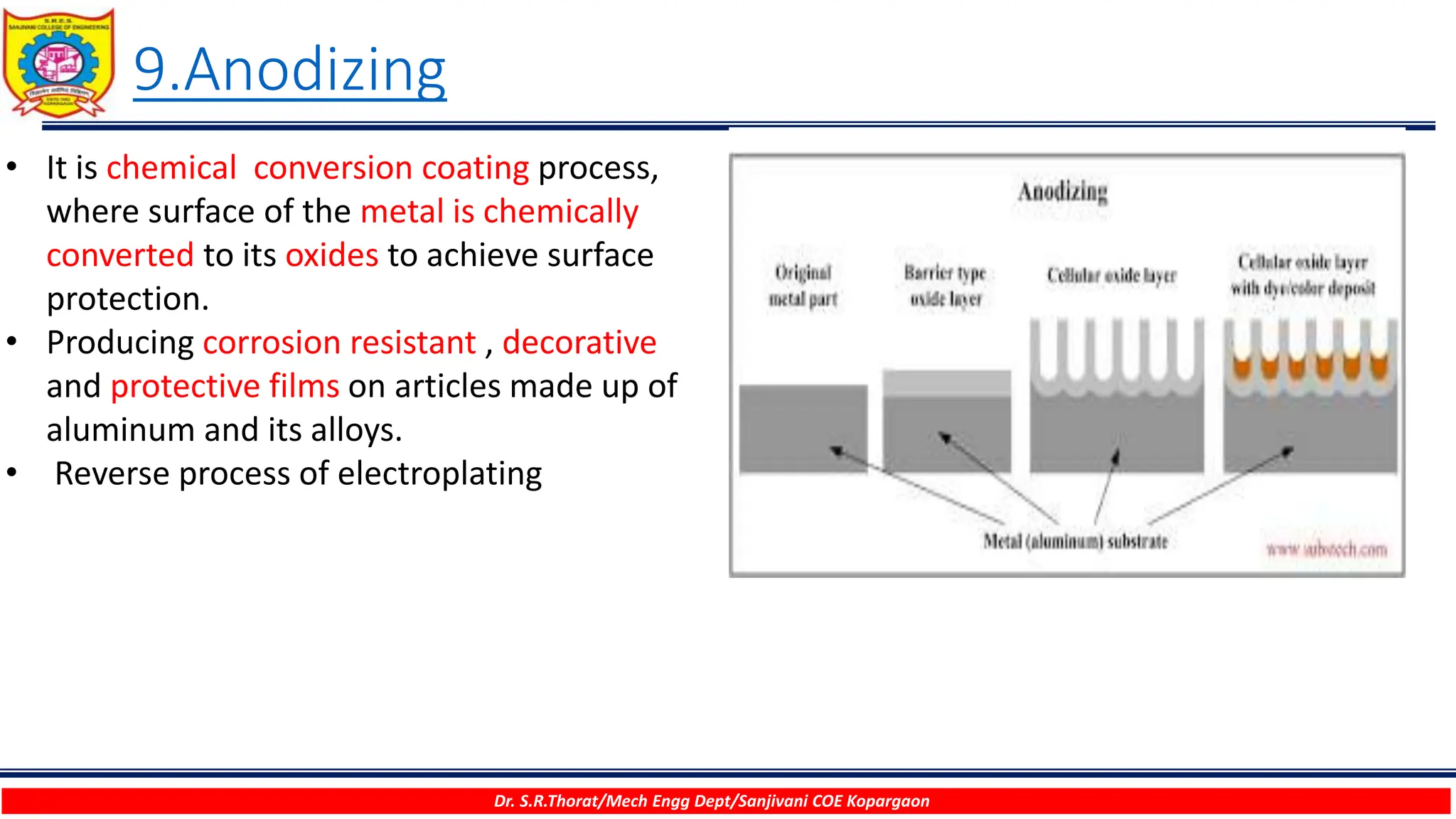
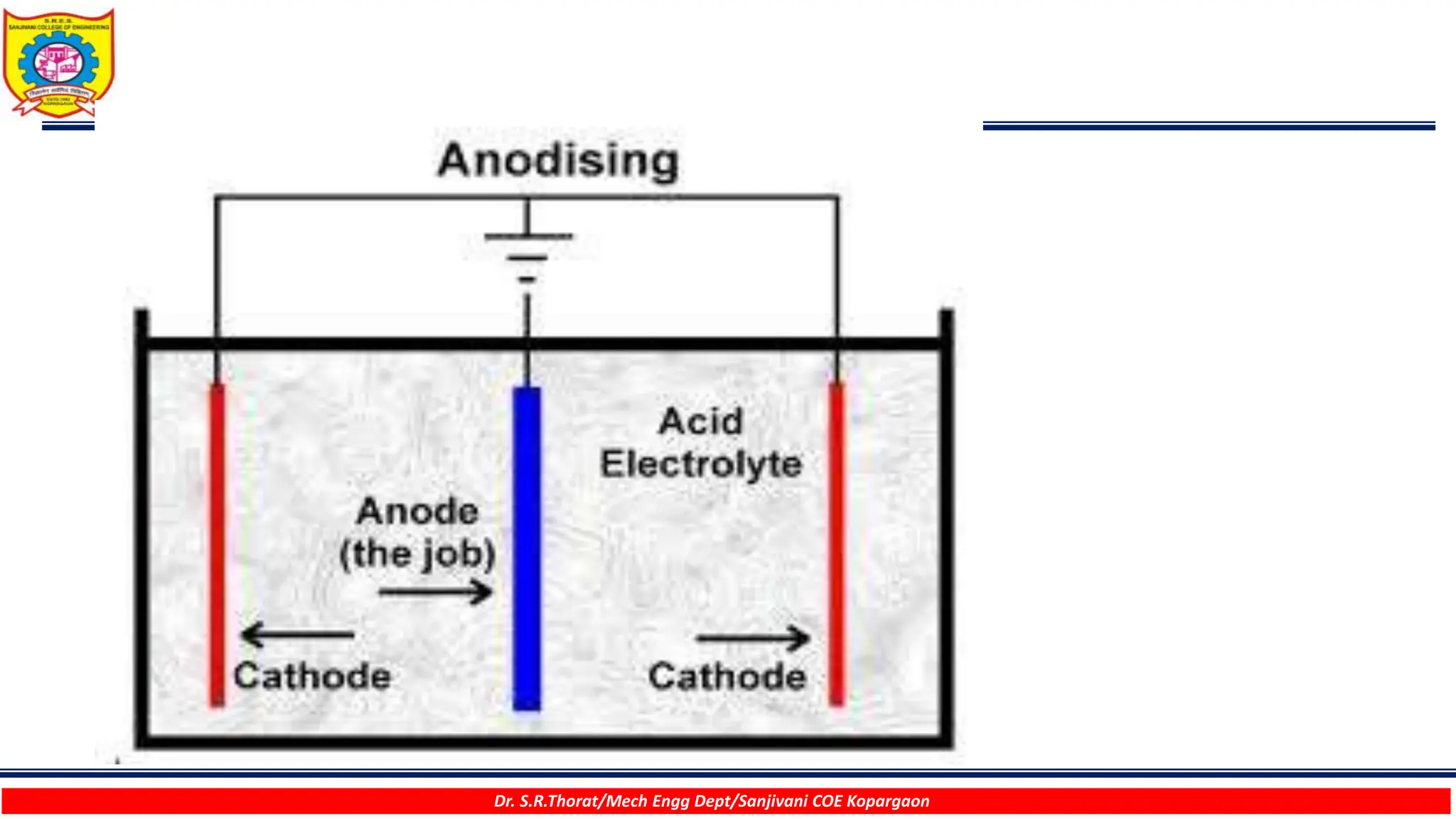
9.Anodizing
Dr. S.R.Thorat/Mech Engg Dept/Sanjivani COE Kopargaon
• It is chemical conversion coating process,
where surface of the metal is chemically
converted to its oxides to achieve surface
protection.
• Producing corrosion resistant , decorative
and protective films on articles made up of
aluminum and its alloys.
• Reverse process of electroplating
Dr. S.R.Thorat/Mech Engg Dept/Sanjivani COE Kopargaon
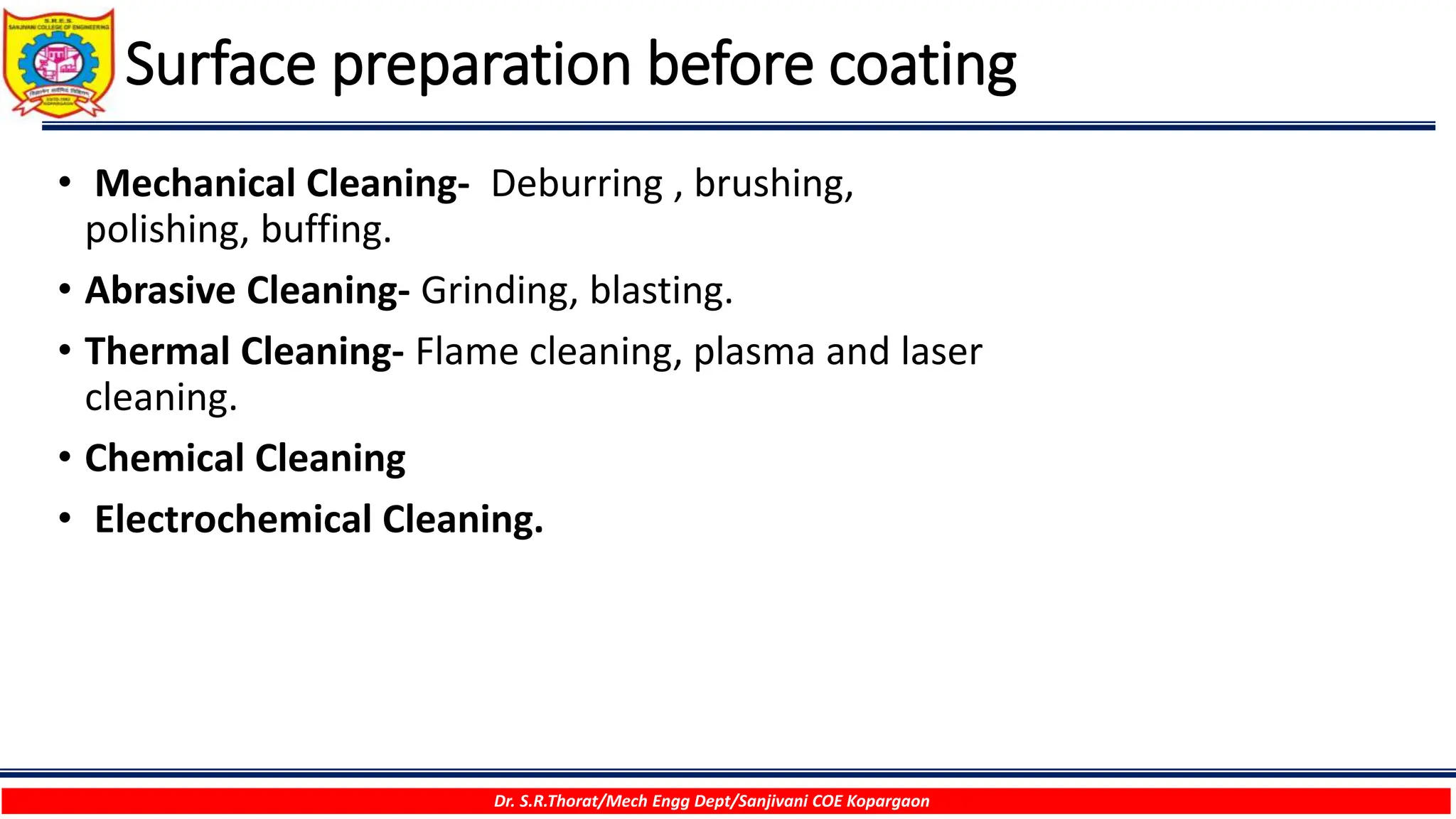
Surface preparation before coating
• Mechanical Cleaning- Deburring , brushing,
polishing, buffing.
• Abrasive Cleaning- Grinding, blasting.
• Thermal Cleaning- Flame cleaning, plasma and laser
cleaning.
• Chemical Cleaning
• Electrochemical Cleaning.
Coating Defects
Dr. S.R.Thorat/Mech Engg Dept/Sanjivani COE Kopargaon
• Cracking
• Cracking at welds
• Edge corrosion
• Erosion
• Abrasion
• Adhesion Failure
• Soft coat
• Discolouration
• Crater
• Blisters
Thank You
Dr. S.R.Thorat/Mech Engg Dept/Sanjivani COE Kopargaon

Unit 3 Surface Modification Methods -2.pptx

  • 1.
    Sanjivani Rural EducationSociety’s Sanjivani College of Engineering, Kopargaon-423 603 (An Autonomous Institute, Affiliated to Savitribai Phule Pune University, Pune) NAAC ‘A’ Grade Accredited, ISO 9001:2015 Certified Department of Mechanical Engineering Dr.S.R.Thorat Assistant Professor E-mail : thoratsandipmech@sanjivani.org.in Subject :- Advanced Materials and Technology (ME405D) B. Tech Unit 3- Surface Modification Technology
  • 2.
    Contents • Importance ofsurface modification, • classification of different methods & factors affecting : • Electroplating , PVD , CVD ,IVD, powder coating, shot blasting, ion implantation, plasma nitriding , anodizing, • Surface preparation before coating & coating defects. Dr. S.R.Thorat/Mech Engg Dept/Sanjivani COE Kopargaon
  • 3.
    Introduction Thorat S.R. DepartmentOf Mechanical Engineering, Sanjivani COE, Kopargaon What is surface? Surface can be defined as geometrical boundary between solid and environment and near surface of material to some depth.
  • 4.
    Importance of SurfacePreparation Dr. S.R.Thorat/Mech Engg Dept/Sanjivani COE Kopargaon Enhancing anticorrosive properties Improving electrical conductivity and optical property increasing bioactivities Improving adhesion properties Improve component lifetime and resistance to aggressive environment Produce biocompatibility
  • 5.
    Thorat S.R. DepartmentOf Mechanical Engineering, Sanjivani COE, Kopargaon • Bielby layer (surface flow during machining)(1- 100nm) • Oxide layer (chemical reaction of metal with environment)(10-100nm) • Deformed layer (contain some entrapped lubricants) • (1-10 micrometer) Surface layer
  • 6.
    Prof. S.R.Thorat/Mech EnggDept/Sanjivani COE Kopargaon Classification of Technology 1. Electroplating 2. Chemical conversion coating 3. Vapour depositions i) PVD ii) CVD iii) IVD 4. Powder coating 5. Paint coating 6.Shot Blasting 7. Plasma nitriding
  • 7.
    Prof. S.R.Thorat/Mech EnggDept/Sanjivani COE Kopargaon Typical thickness of engineered surface layers physical vapour deposition
  • 8.
    1.Electroplating • The electroplatingprocess is also known as electro-deposition and is carried out in electroplating cell. • It is used in copper plating of steel . • coating thickness can be as large as 500 micrometer and as small as 1 micrometer. • Gold, silver, platinum, zinc, nickel, tin, cadmium, are the common materials plated on large numbers of parts. • Factors affecting electroplating- surface condition , Temperature, Current density , Design of components Dr. S.R.Thorat/Mech Engg Dept/Sanjivani COE Kopargaon
  • 9.
    Dr. S.R.Thorat/Mech EnggDept/Sanjivani COE Kopargaon 2.Physical Vapor Deposition (PVD) • Creation of material vapours and their subsequent condensation on to substrate to form film . • Evaporation, Sputtering or laser ablation • Very thin film upto 10 microns of material get deposited on other material or metal. • High instantaneous deposition rate • Applications- electronic components mother boards, semiconductors , tool engineering
  • 10.
    Dr. S.R.Thorat/Mech EnggDept/Sanjivani COE Kopargaon Titanium nitride (TiN) 80HRC
  • 11.
    Dr. S.R.Thorat/Mech EnggDept/Sanjivani COE Kopargaon • Advantages • PVD is Harder &more corrosion resistant • Most durable & excellent Abrasion resistance Disadvantages • PVD operates at very high temp. • Required cooling water to dissipate large heat. • Special attention is required
  • 12.
    Dr. S.R.Thorat/Mech EnggDept/Sanjivani COE Kopargaon 3. Chemical Vapor Deposition (CVD) • Vapour of metal carbonyl M(Co) is deposited on on surface of component. • Metal carbide or oxides can be deposited by CVD. • Thermal, Plasma and Laser CVD Methods • Deposit materials which are very hard to evaporate • Applications- cutting and forming tools.
  • 13.
    4.Ion Vapor Deposition Dr.S.R.Thorat/Mech Engg Dept/Sanjivani COE Kopargaon • Replacement of Cadmium plating on steel- (Toxic and Pollution) • Metal to be deposited is melted and Vaporized. • Vapor is ionized and deposited on component. • Contamination of pure Al with water vapor & oxygen present in atmosphere. • Aplications- • Coating of alloy steel with pure aluminum , aircraft, marine .
  • 14.
    Dr. S.R.Thorat/Mech EnggDept/Sanjivani COE Kopargaon
  • 15.
    5.Ion Implantation Dr. S.R.Thorat/MechEngg Dept/Sanjivani COE Kopargaon • Ions of materials are accelerated in electrical field & impacted on to substrate. • Atoms of the metal to be penetrated into another metal are ionized. • The ions alter chemical composition of the target. • Applications- Fabrication of semiconductors, Coating on injection molded components
  • 16.
    Dr. S.R.Thorat/Mech EnggDept/Sanjivani COE Kopargaon
  • 17.
    6. Powder coating Dr.S.R.Thorat/Mech Engg Dept/Sanjivani COE Kopargaon • Painting • Powder sticks to parts due to electrostatic charging of powder and grounding of parts.
  • 18.
    Dr. S.R.Thorat/Mech EnggDept/Sanjivani COE Kopargaon Applications- Automobile components, home appliances
  • 19.
    7. Shot blasting Dr.S.R.Thorat/Mech Engg Dept/Sanjivani COE Kopargaon • It is Method used to clean , strengthen material surface. • Wheel blasting and Air Blasting
  • 20.
    8.Plasma Nitriding • Thermochemical method of diffusing elemental nitrogen into surface of low carbon steel and cast irons. • Ion nitriding • Applications: • (Mechanical load, fatigue, wear) • Shock absorbers, piston rods, cylinders, drive shafts, gears Dr. S.R.Thorat/Mech Engg Dept/Sanjivani COE Kopargaon
  • 21.
    9.Anodizing Dr. S.R.Thorat/Mech EnggDept/Sanjivani COE Kopargaon • It is chemical conversion coating process, where surface of the metal is chemically converted to its oxides to achieve surface protection. • Producing corrosion resistant , decorative and protective films on articles made up of aluminum and its alloys. • Reverse process of electroplating
  • 22.
    Dr. S.R.Thorat/Mech EnggDept/Sanjivani COE Kopargaon
  • 23.
    Dr. S.R.Thorat/Mech EnggDept/Sanjivani COE Kopargaon Surface preparation before coating • Mechanical Cleaning- Deburring , brushing, polishing, buffing. • Abrasive Cleaning- Grinding, blasting. • Thermal Cleaning- Flame cleaning, plasma and laser cleaning. • Chemical Cleaning • Electrochemical Cleaning.
  • 24.
    Coating Defects Dr. S.R.Thorat/MechEngg Dept/Sanjivani COE Kopargaon • Cracking • Cracking at welds • Edge corrosion • Erosion • Abrasion • Adhesion Failure • Soft coat • Discolouration • Crater • Blisters
  • 25.
    Thank You Dr. S.R.Thorat/MechEngg Dept/Sanjivani COE Kopargaon