A technical seminar on
NON-DESTRUCTIVE TESTING IN
RAILWAYS
Presented by
N.SUDHEER
M.TECH(MACHINE DESIGN)
16481D1509
GUDLAVALLERU ENGINEERING COLLEGE
Sheshadri Rao Knowledge Village, Gudlavalleru, PIN:521356
Introduction:
Amongst the different modes of transport,
Railways have their greatest utilization in the
transport of large volumes of heavy and bulk
commodities and passengers over long
distances with safety, comfort and convenience.
So railroads require constant support to
maintain their integrity and operate safely.
Role of Non-Destructive Testing(NDT) in
Industries:
NDT is widely used in industries for :
Verification of design quality,
Certification of manufactured products,
Assessment of product degradation, and
Effective repair or replacement during service.
NDT has also been a valuable tool in risk
assessment based on experience.
A number of railway components and assemblies
are tested and evaluated using NDT
methodologies, during manufacture for freedom
from unacceptable defects and anomalies.
The major components subjected to various NDT
methods are:
Rails,
Wheels,
Axles,
Bearings,
Welded rail joints, and
Brides, etc.
Rail inspection is the practice of examining rail
tracks for flaws. Non-destructive testing (NDT)
methods are used as a preventive and/or predictive
measure against track failures and possible
derailment.
Methods used to detect flaws in rails:
Visual Examination(VE)
Ultrasonic Testing (UT)
Eddy Current Testing (ET)
Magnetic Particle Inspection (MPI)
Radiographic Testing (RT)
Electromagnetic Acoustic Transducer (EMAT)
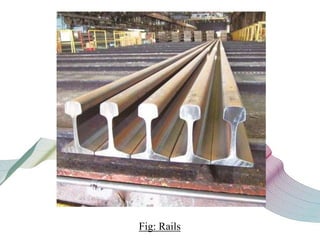
Rails
Rails are the members of the track laid in two
parallel lines to provide an unchanging,
continuous and level surface for the movement
of trains.
To be able to withstand high amount of
stresses these are made of high carbon
steel(HCS).
Fig: Rails
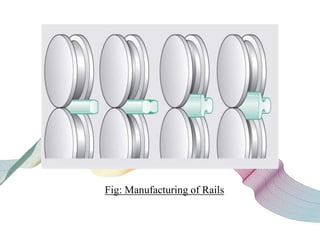
Fig: Manufacturing of Rails
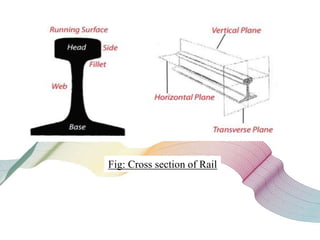
Fig: Cross section of Rail
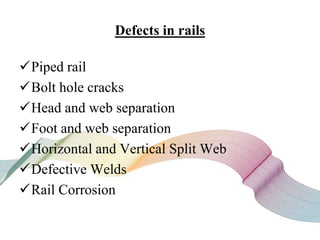
Defects in rails
Piped rail
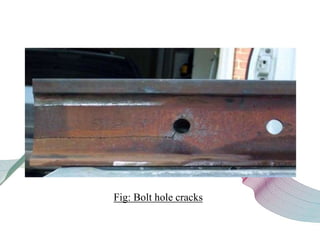
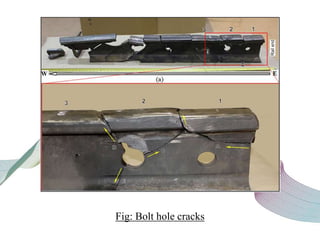
Bolt hole cracks
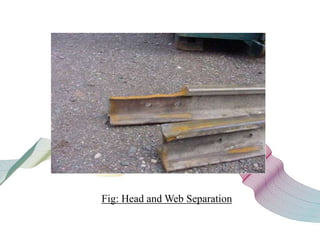
Head and web separation
Foot and web separation
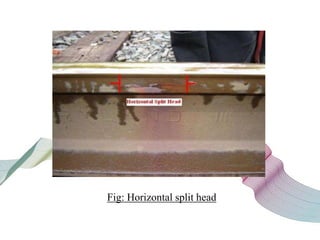
Horizontal and Vertical Split Web
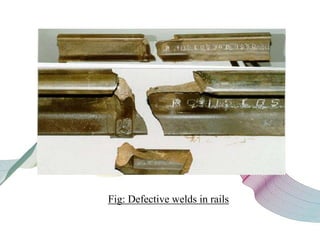
Defective Welds
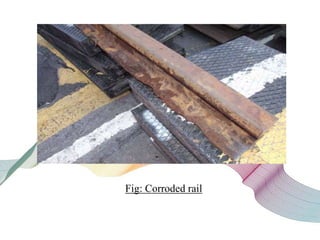
Rail Corrosion
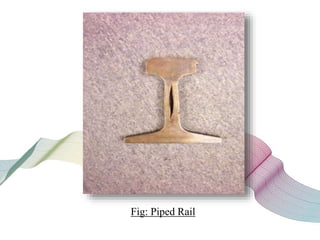
Fig: Piped Rail
Fig: Bolt hole cracks
Fig: Head and Web Separation
Fig: Horizontal split head
Fig: Defective welds in rails
Fig: Corroded rail
Visual Inspection/Testing(VT)
Non-destructive rail testing procedure usually
starts with a visual inspection:
With the naked eye and supported with
mirrors,
Magnifying glasses, and
Artificial light sources experts can recognise
exactly which testing methods should be used.
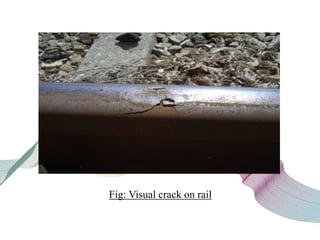
Fig: Visual crack on rail
Ultra sonic Testing(UT) of Rails
Ultrasonic Testing (UT) is a non-destructive inspection
method that uses high frequency sound waves
(ultrasound) that are above the range of human hearing,
to measure geometric and physical properties in
materials.
Ultrasound travels in different materials at different
speeds (velocity).
However, the speed of sound propagation in a given
material is a constant.
Steps in Ultra sonic Testing
Surface preparation,
Calibration,
Conduct examination, and
Interpretation of results.
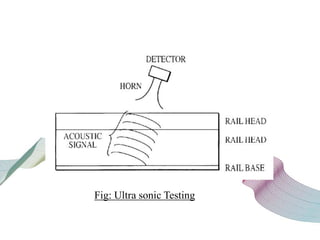
Irregularities in material and internal faults can
be detected by the ultrasonic testing method.
In the process, areas of the rail that are subject
to faults can be checked through the various
angles of incidence and probe heads.
Fig: Ultra sonic Testing
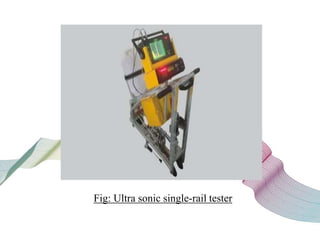
Fig: Ultra sonic single-rail tester
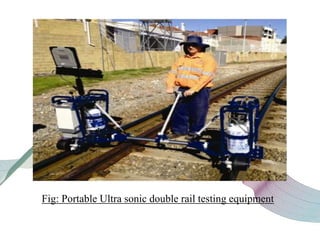
Fig: Portable Ultra sonic double rail testing equipment
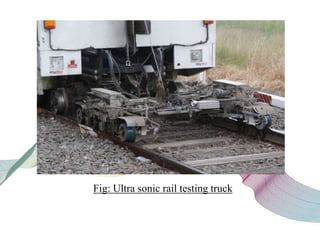
Fig: Ultra sonic rail testing truck
Eddy Current Testing(ET)
Eddy current inspection uses the principal of
“electromagnetism” as the basis for conducting
examinations. Eddy currents are created through
a process called electromagnetic induction..
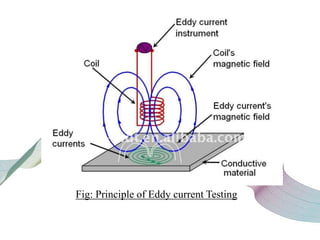
 When alternating current is applied to the
conductor, such as copper wire, a magnetic
field develops in and around the conductor.
 This magnetic field expands as the
alternating current rises to maximum and
collapses as the current is reduced to zero.
 If another electrical conductor is brought into
the close proximity to this changing magnetic
field, current will be induced in this second
conductor.
Fig: Principle of Eddy current Testing
Steps in Eddy current Testing
Setup equipment,
Calibrate instrument,
Calibrate probe,
Inspect for indications, and
Monitor the readings.
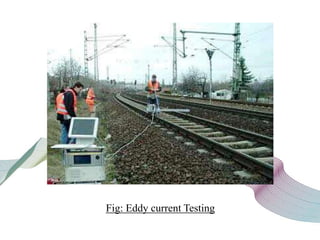
Fig: Eddy current Testing
Magnetic particle Testing(MPT)
MPT uses magnetic fields and small magnetic
iron filings to detect defects in components.
The only requirement is that the component
being inspected must be made of a
ferromagnetic material such as iron, nickel, or
some of their alloys.
Ferromagnetic materials are those that can be
magnetized to a level that will allow the
inspection to be effective.
Steps in Magnetic Particle Testing
Prepare the part surface,
Apply the magnetizing force,
Dust on the dry magnetic particles,
Gently blow off the excess powder,
Terminate the magnetizing force,
Inspect for indications, and
Resetting the magnetisation.
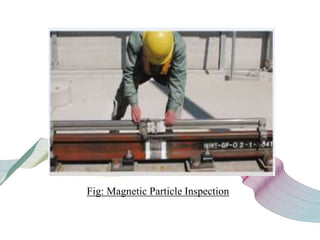
Fig: Magnetic Particle Inspection
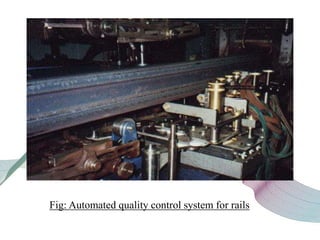
Fig: Automated quality control system for rails
Wheels and Axle
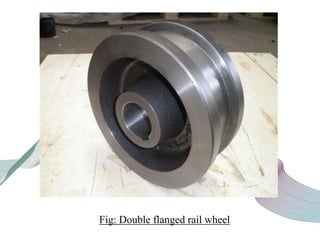
A train wheel or rail wheel is a type
of wheel specially designed for use on rail
tracks.
An axle is a central shaft for a rotating wheel.
A wheel set is the wheel - axle assembly of
a railroad car(locomotive).
Wheels are cast or forged (wrought) and are
heat-treated to have a specific hardness.
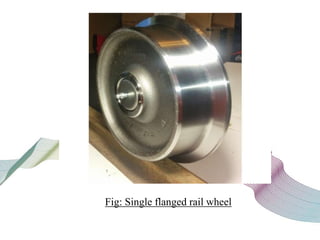
Fig: Single flanged rail wheel
Fig: Double flanged rail wheel
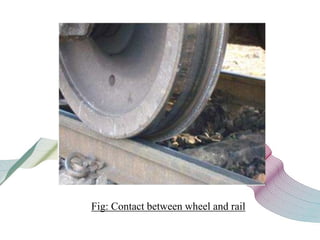
Fig: Contact between wheel and rail
NDT for wheels and axles
• Ultra sonic inspection,
• Magnetic particle inspection,
• Radiography, and
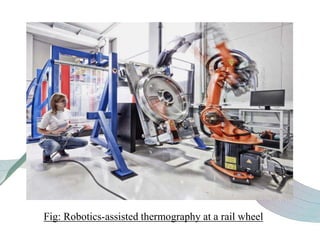
• Thermography.
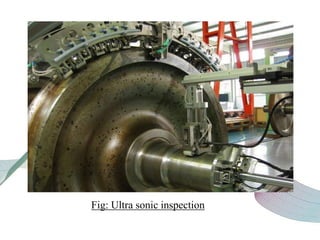
Fig: Ultra sonic inspection
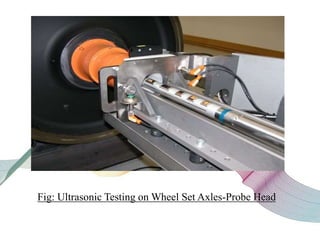
Fig: Ultrasonic Testing on Wheel Set Axles-Probe Head
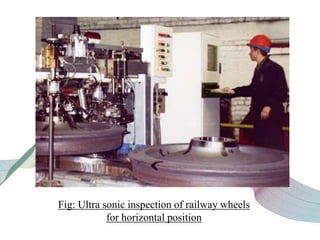
Fig: Ultra sonic inspection of railway wheels
for horizontal position
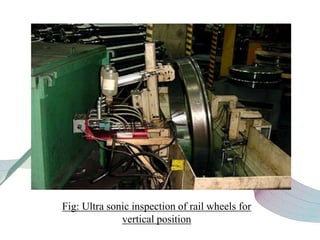
Fig: Ultra sonic inspection of rail wheels for
vertical position
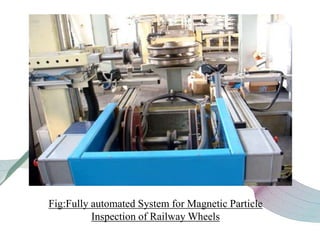
Fig:Fully automated System for Magnetic Particle
Inspection of Railway Wheels
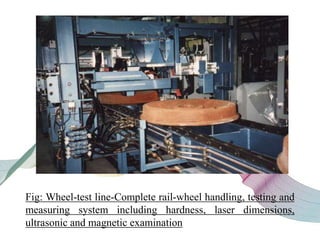
Fig: Wheel-test line-Complete rail-wheel handling, testing and
measuring system including hardness, laser dimensions,
ultrasonic and magnetic examination
Fig: Robotics-assisted thermography at a rail wheel
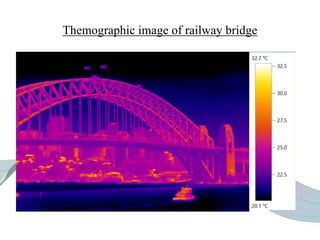
Themographic image of railway bridge
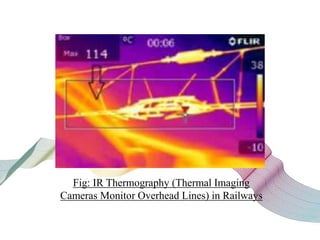
Fig: IR Thermography (Thermal Imaging
Cameras Monitor Overhead Lines) in Railways
Conclusion
• Non-destructive testing (or) NDT is the use of non-
invasive techniques to determine the integrity of a
material, component or structure.
• These techniques allow for inspection without
interfering with the specimen’s final use.
• NDT has a wide range of applications in industries.
Especially in railway industries, various NDT
techniques such as visual examination, ultra sonic
testing, eddy current testing, magnetic particle testing,
and thermography, etc., plays a vital role to inspect and
monitor the condition of infrastructure effectively.
References
 Applications of NDT in rail track - Lee Guan Bin (Nanyang
Technological University, School of mechanical and aerospace
engineering).
 Detection and evaluation of rail defects with nondestructive
testing methods Anika Dey 1, Jochen Kurz 2, Lukasz
Tenczynski 3 .
 Hand book of non destructive evaluation – Charles Hellier
(Mc Graw-Hill publishers).
THANK YOU

NONDESTRUCTIVE TESTING FOR RAILWAYS

  • 1.
    A technical seminaron NON-DESTRUCTIVE TESTING IN RAILWAYS Presented by N.SUDHEER M.TECH(MACHINE DESIGN) 16481D1509 GUDLAVALLERU ENGINEERING COLLEGE Sheshadri Rao Knowledge Village, Gudlavalleru, PIN:521356
  • 2.
    Introduction: Amongst the differentmodes of transport, Railways have their greatest utilization in the transport of large volumes of heavy and bulk commodities and passengers over long distances with safety, comfort and convenience. So railroads require constant support to maintain their integrity and operate safely.
  • 3.
    Role of Non-DestructiveTesting(NDT) in Industries: NDT is widely used in industries for : Verification of design quality, Certification of manufactured products, Assessment of product degradation, and Effective repair or replacement during service. NDT has also been a valuable tool in risk assessment based on experience.
  • 4.
    A number ofrailway components and assemblies are tested and evaluated using NDT methodologies, during manufacture for freedom from unacceptable defects and anomalies. The major components subjected to various NDT methods are: Rails, Wheels, Axles, Bearings, Welded rail joints, and Brides, etc.
  • 5.
    Rail inspection isthe practice of examining rail tracks for flaws. Non-destructive testing (NDT) methods are used as a preventive and/or predictive measure against track failures and possible derailment. Methods used to detect flaws in rails: Visual Examination(VE) Ultrasonic Testing (UT) Eddy Current Testing (ET) Magnetic Particle Inspection (MPI) Radiographic Testing (RT) Electromagnetic Acoustic Transducer (EMAT)
  • 6.
    Rails Rails are themembers of the track laid in two parallel lines to provide an unchanging, continuous and level surface for the movement of trains. To be able to withstand high amount of stresses these are made of high carbon steel(HCS).
  • 7.
  • 8.
  • 9.
  • 10.
    Defects in rails Pipedrail Bolt hole cracks Head and web separation Foot and web separation Horizontal and Vertical Split Web Defective Welds Rail Corrosion
  • 11.
  • 12.
  • 13.
  • 14.
    Fig: Head andWeb Separation
  • 15.
  • 16.
  • 17.
  • 18.
    Visual Inspection/Testing(VT) Non-destructive railtesting procedure usually starts with a visual inspection: With the naked eye and supported with mirrors, Magnifying glasses, and Artificial light sources experts can recognise exactly which testing methods should be used.
  • 19.
  • 20.
    Ultra sonic Testing(UT)of Rails Ultrasonic Testing (UT) is a non-destructive inspection method that uses high frequency sound waves (ultrasound) that are above the range of human hearing, to measure geometric and physical properties in materials. Ultrasound travels in different materials at different speeds (velocity). However, the speed of sound propagation in a given material is a constant.
  • 21.
    Steps in Ultrasonic Testing Surface preparation, Calibration, Conduct examination, and Interpretation of results.
  • 22.
    Irregularities in materialand internal faults can be detected by the ultrasonic testing method. In the process, areas of the rail that are subject to faults can be checked through the various angles of incidence and probe heads.
  • 23.
  • 24.
    Fig: Ultra sonicsingle-rail tester
  • 25.
    Fig: Portable Ultrasonic double rail testing equipment
  • 26.
    Fig: Ultra sonicrail testing truck
  • 27.
    Eddy Current Testing(ET) Eddycurrent inspection uses the principal of “electromagnetism” as the basis for conducting examinations. Eddy currents are created through a process called electromagnetic induction..
  • 28.
     When alternatingcurrent is applied to the conductor, such as copper wire, a magnetic field develops in and around the conductor.  This magnetic field expands as the alternating current rises to maximum and collapses as the current is reduced to zero.  If another electrical conductor is brought into the close proximity to this changing magnetic field, current will be induced in this second conductor.
  • 29.
    Fig: Principle ofEddy current Testing
  • 30.
    Steps in Eddycurrent Testing Setup equipment, Calibrate instrument, Calibrate probe, Inspect for indications, and Monitor the readings.
  • 31.
  • 32.
    Magnetic particle Testing(MPT) MPTuses magnetic fields and small magnetic iron filings to detect defects in components. The only requirement is that the component being inspected must be made of a ferromagnetic material such as iron, nickel, or some of their alloys. Ferromagnetic materials are those that can be magnetized to a level that will allow the inspection to be effective.
  • 33.
    Steps in MagneticParticle Testing Prepare the part surface, Apply the magnetizing force, Dust on the dry magnetic particles, Gently blow off the excess powder, Terminate the magnetizing force, Inspect for indications, and Resetting the magnetisation.
  • 34.
  • 35.
    Fig: Automated qualitycontrol system for rails
  • 36.
    Wheels and Axle Atrain wheel or rail wheel is a type of wheel specially designed for use on rail tracks. An axle is a central shaft for a rotating wheel. A wheel set is the wheel - axle assembly of a railroad car(locomotive). Wheels are cast or forged (wrought) and are heat-treated to have a specific hardness.
  • 37.
  • 38.
  • 39.
    Fig: Contact betweenwheel and rail
  • 40.
    NDT for wheelsand axles • Ultra sonic inspection, • Magnetic particle inspection, • Radiography, and • Thermography.
  • 41.
    Fig: Ultra sonicinspection
  • 42.
    Fig: Ultrasonic Testingon Wheel Set Axles-Probe Head
  • 43.
    Fig: Ultra sonicinspection of railway wheels for horizontal position
  • 44.
    Fig: Ultra sonicinspection of rail wheels for vertical position
  • 45.
    Fig:Fully automated Systemfor Magnetic Particle Inspection of Railway Wheels
  • 46.
    Fig: Wheel-test line-Completerail-wheel handling, testing and measuring system including hardness, laser dimensions, ultrasonic and magnetic examination
  • 47.
  • 48.
    Themographic image ofrailway bridge
  • 49.
    Fig: IR Thermography(Thermal Imaging Cameras Monitor Overhead Lines) in Railways
  • 50.
    Conclusion • Non-destructive testing(or) NDT is the use of non- invasive techniques to determine the integrity of a material, component or structure. • These techniques allow for inspection without interfering with the specimen’s final use. • NDT has a wide range of applications in industries. Especially in railway industries, various NDT techniques such as visual examination, ultra sonic testing, eddy current testing, magnetic particle testing, and thermography, etc., plays a vital role to inspect and monitor the condition of infrastructure effectively.
  • 51.
    References  Applications ofNDT in rail track - Lee Guan Bin (Nanyang Technological University, School of mechanical and aerospace engineering).  Detection and evaluation of rail defects with nondestructive testing methods Anika Dey 1, Jochen Kurz 2, Lukasz Tenczynski 3 .  Hand book of non destructive evaluation – Charles Hellier (Mc Graw-Hill publishers).
  • 52.