Brick Masonry Tools
Ar. Sahil Pahal
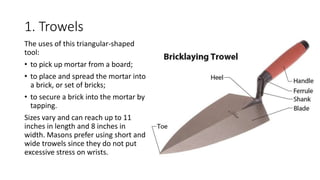
1. Trowels
The uses of this triangular-shaped
tool:
• to pick up mortar from a board;
• to place and spread the mortar into
a brick, or set of bricks;
• to secure a brick into the mortar by
tapping.
Sizes vary and can reach up to 11
inches in length and 8 inches in
width. Masons prefer using short and
wide trowels since they do not put
excessive stress on wrists.
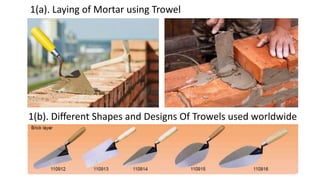
1(b). Different Shapes and Designs Of Trowels used worldwide
1(a). Laying of Mortar using Trowel
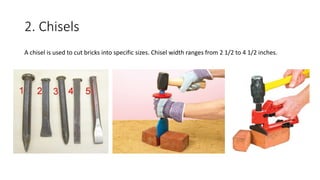
2. Chisels
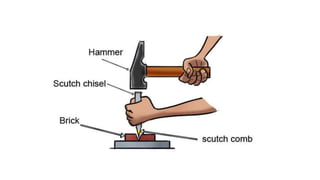
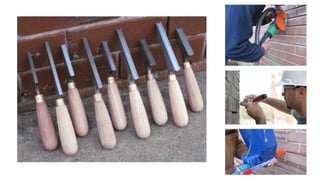
A chisel is used to cut bricks into specific sizes. Chisel width ranges from 2 1/2 to 4 1/2 inches.
3. Hammer
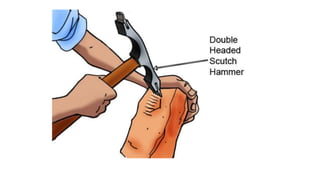
A masonry hammer has a square face on one end for breaking; it has a sharp edge on the other for
cutting. They are used to split hard bricks.
4. Jointer
A jointer is used to make mortar joints. There are three types of jointer shapes: flat, pointed and
rounded.
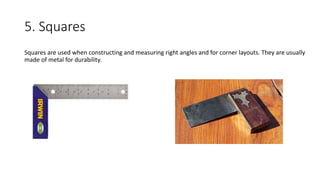
5. Squares
Squares are used when constructing and measuring right angles and for corner layouts. They are usually
made of metal for durability.
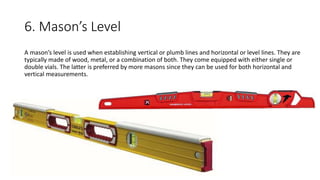
6. Mason’s Level
A mason’s level is used when establishing vertical or plumb lines and horizontal or level lines. They are
typically made of wood, metal, or a combination of both. They come equipped with either single or
double vials. The latter is preferred by more masons since they can be used for both horizontal and
vertical measurements.
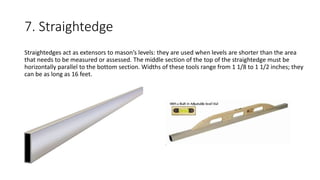
7. Straightedge
Straightedges act as extensors to mason’s levels: they are used when levels are shorter than the area
that needs to be measured or assessed. The middle section of the top of the straightedge must be
horizontally parallel to the bottom section. Widths of these tools range from 1 1/8 to 1 1/2 inches; they
can be as long as 16 feet.
8. Plumb Bob
A plumb-bob or a plummet is a weight, usually with a pointed tip on the bottom, that is suspended
from a string and used as a vertical reference line, or plumb-line. It is essentially the vertical equivalent
of a "water level".
It is usually used to check the verticality of wall

Brick masonry tools

  • 1.
  • 2.
    1. Trowels The usesof this triangular-shaped tool: • to pick up mortar from a board; • to place and spread the mortar into a brick, or set of bricks; • to secure a brick into the mortar by tapping. Sizes vary and can reach up to 11 inches in length and 8 inches in width. Masons prefer using short and wide trowels since they do not put excessive stress on wrists.
  • 3.
    1(b). Different Shapesand Designs Of Trowels used worldwide 1(a). Laying of Mortar using Trowel
  • 5.
    2. Chisels A chiselis used to cut bricks into specific sizes. Chisel width ranges from 2 1/2 to 4 1/2 inches.
  • 6.
    3. Hammer A masonryhammer has a square face on one end for breaking; it has a sharp edge on the other for cutting. They are used to split hard bricks.
  • 9.
    4. Jointer A jointeris used to make mortar joints. There are three types of jointer shapes: flat, pointed and rounded.
  • 11.
    5. Squares Squares areused when constructing and measuring right angles and for corner layouts. They are usually made of metal for durability.
  • 12.
    6. Mason’s Level Amason’s level is used when establishing vertical or plumb lines and horizontal or level lines. They are typically made of wood, metal, or a combination of both. They come equipped with either single or double vials. The latter is preferred by more masons since they can be used for both horizontal and vertical measurements.
  • 13.
    7. Straightedge Straightedges actas extensors to mason’s levels: they are used when levels are shorter than the area that needs to be measured or assessed. The middle section of the top of the straightedge must be horizontally parallel to the bottom section. Widths of these tools range from 1 1/8 to 1 1/2 inches; they can be as long as 16 feet.
  • 14.
    8. Plumb Bob Aplumb-bob or a plummet is a weight, usually with a pointed tip on the bottom, that is suspended from a string and used as a vertical reference line, or plumb-line. It is essentially the vertical equivalent of a "water level". It is usually used to check the verticality of wall