BRICK MASONRY TOOLS
ARCHITECT SANJIB SENGUPTA
Tools that are commonly used in brick masonry works.
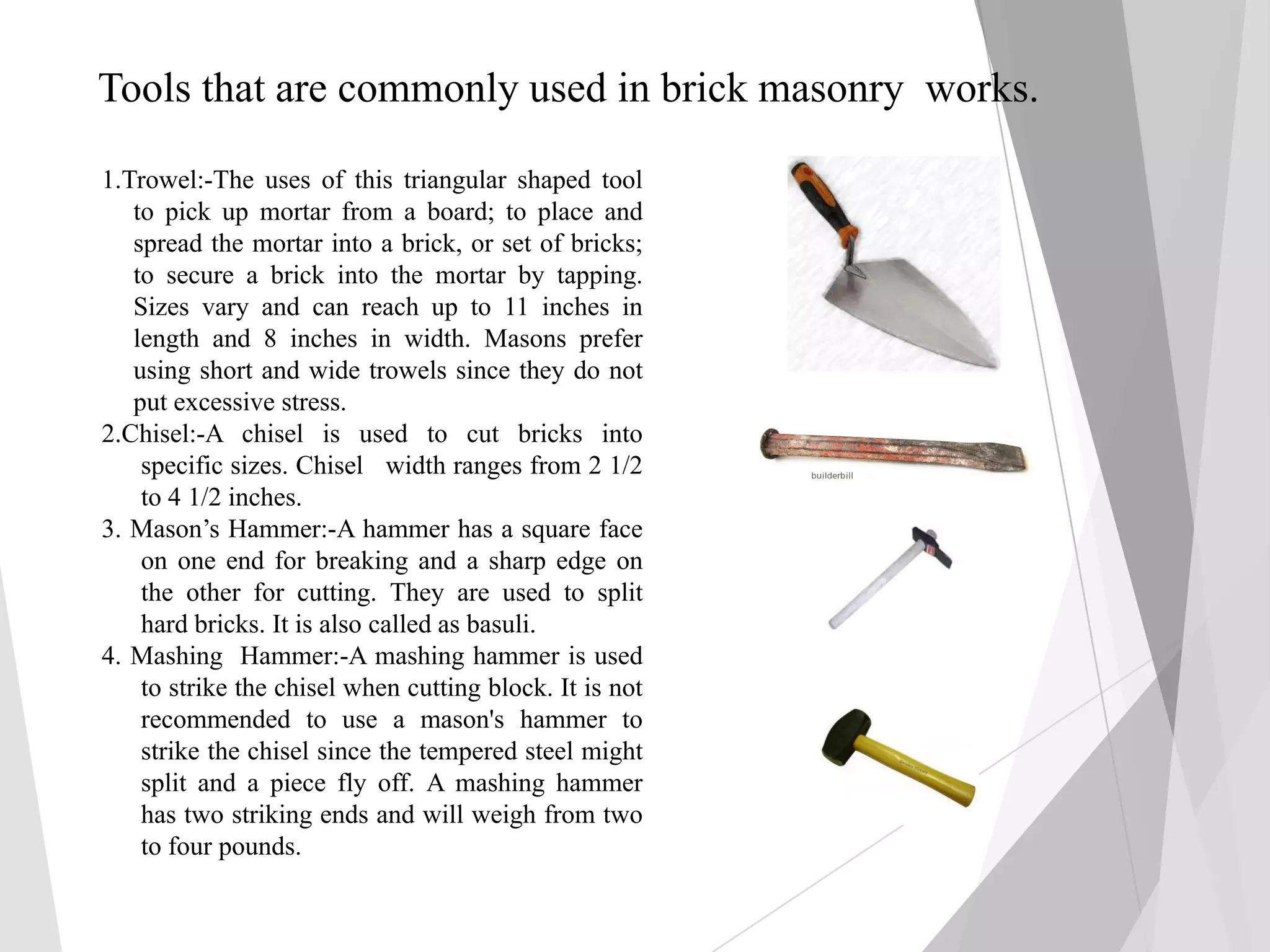
1.Trowel:-The uses of this triangular shaped tool
to pick up mortar from a board; to place and
spread the mortar into a brick, or set of bricks;
to secure a brick into the mortar by tapping.
Sizes vary and can reach up to 11 inches in
length and 8 inches in width. Masons prefer
using short and wide trowels since they do not
put excessive stress.
2.Chisel:-A chisel is used to cut bricks into
specific sizes. Chisel width ranges from 2 1/2
to 4 1/2 inches.
3. Mason’s Hammer:-A hammer has a square face
on one end for breaking and a sharp edge on
the other for cutting. They are used to split
hard bricks. It is also called as basuli.
4. Mashing Hammer:-A mashing hammer is used
to strike the chisel when cutting block. It is not
recommended to use a mason's hammer to
strike the chisel since the tempered steel might
split and a piece fly off. A mashing hammer
has two striking ends and will weigh from two
to four pounds.
Tools that are commonly used in brick masonry works(Cont.--)
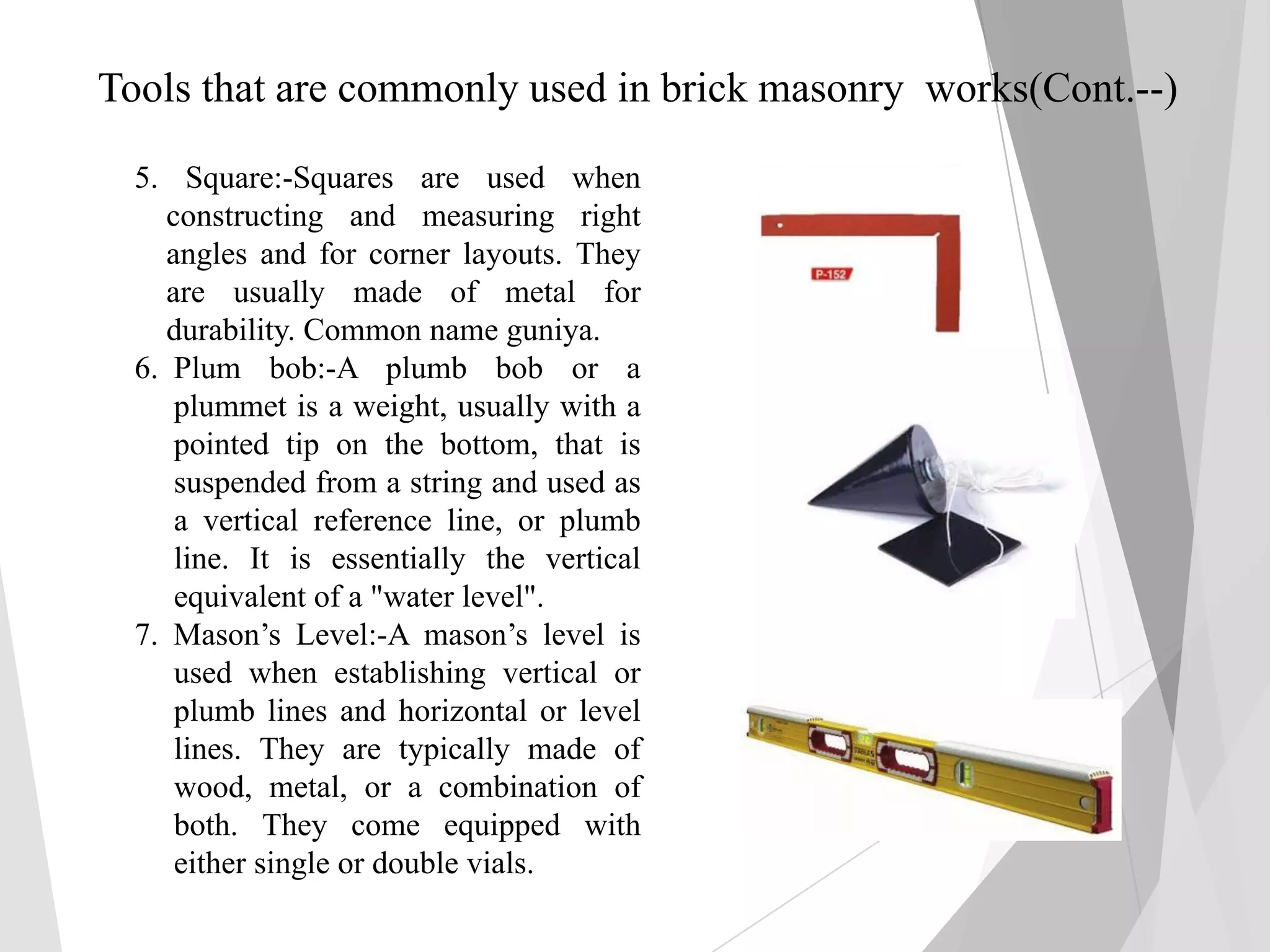
5. Square:-Squares are used when
constructing and measuring right
angles and for corner layouts. They
are usually made of metal for
durability. Common name guniya.
6. Plum bob:-A plumb bob or a
plummet is a weight, usually with a
pointed tip on the bottom, that is
suspended from a string and used as
a vertical reference line, or plumb
line. It is essentially the vertical
equivalent of a "water level".
7. Mason’s Level:-A mason’s level is
used when establishing vertical or
plumb lines and horizontal or level
lines. They are typically made of
wood, metal, or a combination of
both. They come equipped with
either single or double vials.
Tools that are commonly used in brick masonry works(Cont.--)
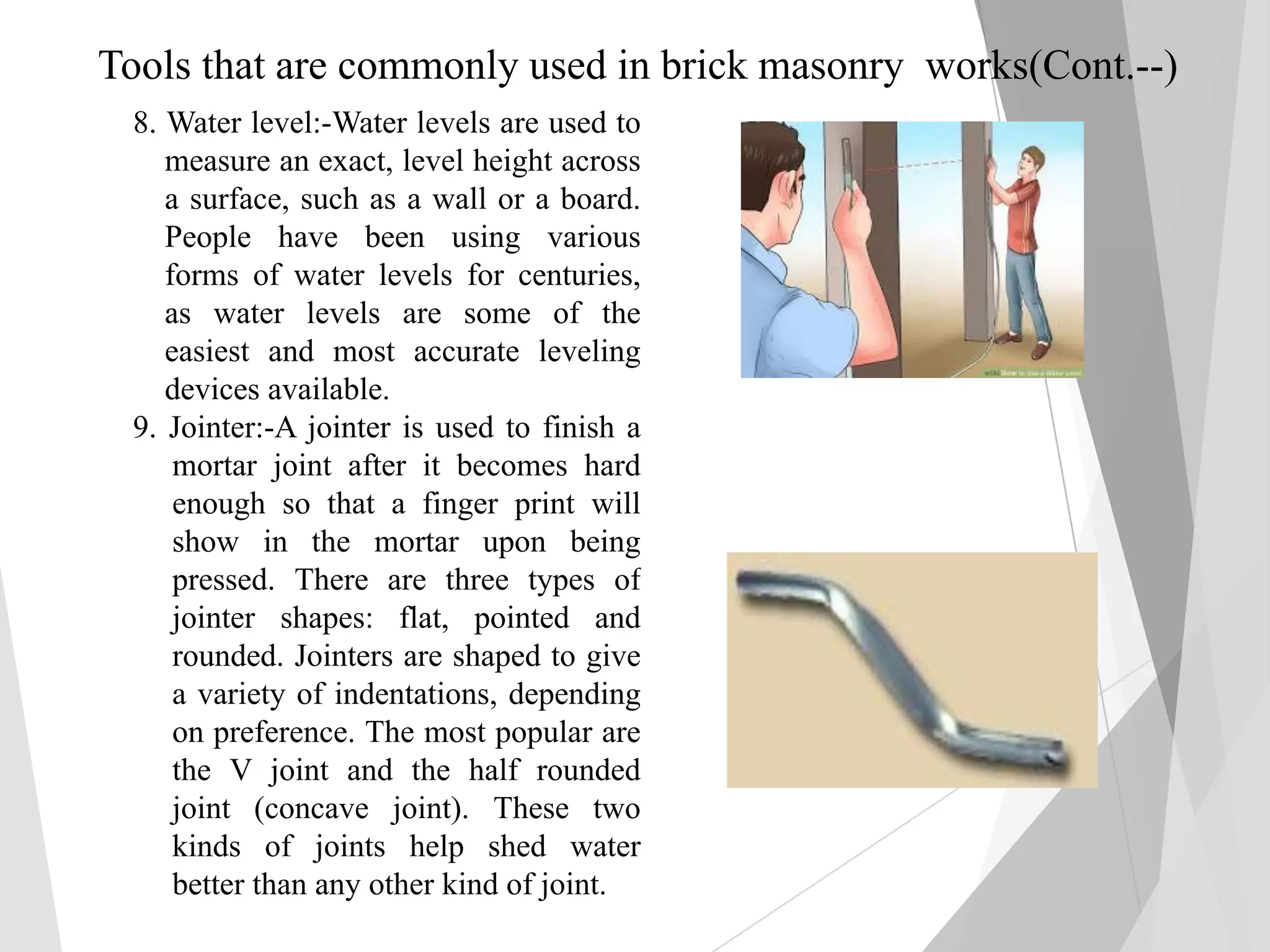
8. Water level:-Water levels are used to
measure an exact, level height across
a surface, such as a wall or a board.
People have been using various
forms of water levels for centuries,
as water levels are some of the
easiest and most accurate leveling
devices available.
9. Jointer:-A jointer is used to finish a
mortar joint after it becomes hard
enough so that a finger print will
show in the mortar upon being
pressed. There are three types of
jointer shapes: flat, pointed and
rounded. Jointers are shaped to give
a variety of indentations, depending
on preference. The most popular are
the V joint and the half rounded
joint (concave joint). These two
kinds of joints help shed water
better than any other kind of joint.
Tools that are commonly used in brick masonry works(Cont.--)
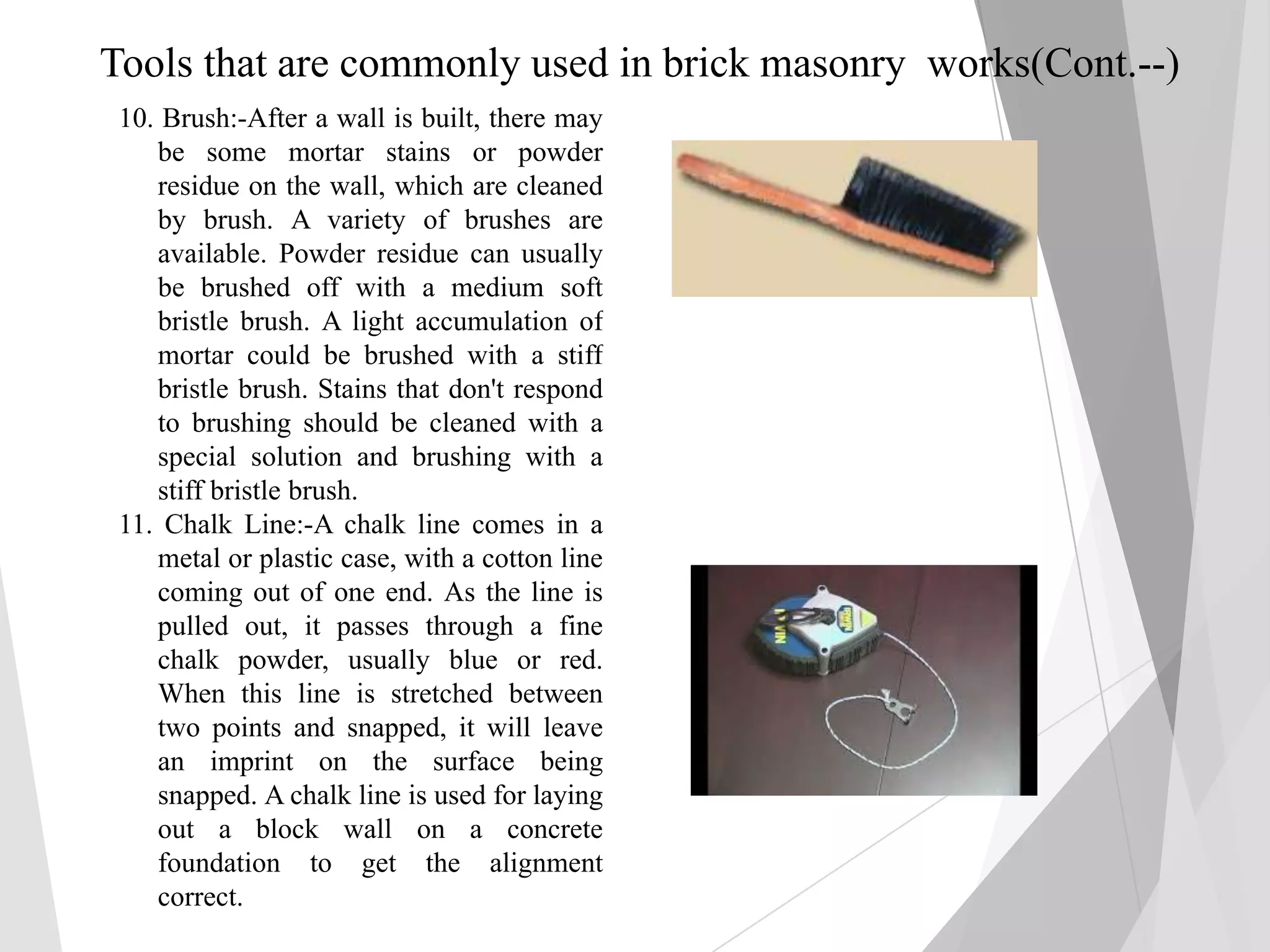
10. Brush:-After a wall is built, there may
be some mortar stains or powder
residue on the wall, which are cleaned
by brush. A variety of brushes are
available. Powder residue can usually
be brushed off with a medium soft
bristle brush. A light accumulation of
mortar could be brushed with a stiff
bristle brush. Stains that don't respond
to brushing should be cleaned with a
special solution and brushing with a
stiff bristle brush.
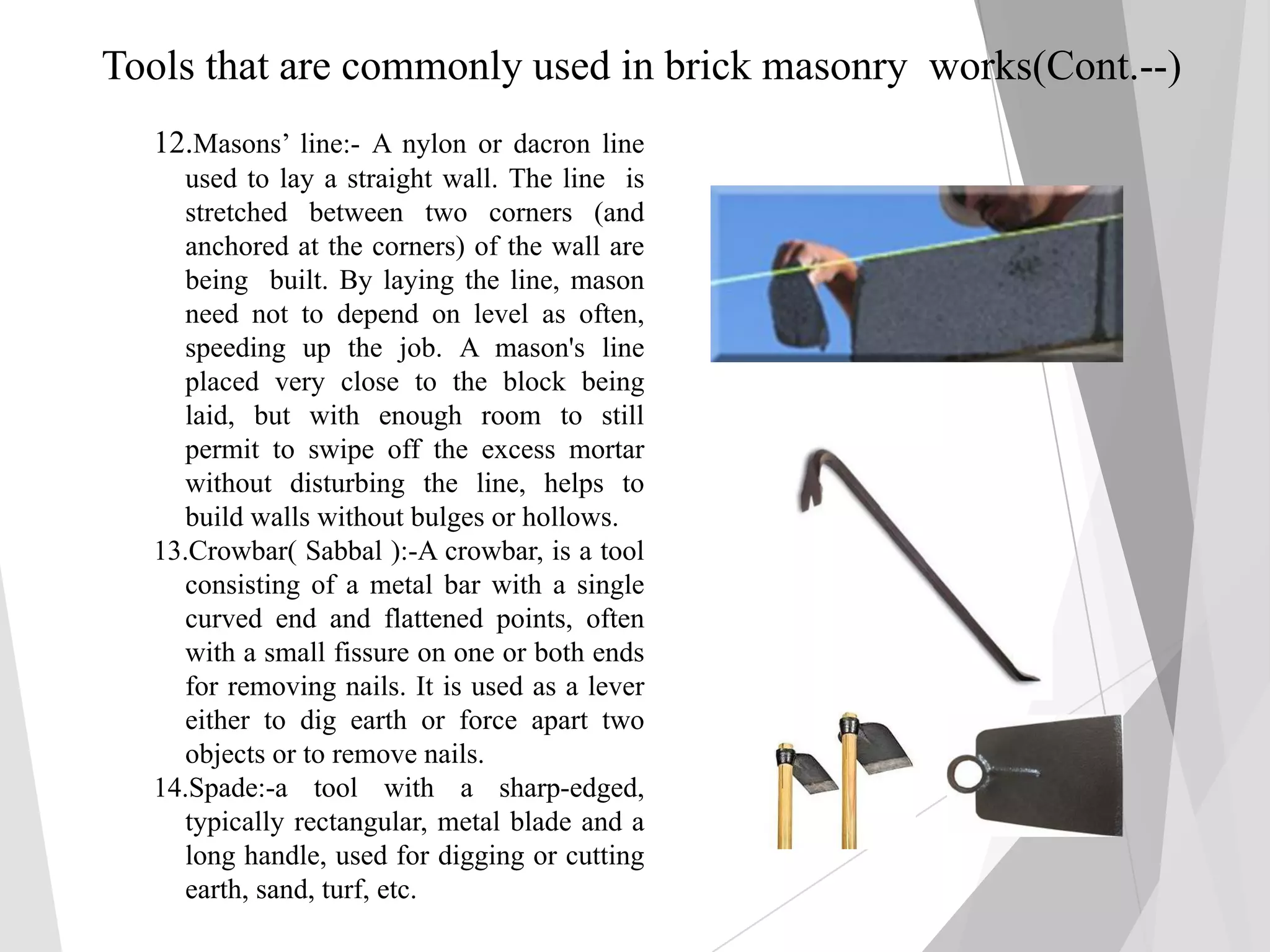
11. Chalk Line:-A chalk line comes in a
metal or plastic case, with a cotton line
coming out of one end. As the line is
pulled out, it passes through a fine
chalk powder, usually blue or red.
When this line is stretched between
two points and snapped, it will leave
an imprint on the surface being
snapped. A chalk line is used for laying
out a block wall on a concrete
foundation to get the alignment
correct.
Tools that are commonly used in brick masonry works(Cont.--)
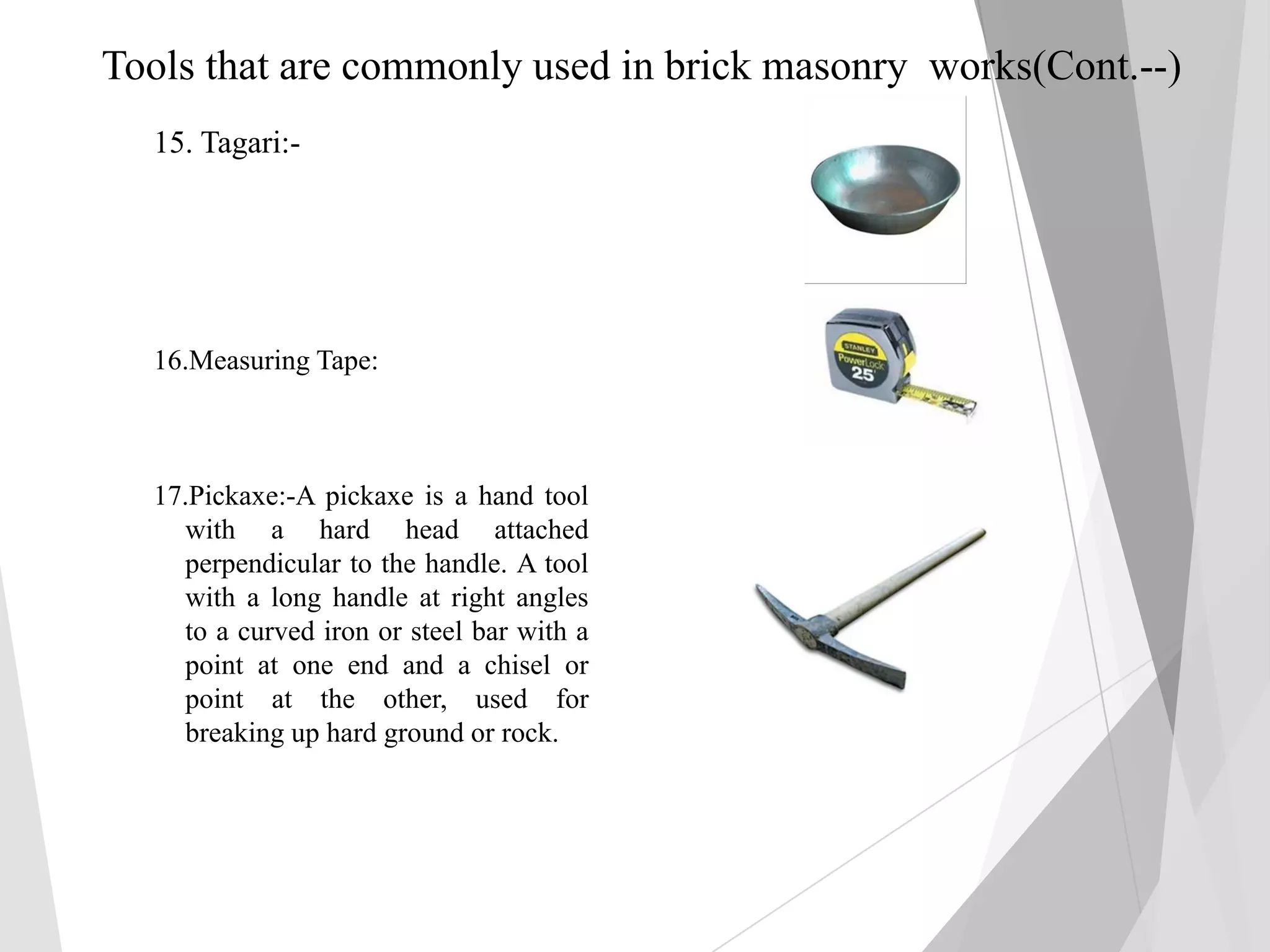
12.Masons’ line:- A nylon or dacron line
used to lay a straight wall. The line is
stretched between two corners (and
anchored at the corners) of the wall are
being built. By laying the line, mason
need not to depend on level as often,
speeding up the job. A mason's line
placed very close to the block being
laid, but with enough room to still
permit to swipe off the excess mortar
without disturbing the line, helps to
build walls without bulges or hollows.
13.Crowbar( Sabbal ):-A crowbar, is a tool
consisting of a metal bar with a single
curved end and flattened points, often
with a small fissure on one or both ends
for removing nails. It is used as a lever
either to dig earth or force apart two
objects or to remove nails.
14.Spade:-a tool with a sharp-edged,
typically rectangular, metal blade and a
long handle, used for digging or cutting
earth, sand, turf, etc.
Tools that are commonly used in brick masonry works(Cont.--)
15. Tagari:-
16.Measuring Tape:
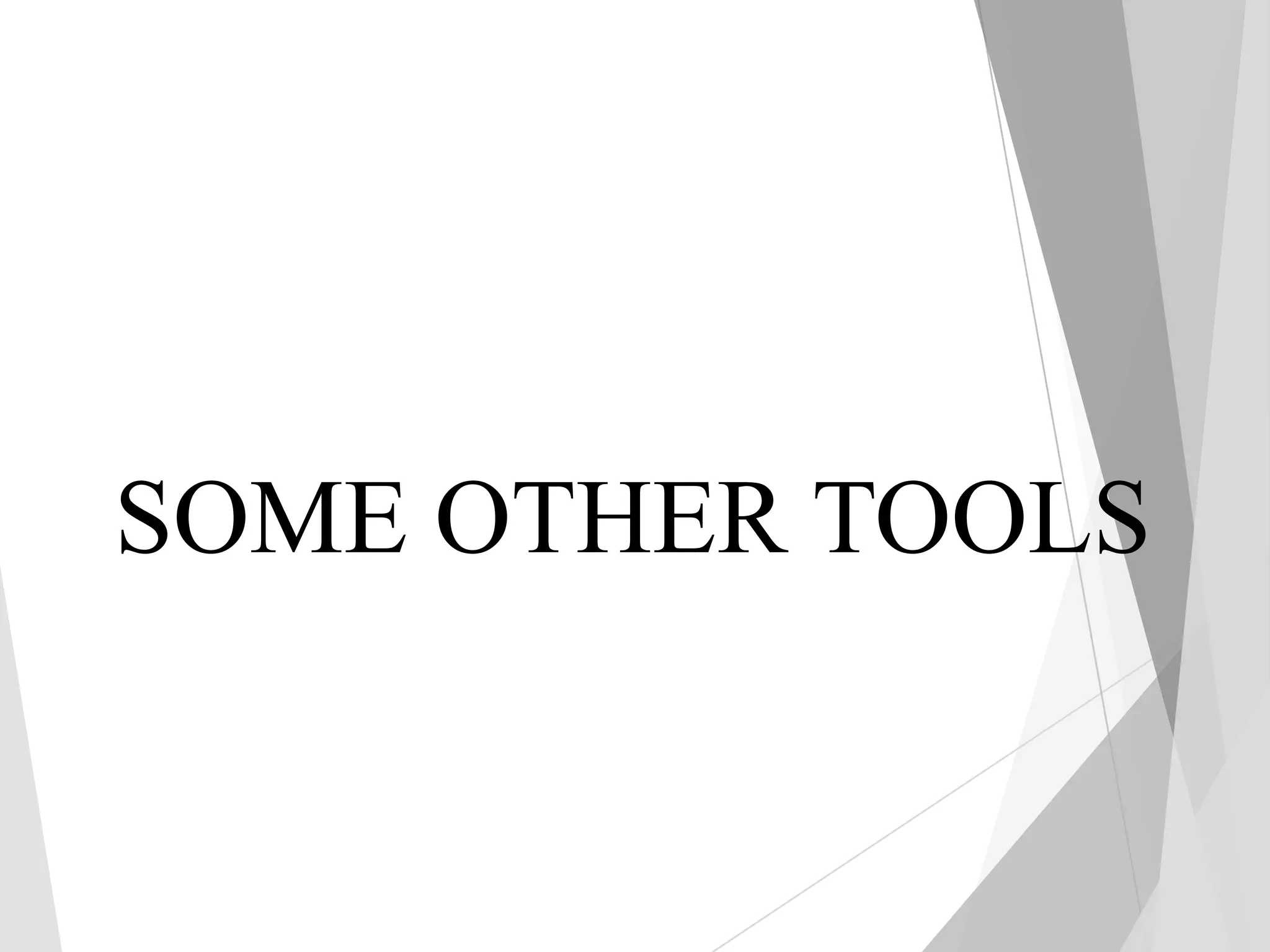
17.Pickaxe:-A pickaxe is a hand tool
with a hard head attached
perpendicular to the handle. A tool
with a long handle at right angles
to a curved iron or steel bar with a
point at one end and a chisel or
point at the other, used for
breaking up hard ground or rock.
SOME OTHER TOOLS
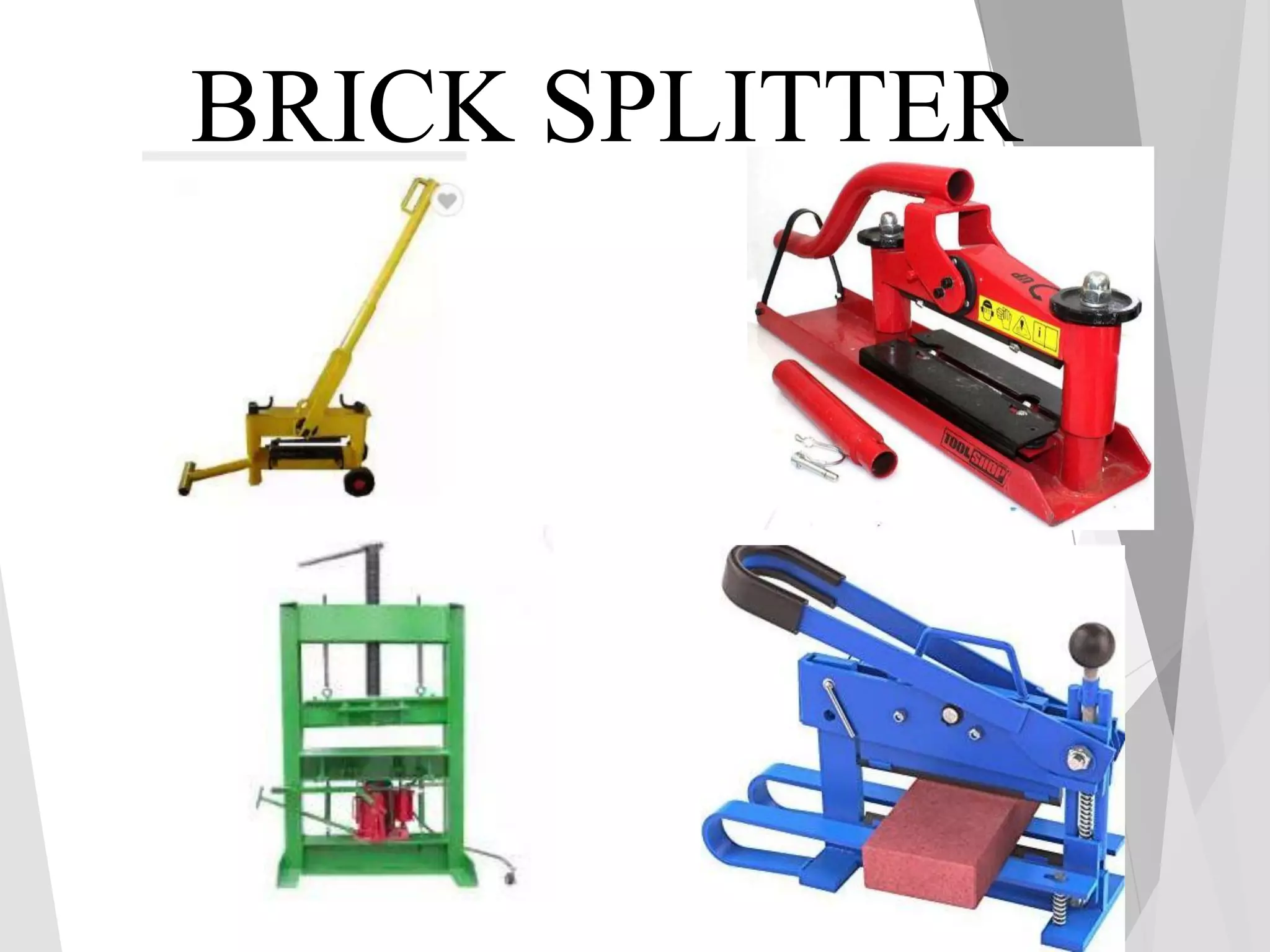
BRICK SPLITTER
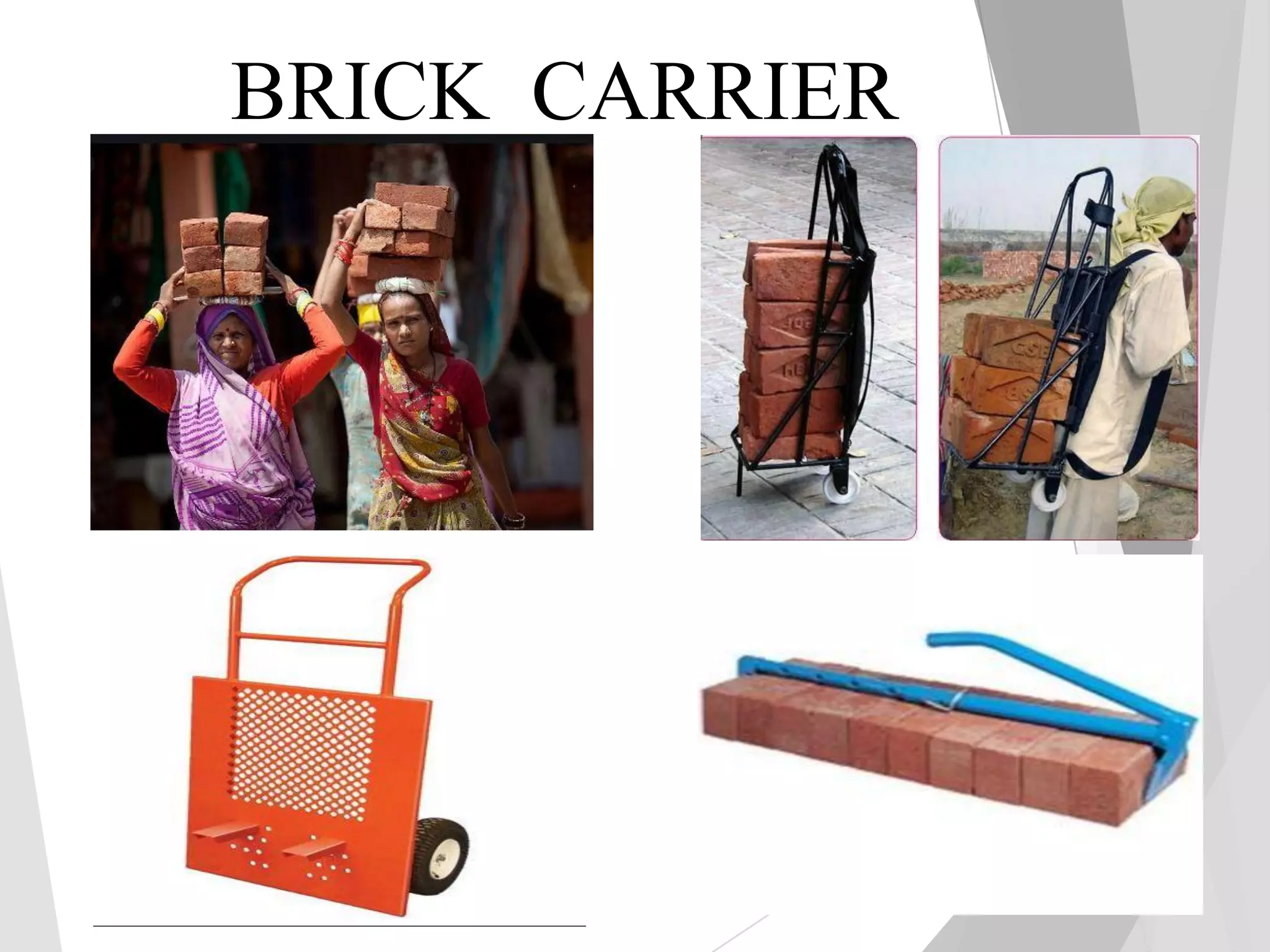
BRICK CARRIER
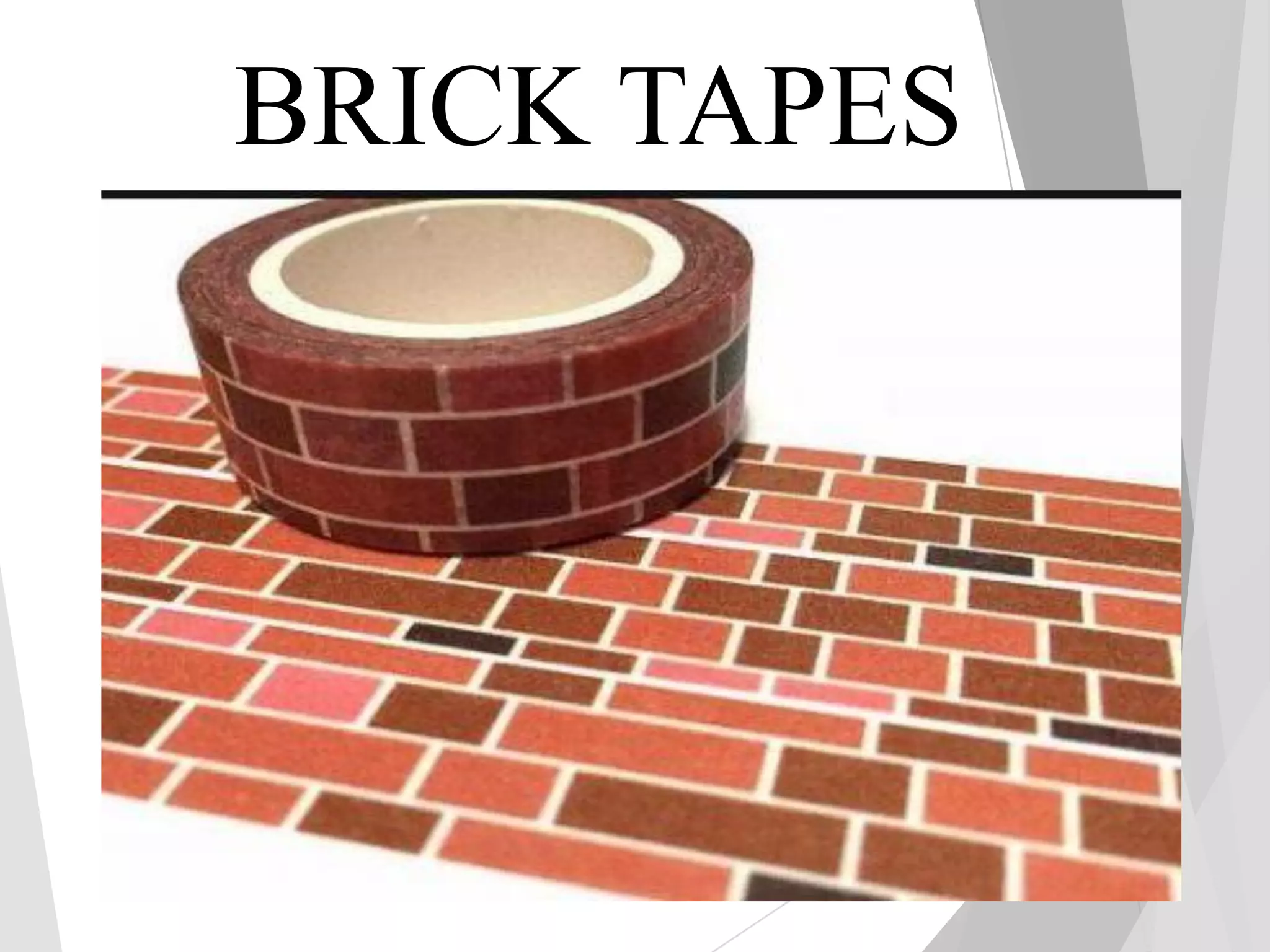
BRICK TAPES
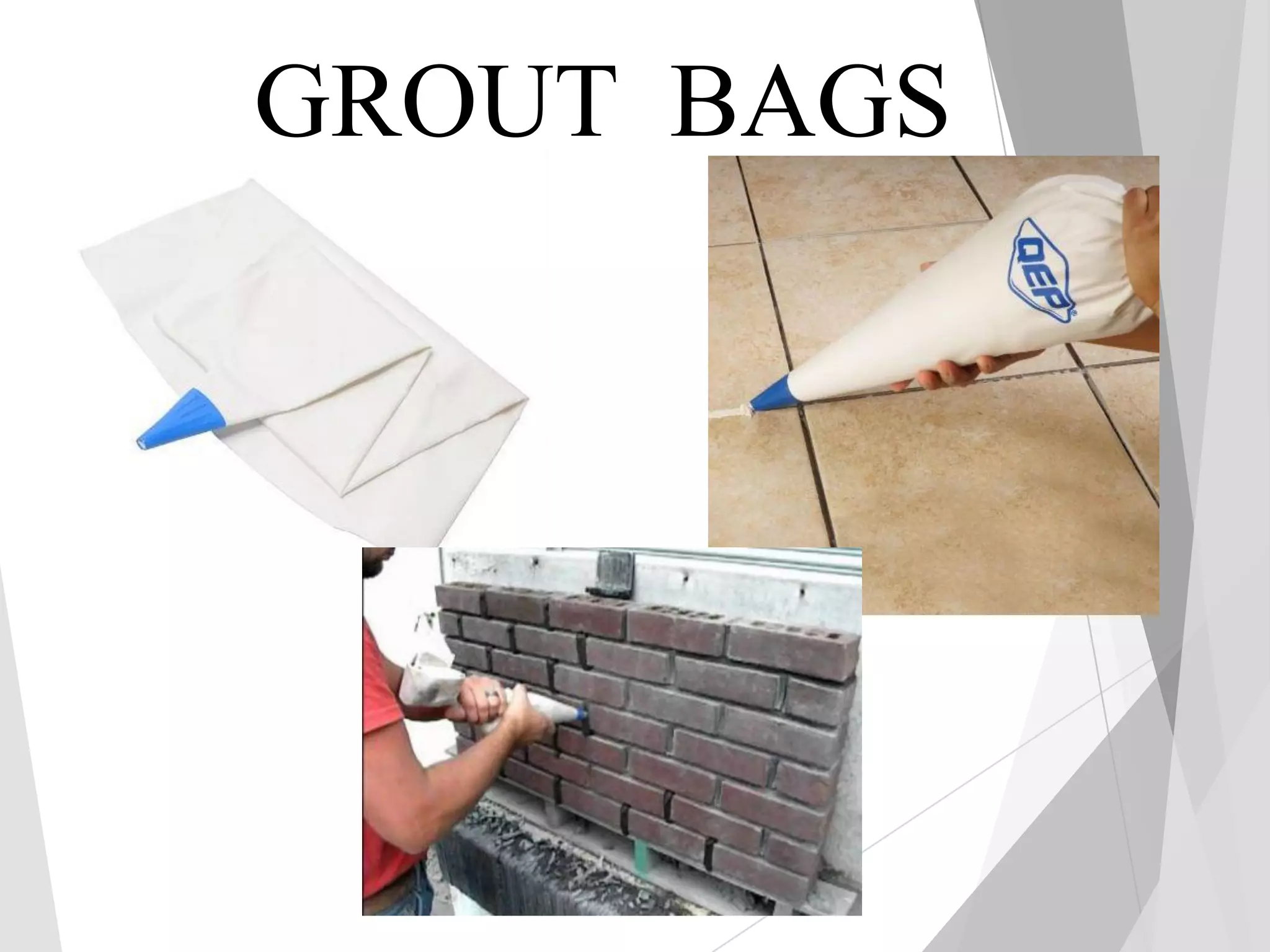
GROUT BAGS
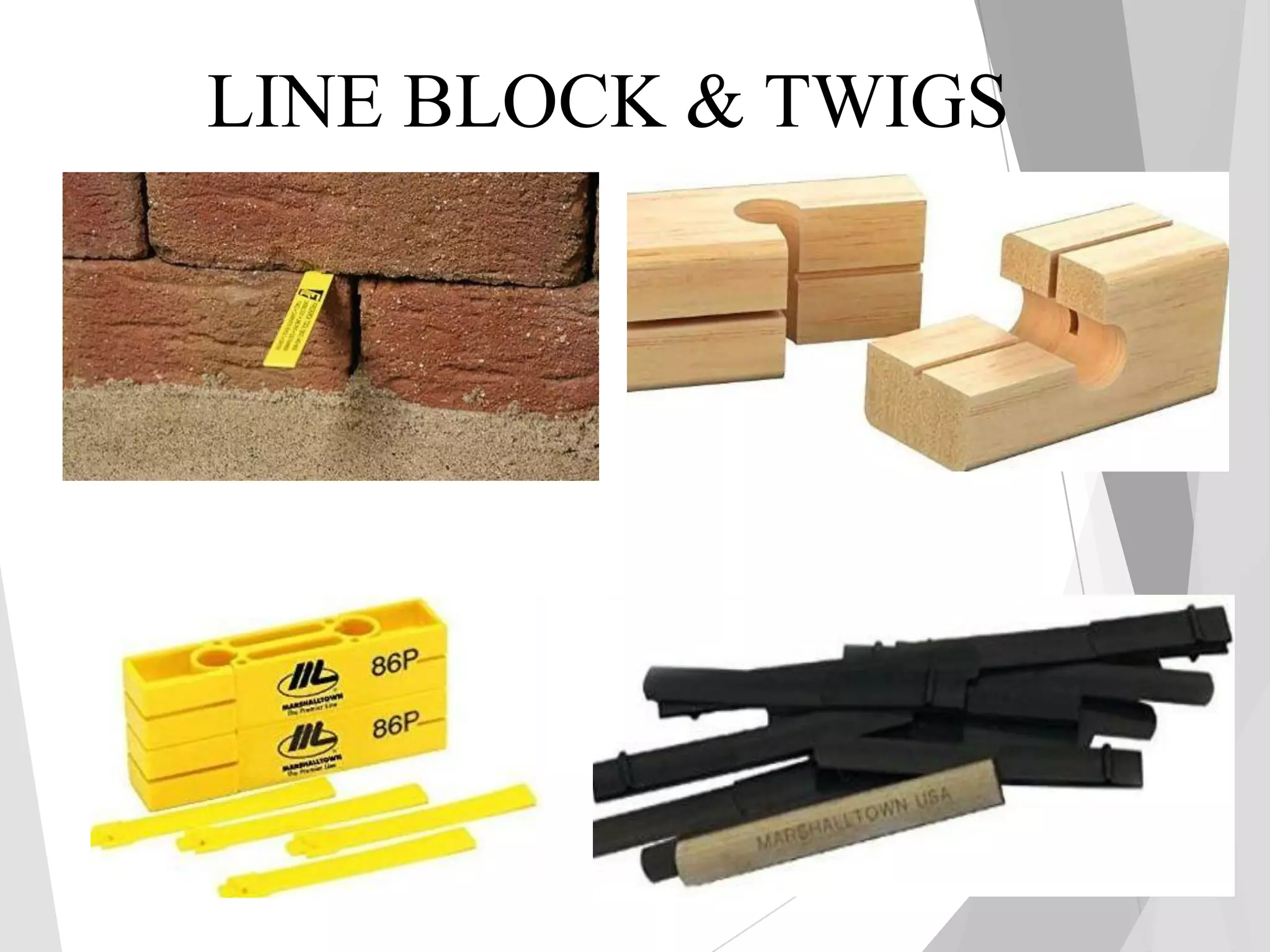
LINE BLOCK & TWIGS
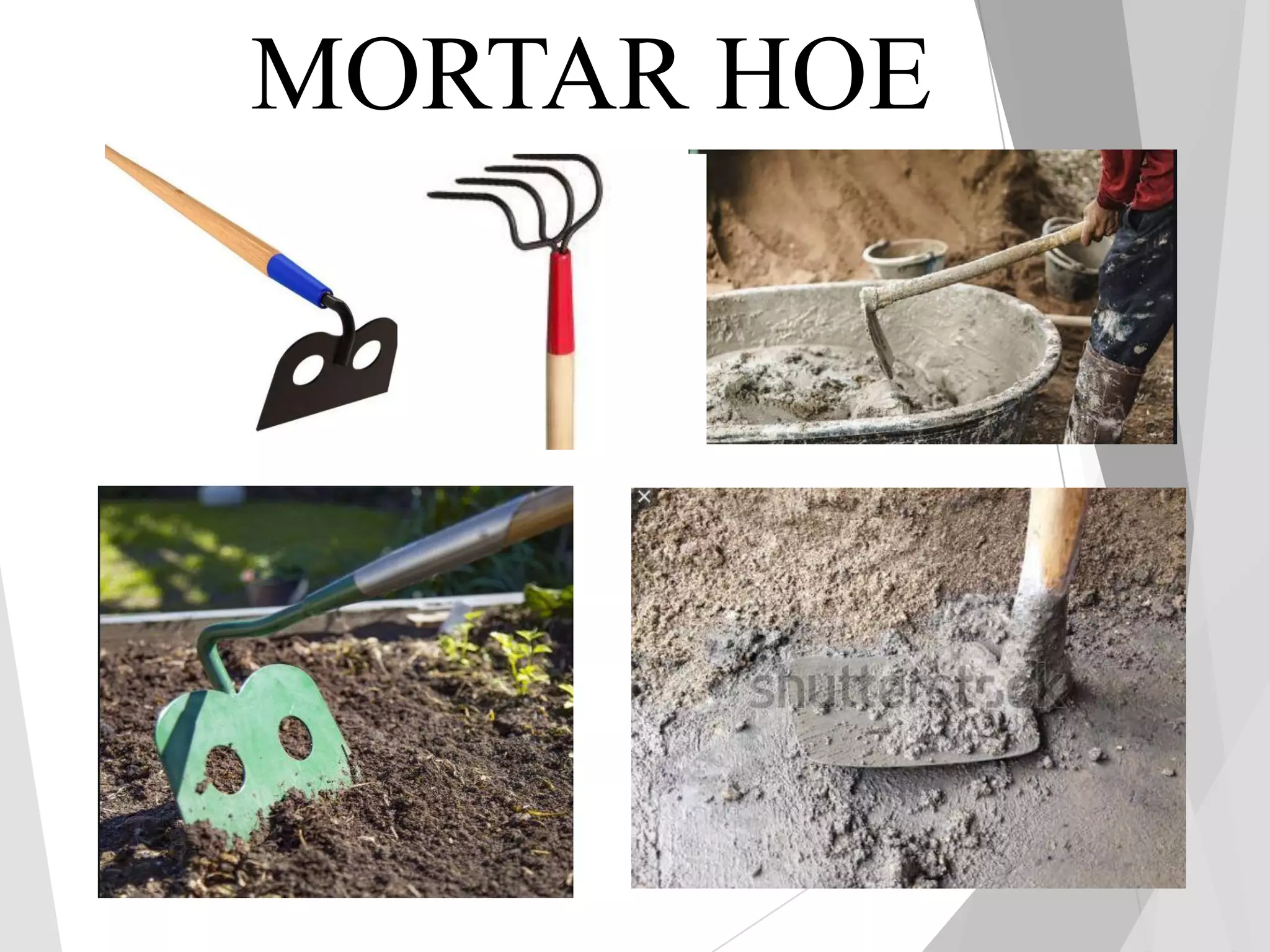
MORTAR HOE
SLED RUNNER
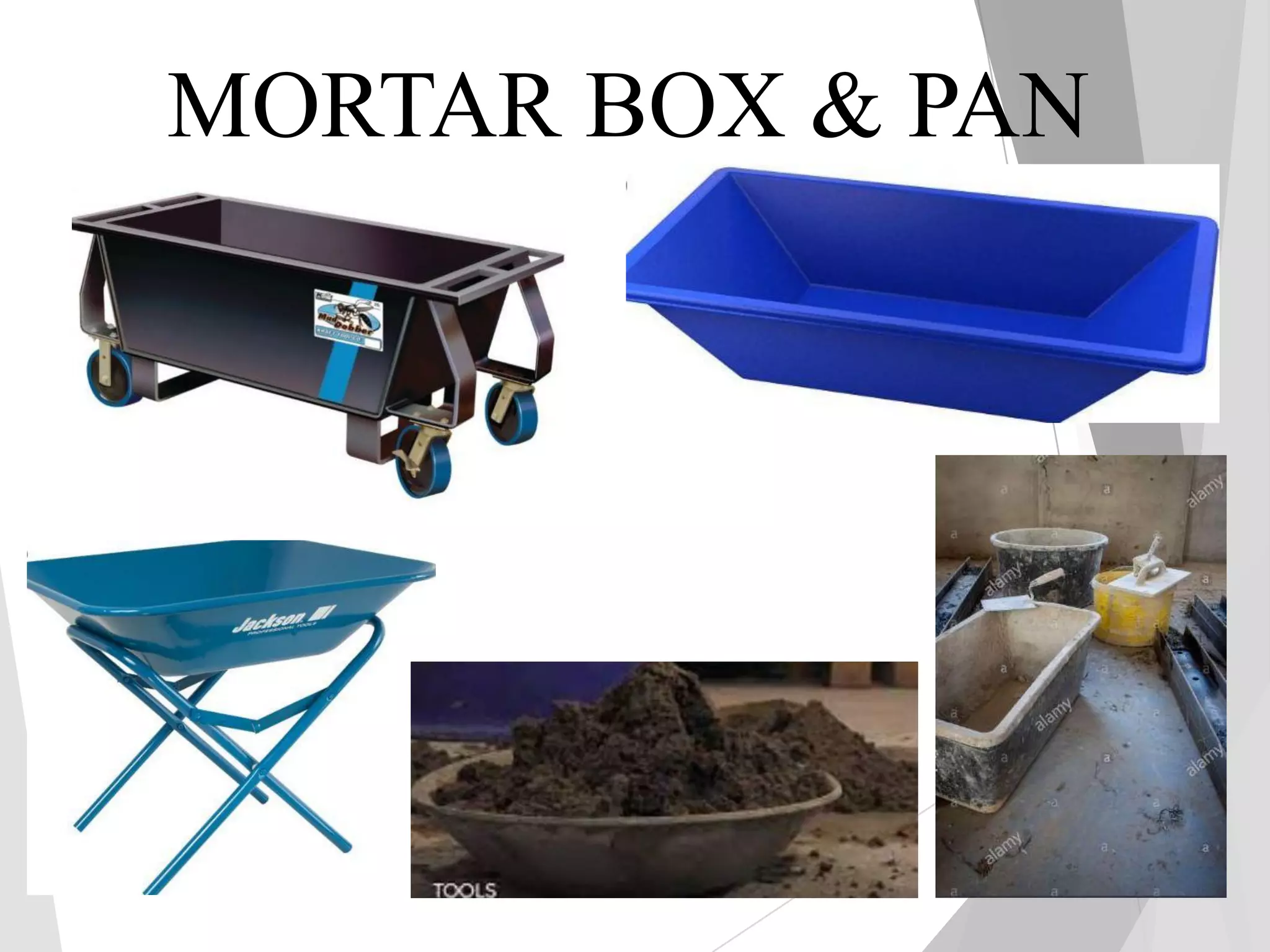
MORTAR BOX & PAN
Thank You

Brick masonry tools

  • 1.
  • 2.
    Tools that arecommonly used in brick masonry works. 1.Trowel:-The uses of this triangular shaped tool to pick up mortar from a board; to place and spread the mortar into a brick, or set of bricks; to secure a brick into the mortar by tapping. Sizes vary and can reach up to 11 inches in length and 8 inches in width. Masons prefer using short and wide trowels since they do not put excessive stress. 2.Chisel:-A chisel is used to cut bricks into specific sizes. Chisel width ranges from 2 1/2 to 4 1/2 inches. 3. Mason’s Hammer:-A hammer has a square face on one end for breaking and a sharp edge on the other for cutting. They are used to split hard bricks. It is also called as basuli. 4. Mashing Hammer:-A mashing hammer is used to strike the chisel when cutting block. It is not recommended to use a mason's hammer to strike the chisel since the tempered steel might split and a piece fly off. A mashing hammer has two striking ends and will weigh from two to four pounds.
  • 3.
    Tools that arecommonly used in brick masonry works(Cont.--) 5. Square:-Squares are used when constructing and measuring right angles and for corner layouts. They are usually made of metal for durability. Common name guniya. 6. Plum bob:-A plumb bob or a plummet is a weight, usually with a pointed tip on the bottom, that is suspended from a string and used as a vertical reference line, or plumb line. It is essentially the vertical equivalent of a "water level". 7. Mason’s Level:-A mason’s level is used when establishing vertical or plumb lines and horizontal or level lines. They are typically made of wood, metal, or a combination of both. They come equipped with either single or double vials.
  • 4.
    Tools that arecommonly used in brick masonry works(Cont.--) 8. Water level:-Water levels are used to measure an exact, level height across a surface, such as a wall or a board. People have been using various forms of water levels for centuries, as water levels are some of the easiest and most accurate leveling devices available. 9. Jointer:-A jointer is used to finish a mortar joint after it becomes hard enough so that a finger print will show in the mortar upon being pressed. There are three types of jointer shapes: flat, pointed and rounded. Jointers are shaped to give a variety of indentations, depending on preference. The most popular are the V joint and the half rounded joint (concave joint). These two kinds of joints help shed water better than any other kind of joint.
  • 5.
    Tools that arecommonly used in brick masonry works(Cont.--) 10. Brush:-After a wall is built, there may be some mortar stains or powder residue on the wall, which are cleaned by brush. A variety of brushes are available. Powder residue can usually be brushed off with a medium soft bristle brush. A light accumulation of mortar could be brushed with a stiff bristle brush. Stains that don't respond to brushing should be cleaned with a special solution and brushing with a stiff bristle brush. 11. Chalk Line:-A chalk line comes in a metal or plastic case, with a cotton line coming out of one end. As the line is pulled out, it passes through a fine chalk powder, usually blue or red. When this line is stretched between two points and snapped, it will leave an imprint on the surface being snapped. A chalk line is used for laying out a block wall on a concrete foundation to get the alignment correct.
  • 6.
    Tools that arecommonly used in brick masonry works(Cont.--) 12.Masons’ line:- A nylon or dacron line used to lay a straight wall. The line is stretched between two corners (and anchored at the corners) of the wall are being built. By laying the line, mason need not to depend on level as often, speeding up the job. A mason's line placed very close to the block being laid, but with enough room to still permit to swipe off the excess mortar without disturbing the line, helps to build walls without bulges or hollows. 13.Crowbar( Sabbal ):-A crowbar, is a tool consisting of a metal bar with a single curved end and flattened points, often with a small fissure on one or both ends for removing nails. It is used as a lever either to dig earth or force apart two objects or to remove nails. 14.Spade:-a tool with a sharp-edged, typically rectangular, metal blade and a long handle, used for digging or cutting earth, sand, turf, etc.
  • 7.
    Tools that arecommonly used in brick masonry works(Cont.--) 15. Tagari:- 16.Measuring Tape: 17.Pickaxe:-A pickaxe is a hand tool with a hard head attached perpendicular to the handle. A tool with a long handle at right angles to a curved iron or steel bar with a point at one end and a chisel or point at the other, used for breaking up hard ground or rock.
  • 8.
  • 9.
  • 10.
  • 11.
  • 12.
  • 13.
  • 14.
  • 15.
  • 16.
  • 17.