PLUMBING
P l u m b i n g
Definition
the art and technique of installing pipes, fixtures,
and other apparatuses in buildings for bringing in the
supply of liquids, substances and/or ingredients and
removing them; and such
water, liquid and other carried-wastes
hazardous to health, sanitation, life and property;
also the
pipes and fixtures after installation i.e., the
‘plumbing system’
- NPC 217.6
H i s t o r y
Plumbing Practice in the Philippines
In 1902, the Plumbing Trade was duly recognized by the government
in the City of Manila. Master Plumber John F. Haas became the first
Chief of the Division of Plumbing Construction and Inspection. A
Plumbing Code based on the Plumbing Code of the United States
was incorporated into the Building Code for the City of Manila.
In 1935, the National Master Plumbers Association of the Philippines
(NAMPAP) was formally organized
Manila City Ordinance 2411, the “Plumbing Code for the City of
Manila” was enacted and placed under the Department of Public
Services, Manila.
H i s t o r y
On January 28, 1959, the National Plumbing Code of the Philippines
prepared by NAMPAP was promulgated and approved by
Malacañang.
Before Martial Law in 1972, Republic Act No. 6541 otherwise known
as the “Building Code of the Philippines” was passed with the
“National Plumbing Code of 1959” as referral code in full text.
The Professional Regulation Commission (PRC) adopted the Revised
Plumbing Code of 1999 which President Joseph Estrada approved
December 21, 1999 pursuant to Section 4 of R.A. 1378 known as the
Plumbing Law.
In 1954, the Third Congress approved House Bill No. 962 which in
June 18, 1955, became R.A. 1378 “Plumbing Law of the Philippines”
upon ratification of President Ramon Magsaysay.
3
2
1
P r i n c i p l e s
All premises intended for human use or habitation shall be provided
with a supply of pure and wholesome water, neither connected to
unsafe water supply nor subject to backflow or back- siphonage.
22 Basic Principles of the Plumbing Code
Plumbing fixtures, devices and appurtenances shall be supplied with
water in sufficient volume and pressure adequate to function
satisfactorily and without undue noise.
Plumbing shall be designed and adjusted to use the minimum
quantity of water consistent with proper performance and cleaning.
4
Devices for heating and storing water shall be so designed and
installed as to prevent dangers from explosion through overheating.
6
5
P r i n c i p l e s
Every building abutting on a street, alley or easement with a public
sewer shall connect its plumbing fixtures to the sewer system.
Each family dwelling unit shall have at least one water closet, one
kitchen type sink, a lavatory and a bathtub or shower to meet the
basic requirements of sanitation and personal hygiene.
7
Plumbing fixtures shall be made of smooth non-absorbent material,
free from concealed fouling surfaces and shall be located in
ventilated enclosures.
8
The drainage system shall be designed, constructed and maintained
to safeguard against fouling, deposit of solids, clogging and with
adequate cleanouts so arranged that the pipes may be readily
cleaned.
9
P r i n c i p l e s
All piping shall be of durable NAMPAP-APPROVED materials, free
from defective workmanship, designed and constructed by
Registered Master Plumbers to ensure satisfactory service.
10
Each fixture directly connected to the drainage system shall be
equipped with a water-sealed trap.
11
The drainage pipes piping system shall be designed to provide
adequate circulation of air free from siphonage, aspiration or forcing
of trap seals under ordinary use.
12
Vent terminals shall extend to the outer air and installed to prevent
clogging and the return of foul air to the building.
13
Plumbing systems shall be subjected to such tests to effectively
disclose all leaks and defects in the workmanship.
P r i n c i p l e s
14
Substance which will clog the pipes, produce explosive mixtures,
destroy the pipes or their joints or interfere unduly with the sewage-
disposal process shall not be allowed to enter the building drainage
system.
15
Proper protection shall be provided to prevent contamination of
food, water, sterile goods and similar materials by backflow of
sewage. When necessary, the fixture, device or appliance shall be
connected indirectly with the building drainage system.
16
No water closet shall be located in a room or compartment which is
not properly lighted and ventilated.
17
If there is no sewer system in the area, suitable provision shall be
made for the disposal of building sewage by some accepted method
of sewage treatment and disposal, such as a septic tank.
20
19
P r i n c i p l e s
Plumbing systems shall be maintained in serviceable condition by
Registered Master Plumbers.
All plumbing fixtures shall be installed properly spaced, to be
accessible for their intended use.
18
Where a plumbing drainage system may be subject to backflow of
sewage, suitable provision shall be made to prevent its overflow in
the building.
21
Plumbing shall be installed with due regard to the preservation of
the strength of structural members and the prevention of damage to
walls and other surfaces through fixture usage.
22
Sewage or other waste from plumbing system which may be
deleterious to surface or sub-surface waters shall not be discharged
into the ground or into any waterway, unless first rendered
innocuous through subjection to some acceptable form of
treatment.
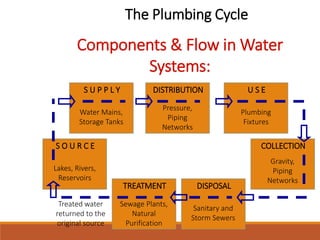
The Plumbing Cycle
Components & Flow in Water
Systems:
S U P P L Y
Water Mains,
Storage Tanks
DISTRIBUTION
Pressure,
Piping
Networks
U S E
Plumbing
Fixtures
COLLECTION
Gravity,
Piping
Networks
TREATMENT
Sewage Plants,
Natural
Purification
S O U R C E
Lakes, Rivers,
Reservoirs
Treated water
returned to the
original source
DISPOSAL
Sanitary and
Storm Sewers
The Plumbing Cycle
Water Functions Diagram:
SUPPLY DISTRIBUTION U S E COLLECTION DISPOSAL
Flow of water (& water carried wastes) should always be
only in one direction (from supply to disposal)
The two sides should always be carefully separated from
each other
PLUMBING FIXTURES
Plumbing Fixtures
Definition:
Receptacles which are used to provide, receive
and discharge water, liquid and water-carried
wastes into a drainage system with which they
are connected to
Classifications:
Soil Scullery Bathing
Water Closets
Urinals
Slop Sinks
Kitchen Sinks
Laundry Tubs
Lavatories
Bathtubs
Shower Baths
Bidets
Foot/Sitz Tub
Shower Receptors
Shower Compartments
Bar Sinks
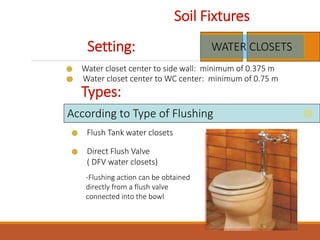
Soil Fixtures
Types:
According to Type of Flushing
Flush Tank water closets
Direct Flush Valve
( DFV water closets)
WATER CLOSETS
-Flushing action can be obtained
directly from a flush valve
connected into the bowl
Setting:
Water closet center to side wall: minimum of 0.375 m
Water closet center to WC center: minimum of 0.75 m
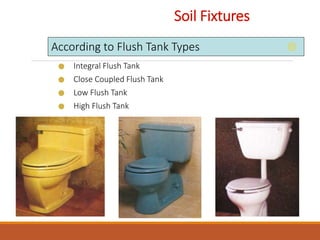
Soil Fixtures
According to Flush Tank Types
Integral Flush Tank
Close Coupled Flush Tank
Low Flush Tank
High Flush Tank
Soil Fixtures
According to Mounting
Floor Mounted
Wall Hung
Soil Fixtures
According to Flushing Action
- Flushes through a simple
wash down action
Wash Down
- Discharges waste into a
trapway located at the front
of the bowl
- Has a bulge on the front
- Has a small amount of
standing water
- Cost less but is least
efficient and noisiest
Soil Fixtures
- Has a larger trapway
making it less likely to clog
Siphon Jet
- Quieter flushing action
- Retains a large amount of
standing water
- Flushes through a siphon
action created in the trapway
Reverse Trap
Soil Fixtures
Direct Flush Valve - flushing action is obtained
directly from a flush valve
connected into the bowl
- Less noisy and very
efficient
Siphon Vortex
- Flushing action is started
by a whirlpool motion
followed by a complete
flush down
- Retains a large amount of
standing water
Soil Fixtures
Squat Type Washout
Other Types of Water Closets
Soil Fixtures
Soil Fixtures
Soil Fixtures
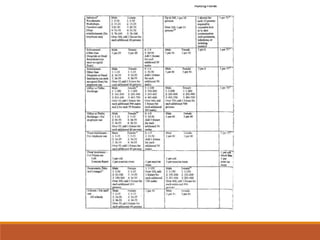
OCCUPANCY MIN. WC KIND & NO. OF USERS
Dwelling or Apartment 1 family
Elementary Schools 1
2
1
for 1-20 persons
For 21-50 persons
per additional 50 persons
Assembly Places
(Theaters and Auditoriums- for
public use)
1
2
3
3
4
8
1
2
per 1-100 males
per 101-200 males
per 201-400 males
per 1-50 females
per 51-100 females
per 101-200 females
per additional 500 males over 400
per additional 300 females over 400
Dormitories 1
1
1
per 10 males
per 8 females
per additional 25 males, 20 females
Industrial 1
2
3
4
5
1
per 1 - 10 persons
for 11 - 25 persons
for 26 - 50 persons
for 51 - 75 persons
for 76 - 100 persons
per additional 30 persons in excess of 100
Minimum Requirements for Water Closets
Soil Fixtures
Types:
Wall Hung
URINALS
Pedestal
Through
Stall
Soil Fixtures
Setting:
Urinal center to side wall: minimum of 0.30 m
Urinal center to urinal center: minimum of 0.60 m
Flushing:
Flushing urinals shall be done through automatic flushing
tanks. (NPC 408.1)
Flushometer valves shall be self-closing type discharging
a predetermined quantity of water. No manually controlled
flushometer valve shall be used to flush group urinals.
(NPC 408.2)
Soil Fixtures
OCCUPANCY MIN. # KIND & NO. OF USERS
Schools:
Elementary
Secondary
1
1
per 75 males
per 35 males
Office or Public Building 1
2
3
4
1
per 1-100 males
per 101-200 males
per 201-400 males
per 401-600 males
For each additional 300 males
Assembly Places
( Theaters and auditoriums)-
for public use)
1
2
3
4
1
per 1-100 males
per 101-200 males
per 201-400 males
per 401-600 males
For each additional 500 males
Dormitories 1
1
Per 25 males
per 50 males in excess of 150
Minimum Requirements for Urinals
Scullery Fixtures
KITCHEN SINKS
Materials:
Cast Iron Enamel
Formed Steel Coated with Porcelain Enamel
Stainless Steel
Single, Double or Triple Well, Shallow and Deep well, etc.
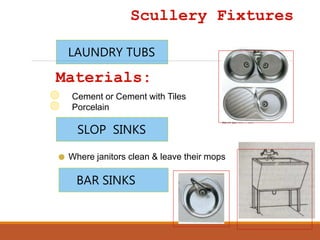
Materials:
Cement or Cement with Tiles
Porcelain
Scullery Fixtures
BAR SINKS
SLOP SINKS
Where janitors clean & leave their mops
LAUNDRY TUBS
Scullery Fixtures
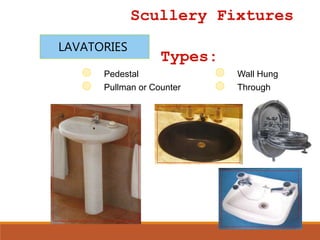
LAVATORIES
Types:
Pedestal
Pullman or Counter
Wall Hung
Through
Bathing Fixtures
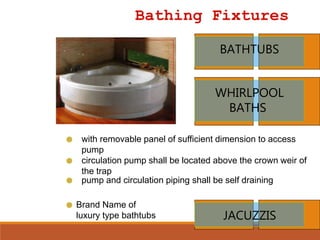
BATHTUBS
with removable panel of sufficient dimension to access
pump
WHIRLPOOL
BATHS
circulation pump shall be located above the crown weir of
the trap
pump and circulation piping shall be self draining
JACUZZIS
Brand Name of
luxury type bathtubs
Bathing Fixtures
BIDETS
Setting:
Bidet center to side wall: minimum of 0.375 m
Bidet center to bidet center: minimum of 0.75 m
Used for cleaning private parts
Sometimes referred to as
female urinals
Bathing Fixtures
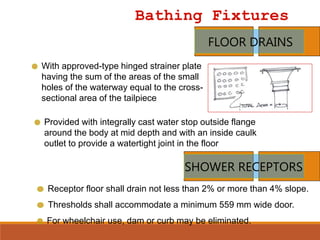
FLOOR DRAINS
With approved-type hinged strainer plate
having the sum of the areas of the small
holes of the waterway equal to the cross-
sectional area of the tailpiece
Provided with integrally cast water stop outside flange
around the body at mid depth and with an inside caulk
outlet to provide a watertight joint in the floor
SHOWER RECEPTORS
Receptor floor shall drain not less than 2% or more than 4% slope.
Thresholds shall accommodate a minimum 559 mm wide door.
For wheelchair use, dam or curb may be eliminated.
Bathing Fixtures
SHOWER BATHS/
COMPARTMENTS
Shall have a minimum interior area of 0.6 sqm and shall
be capable of encompassing a 762 mm diameter circle.
This area shall be maintained from a point above the shower
drain to a height of 1.78 m with no protrusions other than the
fixture valve, shower head and safety grab rails.
Drains for gang shower rooms shall be spaced not more
than 4.9 m apart.
Metal enclosure containing
shower head, valves and faucets
Gang d2
lang ang
Kwiz 1. ty
PIPES and FITTINGS
Cast Iron Soil Pipe
2 Types:
Most popular and generally specified material for drainage
installation. Extensively used in the 60s and 70s.
Durable, conveniently installed (<25 storey)
SV type - generally used; for building installations
XV type - extra duty; for underground installations
Commercial length: 600 cm
Diameters: 50-150mm
HUB
SPIGOT
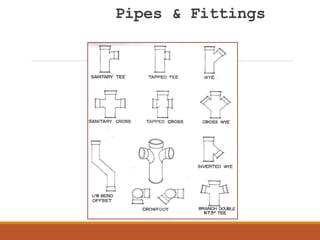
Pipes & Fittings
Affected to some extent by corrosion by acid formed by Carbon
Dioxide, Sulphur Oxide, and Methane Gases that create rust
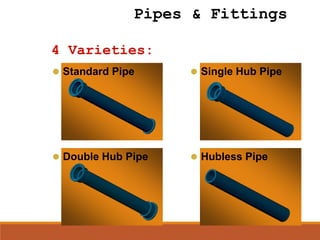
4 Varieties:
Standard Pipe Single Hub Pipe
Double Hub Pipe Hubless Pipe
Pipes & Fittings
Acid Resistant Cast Iron Pipe
Made of an alloy of cast iron and silicon
Installed in chemical laboratories, industries and other installations
where acid wastes are being discharged
Brittle and cracks easily, thus
horizontal runs have to be
Supported at every 1.50 meter
interval to prevent sagging
Pipes & Fittings
Asbestos Pipe
Made of an asbestos fibers and portland cement
Used as soil, waste, ventilation pipe & downspouts
Suited for concrete embedment because of similar properties
Bituminous Fiber Sewer Pipe
Cheapest of all types of pipes
Light in weight, slightly flexible and can take slight soil movement
without danger of cracking or pulling out of its joints. It is thus
suited for house sewer and septic tank installations
may be softened/damaged by excessive hot water or
chemical flow
Pipes & Fittings
Vitrified Clay Pipe
One of the oldest materials used for sewer lines
Highly resistant to most acids
Because it is made of clay, it is brittle and cracks easily
when laid on unstable ground
Made in short lengths of 750mm
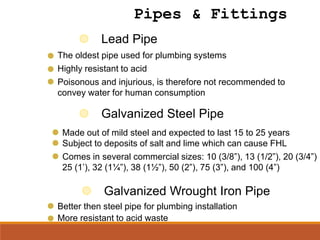
Lead Pipe
Highly resistant to acid
Poisonous and injurious, is therefore not recommended to
convey water for human consumption
Galvanized Wrought Iron Pipe
Better then steel pipe for plumbing installation
More resistant to acid waste
Pipes & Fittings
The oldest pipe used for plumbing systems
Galvanized Steel Pipe
Made out of mild steel and expected to last 15 to 25 years
Subject to deposits of salt and lime which can cause FHL
Comes in several commercial sizes: 10 (3/8”), 13 (1/2”), 20 (3/4”)
25 (1’), 32 (1¼”), 38 (1½”), 50 (2”), 75 (3”), and 100 (4”)
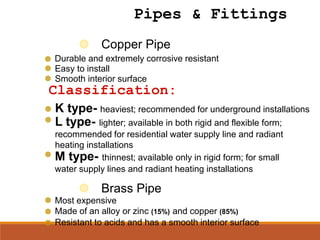
Copper Pipe
Durable and extremely corrosive resistant
Easy to install
K type- heaviest; recommended for underground installations
L type- lighter; available in both rigid and flexible form;
recommended for residential water supply line and radiant
heating installations
Classification:
M type- thinnest; available only in rigid form; for small
water supply lines and radiant heating installations
Smooth interior surface
Brass Pipe
Most expensive
Made of an alloy or zinc (15%) and copper (85%)
Resistant to acids and has a smooth interior surface
Pipes & Fittings
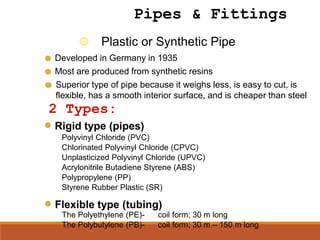
Plastic or Synthetic Pipe
Developed in Germany in 1935
2 Types:
Rigid type (pipes)
Flexible type (tubing)
Polyvinyl Chloride (PVC)
Chlorinated Polyvinyl Chloride (CPVC)
Unplasticized Polyvinyl Chloride (UPVC)
Acrylonitrile Butadiene Styrene (ABS)
Polypropylene (PP)
Styrene Rubber Plastic (SR)
The Polyethylene (PE)- coil form; 30 m long
The Polybutylene (PB)- coil form; 30 m – 150 m long
Most are produced from synthetic resins
Pipes & Fittings
Superior type of pipe because it weighs less, is easy to cut, is
flexible, has a smooth interior surface, and is cheaper than steel
Considerations in
choosing materials:
Quality and durability.
Resistance to external and internal
contact with foreign matters.
Resistance to acid waste and
other chemical elements that
will pass into it.
Cost of materials and labor.
Pipes & Fittings
Pipes & Fittings
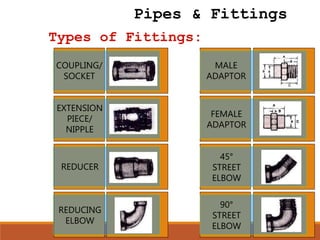
Types of Fittings:
COUPLING/
SOCKET
EXTENSION
PIECE/
NIPPLE
REDUCER
MALE
ADAPTOR
FEMALE
ADAPTOR
45°
STREET
ELBOW
REDUCING
ELBOW
90°
STREET
ELBOW
Pipes & Fittings
TEE
REDUCING
TEE
CAP
CROSS
PLUG
UNION
DOUBLE
HUB
Pipes & Fittings
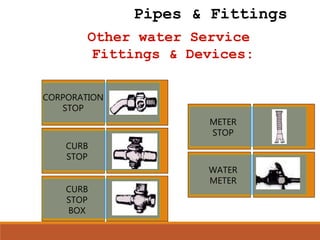
Other water Service
Fittings & Devices:
CORPORATION
STOP
CURB
STOP
METER
STOP
CURB
STOP
BOX
WATER
METER
SANITARY FITTINGS
Pipes & Fittings
Pipes & Fittings
Working Drawings
Piping Symbols for Plumbing:
DRAIN OR WASTE ABOVE GROUND
DRAIN OR WASTE BELOW GROUND
VENT
SD STORM DRAIN
COLD WATER
SW SOFT COLD WATER
HOT WATER
S SPRINKLER MAIN
SPRINKLER BRANCH AND HEAD
Working Drawings
GAS
G G
COMPRESSED AIR
A
VACUUM
V
SEWER – CAST IRON
S - CI
SEWER – CLAY TILE
S - CT
SEWER – PLASTIC
S - P
Working Drawings
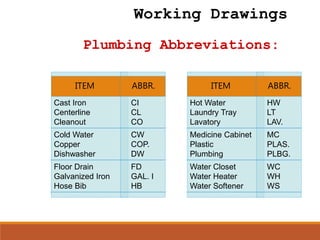
Plumbing Abbreviations:
ABBR.
ITEM
Cast Iron
Centerline
Cleanout
CI
CL
CO
Cold Water
Copper
Dishwasher
CW
COP.
DW
Floor Drain
Galvanized Iron
Hose Bib
FD
GAL. I
HB
ABBR.
ITEM
Hot Water
Laundry Tray
Lavatory
HW
LT
LAV.
Medicine Cabinet
Plastic
Plumbing
MC
PLAS.
PLBG.
Water Closet
Water Heater
Water Softener
WC
WH
WS
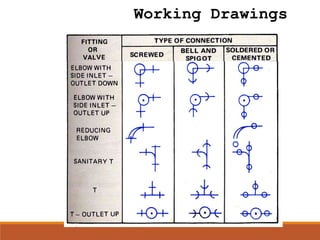
Working Drawings
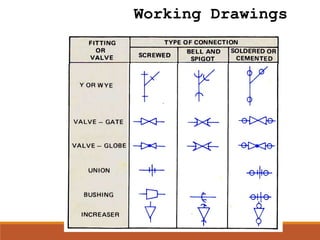
Pipe & Fitting Symbols:
Working Drawings
Working Drawings
Working Drawings
Joints & Connections
General Methods:
Caulking (lead and oakum)
Threading
Welding / Soldering
Rubber Ring method (rubber gaskets)
Hubless connections (steel plates and
clamps and neoprene rubber)
Adhesives
Flanged connections
(screws and bolts)
Inspection & Test
Water Testing:
Air Pressure Testing:
Testing of water supply piping is conducted by
closing all outlets & filling the system with water
from the main to locate leaks and other potential
problems
Used in detecting leaks by filling the piping
system with compressed air (use of soap suds
in locating escaping air)

PLUMBING 1.ppt

  • 1.
  • 3.
    P l um b i n g Definition the art and technique of installing pipes, fixtures, and other apparatuses in buildings for bringing in the supply of liquids, substances and/or ingredients and removing them; and such water, liquid and other carried-wastes hazardous to health, sanitation, life and property; also the pipes and fixtures after installation i.e., the ‘plumbing system’ - NPC 217.6
  • 5.
    H i st o r y Plumbing Practice in the Philippines In 1902, the Plumbing Trade was duly recognized by the government in the City of Manila. Master Plumber John F. Haas became the first Chief of the Division of Plumbing Construction and Inspection. A Plumbing Code based on the Plumbing Code of the United States was incorporated into the Building Code for the City of Manila. In 1935, the National Master Plumbers Association of the Philippines (NAMPAP) was formally organized Manila City Ordinance 2411, the “Plumbing Code for the City of Manila” was enacted and placed under the Department of Public Services, Manila.
  • 6.
    H i st o r y On January 28, 1959, the National Plumbing Code of the Philippines prepared by NAMPAP was promulgated and approved by Malacañang. Before Martial Law in 1972, Republic Act No. 6541 otherwise known as the “Building Code of the Philippines” was passed with the “National Plumbing Code of 1959” as referral code in full text. The Professional Regulation Commission (PRC) adopted the Revised Plumbing Code of 1999 which President Joseph Estrada approved December 21, 1999 pursuant to Section 4 of R.A. 1378 known as the Plumbing Law. In 1954, the Third Congress approved House Bill No. 962 which in June 18, 1955, became R.A. 1378 “Plumbing Law of the Philippines” upon ratification of President Ramon Magsaysay.
  • 7.
    3 2 1 P r in c i p l e s All premises intended for human use or habitation shall be provided with a supply of pure and wholesome water, neither connected to unsafe water supply nor subject to backflow or back- siphonage. 22 Basic Principles of the Plumbing Code Plumbing fixtures, devices and appurtenances shall be supplied with water in sufficient volume and pressure adequate to function satisfactorily and without undue noise. Plumbing shall be designed and adjusted to use the minimum quantity of water consistent with proper performance and cleaning. 4 Devices for heating and storing water shall be so designed and installed as to prevent dangers from explosion through overheating.
  • 8.
    6 5 P r in c i p l e s Every building abutting on a street, alley or easement with a public sewer shall connect its plumbing fixtures to the sewer system. Each family dwelling unit shall have at least one water closet, one kitchen type sink, a lavatory and a bathtub or shower to meet the basic requirements of sanitation and personal hygiene. 7 Plumbing fixtures shall be made of smooth non-absorbent material, free from concealed fouling surfaces and shall be located in ventilated enclosures. 8 The drainage system shall be designed, constructed and maintained to safeguard against fouling, deposit of solids, clogging and with adequate cleanouts so arranged that the pipes may be readily cleaned.
  • 9.
    9 P r in c i p l e s All piping shall be of durable NAMPAP-APPROVED materials, free from defective workmanship, designed and constructed by Registered Master Plumbers to ensure satisfactory service. 10 Each fixture directly connected to the drainage system shall be equipped with a water-sealed trap. 11 The drainage pipes piping system shall be designed to provide adequate circulation of air free from siphonage, aspiration or forcing of trap seals under ordinary use. 12 Vent terminals shall extend to the outer air and installed to prevent clogging and the return of foul air to the building. 13 Plumbing systems shall be subjected to such tests to effectively disclose all leaks and defects in the workmanship.
  • 10.
    P r in c i p l e s 14 Substance which will clog the pipes, produce explosive mixtures, destroy the pipes or their joints or interfere unduly with the sewage- disposal process shall not be allowed to enter the building drainage system. 15 Proper protection shall be provided to prevent contamination of food, water, sterile goods and similar materials by backflow of sewage. When necessary, the fixture, device or appliance shall be connected indirectly with the building drainage system. 16 No water closet shall be located in a room or compartment which is not properly lighted and ventilated. 17 If there is no sewer system in the area, suitable provision shall be made for the disposal of building sewage by some accepted method of sewage treatment and disposal, such as a septic tank.
  • 11.
    20 19 P r in c i p l e s Plumbing systems shall be maintained in serviceable condition by Registered Master Plumbers. All plumbing fixtures shall be installed properly spaced, to be accessible for their intended use. 18 Where a plumbing drainage system may be subject to backflow of sewage, suitable provision shall be made to prevent its overflow in the building. 21 Plumbing shall be installed with due regard to the preservation of the strength of structural members and the prevention of damage to walls and other surfaces through fixture usage. 22 Sewage or other waste from plumbing system which may be deleterious to surface or sub-surface waters shall not be discharged into the ground or into any waterway, unless first rendered innocuous through subjection to some acceptable form of treatment.
  • 12.
    The Plumbing Cycle Components& Flow in Water Systems: S U P P L Y Water Mains, Storage Tanks DISTRIBUTION Pressure, Piping Networks U S E Plumbing Fixtures COLLECTION Gravity, Piping Networks TREATMENT Sewage Plants, Natural Purification S O U R C E Lakes, Rivers, Reservoirs Treated water returned to the original source DISPOSAL Sanitary and Storm Sewers
  • 13.
    The Plumbing Cycle WaterFunctions Diagram: SUPPLY DISTRIBUTION U S E COLLECTION DISPOSAL Flow of water (& water carried wastes) should always be only in one direction (from supply to disposal) The two sides should always be carefully separated from each other
  • 14.
  • 15.
    Plumbing Fixtures Definition: Receptacles whichare used to provide, receive and discharge water, liquid and water-carried wastes into a drainage system with which they are connected to Classifications: Soil Scullery Bathing Water Closets Urinals Slop Sinks Kitchen Sinks Laundry Tubs Lavatories Bathtubs Shower Baths Bidets Foot/Sitz Tub Shower Receptors Shower Compartments Bar Sinks
  • 16.
    Soil Fixtures Types: According toType of Flushing Flush Tank water closets Direct Flush Valve ( DFV water closets) WATER CLOSETS -Flushing action can be obtained directly from a flush valve connected into the bowl Setting: Water closet center to side wall: minimum of 0.375 m Water closet center to WC center: minimum of 0.75 m
  • 17.
    Soil Fixtures According toFlush Tank Types Integral Flush Tank Close Coupled Flush Tank Low Flush Tank High Flush Tank
  • 18.
    Soil Fixtures According toMounting Floor Mounted Wall Hung
  • 19.
    Soil Fixtures According toFlushing Action - Flushes through a simple wash down action Wash Down - Discharges waste into a trapway located at the front of the bowl - Has a bulge on the front - Has a small amount of standing water - Cost less but is least efficient and noisiest
  • 20.
    Soil Fixtures - Hasa larger trapway making it less likely to clog Siphon Jet - Quieter flushing action - Retains a large amount of standing water - Flushes through a siphon action created in the trapway Reverse Trap
  • 21.
    Soil Fixtures Direct FlushValve - flushing action is obtained directly from a flush valve connected into the bowl - Less noisy and very efficient Siphon Vortex - Flushing action is started by a whirlpool motion followed by a complete flush down - Retains a large amount of standing water
  • 22.
    Soil Fixtures Squat TypeWashout Other Types of Water Closets
  • 23.
  • 24.
  • 25.
    Soil Fixtures OCCUPANCY MIN.WC KIND & NO. OF USERS Dwelling or Apartment 1 family Elementary Schools 1 2 1 for 1-20 persons For 21-50 persons per additional 50 persons Assembly Places (Theaters and Auditoriums- for public use) 1 2 3 3 4 8 1 2 per 1-100 males per 101-200 males per 201-400 males per 1-50 females per 51-100 females per 101-200 females per additional 500 males over 400 per additional 300 females over 400 Dormitories 1 1 1 per 10 males per 8 females per additional 25 males, 20 females Industrial 1 2 3 4 5 1 per 1 - 10 persons for 11 - 25 persons for 26 - 50 persons for 51 - 75 persons for 76 - 100 persons per additional 30 persons in excess of 100 Minimum Requirements for Water Closets
  • 26.
  • 27.
    Soil Fixtures Setting: Urinal centerto side wall: minimum of 0.30 m Urinal center to urinal center: minimum of 0.60 m Flushing: Flushing urinals shall be done through automatic flushing tanks. (NPC 408.1) Flushometer valves shall be self-closing type discharging a predetermined quantity of water. No manually controlled flushometer valve shall be used to flush group urinals. (NPC 408.2)
  • 28.
    Soil Fixtures OCCUPANCY MIN.# KIND & NO. OF USERS Schools: Elementary Secondary 1 1 per 75 males per 35 males Office or Public Building 1 2 3 4 1 per 1-100 males per 101-200 males per 201-400 males per 401-600 males For each additional 300 males Assembly Places ( Theaters and auditoriums)- for public use) 1 2 3 4 1 per 1-100 males per 101-200 males per 201-400 males per 401-600 males For each additional 500 males Dormitories 1 1 Per 25 males per 50 males in excess of 150 Minimum Requirements for Urinals
  • 29.
    Scullery Fixtures KITCHEN SINKS Materials: CastIron Enamel Formed Steel Coated with Porcelain Enamel Stainless Steel Single, Double or Triple Well, Shallow and Deep well, etc.
  • 30.
    Materials: Cement or Cementwith Tiles Porcelain Scullery Fixtures BAR SINKS SLOP SINKS Where janitors clean & leave their mops LAUNDRY TUBS
  • 31.
  • 32.
    Bathing Fixtures BATHTUBS with removablepanel of sufficient dimension to access pump WHIRLPOOL BATHS circulation pump shall be located above the crown weir of the trap pump and circulation piping shall be self draining JACUZZIS Brand Name of luxury type bathtubs
  • 33.
    Bathing Fixtures BIDETS Setting: Bidet centerto side wall: minimum of 0.375 m Bidet center to bidet center: minimum of 0.75 m Used for cleaning private parts Sometimes referred to as female urinals
  • 34.
    Bathing Fixtures FLOOR DRAINS Withapproved-type hinged strainer plate having the sum of the areas of the small holes of the waterway equal to the cross- sectional area of the tailpiece Provided with integrally cast water stop outside flange around the body at mid depth and with an inside caulk outlet to provide a watertight joint in the floor SHOWER RECEPTORS Receptor floor shall drain not less than 2% or more than 4% slope. Thresholds shall accommodate a minimum 559 mm wide door. For wheelchair use, dam or curb may be eliminated.
  • 35.
    Bathing Fixtures SHOWER BATHS/ COMPARTMENTS Shallhave a minimum interior area of 0.6 sqm and shall be capable of encompassing a 762 mm diameter circle. This area shall be maintained from a point above the shower drain to a height of 1.78 m with no protrusions other than the fixture valve, shower head and safety grab rails. Drains for gang shower rooms shall be spaced not more than 4.9 m apart. Metal enclosure containing shower head, valves and faucets
  • 39.
  • 40.
  • 41.
    Cast Iron SoilPipe 2 Types: Most popular and generally specified material for drainage installation. Extensively used in the 60s and 70s. Durable, conveniently installed (<25 storey) SV type - generally used; for building installations XV type - extra duty; for underground installations Commercial length: 600 cm Diameters: 50-150mm HUB SPIGOT Pipes & Fittings Affected to some extent by corrosion by acid formed by Carbon Dioxide, Sulphur Oxide, and Methane Gases that create rust
  • 42.
    4 Varieties: Standard PipeSingle Hub Pipe Double Hub Pipe Hubless Pipe Pipes & Fittings
  • 43.
    Acid Resistant CastIron Pipe Made of an alloy of cast iron and silicon Installed in chemical laboratories, industries and other installations where acid wastes are being discharged Brittle and cracks easily, thus horizontal runs have to be Supported at every 1.50 meter interval to prevent sagging Pipes & Fittings Asbestos Pipe Made of an asbestos fibers and portland cement Used as soil, waste, ventilation pipe & downspouts Suited for concrete embedment because of similar properties
  • 44.
    Bituminous Fiber SewerPipe Cheapest of all types of pipes Light in weight, slightly flexible and can take slight soil movement without danger of cracking or pulling out of its joints. It is thus suited for house sewer and septic tank installations may be softened/damaged by excessive hot water or chemical flow Pipes & Fittings Vitrified Clay Pipe One of the oldest materials used for sewer lines Highly resistant to most acids Because it is made of clay, it is brittle and cracks easily when laid on unstable ground Made in short lengths of 750mm
  • 45.
    Lead Pipe Highly resistantto acid Poisonous and injurious, is therefore not recommended to convey water for human consumption Galvanized Wrought Iron Pipe Better then steel pipe for plumbing installation More resistant to acid waste Pipes & Fittings The oldest pipe used for plumbing systems Galvanized Steel Pipe Made out of mild steel and expected to last 15 to 25 years Subject to deposits of salt and lime which can cause FHL Comes in several commercial sizes: 10 (3/8”), 13 (1/2”), 20 (3/4”) 25 (1’), 32 (1¼”), 38 (1½”), 50 (2”), 75 (3”), and 100 (4”)
  • 46.
    Copper Pipe Durable andextremely corrosive resistant Easy to install K type- heaviest; recommended for underground installations L type- lighter; available in both rigid and flexible form; recommended for residential water supply line and radiant heating installations Classification: M type- thinnest; available only in rigid form; for small water supply lines and radiant heating installations Smooth interior surface Brass Pipe Most expensive Made of an alloy or zinc (15%) and copper (85%) Resistant to acids and has a smooth interior surface Pipes & Fittings
  • 47.
    Plastic or SyntheticPipe Developed in Germany in 1935 2 Types: Rigid type (pipes) Flexible type (tubing) Polyvinyl Chloride (PVC) Chlorinated Polyvinyl Chloride (CPVC) Unplasticized Polyvinyl Chloride (UPVC) Acrylonitrile Butadiene Styrene (ABS) Polypropylene (PP) Styrene Rubber Plastic (SR) The Polyethylene (PE)- coil form; 30 m long The Polybutylene (PB)- coil form; 30 m – 150 m long Most are produced from synthetic resins Pipes & Fittings Superior type of pipe because it weighs less, is easy to cut, is flexible, has a smooth interior surface, and is cheaper than steel
  • 48.
    Considerations in choosing materials: Qualityand durability. Resistance to external and internal contact with foreign matters. Resistance to acid waste and other chemical elements that will pass into it. Cost of materials and labor. Pipes & Fittings
  • 49.
    Pipes & Fittings Typesof Fittings: COUPLING/ SOCKET EXTENSION PIECE/ NIPPLE REDUCER MALE ADAPTOR FEMALE ADAPTOR 45° STREET ELBOW REDUCING ELBOW 90° STREET ELBOW
  • 50.
  • 51.
    Pipes & Fittings Otherwater Service Fittings & Devices: CORPORATION STOP CURB STOP METER STOP CURB STOP BOX WATER METER
  • 52.
  • 53.
  • 54.
    Working Drawings Piping Symbolsfor Plumbing: DRAIN OR WASTE ABOVE GROUND DRAIN OR WASTE BELOW GROUND VENT SD STORM DRAIN COLD WATER SW SOFT COLD WATER HOT WATER S SPRINKLER MAIN SPRINKLER BRANCH AND HEAD
  • 55.
    Working Drawings GAS G G COMPRESSEDAIR A VACUUM V SEWER – CAST IRON S - CI SEWER – CLAY TILE S - CT SEWER – PLASTIC S - P
  • 56.
    Working Drawings Plumbing Abbreviations: ABBR. ITEM CastIron Centerline Cleanout CI CL CO Cold Water Copper Dishwasher CW COP. DW Floor Drain Galvanized Iron Hose Bib FD GAL. I HB ABBR. ITEM Hot Water Laundry Tray Lavatory HW LT LAV. Medicine Cabinet Plastic Plumbing MC PLAS. PLBG. Water Closet Water Heater Water Softener WC WH WS
  • 57.
    Working Drawings Pipe &Fitting Symbols:
  • 58.
  • 59.
  • 60.
  • 61.
    Joints & Connections GeneralMethods: Caulking (lead and oakum) Threading Welding / Soldering Rubber Ring method (rubber gaskets) Hubless connections (steel plates and clamps and neoprene rubber) Adhesives Flanged connections (screws and bolts)
  • 62.
    Inspection & Test WaterTesting: Air Pressure Testing: Testing of water supply piping is conducted by closing all outlets & filling the system with water from the main to locate leaks and other potential problems Used in detecting leaks by filling the piping system with compressed air (use of soap suds in locating escaping air)