Concrete and Admixtures


Reported by:
         Morales, Zani Gamaliel F.
         Odiame, Yeoj C.

Submitted to:
         Arch. Sylvester, Seño D.
                                                     CONCRETE AND MIXTURES
                                              Morales, Zani Gamaliel F. / Odiame, Yeoj C.
                                     BUILDING TECHNOLOGY – 1 / 10:00 – 11:00
History / Origin of Concrete
• Concrete comes from the Latin word "concretus" (meaning compact or
  condensed), the perfect passive participle of "concrescere", from "con-"
  (together) and "crescere" (to grow).

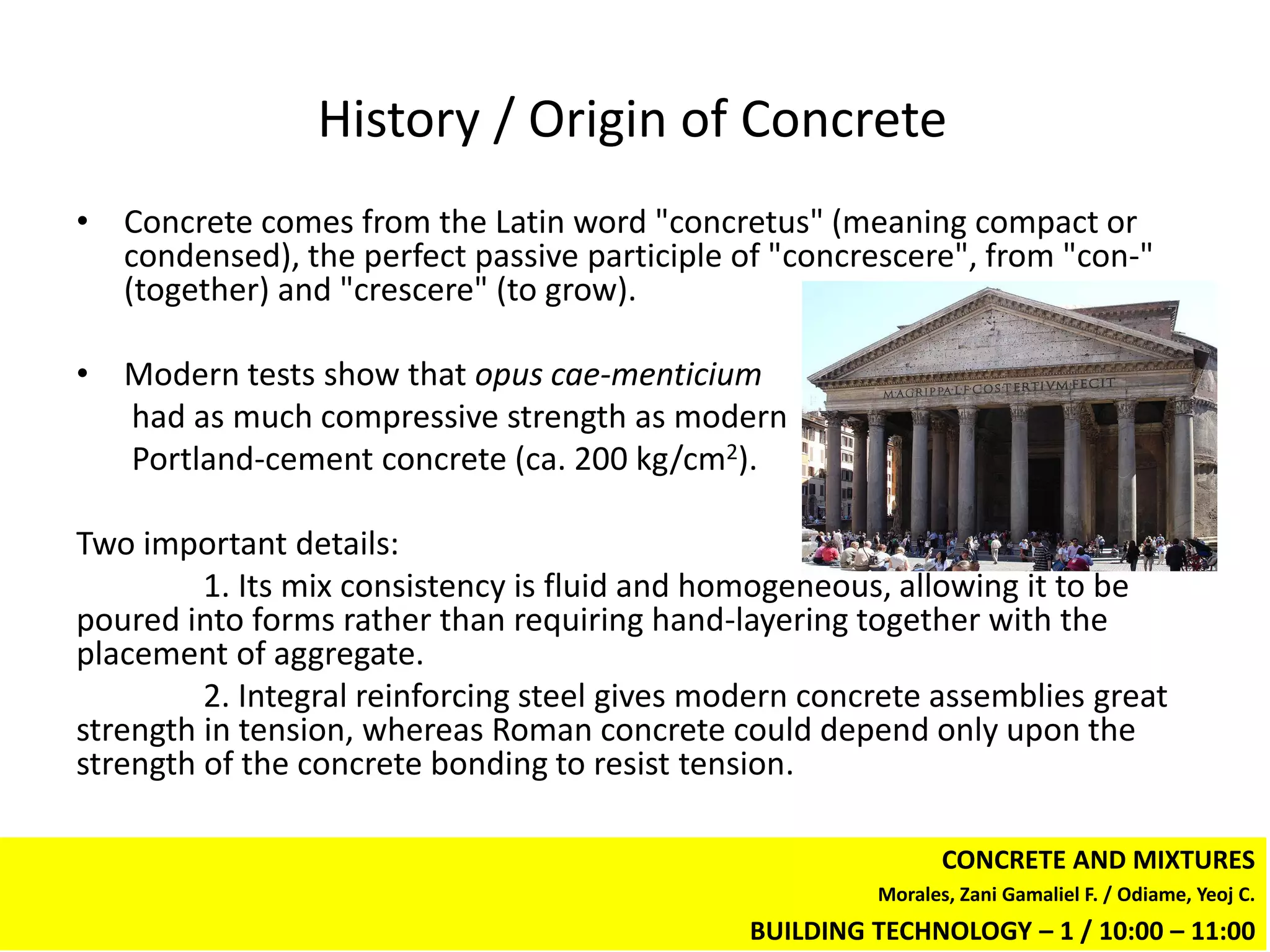
• Modern tests show that opus cae-menticium
  had as much compressive strength as modern
  Portland-cement concrete (ca. 200 kg/cm2).

Two important details:
         1. Its mix consistency is fluid and homogeneous, allowing it to be
poured into forms rather than requiring hand-layering together with the
placement of aggregate.
         2. Integral reinforcing steel gives modern concrete assemblies great
strength in tension, whereas Roman concrete could depend only upon the
strength of the concrete bonding to resist tension.

                                                               CONCRETE AND MIXTURES
                                                        Morales, Zani Gamaliel F. / Odiame, Yeoj C.
                                               BUILDING TECHNOLOGY – 1 / 10:00 – 11:00
History / Origin of Concrete

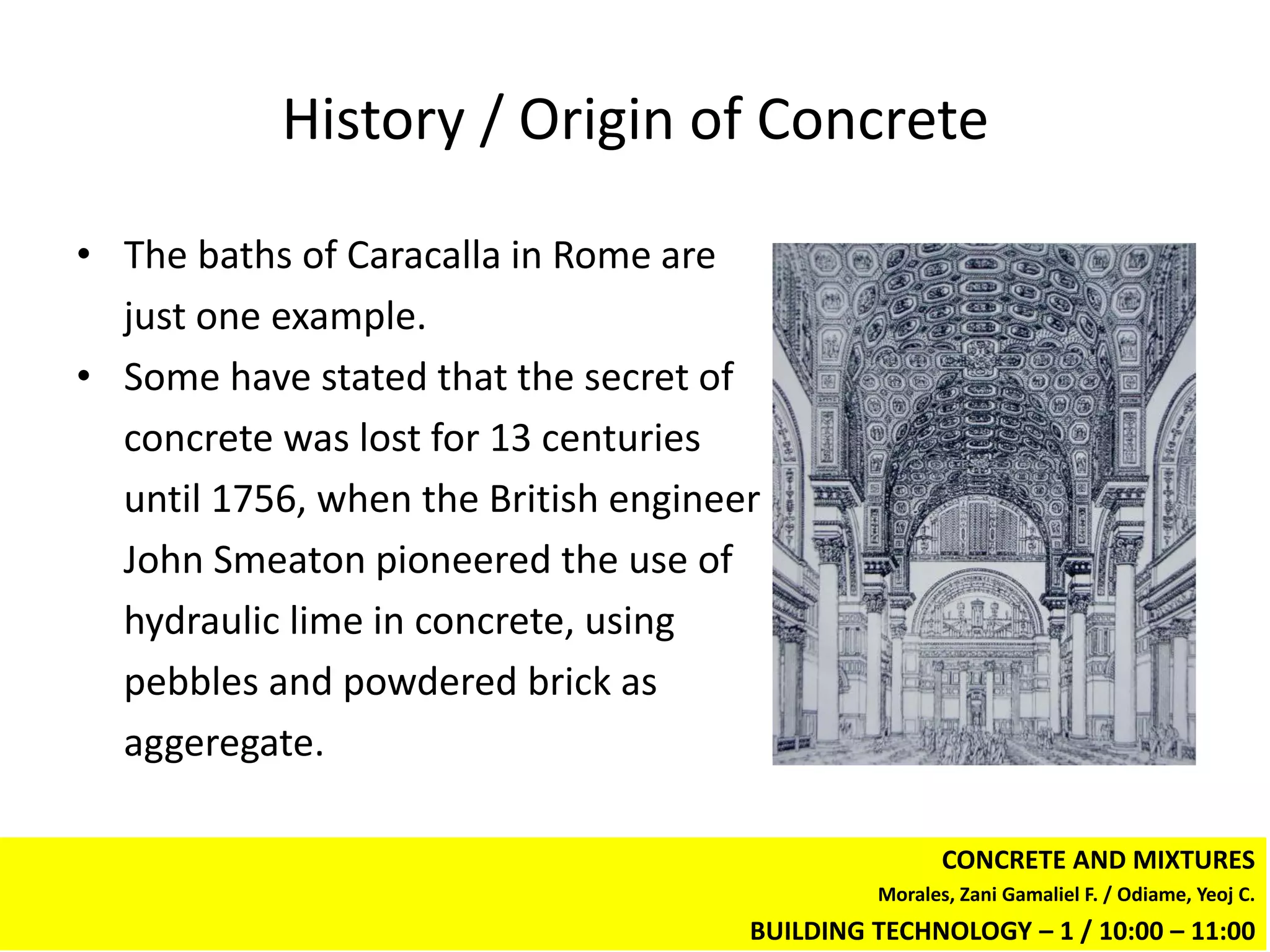
• The baths of Caracalla in Rome are
  just one example.
• Some have stated that the secret of
  concrete was lost for 13 centuries
  until 1756, when the British engineer
  John Smeaton pioneered the use of
  hydraulic lime in concrete, using
  pebbles and powdered brick as
  aggeregate.

                                                      CONCRETE AND MIXTURES
                                               Morales, Zani Gamaliel F. / Odiame, Yeoj C.
                                      BUILDING TECHNOLOGY – 1 / 10:00 – 11:00
Difference
•   Roman Conrete
     – Made of quicklime , pozzolana and an aggregate of pumice during the Roman Empire (old
       concrete used by the Romans, did not use any steel reinforcing bars)
     – Widespread use of concrete in Roman structures
          •   Freed Roman construction from restrictions of stone and brick materials
          •   Allowed for revolutionary new designs in terms of structural complexity and dimensions
     – Had much compressive strength as modern Portland cement
     – Tensile strength is lower without steel reinforcement
     – Mix consistency requires hand layering together with placement of aggregate that consisted of
       rubble
     – Depend upon the strength of concrete bonding to resist tension
•   Modern structural concrete
     - Mix consistency is fluid and homogenous
     - Could be poured into forms
     - Integral reinforcing steel gives modern concrete assemblies great
         strength in tension


                                                                                        CONCRETE AND MIXTURES
                                                                                 Morales, Zani Gamaliel F. / Odiame, Yeoj C.
                                                                   BUILDING TECHNOLOGY – 1 / 10:00 – 11:00
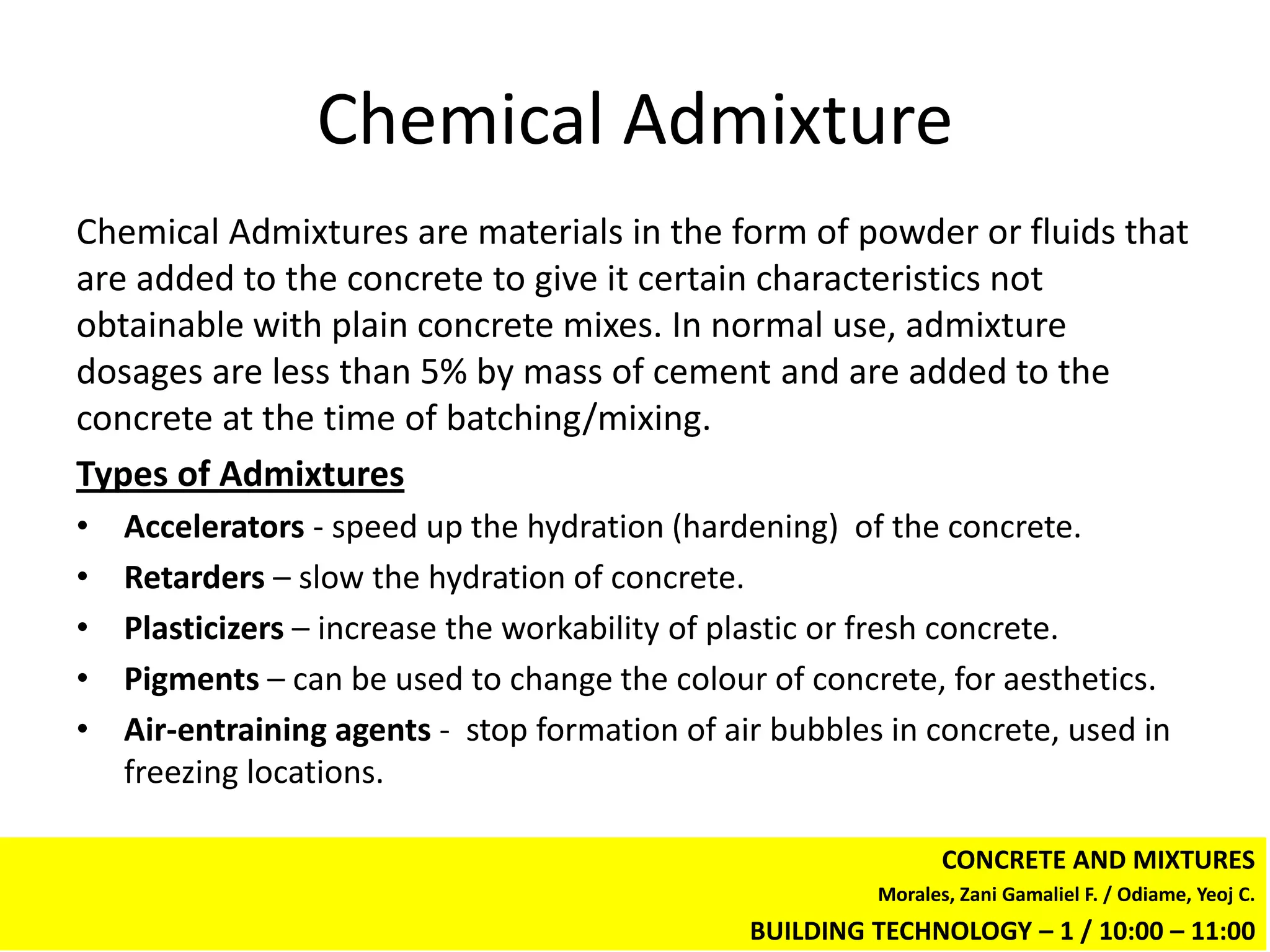
Chemical Admixture
Chemical Admixtures are materials in the form of powder or fluids that
are added to the concrete to give it certain characteristics not
obtainable with plain concrete mixes. In normal use, admixture
dosages are less than 5% by mass of cement and are added to the
concrete at the time of batching/mixing.
Types of Admixtures
•   Accelerators - speed up the hydration (hardening) of the concrete.
•   Retarders – slow the hydration of concrete.
•   Plasticizers – increase the workability of plastic or fresh concrete.
•   Pigments – can be used to change the colour of concrete, for aesthetics.
•   Air-entraining agents - stop formation of air bubbles in concrete, used in
    freezing locations.

                                                                CONCRETE AND MIXTURES
                                                         Morales, Zani Gamaliel F. / Odiame, Yeoj C.
                                                BUILDING TECHNOLOGY – 1 / 10:00 – 11:00
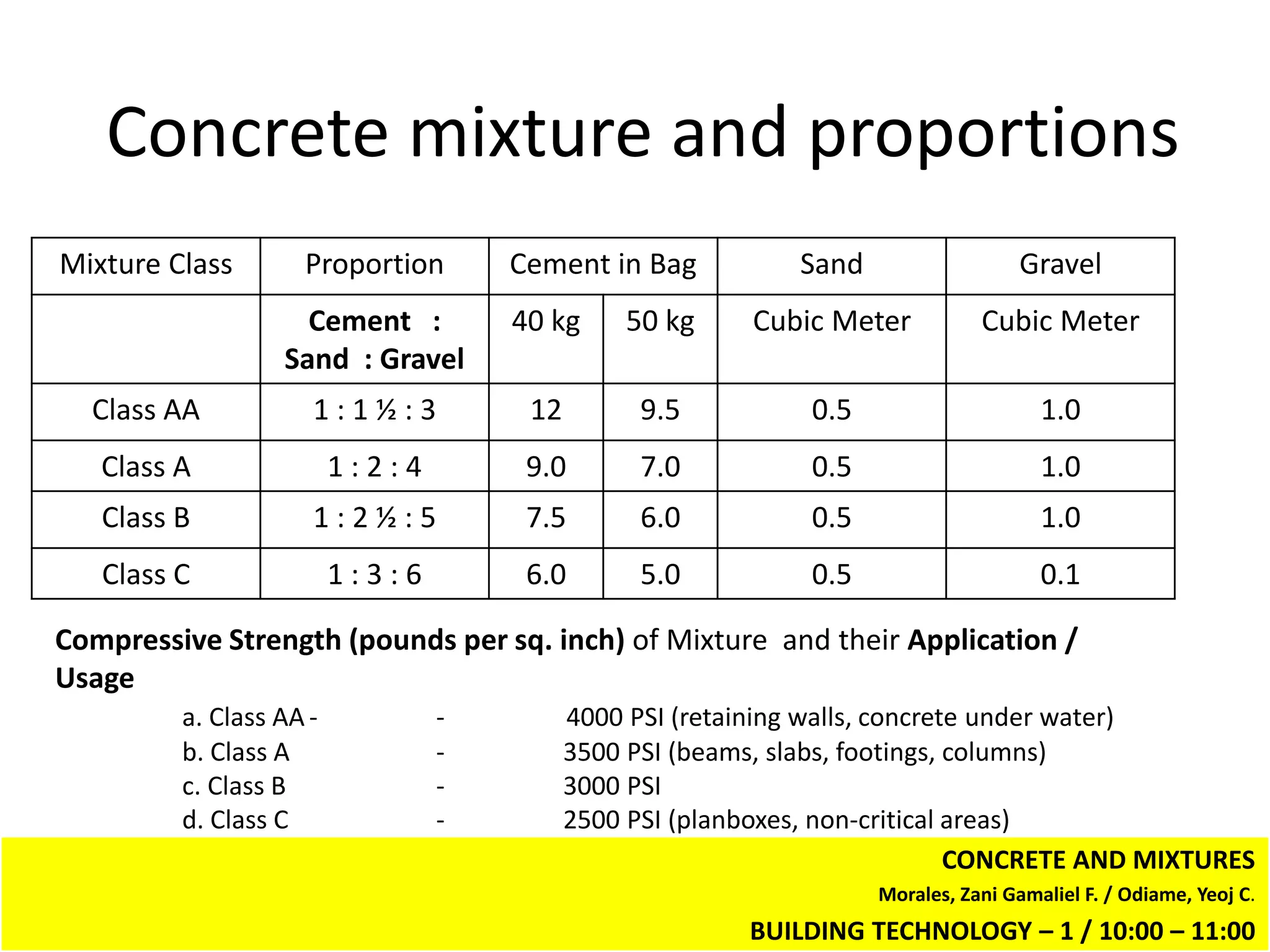
Concrete mixture and proportions
Mixture Class       Proportion       Cement in Bag           Sand                   Gravel
                    Cement :         40 kg     50 kg      Cubic Meter          Cubic Meter
                  Sand : Gravel
  Class AA           1:1½:3           12         9.5          0.5                     1.0
   Class A               1:2:4        9.0        7.0          0.5                     1.0
   Class B           1:2½:5           7.5        6.0          0.5                     1.0
   Class C               1:3:6        6.0        5.0          0.5                     0.1

Compressive Strength (pounds per sq. inch) of Mixture and their Application /
Usage
         a. Class AA -           -         4000 PSI (retaining walls, concrete under water)
         b. Class A              -         3500 PSI (beams, slabs, footings, columns)
         c. Class B              -         3000 PSI
         d. Class C              -         2500 PSI (planboxes, non-critical areas)
                                                                             CONCRETE AND MIXTURES
                                                                    Morales, Zani Gamaliel F. / Odiame, Yeoj C.
                                                         BUILDING TECHNOLOGY – 1 / 10:00 – 11:00
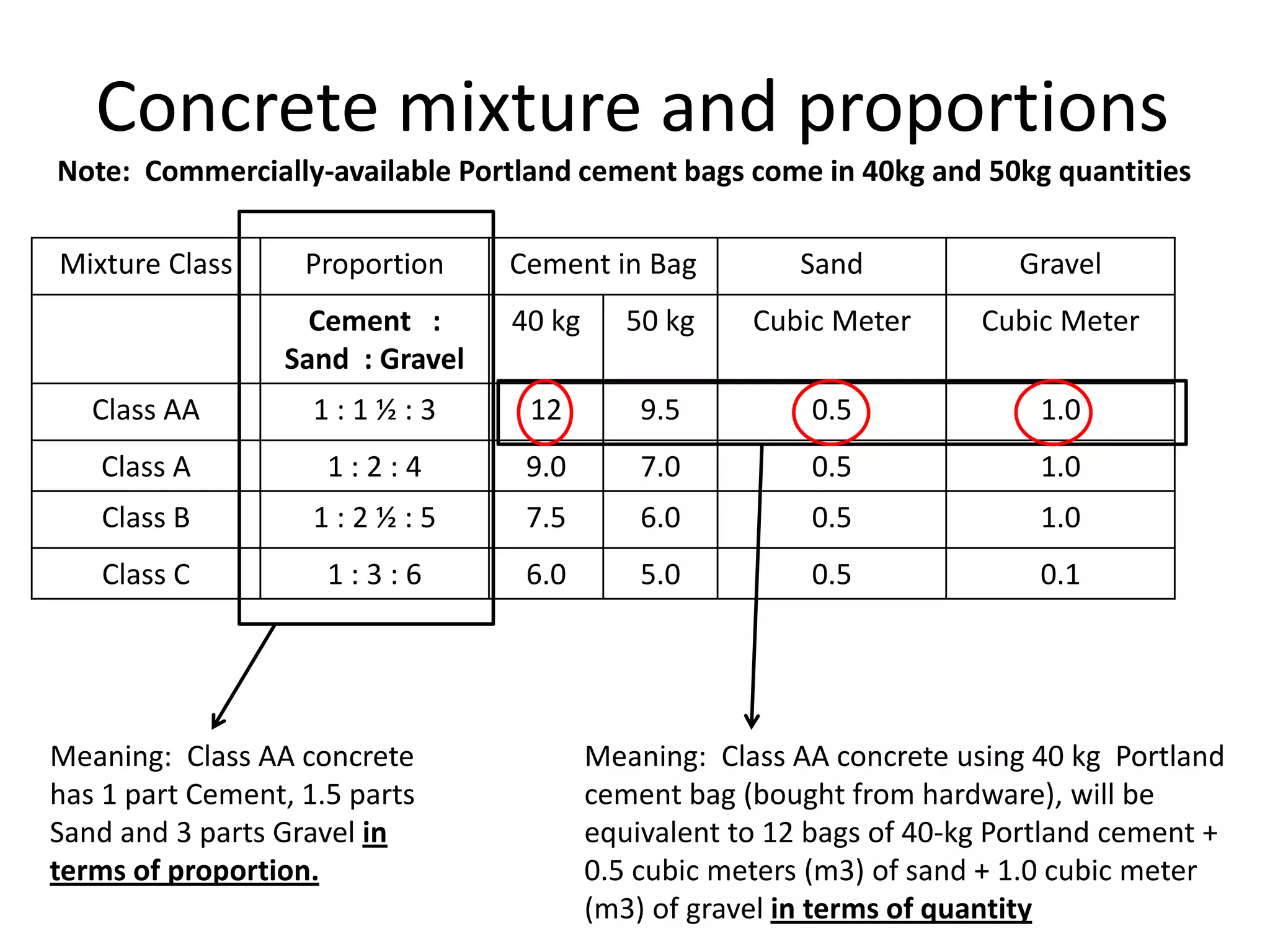
Concrete mixture and proportions
Note: Commercially-available Portland cement bags come in 40kg and 50kg quantities

Mixture Class      Proportion    Cement in Bag           Sand            Gravel
                   Cement :      40 kg      50 kg    Cubic Meter      Cubic Meter
                 Sand : Gravel
   Class AA         1:1½:3        12         9.5          0.5              1.0
   Class A           1:2:4        9.0        7.0          0.5              1.0
   Class B          1:2½:5        7.5        6.0          0.5              1.0
   Class C           1:3:6        6.0        5.0          0.5              0.1


Meaning: Class AA concrete               Meaning: Class AA concrete using 40 kg Portland
has 1 part Cement, 1.5 parts             cement bag (bought from hardware), will be
Sand and 3 parts Gravel in               equivalent to 12 bags of 40-kg Portland cement +
terms of proportion.                     0.5 cubic meters (m3) of sand + 1.0 cubic meter
                                         (m3) of gravel in terms of quantity
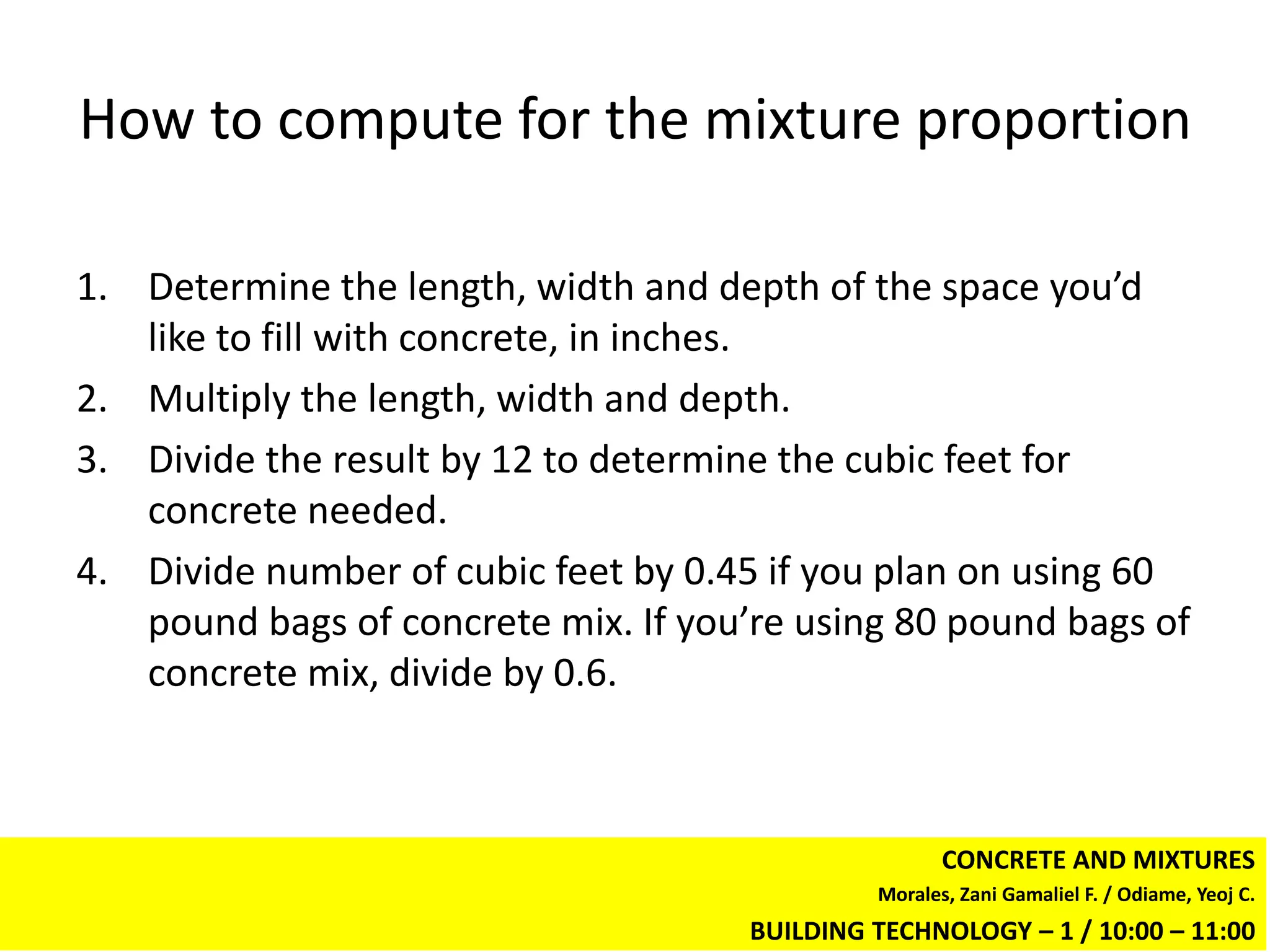
How to compute for the mixture proportion

1. Determine the length, width and depth of the space you’d
   like to fill with concrete, in inches.
2. Multiply the length, width and depth.
3. Divide the result by 12 to determine the cubic feet for
   concrete needed.
4. Divide number of cubic feet by 0.45 if you plan on using 60
   pound bags of concrete mix. If you’re using 80 pound bags of
   concrete mix, divide by 0.6.


                                                      CONCRETE AND MIXTURES
                                               Morales, Zani Gamaliel F. / Odiame, Yeoj C.
                                      BUILDING TECHNOLOGY – 1 / 10:00 – 11:00
How to compute for the mixture proportion
Another method:
1. Measure the length and width in feet of the space to be filled with
    a tape measure. Multiply these measurements to arrive at the
    square footage of the space.
2. Measure the depth in feet of the space to be filled. Multiply this
    measurement by the square footage number. This will give you
    the number of cubic feet of concrete you will need to buy.
3. Divide the number of cubic feet by three to arrive at the number
    of cubic yards of concrete to be mixed and poured. Some
    companies will sell concrete by the cubic foot; you can buy it
    without the extra step.
4. Add a cubic foot or yard to the number before purchasing to allow
    for errors. Because pouring concrete is a permanent form of
    construction and difficult to fix once it's done, it is usually better
    to have a little too much concrete than not enough.
                                                            CONCRETE AND MIXTURES
                                                     Morales, Zani Gamaliel F. / Odiame, Yeoj C.
                                            BUILDING TECHNOLOGY – 1 / 10:00 – 11:00
Differentiation
Concrete – is a composite construction material
composed primarily of aggregate, cement and sand. It is
also widely used for making architectural structures,
foundations, pavements etc.

Cement – is a binder, a substance that sets and hardens
independently, and can bind other materials together.

Therefore, cement and concrete can be differentiated in
such a way that cement is just one of the 3 main
ingredients to create a concrete.
                                                  CONCRETE AND MIXTURES
                                           Morales, Zani Gamaliel F. / Odiame, Yeoj C.
                                  BUILDING TECHNOLOGY – 1 / 10:00 – 11:00
Differentiation
Grout – is generally composed of a mixture of water,
cement, sand, often colour tint, and sometimes fine
gravel.

Plaster (cement) – is a mixture of suitable plaster, sand,
Portland cement, and water which is normally applied to
masonry interiors and exteriors to achieve a smooth
surface.

Therefore Grout is used in flooring in between while
Plaster (cement) is used in exterior / interior wall to have
a smooth surface.
                                                  CONCRETE AND MIXTURES
                                                     Odiame, Yeoj C. / Morales, Zam
                                    BUILDING TECHNOLOGY – 1 / 10:00 – 11:00

BT 1: Concrete and Admixtures

  • 1.
    Concrete and Admixtures Reportedby: Morales, Zani Gamaliel F. Odiame, Yeoj C. Submitted to: Arch. Sylvester, Seño D. CONCRETE AND MIXTURES Morales, Zani Gamaliel F. / Odiame, Yeoj C. BUILDING TECHNOLOGY – 1 / 10:00 – 11:00
  • 2.
    History / Originof Concrete • Concrete comes from the Latin word "concretus" (meaning compact or condensed), the perfect passive participle of "concrescere", from "con-" (together) and "crescere" (to grow). • Modern tests show that opus cae-menticium had as much compressive strength as modern Portland-cement concrete (ca. 200 kg/cm2). Two important details: 1. Its mix consistency is fluid and homogeneous, allowing it to be poured into forms rather than requiring hand-layering together with the placement of aggregate. 2. Integral reinforcing steel gives modern concrete assemblies great strength in tension, whereas Roman concrete could depend only upon the strength of the concrete bonding to resist tension. CONCRETE AND MIXTURES Morales, Zani Gamaliel F. / Odiame, Yeoj C. BUILDING TECHNOLOGY – 1 / 10:00 – 11:00
  • 3.
    History / Originof Concrete • The baths of Caracalla in Rome are just one example. • Some have stated that the secret of concrete was lost for 13 centuries until 1756, when the British engineer John Smeaton pioneered the use of hydraulic lime in concrete, using pebbles and powdered brick as aggeregate. CONCRETE AND MIXTURES Morales, Zani Gamaliel F. / Odiame, Yeoj C. BUILDING TECHNOLOGY – 1 / 10:00 – 11:00
  • 4.
    Difference • Roman Conrete – Made of quicklime , pozzolana and an aggregate of pumice during the Roman Empire (old concrete used by the Romans, did not use any steel reinforcing bars) – Widespread use of concrete in Roman structures • Freed Roman construction from restrictions of stone and brick materials • Allowed for revolutionary new designs in terms of structural complexity and dimensions – Had much compressive strength as modern Portland cement – Tensile strength is lower without steel reinforcement – Mix consistency requires hand layering together with placement of aggregate that consisted of rubble – Depend upon the strength of concrete bonding to resist tension • Modern structural concrete - Mix consistency is fluid and homogenous - Could be poured into forms - Integral reinforcing steel gives modern concrete assemblies great strength in tension CONCRETE AND MIXTURES Morales, Zani Gamaliel F. / Odiame, Yeoj C. BUILDING TECHNOLOGY – 1 / 10:00 – 11:00
  • 5.
    Chemical Admixture Chemical Admixturesare materials in the form of powder or fluids that are added to the concrete to give it certain characteristics not obtainable with plain concrete mixes. In normal use, admixture dosages are less than 5% by mass of cement and are added to the concrete at the time of batching/mixing. Types of Admixtures • Accelerators - speed up the hydration (hardening) of the concrete. • Retarders – slow the hydration of concrete. • Plasticizers – increase the workability of plastic or fresh concrete. • Pigments – can be used to change the colour of concrete, for aesthetics. • Air-entraining agents - stop formation of air bubbles in concrete, used in freezing locations. CONCRETE AND MIXTURES Morales, Zani Gamaliel F. / Odiame, Yeoj C. BUILDING TECHNOLOGY – 1 / 10:00 – 11:00
  • 6.
    Concrete mixture andproportions Mixture Class Proportion Cement in Bag Sand Gravel Cement : 40 kg 50 kg Cubic Meter Cubic Meter Sand : Gravel Class AA 1:1½:3 12 9.5 0.5 1.0 Class A 1:2:4 9.0 7.0 0.5 1.0 Class B 1:2½:5 7.5 6.0 0.5 1.0 Class C 1:3:6 6.0 5.0 0.5 0.1 Compressive Strength (pounds per sq. inch) of Mixture and their Application / Usage a. Class AA - - 4000 PSI (retaining walls, concrete under water) b. Class A - 3500 PSI (beams, slabs, footings, columns) c. Class B - 3000 PSI d. Class C - 2500 PSI (planboxes, non-critical areas) CONCRETE AND MIXTURES Morales, Zani Gamaliel F. / Odiame, Yeoj C. BUILDING TECHNOLOGY – 1 / 10:00 – 11:00
  • 7.
    Concrete mixture andproportions Note: Commercially-available Portland cement bags come in 40kg and 50kg quantities Mixture Class Proportion Cement in Bag Sand Gravel Cement : 40 kg 50 kg Cubic Meter Cubic Meter Sand : Gravel Class AA 1:1½:3 12 9.5 0.5 1.0 Class A 1:2:4 9.0 7.0 0.5 1.0 Class B 1:2½:5 7.5 6.0 0.5 1.0 Class C 1:3:6 6.0 5.0 0.5 0.1 Meaning: Class AA concrete Meaning: Class AA concrete using 40 kg Portland has 1 part Cement, 1.5 parts cement bag (bought from hardware), will be Sand and 3 parts Gravel in equivalent to 12 bags of 40-kg Portland cement + terms of proportion. 0.5 cubic meters (m3) of sand + 1.0 cubic meter (m3) of gravel in terms of quantity
  • 8.
    How to computefor the mixture proportion 1. Determine the length, width and depth of the space you’d like to fill with concrete, in inches. 2. Multiply the length, width and depth. 3. Divide the result by 12 to determine the cubic feet for concrete needed. 4. Divide number of cubic feet by 0.45 if you plan on using 60 pound bags of concrete mix. If you’re using 80 pound bags of concrete mix, divide by 0.6. CONCRETE AND MIXTURES Morales, Zani Gamaliel F. / Odiame, Yeoj C. BUILDING TECHNOLOGY – 1 / 10:00 – 11:00
  • 9.
    How to computefor the mixture proportion Another method: 1. Measure the length and width in feet of the space to be filled with a tape measure. Multiply these measurements to arrive at the square footage of the space. 2. Measure the depth in feet of the space to be filled. Multiply this measurement by the square footage number. This will give you the number of cubic feet of concrete you will need to buy. 3. Divide the number of cubic feet by three to arrive at the number of cubic yards of concrete to be mixed and poured. Some companies will sell concrete by the cubic foot; you can buy it without the extra step. 4. Add a cubic foot or yard to the number before purchasing to allow for errors. Because pouring concrete is a permanent form of construction and difficult to fix once it's done, it is usually better to have a little too much concrete than not enough. CONCRETE AND MIXTURES Morales, Zani Gamaliel F. / Odiame, Yeoj C. BUILDING TECHNOLOGY – 1 / 10:00 – 11:00
  • 10.
    Differentiation Concrete – isa composite construction material composed primarily of aggregate, cement and sand. It is also widely used for making architectural structures, foundations, pavements etc. Cement – is a binder, a substance that sets and hardens independently, and can bind other materials together. Therefore, cement and concrete can be differentiated in such a way that cement is just one of the 3 main ingredients to create a concrete. CONCRETE AND MIXTURES Morales, Zani Gamaliel F. / Odiame, Yeoj C. BUILDING TECHNOLOGY – 1 / 10:00 – 11:00
  • 11.
    Differentiation Grout – isgenerally composed of a mixture of water, cement, sand, often colour tint, and sometimes fine gravel. Plaster (cement) – is a mixture of suitable plaster, sand, Portland cement, and water which is normally applied to masonry interiors and exteriors to achieve a smooth surface. Therefore Grout is used in flooring in between while Plaster (cement) is used in exterior / interior wall to have a smooth surface. CONCRETE AND MIXTURES Odiame, Yeoj C. / Morales, Zam BUILDING TECHNOLOGY – 1 / 10:00 – 11:00