LOG
O
GeoSpatial Training
Integrating GeoSpatial and IT for Informed
Passive Remote sensing
LOGORead More: Grass GIS Training
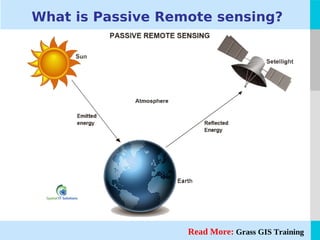
What is Passive Remote sensing?
LOGO
Remote Sensing is the acquisition of information about an object or phenomenon relating to the
object without making any kind of physical contact with the object.
Passive remote sensing is a class of Remote Sensing that make use of Passive Remote Sensors. The
sensors are used to detect natural radiations that are emitted by the object or by its surrounding areas.
The most common source of energy that is measured by Passive Remote Sensors is “Reflected
Sunlight”.
The sensors that are used for Passive Remote Sensing can only be used when there is some naturally
occurring energy available. Thus, for all reflected energy, Passive Remote Sensing can only take
place when the sun is illuminating the surface of the earth. No reflected is available from the sun at
night.
Passive Remote Sensors obtain measurements from naturally occurring radiations. The sensors have
several characteristics and they are often called its advantages :
●
Multiple wavelength information
●
Comparatively low electrical power requirements
●
Small size possible
Read More: Spatial Data Analysis
Passive Remote sensing
LOGO
The Passive Remote Sensing systems are pretty much similar to what the eyes see. They are more or
less similar to photographs. Passive Sensing radiates visible light. Some of the very common
examples of Passive Remote Sensing are :
●
Charge-Coupled Devices
●
Infrared
●
Film Photography
●
Radiometers
The energy that is radiated naturally can be detected day or night, as long as the amount of energy is
large enough to be recorded.
Read More: GeoSpatial Consulting Services
Passive Remote sensing
LOGO
Thanks For Reading
A young company led by professionals who bring on board comprehensive work and
research experience having previously served as specialists in leading organizations.
Management of SISPL has a strong commitment towards research and enhancement of
the outreach of the benefits of the powerful GIS technology at grassroots level especially
in the developing countries like India.
Website: http://spatialitsolutions.com/
Blog: http://geospatialconsultingservices.blogspot.in/
Google Plus: http://goo.gl/40o1E6
Facebook: http://www.facebook.com/spatialitsolutions
https://www.facebook.com/gistraininginjaipur
Pinterest: http://www.pinterest.com/SISPL
Twitter: https://twitter.com/SpatialITSoluti
E-Mail: Patronage@spatialitsolutions.com
Mobile: +91 097722-33443

Passive Remote sensing

  • 1.
    LOG O GeoSpatial Training Integrating GeoSpatialand IT for Informed Passive Remote sensing
  • 2.
    LOGORead More: GrassGIS Training What is Passive Remote sensing?
  • 3.
    LOGO Remote Sensing isthe acquisition of information about an object or phenomenon relating to the object without making any kind of physical contact with the object. Passive remote sensing is a class of Remote Sensing that make use of Passive Remote Sensors. The sensors are used to detect natural radiations that are emitted by the object or by its surrounding areas. The most common source of energy that is measured by Passive Remote Sensors is “Reflected Sunlight”. The sensors that are used for Passive Remote Sensing can only be used when there is some naturally occurring energy available. Thus, for all reflected energy, Passive Remote Sensing can only take place when the sun is illuminating the surface of the earth. No reflected is available from the sun at night. Passive Remote Sensors obtain measurements from naturally occurring radiations. The sensors have several characteristics and they are often called its advantages : ● Multiple wavelength information ● Comparatively low electrical power requirements ● Small size possible Read More: Spatial Data Analysis Passive Remote sensing
  • 4.
    LOGO The Passive RemoteSensing systems are pretty much similar to what the eyes see. They are more or less similar to photographs. Passive Sensing radiates visible light. Some of the very common examples of Passive Remote Sensing are : ● Charge-Coupled Devices ● Infrared ● Film Photography ● Radiometers The energy that is radiated naturally can be detected day or night, as long as the amount of energy is large enough to be recorded. Read More: GeoSpatial Consulting Services Passive Remote sensing
  • 5.
    LOGO Thanks For Reading Ayoung company led by professionals who bring on board comprehensive work and research experience having previously served as specialists in leading organizations. Management of SISPL has a strong commitment towards research and enhancement of the outreach of the benefits of the powerful GIS technology at grassroots level especially in the developing countries like India. Website: http://spatialitsolutions.com/ Blog: http://geospatialconsultingservices.blogspot.in/ Google Plus: http://goo.gl/40o1E6 Facebook: http://www.facebook.com/spatialitsolutions https://www.facebook.com/gistraininginjaipur Pinterest: http://www.pinterest.com/SISPL Twitter: https://twitter.com/SpatialITSoluti E-Mail: Patronage@spatialitsolutions.com Mobile: +91 097722-33443