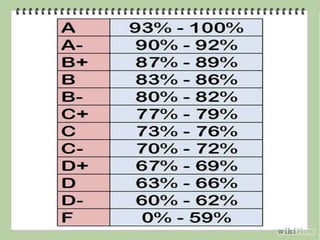
•PERCENTAGE GRADING -
Using a percentage scale (percent
of 100), usually based on percent
correct on exams and/or percent of
points earned on assignments
•LETTER GRADING AND
VARIATIONS - Using a series of
letters (often A, B, C, D, F) or
letters with plusses and minuses
as an ordered category scale -
can be done in a norm-
referenced (standards-based)
manner
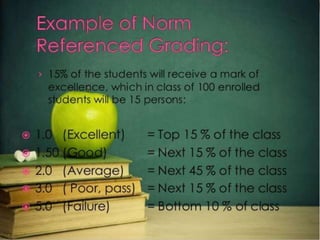
•NORM – REFERENCE
GRADING - Comparing
students to each other; using
class standing as the basis for
assigning grades (usually letter
grades)
•MASTERY GRADING -
Grading students as “masters” or
“passers” when their attainment
reaches a prespecified level,
usually allowing different
amounts of time for different
students to reach mastery
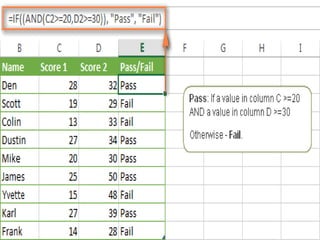
•PASS OR FAIL - Using a
scale with two levels (pass
and fail), sometimes in
connection with mastery
grading
•STANDARD GRADING/ABSOLUTE
STANDARDS - Originally, comparing student
performance to a pre - established standard
(level) of performance; currently, standards
grading sometimes means grading with
reference to a list of state or district content
standards according to pre - established
performance levels.
•NARRATIVE GRADING -
Writing comments about
students’ achievement, either
in addition to or instead of
using numbers or letters
1.) More students take rigorous
courses.
2.) More challenging courses can
be offered.
3.) It increases a student's GPA.
4.) Higher class rankings for
those who take more
demanding courses.
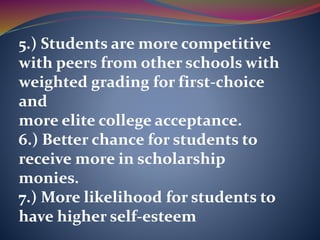
5.) Students are more competitive
with peers from other schools with
weighted grading for first-choice
and
more elite college acceptance.
6.) Better chance for students to
receive more in scholarship
monies.
7.) More likelihood for students to
have higher self-esteem
1.) Lack of consistency from school to
school as to what courses are weighted
and how much they are
weighted.
2.)Not all courses, even honors and AP,
are equally demanding.
3.) It may send a message to those who
are taking regular courses, that their
work is not as highly valued
as weighted classes, which may lower
self-esteem and attempts to strive for
high grades.
4.) College admissions offices tend to
look at the overall GPA and not if the
grades had been weighted.
5.) If a student is afraid of getting a low
grade in a more rigorous course, he/she
may opt to take a less
demanding course in order to earn a
higher grade.
6.) Tracking of students could become
more common.
Types of grading system

Types of grading system

  • 2.
    •PERCENTAGE GRADING - Usinga percentage scale (percent of 100), usually based on percent correct on exams and/or percent of points earned on assignments
  • 4.
    •LETTER GRADING AND VARIATIONS- Using a series of letters (often A, B, C, D, F) or letters with plusses and minuses as an ordered category scale - can be done in a norm- referenced (standards-based) manner
  • 5.
    •NORM – REFERENCE GRADING- Comparing students to each other; using class standing as the basis for assigning grades (usually letter grades)
  • 7.
    •MASTERY GRADING - Gradingstudents as “masters” or “passers” when their attainment reaches a prespecified level, usually allowing different amounts of time for different students to reach mastery
  • 9.
    •PASS OR FAIL- Using a scale with two levels (pass and fail), sometimes in connection with mastery grading
  • 11.
    •STANDARD GRADING/ABSOLUTE STANDARDS -Originally, comparing student performance to a pre - established standard (level) of performance; currently, standards grading sometimes means grading with reference to a list of state or district content standards according to pre - established performance levels.
  • 12.
    •NARRATIVE GRADING - Writingcomments about students’ achievement, either in addition to or instead of using numbers or letters
  • 15.
    1.) More studentstake rigorous courses. 2.) More challenging courses can be offered. 3.) It increases a student's GPA. 4.) Higher class rankings for those who take more demanding courses.
  • 16.
    5.) Students aremore competitive with peers from other schools with weighted grading for first-choice and more elite college acceptance. 6.) Better chance for students to receive more in scholarship monies. 7.) More likelihood for students to have higher self-esteem
  • 18.
    1.) Lack ofconsistency from school to school as to what courses are weighted and how much they are weighted. 2.)Not all courses, even honors and AP, are equally demanding. 3.) It may send a message to those who are taking regular courses, that their work is not as highly valued as weighted classes, which may lower self-esteem and attempts to strive for high grades.
  • 19.
    4.) College admissionsoffices tend to look at the overall GPA and not if the grades had been weighted. 5.) If a student is afraid of getting a low grade in a more rigorous course, he/she may opt to take a less demanding course in order to earn a higher grade. 6.) Tracking of students could become more common.