Philosophy Theory of Truth
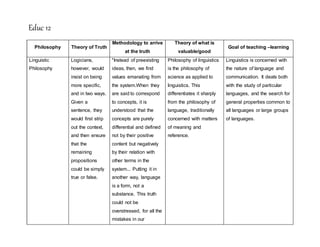
Methodology to arrive
at the truth
Theory of what is
valuable/good
Goal of teaching –learning
Linguistic
Philosophy
Logicians,
however, would
insist on being
more specific,
and in two ways.
Given a
sentence, they
would first strip
out the context,
and then ensure
that the
remaining
propositions
could be simply
true or false.
"Instead of preexisting
ideas, then, we find
values emanating from
the system.When they
are said to correspond
to concepts, it is
understood that the
concepts are purely
differential and defined
not by their positive
content but negatively
by their relation with
other terms in the
system... Putting it in
another way, language
is a form, not a
substance. This truth
could not be
overstressed, for all the
mistakes in our
Philosophy of linguistics
is the philosophy of
science as applied to
linguistics. This
differentiates it sharply
from the philosophy of
language, traditionally
concerned with matters
of meaning and
reference.
Linguistics is concerned with
the nature of language and
communication. It deals both
with the study of particular
languages, and the search for
general properties common to
all languages or large groups
of languages.
Educ 12
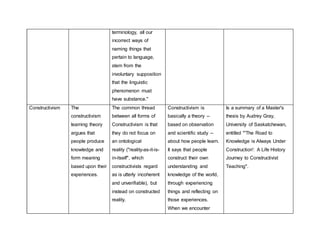
terminology, all our
incorrect ways of
naming things that
pertain to language,
stem from the
involuntary supposition
that the linguistic
phenomenon must
have substance."
Constructivism The
constructivism
learning theory
argues that
people produce
knowledge and
form meaning
based upon their
experiences.
The common thread
between all forms of
Constructivism is that
they do not focus on
an ontological
reality ("reality-as-it-is-
in-itself", which
constructivists regard
as is utterly incoherent
and unverifiable), but
instead on constructed
reality.
Constructivism is
basically a theory --
based on observation
and scientific study --
about how people learn.
It says that people
construct their own
understanding and
knowledge of the world,
through experiencing
things and reflecting on
those experiences.
When we encounter
Is a summary of a Master's
thesis by Audrey Gray,
University of Saskatchewan,
entitled "'The Road to
Knowledge is Always Under
Construction': A Life History
Journey to Constructivist
Teaching".
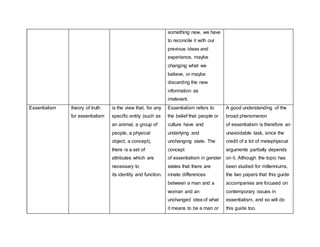
something new, we have
to reconcile it with our
previous ideas and
experience, maybe
changing what we
believe, or maybe
discarding the new
information as
irrelevant.
Essentialism theory of truth
for essentialism
is the view that, for any
specific entity (such as
an animal, a group of
people, a physical
object, a concept),
there is a set of
attributes which are
necessary to
its identity and function.
Essentialism refers to
the belief that people or
culture have and
underlying and
unchanging state. The
concept
of essentialism in gender
states that there are
innate differences
between a man and a
woman and an
unchanged idea of what
it means to be a man or
A good understanding of the
broad phenomenon
of essentialism is therefore an
unavoidable task, since the
credit of a lot of metaphysical
arguments partially depends
on it. Although the topic has
been studied for millenniums,
the two papers that this guide
accompanies are focused on
contemporary issues in
essentialism, and so will do
this guide too.
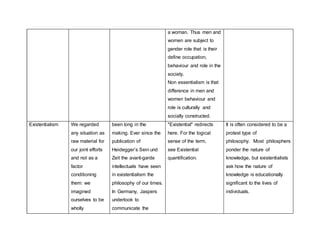
a woman. Thus men and
women are subject to
gender role that is their
define occupation,
behaviour and role in the
society.
Non essentialism is that
difference in men and
women behaviour and
role is culturally and
socially constructed.
Existentialism We regarded
any situation as
raw material for
our joint efforts
and not as a
factor
conditioning
them: we
imagined
ourselves to be
wholly
been long in the
making. Ever since the
publication of
Heidegger’s Sein und
Zeit the avant-garde
intellectuals have seen
in existentialism the
philosophy of our times.
In Germany, Jaspers
undertook to
communicate the
"Existential" redirects
here. For the logical
sense of the term,
see Existential
quantification.
It is often considered to be a
protest type of
philosophy. Most philosphers
ponder the nature of
knowledge, but existentialists
ask how the nature of
knowledge is educationally
significant to the lives of
individuals.
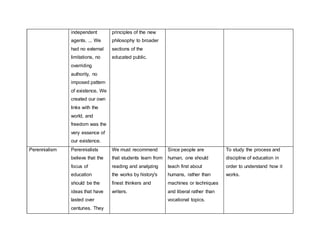
independent
agents. ... We
had no external
limitations, no
overriding
authority, no
imposed pattern
of existence, We
created our own
links with the
world, and
freedom was the
very essence of
our existence.
principles of the new
philosophy to broader
sections of the
educated public.
Perennialism Perennialists
believe that the
focus of
education
should be the
ideas that have
lasted over
centuries. They
We must recommend
that students learn from
reading and analyzing
the works by history's
finest thinkers and
writers.
Since people are
human, one should
teach first about
humans, rather than
machines or techniques
and liberal rather than
vocational topics.
To study the process and
discipline of education in
order to understand how it
works.
believe the ideas
are as relevant
and meaningful
today as when
they were
written. They
recommend that
students learn
from reading
and analyzing
the works by
history's finest
thinkers and
writers.
Essentialists
believe that
when students
study these
works and ideas,
they will
appreciate
learning. Similar
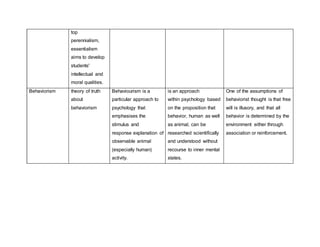
top
perennialism,
essentialism
aims to develop
students'
intellectual and
moral qualities.
Behaviorism theory of truth
about
behaviorism
Behaviourism is a
particular approach to
psychology that
emphasises the
stimulus and
response explanation of
observable animal
(especially human)
activity.
is an approach
within psychology based
on the proposition that
behavior, human as well
as animal, can be
researched scientifically
and understood without
recourse to inner mental
states.
One of the assumptions of
behaviorist thought is that free
will is illusory, and that all
behavior is determined by the
environment either through
association or reinforcement.

Assignment

  • 1.
    Philosophy Theory ofTruth Methodology to arrive at the truth Theory of what is valuable/good Goal of teaching –learning Linguistic Philosophy Logicians, however, would insist on being more specific, and in two ways. Given a sentence, they would first strip out the context, and then ensure that the remaining propositions could be simply true or false. "Instead of preexisting ideas, then, we find values emanating from the system.When they are said to correspond to concepts, it is understood that the concepts are purely differential and defined not by their positive content but negatively by their relation with other terms in the system... Putting it in another way, language is a form, not a substance. This truth could not be overstressed, for all the mistakes in our Philosophy of linguistics is the philosophy of science as applied to linguistics. This differentiates it sharply from the philosophy of language, traditionally concerned with matters of meaning and reference. Linguistics is concerned with the nature of language and communication. It deals both with the study of particular languages, and the search for general properties common to all languages or large groups of languages. Educ 12
  • 2.
    terminology, all our incorrectways of naming things that pertain to language, stem from the involuntary supposition that the linguistic phenomenon must have substance." Constructivism The constructivism learning theory argues that people produce knowledge and form meaning based upon their experiences. The common thread between all forms of Constructivism is that they do not focus on an ontological reality ("reality-as-it-is- in-itself", which constructivists regard as is utterly incoherent and unverifiable), but instead on constructed reality. Constructivism is basically a theory -- based on observation and scientific study -- about how people learn. It says that people construct their own understanding and knowledge of the world, through experiencing things and reflecting on those experiences. When we encounter Is a summary of a Master's thesis by Audrey Gray, University of Saskatchewan, entitled "'The Road to Knowledge is Always Under Construction': A Life History Journey to Constructivist Teaching".
  • 3.
    something new, wehave to reconcile it with our previous ideas and experience, maybe changing what we believe, or maybe discarding the new information as irrelevant. Essentialism theory of truth for essentialism is the view that, for any specific entity (such as an animal, a group of people, a physical object, a concept), there is a set of attributes which are necessary to its identity and function. Essentialism refers to the belief that people or culture have and underlying and unchanging state. The concept of essentialism in gender states that there are innate differences between a man and a woman and an unchanged idea of what it means to be a man or A good understanding of the broad phenomenon of essentialism is therefore an unavoidable task, since the credit of a lot of metaphysical arguments partially depends on it. Although the topic has been studied for millenniums, the two papers that this guide accompanies are focused on contemporary issues in essentialism, and so will do this guide too.
  • 4.
    a woman. Thusmen and women are subject to gender role that is their define occupation, behaviour and role in the society. Non essentialism is that difference in men and women behaviour and role is culturally and socially constructed. Existentialism We regarded any situation as raw material for our joint efforts and not as a factor conditioning them: we imagined ourselves to be wholly been long in the making. Ever since the publication of Heidegger’s Sein und Zeit the avant-garde intellectuals have seen in existentialism the philosophy of our times. In Germany, Jaspers undertook to communicate the "Existential" redirects here. For the logical sense of the term, see Existential quantification. It is often considered to be a protest type of philosophy. Most philosphers ponder the nature of knowledge, but existentialists ask how the nature of knowledge is educationally significant to the lives of individuals.
  • 5.
    independent agents. ... We hadno external limitations, no overriding authority, no imposed pattern of existence, We created our own links with the world, and freedom was the very essence of our existence. principles of the new philosophy to broader sections of the educated public. Perennialism Perennialists believe that the focus of education should be the ideas that have lasted over centuries. They We must recommend that students learn from reading and analyzing the works by history's finest thinkers and writers. Since people are human, one should teach first about humans, rather than machines or techniques and liberal rather than vocational topics. To study the process and discipline of education in order to understand how it works.
  • 6.
    believe the ideas areas relevant and meaningful today as when they were written. They recommend that students learn from reading and analyzing the works by history's finest thinkers and writers. Essentialists believe that when students study these works and ideas, they will appreciate learning. Similar
  • 7.
    top perennialism, essentialism aims to develop students' intellectualand moral qualities. Behaviorism theory of truth about behaviorism Behaviourism is a particular approach to psychology that emphasises the stimulus and response explanation of observable animal (especially human) activity. is an approach within psychology based on the proposition that behavior, human as well as animal, can be researched scientifically and understood without recourse to inner mental states. One of the assumptions of behaviorist thought is that free will is illusory, and that all behavior is determined by the environment either through association or reinforcement.