
DDS over Low Bandwidth Data Links: 
Tactical Radios, Satellite, etc. 
Connext Conference - London 
October/08/2014 
Jaime Martin Losa 
CEO eProsima 
JaimeMartin@eProsima.com 
+34 607 91 37 45 www.eProsima.com
eProsima in one shot 
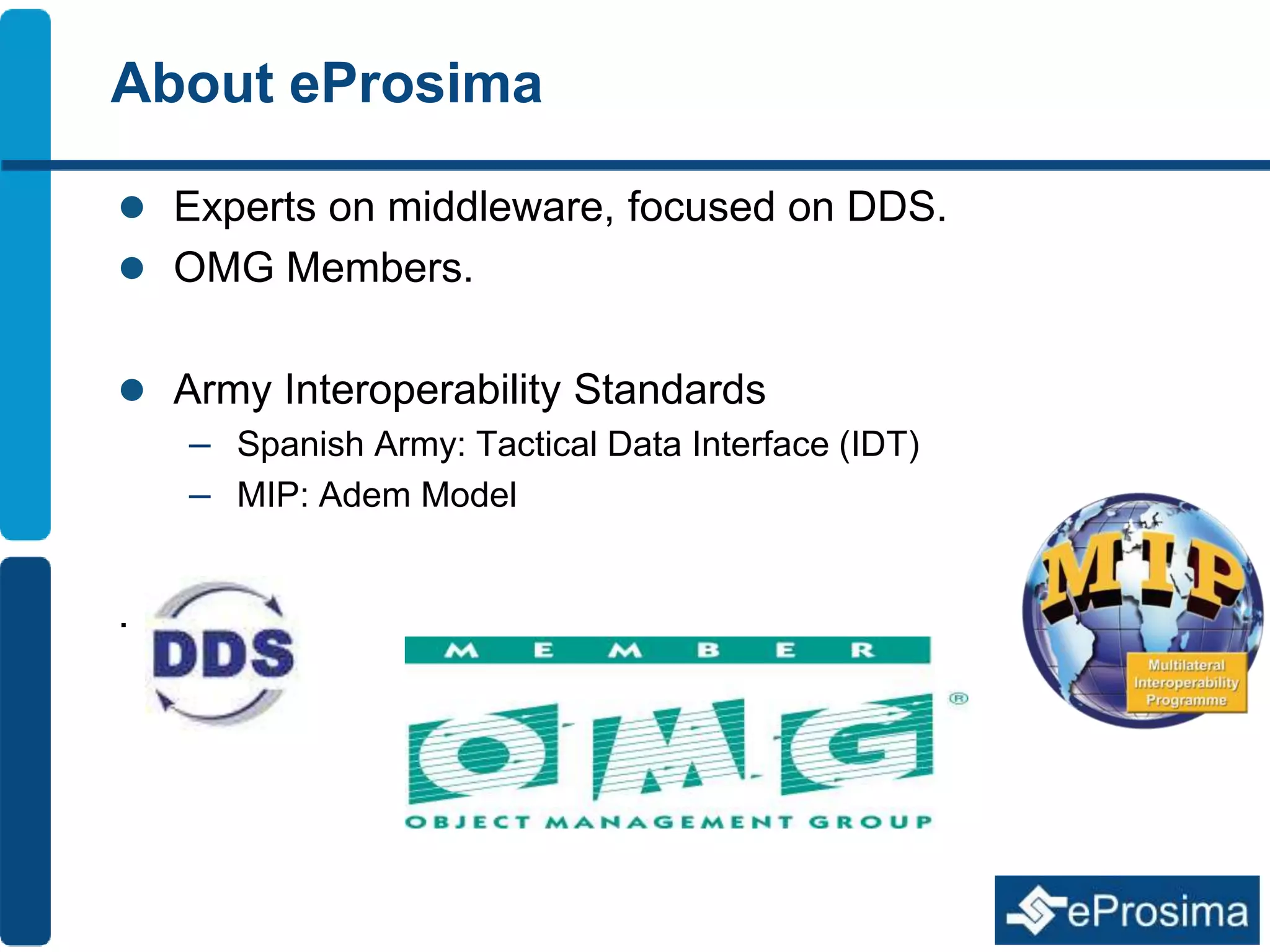
 Experts on middleware, focused on DDS. 
 OMG Members. 
– RPC over DDS, Web Enabled DDS, DDS Security (Supporter) 
 Army Interoperability Standards Contributor 
– Spanish Army: Tactical Data Interface (IDT) 
– MIP: Adem Model 
 RTI Spanish Distributor 
.
Agenda 
 Initial Motivation, solution and results 
 DDS main concerns in Low Bandwidth Links 
 eProsima Low Bandwidth Plugins for DDS (Now RTI DIL 
Plugins) 
– Discovery Plugin 
– Compression Transport Plugin 
– RTPS Header Reduction Transport Plugin 
– Link Simulation Plugin 
 Some More hints - Questions 
 Appendix: 
– About eProsima 
– eProsima Success Cases 
 C2 Interoperability 
 Low Bandwidth Data Links
Initial Motivation, Solution and Results 
DDS in Low Bandwidth Enviroments
Initial Motivation 
 Bring DDS communications to the C2 
Tactical level (Spanish Army): 
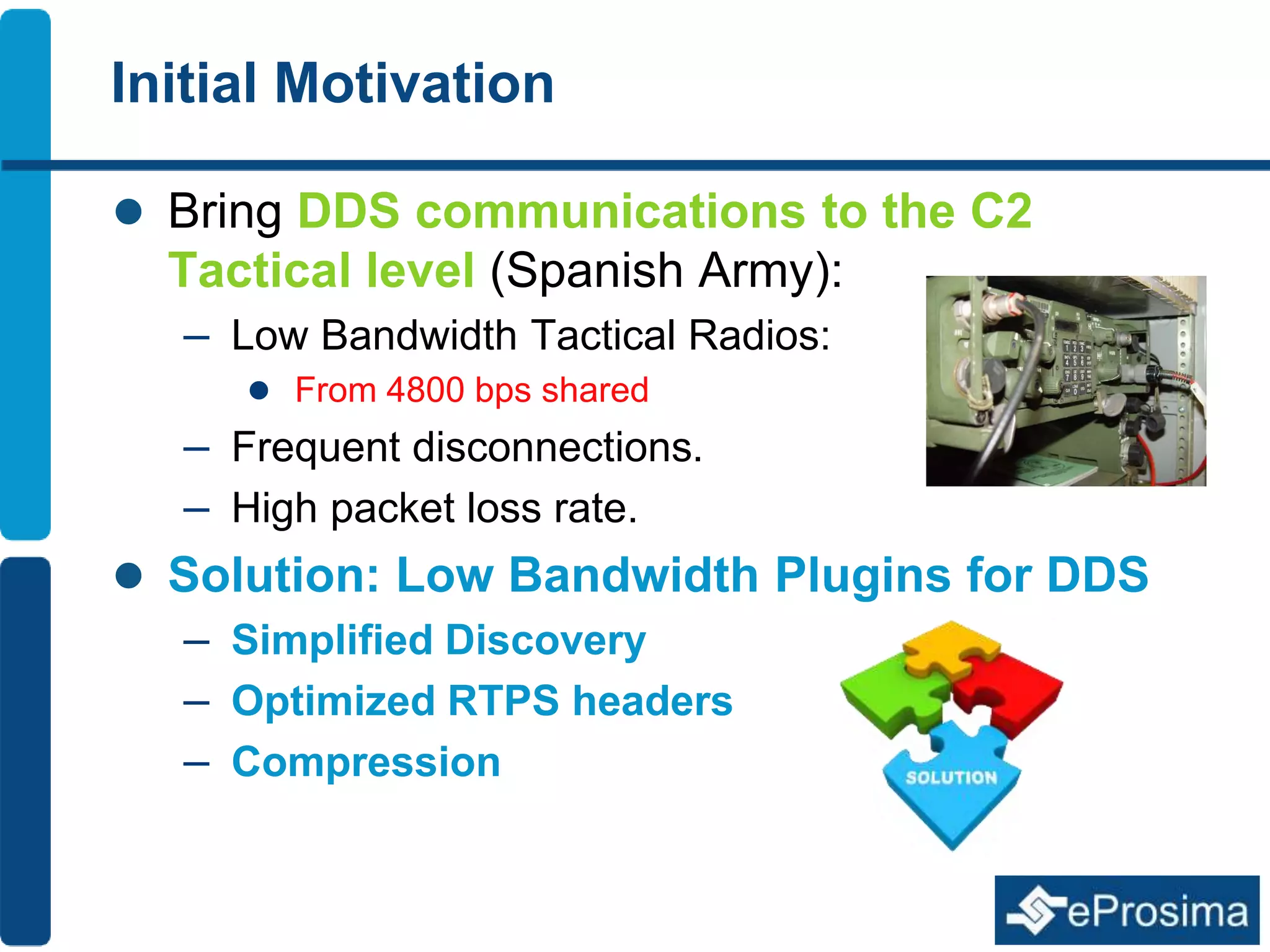
– Low Bandwidth Tactical Radios: 
 From 4800 bps shared 
– Frequent disconnections. 
– High packet loss rate. 
 Solution: Low Bandwidth Plugins for DDS 
– Simplified Discovery 
– Optimized RTPS headers 
– Compression
Results 
 DDS is mandated by the spanish Army for 
C2 interoperability in Tactical Radios, Satellite 
and Lan 
 Formal Interoperability Specification 
released, specifying how to use DDS and the 
information model (Spanish Tactical Data 
Interface, IDT)
Next Step: International C2 
Interoperability: MIP ADEM 
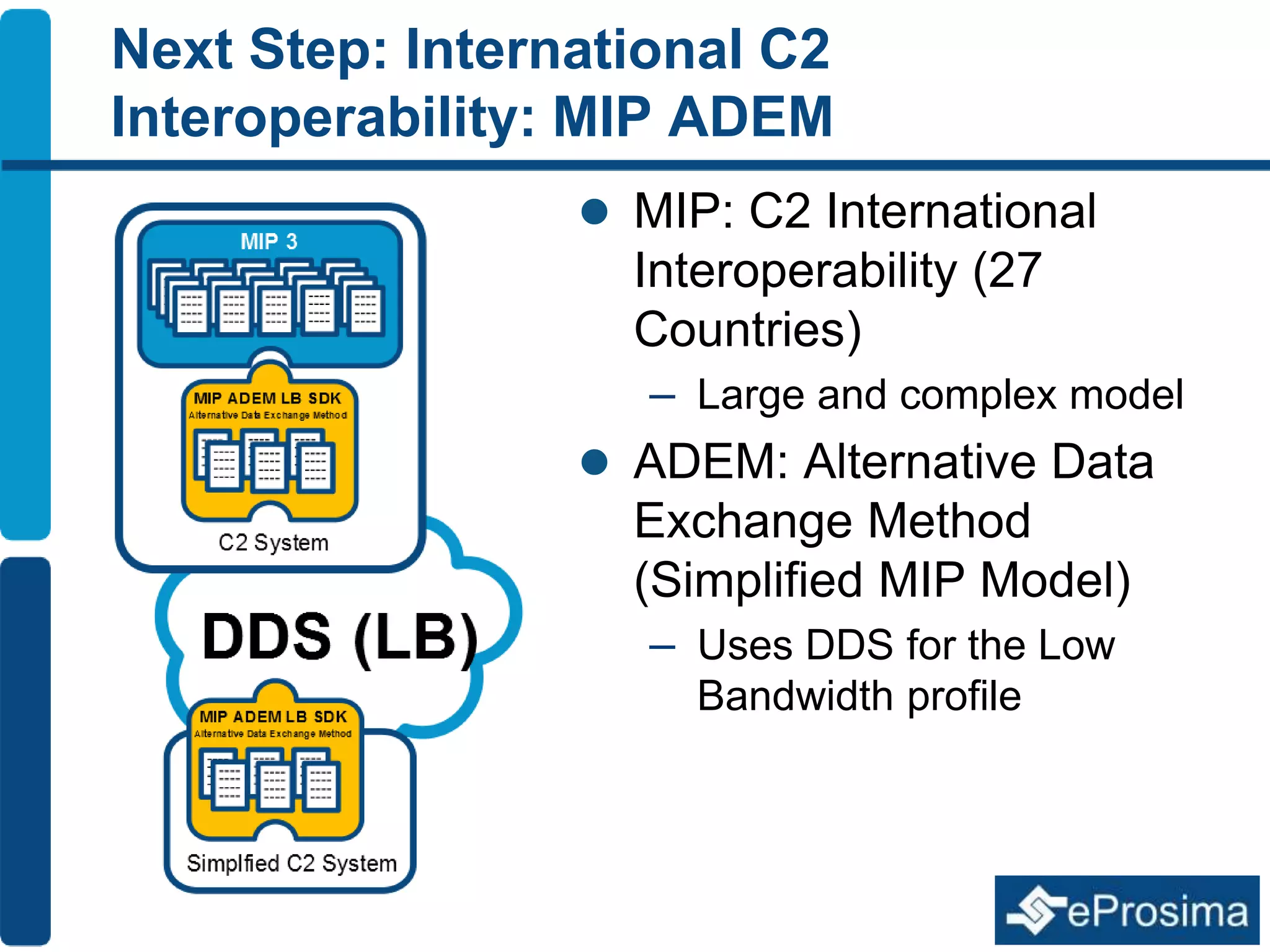
 MIP: C2 International 
Interoperability (27 
Countries) 
– Large and complex model 
 ADEM: Alternative Data 
Exchange Method 
(Simplified MIP Model) 
– Uses DDS for the Low 
Bandwidth profile
Real Performance Example: ADEM 
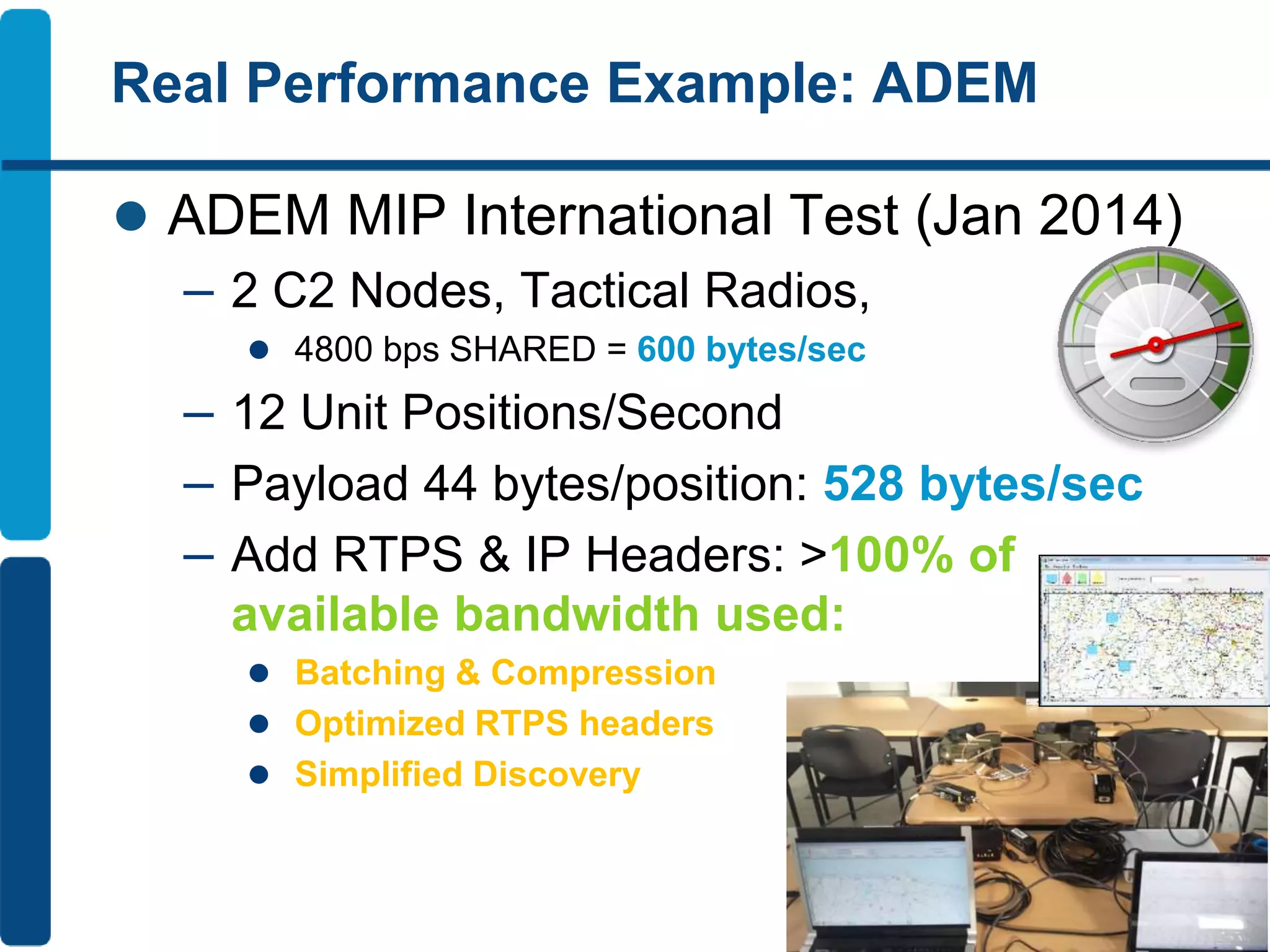
 ADEM MIP International Test (Jan 2014) 
– 2 C2 Nodes, Tactical Radios, 
 4800 bps SHARED = 600 bytes/sec 
– 12 Unit Positions/Second 
– Payload 44 bytes/position: 528 bytes/sec 
– Add RTPS & IP Headers: >100% of 
available bandwidth used: 
 Batching & Compression 
 Optimized RTPS headers 
 Simplified Discovery
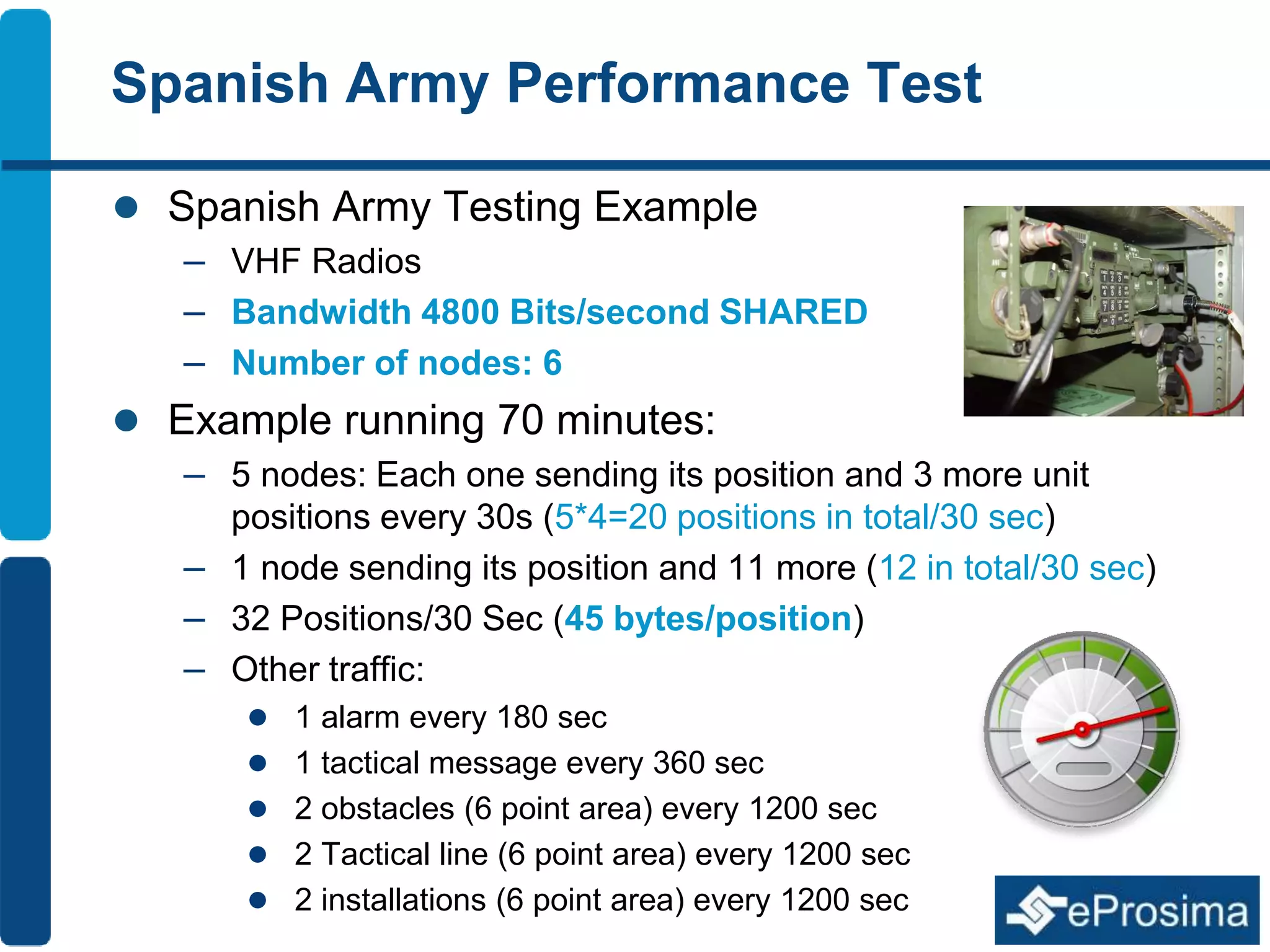
Spanish Army Performance Test 
 Spanish Army Testing Example 
– VHF Radios 
– Bandwidth 4800 Bits/second SHARED 
– Number of nodes: 6 
 Example running 70 minutes: 
– 5 nodes: Each one sending its position and 3 more unit 
positions every 30s (5*4=20 positions in total/30 sec) 
– 1 node sending its position and 11 more (12 in total/30 sec) 
– 32 Positions/30 Sec (45 bytes/position) 
– Other traffic: 
 1 alarm every 180 sec 
 1 tactical message every 360 sec 
 2 obstacles (6 point area) every 1200 sec 
 2 Tactical line (6 point area) every 1200 sec 
 2 installations (6 point area) every 1200 sec
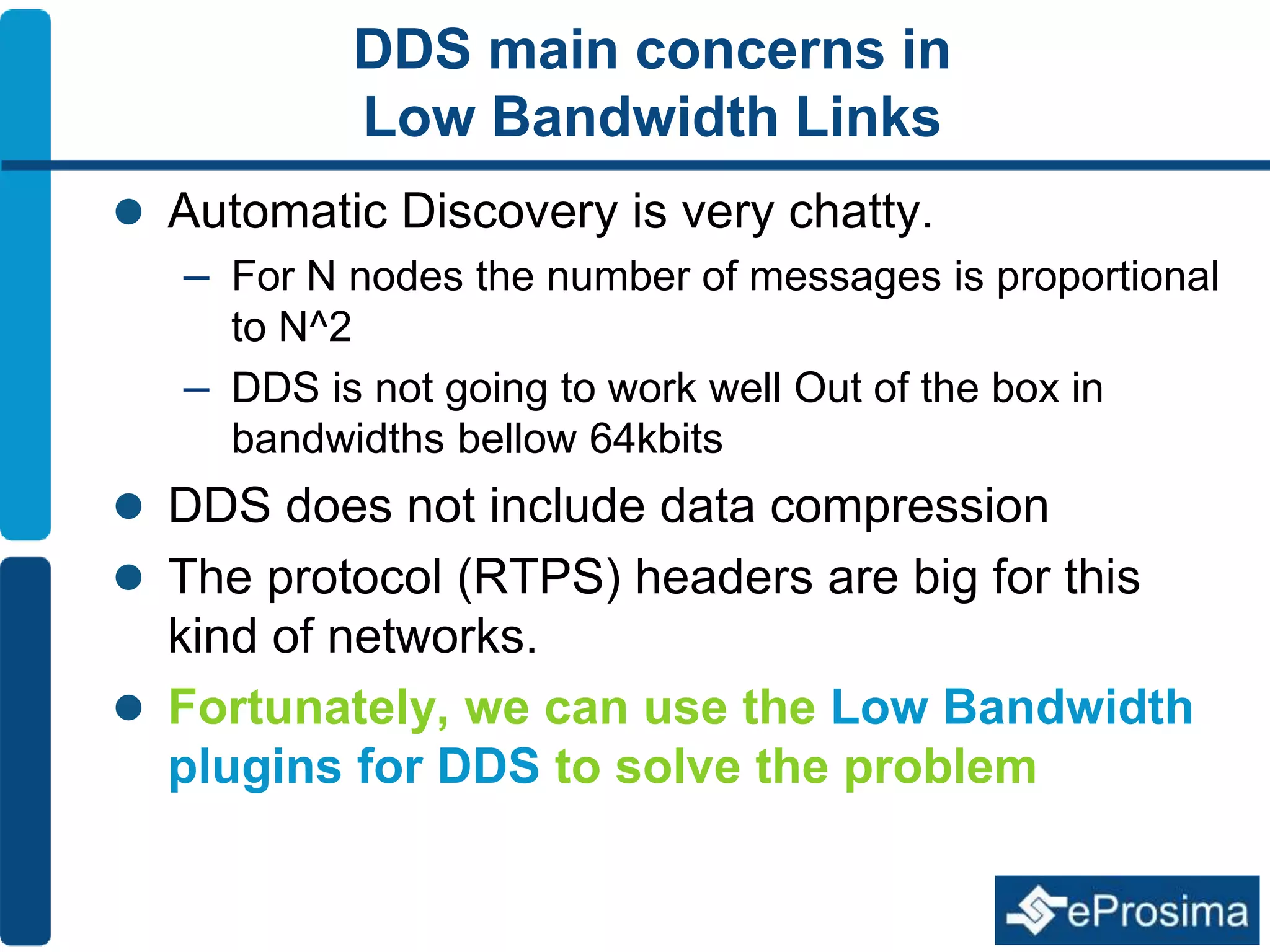
DDS main concerns in 
Low Bandwidth Links 
DDS in Low Bandwidth Enviroments
DDS main concerns in 
Low Bandwidth Links 
 Automatic Discovery is very chatty. 
– For N nodes the number of messages is proportional 
to N^2 
– DDS is not going to work well Out of the box in 
bandwidths bellow 64kbits 
 DDS does not include data compression 
 The protocol (RTPS) headers are big for this 
kind of networks. 
 Fortunately, we can use the Low Bandwidth 
plugins for DDS to solve the problem
Low Bandwidth Discovery Plugin 
DDS in Low Bandwidth Enviroments
Overview 
 What is discovery? 
 Discovery phases 
– Participant discovery phase 
– Endpoint discovery phase 
 Low Bandwidth Discovery Plugin (LBDP)
What is discovery? 
 The process by which domain participants find 
out about each other’s entities 
– Each participant maintains database on other 
participants in the domain and their entities 
 Happens automatically behind the scenes 
– “anonymous publish-subscribe” 
 Dynamic discovery 
– Participants must refresh their presence in the 
domain or will be aged out of database 
– QoS changes are propagated to remote participants
Discovery phases 
 Two consecutive phases 
– Participant discovery phase 
 Participants discover each other 
 Best-effort communication, multicast (default) 
– Endpoint discovery phase 
 Participants exchange information about their datawriter 
and datareader entities 
 Reliable communication, unicast(default) 
 Steady state traffic to maintain liveliness of 
participants
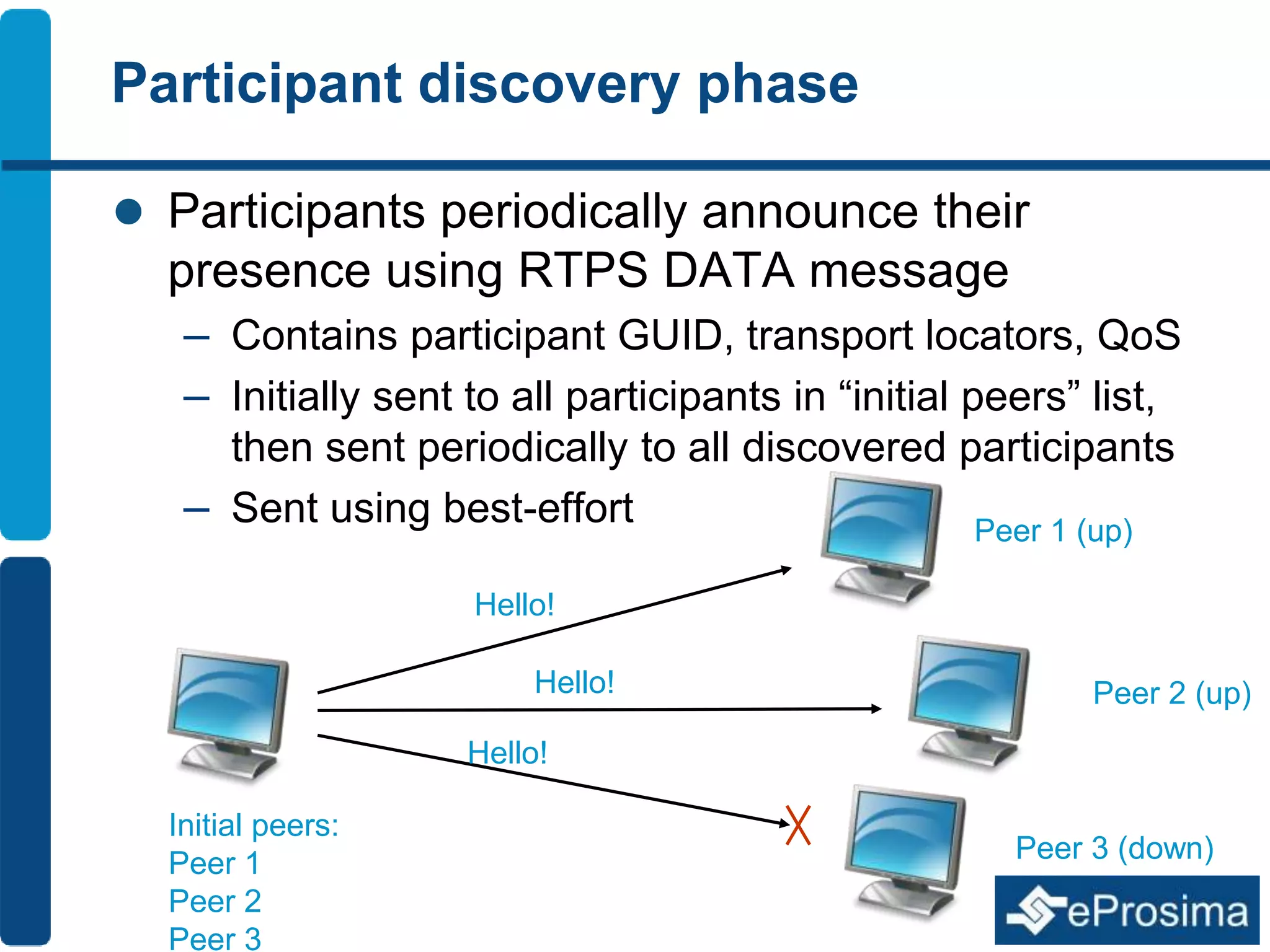
Participant discovery phase 
 Participants periodically announce their 
presence using RTPS DATA message 
– Contains participant GUID, transport locators, QoS 
– Initially sent to all participants in “initial peers” list, 
then sent periodically to all discovered participants 
– Sent using best-effort 
Peer 1 (up) 
Peer 2 (up) 
Peer 3 (down) 
Hello! 
Hello! 
Hello! 
Initial peers: 
Peer 1 
Peer 2 
Peer 3
Endpoint discovery phase 
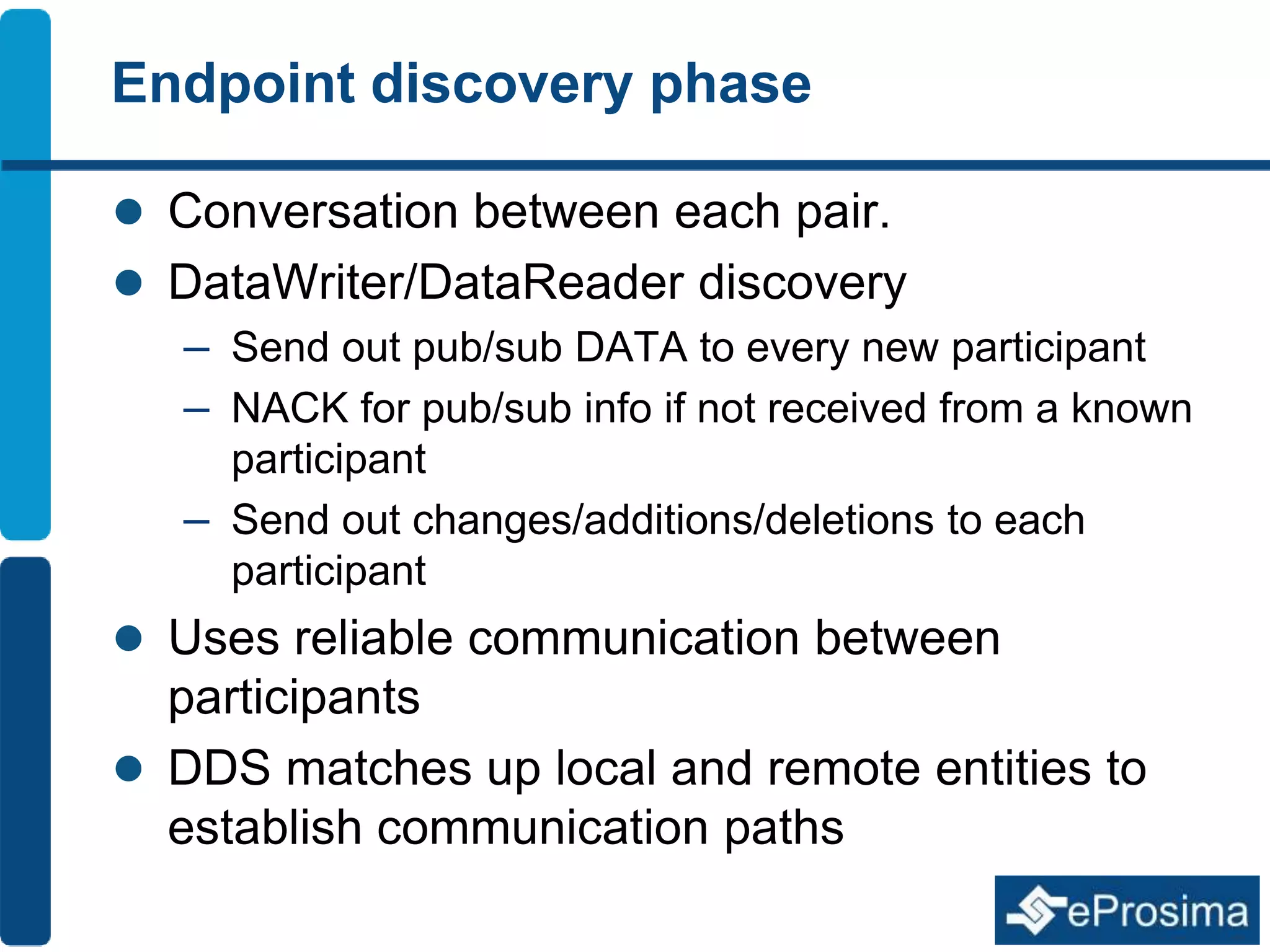
 Conversation between each pair. 
 DataWriter/DataReader discovery 
– Send out pub/sub DATA to every new participant 
– NACK for pub/sub info if not received from a known 
participant 
– Send out changes/additions/deletions to each 
participant 
 Uses reliable communication between 
participants 
 DDS matches up local and remote entities to 
establish communication paths
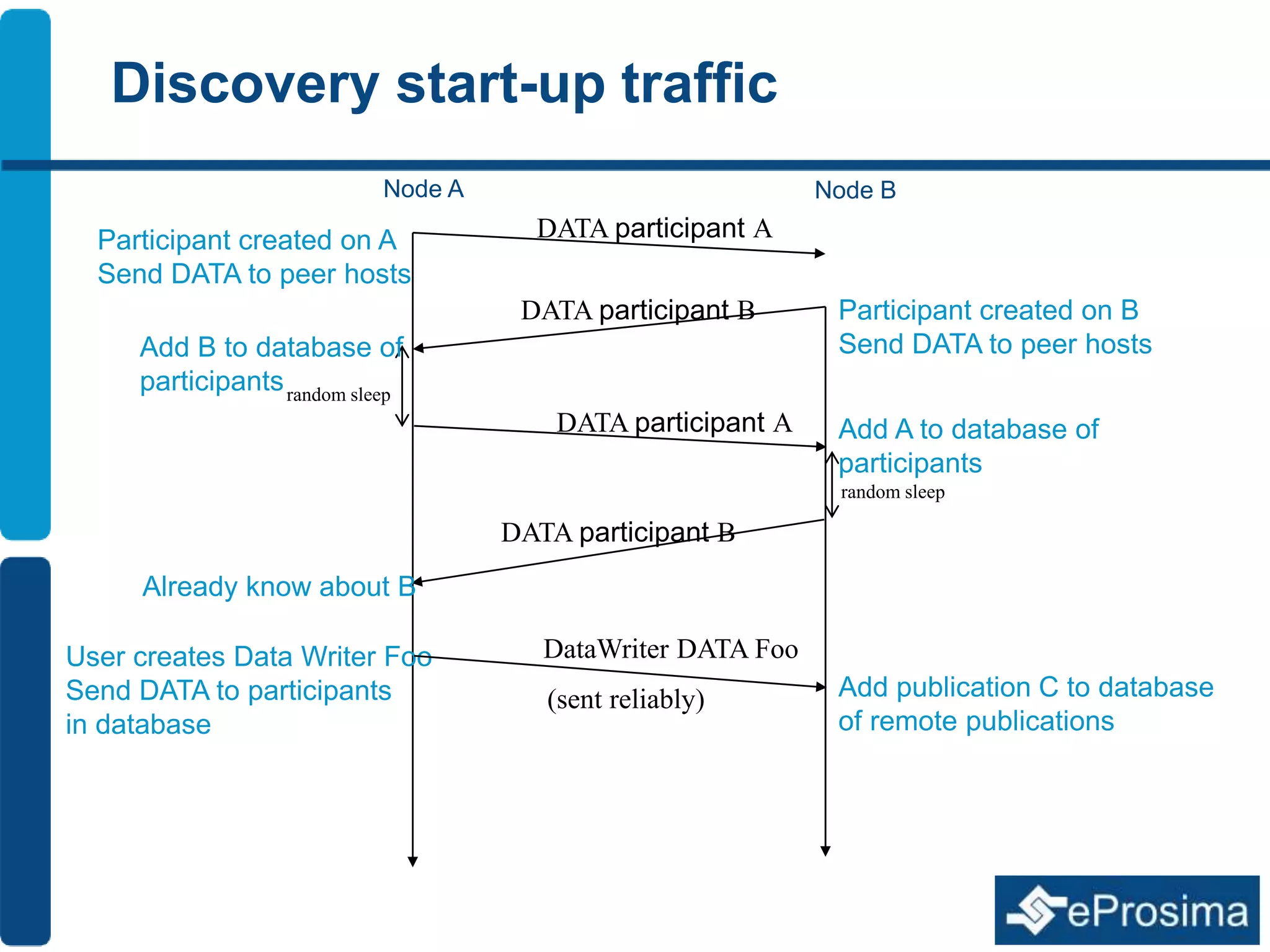
Discovery start-up traffic 
Node A Node B 
Participant created on A 
Send DATA to peer hosts 
Participant created on B 
Send DATA to peer hosts 
DATA participant A 
DATA participant B 
DATA participant A 
DATA participant B 
User creates Data Writer Foo 
Send DATA to participants 
in database 
DataWriter DATA Foo 
Add publication C to database 
of remote publications 
random sleep 
random sleep 
Add B to database of 
participants 
Add A to database of 
participants 
Already know about B 
(sent reliably)
Discovery Implementation 
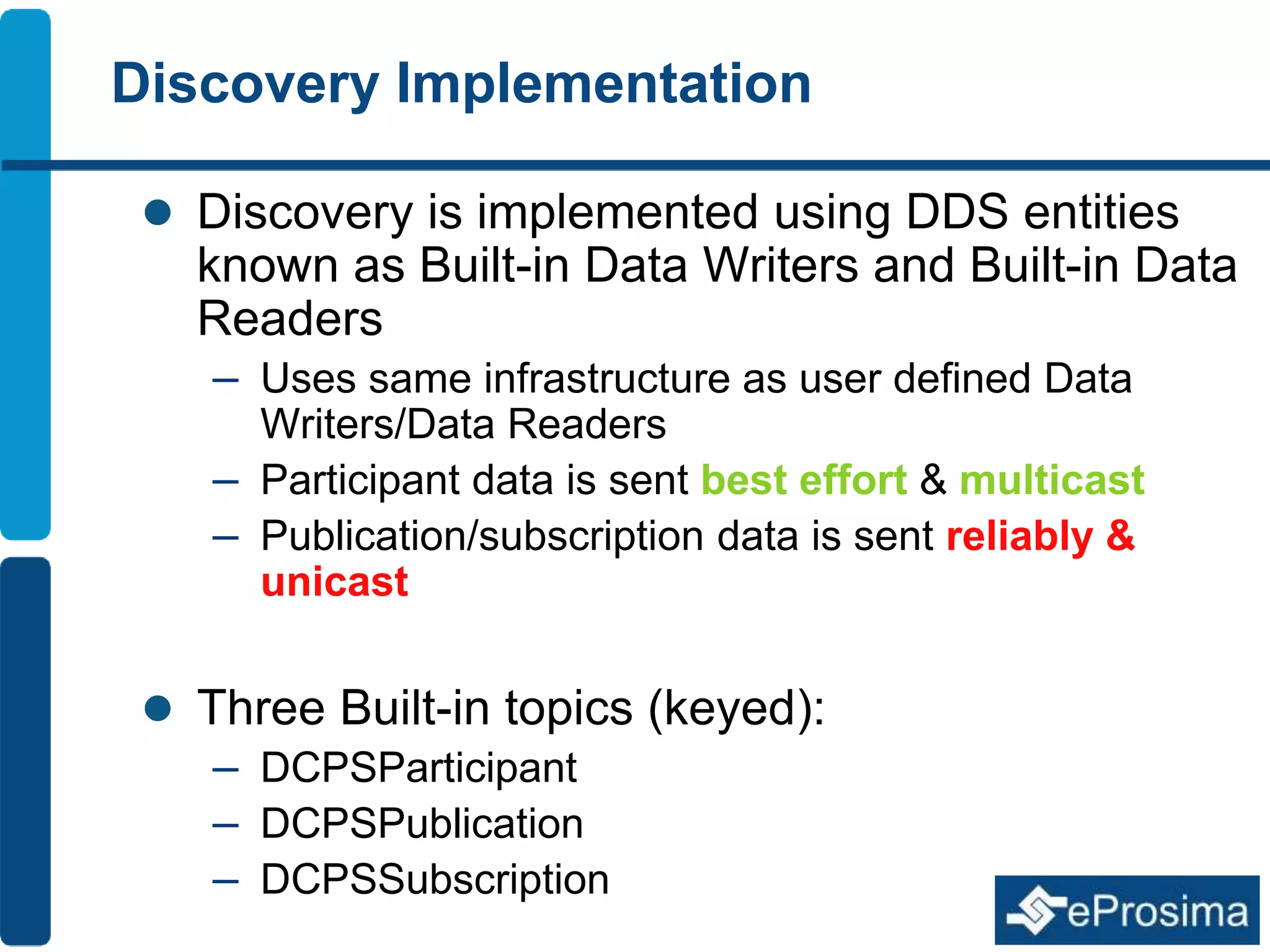
 Discovery is implemented using DDS entities 
known as Built-in Data Writers and Built-in Data 
Readers 
– Uses same infrastructure as user defined Data 
Writers/Data Readers 
– Participant data is sent best effort & multicast 
– Publication/subscription data is sent reliably & 
unicast 
 Three Built-in topics (keyed): 
– DCPSParticipant 
– DCPSPublication 
– DCPSSubscription
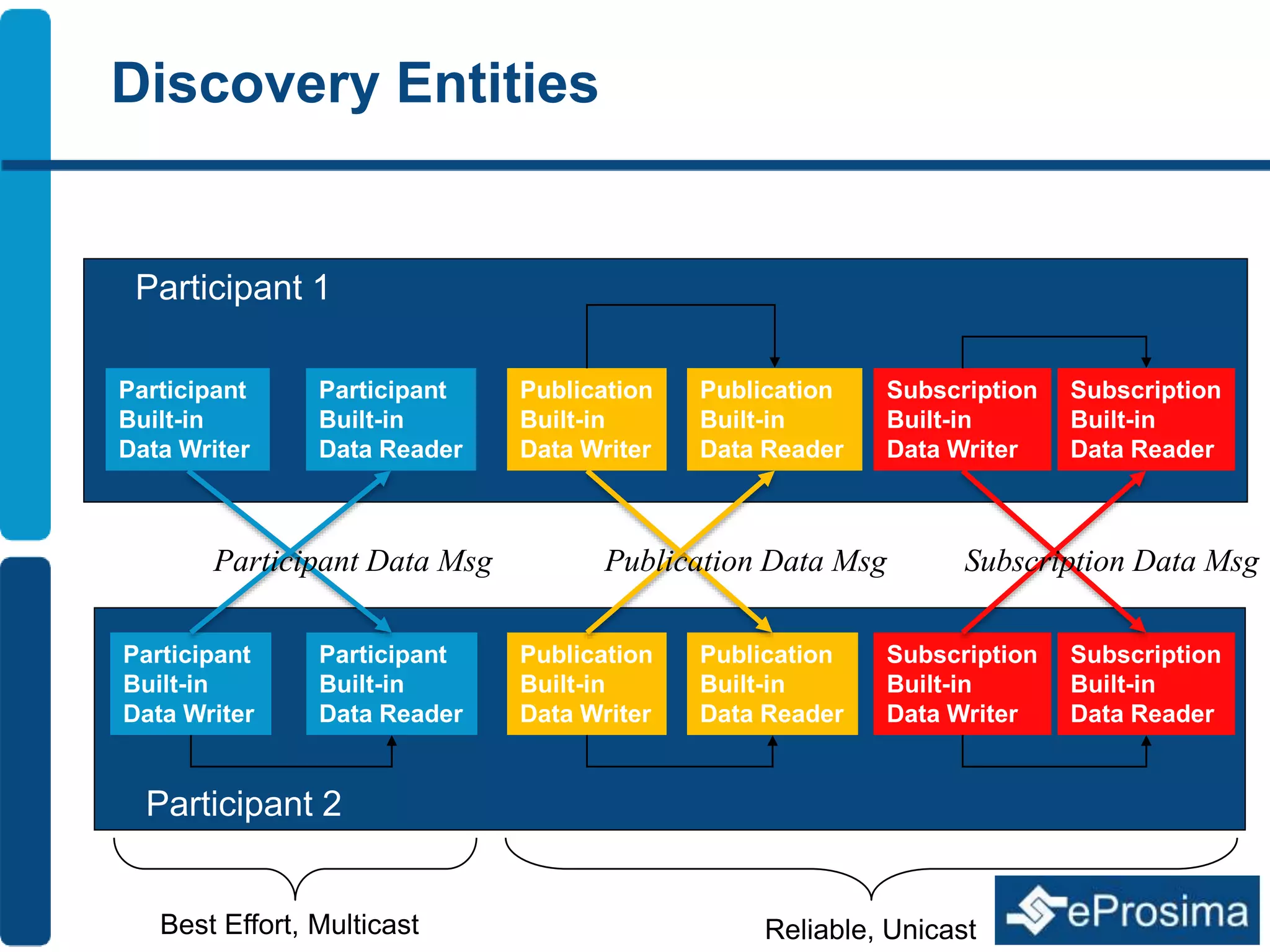
Discovery Entities 
Participant 1 
Participant 
Built-in 
Data Reader 
Publication 
Built-in 
Data Writer 
Subscription 
Built-in 
Data Reader 
Participant 
Built-in 
Data Writer 
Subscription 
Built-in 
Data Writer 
Publication 
Built-in 
Data Reader 
Participant Data Msg Publication Data Msg Subscription Data Msg 
Participant 
Built-in 
Data Reader 
Participant 2 
Publication 
Built-in 
Data Writer 
Subscription 
Built-in 
Data Reader 
Participant 
Built-in 
Data Writer 
Subscription 
Built-in 
Data Writer 
Publication 
Built-in 
Data Reader 
Best Effort, Multicast Reliable, Unicast
LBDP 
 Goals: 
– Reduce the discovery information transmitted. 
– Reduce net traffic: Less Packets. 
 Scenario: 
– We now most details of the participant applications in 
advance. 
 Solution: 
– Suppress second discovery phase. 
– Mixed static and dynamic behavior. 
– Information about endpoints stored in XML files or 
Databases
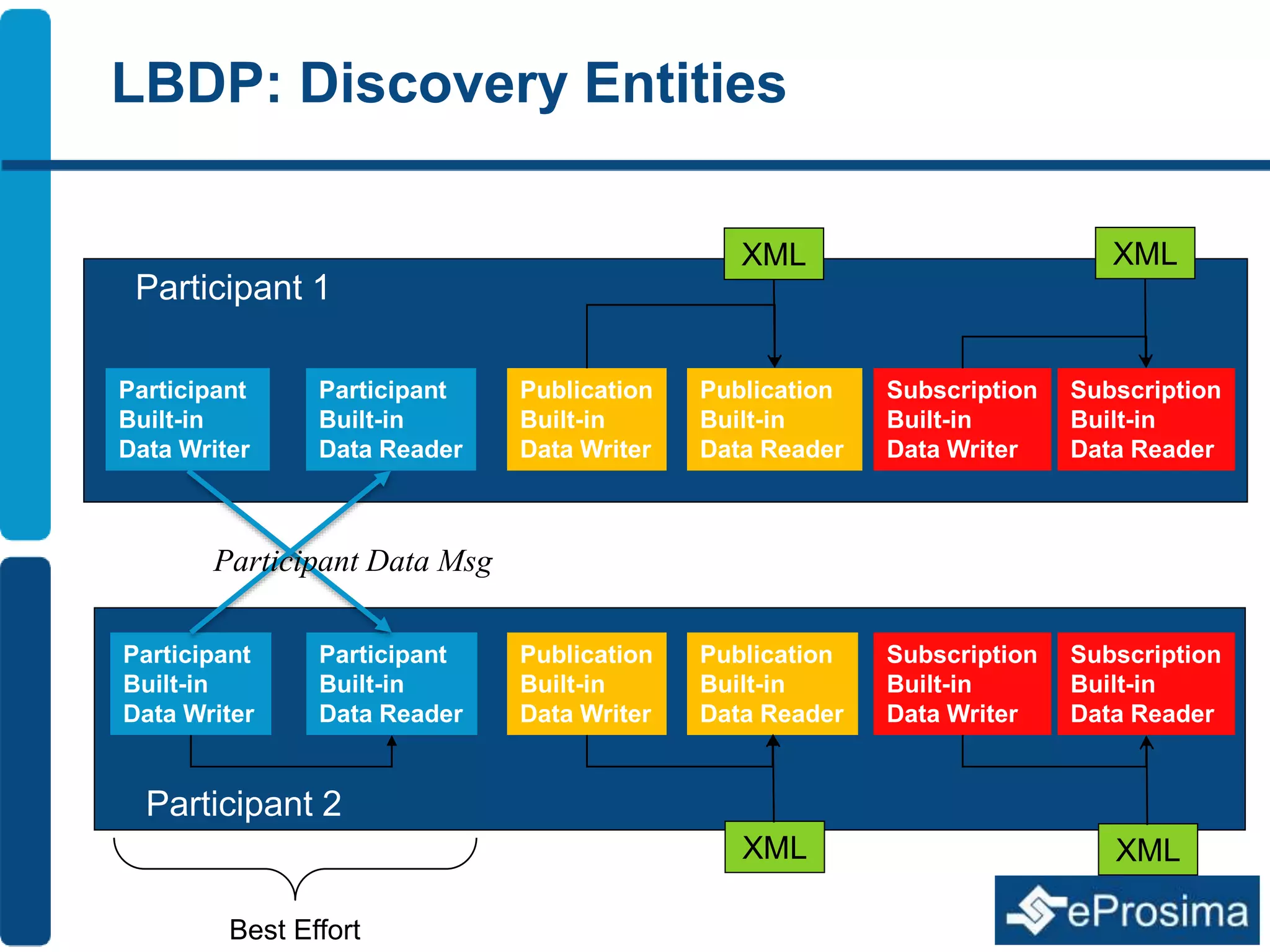
LBDP: Discovery Entities 
Participant 1 
Participant 
Built-in 
Data Reader 
Publication 
Built-in 
Data Writer 
Subscription 
Built-in 
Data Reader 
Participant 
Built-in 
Data Writer 
Subscription 
Built-in 
Data Writer 
Publication 
Built-in 
Data Reader 
Participant 
Built-in 
Data Reader 
Participant 2 
Publication 
Built-in 
Data Writer 
Subscription 
Built-in 
Data Reader 
Participant 
Built-in 
Data Writer 
Subscription 
Built-in 
Data Writer 
Publication 
Built-in 
Data Reader 
Participant Data Msg 
Best Effort 
XML XML 
XML XML
Low Bandwidth Compression transport 
DDS in Low Bandwidth Enviroments
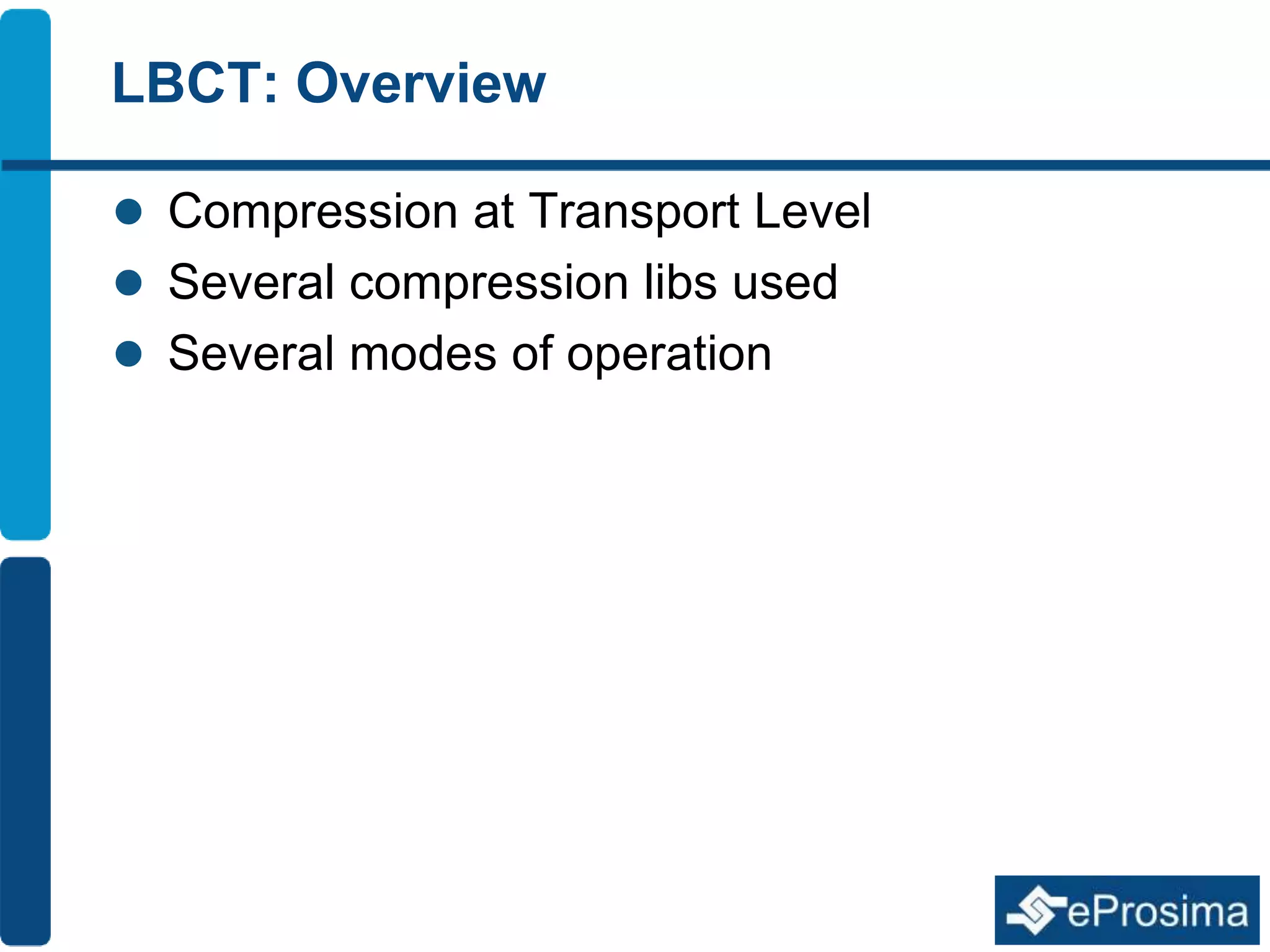
LBCT: Overview 
 Compression at Transport Level 
 Several compression libs used 
 Several modes of operation
LBCT: Compression at Transport Level 
 Compression at Transport Level 
– Stackable: Use it over any transport: UDP, Serial, Ad 
hoc…
LBCT:Several compression libs 
 Several compression libs can be used: 
– ZLIB 
– BZIP2 
– LZO : LZO1X, LZO1B & LZO1F 
– UCL : UCL_NRV2B, UCL_NRV2D & UCL_NRV2E 
 Easy to add more by the user. 
– Through Public API.
Several modes of operation 
 Several modes of operation: 
– Fixed Algorithm 
– Algorithm depending on packet size. 
– Automatic: when CPU is not the bottleneck, the 
plugin select the best algorithm for each package.
Results 
 40% improvement in standard 
Discovery traffic 
– Applies also to Static Discovery 
 60-80% improvement in Data 
– We used several sample applications 
from command and control systems of 
Spanish Army.
Low Bandwidth RTPS 
Transport 
DDS in Low Bandwidth Enviroments
LB RTPS: Overview 
 Optimized RTPS for low bandwidth scenarios 
 Implemented as a transport.
LB RTPS: Optimized RTPS 
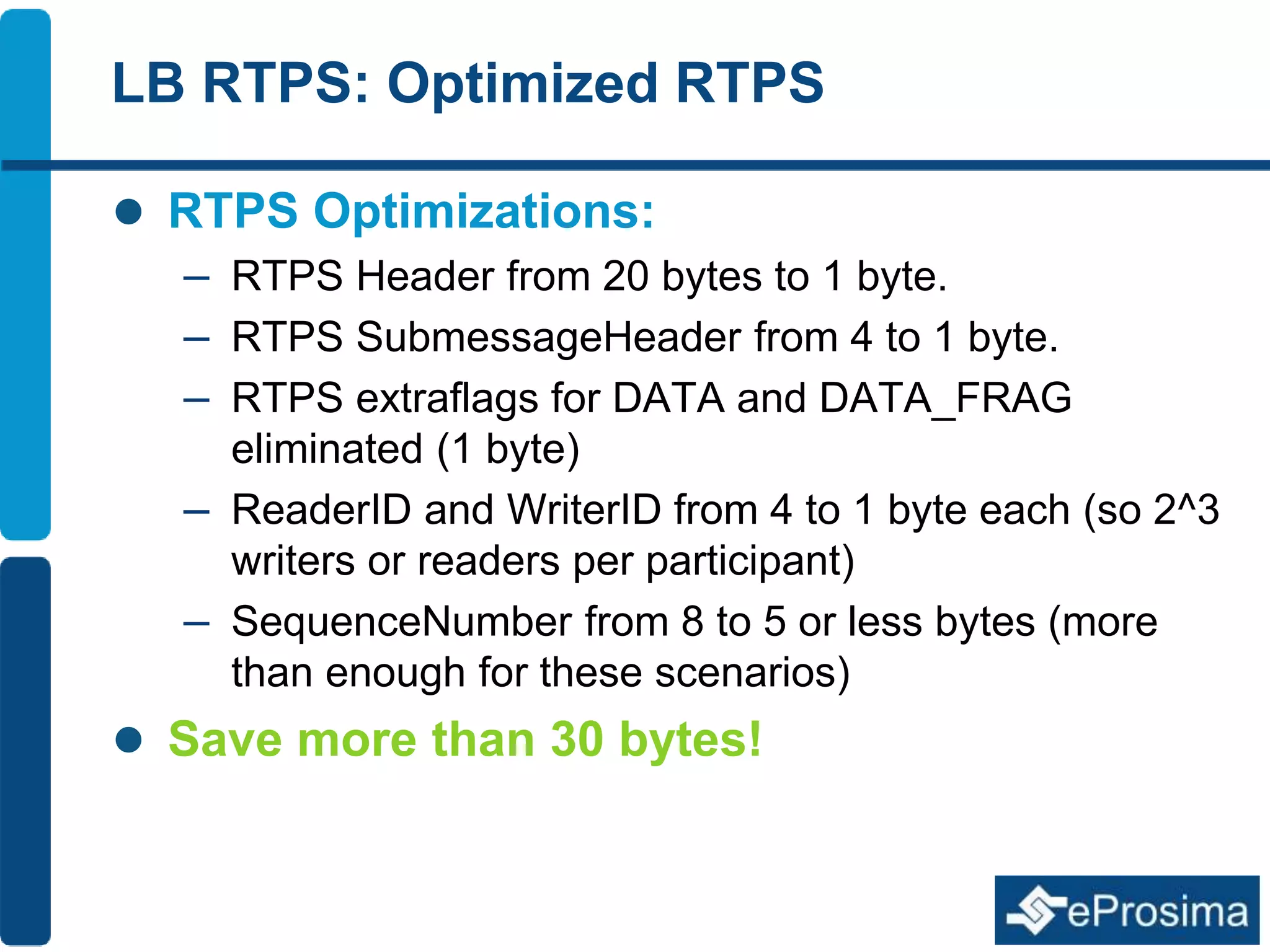
 RTPS Optimizations: 
– RTPS Header from 20 bytes to 1 byte. 
– RTPS SubmessageHeader from 4 to 1 byte. 
– RTPS extraflags for DATA and DATA_FRAG 
eliminated (1 byte) 
– ReaderID and WriterID from 4 to 1 byte each (so 2^3 
writers or readers per participant) 
– SequenceNumber from 8 to 5 or less bytes (more 
than enough for these scenarios) 
 Save more than 30 bytes!
LB RTPS: 
Implemented as a transport 
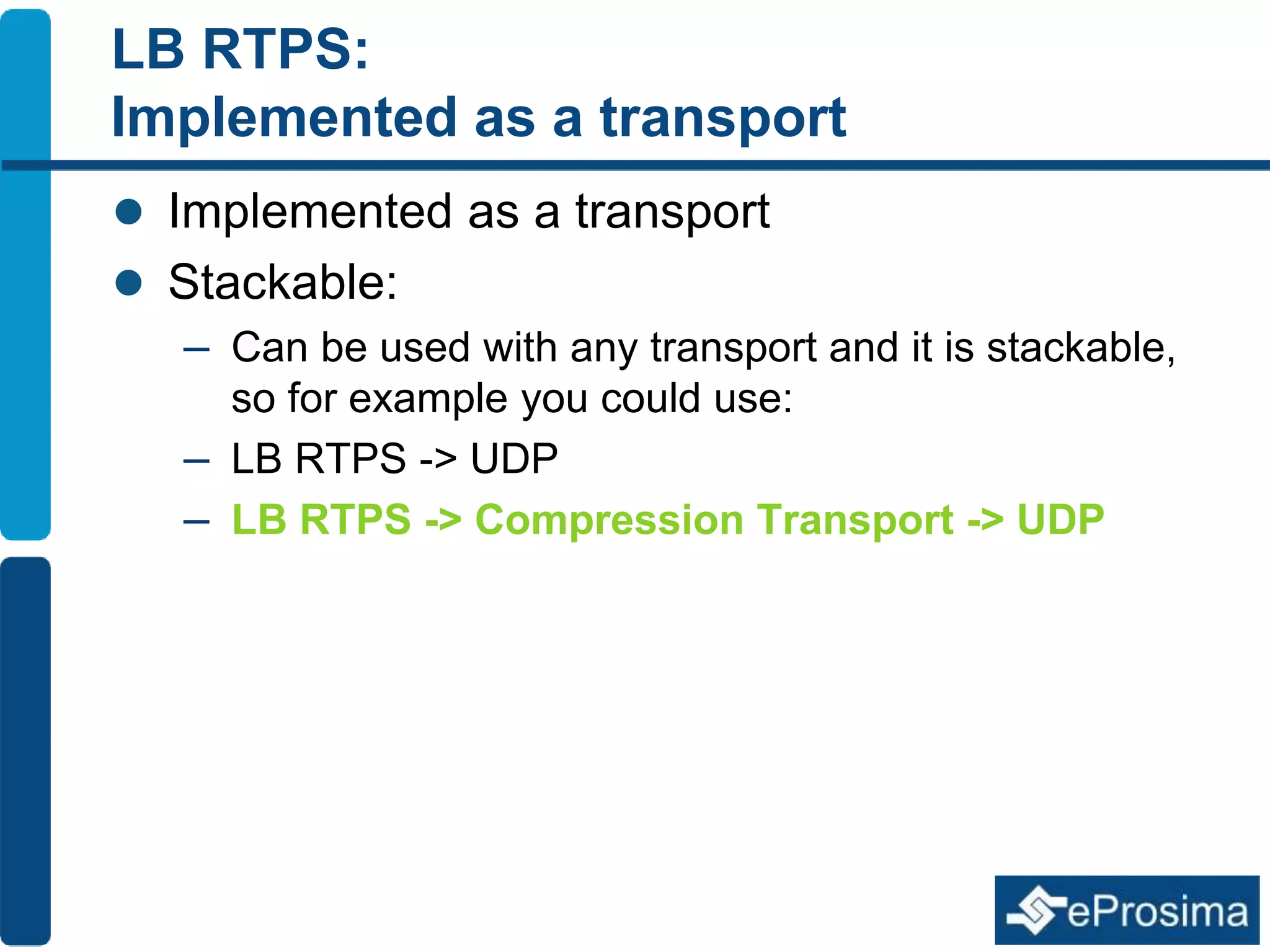
 Implemented as a transport 
 Stackable: 
– Can be used with any transport and it is stackable, 
so for example you could use: 
– LB RTPS -> UDP 
– LB RTPS -> Compression Transport -> UDP
Low Bandwidth 
Simulation Transport 
DDS in Low Bandwidth Enviroments
LB Simulation Transport: Overview 
 Simulate your low bandwidth scenario 
 Implemented as a Transport plugin (stackable) 
 Two operation modes: 
– Simple Channel mode: Easy to Set Up 
 The bandwidth is controlled for each node independently 
– Advanced Channel mode: 
 Bandwidth controlled accounting the activity in all the 
nodes.
LB Simulation Transport: Simulate your 
low bandwidth scenario 
 Simulate your low bandwidth scenario: 
– Designed to cover a variety of devices: 
 Tactical Radios 
 Satellite links 
– General purpose.
Low Bandwidth: Hints 
DDS in Low Bandwidth Enviroments
Low Bandwidth Scenarios: Hints 
 Use Best Effort or NACK Based Reliability 
 Use Multicast in Radio Scenarios 
 Flow controllers 
 Optimize Types. 
– Sparse Types. 
 Call us 
Low Bandwidth Scenarios: Hints (II) 
 eProsima Smart Flow Controller for DDS 
– Take into account the network state in real time 
 The product calculates the available bandwidth in real 
time with the latencies & packet loss 
– Assign real priorities and bandwidth resources to 
your DDS Topics 
 In Terms of the available bandwidth.
Want to know more? 
 www.eProsima.com 
 Youtube: 
https://www.youtube.com/user/eprosima 
 Mail: JaimeMartin@eProsima.com 
 Phone: +34 607913745 
 Twitter: @jaimemartinlosa 
 http://es.slideshare.net/JaimeMartin-eProsima
Appendixes
About eProsima
About eProsima 
 Experts on middleware, focused on DDS. 
 OMG Members. 
 Army Interoperability Standards 
– Spanish Army: Tactical Data Interface (IDT) 
– MIP: Adem Model 
.
About eProsima: Products And Services 
 eProsima Products: 
– DDS based: Plugins, add-ons, adaptors, etc 
 Services: 
– Communication modules, App development, DDS 
training, Support. 
 R&D: 
– R&D Projects with enterprises and universities. 
 Quality: ISO 9001 
– Design, Development, Marketing and Support of 
Software.
Customers (I) 
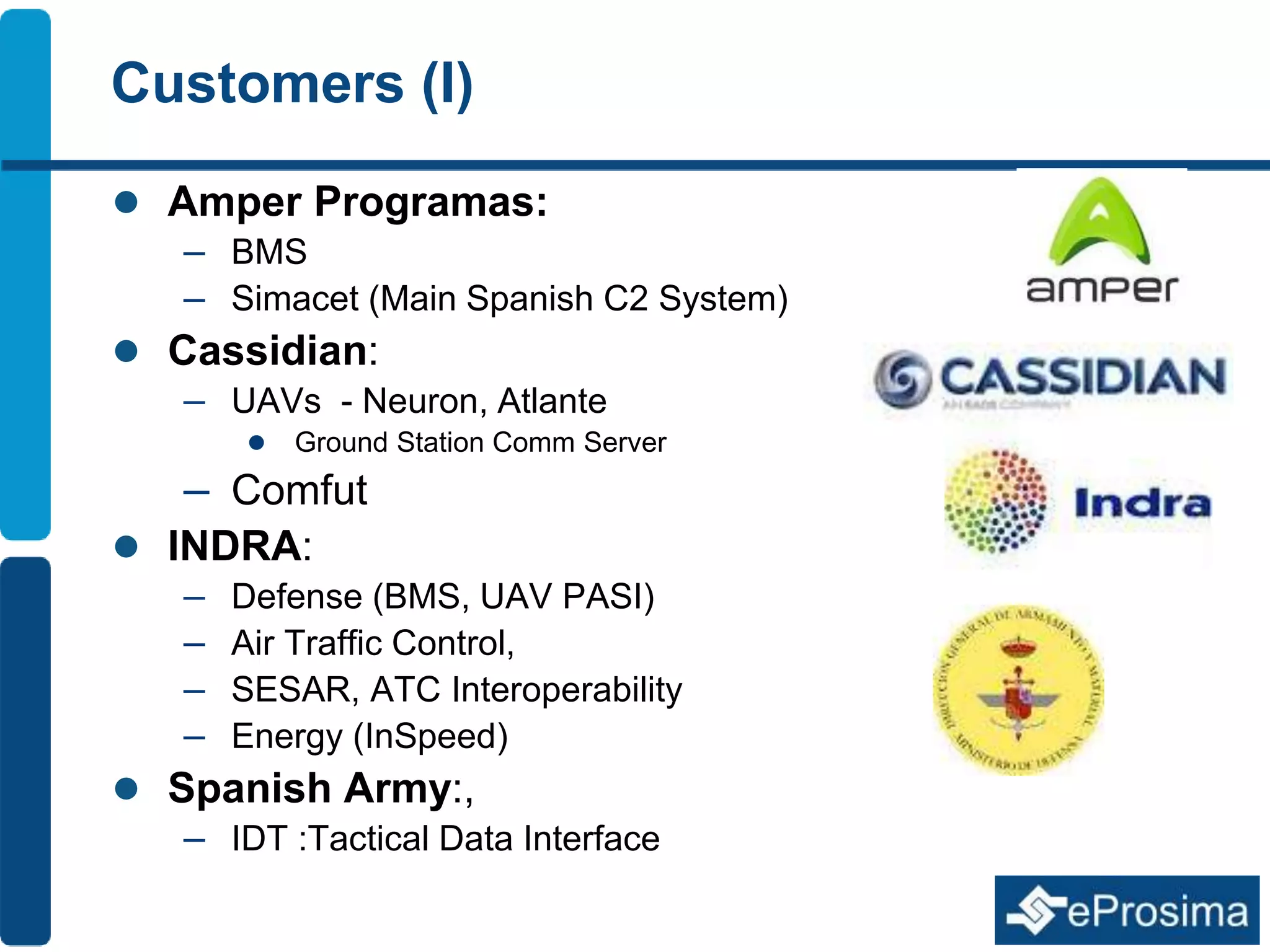
 Amper Programas: 
– BMS 
– Simacet (Main Spanish C2 System) 
 Cassidian: 
– UAVs - Neuron, Atlante 
 Ground Station Comm Server 
– Comfut 
 INDRA: 
– Defense (BMS, UAV PASI) 
– Air Traffic Control, 
– SESAR, ATC Interoperability 
– Energy (InSpeed) 
 Spanish Army:, 
– IDT :Tactical Data Interface
Customers (II) 
 Isdefe 
 Spanish Army: JCISAT, DGAM 
 CATEC-FADA: R&D Aerospatial 
 Santa Barbara: Armoured Vehicles 
 RTI 
 GMV
Customers (III) 
 Tecnobit: COSMOS, Reserved Projects. 
 IKERLAN: R&D. 
 Navantia: F105 (Aegis) 
 Boeing: Atlantida, Swim suit
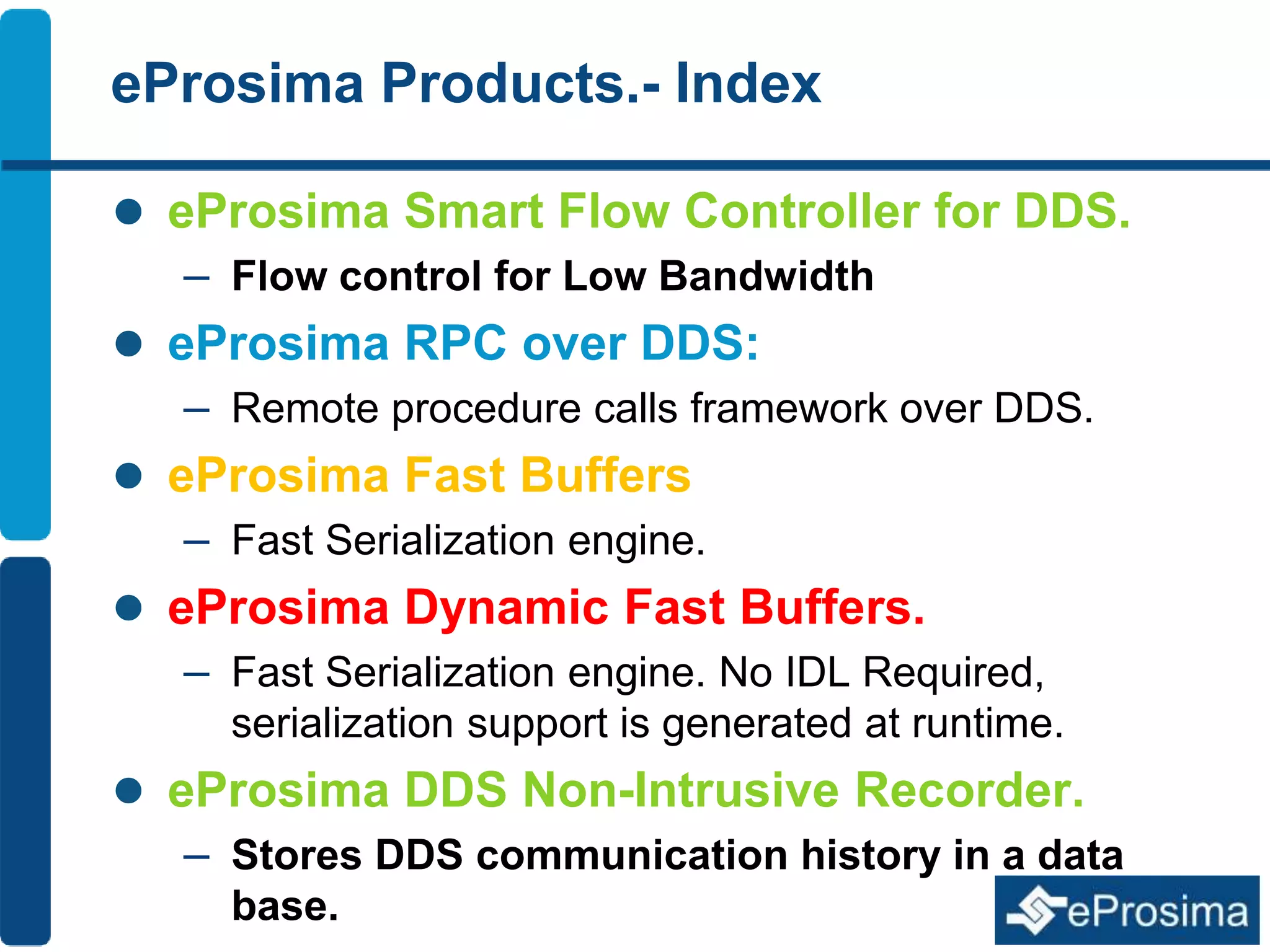
eProsima Products.- Index 
 eProsima Smart Flow Controller for DDS. 
– Flow control for Low Bandwidth 
 eProsima RPC over DDS: 
– Remote procedure calls framework over DDS. 
 eProsima Fast Buffers 
– Fast Serialization engine. 
 eProsima Dynamic Fast Buffers. 
– Fast Serialization engine. No IDL Required, 
serialization support is generated at runtime. 
 eProsima DDS Non-Intrusive Recorder. 
– Stores DDS communication history in a data 
base.
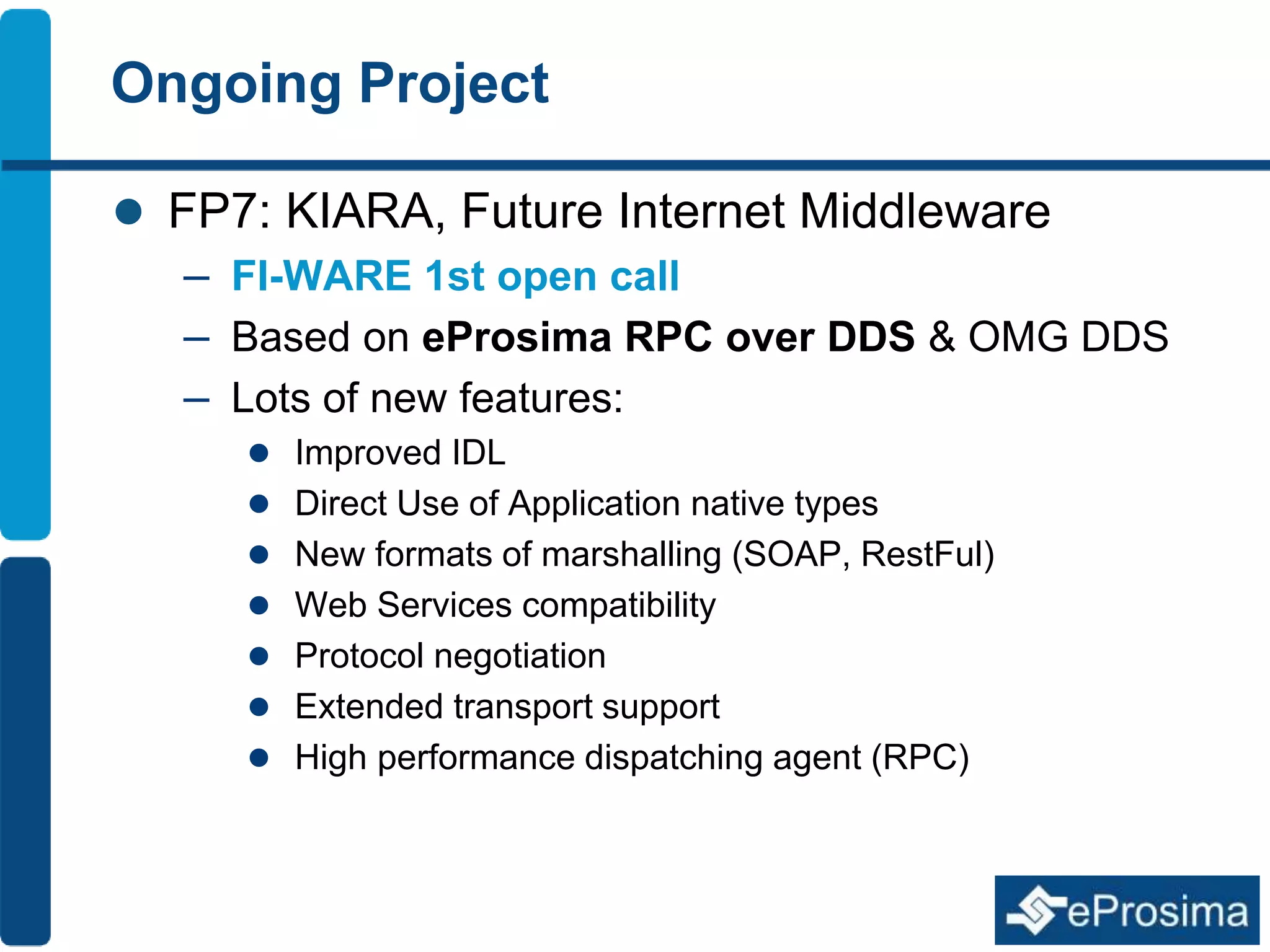
Ongoing Project 
 FP7: KIARA, Future Internet Middleware 
– FI-WARE 1st open call 
– Based on eProsima RPC over DDS & OMG DDS 
– Lots of new features: 
 Improved IDL 
 Direct Use of Application native types 
 New formats of marshalling (SOAP, RestFul) 
 Web Services compatibility 
 Protocol negotiation 
 Extended transport support 
 High performance dispatching agent (RPC)
eProsima 
Success Cases
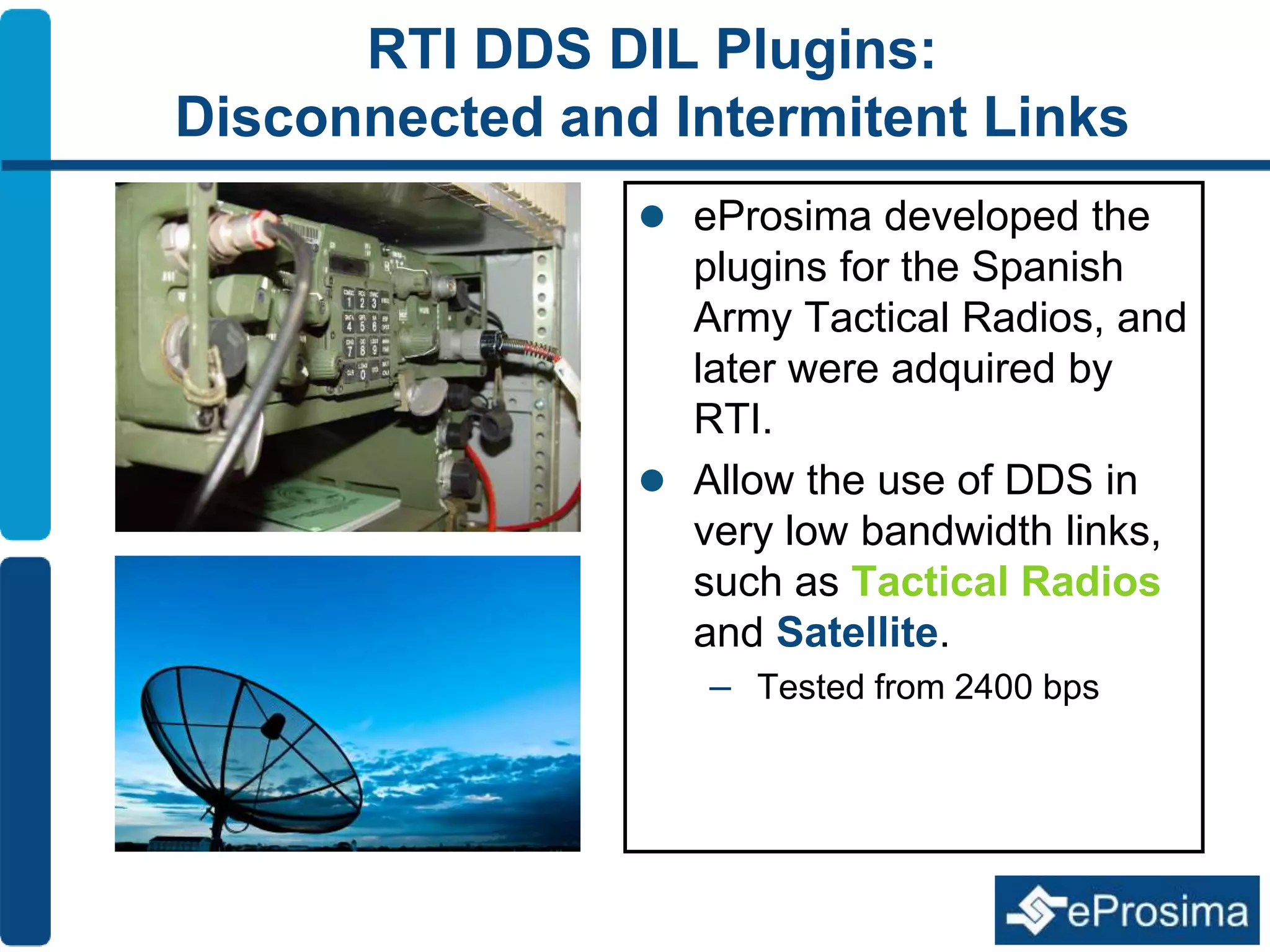
RTI DDS DIL Plugins: 
Disconnected and Intermitent Links 
 eProsima developed the 
plugins for the Spanish 
Army Tactical Radios, and 
later were adquired by 
RTI. 
 Allow the use of DDS in 
very low bandwidth links, 
such as Tactical Radios 
and Satellite. 
– Tested from 2400 bps
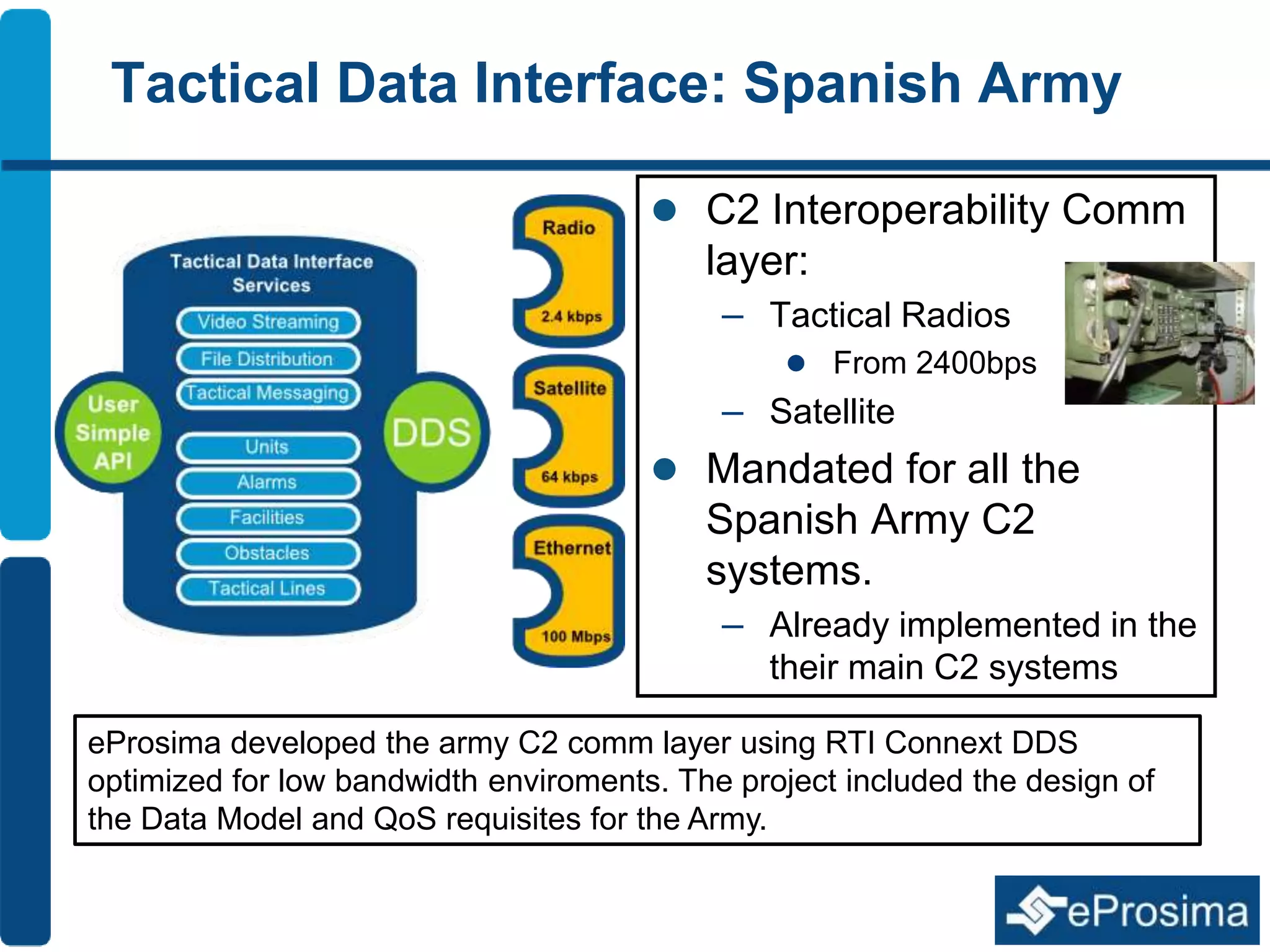
Tactical Data Interface: Spanish Army 
 C2 Interoperability Comm 
layer: 
– Tactical Radios 
 From 2400bps 
– Satellite 
 Mandated for all the 
Spanish Army C2 
systems. 
– Already implemented in the 
their main C2 systems 
eProsima developed the army C2 comm layer using RTI Connext DDS 
optimized for low bandwidth enviroments. The project included the design of 
the Data Model and QoS requisites for the Army.
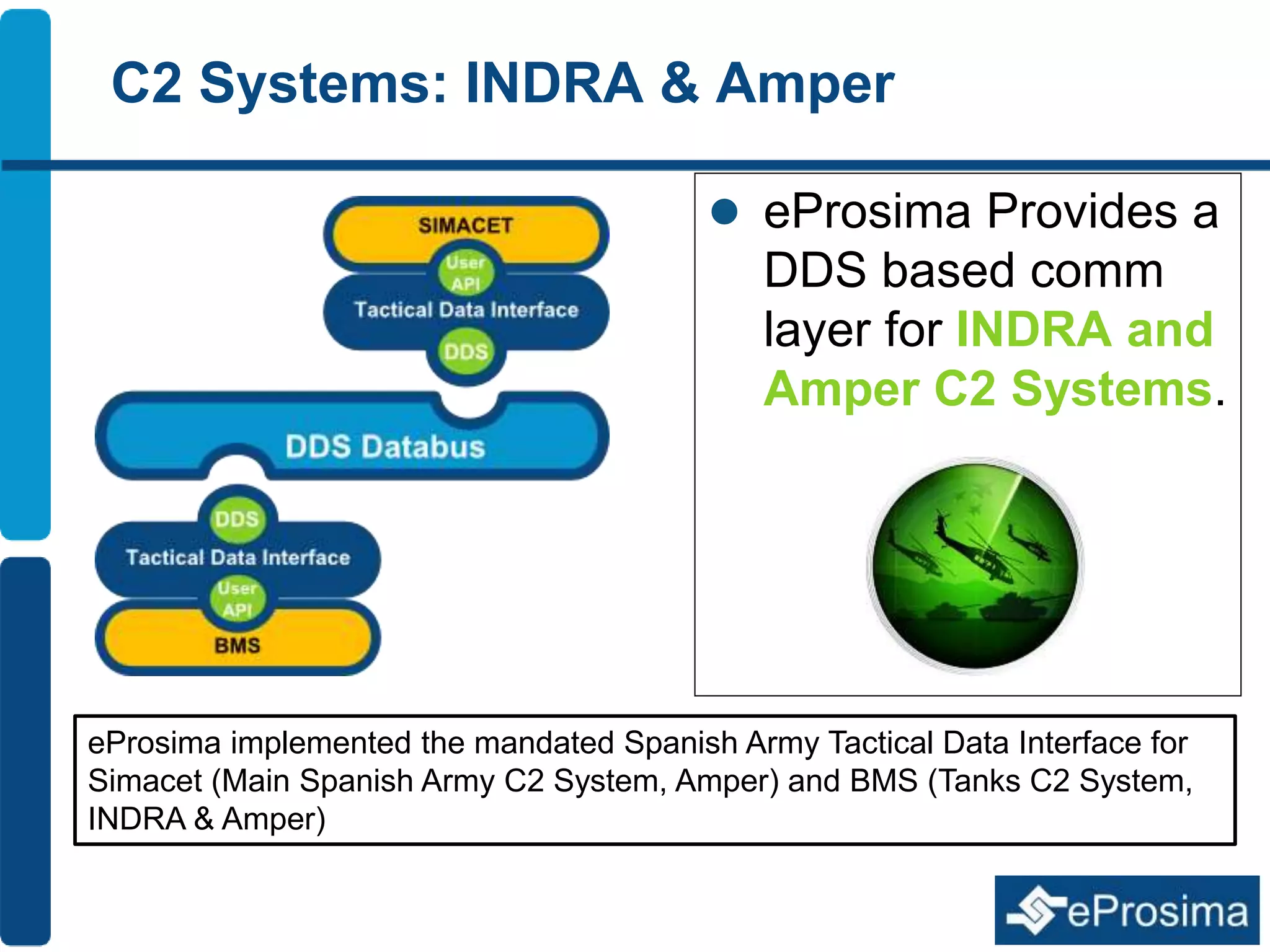
C2 Systems: INDRA & Amper 
 eProsima Provides a 
DDS based comm 
layer for INDRA and 
Amper C2 Systems. 
eProsima implemented the mandated Spanish Army Tactical Data Interface for 
Simacet (Main Spanish Army C2 System, Amper) and BMS (Tanks C2 System, 
INDRA & Amper)
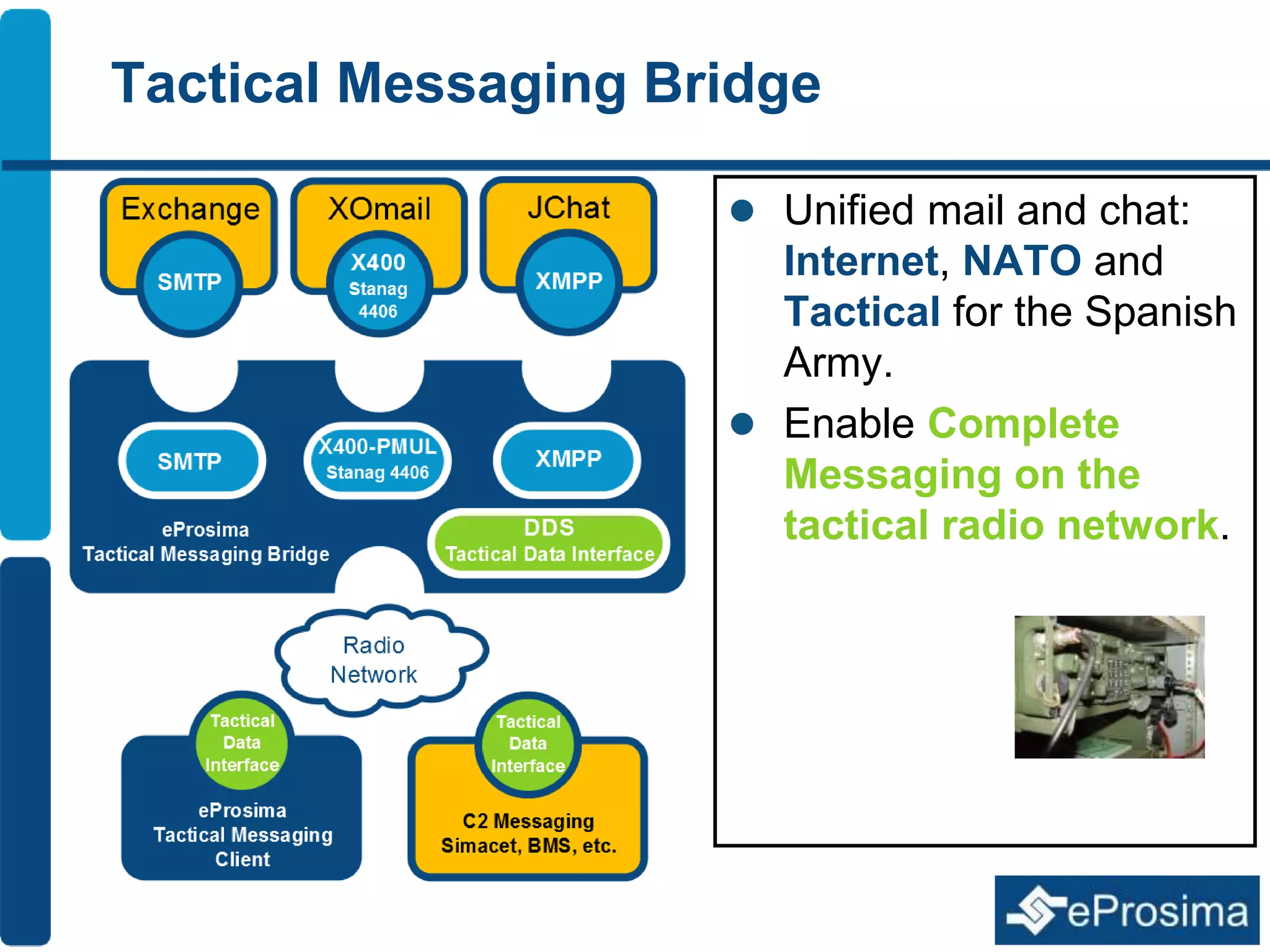
Tactical Messaging Bridge 
 Unified mail and chat: 
Internet, NATO and 
Tactical for the Spanish 
Army. 
 Enable Complete 
Messaging on the 
tactical radio network.
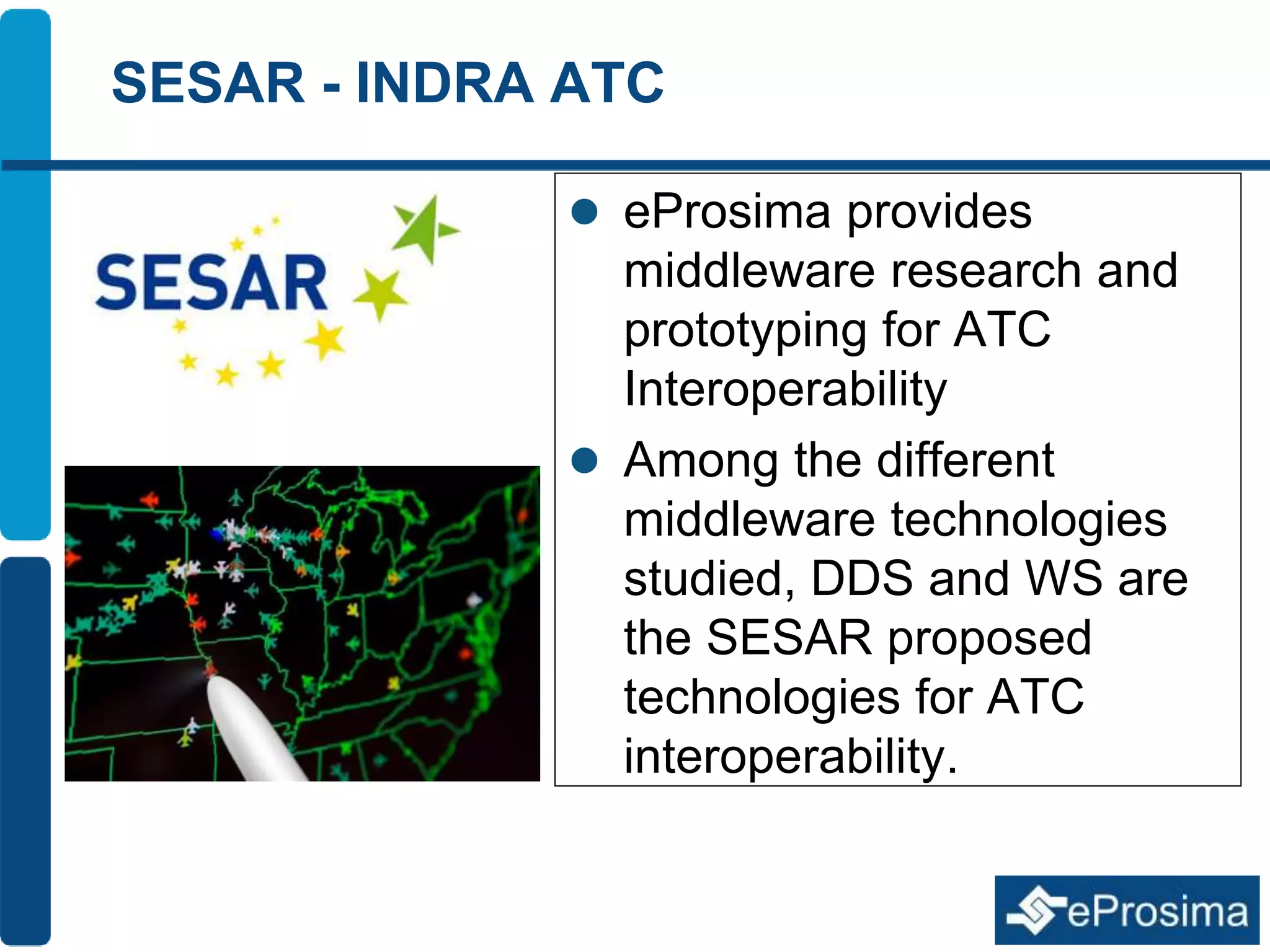
SESAR - INDRA ATC 
 eProsima provides 
middleware research and 
prototyping for ATC 
Interoperability 
 Among the different 
middleware technologies 
studied, DDS and WS are 
the SESAR proposed 
technologies for ATC 
interoperability.
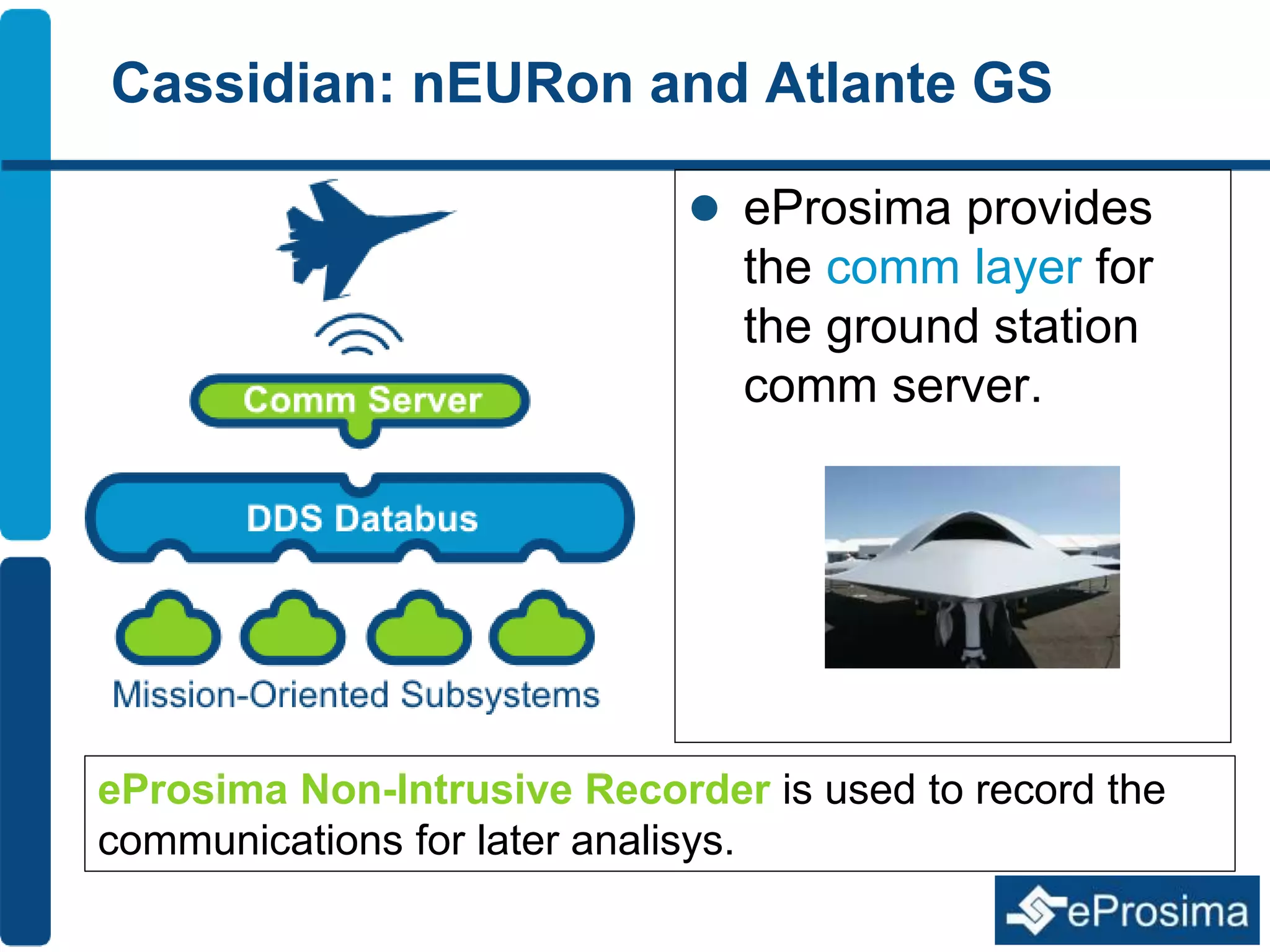
Cassidian: nEURon and Atlante GS 
 eProsima provides 
the comm layer for 
the ground station 
comm server. 
eProsima Non-Intrusive Recorder is used to record the 
communications for later analisys.
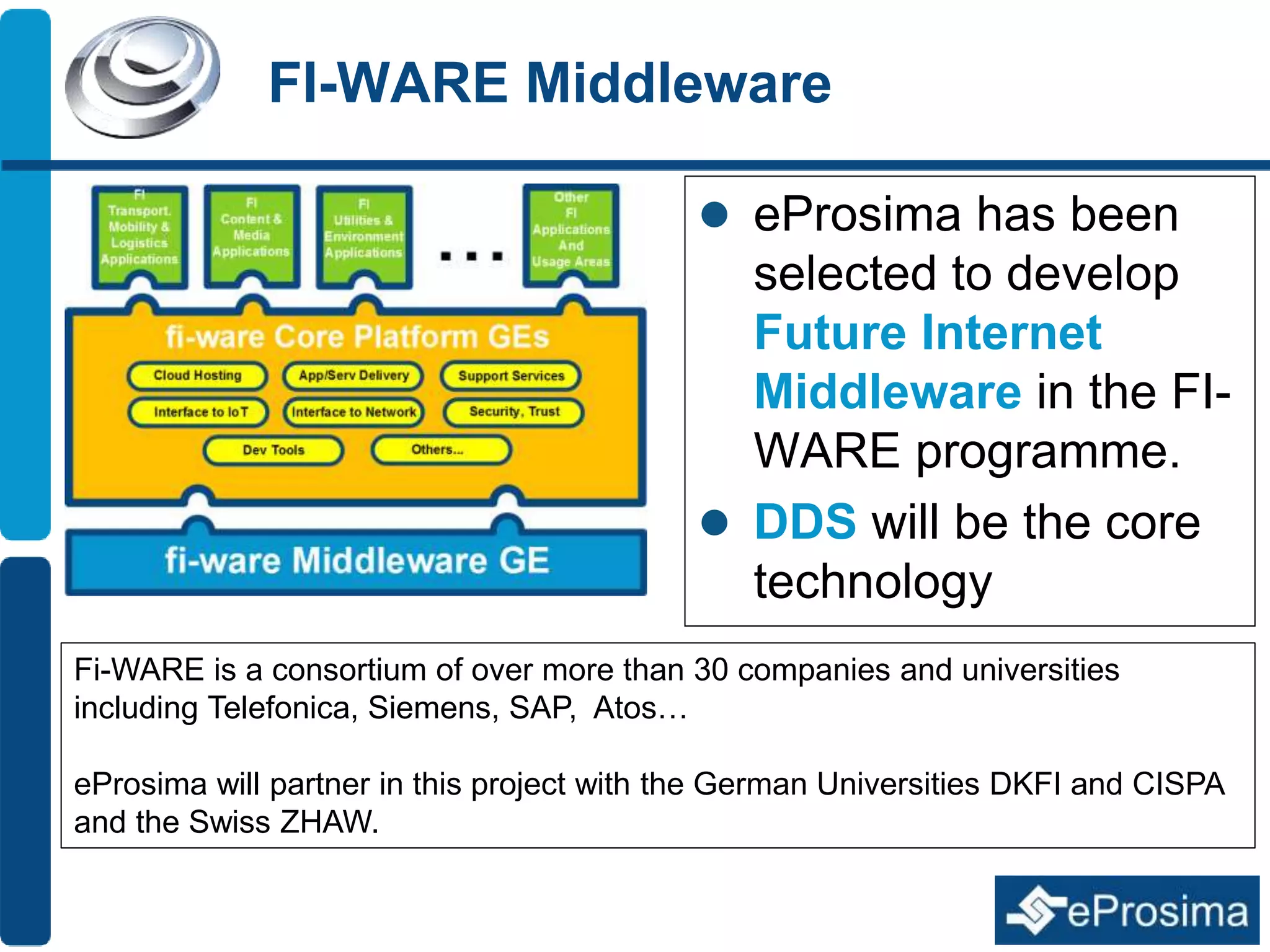
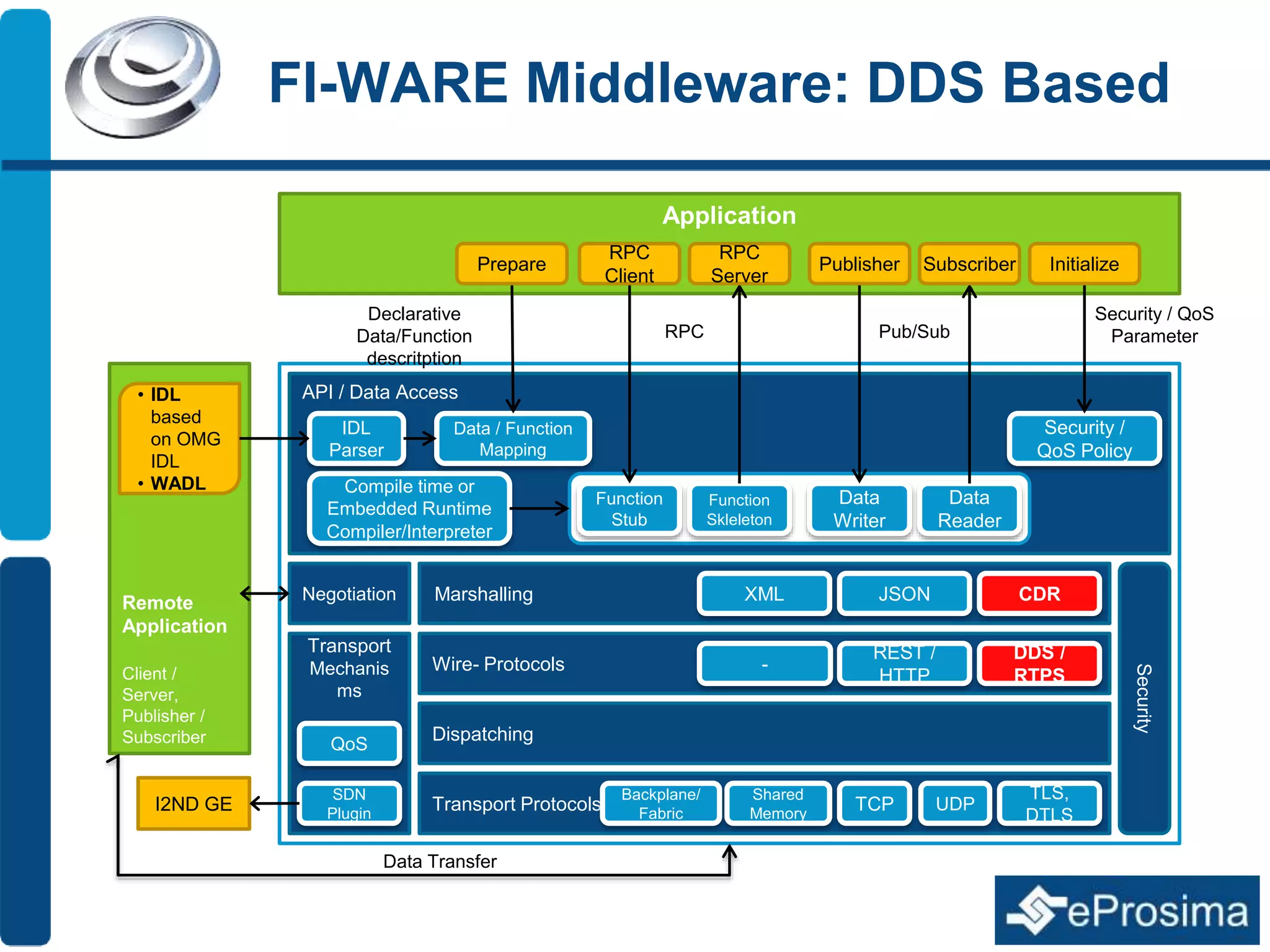
FI-WARE Middleware 
 eProsima has been 
selected to develop 
Future Internet 
Middleware in the FI-WARE 
programme. 
 DDS will be the core 
technology 
Fi-WARE is a consortium of over more than 30 companies and universities 
including Telefonica, Siemens, SAP, Atos… 
eProsima will partner in this project with the German Universities DKFI and CISPA 
and the Swiss ZHAW.
Remote 
Application 
Client / 
Server, 
Publisher / 
Subscriber 
Application 
Declarative 
Data/Function 
descritption 
API / Data Access 
Data / Function 
Mapping 
Compile time or 
Embedded Runtime 
Compiler/Interpreter 
Marshalling 
Transport 
Mechanis 
ms 
Wire- Protocols 
RPC Pub/Sub 
Transport Protocols TCP UDP 
TLS, 
DTLS 
Shared 
Memory 
Backplane/ 
Fabric 
XML JSON CDR 
SDN 
Plugin 
Data Transfer 
Security / QoS 
Parameter 
Security / 
QoS Policy 
Function 
Stub 
Function 
Skleleton 
QoS 
Data 
Writer 
Data 
Reader 
- 
DDS / 
RTPS 
REST / 
HTTP 
Negotiation 
Publisher Subscriber 
RPC 
Server 
RPC 
Client 
Prepare Initialize 
IDL 
Parser 
• IDL 
based 
on OMG 
IDL 
• WADL 
Security 
Dispatching 
I2ND GE 
FI-WARE Middleware: DDS Based
Thank you! 
Jaime Martin Losa 
CEO eProsima 
JaimeMartin@eProsima.com 
+34 607 91 37 45 www.eProsima.com

DDS Over Low Bandwidth Data Links

  • 1.
    DDS over LowBandwidth Data Links: Tactical Radios, Satellite, etc. Connext Conference - London October/08/2014 Jaime Martin Losa CEO eProsima JaimeMartin@eProsima.com +34 607 91 37 45 www.eProsima.com
  • 2.
    eProsima in oneshot  Experts on middleware, focused on DDS.  OMG Members. – RPC over DDS, Web Enabled DDS, DDS Security (Supporter)  Army Interoperability Standards Contributor – Spanish Army: Tactical Data Interface (IDT) – MIP: Adem Model  RTI Spanish Distributor .
  • 3.
    Agenda  InitialMotivation, solution and results  DDS main concerns in Low Bandwidth Links  eProsima Low Bandwidth Plugins for DDS (Now RTI DIL Plugins) – Discovery Plugin – Compression Transport Plugin – RTPS Header Reduction Transport Plugin – Link Simulation Plugin  Some More hints - Questions  Appendix: – About eProsima – eProsima Success Cases  C2 Interoperability  Low Bandwidth Data Links
  • 4.
    Initial Motivation, Solutionand Results DDS in Low Bandwidth Enviroments
  • 5.
    Initial Motivation Bring DDS communications to the C2 Tactical level (Spanish Army): – Low Bandwidth Tactical Radios:  From 4800 bps shared – Frequent disconnections. – High packet loss rate.  Solution: Low Bandwidth Plugins for DDS – Simplified Discovery – Optimized RTPS headers – Compression
  • 6.
    Results  DDSis mandated by the spanish Army for C2 interoperability in Tactical Radios, Satellite and Lan  Formal Interoperability Specification released, specifying how to use DDS and the information model (Spanish Tactical Data Interface, IDT)
  • 7.
    Next Step: InternationalC2 Interoperability: MIP ADEM  MIP: C2 International Interoperability (27 Countries) – Large and complex model  ADEM: Alternative Data Exchange Method (Simplified MIP Model) – Uses DDS for the Low Bandwidth profile
  • 8.
    Real Performance Example:ADEM  ADEM MIP International Test (Jan 2014) – 2 C2 Nodes, Tactical Radios,  4800 bps SHARED = 600 bytes/sec – 12 Unit Positions/Second – Payload 44 bytes/position: 528 bytes/sec – Add RTPS & IP Headers: >100% of available bandwidth used:  Batching & Compression  Optimized RTPS headers  Simplified Discovery
  • 9.
    Spanish Army PerformanceTest  Spanish Army Testing Example – VHF Radios – Bandwidth 4800 Bits/second SHARED – Number of nodes: 6  Example running 70 minutes: – 5 nodes: Each one sending its position and 3 more unit positions every 30s (5*4=20 positions in total/30 sec) – 1 node sending its position and 11 more (12 in total/30 sec) – 32 Positions/30 Sec (45 bytes/position) – Other traffic:  1 alarm every 180 sec  1 tactical message every 360 sec  2 obstacles (6 point area) every 1200 sec  2 Tactical line (6 point area) every 1200 sec  2 installations (6 point area) every 1200 sec
  • 10.
    DDS main concernsin Low Bandwidth Links DDS in Low Bandwidth Enviroments
  • 11.
    DDS main concernsin Low Bandwidth Links  Automatic Discovery is very chatty. – For N nodes the number of messages is proportional to N^2 – DDS is not going to work well Out of the box in bandwidths bellow 64kbits  DDS does not include data compression  The protocol (RTPS) headers are big for this kind of networks.  Fortunately, we can use the Low Bandwidth plugins for DDS to solve the problem
  • 12.
    Low Bandwidth DiscoveryPlugin DDS in Low Bandwidth Enviroments
  • 13.
    Overview  Whatis discovery?  Discovery phases – Participant discovery phase – Endpoint discovery phase  Low Bandwidth Discovery Plugin (LBDP)
  • 14.
    What is discovery?  The process by which domain participants find out about each other’s entities – Each participant maintains database on other participants in the domain and their entities  Happens automatically behind the scenes – “anonymous publish-subscribe”  Dynamic discovery – Participants must refresh their presence in the domain or will be aged out of database – QoS changes are propagated to remote participants
  • 15.
    Discovery phases Two consecutive phases – Participant discovery phase  Participants discover each other  Best-effort communication, multicast (default) – Endpoint discovery phase  Participants exchange information about their datawriter and datareader entities  Reliable communication, unicast(default)  Steady state traffic to maintain liveliness of participants
  • 16.
    Participant discovery phase  Participants periodically announce their presence using RTPS DATA message – Contains participant GUID, transport locators, QoS – Initially sent to all participants in “initial peers” list, then sent periodically to all discovered participants – Sent using best-effort Peer 1 (up) Peer 2 (up) Peer 3 (down) Hello! Hello! Hello! Initial peers: Peer 1 Peer 2 Peer 3
  • 17.
    Endpoint discovery phase  Conversation between each pair.  DataWriter/DataReader discovery – Send out pub/sub DATA to every new participant – NACK for pub/sub info if not received from a known participant – Send out changes/additions/deletions to each participant  Uses reliable communication between participants  DDS matches up local and remote entities to establish communication paths
  • 18.
    Discovery start-up traffic Node A Node B Participant created on A Send DATA to peer hosts Participant created on B Send DATA to peer hosts DATA participant A DATA participant B DATA participant A DATA participant B User creates Data Writer Foo Send DATA to participants in database DataWriter DATA Foo Add publication C to database of remote publications random sleep random sleep Add B to database of participants Add A to database of participants Already know about B (sent reliably)
  • 19.
    Discovery Implementation Discovery is implemented using DDS entities known as Built-in Data Writers and Built-in Data Readers – Uses same infrastructure as user defined Data Writers/Data Readers – Participant data is sent best effort & multicast – Publication/subscription data is sent reliably & unicast  Three Built-in topics (keyed): – DCPSParticipant – DCPSPublication – DCPSSubscription
  • 20.
    Discovery Entities Participant1 Participant Built-in Data Reader Publication Built-in Data Writer Subscription Built-in Data Reader Participant Built-in Data Writer Subscription Built-in Data Writer Publication Built-in Data Reader Participant Data Msg Publication Data Msg Subscription Data Msg Participant Built-in Data Reader Participant 2 Publication Built-in Data Writer Subscription Built-in Data Reader Participant Built-in Data Writer Subscription Built-in Data Writer Publication Built-in Data Reader Best Effort, Multicast Reliable, Unicast
  • 21.
    LBDP  Goals: – Reduce the discovery information transmitted. – Reduce net traffic: Less Packets.  Scenario: – We now most details of the participant applications in advance.  Solution: – Suppress second discovery phase. – Mixed static and dynamic behavior. – Information about endpoints stored in XML files or Databases
  • 22.
    LBDP: Discovery Entities Participant 1 Participant Built-in Data Reader Publication Built-in Data Writer Subscription Built-in Data Reader Participant Built-in Data Writer Subscription Built-in Data Writer Publication Built-in Data Reader Participant Built-in Data Reader Participant 2 Publication Built-in Data Writer Subscription Built-in Data Reader Participant Built-in Data Writer Subscription Built-in Data Writer Publication Built-in Data Reader Participant Data Msg Best Effort XML XML XML XML
  • 23.
    Low Bandwidth Compressiontransport DDS in Low Bandwidth Enviroments
  • 24.
    LBCT: Overview Compression at Transport Level  Several compression libs used  Several modes of operation
  • 25.
    LBCT: Compression atTransport Level  Compression at Transport Level – Stackable: Use it over any transport: UDP, Serial, Ad hoc…
  • 26.
    LBCT:Several compression libs  Several compression libs can be used: – ZLIB – BZIP2 – LZO : LZO1X, LZO1B & LZO1F – UCL : UCL_NRV2B, UCL_NRV2D & UCL_NRV2E  Easy to add more by the user. – Through Public API.
  • 27.
    Several modes ofoperation  Several modes of operation: – Fixed Algorithm – Algorithm depending on packet size. – Automatic: when CPU is not the bottleneck, the plugin select the best algorithm for each package.
  • 28.
    Results  40%improvement in standard Discovery traffic – Applies also to Static Discovery  60-80% improvement in Data – We used several sample applications from command and control systems of Spanish Army.
  • 29.
    Low Bandwidth RTPS Transport DDS in Low Bandwidth Enviroments
  • 30.
    LB RTPS: Overview  Optimized RTPS for low bandwidth scenarios  Implemented as a transport.
  • 31.
    LB RTPS: OptimizedRTPS  RTPS Optimizations: – RTPS Header from 20 bytes to 1 byte. – RTPS SubmessageHeader from 4 to 1 byte. – RTPS extraflags for DATA and DATA_FRAG eliminated (1 byte) – ReaderID and WriterID from 4 to 1 byte each (so 2^3 writers or readers per participant) – SequenceNumber from 8 to 5 or less bytes (more than enough for these scenarios)  Save more than 30 bytes!
  • 32.
    LB RTPS: Implementedas a transport  Implemented as a transport  Stackable: – Can be used with any transport and it is stackable, so for example you could use: – LB RTPS -> UDP – LB RTPS -> Compression Transport -> UDP
  • 33.
    Low Bandwidth SimulationTransport DDS in Low Bandwidth Enviroments
  • 34.
    LB Simulation Transport:Overview  Simulate your low bandwidth scenario  Implemented as a Transport plugin (stackable)  Two operation modes: – Simple Channel mode: Easy to Set Up  The bandwidth is controlled for each node independently – Advanced Channel mode:  Bandwidth controlled accounting the activity in all the nodes.
  • 35.
    LB Simulation Transport:Simulate your low bandwidth scenario  Simulate your low bandwidth scenario: – Designed to cover a variety of devices:  Tactical Radios  Satellite links – General purpose.
  • 36.
    Low Bandwidth: Hints DDS in Low Bandwidth Enviroments
  • 37.
    Low Bandwidth Scenarios:Hints  Use Best Effort or NACK Based Reliability  Use Multicast in Radio Scenarios  Flow controllers  Optimize Types. – Sparse Types.  Call us 
  • 38.
    Low Bandwidth Scenarios:Hints (II)  eProsima Smart Flow Controller for DDS – Take into account the network state in real time  The product calculates the available bandwidth in real time with the latencies & packet loss – Assign real priorities and bandwidth resources to your DDS Topics  In Terms of the available bandwidth.
  • 39.
    Want to knowmore?  www.eProsima.com  Youtube: https://www.youtube.com/user/eprosima  Mail: JaimeMartin@eProsima.com  Phone: +34 607913745  Twitter: @jaimemartinlosa  http://es.slideshare.net/JaimeMartin-eProsima
  • 40.
  • 41.
  • 42.
    About eProsima Experts on middleware, focused on DDS.  OMG Members.  Army Interoperability Standards – Spanish Army: Tactical Data Interface (IDT) – MIP: Adem Model .
  • 43.
    About eProsima: ProductsAnd Services  eProsima Products: – DDS based: Plugins, add-ons, adaptors, etc  Services: – Communication modules, App development, DDS training, Support.  R&D: – R&D Projects with enterprises and universities.  Quality: ISO 9001 – Design, Development, Marketing and Support of Software.
  • 44.
    Customers (I) Amper Programas: – BMS – Simacet (Main Spanish C2 System)  Cassidian: – UAVs - Neuron, Atlante  Ground Station Comm Server – Comfut  INDRA: – Defense (BMS, UAV PASI) – Air Traffic Control, – SESAR, ATC Interoperability – Energy (InSpeed)  Spanish Army:, – IDT :Tactical Data Interface
  • 45.
    Customers (II) Isdefe  Spanish Army: JCISAT, DGAM  CATEC-FADA: R&D Aerospatial  Santa Barbara: Armoured Vehicles  RTI  GMV
  • 46.
    Customers (III) Tecnobit: COSMOS, Reserved Projects.  IKERLAN: R&D.  Navantia: F105 (Aegis)  Boeing: Atlantida, Swim suit
  • 47.
    eProsima Products.- Index  eProsima Smart Flow Controller for DDS. – Flow control for Low Bandwidth  eProsima RPC over DDS: – Remote procedure calls framework over DDS.  eProsima Fast Buffers – Fast Serialization engine.  eProsima Dynamic Fast Buffers. – Fast Serialization engine. No IDL Required, serialization support is generated at runtime.  eProsima DDS Non-Intrusive Recorder. – Stores DDS communication history in a data base.
  • 48.
    Ongoing Project FP7: KIARA, Future Internet Middleware – FI-WARE 1st open call – Based on eProsima RPC over DDS & OMG DDS – Lots of new features:  Improved IDL  Direct Use of Application native types  New formats of marshalling (SOAP, RestFul)  Web Services compatibility  Protocol negotiation  Extended transport support  High performance dispatching agent (RPC)
  • 49.
  • 50.
    RTI DDS DILPlugins: Disconnected and Intermitent Links  eProsima developed the plugins for the Spanish Army Tactical Radios, and later were adquired by RTI.  Allow the use of DDS in very low bandwidth links, such as Tactical Radios and Satellite. – Tested from 2400 bps
  • 51.
    Tactical Data Interface:Spanish Army  C2 Interoperability Comm layer: – Tactical Radios  From 2400bps – Satellite  Mandated for all the Spanish Army C2 systems. – Already implemented in the their main C2 systems eProsima developed the army C2 comm layer using RTI Connext DDS optimized for low bandwidth enviroments. The project included the design of the Data Model and QoS requisites for the Army.
  • 52.
    C2 Systems: INDRA& Amper  eProsima Provides a DDS based comm layer for INDRA and Amper C2 Systems. eProsima implemented the mandated Spanish Army Tactical Data Interface for Simacet (Main Spanish Army C2 System, Amper) and BMS (Tanks C2 System, INDRA & Amper)
  • 53.
    Tactical Messaging Bridge  Unified mail and chat: Internet, NATO and Tactical for the Spanish Army.  Enable Complete Messaging on the tactical radio network.
  • 54.
    SESAR - INDRAATC  eProsima provides middleware research and prototyping for ATC Interoperability  Among the different middleware technologies studied, DDS and WS are the SESAR proposed technologies for ATC interoperability.
  • 55.
    Cassidian: nEURon andAtlante GS  eProsima provides the comm layer for the ground station comm server. eProsima Non-Intrusive Recorder is used to record the communications for later analisys.
  • 56.
    FI-WARE Middleware eProsima has been selected to develop Future Internet Middleware in the FI-WARE programme.  DDS will be the core technology Fi-WARE is a consortium of over more than 30 companies and universities including Telefonica, Siemens, SAP, Atos… eProsima will partner in this project with the German Universities DKFI and CISPA and the Swiss ZHAW.
  • 57.
    Remote Application Client/ Server, Publisher / Subscriber Application Declarative Data/Function descritption API / Data Access Data / Function Mapping Compile time or Embedded Runtime Compiler/Interpreter Marshalling Transport Mechanis ms Wire- Protocols RPC Pub/Sub Transport Protocols TCP UDP TLS, DTLS Shared Memory Backplane/ Fabric XML JSON CDR SDN Plugin Data Transfer Security / QoS Parameter Security / QoS Policy Function Stub Function Skleleton QoS Data Writer Data Reader - DDS / RTPS REST / HTTP Negotiation Publisher Subscriber RPC Server RPC Client Prepare Initialize IDL Parser • IDL based on OMG IDL • WADL Security Dispatching I2ND GE FI-WARE Middleware: DDS Based
  • 58.
    Thank you! JaimeMartin Losa CEO eProsima JaimeMartin@eProsima.com +34 607 91 37 45 www.eProsima.com