
SimWare HLA RTI: the next frontier
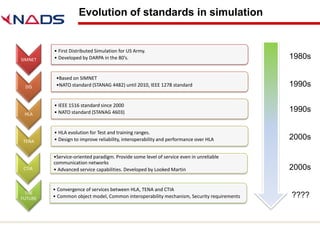
Evolution of standards in simulation


         • First Distributed Simulation for US Army.
SIMNET   • Developed by DARPA in the 80’s.                                                 1980s

          •Based on SIMNET
 DIS      •NATO standard (STANAG 4482) until 2010, IEEE 1278 standard                      1990s

         • IEEE 1516 standard since 2000
 HLA     • NATO standard (STANAG 4603)                                                     1990s

         • HLA evolution for Test and training ranges.
TENA     • Design to improve reliability, interoperability and performance over HLA        2000s

         •Service-oriented paradigm. Provide some level of service even in unreliable
         communication networks
 CTIA    • Advanced service capabilities. Developed by Looked Martin                       2000s

         • Convergence of services between HLA, TENA and CTIA
  THE
FUTURE   • Common object model, Common interoperability mechanism, Security requirements   ????
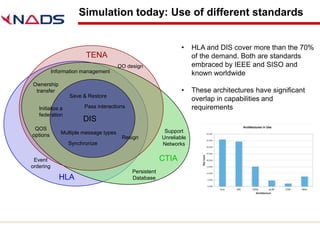
Simulation today: Use of different standards


                                                                 •    HLA and DIS cover more than the 70%
                        TENA                                          of the demand. Both are standards
                                       OO design                      embraced by IEEE and SISO and
           Information management                                     known worldwide
Ownership
 transfer                                                        •    These architectures have significant
                  Save & Restore
                                                                      overlap in capabilities and
   Initialize a         Pass interactions                             requirements
   federation
                       DIS
 QOS                                                      Support
options       Multiple message types
                                        Resign           Unreliable
                  Synchronize                            Networks


 Event                                                   CTIA
ordering
                                            Persistent
              HLA                           Database
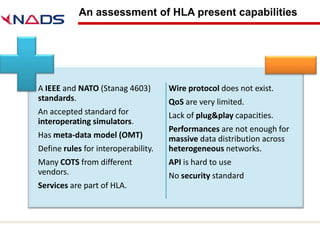
An assessment of HLA present capabilities


A IEEE and NATO (Stanag 4603)        Wire protocol does not exist.
standards.                           QoS are very limited.
An accepted standard for             Lack of plug&play capacities.
interoperating simulators.
                                     Performances are not enough for
Has meta-data model (OMT)            massive data distribution across
Define rules for interoperability.   heterogeneous networks.
Many COTS from different             API is hard to use
vendors.                             No security standard
Services are part of HLA.
OMG DDS: a perfect complement to HLA

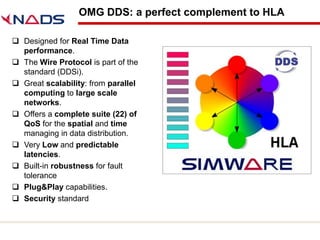
 Designed for Real Time Data
  performance.
 The Wire Protocol is part of the
  standard (DDSi).
 Great scalability: from parallel
  computing to large scale
  networks.
 Offers a complete suite (22) of
  QoS for the spatial and time
  managing in data distribution.
 Very Low and predictable
  latencies.
 Built-in robustness for fault
  tolerance
 Plug&Play capabilities.
 Security standard
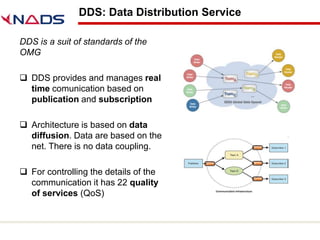
DDS: Data Distribution Service

DDS is a suit of standards of the
OMG

 DDS provides and manages real
  time comunication based on
  publication and subscription

 Architecture is based on data
  diffusion. Data are based on the
  net. There is no data coupling.

 For controlling the details of the
  communication it has 22 quality
  of services (QoS)
The OMG Data Distribution Service (DDS)


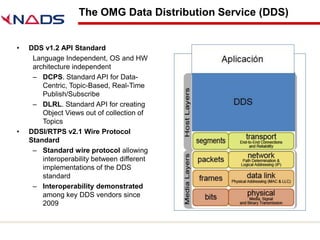
•   DDS v1.2 API Standard
     Language Independent, OS and HW
     architecture independent
     – DCPS. Standard API for Data-
        Centric, Topic-Based, Real-Time
        Publish/Subscribe
     – DLRL. Standard API for creating
        Object Views out of collection of
        Topics
•   DDSI/RTPS v2.1 Wire Protocol
    Standard
     – Standard wire protocol allowing
        interoperability between different
        implementations of the DDS
        standard
     – Interoperability demonstrated
        among key DDS vendors since
        2009
Global data space


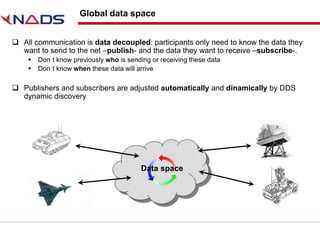
 All communication is data decoupled: participants only need to know the data they
  want to send to the net –publish- and the data they want to receive –subscribe-.
       Don t know previously who is sending or receiving these data
       Don t know when these data will arrive

 Publishers and subscribers are adjusted automatically and dinamically by DDS
  dynamic discovery


                                         Data space
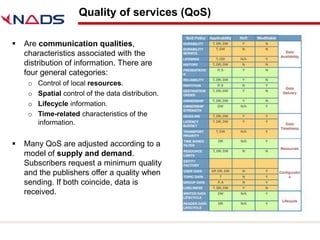
Quality of services (QoS)

   Are communication qualities,
    characteristics associated with the
    distribution of information. There are
    four general categories:
     o   Control of local resources.
     o   Spatial control of the data distribution.
     o   Lifecycle information.
     o   Time-related characteristics of the
         information.


   Many QoS are adjusted according to a
    model of supply and demand.
    Subscribers request a minimum quality
    and the publishers offer a quality when
    sending. If both coincide, data is
    received.
HLA and DDS; DDS and HLA: the odd couple?


 SimWare has put together the
  simulation stardard –HLA- plus the
  best communication in real time –DDS-

 The result is called SimWare HLA RTI
SimWare RTI : The first RTI to join DDS with HLA RTI


 HLA Run Time Infrastructure designed for real
  time performance in large federations
 IEEE 1516 HLA API for virtual and live
  simulations
 Use DDS for Data Distribution  functionality
  of an HLA RTI with the
  features, performance, power and reliability of
  OMG DDS standard
 No gateways needed to connect HLA to DDS.
 Full HLA services support as required in virtual
  & live simulations :
     federation management
     declaration management
     object management
     ownership management
NEXTEL AEROSPACE DEFENCE & SECURITY S.L.
Avenida de Manoteras, 18
28050 Madrid – Spain
+34 91 803 38 02
www.nads.es

HLA over DDS

  • 1.
    SimWare HLA RTI:the next frontier
  • 2.
    Evolution of standardsin simulation • First Distributed Simulation for US Army. SIMNET • Developed by DARPA in the 80’s. 1980s •Based on SIMNET DIS •NATO standard (STANAG 4482) until 2010, IEEE 1278 standard 1990s • IEEE 1516 standard since 2000 HLA • NATO standard (STANAG 4603) 1990s • HLA evolution for Test and training ranges. TENA • Design to improve reliability, interoperability and performance over HLA 2000s •Service-oriented paradigm. Provide some level of service even in unreliable communication networks CTIA • Advanced service capabilities. Developed by Looked Martin 2000s • Convergence of services between HLA, TENA and CTIA THE FUTURE • Common object model, Common interoperability mechanism, Security requirements ????
  • 3.
    Simulation today: Useof different standards • HLA and DIS cover more than the 70% TENA of the demand. Both are standards OO design embraced by IEEE and SISO and Information management known worldwide Ownership transfer • These architectures have significant Save & Restore overlap in capabilities and Initialize a Pass interactions requirements federation DIS QOS Support options Multiple message types Resign Unreliable Synchronize Networks Event CTIA ordering Persistent HLA Database
  • 4.
    An assessment ofHLA present capabilities A IEEE and NATO (Stanag 4603) Wire protocol does not exist. standards. QoS are very limited. An accepted standard for Lack of plug&play capacities. interoperating simulators. Performances are not enough for Has meta-data model (OMT) massive data distribution across Define rules for interoperability. heterogeneous networks. Many COTS from different API is hard to use vendors. No security standard Services are part of HLA.
  • 5.
    OMG DDS: aperfect complement to HLA  Designed for Real Time Data performance.  The Wire Protocol is part of the standard (DDSi).  Great scalability: from parallel computing to large scale networks.  Offers a complete suite (22) of QoS for the spatial and time managing in data distribution.  Very Low and predictable latencies.  Built-in robustness for fault tolerance  Plug&Play capabilities.  Security standard
  • 6.
    DDS: Data DistributionService DDS is a suit of standards of the OMG  DDS provides and manages real time comunication based on publication and subscription  Architecture is based on data diffusion. Data are based on the net. There is no data coupling.  For controlling the details of the communication it has 22 quality of services (QoS)
  • 7.
    The OMG DataDistribution Service (DDS) • DDS v1.2 API Standard Language Independent, OS and HW architecture independent – DCPS. Standard API for Data- Centric, Topic-Based, Real-Time Publish/Subscribe – DLRL. Standard API for creating Object Views out of collection of Topics • DDSI/RTPS v2.1 Wire Protocol Standard – Standard wire protocol allowing interoperability between different implementations of the DDS standard – Interoperability demonstrated among key DDS vendors since 2009
  • 8.
    Global data space All communication is data decoupled: participants only need to know the data they want to send to the net –publish- and the data they want to receive –subscribe-.  Don t know previously who is sending or receiving these data  Don t know when these data will arrive  Publishers and subscribers are adjusted automatically and dinamically by DDS dynamic discovery Data space
  • 9.
    Quality of services(QoS)  Are communication qualities, characteristics associated with the distribution of information. There are four general categories: o Control of local resources. o Spatial control of the data distribution. o Lifecycle information. o Time-related characteristics of the information.  Many QoS are adjusted according to a model of supply and demand. Subscribers request a minimum quality and the publishers offer a quality when sending. If both coincide, data is received.
  • 10.
    HLA and DDS;DDS and HLA: the odd couple?  SimWare has put together the simulation stardard –HLA- plus the best communication in real time –DDS-  The result is called SimWare HLA RTI
  • 11.
    SimWare RTI :The first RTI to join DDS with HLA RTI  HLA Run Time Infrastructure designed for real time performance in large federations  IEEE 1516 HLA API for virtual and live simulations  Use DDS for Data Distribution  functionality of an HLA RTI with the features, performance, power and reliability of OMG DDS standard  No gateways needed to connect HLA to DDS.  Full HLA services support as required in virtual & live simulations :  federation management  declaration management  object management  ownership management
  • 12.
    NEXTEL AEROSPACE DEFENCE& SECURITY S.L. Avenida de Manoteras, 18 28050 Madrid – Spain +34 91 803 38 02 www.nads.es