How the Fusion of Time-Sensitive Networking
and Data Centricity Can Change Industrial Control
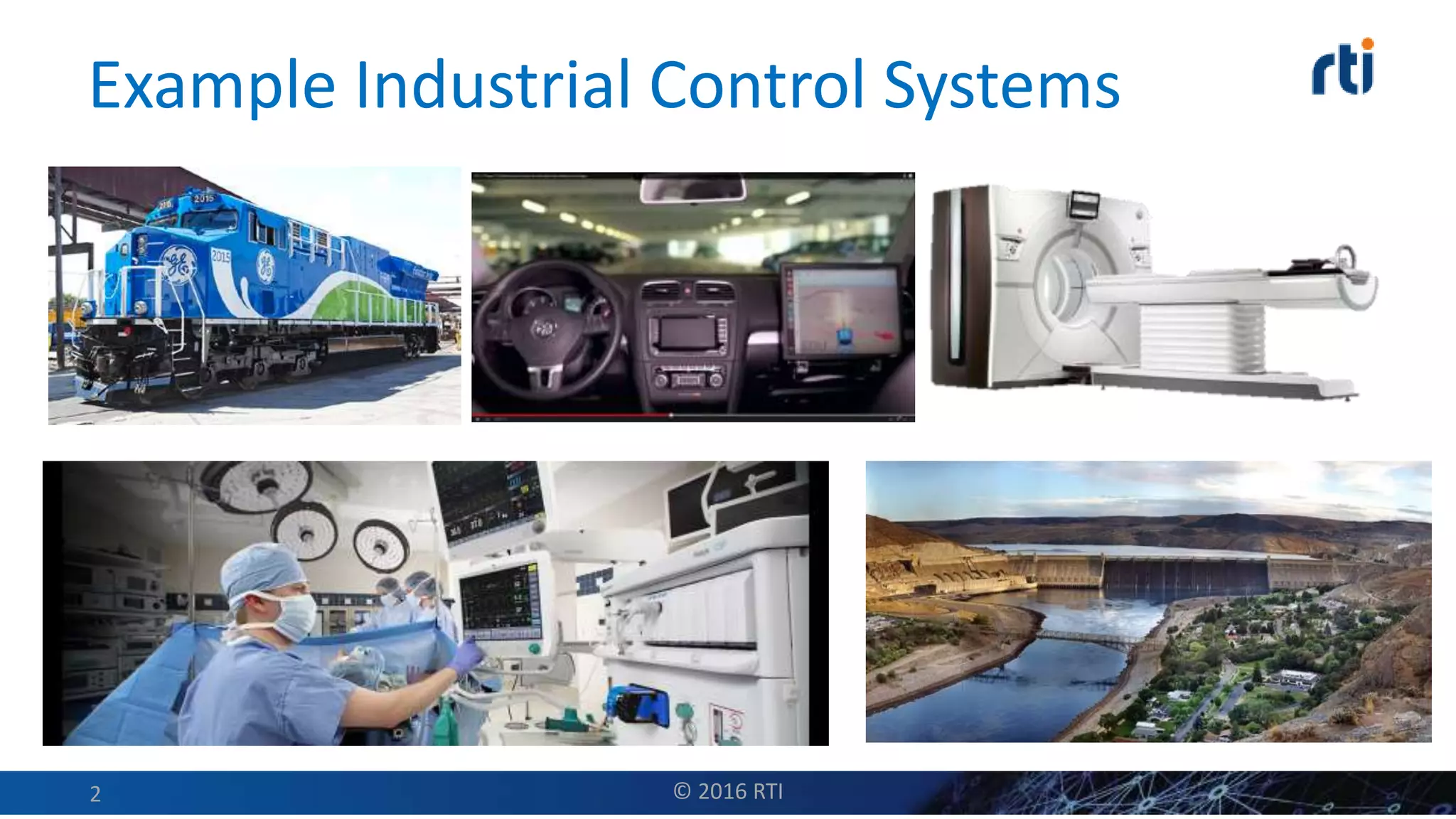
Example Industrial Control Systems
© 2016 RTI2
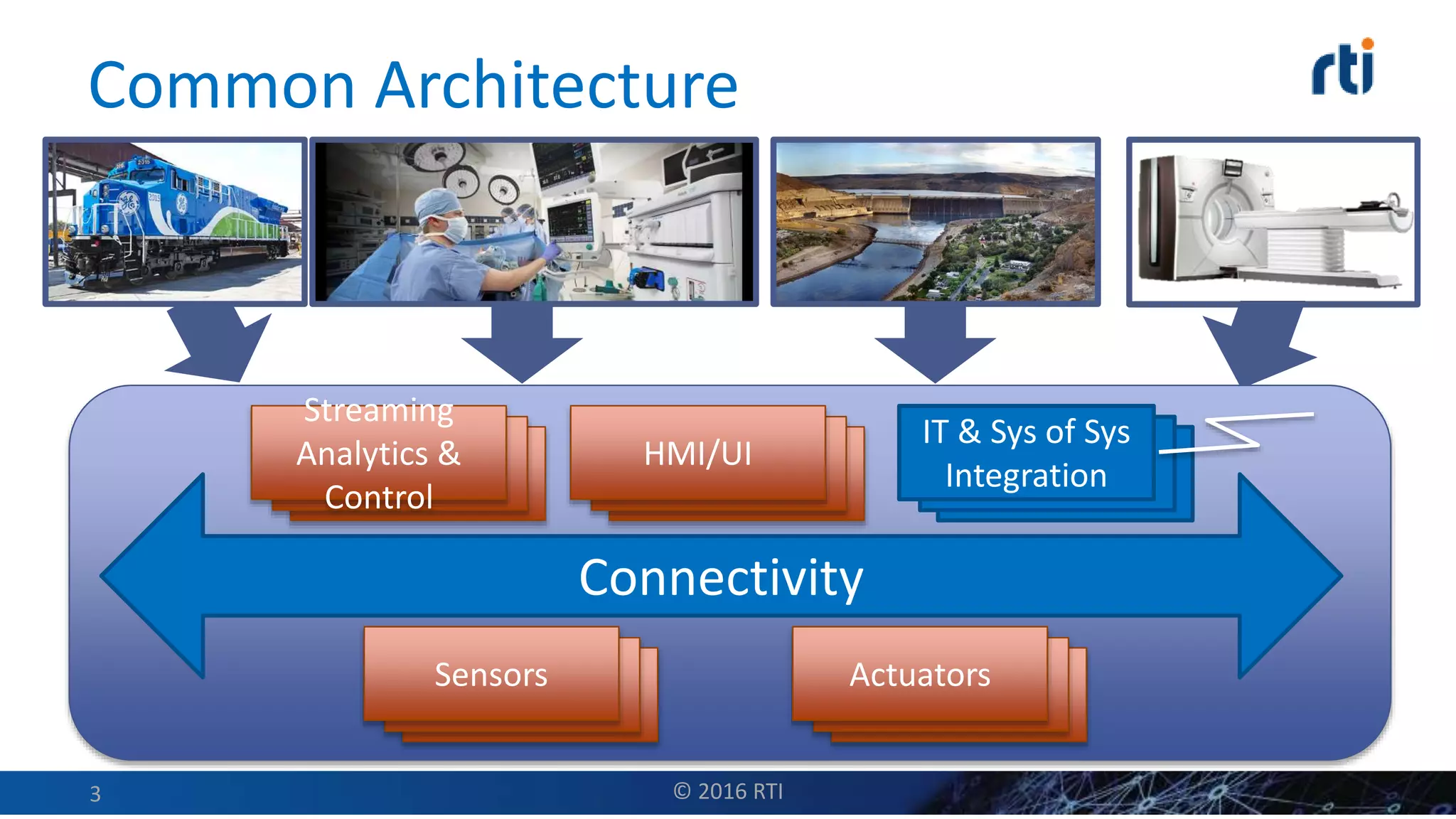
Common Architecture
Connectivity
Sensors Actuators
Streaming
Analytics &
Control
HMI/UI
IT & Sys of Sys
Integration
© 2016 RTI3
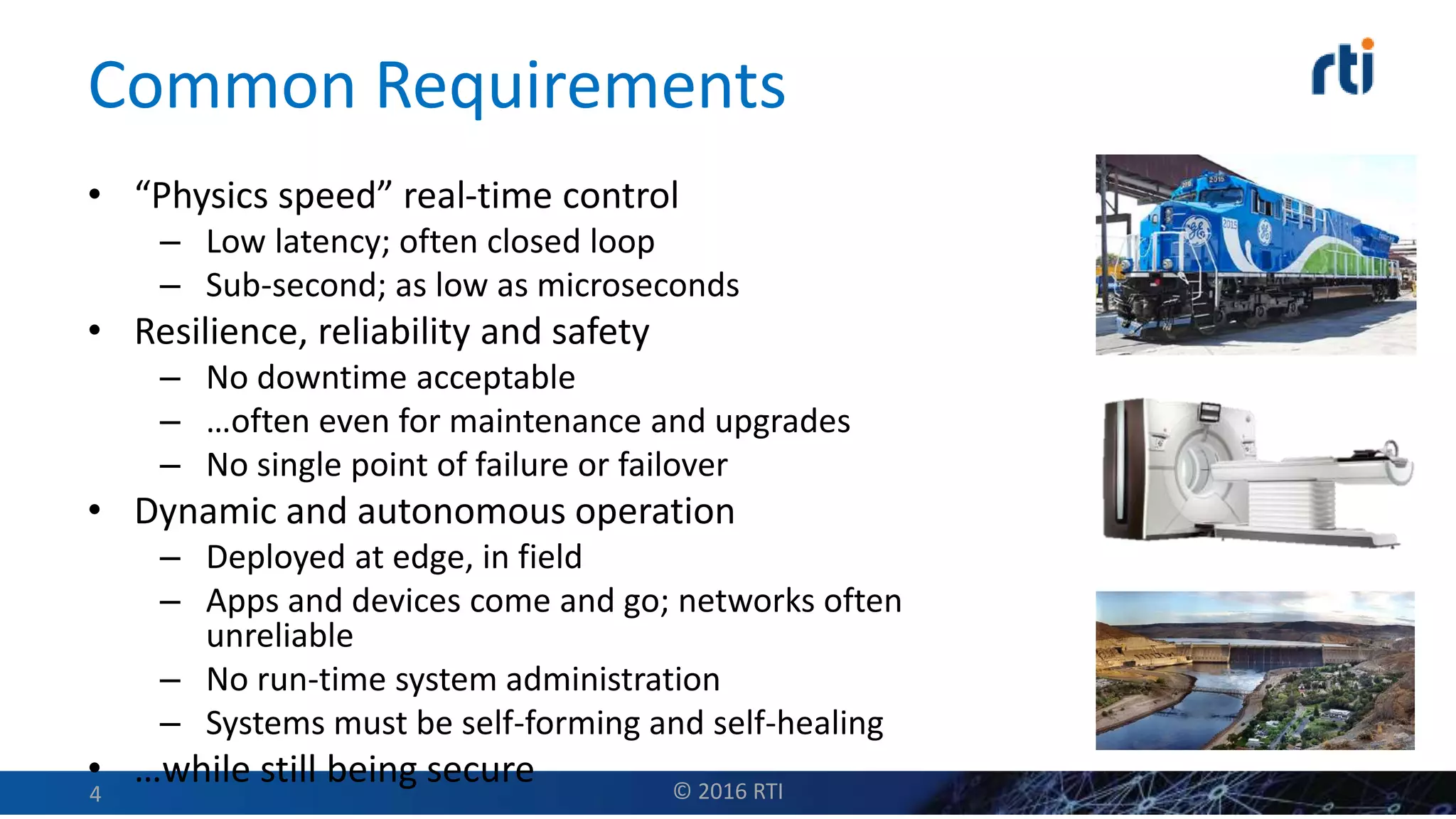
Common Requirements
• “Physics speed” real-time control
– Low latency; often closed loop
– Sub-second; as low as microseconds
• Resilience, reliability and safety
– No downtime acceptable
– …often even for maintenance and upgrades
– No single point of failure or failover
• Dynamic and autonomous operation
– Deployed at edge, in field
– Apps and devices come and go; networks often
unreliable
– No run-time system administration
– Systems must be self-forming and self-healing
• …while still being secure © 2016 RTI4
Traditional Connectivity Approach
• Field busses for low-level communications
• Programmable Logic Controllers (PLCs) for
real-time control
• Custom application APIs
© 2016 RTI5
Challenges
• Expensive, special purpose hardware
– Fragmented ecosystems
• Difficult and expense integration
– Large teams
– Supply chains
– Ecosystems
• Poor data sharing
– Hard to capitalize on IIoT, apps not anticipated at
initial development
© 2016 RTI6
Solution: DDS + TSN
• Data Distribution Service (DDS)
– Standard API, semantics and interoperability
protocol
– Enables loose coupling, plug-and-play integration
• Time-Sensitive Networking (TSN)
– Real-time and isochronous communication over
Ethernet
– Leverages commodity hardware
© 2016 RTI7
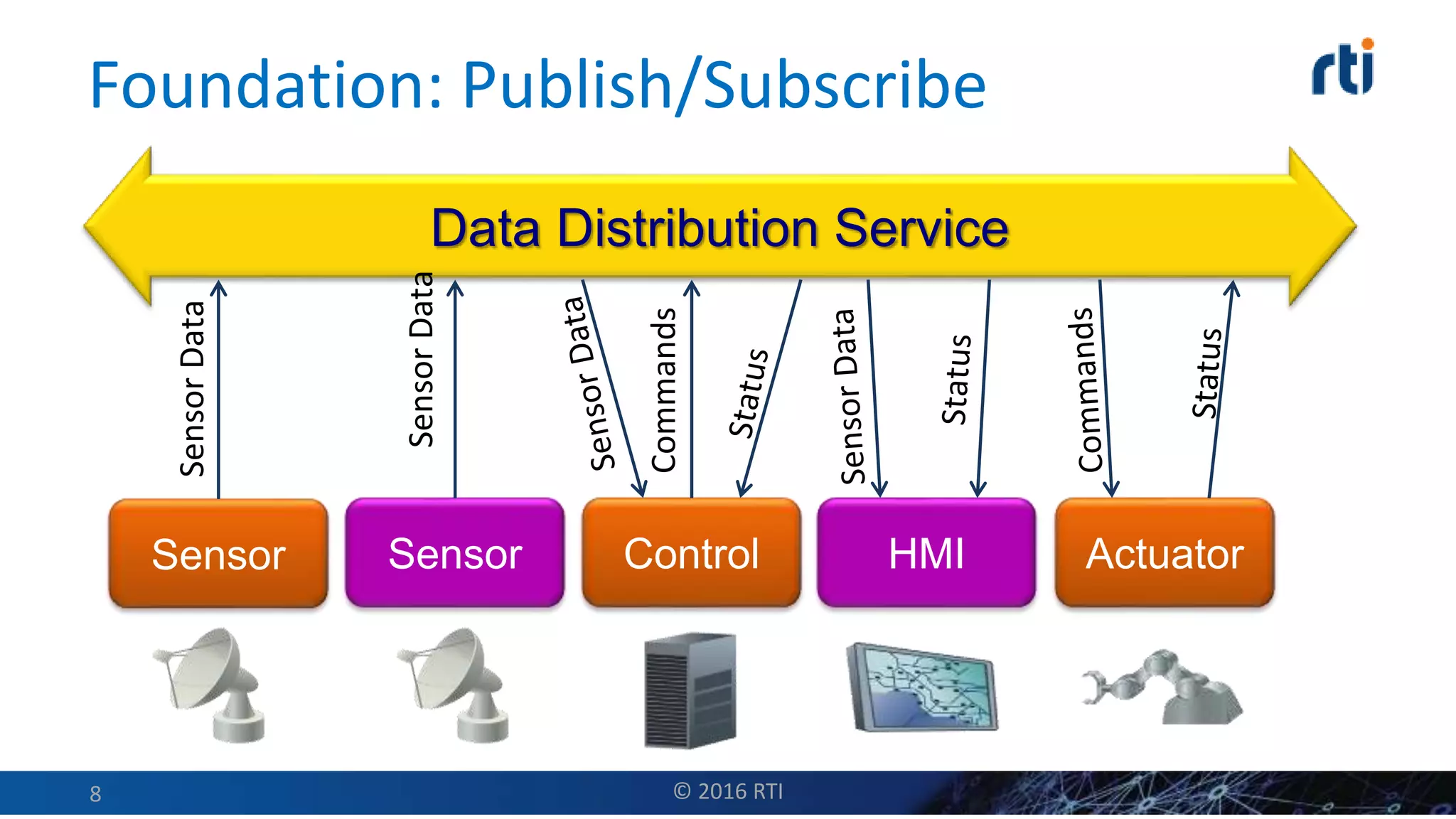
Foundation: Publish/Subscribe
Data Distribution Service
Control
Commands
Sensor
SensorData
ActuatorSensor
SensorData
HMI
© 2016 RTI8
Data-Centric Publish/Subscribe
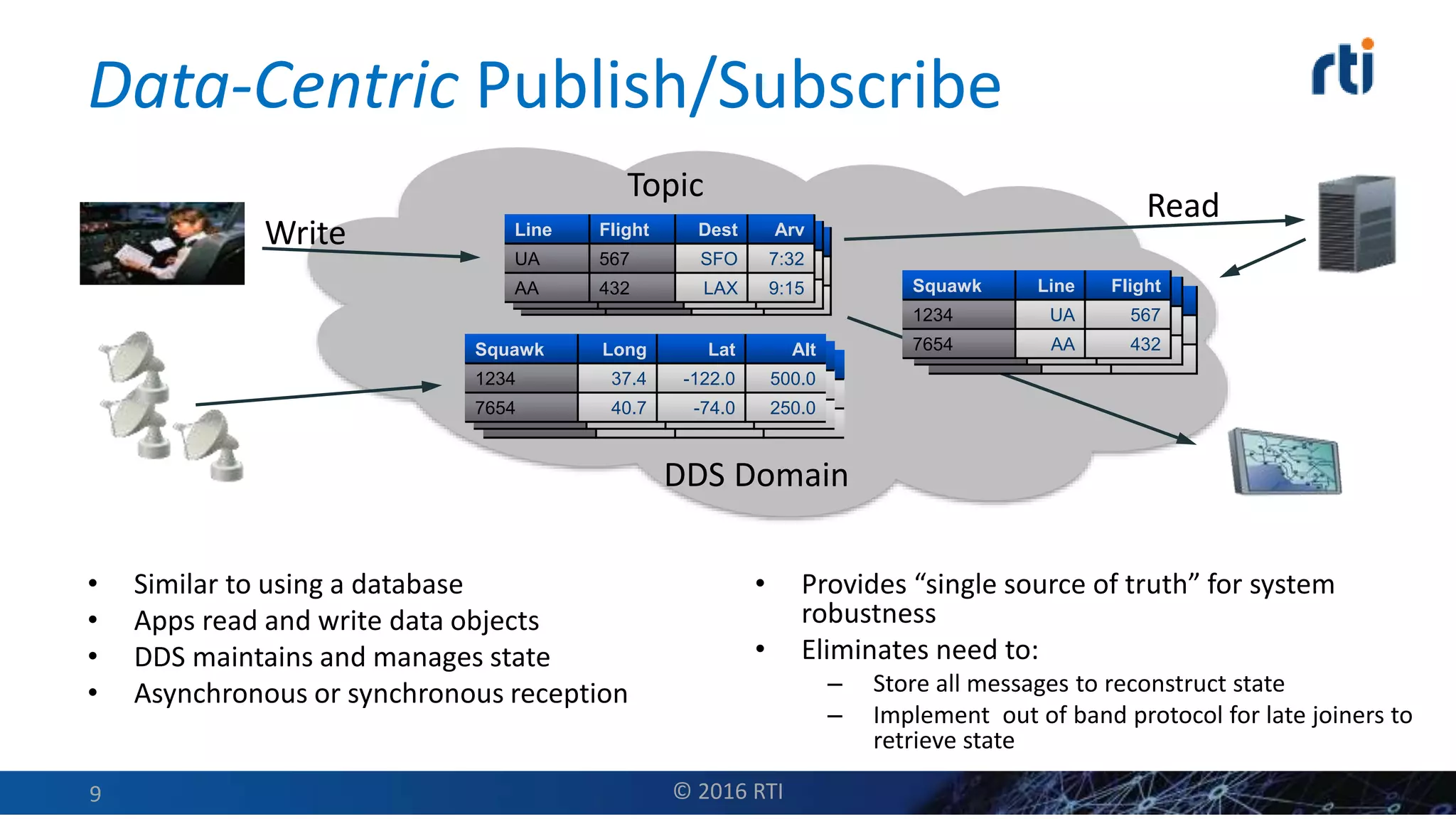
• Similar to using a database
• Apps read and write data objects
• DDS maintains and manages state
• Asynchronous or synchronous reception
• Provides “single source of truth” for system
robustness
• Eliminates need to:
– Store all messages to reconstruct state
– Implement out of band protocol for late joiners to
retrieve state
Write
Read
DDS Domain
Line Flight Dest Arv
UA 567 SFO 7:32
AA 432 LAX 9:15
Squawk Long Lat Alt
1234 37.4 -122.0 500.0
7654 40.7 -74.0 250.0
Squawk Line Flight
1234 UA 567
7654 AA 432
Topic
© 2016 RTI9
Real-Time Quality of Service
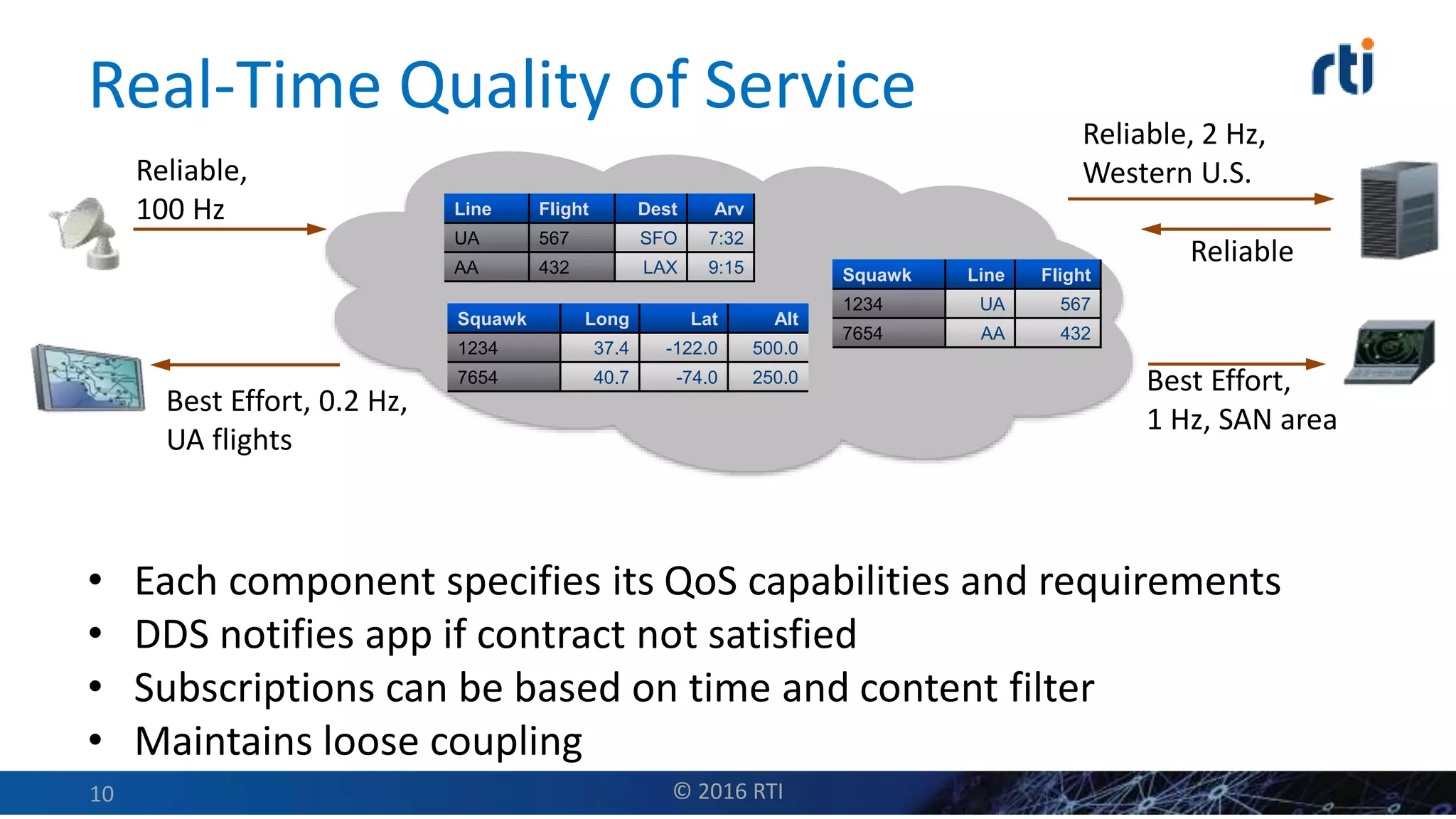
• Each component specifies its QoS capabilities and requirements
• DDS notifies app if contract not satisfied
• Subscriptions can be based on time and content filter
• Maintains loose coupling
Squawk Long Lat Alt
1234 37.4 -122.0 500.0
7654 40.7 -74.0 250.0
Line Flight Dest Arv
UA 567 SFO 7:32
AA 432 LAX 9:15 Squawk Line Flight
1234 UA 567
7654 AA 432
Reliable,
100 Hz
Reliable, 2 Hz,
Western U.S.
Reliable
Best Effort,
1 Hz, SAN area
Best Effort, 0.2 Hz,
UA flights
© 2016 RTI10
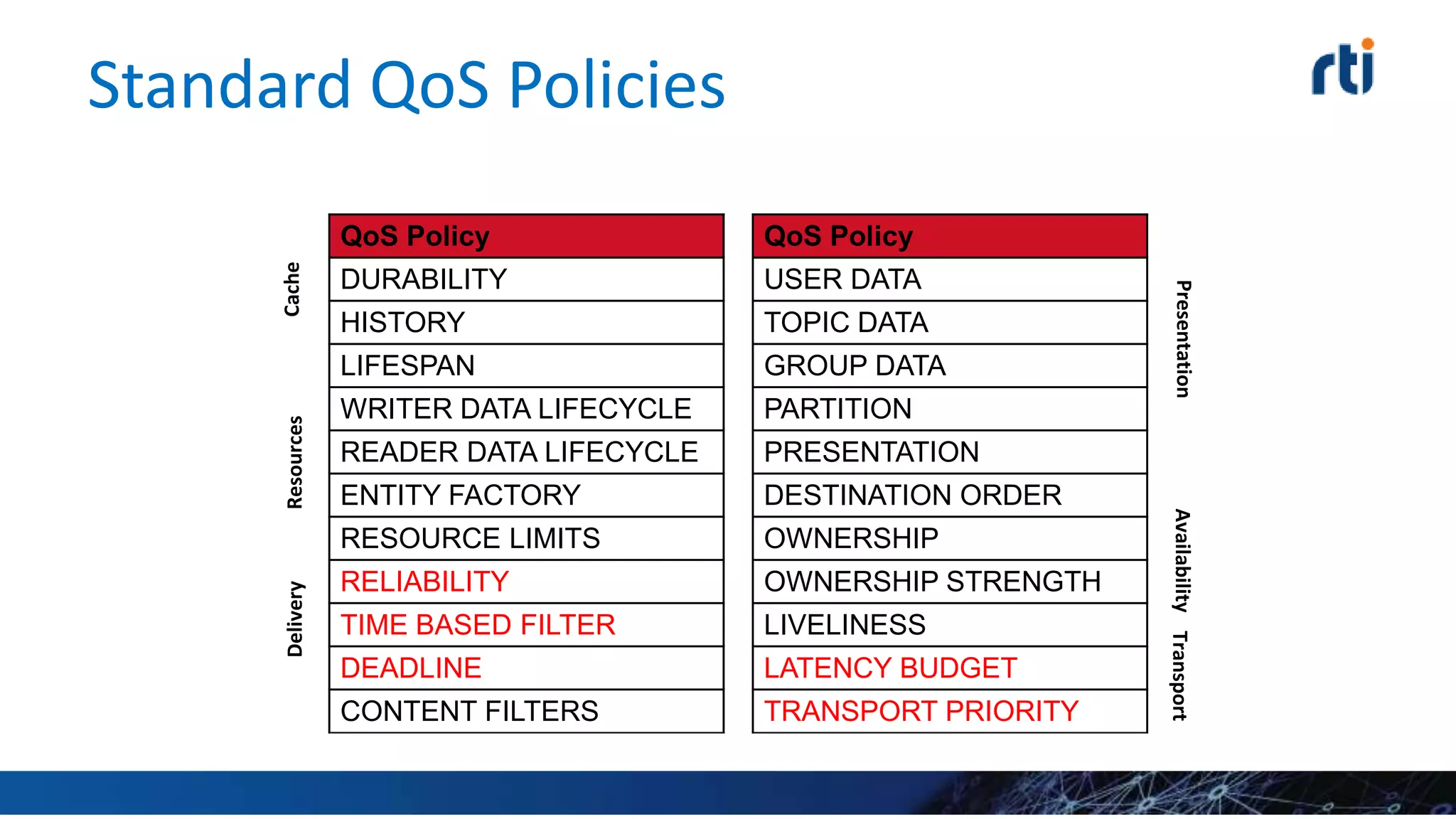
Standard QoS Policies
QoS Policy
DURABILITY
HISTORY
LIFESPAN
WRITER DATA LIFECYCLE
READER DATA LIFECYCLE
ENTITY FACTORY
RESOURCE LIMITS
RELIABILITY
TIME BASED FILTER
DEADLINE
CONTENT FILTERS
CacheDelivery
PresentationAvailability
Resources
Transport
QoS Policy
USER DATA
TOPIC DATA
GROUP DATA
PARTITION
PRESENTATION
DESTINATION ORDER
OWNERSHIP
OWNERSHIP STRENGTH
LIVELINESS
LATENCY BUDGET
TRANSPORT PRIORITY
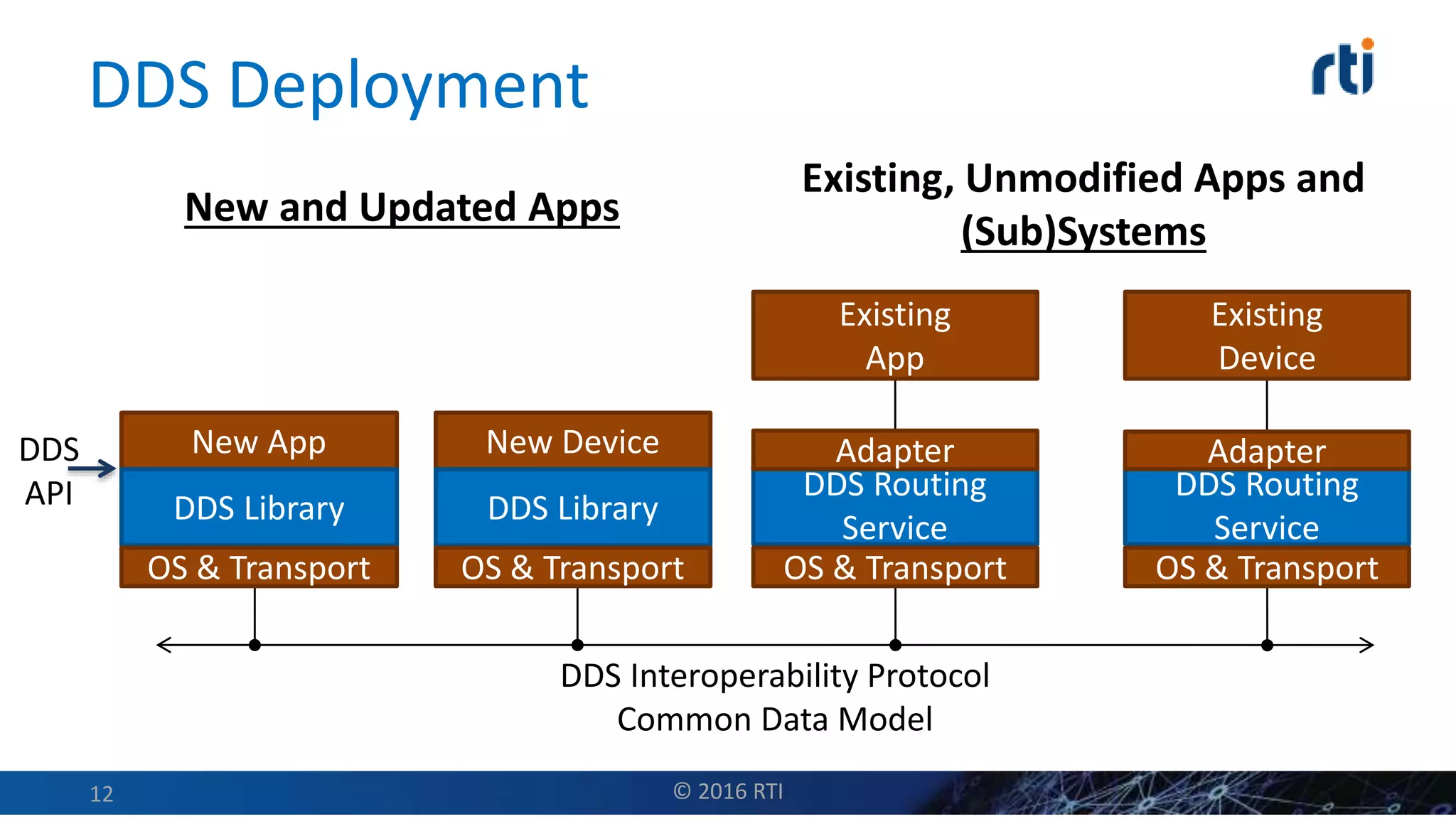
DDS Deployment
New and Updated Apps
Existing, Unmodified Apps and
(Sub)Systems
DDS Interoperability Protocol
Common Data Model
New App
DDS Library
New Device
DDS Library
OS & Transport OS & Transport
Existing
App
DDS Routing
Service
Adapter
Existing
Device
DDS Routing
Service
Adapter
OS & Transport OS & Transport
DDS
API
© 2016 RTI12
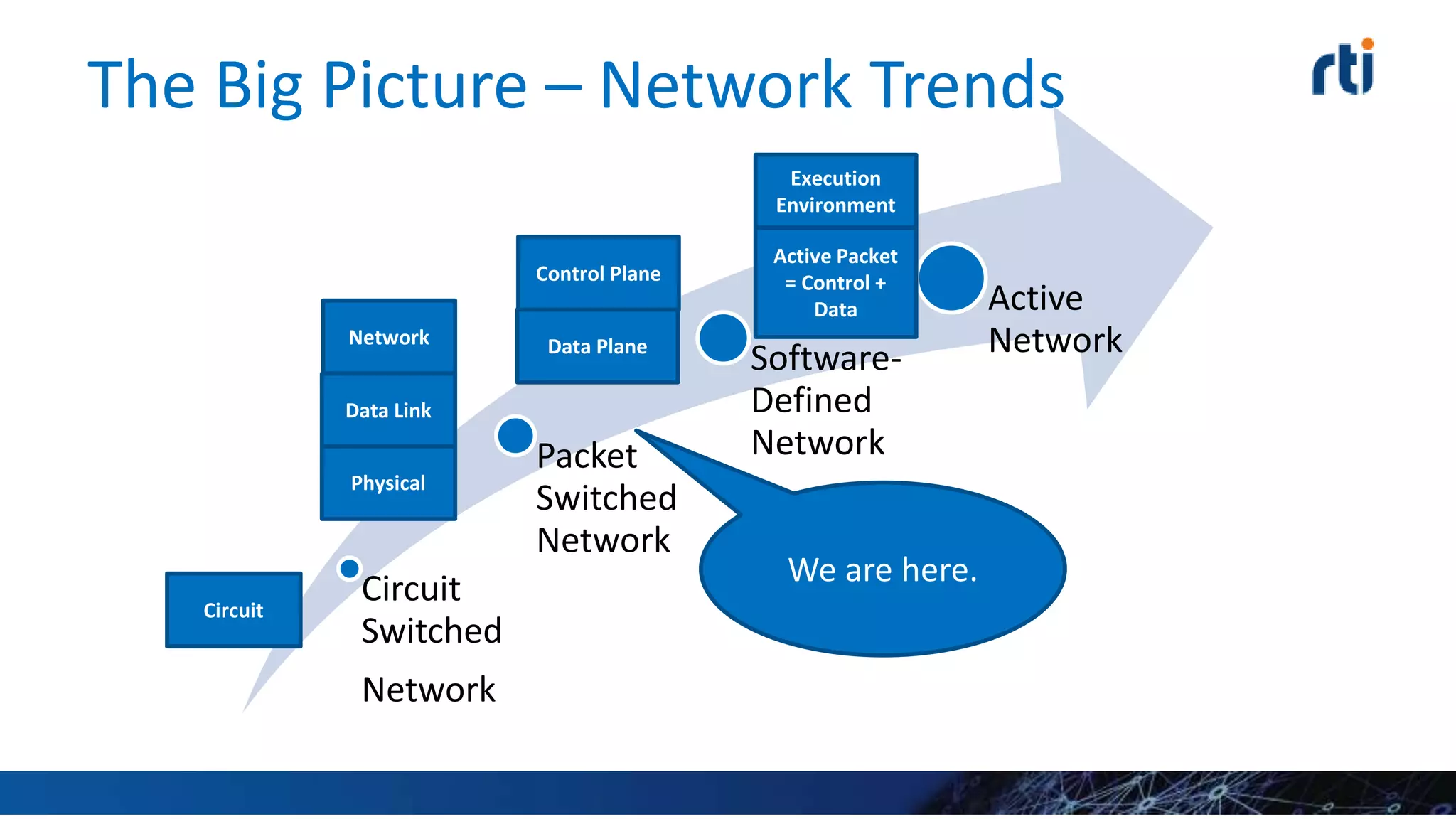
The Big Picture – Network Trends
Circuit
Switched
Network
Packet
Switched
Network
Software-
Defined
Network
Active
Network
Circuit
Physical
Data Link
Network
Active Packet
= Control +
Data
Execution
Environment
Data Plane
Control Plane
We are here.
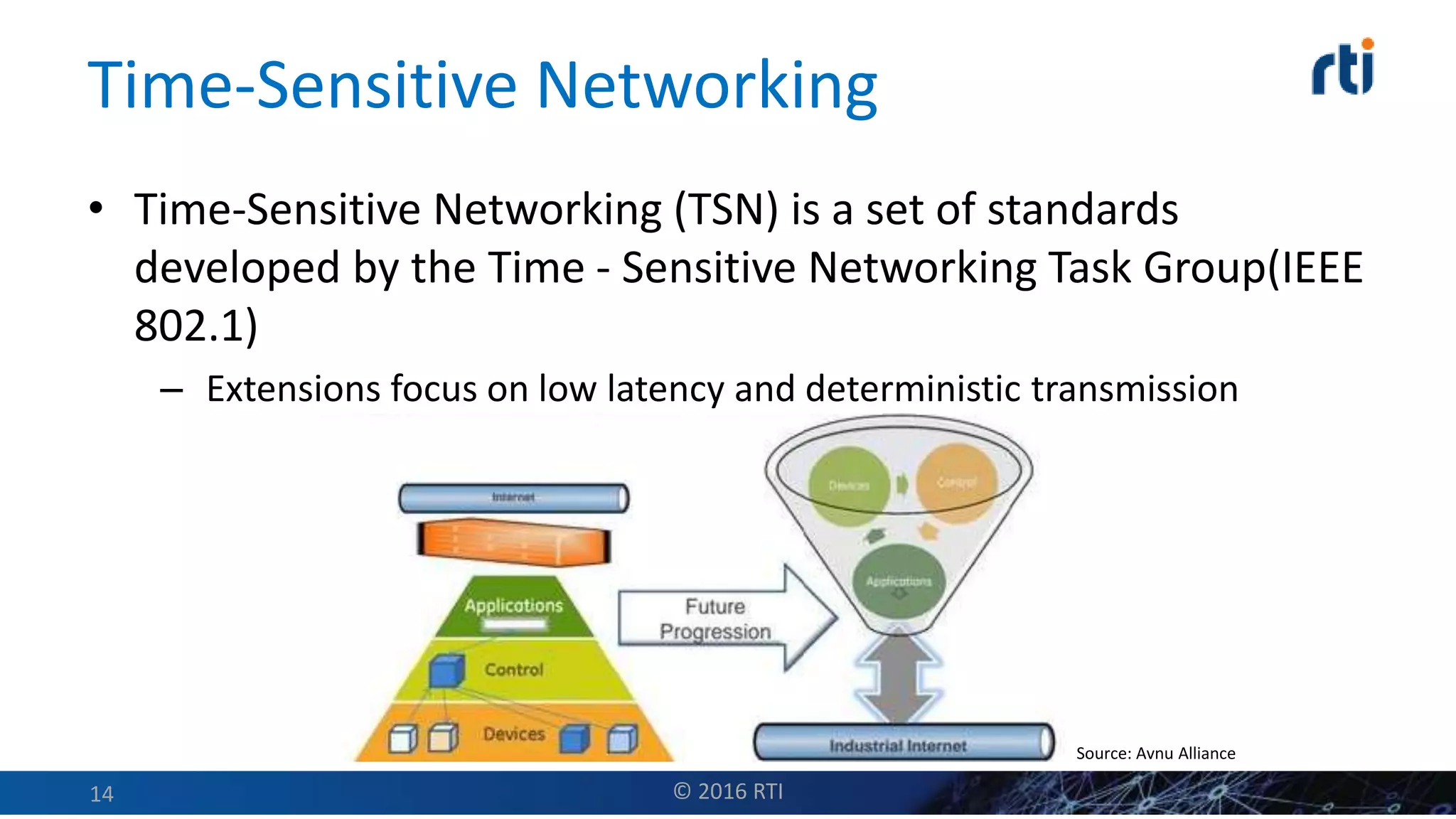
Time-Sensitive Networking
• Time-Sensitive Networking (TSN) is a set of standards
developed by the Time - Sensitive Networking Task Group(IEEE
802.1)
– Extensions focus on low latency and deterministic transmission
© 2016 RTI14
Source: Avnu Alliance
TTE
1588
1588
Eth
TTE
TTE
Eth
TTE
TTE
TTE
TTE
TTE
TTE
Eth
IN 1
Send at 6:00
and 12:00
Forward at 7:00
and 1:00IN 1
IN 1
Forward at 8:00
and 2:00
IN 1
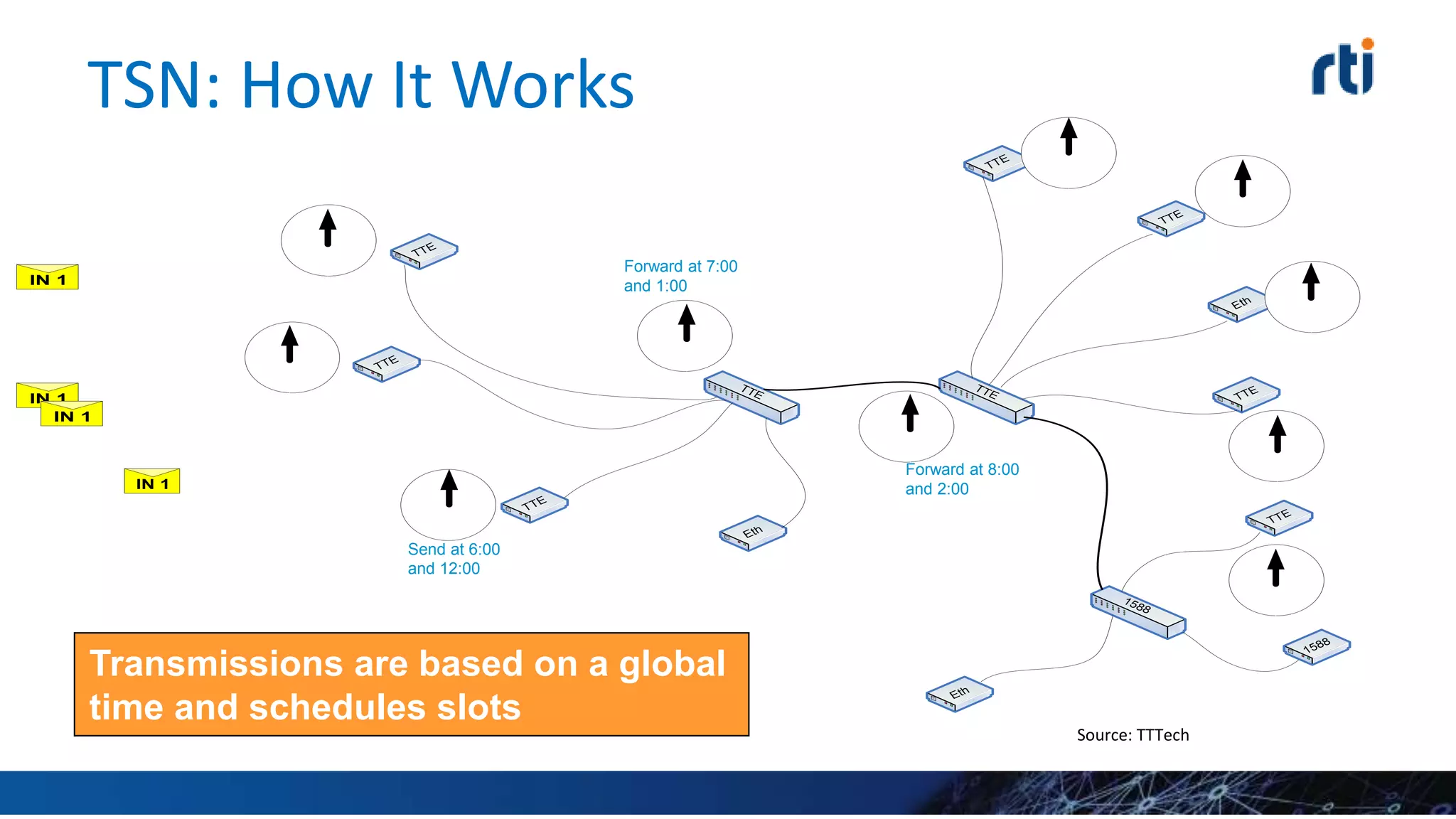
Transmissions are based on a global
time and schedules slots
TSN: How It Works
Source: TTTech
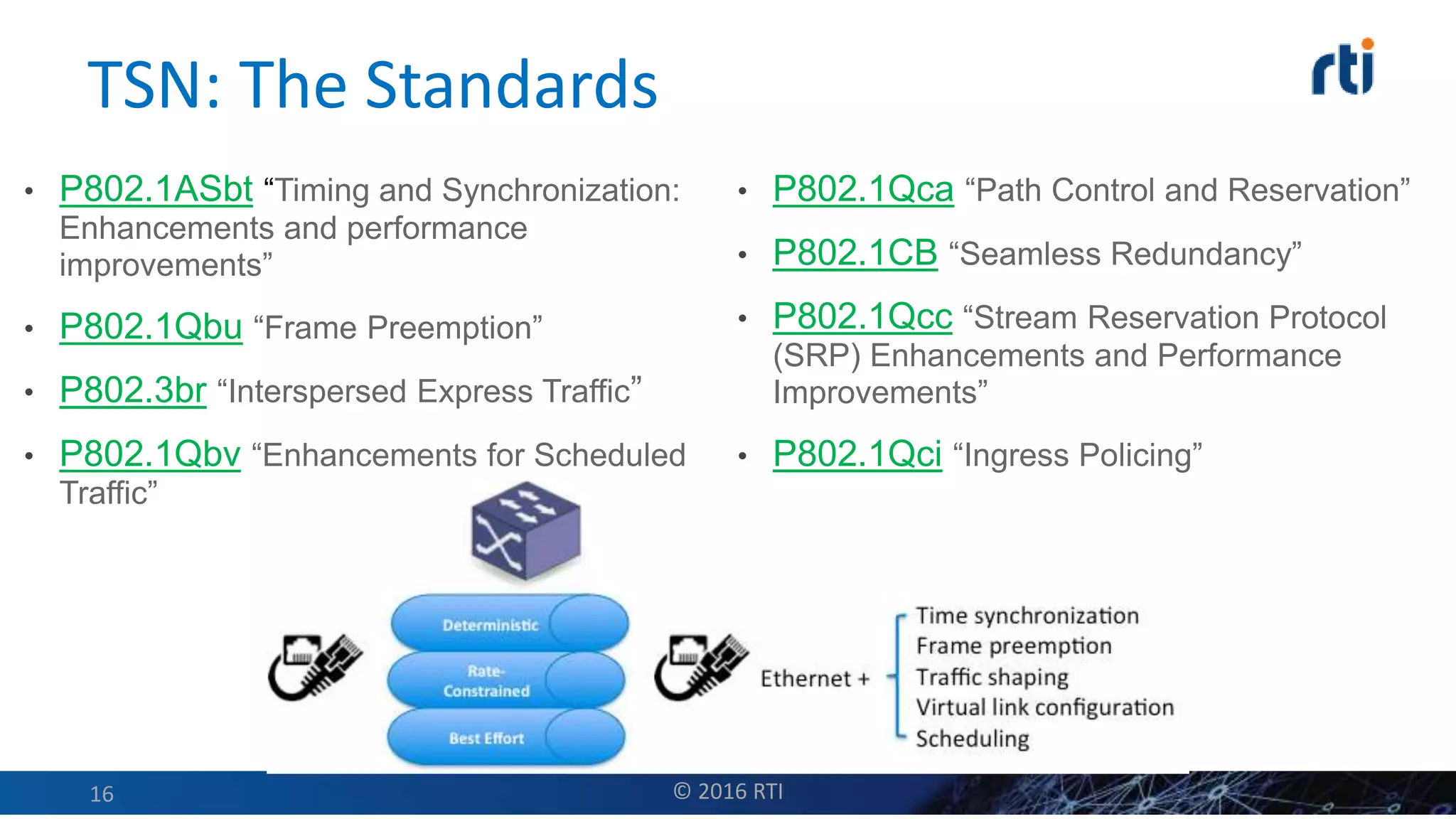
TSN: The Standards
© 2016 RTI16
• P802.1ASbt “Timing and Synchronization:
Enhancements and performance
improvements”
• P802.1Qbu “Frame Preemption”
• P802.3br “Interspersed Express Traffic”
• P802.1Qbv “Enhancements for Scheduled
Traffic”
• P802.1Qca “Path Control and Reservation”
• P802.1CB “Seamless Redundancy”
• P802.1Qcc “Stream Reservation Protocol
(SRP) Enhancements and Performance
Improvements”
• P802.1Qci “Ingress Policing”
TSN: The Standards (cont’d)
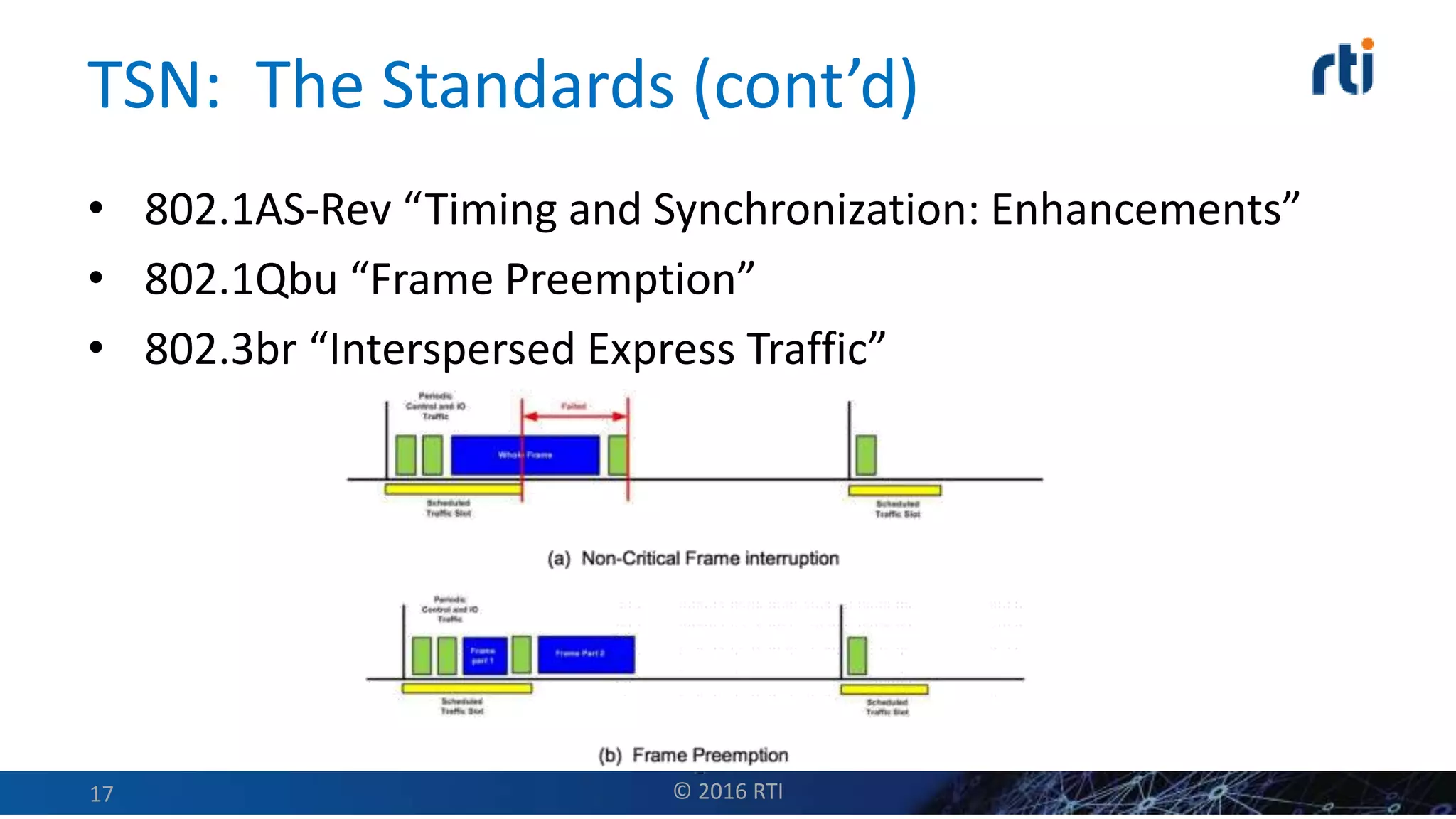
• 802.1AS-Rev “Timing and Synchronization: Enhancements”
• 802.1Qbu “Frame Preemption”
• 802.3br “Interspersed Express Traffic”
© 2016 RTI17
TSN: The Standards (cont’d)
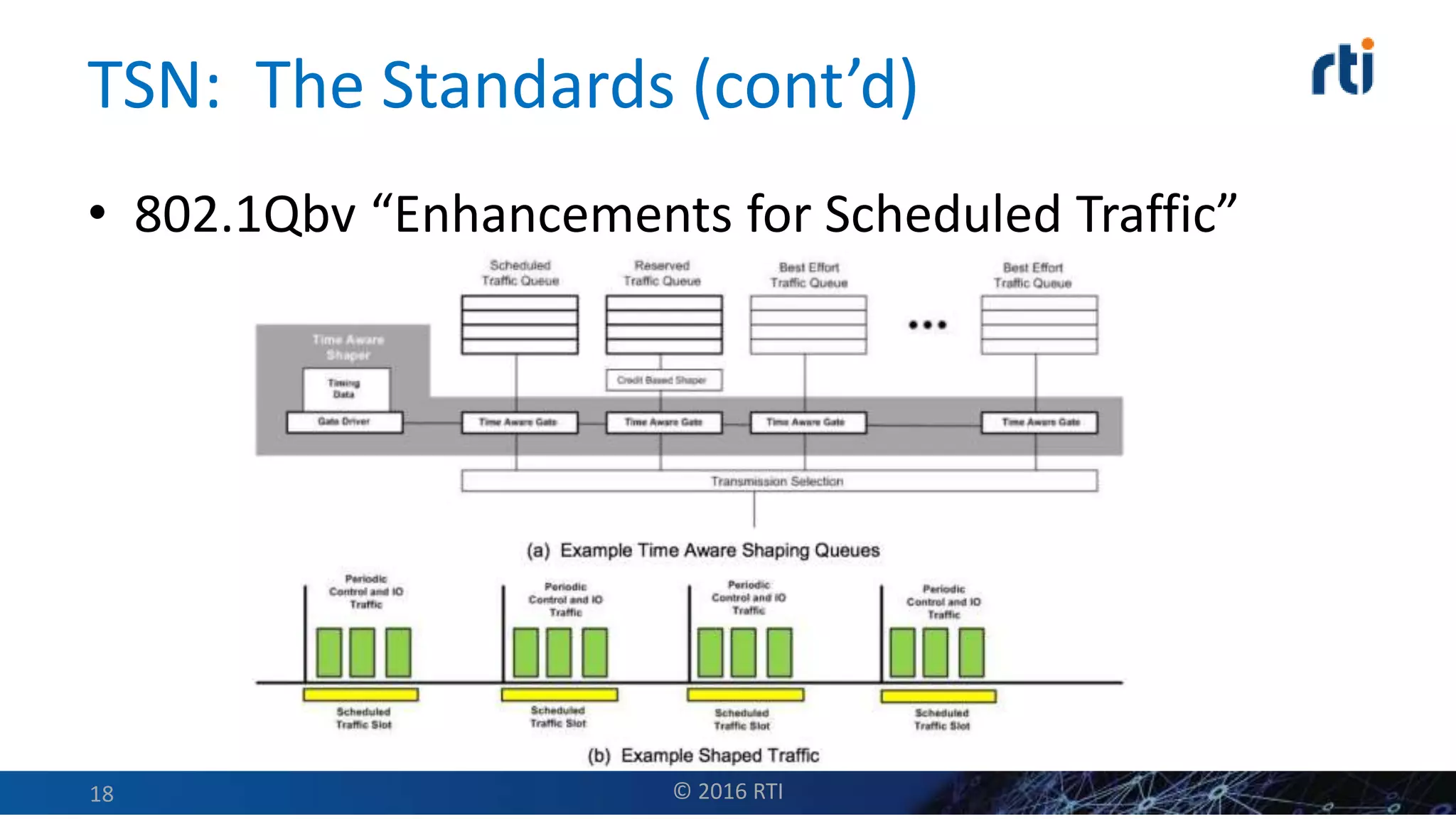
• 802.1Qbv “Enhancements for Scheduled Traffic”
© 2016 RTI18
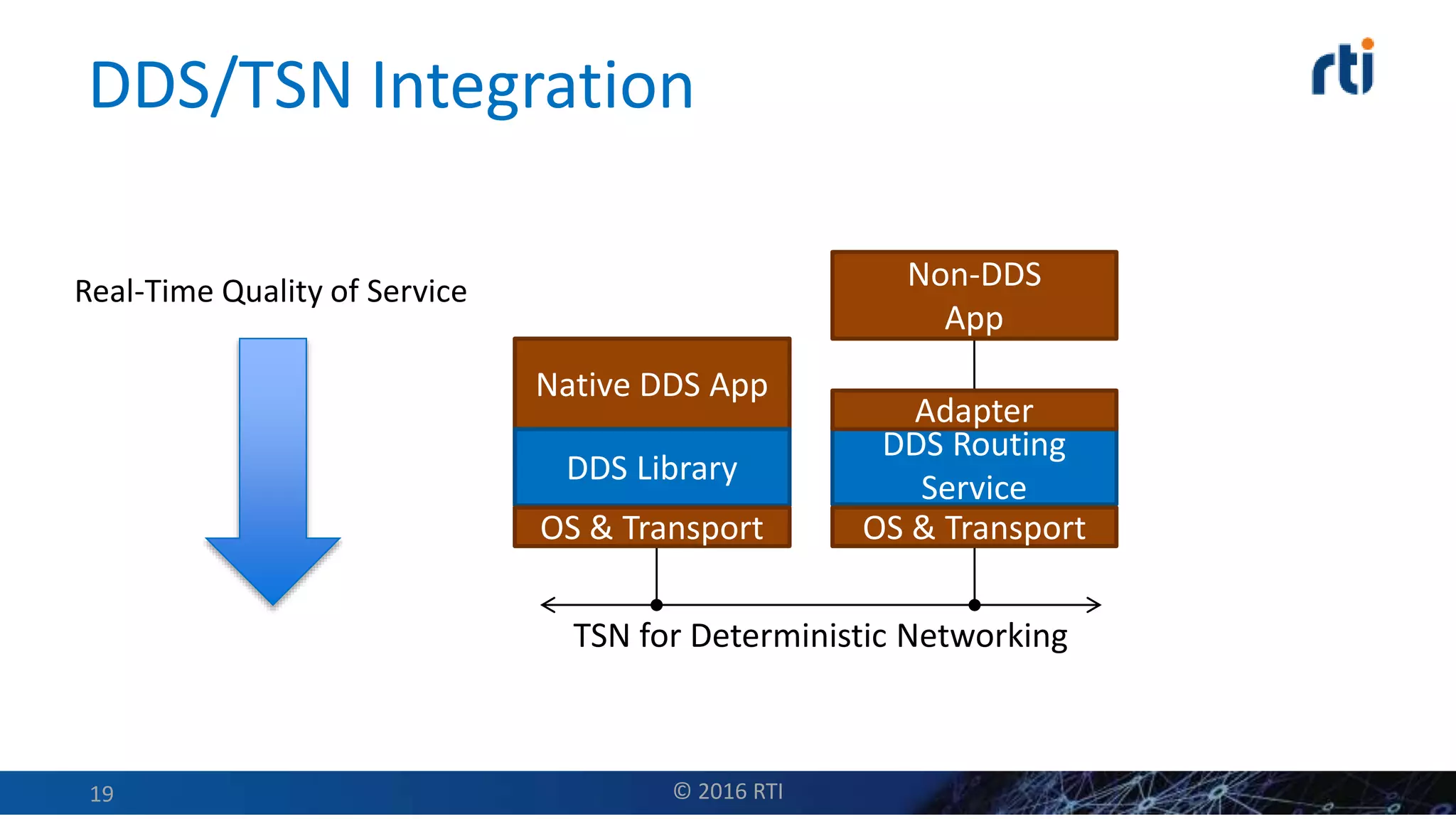
DDS/TSN Integration
TSN for Deterministic Networking
Native DDS App
DDS Library
OS & Transport
Non-DDS
App
DDS Routing
Service
Adapter
OS & Transport
© 2016 RTI19
Real-Time Quality of Service
DDS/TSN Integration QoS
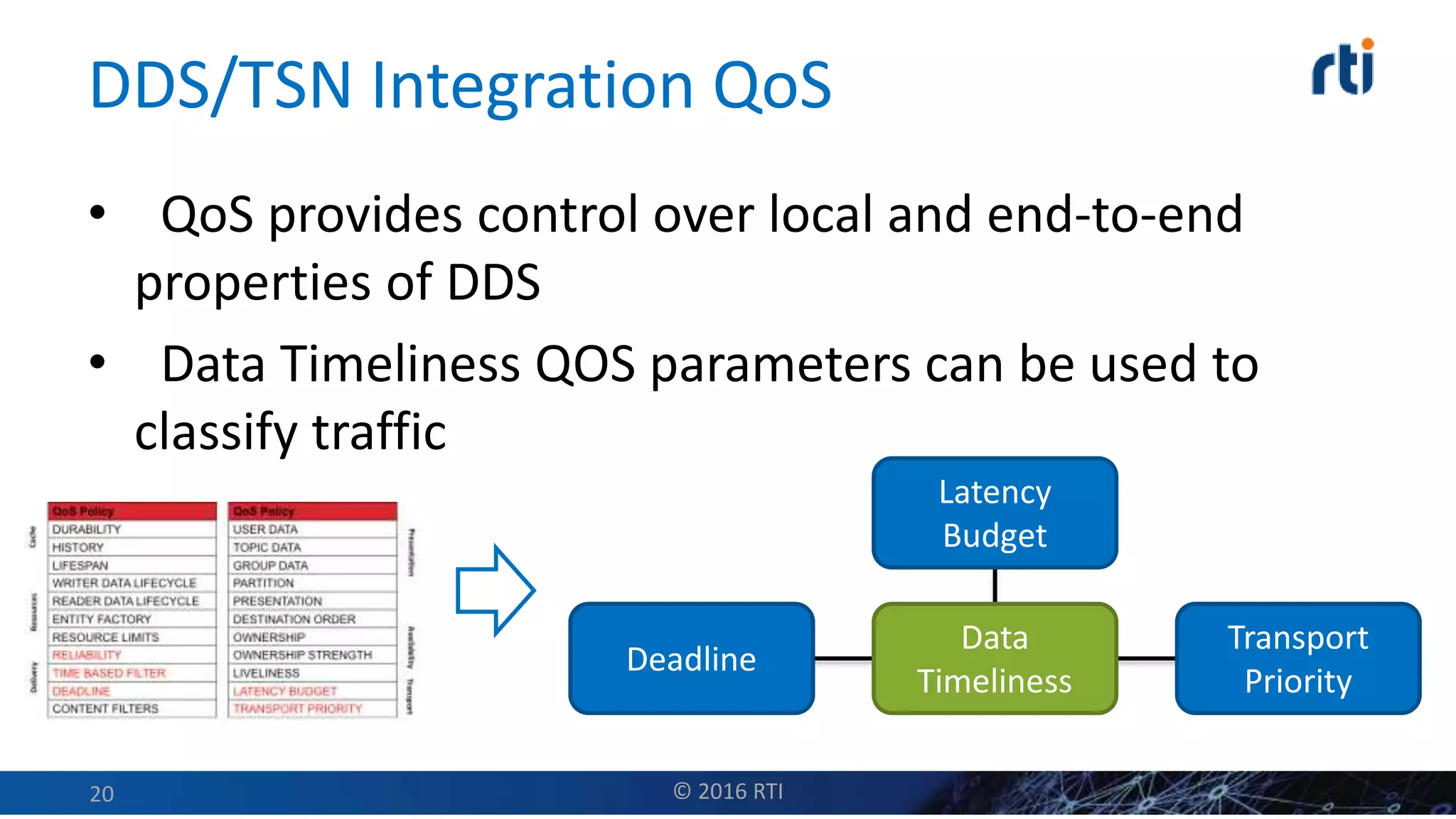
• QoS provides control over local and end-to-end
properties of DDS
• Data Timeliness QOS parameters can be used to
classify traffic
© 2016 RTI20
Latency
Budget
Deadline
Transport
Priority
Data
Timeliness
DDS/TSN Integration QoS (cont’d)
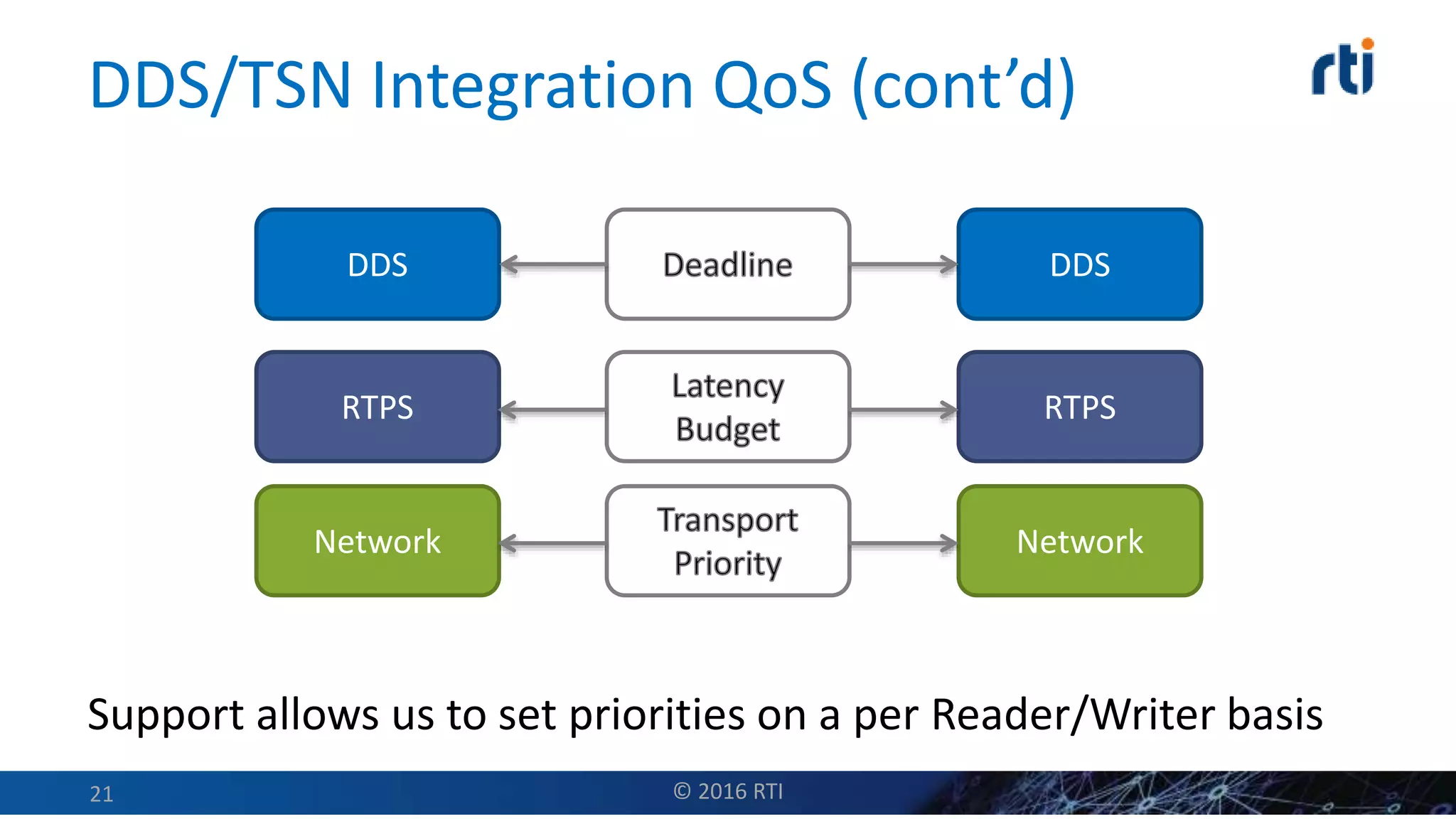
Support allows us to set priorities on a per Reader/Writer basis
© 2016 RTI21
DDS
RTPS
Network
DDS
RTPS
Network
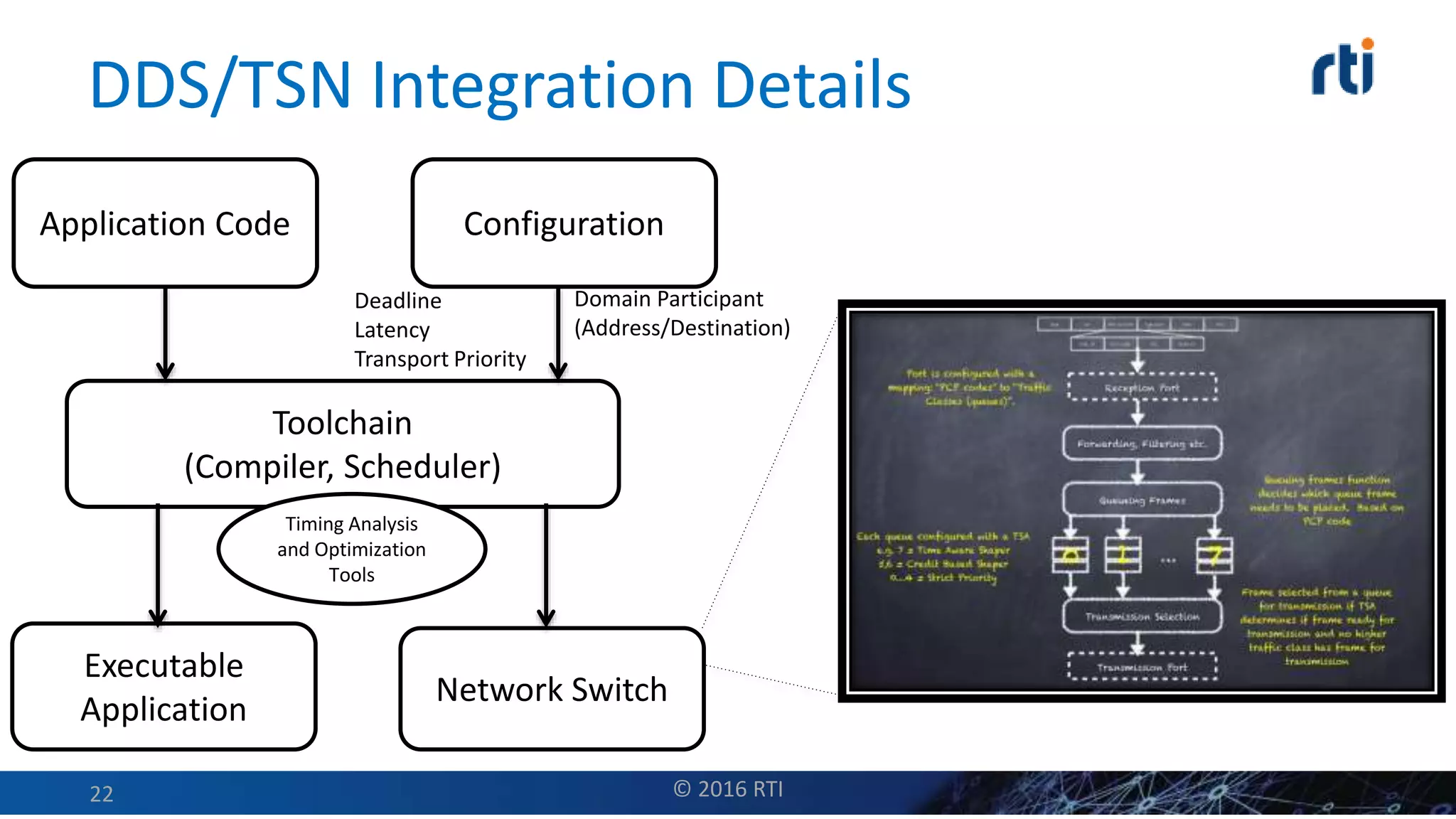
DDS/TSN Integration Details
© 2016 RTI22
Application Code Configuration
Executable
Application
Network Switch
Toolchain
(Compiler, Scheduler)
Timing Analysis
and Optimization
Tools
Deadline
Latency
Transport Priority
Domain Participant
(Address/Destination)
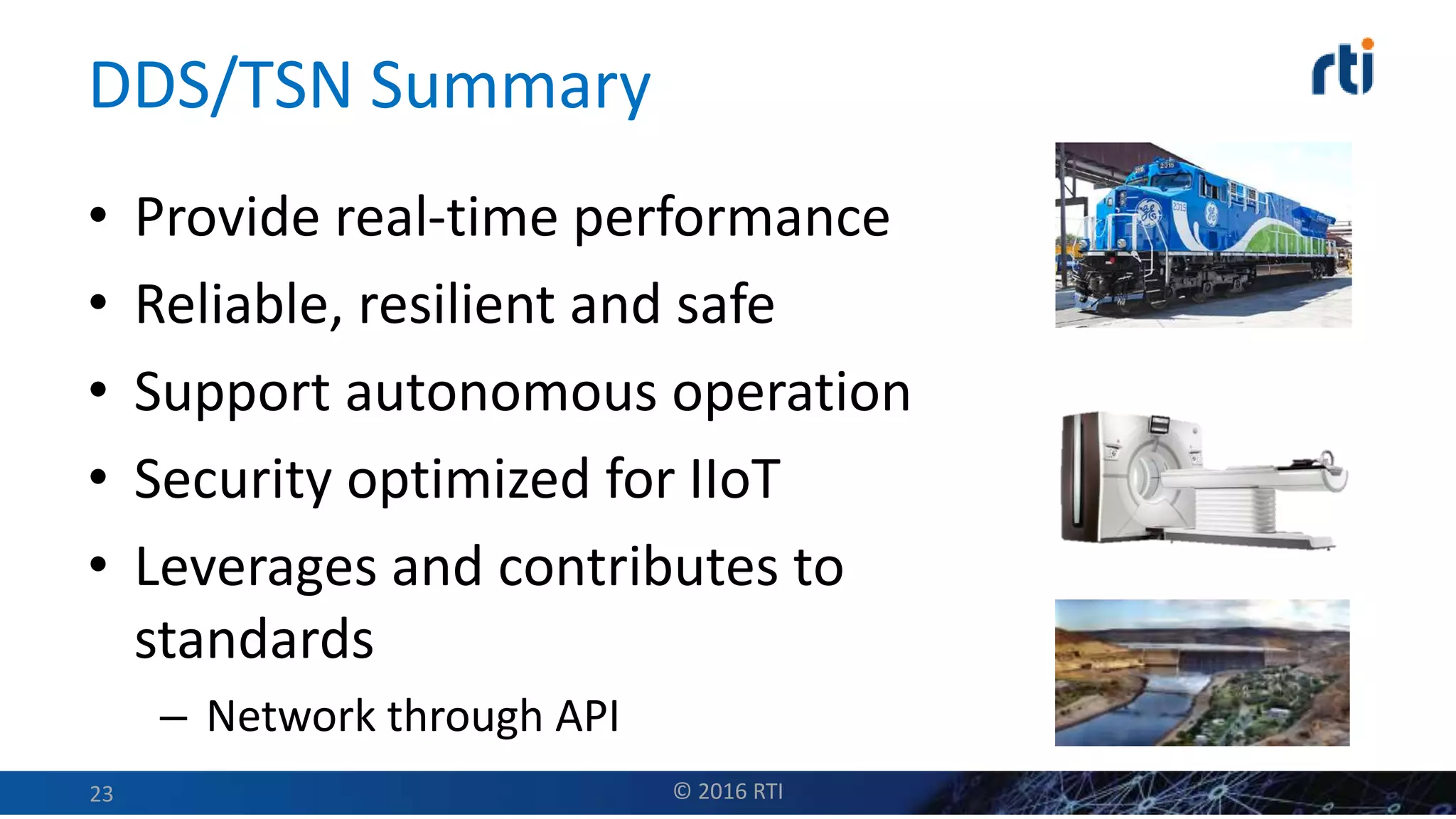
DDS/TSN Summary
• Provide real-time performance
• Reliable, resilient and safe
• Support autonomous operation
• Security optimized for IIoT
• Leverages and contributes to
standards
– Network through API
© 2016 RTI23

How the fusion of time sensitive networking, time-triggered ethernet and data centricity can change industrial control

  • 1.
    How the Fusionof Time-Sensitive Networking and Data Centricity Can Change Industrial Control
  • 2.
    Example Industrial ControlSystems © 2016 RTI2
  • 3.
    Common Architecture Connectivity Sensors Actuators Streaming Analytics& Control HMI/UI IT & Sys of Sys Integration © 2016 RTI3
  • 4.
    Common Requirements • “Physicsspeed” real-time control – Low latency; often closed loop – Sub-second; as low as microseconds • Resilience, reliability and safety – No downtime acceptable – …often even for maintenance and upgrades – No single point of failure or failover • Dynamic and autonomous operation – Deployed at edge, in field – Apps and devices come and go; networks often unreliable – No run-time system administration – Systems must be self-forming and self-healing • …while still being secure © 2016 RTI4
  • 5.
    Traditional Connectivity Approach •Field busses for low-level communications • Programmable Logic Controllers (PLCs) for real-time control • Custom application APIs © 2016 RTI5
  • 6.
    Challenges • Expensive, specialpurpose hardware – Fragmented ecosystems • Difficult and expense integration – Large teams – Supply chains – Ecosystems • Poor data sharing – Hard to capitalize on IIoT, apps not anticipated at initial development © 2016 RTI6
  • 7.
    Solution: DDS +TSN • Data Distribution Service (DDS) – Standard API, semantics and interoperability protocol – Enables loose coupling, plug-and-play integration • Time-Sensitive Networking (TSN) – Real-time and isochronous communication over Ethernet – Leverages commodity hardware © 2016 RTI7
  • 8.
    Foundation: Publish/Subscribe Data DistributionService Control Commands Sensor SensorData ActuatorSensor SensorData HMI © 2016 RTI8
  • 9.
    Data-Centric Publish/Subscribe • Similarto using a database • Apps read and write data objects • DDS maintains and manages state • Asynchronous or synchronous reception • Provides “single source of truth” for system robustness • Eliminates need to: – Store all messages to reconstruct state – Implement out of band protocol for late joiners to retrieve state Write Read DDS Domain Line Flight Dest Arv UA 567 SFO 7:32 AA 432 LAX 9:15 Squawk Long Lat Alt 1234 37.4 -122.0 500.0 7654 40.7 -74.0 250.0 Squawk Line Flight 1234 UA 567 7654 AA 432 Topic © 2016 RTI9
  • 10.
    Real-Time Quality ofService • Each component specifies its QoS capabilities and requirements • DDS notifies app if contract not satisfied • Subscriptions can be based on time and content filter • Maintains loose coupling Squawk Long Lat Alt 1234 37.4 -122.0 500.0 7654 40.7 -74.0 250.0 Line Flight Dest Arv UA 567 SFO 7:32 AA 432 LAX 9:15 Squawk Line Flight 1234 UA 567 7654 AA 432 Reliable, 100 Hz Reliable, 2 Hz, Western U.S. Reliable Best Effort, 1 Hz, SAN area Best Effort, 0.2 Hz, UA flights © 2016 RTI10
  • 11.
    Standard QoS Policies QoSPolicy DURABILITY HISTORY LIFESPAN WRITER DATA LIFECYCLE READER DATA LIFECYCLE ENTITY FACTORY RESOURCE LIMITS RELIABILITY TIME BASED FILTER DEADLINE CONTENT FILTERS CacheDelivery PresentationAvailability Resources Transport QoS Policy USER DATA TOPIC DATA GROUP DATA PARTITION PRESENTATION DESTINATION ORDER OWNERSHIP OWNERSHIP STRENGTH LIVELINESS LATENCY BUDGET TRANSPORT PRIORITY
  • 12.
    DDS Deployment New andUpdated Apps Existing, Unmodified Apps and (Sub)Systems DDS Interoperability Protocol Common Data Model New App DDS Library New Device DDS Library OS & Transport OS & Transport Existing App DDS Routing Service Adapter Existing Device DDS Routing Service Adapter OS & Transport OS & Transport DDS API © 2016 RTI12
  • 13.
    The Big Picture– Network Trends Circuit Switched Network Packet Switched Network Software- Defined Network Active Network Circuit Physical Data Link Network Active Packet = Control + Data Execution Environment Data Plane Control Plane We are here.
  • 14.
    Time-Sensitive Networking • Time-SensitiveNetworking (TSN) is a set of standards developed by the Time - Sensitive Networking Task Group(IEEE 802.1) – Extensions focus on low latency and deterministic transmission © 2016 RTI14 Source: Avnu Alliance
  • 15.
    TTE 1588 1588 Eth TTE TTE Eth TTE TTE TTE TTE TTE TTE Eth IN 1 Send at6:00 and 12:00 Forward at 7:00 and 1:00IN 1 IN 1 Forward at 8:00 and 2:00 IN 1 Transmissions are based on a global time and schedules slots TSN: How It Works Source: TTTech
  • 16.
    TSN: The Standards ©2016 RTI16 • P802.1ASbt “Timing and Synchronization: Enhancements and performance improvements” • P802.1Qbu “Frame Preemption” • P802.3br “Interspersed Express Traffic” • P802.1Qbv “Enhancements for Scheduled Traffic” • P802.1Qca “Path Control and Reservation” • P802.1CB “Seamless Redundancy” • P802.1Qcc “Stream Reservation Protocol (SRP) Enhancements and Performance Improvements” • P802.1Qci “Ingress Policing”
  • 17.
    TSN: The Standards(cont’d) • 802.1AS-Rev “Timing and Synchronization: Enhancements” • 802.1Qbu “Frame Preemption” • 802.3br “Interspersed Express Traffic” © 2016 RTI17
  • 18.
    TSN: The Standards(cont’d) • 802.1Qbv “Enhancements for Scheduled Traffic” © 2016 RTI18
  • 19.
    DDS/TSN Integration TSN forDeterministic Networking Native DDS App DDS Library OS & Transport Non-DDS App DDS Routing Service Adapter OS & Transport © 2016 RTI19 Real-Time Quality of Service
  • 20.
    DDS/TSN Integration QoS •QoS provides control over local and end-to-end properties of DDS • Data Timeliness QOS parameters can be used to classify traffic © 2016 RTI20 Latency Budget Deadline Transport Priority Data Timeliness
  • 21.
    DDS/TSN Integration QoS(cont’d) Support allows us to set priorities on a per Reader/Writer basis © 2016 RTI21 DDS RTPS Network DDS RTPS Network
  • 22.
    DDS/TSN Integration Details ©2016 RTI22 Application Code Configuration Executable Application Network Switch Toolchain (Compiler, Scheduler) Timing Analysis and Optimization Tools Deadline Latency Transport Priority Domain Participant (Address/Destination)
  • 23.
    DDS/TSN Summary • Providereal-time performance • Reliable, resilient and safe • Support autonomous operation • Security optimized for IIoT • Leverages and contributes to standards – Network through API © 2016 RTI23