Distributed Systems: How to
connect your real-time applications
UsingCPP 24/11/2016
Jaime Martin Losa
CTO eProsima
JaimeMartin@eProsima.com
+34 607 91 37 45
www.eProsima.com
Agenda
 Introduction
– DDS
– Architecture
– Shapes Demo
 Hello World
– eProsima Fast RTPS – Open Source (Apache 2.0)
– RTI Connext DDS - Comercial
 Modern CPP API
Introduction and
Background
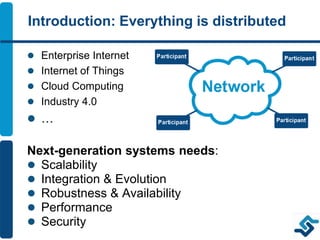
Introduction: Everything is distributed
 Enterprise Internet
 Internet of Things
 Cloud Computing
 Industry 4.0
 …
Next-generation systems needs:
 Scalability
 Integration & Evolution
 Robustness & Availability
 Performance
 Security
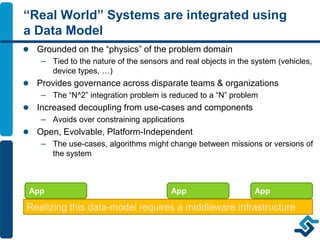
“Real World” Systems are integrated using
a Data Model
 Grounded on the “physics” of the problem domain
– Tied to the nature of the sensors and real objects in the system (vehicles,
device types, …)
 Provides governance across disparate teams & organizations
– The “N^2” integration problem is reduced to a “N” problem
 Increased decoupling from use-cases and components
– Avoids over constraining applications
 Open, Evolvable, Platform-Independent
– The use-cases, algorithms might change between missions or versions of
the system
© 2010 Real-Time Innovations, Inc.
Realizing this data-model requires a middleware infrastructure
App AppApp
Challenge
 Everything is connected, and we should enable
communication between the different nodes.
 And this means:
– Common protocols
– Common Data Types
– Known interfaces
– Different QoS over different datalinks and
performance requirements.
– Different comunications patterns.
– Broad platform and programming language support.
– Good Data Models!
– …
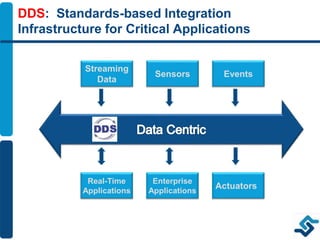
DDS: Standards-based Integration
Infrastructure for Critical Applications
Streaming
Data
Sensors Events
Real-Time
Applications
Enterprise
Applications
Actuators
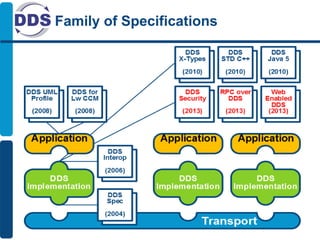
Family of Specifications
Broad Adoption
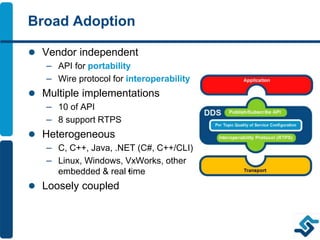
 Vendor independent
– API for portability
– Wire protocol for interoperability
 Multiple implementations
– 10 of API
– 8 support RTPS
 Heterogeneous
– C, C++, Java, .NET (C#, C++/CLI)
– Linux, Windows, VxWorks, other
embedded & real•time
 Loosely coupled
DDS adopted by key programs in Europe
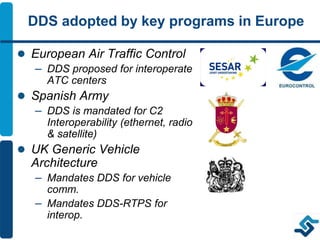
 European Air Traffic Control
– DDS proposed for interoperate
ATC centers
 Spanish Army
– DDS is mandated for C2
Interoperability (ethernet, radio
& satellite)
 UK Generic Vehicle
Architecture
– Mandates DDS for vehicle
comm.
– Mandates DDS-RTPS for
interop.
US-DoD mandates DDS for data-distribution
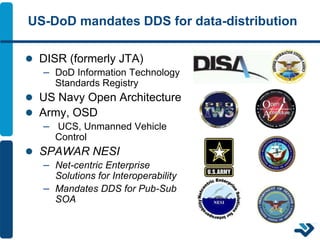
 DISR (formerly JTA)
– DoD Information Technology
Standards Registry
 US Navy Open Architecture
 Army, OSD
– UCS, Unmanned Vehicle
Control
 SPAWAR NESI
– Net-centric Enterprise
Solutions for Interoperability
– Mandates DDS for Pub-Sub
SOA
RTPS Adoption
 ROS (Robotic Operating
System)
 FIWARE
– EU R&D Software Platform
 Many Drone Companies
– 3D Robotics
– Magma UAVs
– …
DDS Architecture
DDS
 DDS (Data Distribution Service for Real-Time Systems)
is a OMG specification for a pub/sub data centric model
(DCPS, Data Centric Publish/Subscribe) for Real-Time
data comms in distributed systems.
 DDS is a networking middleware that:
– Simplifies and Standardizes data flows in distributed real-time
systems.
– Provides robust comms (no single point of failure) and efficient
(minimum latency)
– Provides all kind of QoS to shape the data flows and deliver
predictable results.
DDS
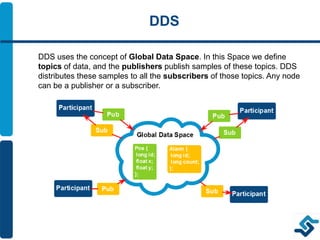
DDS uses the concept of Global Data Space. In this Space we define
topics of data, and the publishers publish samples of these topics. DDS
distributes these samples to all the subscribers of those topics. Any node
can be a publisher or a subscriber.
Why DDS? Decoupled model
 Space (location)
– Automatic Discovery ensures network topology independence
 Redundancy:
– It is possible to configure redundant publishers and subscribers,
primary/secundary and takeover schemas supported
 Time:
– The reception of data does not need to be synchronous with the
writing. A subscriber may, if so configured, receive data that was
written even before the subscriber joined the network.
 Platform:
– Applications do not have to worry about data representation, processor
architecture, Operating System, or even programming language on the
other side
 Implementation:
– DDS Protocol is also an standard. Different implementations
interoperate.
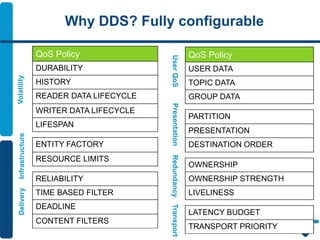
Why DDS? Fully configurable
QoS Policy
DURABILITY
HISTORY
READER DATA LIFECYCLE
WRITER DATA LIFECYCLE
LIFESPAN
ENTITY FACTORY
RESOURCE LIMITS
RELIABILITY
TIME BASED FILTER
DEADLINE
CONTENT FILTERS
Volatility
UserQoS
Delivery
PresentationRedundancy
Infrastructure
Transport
QoS Policy
USER DATA
TOPIC DATA
GROUP DATA
PARTITION
PRESENTATION
DESTINATION ORDER
OWNERSHIP
OWNERSHIP STRENGTH
LIVELINESS
LATENCY BUDGET
TRANSPORT PRIORITY
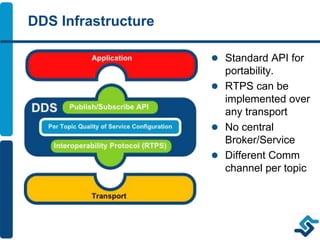
DDS Infrastructure
 Standard API for
portability.
 RTPS can be
implemented over
any transport
 No central
Broker/Service
 Different Comm
channel per topic
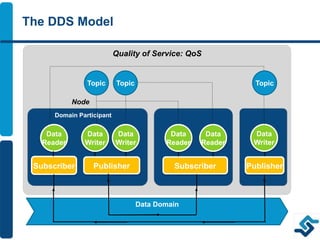
Quality of Service: QoS
The DDS Model
Domain Participant
Data
Reader
Node
Subscriber
Data Domain
Subscriber
Data
Writer
Data
Writer
Data
Reader
Data
Reader
Data
Writer
Publisher
Topic
Publisher
Topic Topic
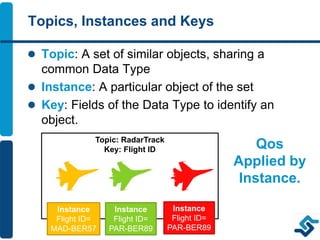
Topics, Instances and Keys
 Topic: A set of similar objects, sharing a
common Data Type
 Instance: A particular object of the set
 Key: Fields of the Data Type to identify an
object.
Topic: RadarTrack
Key: Flight ID
Instance
Flight ID=
MAD-BER57
Instance
Flight ID=
PAR-BER89
Instance
Flight ID=
PAR-BER89
Qos
Applied by
Instance.
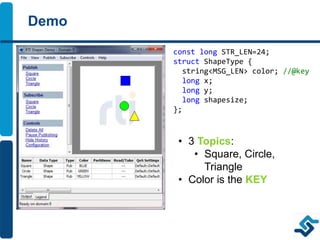
Demo
const long STR_LEN=24;
struct ShapeType {
string<MSG_LEN> color; //@key
long x;
long y;
long shapesize;
};
• 3 Topics:
• Square, Circle,
Triangle
• Color is the KEY
Questions?
Jaime Martin Losa
CTO eProsima
JaimeMartin@eProsima.com
+34 607 91 37 45 www.eProsima.com
Fast RTPS Hands On:
A Hello World
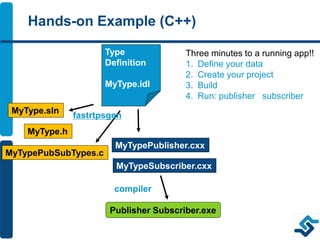
Hands-on Example (C++)
Type
Definition
MyType.idl
fastrtpsgen
MyType.h
MyTypePubSubTypes.c
MyTypePublisher.cxx
MyTypeSubscriber.cxx
MyType.sln
Publisher Subscriber.exe
Three minutes to a running app!!
1. Define your data
2. Create your project
3. Build
4. Run: publisher subscriber
compiler
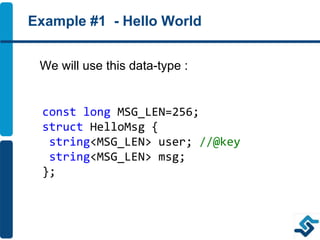
Example #1 - Hello World
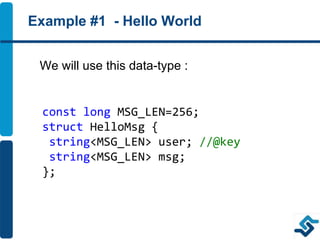
We will use this data-type :
const long MSG_LEN=256;
struct HelloMsg {
string<MSG_LEN> user; //@key
string<MSG_LEN> msg;
};
Generate type support (for C++) [Windows]
 Look at the directory you should see:
– solution-x64Win64VS2015.sln
– And Several other files…
 Open the Solution:
 Compile from visual studio
fastrtpsgen HelloMsg.idl -example x64Win64VS2015
-replace -ppDisable
Execute the program [Windows]
 C++:
– On one window run:
 binx64Win64VS2015HelloMsgPublisherSubscriberd.exe publisher
– On another window run:
 binx64Win64VS2015HelloMsgPublisherSubscriberd.exe subscriber
 You should see the subscribers getting an empty string…
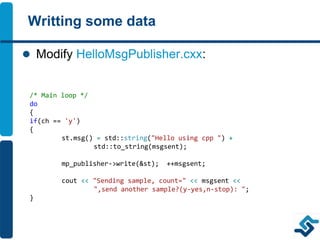
Writting some data
 Modify HelloMsgPublisher.cxx:
/* Main loop */
do
{
if(ch == 'y')
{
st.msg() = std::string("Hello using cpp ") +
std::to_string(msgsent);
mp_publisher->write(&st); ++msgsent;
cout << "Sending sample, count=" << msgsent <<
",send another sample?(y-yes,n-stop): ";
}
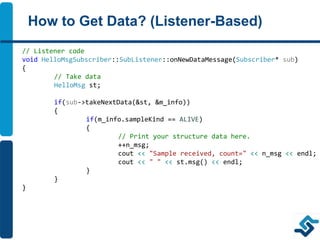
How to Get Data? (Listener-Based)
// Listener code
void HelloMsgSubscriber::SubListener::onNewDataMessage(Subscriber* sub)
{
// Take data
HelloMsg st;
if(sub->takeNextData(&st, &m_info))
{
if(m_info.sampleKind == ALIVE)
{
// Print your structure data here.
++n_msg;
cout << "Sample received, count=" << n_msg << endl;
cout << " " << st.msg() << endl;
}
}
}
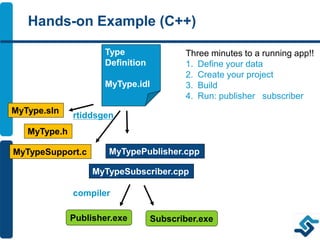
RTI Connext DDS
Hands On:
A Hello World
Hands-on Example (C++)
Type
Definition
MyType.idl
rtiddsgen
MyType.h
MyTypeSupport.c MyTypePublisher.cpp
MyTypeSubscriber.cpp
MyType.sln
Publisher.exe Subscriber.exe
Three minutes to a running app!!
1. Define your data
2. Create your project
3. Build
4. Run: publisher subscriber
compiler
Example #1 - Hello World
We will use this data-type :
const long MSG_LEN=256;
struct HelloMsg {
string<MSG_LEN> user; //@key
string<MSG_LEN> msg;
};
Generate type support (for C++) [Windows]
 Look at the directory you should see:
– HelloMsg-64-vs2010.sln
– And Several other files…
 Open the Solution:
HelloMsgPublisher.cxx
 Compile from visual studio
rtiddsgen HelloMsg.idl -language C++ -example x64Win64VS2010
-replace -ppDisable
Execute the program [Windows]
 C++:
– On one window run:
 objsi86Win32VS2005HelloMsgPublisher.exe
– On another window run:
 objsi86Win32VS2005HelloMsgSubscriber.exe
 Java
– On one window run:
 gmake –f makefile_hello_i86Win32jdk HelloMsgPublisher
– On another window run:
 gmake –f makefile_hello_i86Win32jdk HelloMsgSubscriber
 You should see the subscribers getting an empty string…
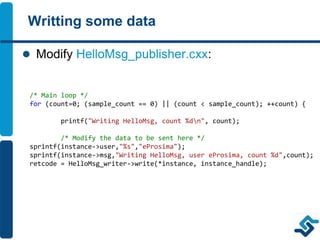
Writting some data
 Modify HelloMsg_publisher.cxx:
/* Main loop */
for (count=0; (sample_count == 0) || (count < sample_count); ++count) {
printf("Writing HelloMsg, count %dn", count);
/* Modify the data to be sent here */
sprintf(instance->user,"%s","eProsima");
sprintf(instance->msg,"Writing HelloMsg, user eProsima, count %d",count);
retcode = HelloMsg_writer->write(*instance, instance_handle);
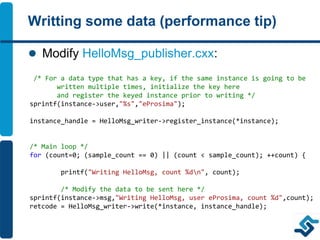
Writting some data (performance tip)
 Modify HelloMsg_publisher.cxx:
/* For a data type that has a key, if the same instance is going to be
written multiple times, initialize the key here
and register the keyed instance prior to writing */
sprintf(instance->user,"%s","eProsima");
instance_handle = HelloMsg_writer->register_instance(*instance);
/* Main loop */
for (count=0; (sample_count == 0) || (count < sample_count); ++count) {
printf("Writing HelloMsg, count %dn", count);
/* Modify the data to be sent here */
sprintf(instance->msg,"Writing HelloMsg, user eProsima, count %d",count);
retcode = HelloMsg_writer->write(*instance, instance_handle);
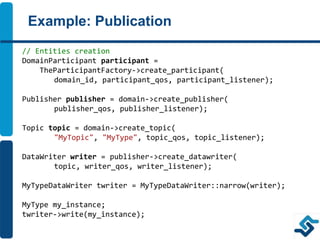
Example: Publication
// Entities creation
DomainParticipant participant =
TheParticipantFactory->create_participant(
domain_id, participant_qos, participant_listener);
Publisher publisher = domain->create_publisher(
publisher_qos, publisher_listener);
Topic topic = domain->create_topic(
"MyTopic", "MyType", topic_qos, topic_listener);
DataWriter writer = publisher->create_datawriter(
topic, writer_qos, writer_listener);
MyTypeDataWriter twriter = MyTypeDataWriter::narrow(writer);
MyType my_instance;
twriter->write(my_instance);
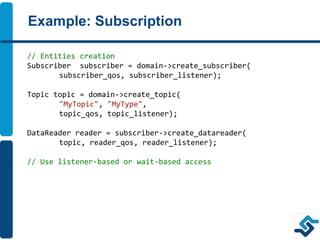
Example: Subscription
// Entities creation
Subscriber subscriber = domain->create_subscriber(
subscriber_qos, subscriber_listener);
Topic topic = domain->create_topic(
"MyTopic", "MyType",
topic_qos, topic_listener);
DataReader reader = subscriber->create_datareader(
topic, reader_qos, reader_listener);
// Use listener-based or wait-based access
How to Get Data? (Listener-Based)
// Listener code
MyListener::on_data_available( DataReader reader )
{
MyTypeSeq received_data;
SampleInfoSeq sample_info;
MyTypeDataReader treader = TextDataReader::narrow(reader);
treader->take( &received_data, &sample_info, …)
// Use received_data
printf("Got: %sn", received_data[0]->contents);
}
DDS Modern CPP
UsingCPP Conference 23/11/2016
Jaime Martin Losa
CTO eProsima
JaimeMartin@eProsima.com
+34 607 91 37 45
www.eProsima.com
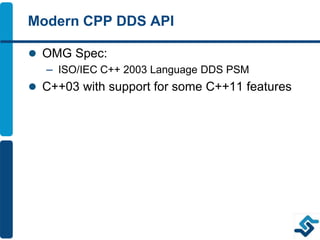
Modern CPP DDS API
 OMG Spec:
– ISO/IEC C++ 2003 Language DDS PSM
 C++03 with support for some C++11 features
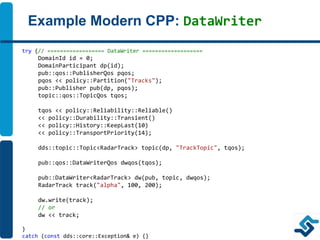
Example Modern CPP: DataWriter
try {// ================== DataWriter ===================
DomainId id = 0;
DomainParticipant dp(id);
pub::qos::PublisherQos pqos;
pqos << policy::Partition("Tracks");
pub::Publisher pub(dp, pqos);
topic::qos::TopicQos tqos;
tqos << policy::Reliability::Reliable()
<< policy::Durability::Transient()
<< policy::History::KeepLast(10)
<< policy::TransportPriority(14);
dds::topic::Topic<RadarTrack> topic(dp, "TrackTopic", tqos);
pub::qos::DataWriterQos dwqos(tqos);
pub::DataWriter<RadarTrack> dw(pub, topic, dwqos);
RadarTrack track("alpha", 100, 200);
dw.write(track);
// or
dw << track;
}
catch (const dds::core::Exception& e) {}
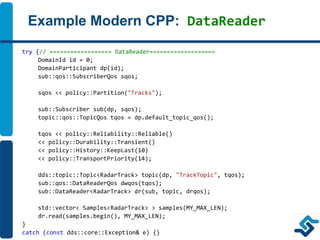
Example Modern CPP: DataReader
try {// ================== DataReader===================
DomainId id = 0;
DomainParticipant dp(id);
sub::qos::SubscriberQos sqos;
sqos << policy::Partition("Tracks");
sub::Subscriber sub(dp, sqos);
topic::qos::TopicQos tqos = dp.default_topic_qos();
tqos << policy::Reliability::Reliable()
<< policy::Durability::Transient()
<< policy::History::KeepLast(10)
<< policy::TransportPriority(14);
dds::topic::Topic<RadarTrack> topic(dp, "TrackTopic", tqos);
sub::qos::DataReaderQos dwqos(tqos);
sub::DataReader<RadarTrack> dr(sub, topic, drqos);
std::vector< Samples<RadarTrack> > samples(MY_MAX_LEN);
dr.read(samples.begin(), MY_MAX_LEN);
}
catch (const dds::core::Exception& e) {}
Questions?
Jaime Martin Losa
CTO eProsima
JaimeMartin@eProsima.com
+34 607 91 37 45 www.eProsima.com
Want to know more?
 www.eProsima.com
 Youtube:
https://www.youtube.com/user/eprosima
 Mail: JaimeMartin@eProsima.com
 Phone: +34 607913745
 Twitter: @jaimemartinlosa
 http://es.slideshare.net/JaimeMartin-eProsima
Thank you!
Jaime Martin Losa
CTO eProsima
JaimeMartin@eProsima.com
+34 607 91 37 45 www.eProsima.com

Distributed Systems: How to connect your real-time applications

  • 1.
    Distributed Systems: Howto connect your real-time applications UsingCPP 24/11/2016 Jaime Martin Losa CTO eProsima JaimeMartin@eProsima.com +34 607 91 37 45 www.eProsima.com
  • 2.
    Agenda  Introduction – DDS –Architecture – Shapes Demo  Hello World – eProsima Fast RTPS – Open Source (Apache 2.0) – RTI Connext DDS - Comercial  Modern CPP API
  • 3.
  • 4.
    Introduction: Everything isdistributed  Enterprise Internet  Internet of Things  Cloud Computing  Industry 4.0  … Next-generation systems needs:  Scalability  Integration & Evolution  Robustness & Availability  Performance  Security
  • 5.
    “Real World” Systemsare integrated using a Data Model  Grounded on the “physics” of the problem domain – Tied to the nature of the sensors and real objects in the system (vehicles, device types, …)  Provides governance across disparate teams & organizations – The “N^2” integration problem is reduced to a “N” problem  Increased decoupling from use-cases and components – Avoids over constraining applications  Open, Evolvable, Platform-Independent – The use-cases, algorithms might change between missions or versions of the system © 2010 Real-Time Innovations, Inc. Realizing this data-model requires a middleware infrastructure App AppApp
  • 6.
    Challenge  Everything isconnected, and we should enable communication between the different nodes.  And this means: – Common protocols – Common Data Types – Known interfaces – Different QoS over different datalinks and performance requirements. – Different comunications patterns. – Broad platform and programming language support. – Good Data Models! – …
  • 7.
    DDS: Standards-based Integration Infrastructurefor Critical Applications Streaming Data Sensors Events Real-Time Applications Enterprise Applications Actuators
  • 8.
  • 9.
    Broad Adoption  Vendorindependent – API for portability – Wire protocol for interoperability  Multiple implementations – 10 of API – 8 support RTPS  Heterogeneous – C, C++, Java, .NET (C#, C++/CLI) – Linux, Windows, VxWorks, other embedded & real•time  Loosely coupled
  • 10.
    DDS adopted bykey programs in Europe  European Air Traffic Control – DDS proposed for interoperate ATC centers  Spanish Army – DDS is mandated for C2 Interoperability (ethernet, radio & satellite)  UK Generic Vehicle Architecture – Mandates DDS for vehicle comm. – Mandates DDS-RTPS for interop.
  • 11.
    US-DoD mandates DDSfor data-distribution  DISR (formerly JTA) – DoD Information Technology Standards Registry  US Navy Open Architecture  Army, OSD – UCS, Unmanned Vehicle Control  SPAWAR NESI – Net-centric Enterprise Solutions for Interoperability – Mandates DDS for Pub-Sub SOA
  • 12.
    RTPS Adoption  ROS(Robotic Operating System)  FIWARE – EU R&D Software Platform  Many Drone Companies – 3D Robotics – Magma UAVs – …
  • 13.
  • 14.
    DDS  DDS (DataDistribution Service for Real-Time Systems) is a OMG specification for a pub/sub data centric model (DCPS, Data Centric Publish/Subscribe) for Real-Time data comms in distributed systems.  DDS is a networking middleware that: – Simplifies and Standardizes data flows in distributed real-time systems. – Provides robust comms (no single point of failure) and efficient (minimum latency) – Provides all kind of QoS to shape the data flows and deliver predictable results.
  • 15.
    DDS DDS uses theconcept of Global Data Space. In this Space we define topics of data, and the publishers publish samples of these topics. DDS distributes these samples to all the subscribers of those topics. Any node can be a publisher or a subscriber.
  • 16.
    Why DDS? Decoupledmodel  Space (location) – Automatic Discovery ensures network topology independence  Redundancy: – It is possible to configure redundant publishers and subscribers, primary/secundary and takeover schemas supported  Time: – The reception of data does not need to be synchronous with the writing. A subscriber may, if so configured, receive data that was written even before the subscriber joined the network.  Platform: – Applications do not have to worry about data representation, processor architecture, Operating System, or even programming language on the other side  Implementation: – DDS Protocol is also an standard. Different implementations interoperate.
  • 17.
    Why DDS? Fullyconfigurable QoS Policy DURABILITY HISTORY READER DATA LIFECYCLE WRITER DATA LIFECYCLE LIFESPAN ENTITY FACTORY RESOURCE LIMITS RELIABILITY TIME BASED FILTER DEADLINE CONTENT FILTERS Volatility UserQoS Delivery PresentationRedundancy Infrastructure Transport QoS Policy USER DATA TOPIC DATA GROUP DATA PARTITION PRESENTATION DESTINATION ORDER OWNERSHIP OWNERSHIP STRENGTH LIVELINESS LATENCY BUDGET TRANSPORT PRIORITY
  • 18.
    DDS Infrastructure  StandardAPI for portability.  RTPS can be implemented over any transport  No central Broker/Service  Different Comm channel per topic
  • 19.
    Quality of Service:QoS The DDS Model Domain Participant Data Reader Node Subscriber Data Domain Subscriber Data Writer Data Writer Data Reader Data Reader Data Writer Publisher Topic Publisher Topic Topic
  • 20.
    Topics, Instances andKeys  Topic: A set of similar objects, sharing a common Data Type  Instance: A particular object of the set  Key: Fields of the Data Type to identify an object. Topic: RadarTrack Key: Flight ID Instance Flight ID= MAD-BER57 Instance Flight ID= PAR-BER89 Instance Flight ID= PAR-BER89 Qos Applied by Instance.
  • 21.
    Demo const long STR_LEN=24; structShapeType { string<MSG_LEN> color; //@key long x; long y; long shapesize; }; • 3 Topics: • Square, Circle, Triangle • Color is the KEY
  • 22.
    Questions? Jaime Martin Losa CTOeProsima JaimeMartin@eProsima.com +34 607 91 37 45 www.eProsima.com
  • 23.
    Fast RTPS HandsOn: A Hello World
  • 24.
    Hands-on Example (C++) Type Definition MyType.idl fastrtpsgen MyType.h MyTypePubSubTypes.c MyTypePublisher.cxx MyTypeSubscriber.cxx MyType.sln PublisherSubscriber.exe Three minutes to a running app!! 1. Define your data 2. Create your project 3. Build 4. Run: publisher subscriber compiler
  • 25.
    Example #1 -Hello World We will use this data-type : const long MSG_LEN=256; struct HelloMsg { string<MSG_LEN> user; //@key string<MSG_LEN> msg; };
  • 26.
    Generate type support(for C++) [Windows]  Look at the directory you should see: – solution-x64Win64VS2015.sln – And Several other files…  Open the Solution:  Compile from visual studio fastrtpsgen HelloMsg.idl -example x64Win64VS2015 -replace -ppDisable
  • 27.
    Execute the program[Windows]  C++: – On one window run:  binx64Win64VS2015HelloMsgPublisherSubscriberd.exe publisher – On another window run:  binx64Win64VS2015HelloMsgPublisherSubscriberd.exe subscriber  You should see the subscribers getting an empty string…
  • 28.
    Writting some data Modify HelloMsgPublisher.cxx: /* Main loop */ do { if(ch == 'y') { st.msg() = std::string("Hello using cpp ") + std::to_string(msgsent); mp_publisher->write(&st); ++msgsent; cout << "Sending sample, count=" << msgsent << ",send another sample?(y-yes,n-stop): "; }
  • 29.
    How to GetData? (Listener-Based) // Listener code void HelloMsgSubscriber::SubListener::onNewDataMessage(Subscriber* sub) { // Take data HelloMsg st; if(sub->takeNextData(&st, &m_info)) { if(m_info.sampleKind == ALIVE) { // Print your structure data here. ++n_msg; cout << "Sample received, count=" << n_msg << endl; cout << " " << st.msg() << endl; } } }
  • 30.
    RTI Connext DDS HandsOn: A Hello World
  • 31.
    Hands-on Example (C++) Type Definition MyType.idl rtiddsgen MyType.h MyTypeSupport.cMyTypePublisher.cpp MyTypeSubscriber.cpp MyType.sln Publisher.exe Subscriber.exe Three minutes to a running app!! 1. Define your data 2. Create your project 3. Build 4. Run: publisher subscriber compiler
  • 32.
    Example #1 -Hello World We will use this data-type : const long MSG_LEN=256; struct HelloMsg { string<MSG_LEN> user; //@key string<MSG_LEN> msg; };
  • 33.
    Generate type support(for C++) [Windows]  Look at the directory you should see: – HelloMsg-64-vs2010.sln – And Several other files…  Open the Solution: HelloMsgPublisher.cxx  Compile from visual studio rtiddsgen HelloMsg.idl -language C++ -example x64Win64VS2010 -replace -ppDisable
  • 34.
    Execute the program[Windows]  C++: – On one window run:  objsi86Win32VS2005HelloMsgPublisher.exe – On another window run:  objsi86Win32VS2005HelloMsgSubscriber.exe  Java – On one window run:  gmake –f makefile_hello_i86Win32jdk HelloMsgPublisher – On another window run:  gmake –f makefile_hello_i86Win32jdk HelloMsgSubscriber  You should see the subscribers getting an empty string…
  • 35.
    Writting some data Modify HelloMsg_publisher.cxx: /* Main loop */ for (count=0; (sample_count == 0) || (count < sample_count); ++count) { printf("Writing HelloMsg, count %dn", count); /* Modify the data to be sent here */ sprintf(instance->user,"%s","eProsima"); sprintf(instance->msg,"Writing HelloMsg, user eProsima, count %d",count); retcode = HelloMsg_writer->write(*instance, instance_handle);
  • 36.
    Writting some data(performance tip)  Modify HelloMsg_publisher.cxx: /* For a data type that has a key, if the same instance is going to be written multiple times, initialize the key here and register the keyed instance prior to writing */ sprintf(instance->user,"%s","eProsima"); instance_handle = HelloMsg_writer->register_instance(*instance); /* Main loop */ for (count=0; (sample_count == 0) || (count < sample_count); ++count) { printf("Writing HelloMsg, count %dn", count); /* Modify the data to be sent here */ sprintf(instance->msg,"Writing HelloMsg, user eProsima, count %d",count); retcode = HelloMsg_writer->write(*instance, instance_handle);
  • 37.
    Example: Publication // Entitiescreation DomainParticipant participant = TheParticipantFactory->create_participant( domain_id, participant_qos, participant_listener); Publisher publisher = domain->create_publisher( publisher_qos, publisher_listener); Topic topic = domain->create_topic( "MyTopic", "MyType", topic_qos, topic_listener); DataWriter writer = publisher->create_datawriter( topic, writer_qos, writer_listener); MyTypeDataWriter twriter = MyTypeDataWriter::narrow(writer); MyType my_instance; twriter->write(my_instance);
  • 38.
    Example: Subscription // Entitiescreation Subscriber subscriber = domain->create_subscriber( subscriber_qos, subscriber_listener); Topic topic = domain->create_topic( "MyTopic", "MyType", topic_qos, topic_listener); DataReader reader = subscriber->create_datareader( topic, reader_qos, reader_listener); // Use listener-based or wait-based access
  • 39.
    How to GetData? (Listener-Based) // Listener code MyListener::on_data_available( DataReader reader ) { MyTypeSeq received_data; SampleInfoSeq sample_info; MyTypeDataReader treader = TextDataReader::narrow(reader); treader->take( &received_data, &sample_info, …) // Use received_data printf("Got: %sn", received_data[0]->contents); }
  • 40.
    DDS Modern CPP UsingCPPConference 23/11/2016 Jaime Martin Losa CTO eProsima JaimeMartin@eProsima.com +34 607 91 37 45 www.eProsima.com
  • 41.
    Modern CPP DDSAPI  OMG Spec: – ISO/IEC C++ 2003 Language DDS PSM  C++03 with support for some C++11 features
  • 42.
    Example Modern CPP:DataWriter try {// ================== DataWriter =================== DomainId id = 0; DomainParticipant dp(id); pub::qos::PublisherQos pqos; pqos << policy::Partition("Tracks"); pub::Publisher pub(dp, pqos); topic::qos::TopicQos tqos; tqos << policy::Reliability::Reliable() << policy::Durability::Transient() << policy::History::KeepLast(10) << policy::TransportPriority(14); dds::topic::Topic<RadarTrack> topic(dp, "TrackTopic", tqos); pub::qos::DataWriterQos dwqos(tqos); pub::DataWriter<RadarTrack> dw(pub, topic, dwqos); RadarTrack track("alpha", 100, 200); dw.write(track); // or dw << track; } catch (const dds::core::Exception& e) {}
  • 43.
    Example Modern CPP:DataReader try {// ================== DataReader=================== DomainId id = 0; DomainParticipant dp(id); sub::qos::SubscriberQos sqos; sqos << policy::Partition("Tracks"); sub::Subscriber sub(dp, sqos); topic::qos::TopicQos tqos = dp.default_topic_qos(); tqos << policy::Reliability::Reliable() << policy::Durability::Transient() << policy::History::KeepLast(10) << policy::TransportPriority(14); dds::topic::Topic<RadarTrack> topic(dp, "TrackTopic", tqos); sub::qos::DataReaderQos dwqos(tqos); sub::DataReader<RadarTrack> dr(sub, topic, drqos); std::vector< Samples<RadarTrack> > samples(MY_MAX_LEN); dr.read(samples.begin(), MY_MAX_LEN); } catch (const dds::core::Exception& e) {}
  • 44.
    Questions? Jaime Martin Losa CTOeProsima JaimeMartin@eProsima.com +34 607 91 37 45 www.eProsima.com
  • 45.
    Want to knowmore?  www.eProsima.com  Youtube: https://www.youtube.com/user/eprosima  Mail: JaimeMartin@eProsima.com  Phone: +34 607913745  Twitter: @jaimemartinlosa  http://es.slideshare.net/JaimeMartin-eProsima
  • 46.
    Thank you! Jaime MartinLosa CTO eProsima JaimeMartin@eProsima.com +34 607 91 37 45 www.eProsima.com