INTERVERTEBRAL
DISC PROLAPSE
RATHEESH R L
DEFINITION
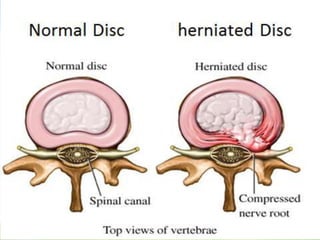
• Spinal disc herniation, also known as
a slipped disc, is a medical condition
affecting the spine in which a tear in the
outer, fibrous ring of an intervertebral
disc allows the soft, central portion
to bulge out beyond the damaged outer
rings.
• Is relatively avascular structure and
the Essential minerals and fluids
required for regeneration enter the
disks passively during the night.
FUNCTIONS OF IVD
1-It supports the axial load on the column that is
delivered by the body mass.
2- Assist a limited range of motion at the spine.
3- Shock absorbing system.
4- Serve ligamental functions between vertebral
bodies.
5- Assist to keep the normal shape & curvature of
each spinal region (cervical, thoracic, ..etc)
Location
 The majority of spinal disc herniation cases
occur in lumbar region (95% in L4-L5 or
L5-S1).
 The second most common site is
the cervical region (C5-C6, C6-C7).
 The thoracic region accounts for only
0.15% to 4.0% of cases.
Cervical
 Cervical disc herniations occur in the neck,
most often between the fifth & sixth
(C5/6) and the sixth and seventh (C6/7)
cervical vertebral bodies.
 Symptoms can affect the back of the skull,
the neck, shoulder girdle,
scapula, shoulder, arm, and hand.
 The nerves of the cervical
plexus and brachial plexus can be affected.
Thoracic
 Thoracic discs are very stable and
herniations in this region are quite
rare.
 Herniation of the uppermost thoracic
discs can mimic cervical disc
herniations, while herniation of the
other discs can mimic lumbar
herniations.
Lumbar
 Lumbar disc herniations occur in the lower
back, most often between the fourth and
fifth lumbar vertebral bodies or between
the fifth and the sacrum.
 Symptoms can affect the lower
back,buttocks, thigh, anal/genital
region (via the Perineal nerve), and may
radiate into the foot and/or toe.
 Repetitive mechanical activities –
Frequent bending, twisting, lifting, and
other similar activities without breaks and
proper stretching can leave the discs
damaged.
CAUSES
 Traumatic injury to lumbar discs-
commonly occurs when lifting
while bent at the waist, rather
than lifting with the legs while
the back is straight.
• Living a sedentary lifestyle –
Individuals who rarely if ever
engage in physical activity are more
prone to herniated discs because the
muscles that support the back and
neck weaken, which increases strain
on the spine.
 Obesity – Spinal degeneration can be
quickened as a result of the burden of
supporting excess body fat.
 Practicing poor posture – Improper spinal
alignment while sitting, standing, or lying
down strains the back and neck.
CAUSES
 Tobacco abuse – The chemicals
commonly found in cigarettes can
interfere with the disc’s ability to
absorb nutrients, which results in the
weakening of the disc.
• Mutation-
in genes coding for proteins
involved in the regulation of the
extracellular matrix, such
as MMP2 and THBS2, has been
demonstrated to contribute to lumbar
disc herniation.
 There is now recognition of the importance of
“chemical radiculitis” in the generation of back
pain.
 A primary focus of surgery is to remove
“pressure” or reduce mechanical compression on
a neural element: either the spinal cord, or
a nerve root.
Pathophysiology
• But it is increasingly recognized that
back pain, rather than being solely
due to compression, may also be due
to chemical inflammation.
 There is evidence that points to a specific
inflammatory mediator of this pain.
 This inflammatory molecule, called tumor
necrosis factor-alpha (TNF), is released not
only by the herniated disc, but also in
cases of disc tear (annular tear), by facet
joints, and in spinal stenosis.
• In addition to causing pain and
inflammation, TNF may also contribute
to disc degeneration.
SYMPTOMS
• The symptoms of a herniated or prolapsed
disc may not include back or neck pain in
some individuals, although such pain is
common. The main symptoms of a prolapsed
disc include:
• In severe cases, loss of control of bladder
and/or bowels, numbness in the genital area,
and impotence (in men)
• Numbness, pins and needles, or tingling in
one or both arms or legs
• Pain behind the shoulder blade(s) or in the
buttock(s)
• Pain running down one or both arms or legs
• The location of these symptoms depends
upon which nerve(s) has been affected. In
other words, the precise location of the
symptoms helps determine your diagnosis.
• Weakness involving one or both arms or legs
TYPES OF HERNIATION
posterolateral disc herniation –
 protrusion is usually posterolateral into
vertebral canal, compress the roots of a
spinal nerve.
 protruded disc usually compresses next
lower nerve as that nerve crosses level of
disc in its path to its foramen.
(eg.protrusion of fifth lumbar disc usually
affects S1 instead.
central (posterior) herniation:
 less frequently, a protruded disc
above second lumbar vertebra may
compress spinal cord itself or or may
result in cauda equina syndrome.
 in the lower lumbar segments,
central herniation may result in S1
radiculopathy.
lateral disc herniation:
 may compress the nerve root above the
level of the herniation
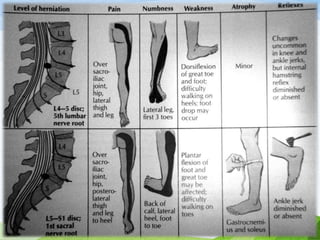
 L4 nerve root is most often involved &
patient typically have intense radicular
pain.
 Diagnosis is based on the history, symptoms,
and physical examination.
 At some point in the evaluation, tests may be
performed to confirm or rule out other causes of
symptoms such
as spondylolisthesis,degeneration, tumors, metasta
ses and space-occupying lesions.
DIAGNOSIS
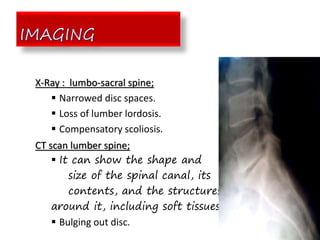
X-Ray : lumbo-sacral spine;
 Narrowed disc spaces.
 Loss of lumber lordosis.
 Compensatory scoliosis.
CT scan lumber spine;
 It can show the shape and
size of the spinal canal, its
contents, and the structures
around it, including soft tissues.
 Bulging out disc.
MRI lumber spine;
 Intervertebral disc protrusion.
 Compression of nerve root.
Myelogram;
 pressure on the spinal cord or
nerves, such as herniated discs,
tumors, or bone spurs.
Normal MRI
.
..
 Bed rest.
 Non-steroidal anti-inflammatory
drugs (NSAIDs).
 Patient education on proper body
mechanics.
 Physical therapy, to address mechanical
factors, and may include modalities to
temporarily relieve pain
(i.e. traction, electrical stimulation
massage).
medical treatments.
 Oral steroids
(e.g. prednisone or methylprednisolone).
 Epidural cortisone injection.
 Intravenous sedation, analgesia-assisted
traction therapy (IVSAAT).
 Weight control.
 Tobacco cessation.
 Lumbosacral back support.
 anti-depressants.
Discectomy/Microdiscectomy -
• This procedure is
used to remove part
of an intervertebral
disc that is
compressing the
spinal cord or a
nerve root.
The Tessys method
• The Tessys method
(transforaminal
endoscopic surgical
system) is a
minimally invasive
surgical procedure
to remove herniated
discs .
Laminectomy-
to relieve spinal
stenosis or nerve
compression
Hemilaminectomy -
Hemilaminectomy is
surgery to help
alleviate the
symptoms of an
impinged or irritated
nerve root in the
spine
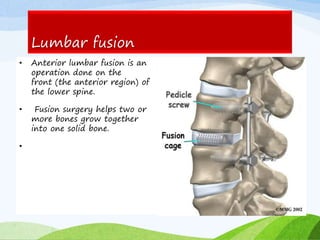
Lumbar fusion
• Anterior lumbar fusion is an
operation done on the
front (the anterior region) of
the lower spine.
• Fusion surgery helps two or
more bones grow together
into one solid bone.
•
• Fusion cages are new devices, essentially hollow
screws filled with bone graft, that help the
bones of the spine heal together firmly.
• Surgeons use this procedure when patients
have symptoms from disc degeneration, disc
herniation, or spinal instability.
• lumbar fusion is only indicated for recurrent
lumbar disc herniations, not primary
herniations
Total Disc Replacement
• Artificial Disc Replacement (ADR), or Total
Disc Replacement (TDR), is a type
of arthroplasty.
• It is a surgical procedure in which
degenerated intervertebral discs in the spinal
column are replaced with artificial devices in
the lumbar (lower) or cervical (upper) spine.
Complications
Chronic pain
Peeminant nerve
injury
Paralysis
NURSING MANAGEMENT
• Assess the general condition of the patient
• Check the vital signs
• Assess the level and characteristics of pain
• Provide proper back care and skin care to
the patient
• Advice patient to do proper exercise
• Provide adequate nutrition
• Change the position frequently
• Advice to avoid heavy exercise like heavy
weight lifting
• Put traction for the prescribed period of
time.
• Continue the medications till the doctor
adviced
Ivdp

Ivdp

  • 1.
  • 2.
    DEFINITION • Spinal discherniation, also known as a slipped disc, is a medical condition affecting the spine in which a tear in the outer, fibrous ring of an intervertebral disc allows the soft, central portion to bulge out beyond the damaged outer rings.
  • 4.
    • Is relativelyavascular structure and the Essential minerals and fluids required for regeneration enter the disks passively during the night.
  • 5.
    FUNCTIONS OF IVD 1-Itsupports the axial load on the column that is delivered by the body mass. 2- Assist a limited range of motion at the spine. 3- Shock absorbing system. 4- Serve ligamental functions between vertebral bodies. 5- Assist to keep the normal shape & curvature of each spinal region (cervical, thoracic, ..etc)
  • 6.
    Location  The majorityof spinal disc herniation cases occur in lumbar region (95% in L4-L5 or L5-S1).  The second most common site is the cervical region (C5-C6, C6-C7).  The thoracic region accounts for only 0.15% to 4.0% of cases.
  • 7.
    Cervical  Cervical discherniations occur in the neck, most often between the fifth & sixth (C5/6) and the sixth and seventh (C6/7) cervical vertebral bodies.  Symptoms can affect the back of the skull, the neck, shoulder girdle, scapula, shoulder, arm, and hand.  The nerves of the cervical plexus and brachial plexus can be affected.
  • 8.
    Thoracic  Thoracic discsare very stable and herniations in this region are quite rare.  Herniation of the uppermost thoracic discs can mimic cervical disc herniations, while herniation of the other discs can mimic lumbar herniations.
  • 9.
    Lumbar  Lumbar discherniations occur in the lower back, most often between the fourth and fifth lumbar vertebral bodies or between the fifth and the sacrum.  Symptoms can affect the lower back,buttocks, thigh, anal/genital region (via the Perineal nerve), and may radiate into the foot and/or toe.
  • 11.
     Repetitive mechanicalactivities – Frequent bending, twisting, lifting, and other similar activities without breaks and proper stretching can leave the discs damaged. CAUSES
  • 12.
     Traumatic injuryto lumbar discs- commonly occurs when lifting while bent at the waist, rather than lifting with the legs while the back is straight.
  • 13.
    • Living asedentary lifestyle – Individuals who rarely if ever engage in physical activity are more prone to herniated discs because the muscles that support the back and neck weaken, which increases strain on the spine.
  • 14.
     Obesity –Spinal degeneration can be quickened as a result of the burden of supporting excess body fat.  Practicing poor posture – Improper spinal alignment while sitting, standing, or lying down strains the back and neck. CAUSES
  • 15.
     Tobacco abuse– The chemicals commonly found in cigarettes can interfere with the disc’s ability to absorb nutrients, which results in the weakening of the disc.
  • 16.
    • Mutation- in genescoding for proteins involved in the regulation of the extracellular matrix, such as MMP2 and THBS2, has been demonstrated to contribute to lumbar disc herniation.
  • 17.
     There isnow recognition of the importance of “chemical radiculitis” in the generation of back pain.  A primary focus of surgery is to remove “pressure” or reduce mechanical compression on a neural element: either the spinal cord, or a nerve root. Pathophysiology
  • 18.
    • But itis increasingly recognized that back pain, rather than being solely due to compression, may also be due to chemical inflammation.
  • 19.
     There isevidence that points to a specific inflammatory mediator of this pain.  This inflammatory molecule, called tumor necrosis factor-alpha (TNF), is released not only by the herniated disc, but also in cases of disc tear (annular tear), by facet joints, and in spinal stenosis.
  • 20.
    • In additionto causing pain and inflammation, TNF may also contribute to disc degeneration.
  • 21.
    SYMPTOMS • The symptomsof a herniated or prolapsed disc may not include back or neck pain in some individuals, although such pain is common. The main symptoms of a prolapsed disc include: • In severe cases, loss of control of bladder and/or bowels, numbness in the genital area, and impotence (in men) • Numbness, pins and needles, or tingling in one or both arms or legs
  • 22.
    • Pain behindthe shoulder blade(s) or in the buttock(s) • Pain running down one or both arms or legs • The location of these symptoms depends upon which nerve(s) has been affected. In other words, the precise location of the symptoms helps determine your diagnosis. • Weakness involving one or both arms or legs
  • 23.
    TYPES OF HERNIATION posterolateraldisc herniation –  protrusion is usually posterolateral into vertebral canal, compress the roots of a spinal nerve.  protruded disc usually compresses next lower nerve as that nerve crosses level of disc in its path to its foramen. (eg.protrusion of fifth lumbar disc usually affects S1 instead.
  • 24.
    central (posterior) herniation: less frequently, a protruded disc above second lumbar vertebra may compress spinal cord itself or or may result in cauda equina syndrome.  in the lower lumbar segments, central herniation may result in S1 radiculopathy.
  • 25.
    lateral disc herniation: may compress the nerve root above the level of the herniation  L4 nerve root is most often involved & patient typically have intense radicular pain.
  • 26.
     Diagnosis isbased on the history, symptoms, and physical examination.  At some point in the evaluation, tests may be performed to confirm or rule out other causes of symptoms such as spondylolisthesis,degeneration, tumors, metasta ses and space-occupying lesions. DIAGNOSIS
  • 27.
    X-Ray : lumbo-sacralspine;  Narrowed disc spaces.  Loss of lumber lordosis.  Compensatory scoliosis. CT scan lumber spine;  It can show the shape and size of the spinal canal, its contents, and the structures around it, including soft tissues.  Bulging out disc.
  • 28.
    MRI lumber spine; Intervertebral disc protrusion.  Compression of nerve root. Myelogram;  pressure on the spinal cord or nerves, such as herniated discs, tumors, or bone spurs.
  • 29.
  • 31.
  • 32.
  • 34.
     Bed rest. Non-steroidal anti-inflammatory drugs (NSAIDs).  Patient education on proper body mechanics.  Physical therapy, to address mechanical factors, and may include modalities to temporarily relieve pain (i.e. traction, electrical stimulation massage). medical treatments.
  • 35.
     Oral steroids (e.g.prednisone or methylprednisolone).  Epidural cortisone injection.  Intravenous sedation, analgesia-assisted traction therapy (IVSAAT).  Weight control.  Tobacco cessation.  Lumbosacral back support.  anti-depressants.
  • 36.
    Discectomy/Microdiscectomy - • Thisprocedure is used to remove part of an intervertebral disc that is compressing the spinal cord or a nerve root.
  • 37.
    The Tessys method •The Tessys method (transforaminal endoscopic surgical system) is a minimally invasive surgical procedure to remove herniated discs .
  • 38.
  • 39.
    Hemilaminectomy - Hemilaminectomy is surgeryto help alleviate the symptoms of an impinged or irritated nerve root in the spine
  • 40.
    Lumbar fusion • Anteriorlumbar fusion is an operation done on the front (the anterior region) of the lower spine. • Fusion surgery helps two or more bones grow together into one solid bone. •
  • 41.
    • Fusion cagesare new devices, essentially hollow screws filled with bone graft, that help the bones of the spine heal together firmly. • Surgeons use this procedure when patients have symptoms from disc degeneration, disc herniation, or spinal instability. • lumbar fusion is only indicated for recurrent lumbar disc herniations, not primary herniations
  • 42.
    Total Disc Replacement •Artificial Disc Replacement (ADR), or Total Disc Replacement (TDR), is a type of arthroplasty. • It is a surgical procedure in which degenerated intervertebral discs in the spinal column are replaced with artificial devices in the lumbar (lower) or cervical (upper) spine.
  • 43.
  • 44.
    NURSING MANAGEMENT • Assessthe general condition of the patient • Check the vital signs • Assess the level and characteristics of pain • Provide proper back care and skin care to the patient • Advice patient to do proper exercise • Provide adequate nutrition
  • 45.
    • Change theposition frequently • Advice to avoid heavy exercise like heavy weight lifting • Put traction for the prescribed period of time. • Continue the medications till the doctor adviced