ClausesWhy learn about them?Learning about clauses helps us to determine whether we have written a complete sentence.
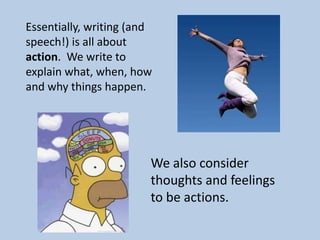
Essentially, writing (and speech!) is all about action.  We write to explain what, when, how and why things happen.We also consider thoughts and feelings to be actions.
The Main ClauseThe main clause (sometimes called an independentclause) must contain:+subjectverbThe subject is involved in the actionThe verb is the action
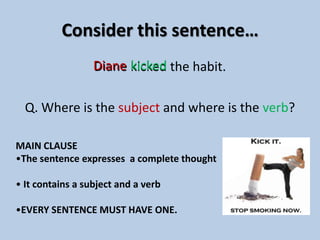
Consider this sentence…Diane kickedDiane kicked the habit.Q. Where is the subject and where is the verb?MAIN CLAUSE   The sentence expresses  a complete thought
 It contains a subject and a verb
EVERY SENTENCE MUST HAVE ONE.The Subordinate ClauseWhenever you place a subordinateconjunction in front of a subject and a verb you will no longer have a complete thought.The subordinate clause is sometimes referred to as a dependentclause.
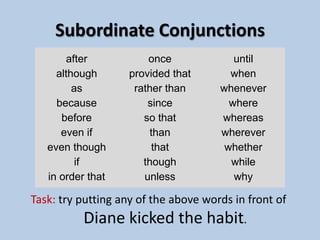
Subordinate ConjunctionsTask: try putting any of the above words in front of  Diane kicked the habit.
After Amy sneezed all over the tuna salad…So what happened? Did she eat it or throw it in the bin?UntilAadesh has his first cup of coffee…What did Aadesh do when he finished his coffee?Provided that the baby sleeps in the afternoon…So what happens if the baby sleeps in the afternoon?Some examples…
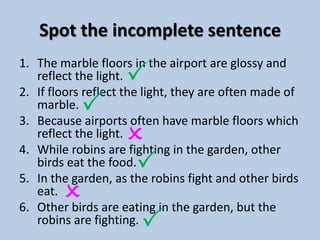
Spot the incomplete sentenceThe marble floors in the airport are glossy and reflect the light.If floors reflect the light, they are often made of marble.Because airports often have marble floors which reflect the light.While robins are fighting in the garden, other birds eat the food.In the garden, as the robins fight and other birds eat.Other birds are eating in the garden, but the robins are fighting.
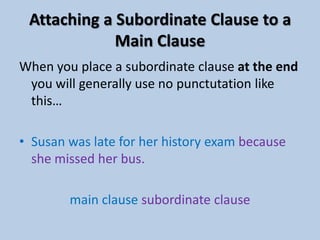
Attaching a Subordinate Clause to a Main ClauseWhen you place a subordinate clause in front of a main clause we use a comma like this…While robins are fighting in the garden,other birds eat the food.subordinate clause + , + main clause

The Main and Subordinate Clause

  • 1.
    ClausesWhy learn aboutthem?Learning about clauses helps us to determine whether we have written a complete sentence.
  • 2.
    Essentially, writing (andspeech!) is all about action. We write to explain what, when, how and why things happen.We also consider thoughts and feelings to be actions.
  • 3.
    The Main ClauseThemain clause (sometimes called an independentclause) must contain:+subjectverbThe subject is involved in the actionThe verb is the action
  • 4.
    Consider this sentence…DianekickedDiane kicked the habit.Q. Where is the subject and where is the verb?MAIN CLAUSE The sentence expresses a complete thought
  • 5.
    It containsa subject and a verb
  • 6.
    EVERY SENTENCE MUSTHAVE ONE.The Subordinate ClauseWhenever you place a subordinateconjunction in front of a subject and a verb you will no longer have a complete thought.The subordinate clause is sometimes referred to as a dependentclause.
  • 7.
    Subordinate ConjunctionsTask: tryputting any of the above words in front of Diane kicked the habit.
  • 8.
    After Amy sneezedall over the tuna salad…So what happened? Did she eat it or throw it in the bin?UntilAadesh has his first cup of coffee…What did Aadesh do when he finished his coffee?Provided that the baby sleeps in the afternoon…So what happens if the baby sleeps in the afternoon?Some examples…
  • 9.
    Spot the incompletesentenceThe marble floors in the airport are glossy and reflect the light.If floors reflect the light, they are often made of marble.Because airports often have marble floors which reflect the light.While robins are fighting in the garden, other birds eat the food.In the garden, as the robins fight and other birds eat.Other birds are eating in the garden, but the robins are fighting.
  • 10.
    Attaching a SubordinateClause to a Main ClauseWhen you place a subordinate clause in front of a main clause we use a comma like this…While robins are fighting in the garden,other birds eat the food.subordinate clause + , + main clause