Performance
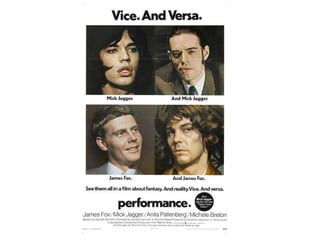
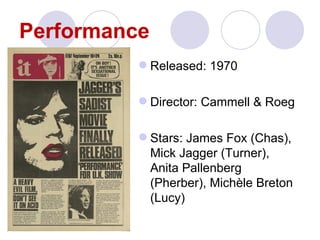
           Released: 1970

           Director: Cammell & Roeg

           Stars: James Fox (Chas),
            Mick Jagger (Turner),
            Anita Pallenberg
            (Pherber), Michèle Breton
            (Lucy)
Bit of Background
 Performance is a film about the merging of
  opposites:
   of male and female,
   of identities, of personae,
   of the apparently different worlds of gangsterism and
    extreme artistic decadence that are both revealed to
    function through the engine of the performative ritual
    of violence.
Bit of background
 The explicit sex and brutal violence of
  Performance were a breakthrough for British
  cinema, explicitly linked in Chas's taste for rough
  sex and his oddly sexualised whipping at the
  hand of Maddocks (Anthony Valentine).

 These elements, and the frequent drug-taking,
  seem to have caused Warner Bros to panic
  about the film, shelving it for two years and then
  re-editing it before its 1970 release.
Non-diegetic Soundtrack
 Performance is as challenging to listen to as it is
  to watch, and it is the soundtrack that is perhaps
  the most influential and groundbreaking aspect
  of the film.

 Rather than being a totally 'composed' score or
  a collection of 'found' pop songs, Jack Nitzsche's
  soundtrack mixes together disparate and
  'impure' musical forms,
Pop Film?
 Performance is also a 'pop' film, or, at least, it
  has often been considered in this way.

 In this respect it is useful to compare it to AHDN
  whereas Lester's film centrally stages the vibrant
  charisma and pop celebrity of their star
  protagonists, Jagger's film appearances are
  much more troubling, indistinct and ill-at-ease.
Performance – A Simple
Story in Complex Terms
 The opening half-hour is a tour of the London underworld
  of the late 1960s.

 Once gangster Chas (James Fox) enters the house of
  reclusive rock star Turner (Mick Jagger), the film
  becomes concerned with the disintegration of his
  perceptions about himself and his world.

 The film becomes a jumble of jump-cuts, point-of-view
  shifts, visual effects, elliptical editing and seamless
  changes between fantasy and reality.
Two Halves – Two Worlds
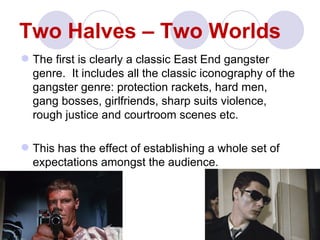
 The first is clearly a classic East End gangster
  genre. It includes all the classic iconography of the
  gangster genre: protection rackets, hard men,
  gang bosses, girlfriends, sharp suits violence,
  rough justice and courtroom scenes etc.

 This has the effect of establishing a whole set of
  expectations amongst the audience.
2 half
  nd

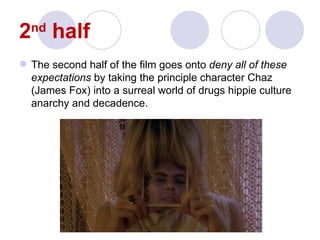
 The second half of the film goes onto deny all of these
  expectations by taking the principle character Chaz
  (James Fox) into a surreal world of drugs hippie culture
  anarchy and decadence.
2 Half
  nd


 All the characters in Powis Square seem to
  believe that their lifestyle is in some way
  superior to Chaz’s.

 Chaz is literally turned on to Turner’s decadent
  lifestyle, in a way that many people involved in
  the drug subculture would recognise.

 Chaz soon comes to see however that Turner’s
  lifestyle is fraught with traps and obstacles of its
  own.
Representations
 Society
  Corrupt / hypocritical / violent.
  Gangsters operate on the business model
   (hostile takeover – “business is business”).
  Progress is not forward (“he’s an out of date
   boy”).
Representations
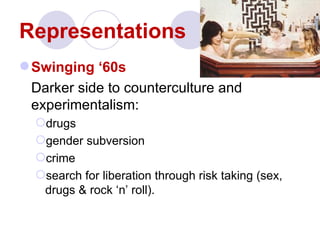
 Swinging ‘60s
 Darker side to counterculture and
 experimentalism:
  drugs
  gender subversion
  crime
  search for liberation through risk taking (sex,
   drugs & rock ‘n’ roll).
Representations
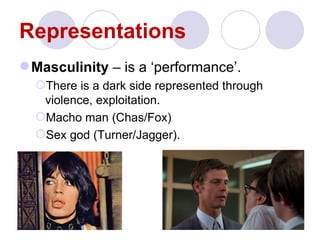
 Masculinity – is a ‘performance’.
  There is a dark side represented through
   violence, exploitation.
  Macho man (Chas/Fox)
  Sex god (Turner/Jagger).
Representations
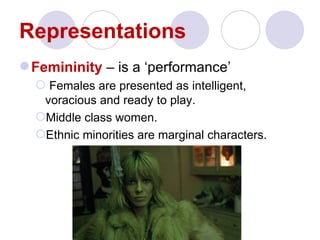
 Femininity – is a ‘performance’
   Females are presented as intelligent,
   voracious and ready to play.
  Middle class women.
  Ethnic minorities are marginal characters.
Representations
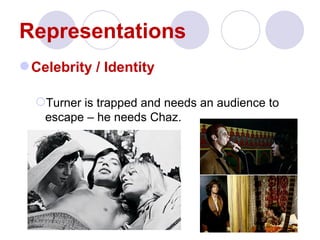
 Celebrity / Identity

  Turner is trapped and needs an audience to
   escape – he needs Chaz.
Themes
 Freedom/restriction – Chas trapped by
  gangster underworld finds freedom in the
  character of Turner – only to discover
  Turner is trapped himself (by drugs and
  celebrity)

 Crime – A way to power. No different to
  business. Linked to celebrity in terms of
  performance.
Themes
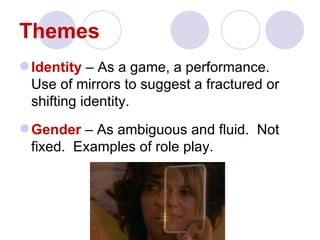
 Identity – As a game, a performance.
  Use of mirrors to suggest a fractured or
  shifting identity.
 Gender – As ambiguous and fluid. Not
  fixed. Examples of role play.
Themes
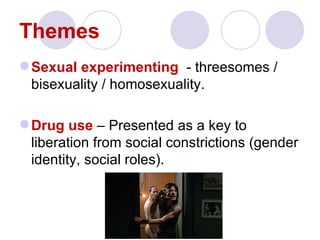
 Sexual experimenting - threesomes /
  bisexuality / homosexuality.

 Drug use – Presented as a key to
  liberation from social constrictions (gender
  identity, social roles).
Psychedelic style (represented as
revolutionary, shocking, decadent)
 Techniques used to shock and disorientate the
  audience.
    Sound design- Abnormal disrupts realist narrative
    Dutch angles – Create sense of mental abnormality extreme
     psychological conditions.
    Non diegetic inserts- Creates disruption of realist narrative
    Montage
 Disruption of continuity style-
    Cutting in on action
    Juxtaposition of images (editing style rapid, symbolic)
    B/W film stock
    Non linear narrative – images out of sequence
Symbolism
 Mirror images - suggest shifting identity
 Photographs - cameras capture identity
 Music Suggests atmosphere and descent into
  decadence
 Non diegetic inserts - (breast/blood/sex)
 Sound - Reinforces disruption of the senses and
  symbolises altered states

Cammell and Roeg's Performance (1970)

  • 2.
    Performance  Released: 1970  Director: Cammell & Roeg  Stars: James Fox (Chas), Mick Jagger (Turner), Anita Pallenberg (Pherber), Michèle Breton (Lucy)
  • 3.
    Bit of Background Performance is a film about the merging of opposites:  of male and female,  of identities, of personae,  of the apparently different worlds of gangsterism and extreme artistic decadence that are both revealed to function through the engine of the performative ritual of violence.
  • 4.
    Bit of background The explicit sex and brutal violence of Performance were a breakthrough for British cinema, explicitly linked in Chas's taste for rough sex and his oddly sexualised whipping at the hand of Maddocks (Anthony Valentine).  These elements, and the frequent drug-taking, seem to have caused Warner Bros to panic about the film, shelving it for two years and then re-editing it before its 1970 release.
  • 5.
    Non-diegetic Soundtrack  Performanceis as challenging to listen to as it is to watch, and it is the soundtrack that is perhaps the most influential and groundbreaking aspect of the film.  Rather than being a totally 'composed' score or a collection of 'found' pop songs, Jack Nitzsche's soundtrack mixes together disparate and 'impure' musical forms,
  • 6.
    Pop Film?  Performanceis also a 'pop' film, or, at least, it has often been considered in this way.  In this respect it is useful to compare it to AHDN whereas Lester's film centrally stages the vibrant charisma and pop celebrity of their star protagonists, Jagger's film appearances are much more troubling, indistinct and ill-at-ease.
  • 7.
    Performance – ASimple Story in Complex Terms  The opening half-hour is a tour of the London underworld of the late 1960s.  Once gangster Chas (James Fox) enters the house of reclusive rock star Turner (Mick Jagger), the film becomes concerned with the disintegration of his perceptions about himself and his world.  The film becomes a jumble of jump-cuts, point-of-view shifts, visual effects, elliptical editing and seamless changes between fantasy and reality.
  • 8.
    Two Halves –Two Worlds  The first is clearly a classic East End gangster genre. It includes all the classic iconography of the gangster genre: protection rackets, hard men, gang bosses, girlfriends, sharp suits violence, rough justice and courtroom scenes etc.  This has the effect of establishing a whole set of expectations amongst the audience.
  • 9.
    2 half nd  The second half of the film goes onto deny all of these expectations by taking the principle character Chaz (James Fox) into a surreal world of drugs hippie culture anarchy and decadence.
  • 10.
    2 Half nd  All the characters in Powis Square seem to believe that their lifestyle is in some way superior to Chaz’s.  Chaz is literally turned on to Turner’s decadent lifestyle, in a way that many people involved in the drug subculture would recognise.  Chaz soon comes to see however that Turner’s lifestyle is fraught with traps and obstacles of its own.
  • 11.
    Representations  Society Corrupt / hypocritical / violent. Gangsters operate on the business model (hostile takeover – “business is business”). Progress is not forward (“he’s an out of date boy”).
  • 12.
    Representations  Swinging ‘60s Darker side to counterculture and experimentalism: drugs gender subversion crime search for liberation through risk taking (sex, drugs & rock ‘n’ roll).
  • 13.
    Representations  Masculinity –is a ‘performance’. There is a dark side represented through violence, exploitation. Macho man (Chas/Fox) Sex god (Turner/Jagger).
  • 14.
    Representations  Femininity –is a ‘performance’  Females are presented as intelligent, voracious and ready to play. Middle class women. Ethnic minorities are marginal characters.
  • 15.
    Representations  Celebrity /Identity Turner is trapped and needs an audience to escape – he needs Chaz.
  • 16.
    Themes  Freedom/restriction –Chas trapped by gangster underworld finds freedom in the character of Turner – only to discover Turner is trapped himself (by drugs and celebrity)  Crime – A way to power. No different to business. Linked to celebrity in terms of performance.
  • 17.
    Themes  Identity –As a game, a performance. Use of mirrors to suggest a fractured or shifting identity.  Gender – As ambiguous and fluid. Not fixed. Examples of role play.
  • 18.
    Themes  Sexual experimenting- threesomes / bisexuality / homosexuality.  Drug use – Presented as a key to liberation from social constrictions (gender identity, social roles).
  • 19.
    Psychedelic style (representedas revolutionary, shocking, decadent)  Techniques used to shock and disorientate the audience.  Sound design- Abnormal disrupts realist narrative  Dutch angles – Create sense of mental abnormality extreme psychological conditions.  Non diegetic inserts- Creates disruption of realist narrative  Montage  Disruption of continuity style-  Cutting in on action  Juxtaposition of images (editing style rapid, symbolic)  B/W film stock  Non linear narrative – images out of sequence
  • 20.
    Symbolism  Mirror images- suggest shifting identity  Photographs - cameras capture identity  Music Suggests atmosphere and descent into decadence  Non diegetic inserts - (breast/blood/sex)  Sound - Reinforces disruption of the senses and symbolises altered states