NARRATIVE WRITING 
Steps Chap 3
*Review 
•Paragraphs must have: 
•A topic sentence that communicates the writer’s main idea 
and a keyword that communicates the purpose; 
•Plenty of vivid, unified details.
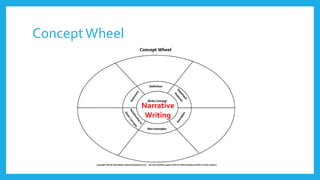
Concept Wheel 
Narrative 
Writing
Definition 
•Narrative Writing--writing that tells a story by presenting 
events in an orderly, logical sequence. 
•Narratives always have a purpose—the writer has a 
reason he/she wants to tell this story.
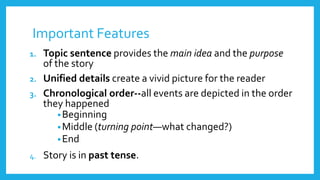
Important Features 
1. Topic sentence provides the main idea and the purpose 
of the story 
2. Unified details create a vivid picture for the reader 
3. Chronological order--all events are depicted in the order 
they happened 
•Beginning 
•Middle (turning point—what changed?) 
•End 
4. Story is in past tense.
Examples 
What are some specific examples of a narrative? 
What are some specific non-examples of a narrative?
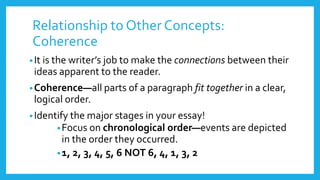
Relationship to Other Concepts: 
Coherence 
• It is the writer’s job to make the connections between their 
ideas apparent to the reader. 
•Coherence—all parts of a paragraph fit together in a clear, 
logical order. 
•Identify the major stages in your essay! 
•Focus on chronological order—events are depicted 
in the order they occurred. 
•1, 2, 3, 4, 5, 6 NOT 6, 4, 1, 3, 2
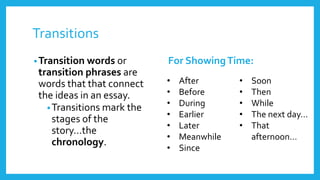
Transitions 
•Transition words or 
transition phrases are 
words that that connect 
the ideas in an essay. 
•Transitions mark the 
stages of the 
story…the 
chronology. 
For Showing Time: 
• After 
• Before 
• During 
• Earlier 
• Later 
• Meanwhile 
• Since 
• Soon 
• Then 
• While 
• The next day… 
• That 
afternoon…
WRITING AN OUTLINE
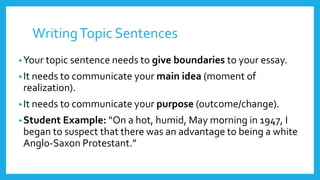
Writing Topic Sentences 
•Your topic sentence needs to give boundaries to your essay. 
• It needs to communicate your main idea (moment of 
realization). 
• It needs to communicate your purpose (outcome/change). 
•Student Example: “On a hot, humid, May morning in 1947, I 
began to suspect that there was an advantage to being a white 
Anglo-Saxon Protestant.”
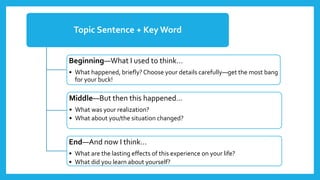
Topic Sentence + Key Word 
Beginning—What I used to think… 
• What happened, briefly? Choose your details carefully—get the most bang 
for your buck! 
Middle—But then this happened… 
• What was your realization? 
• What about you/the situation changed? 
End—And now I think… 
• What are the lasting effects of this experience on your life? 
• What did you learn about yourself?

Narrative Writing (Concept Wheel)

  • 1.
  • 2.
    *Review •Paragraphs musthave: •A topic sentence that communicates the writer’s main idea and a keyword that communicates the purpose; •Plenty of vivid, unified details.
  • 3.
  • 4.
    Definition •Narrative Writing--writingthat tells a story by presenting events in an orderly, logical sequence. •Narratives always have a purpose—the writer has a reason he/she wants to tell this story.
  • 5.
    Important Features 1.Topic sentence provides the main idea and the purpose of the story 2. Unified details create a vivid picture for the reader 3. Chronological order--all events are depicted in the order they happened •Beginning •Middle (turning point—what changed?) •End 4. Story is in past tense.
  • 6.
    Examples What aresome specific examples of a narrative? What are some specific non-examples of a narrative?
  • 7.
    Relationship to OtherConcepts: Coherence • It is the writer’s job to make the connections between their ideas apparent to the reader. •Coherence—all parts of a paragraph fit together in a clear, logical order. •Identify the major stages in your essay! •Focus on chronological order—events are depicted in the order they occurred. •1, 2, 3, 4, 5, 6 NOT 6, 4, 1, 3, 2
  • 8.
    Transitions •Transition wordsor transition phrases are words that that connect the ideas in an essay. •Transitions mark the stages of the story…the chronology. For Showing Time: • After • Before • During • Earlier • Later • Meanwhile • Since • Soon • Then • While • The next day… • That afternoon…
  • 9.
  • 10.
    Writing Topic Sentences •Your topic sentence needs to give boundaries to your essay. • It needs to communicate your main idea (moment of realization). • It needs to communicate your purpose (outcome/change). •Student Example: “On a hot, humid, May morning in 1947, I began to suspect that there was an advantage to being a white Anglo-Saxon Protestant.”
  • 11.
    Topic Sentence +Key Word Beginning—What I used to think… • What happened, briefly? Choose your details carefully—get the most bang for your buck! Middle—But then this happened… • What was your realization? • What about you/the situation changed? End—And now I think… • What are the lasting effects of this experience on your life? • What did you learn about yourself?