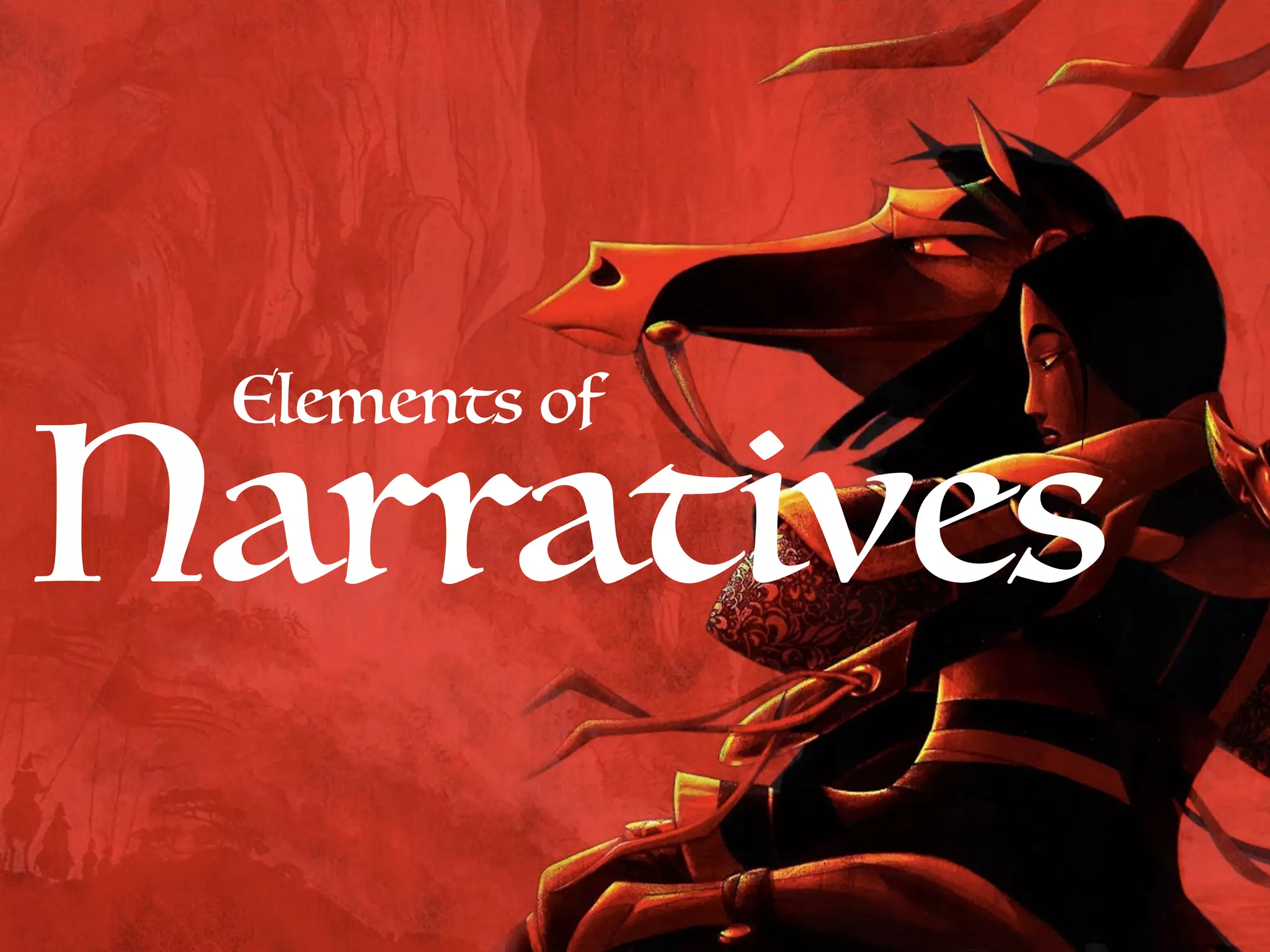
Elements of
Narratives
Personal Narrative
A story about a moment in
your own life.
It is not an autobiography (a story
about your entire life)!
A personal narrative focuses on a
single event or moment in your life.
Fictional Narrative
A story about a moment in a
made-up character’s life.
You create the characters, setting,
and conflict, but it should still
focus on a single event or moment
(because this is a SHORT story!)
Focus!
You can’t write a novel! When creating your
story, focus on a single moment or very
few moments.
Personal Narrative: I will tell the story of the
moment when I forgot my lines while
performing on stage.
Fictional Narrative: I will tell the story of the
moment when my character got lost in the
woods.
Point of View:
1st Person:
“I never thought that
owning a dog would be
so challenging. When I
brought Fluffy home for
the first time, she
destroyed my favorite
pair of shoes within five
minutes. After I found
the damage, I locked
Fluffy in her crate.”
3rd Person:
“Amber used to think that
owning a dog would be
easy, but when she
brought Fluffy home for
the first time, she
discovered she was
wrong. Fluffy had
destroyed her favorite pair
of shoes. When amber
saw them, she locked
Fluffy in her crate.”
Narrative Elements
There are 5 main elements that apply to
narratives in general:
1. Character
2. Setting
3. Conflict
4. Plot
5. Theme
These are
the main
“ingredients”
in a story.
Character
The main people (or other living things)
that are involved in your story.
YOUR GOALS AS THE WRITER:
• Show who your characters are through their behaviors.
• Show what motivates your characters.
• Make your characters realistic.
Setting
Where do different scenes in your story
take place?
YOUR GOALS AS THE WRITER:
• “Paint” a picture of the scene.
• Create a mood.
• Establish context for the story (time and location).
Conflict
What problem or challenge does the main
character in the story face?
YOUR GOALS AS THE WRITER:
• Create tension and interest in your story by making readers
doubt that your characters will be successful.
• Create a problem that motivates and drives the actions of
your characters.
Conflict
Both narrative types need to focus on a
conflict that the main character faces.
Every story worth reading
has a conflict.
If there is no conflict, there is
no tension in the story.
Types of Conflict:
External Conflict: Internal Conflict:
Pip can’t decide if he
should join basketball
or swimming.
The coach says that Pip
isn’t allowed to join the
cross country team
because he is a robot.
Pip will have to struggle
against the coach if he
wants to join the team.
Pip will have
an internal
struggle to
decide what
is best for
him.
Man vs. Self
A man struggles to be kind to his
wife’s ex-boyfriend even though he is
very jealous
A woman struggles to understand her
identity when she is half Chinese and
half American
A man struggles to quit a drug
addiction
examples
Man vs. Man
Two men fall in love with the same
woman
A student struggles against a mean
teacher that always gives him
detention
A hero must defeat the villain who
ruined his life
examples
Man vs. Nature
A man is attacked by bears while on a
camping trip
A family struggles to survive during a
hurricane
A drought kills all of the crops, and a
farmer must try to survive without food
or money
examples
Man vs. Society
A gay couple tries to find acceptance
in a society that does not accept their
choices
An immigrant fights to change a law
that prevents him from becoming a
citizen
A man wants to become a artist, but
his family expects him to be a doctor
examples
Man vs. Technology
A man struggles to hack a computer
in order to steal information
A farmer’s tractor breaks down, and
he struggles to fix it in time for the
harvest
A team of students struggles to build
an underwater robot for a contest
examples
Man vs. Supernatural
A man struggles to survive as a god
tries to ruin his life
A man struggles to get home after
being transported back in time by a
mysterious spell
A fated prophecy states that a man
will kill his father, and he struggles to
prevent this from happening
examples
Conflict:
What might conflict look like in a personal
narrative or college admissions essay?
• You vs. an academic or co-curricular
challenge
• You vs. expectations others hold for you
• You vs. personal shortcomings
• You vs. friends or family members
• You vs. a experience of failure
• You vs. …
Plot
How is the problem introduced? What
steps does the character take to solve the
problem? How is the problem is solved?
YOUR GOALS AS THE WRITER:
• Create a series of events that shows how your character
strives to overcome the problem/conflict.
• Create a plot that feels original (avoid cliches).
Theme
What does the story seek to tell us about
life or human nature? What’s the message
of the story?
YOUR GOALS AS THE WRITER:
• Write a story that means something more to readers than
the surface-level enjoyment of events in the plot.
• Don’t make your theme/message obvious or repetitive.
Let’s identify elements
of narratives in Disney’s…
Mulan
Character
How does the author teach us about who the main
characters are? (Personality, habits, beliefs,
physical appearance, desires, history, etc.?)
We first meet
Mulan. She ties a
bag of grain to her
dog, and uses the
dog to feed the
farm animals.
Exposition
What does the character’s action SHOW
you about their personality?
Character
We first meet
Mulan’s father. He
is praying to his
ancestors for
Mulan to not mess
up on her
important day.
How does the author teach us about who the main
characters are? (Personality, habits, beliefs,
physical appearance, desires, history, etc.?)
Exposition
What does the character’s action SHOW
you about their personality?
Character
Mulan seems
slightly more
confused,
awkward, and
disorganized than
the other girls in
town.
How does the author teach us about who the main
characters are? (Personality, habits, beliefs,
physical appearance, desires, history, etc.?)
Exposition
What does the character’s action SHOW
you about their personality?
Character
She ruins her
meeting with the
town matchmaker
in every way
possible.
How does the author teach us about who the main
characters are? (Personality, habits, beliefs,
physical appearance, desires, history, etc.?)
Exposition
What does the character’s action SHOW
you about their personality?
Setting
How does the author create a mood with setting?
How does the setting enrich the overall story?
Conflict
What struggle motivates the characters to act?
A good story tends to have more than one
conflict.
Mulan sings a sad
song because she
feels like she can’t
be herself. (Her
family/the
community
expects her to be
a housewife).
Intro Conflict
Conflict
What struggle motivates the characters to act?
A good story tends to have more than one
conflict.
An army is
approaching China
and new soldiers
are being recruited.
One man from every
family must go, so
Mulan’s father has
to enlist even
though he is old
and injured. Women
are not allowed in
the army.
Intro Conflict
Plot
What events move the story forward and help the
characters resolve their conflicts?
Mulan dresses up
as a man and
goes to enlist in
the army in order
to protect her
father. She meets
her incompetent
dragon protector,
Mushu.
Rising Action
Character
How does the author teach us about who the main
characters are? (Personality, habits, beliefs,
physical appearance, desires, history, etc.?)
Rising Action
The leader of the
Huns, Shan Yu,
captures two
Chinese scouts
and kills one
because only one
man is needed to
deliver a
message.
What does the character’s action SHOW
you about their personality?
Plot
What events move the story forward and help the
characters resolve their conflicts?
Mulan tries to act
like a man at the
training camp in
hopes of keeping
her identity secret.
Mulan develops a
crush on captain
Shang.
Rising Action
Note that new conflicts arise that build on the main conflicts which
have already been established.
Plot
What events move the story forward and help the
characters resolve their conflicts?
Mulan gradually
proves that she’s
capable of being a
soldier.
Rising Action
Plot
What events move the story forward and help the
characters resolve their conflicts?
Mulan and friends
finally fight the Huns.
Mulan comes up
with a clever plan to
help them win.
Rising Action
Plot
What events move the story forward and help the
characters resolve their conflicts?
Mulan gets injured,
so everyone finds
out she is a woman.
She is kicked out of
the army.
Rising Action
Plot
What events move the story forward and help the
characters resolve their conflicts?
Mulan discovers
that the Hun army
was not destroyed,
so she rides to warn
people in the
capital.
Rising Action
Plot
What events move the story forward and help the
characters resolve their conflicts?
Mulan reunites with
her friends and they
come up with a plan
to protect the
Emperor and stop
the Huns.
Climax
Plot
What events move the story forward and help the
characters resolve their conflicts?
Mulan & friends kill
Shan Yu with
fireworks, and China
is safe.
Climax / One Conflict Resolved
Plot
What events move the story forward and help the
characters resolve their conflicts?
Mulan is honored
by the Emperor.
Mulan travels
home.
Falling Action
Plot
What events move the story forward and help the
characters resolve their conflicts?
Mulan’s father says
he is proud to have
her as a daughter.
Conflict Resolved
Plot
What events move the story forward and help the
characters resolve their conflicts?
Conflict Resolved
Captain Shang
shows up at
Mulan's house
looking for her.
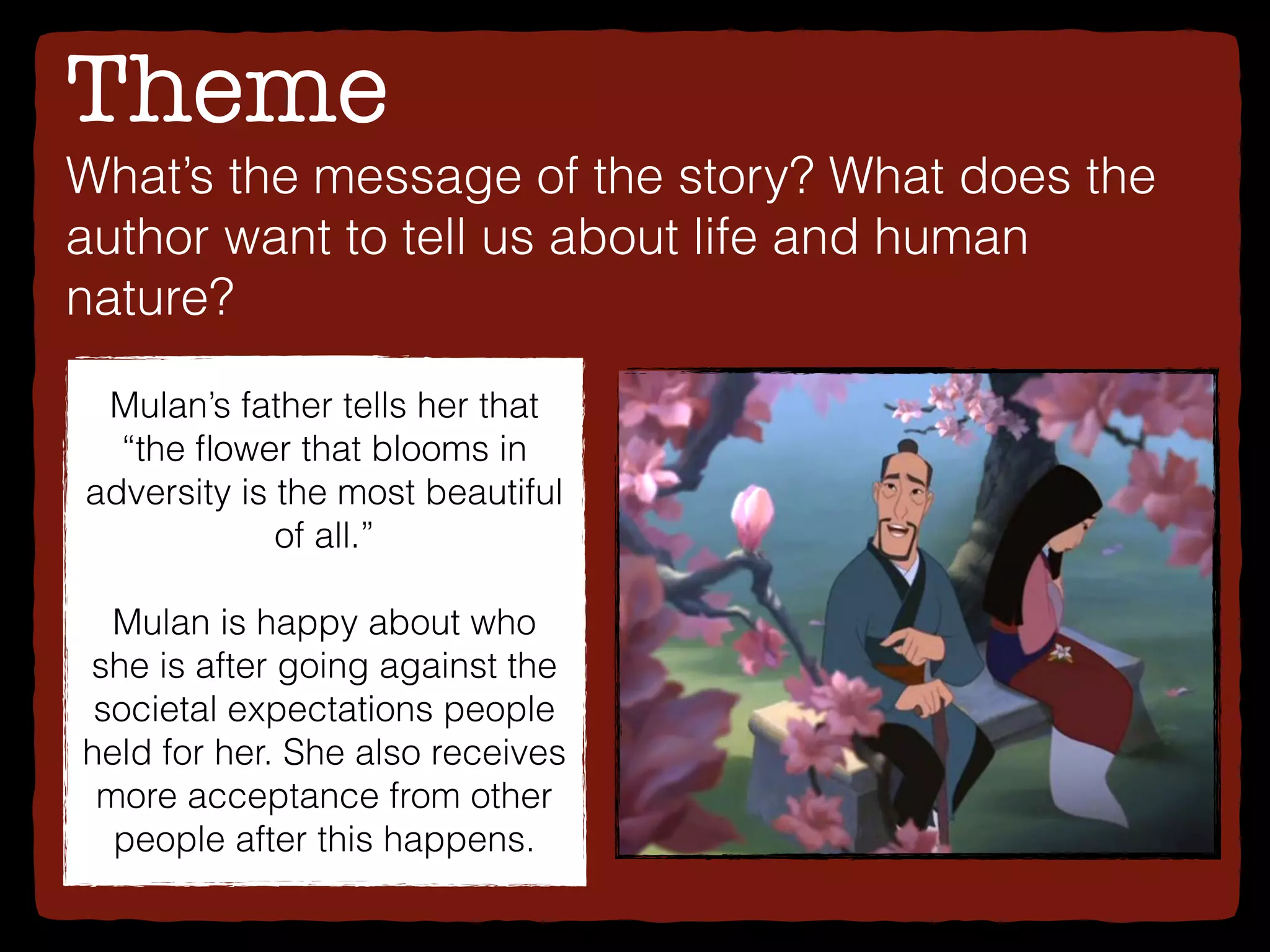
Theme
What’s the message of the story? What does the
author want to tell us about life and human
nature?
Mulan’s father tells her that
“the flower that blooms in
adversity is the most beautiful
of all.”
Mulan is happy about who
she is after going against the
societal expectations people
held for her. She also receives
more acceptance from other
people after this happens.
Reflection
Reflect, or share your thoughts, about why the
story you are telling is meaningful.
YOUR GOALS AS THE WRITER:
• Make your thoughts in your narrative more important than the
events you are describing. Events are generic, but your
thoughts are unique.
• Reveal what you or other people learned by sharing thoughts
• Reflection doesn’t always have to be positive or uplifting, and
you do not have to shy away from the truth of what you
experienced, even if it resulted in failure or tragedy. Honesty,
vulnerability and even confrontation of difficult lessons will
make your essay even more poignant.
Change
Personal narratives tend to depict change.
Maybe your skill level changes, your beliefs
change, the way you understand the world
changes, your mood or habits change…etc.
Often characters learn something from the
change.
Outline
Beginning
• Who is(are) the main character(s)?
• What is the setting?
• What is the problem?
Middle
• How does the character try to solve the
problem?
End
• Is the problem resolved? How?
• Reflect: why was this event important or
meaningful in the life of the character?

Narrative Elements

  • 1.
  • 2.
    Personal Narrative A storyabout a moment in your own life. It is not an autobiography (a story about your entire life)! A personal narrative focuses on a single event or moment in your life.
  • 3.
    Fictional Narrative A storyabout a moment in a made-up character’s life. You create the characters, setting, and conflict, but it should still focus on a single event or moment (because this is a SHORT story!)
  • 4.
    Focus! You can’t writea novel! When creating your story, focus on a single moment or very few moments. Personal Narrative: I will tell the story of the moment when I forgot my lines while performing on stage. Fictional Narrative: I will tell the story of the moment when my character got lost in the woods.
  • 5.
    Point of View: 1stPerson: “I never thought that owning a dog would be so challenging. When I brought Fluffy home for the first time, she destroyed my favorite pair of shoes within five minutes. After I found the damage, I locked Fluffy in her crate.” 3rd Person: “Amber used to think that owning a dog would be easy, but when she brought Fluffy home for the first time, she discovered she was wrong. Fluffy had destroyed her favorite pair of shoes. When amber saw them, she locked Fluffy in her crate.”
  • 6.
    Narrative Elements There are5 main elements that apply to narratives in general: 1. Character 2. Setting 3. Conflict 4. Plot 5. Theme These are the main “ingredients” in a story.
  • 7.
    Character The main people(or other living things) that are involved in your story. YOUR GOALS AS THE WRITER: • Show who your characters are through their behaviors. • Show what motivates your characters. • Make your characters realistic.
  • 8.
    Setting Where do differentscenes in your story take place? YOUR GOALS AS THE WRITER: • “Paint” a picture of the scene. • Create a mood. • Establish context for the story (time and location).
  • 9.
    Conflict What problem orchallenge does the main character in the story face? YOUR GOALS AS THE WRITER: • Create tension and interest in your story by making readers doubt that your characters will be successful. • Create a problem that motivates and drives the actions of your characters.
  • 10.
    Conflict Both narrative typesneed to focus on a conflict that the main character faces. Every story worth reading has a conflict. If there is no conflict, there is no tension in the story.
  • 12.
    Types of Conflict: ExternalConflict: Internal Conflict: Pip can’t decide if he should join basketball or swimming. The coach says that Pip isn’t allowed to join the cross country team because he is a robot. Pip will have to struggle against the coach if he wants to join the team. Pip will have an internal struggle to decide what is best for him.
  • 13.
    Man vs. Self Aman struggles to be kind to his wife’s ex-boyfriend even though he is very jealous A woman struggles to understand her identity when she is half Chinese and half American A man struggles to quit a drug addiction examples
  • 14.
    Man vs. Man Twomen fall in love with the same woman A student struggles against a mean teacher that always gives him detention A hero must defeat the villain who ruined his life examples
  • 15.
    Man vs. Nature Aman is attacked by bears while on a camping trip A family struggles to survive during a hurricane A drought kills all of the crops, and a farmer must try to survive without food or money examples
  • 16.
    Man vs. Society Agay couple tries to find acceptance in a society that does not accept their choices An immigrant fights to change a law that prevents him from becoming a citizen A man wants to become a artist, but his family expects him to be a doctor examples
  • 17.
    Man vs. Technology Aman struggles to hack a computer in order to steal information A farmer’s tractor breaks down, and he struggles to fix it in time for the harvest A team of students struggles to build an underwater robot for a contest examples
  • 18.
    Man vs. Supernatural Aman struggles to survive as a god tries to ruin his life A man struggles to get home after being transported back in time by a mysterious spell A fated prophecy states that a man will kill his father, and he struggles to prevent this from happening examples
  • 19.
    Conflict: What might conflictlook like in a personal narrative or college admissions essay? • You vs. an academic or co-curricular challenge • You vs. expectations others hold for you • You vs. personal shortcomings • You vs. friends or family members • You vs. a experience of failure • You vs. …
  • 20.
    Plot How is theproblem introduced? What steps does the character take to solve the problem? How is the problem is solved? YOUR GOALS AS THE WRITER: • Create a series of events that shows how your character strives to overcome the problem/conflict. • Create a plot that feels original (avoid cliches).
  • 22.
    Theme What does thestory seek to tell us about life or human nature? What’s the message of the story? YOUR GOALS AS THE WRITER: • Write a story that means something more to readers than the surface-level enjoyment of events in the plot. • Don’t make your theme/message obvious or repetitive.
  • 23.
    Let’s identify elements ofnarratives in Disney’s… Mulan
  • 24.
    Character How does theauthor teach us about who the main characters are? (Personality, habits, beliefs, physical appearance, desires, history, etc.?) We first meet Mulan. She ties a bag of grain to her dog, and uses the dog to feed the farm animals. Exposition What does the character’s action SHOW you about their personality?
  • 25.
    Character We first meet Mulan’sfather. He is praying to his ancestors for Mulan to not mess up on her important day. How does the author teach us about who the main characters are? (Personality, habits, beliefs, physical appearance, desires, history, etc.?) Exposition What does the character’s action SHOW you about their personality?
  • 26.
    Character Mulan seems slightly more confused, awkward,and disorganized than the other girls in town. How does the author teach us about who the main characters are? (Personality, habits, beliefs, physical appearance, desires, history, etc.?) Exposition What does the character’s action SHOW you about their personality?
  • 27.
    Character She ruins her meetingwith the town matchmaker in every way possible. How does the author teach us about who the main characters are? (Personality, habits, beliefs, physical appearance, desires, history, etc.?) Exposition What does the character’s action SHOW you about their personality?
  • 28.
    Setting How does theauthor create a mood with setting? How does the setting enrich the overall story?
  • 29.
    Conflict What struggle motivatesthe characters to act? A good story tends to have more than one conflict. Mulan sings a sad song because she feels like she can’t be herself. (Her family/the community expects her to be a housewife). Intro Conflict
  • 30.
    Conflict What struggle motivatesthe characters to act? A good story tends to have more than one conflict. An army is approaching China and new soldiers are being recruited. One man from every family must go, so Mulan’s father has to enlist even though he is old and injured. Women are not allowed in the army. Intro Conflict
  • 31.
    Plot What events movethe story forward and help the characters resolve their conflicts? Mulan dresses up as a man and goes to enlist in the army in order to protect her father. She meets her incompetent dragon protector, Mushu. Rising Action
  • 32.
    Character How does theauthor teach us about who the main characters are? (Personality, habits, beliefs, physical appearance, desires, history, etc.?) Rising Action The leader of the Huns, Shan Yu, captures two Chinese scouts and kills one because only one man is needed to deliver a message. What does the character’s action SHOW you about their personality?
  • 33.
    Plot What events movethe story forward and help the characters resolve their conflicts? Mulan tries to act like a man at the training camp in hopes of keeping her identity secret. Mulan develops a crush on captain Shang. Rising Action Note that new conflicts arise that build on the main conflicts which have already been established.
  • 34.
    Plot What events movethe story forward and help the characters resolve their conflicts? Mulan gradually proves that she’s capable of being a soldier. Rising Action
  • 35.
    Plot What events movethe story forward and help the characters resolve their conflicts? Mulan and friends finally fight the Huns. Mulan comes up with a clever plan to help them win. Rising Action
  • 36.
    Plot What events movethe story forward and help the characters resolve their conflicts? Mulan gets injured, so everyone finds out she is a woman. She is kicked out of the army. Rising Action
  • 37.
    Plot What events movethe story forward and help the characters resolve their conflicts? Mulan discovers that the Hun army was not destroyed, so she rides to warn people in the capital. Rising Action
  • 38.
    Plot What events movethe story forward and help the characters resolve their conflicts? Mulan reunites with her friends and they come up with a plan to protect the Emperor and stop the Huns. Climax
  • 39.
    Plot What events movethe story forward and help the characters resolve their conflicts? Mulan & friends kill Shan Yu with fireworks, and China is safe. Climax / One Conflict Resolved
  • 40.
    Plot What events movethe story forward and help the characters resolve their conflicts? Mulan is honored by the Emperor. Mulan travels home. Falling Action
  • 41.
    Plot What events movethe story forward and help the characters resolve their conflicts? Mulan’s father says he is proud to have her as a daughter. Conflict Resolved
  • 42.
    Plot What events movethe story forward and help the characters resolve their conflicts? Conflict Resolved Captain Shang shows up at Mulan's house looking for her.
  • 43.
    Theme What’s the messageof the story? What does the author want to tell us about life and human nature? Mulan’s father tells her that “the flower that blooms in adversity is the most beautiful of all.” Mulan is happy about who she is after going against the societal expectations people held for her. She also receives more acceptance from other people after this happens.
  • 44.
    Reflection Reflect, or shareyour thoughts, about why the story you are telling is meaningful. YOUR GOALS AS THE WRITER: • Make your thoughts in your narrative more important than the events you are describing. Events are generic, but your thoughts are unique. • Reveal what you or other people learned by sharing thoughts • Reflection doesn’t always have to be positive or uplifting, and you do not have to shy away from the truth of what you experienced, even if it resulted in failure or tragedy. Honesty, vulnerability and even confrontation of difficult lessons will make your essay even more poignant.
  • 45.
    Change Personal narratives tendto depict change. Maybe your skill level changes, your beliefs change, the way you understand the world changes, your mood or habits change…etc. Often characters learn something from the change.
  • 46.
    Outline Beginning • Who is(are)the main character(s)? • What is the setting? • What is the problem? Middle • How does the character try to solve the problem? End • Is the problem resolved? How? • Reflect: why was this event important or meaningful in the life of the character?