Definitions and Characteristics
 Legends: a non-historical or unverifiable story handed down by
tradition from earlier times and popularly accepted as
historical.
 Fable: a short tale to teach a moral lesson, often with animals
or inanimate objects as characters;
 Folktales: a tale or legend originating and traditional among a
people or folk, especially one forming part of the oral tradition
of the common people.
 Fairytales: a story, usually for children, about elves,
hobgoblins, dragons, fairies, or other magical creatures.
www.dictionary.com
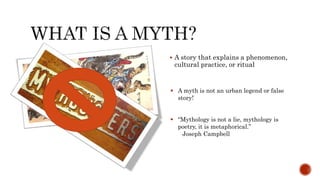
 A story that explains a phenomenon,
cultural practice, or ritual
 A myth is not an urban legend or false
story!
 “Mythology is not a lie, mythology is
poetry, it is metaphorical.”
Joseph Campbell
 Feature a hero
 Deal with gods and demigods
 Intended to teach a lesson
 Some may have factual origins
 Include sacred tales and traditions
 Universality
CREATION
MYTHS
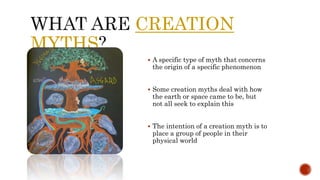
 A specific type of myth that concerns
the origin of a specific phenomenon
 Some creation myths deal with how
the earth or space came to be, but
not all seek to explain this
 The intention of a creation myth is to
place a group of people in their
physical world
 Every society on Earth has a creation myth
 Frequently feature the theme of birth or include a parental figure
 Often utilize local animals
 Almost always describe a supreme being
 Some myths describe life as beginning above or below where it is now
 Some myths describe an initial harmony amongst animals
Most simply put, flood stories are about resetting the world:
A deluge sweeps over the land, washing away the “old.”
Flood stories occur all over the world; there is at least one
on every continent.
Many mythologists believe that flood stories are born as a
means of explaining a natural disaster and therefore will
only appear in regions of the world where flooding is likely
to happen.
Elements of Floods
Floods are the works of a
supernatural being or beings,
often as punishment for human
iniquities.
Floods are global; they cover
the entire world.
An individual or group of
individuals is spared.
Floods are often associated
with rebirth and renewal.
They wash away the original
creation and act as a new
creation story.
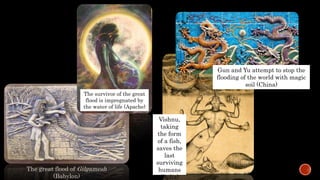
The great flood of Gilgamesh
(Babylon)
The survivor of the great
flood is impregnated by
the water of life (Apache)
Vishnu,
taking
the form
of a fish,
saves the
last
surviving
humans
(India)
Gun and Yu attempt to stop the
flooding of the world with magic
soil (China)
Tricksters
A brief overview
A Universal Archetype
 A creature, person, or spirit in a myth who plays tricks and uses cunning to defy cultural
norms
 Tricksters are found in every society on earth
 Tricksters frequently serve to teach a lesson or impart morals
 The characteristics of tricksters
 Intelligent
 Usually male
 Are often smaller, less aggressive animals or people
 Spirit tricksters spread chaos for the sake of chaos
 Move from geographical location and adapt
 Evolve and change over time
 Can be malicious
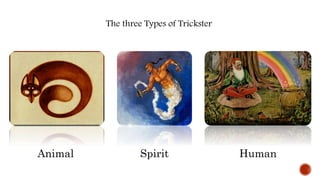
The three Types of Trickster
Animal Spirit Human
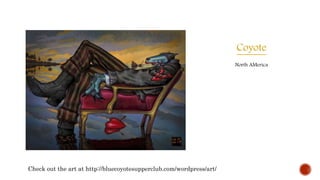
Coyote
North AMerica
Check out the art at http://bluecoyotesupperclub.com/wordpress/art/
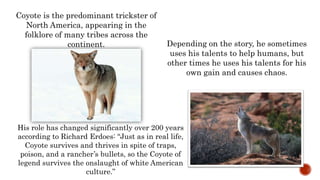
Coyote is the predominant trickster of
North America, appearing in the
folklore of many tribes across the
continent. Depending on the story, he sometimes
uses his talents to help humans, but
other times he uses his talents for his
own gain and causes chaos.
His role has changed significantly over 200 years
according to Richard Erdoes: “Just as in real life,
Coyote survives and thrives in spite of traps,
poison, and a rancher’s bullets, so the Coyote of
legend survives the onslaught of white American
culture.”
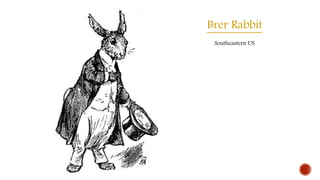
Brer Rabbit
Southeastern US
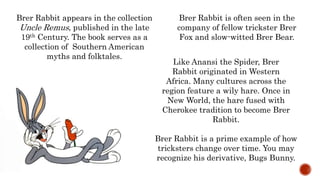
Brer Rabbit is a prime example of how
tricksters change over time. You may
recognize his derivative, Bugs Bunny.
Brer Rabbit appears in the collection
Uncle Remus, published in the late
19th Century. The book serves as a
collection of Southern American
myths and folktales.
Like Anansi the Spider, Brer
Rabbit originated in Western
Africa. Many cultures across the
region feature a wily hare. Once in
New World, the hare fused with
Cherokee tradition to become Brer
Rabbit.
Brer Rabbit is often seen in the
company of fellow trickster Brer
Fox and slow-witted Brer Bear.
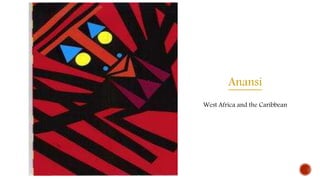
Anansi
West Africa and the Caribbean
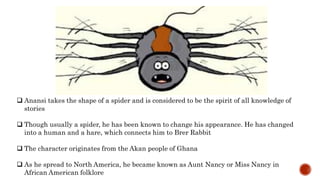
 Anansi takes the shape of a spider and is considered to be the spirit of all knowledge of
stories
 Though usually a spider, he has been known to change his appearance. He has changed
into a human and a hare, which connects him to Brer Rabbit
 The character originates from the Akan people of Ghana
 As he spread to North America, he became known as Aunt Nancy or Miss Nancy in
African American folklore
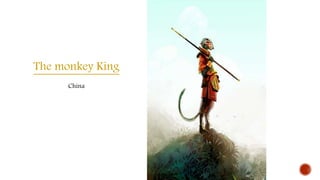
The monkey King
China
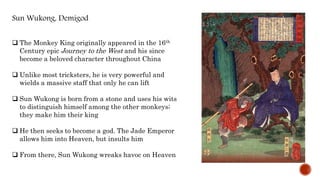
Sun Wukong, Demigod
 The Monkey King originally appeared in the 16th
Century epic Journey to the West and his since
become a beloved character throughout China
 Unlike most tricksters, he is very powerful and
wields a massive staff that only he can lift
 Sun Wukong is born from a stone and uses his wits
to distinguish himself among the other monkeys;
they make him their king
 He then seeks to become a god. The Jade Emperor
allows him into Heaven, but insults him
 From there, Sun Wukong wreaks havoc on Heaven
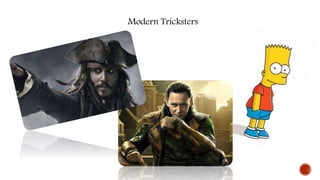
Modern Tricksters

Mythology

  • 1.
  • 2.
     Legends: anon-historical or unverifiable story handed down by tradition from earlier times and popularly accepted as historical.  Fable: a short tale to teach a moral lesson, often with animals or inanimate objects as characters;  Folktales: a tale or legend originating and traditional among a people or folk, especially one forming part of the oral tradition of the common people.  Fairytales: a story, usually for children, about elves, hobgoblins, dragons, fairies, or other magical creatures. www.dictionary.com
  • 3.
     A storythat explains a phenomenon, cultural practice, or ritual  A myth is not an urban legend or false story!  “Mythology is not a lie, mythology is poetry, it is metaphorical.” Joseph Campbell
  • 4.
     Feature ahero  Deal with gods and demigods  Intended to teach a lesson  Some may have factual origins  Include sacred tales and traditions  Universality
  • 5.
    CREATION MYTHS  A specifictype of myth that concerns the origin of a specific phenomenon  Some creation myths deal with how the earth or space came to be, but not all seek to explain this  The intention of a creation myth is to place a group of people in their physical world
  • 6.
     Every societyon Earth has a creation myth  Frequently feature the theme of birth or include a parental figure  Often utilize local animals  Almost always describe a supreme being  Some myths describe life as beginning above or below where it is now  Some myths describe an initial harmony amongst animals
  • 8.
    Most simply put,flood stories are about resetting the world: A deluge sweeps over the land, washing away the “old.” Flood stories occur all over the world; there is at least one on every continent. Many mythologists believe that flood stories are born as a means of explaining a natural disaster and therefore will only appear in regions of the world where flooding is likely to happen.
  • 9.
    Elements of Floods Floodsare the works of a supernatural being or beings, often as punishment for human iniquities. Floods are global; they cover the entire world. An individual or group of individuals is spared. Floods are often associated with rebirth and renewal. They wash away the original creation and act as a new creation story.
  • 10.
    The great floodof Gilgamesh (Babylon) The survivor of the great flood is impregnated by the water of life (Apache) Vishnu, taking the form of a fish, saves the last surviving humans (India) Gun and Yu attempt to stop the flooding of the world with magic soil (China)
  • 11.
  • 12.
    A Universal Archetype A creature, person, or spirit in a myth who plays tricks and uses cunning to defy cultural norms  Tricksters are found in every society on earth  Tricksters frequently serve to teach a lesson or impart morals  The characteristics of tricksters  Intelligent  Usually male  Are often smaller, less aggressive animals or people  Spirit tricksters spread chaos for the sake of chaos  Move from geographical location and adapt  Evolve and change over time  Can be malicious
  • 13.
    The three Typesof Trickster Animal Spirit Human
  • 14.
    Coyote North AMerica Check outthe art at http://bluecoyotesupperclub.com/wordpress/art/
  • 15.
    Coyote is thepredominant trickster of North America, appearing in the folklore of many tribes across the continent. Depending on the story, he sometimes uses his talents to help humans, but other times he uses his talents for his own gain and causes chaos. His role has changed significantly over 200 years according to Richard Erdoes: “Just as in real life, Coyote survives and thrives in spite of traps, poison, and a rancher’s bullets, so the Coyote of legend survives the onslaught of white American culture.”
  • 16.
  • 17.
    Brer Rabbit isa prime example of how tricksters change over time. You may recognize his derivative, Bugs Bunny. Brer Rabbit appears in the collection Uncle Remus, published in the late 19th Century. The book serves as a collection of Southern American myths and folktales. Like Anansi the Spider, Brer Rabbit originated in Western Africa. Many cultures across the region feature a wily hare. Once in New World, the hare fused with Cherokee tradition to become Brer Rabbit. Brer Rabbit is often seen in the company of fellow trickster Brer Fox and slow-witted Brer Bear.
  • 18.
  • 19.
     Anansi takesthe shape of a spider and is considered to be the spirit of all knowledge of stories  Though usually a spider, he has been known to change his appearance. He has changed into a human and a hare, which connects him to Brer Rabbit  The character originates from the Akan people of Ghana  As he spread to North America, he became known as Aunt Nancy or Miss Nancy in African American folklore
  • 20.
  • 21.
    Sun Wukong, Demigod The Monkey King originally appeared in the 16th Century epic Journey to the West and his since become a beloved character throughout China  Unlike most tricksters, he is very powerful and wields a massive staff that only he can lift  Sun Wukong is born from a stone and uses his wits to distinguish himself among the other monkeys; they make him their king  He then seeks to become a god. The Jade Emperor allows him into Heaven, but insults him  From there, Sun Wukong wreaks havoc on Heaven
  • 22.

Editor's Notes

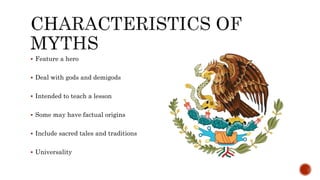
  • #5 This is the eagle of Nahuatl (Aztec) origin stories. The Nahuatl origin myth is that their ancestors were a small, nomadic group that was frequently in (forced) conflict with much more powerful and violent societies. They wandered the desert looking for a home and finally had a sign: An eagle clutching a snake while perched on a cactus. The cactus was in the middle of an island, surrounded on all sides by lake. The lake was fertile (this is where they fished and set up their agriculture). They settled there and built their capital, Tenochtitlan.
  • #6 The photo is the Norse origin story. Not all myths seek to explain how celestial bodies came into being; some focus on why the bear lost his tail, for example.
  • #7 There are many common themes among creation stories. For example, Iroquois and Hindu myths both feature the earth on the back of a turtle. Technically in Hindu creation myths, the Earth is held up by elephants which rest on the back of a turtle (I’m pretty sure….maybe it’s a snake). The breaking up of a primal unity: Mother Earth separating from Father Sky. This is a type of creation story.
  • #9 Deluge: A large, generally overwhelming, amount of rain On the third point: Why do so many flood stories have the same characteristics?
  • #10 Iniquities: Immoral behaviors; wrongdoings
  • #11 Gun and Yu are father and son, respectively. There are many accounts of the flood in China, but they all seem to point to Gun’s failure to stop a gradual flood and Yu’s eventual success. It seems that the flood story in China relates to the origins of irrigation (thanks to Yu) in the country, or at least the southern part of the country. According to the Apache flood story, the flood came from underneath the Earth (where humans originated according to tradition). A man, upon seeing the water rising from the ground, quickly fastened a canoe from a fallen tree and placed a young woman inside of it. She stayed in the canoe throughout the floods and waited until the waters receded before leaving. When the flood was over, she looked around and realized that no one was left, but then the sun shone upon her and water dripped down on her; she conceived the new human race. The flood story preserved in Matsya Purana (a Hindu scripture) is similar to the Hebrew story of Noah’s ark. The gods, particularly Vishnu (called Matsya in his current form, a fish) intend to flood the world. They choose Manu, then instruct him to collect the grains and the animals of the world and place them on a ship. Vishnu remains with the ship throughout the flood, watching over them.
  • #14 The fox is a trickster found throughout Western Europe. The jinn is common in many Islamic countries. The leprechaun is found in Ireland.
  • #18 Wily: Sneaky and prone to mischief Derivative: Derived from, based on another source. Note that this is not quite the same as the mathematical use of the word.
  • #19 Like Brer Rabbit, Anansi originates in Western Africa, where he moved to the western hemisphere via the slave trade
  • #20 It is not uncommon for spiders to represent storytelling across cultures. Many diverse Native American tribes also view spiders as the originators of language and primordial alphabets.
  • #22 Sun Wukong is insulted by being made the stable master of Heaven. Angry, he releases all of the horses. Sun Wukong is also important because he imparts moral wisdom; he’s a Taoist figure.
  • #23 Jack Sparrow is a trickster in the first (and only relevant) Pirates of the Caribbean film; after that he just gets childish.