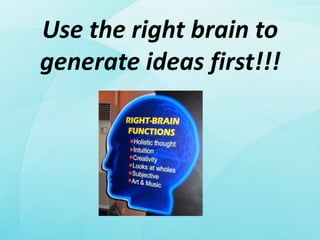
Use the right brain to
generate ideas first!!!
Prewriting
Techniques
Prewriting
• first step in the
  traditional writing
  process

• ANYTHING you do
  before writing your
  first draft
Prewriting
• thinking about your writing purpose
  (what you are trying to communicate
  and why it is important) and
  audience (to whom you are trying to
  communicate)

• generate ideas about a topic
Pre Writing Techniques
•Listing
•Free writing
•Clustering
•Cubing
Listing
• Jot down every idea you have about
  your topic. Free-associate; don’t hold
  back anything.

• Write everything down in a list form
Listing
• can be one word, a phrase, an entire
  sentence, or more

• Do not worry about grammar and
  spelling at this point, just get your
  thoughts on paper
Free writing
• Take out a blank sheet of paper or open a
  new word document

• Begin writing for at least ten to fifteen
  minutes.

• Write whatever comes to your mind
  about your subject.
Free writing
• Do not worry about
  spelling, punctuation, or
  grammar

• Do not change, correct, or delete
  anything
Free writing
• If you cannot think of something to
  write about, just write “I can’t think
  of anything to write right now; I’m
  stumped.” Simply keep writing until a
  new thought comes into your mind.
Clustering
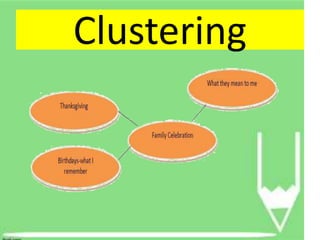
• Place your general subject in a circle in
  the middle of a blank sheet of paper

• Begin to draw other lines or circles that
  shoot out from the original topic

• Cluster the ideas that seem to go
  together
Clustering
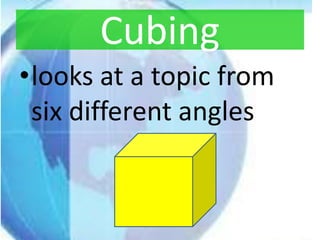
Cubing
•looks at a topic from
 six different angles
6 Angles of the cube
     •Describing
    • Comparing
   • Associating
6 Angles of the cube
    •Analyzing
    • Applying
     •Arguing
a. Describe it
• What does your subject look like?
• What size, colors, texture does it
  have?
• Any special features worth
  noting?
b. Compare or contrast it
• What is your subject similar
  to?

• What is your subject different
  from? In what ways?
c. Free-associate it
• What does this subject remind
  you of?
• What does it call to mind?
• What memories does it conjure
  up?
d. Analyze it
•How does it work?
•How are the parts
 connected?
•What is its significance?
e. Argue for or against it
• What arguments can you make for or
  against your subject?

• What advantages or disadvantages does
  it have?

• What changes or improvements should
  be made?
f. Apply it
• What are the uses of your
  subject?

• What can you do with it?
Let’s Review
1. Differentiate Cyclical and Linear Writers.
2. What are the stages of Writing?
3. What are the prewriting techniques?
4. Choose one prewriting technique and explain
    it briefly.
5. Why is it important to do a prewriting
    activity?
References
• Plata, Sterling M., Ph. D. et.al. (2006). Keys to Critical
  Reading and Writing 1. 2nd Ed. Biñan, Laguna:
  Trailblazer Publications.
• Hacker, Diana and Nancy Sommers. A Writer’s
Reference. 7th ed. Boston: Bedford/St. Martin’s, 2011.
  Print.
• “Techniques for Creating (Prewriting).” Johnson
Community College Writing Center. 2010. PDF file.

Prewriting techniques

  • 1.
    Use the rightbrain to generate ideas first!!!
  • 2.
  • 3.
    Prewriting • first stepin the traditional writing process • ANYTHING you do before writing your first draft
  • 4.
    Prewriting • thinking aboutyour writing purpose (what you are trying to communicate and why it is important) and audience (to whom you are trying to communicate) • generate ideas about a topic
  • 5.
    Pre Writing Techniques •Listing •Freewriting •Clustering •Cubing
  • 6.
    Listing • Jot downevery idea you have about your topic. Free-associate; don’t hold back anything. • Write everything down in a list form
  • 7.
    Listing • can beone word, a phrase, an entire sentence, or more • Do not worry about grammar and spelling at this point, just get your thoughts on paper
  • 8.
    Free writing • Takeout a blank sheet of paper or open a new word document • Begin writing for at least ten to fifteen minutes. • Write whatever comes to your mind about your subject.
  • 9.
    Free writing • Donot worry about spelling, punctuation, or grammar • Do not change, correct, or delete anything
  • 10.
    Free writing • Ifyou cannot think of something to write about, just write “I can’t think of anything to write right now; I’m stumped.” Simply keep writing until a new thought comes into your mind.
  • 11.
    Clustering • Place yourgeneral subject in a circle in the middle of a blank sheet of paper • Begin to draw other lines or circles that shoot out from the original topic • Cluster the ideas that seem to go together
  • 12.
  • 13.
    Cubing •looks at atopic from six different angles
  • 14.
    6 Angles ofthe cube •Describing • Comparing • Associating
  • 15.
    6 Angles ofthe cube •Analyzing • Applying •Arguing
  • 16.
    a. Describe it •What does your subject look like? • What size, colors, texture does it have? • Any special features worth noting?
  • 17.
    b. Compare orcontrast it • What is your subject similar to? • What is your subject different from? In what ways?
  • 18.
    c. Free-associate it •What does this subject remind you of? • What does it call to mind? • What memories does it conjure up?
  • 19.
    d. Analyze it •Howdoes it work? •How are the parts connected? •What is its significance?
  • 20.
    e. Argue foror against it • What arguments can you make for or against your subject? • What advantages or disadvantages does it have? • What changes or improvements should be made?
  • 21.
    f. Apply it •What are the uses of your subject? • What can you do with it?
  • 22.
    Let’s Review 1. DifferentiateCyclical and Linear Writers. 2. What are the stages of Writing? 3. What are the prewriting techniques? 4. Choose one prewriting technique and explain it briefly. 5. Why is it important to do a prewriting activity?
  • 23.
    References • Plata, SterlingM., Ph. D. et.al. (2006). Keys to Critical Reading and Writing 1. 2nd Ed. Biñan, Laguna: Trailblazer Publications. • Hacker, Diana and Nancy Sommers. A Writer’s Reference. 7th ed. Boston: Bedford/St. Martin’s, 2011. Print. • “Techniques for Creating (Prewriting).” Johnson Community College Writing Center. 2010. PDF file.